A steel building permit delay in Prince Edward Island is rarely explained by one review step alone.
Avoidable delays can begin earlier, when the application, site information, engineering, or related approvals still contain unresolved decisions.
The application may have been sent to the wrong authority. The development permit may not be complete. The proposed use may be unclear. The site plan may omit access, wetlands, parking, servicing, or setbacks. The foundation drawings may use preliminary steel reactions. The steel package may also change while the permit remains under review.
A project can depend on separate environmental, highway-access, culvert, septic, electrical, plumbing, or equipment approvals that do not move automatically with the main building-permit application.
For a steel building buyer, the practical lesson is:
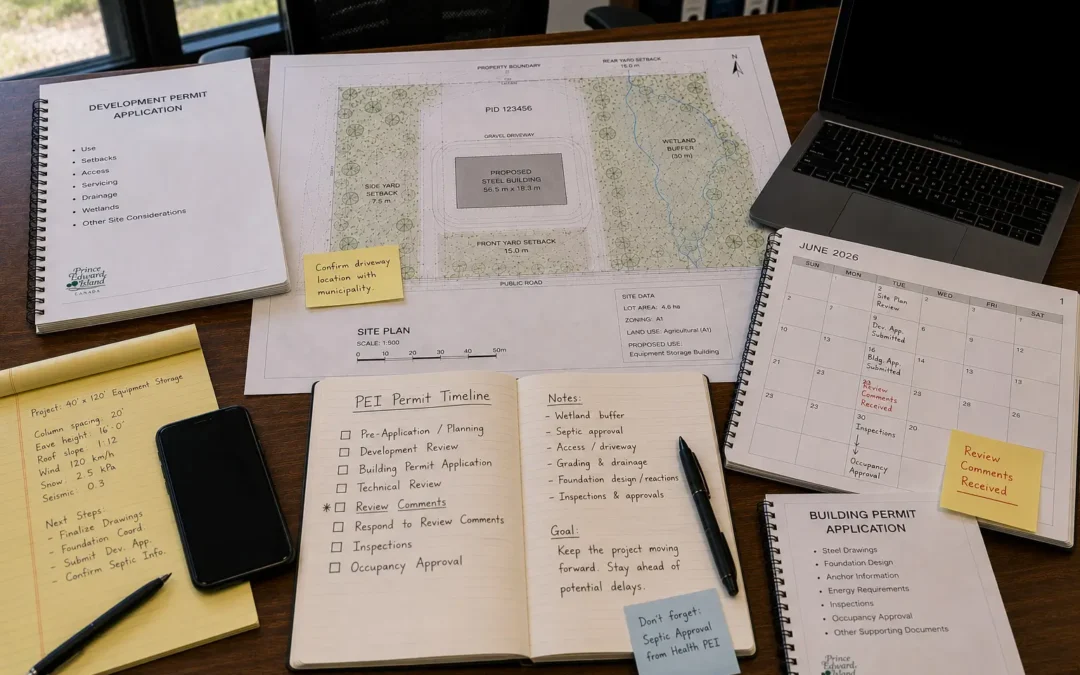
A complete application is not only a collection of drawings. It is a coordinated project in which the site plan, building use, steel system, structural reactions, foundation, access, servicing, environmental constraints, and permit authority all agree.
The broader Steel Building Permits Prince Edward Island guide explains the overall PEI approval framework. This article focuses specifically on the issues that slow permit review and the decisions that can be resolved before submission.
Sources reviewed: June 2026
Quick Answer
Steel building permits in Prince Edward Island can be delayed when the application is incomplete, submitted to the wrong authority, dependent on an unresolved development permit, or based on drawings that do not describe one coordinated project.
Delay triggers can include:
- Applying through the wrong municipality or provincial office
- Failing to complete payment before the provincial processing period begins
- Missing site, foundation, elevation, floor-plan, cross-section, or structural-framing information
- An unclear or changing building use
- Steel and foundation drawings using different dimensions, reactions, grids, or revisions
- Late changes to openings, heating, insulation, occupancy, or interior use
- Unresolved driveway, highway-access, culvert, septic, drainage, or environmental requirements
- Additional reviews by other departments, agencies, or project professionals
- Starting regulated work before the required permits are issued
PEI states that processing for provincial development and building applications begins after full payment is received. It also states that timelines vary according to the nature of the project and required assessments.
Some routine residential permits may be issued within 30 days, but this is not a published approval guarantee for a commercial, industrial, agricultural, or other steel building.
A Delay Is Not Necessarily a Rejection
A delayed permit and a rejected permit are not the same thing.
A delay may mean that the authority still needs:
- Additional information
- A corrected site plan
- Revised engineering
- Clarification of the proposed use
- Confirmation from another authority
- Payment
- A site inspection
- Environmental review
- A coordinated drawing revision
- A decision on a related development issue
A rejection or denial is more serious. It generally means the proposed project does not comply with an applicable requirement or cannot be approved in its submitted form.
A technically acceptable steel building can still be delayed when the application does not prove that the building is acceptable for the proposed property and use.
The fastest project is not necessarily the one submitted first. It is the one submitted with fewer unresolved decisions.
PEI Does Not Use One Permit Office for Every Property
The first possible delay is administrative.
The property location determines where the development-permit and building-permit applications must be submitted.
Charlottetown, Stratford, and Summerside issue their own development and building permits. St. Felix also issues building permits for applicable projects within its municipal boundaries.
Municipalities with an official plan and land-use bylaws generally issue their own development permits, while the provincial Lands Division issues the building permit.
For properties outside a municipality, or within a municipality without an official plan and land-use bylaws, the Lands Division may issue both permits.
| Property situation | Development permit | Building permit |
| Charlottetown, Stratford, or Summerside | Municipality | Municipality |
| St. Felix | Confirm the development-permit authority | St. Felix for applicable building permits |
| Municipality with an official plan and land-use bylaws | Municipality | Provincial Lands Division, unless otherwise assigned |
| Outside a municipality or within a municipality without local planning bylaws | Provincial Lands Division | Provincial Lands Division |
An application sent to the wrong office may need to be redirected, supplemented, or resubmitted through the correct process.
Tower’s guide to municipal versus Lands Division steel building permits in PEI explains why permit routing should be confirmed before the package is assembled.
Processing May Not Start When the Application Is First Sent
Owners often measure permit time from the day the application was uploaded or emailed.
That may not be the date the official provincial processing period begins.
For provincial applications, PEI states that a Client Service Officer contacts the applicant to collect payment and that processing begins after full payment is received.
A file can therefore appear to have been submitted while the processing period has not started because:
- The fee has not been calculated
- The payment request was missed
- Contact information is incorrect
- Payment remains outstanding
- The applicant assumes another party has paid
- The authority is waiting for enough information to classify the project
Applicants can check provincial permit status using the property identification number and the date full payment was received.
The project team should record:
- Submission date
- Payment-request date
- Full-payment date
- Status reference
- Reviewer contact
- Information-request dates
- Resubmission dates
Without this record, the owner may be measuring the wrong timeline.
The Development Permit Can Become the First Bottleneck
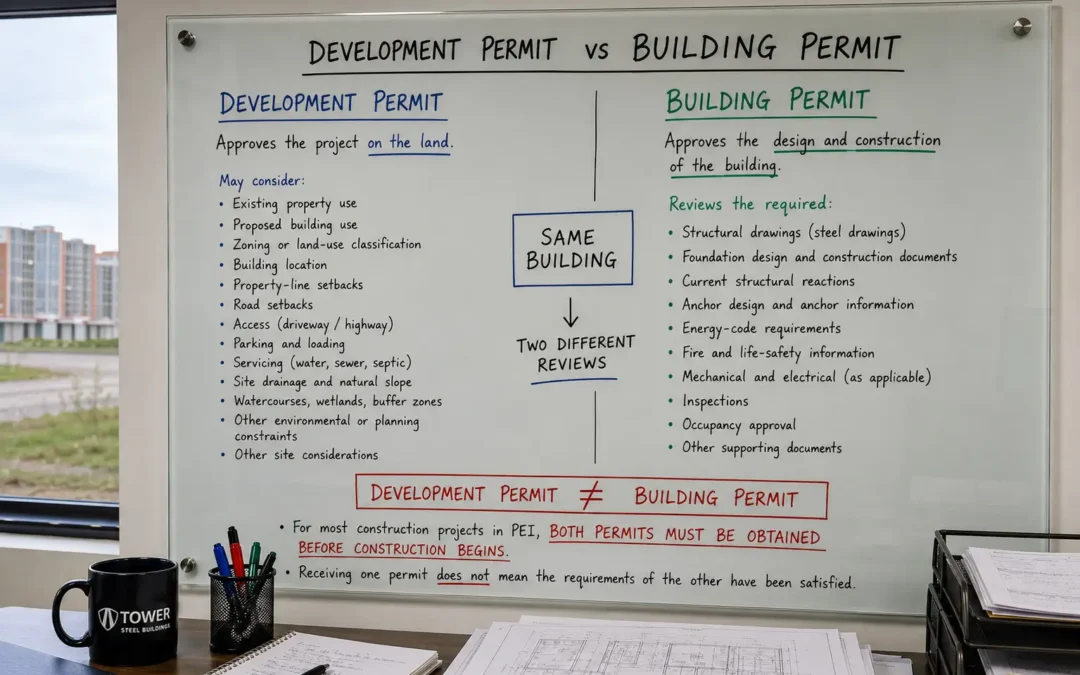
A development permit addresses whether the project is acceptable on the property.
It can review:
- Land use
- Building location
- Setbacks
- Access
- Water and sewer servicing
- Septic conditions
- Parking and loading
- Environmental features
- Existing development
- Site slope
A building permit addresses how the structure will be designed and constructed.
For most PEI construction projects, both approvals are required before work begins.
Development review can delay the building permit when:
- The proposed use is unclear
- The building location is still changing
- A setback has not been satisfied
- A variance, rezoning, discretionary-use, or related planning decision is required
- Parking or access information is incomplete
- Septic or water servicing remains unresolved
- Environmental features require separate review
- Municipal development approval has not been supplied with the provincial building application
- The site sketch and construction drawings show different locations
A building application cannot repair an unresolved land-use problem.
The article on development permits versus building permits in PEI explains why the reviews are separate but must remain coordinated.
The Building Use Is Unclear or Keeps Changing
An incomplete description of the building’s use can trigger major design changes and additional permit review.
Labels such as steel shop, garage, storage building, farm building, warehouse, or workshop may be too broad for permit review.
A reviewer may need to know:
- What will be stored
- Whether employees will work inside
- Whether customers or the public will enter
- Whether vehicles will be repaired
- Whether welding, manufacturing, or processing will occur
- Whether the building will be heated
- Whether offices, washrooms, or mezzanines are included
- Whether hazardous or combustible materials will be present
- Whether livestock, crops, or agricultural products will be housed
- Whether high-piled storage is planned
Use can affect:
- Land-use approval
- Occupancy classification
- Fire separations
- Exits
- Accessibility
- Energy compliance
- Ventilation
- Plumbing
- Electrical service
- Parking and loading
- Professional-design requirements
A building described as unheated private storage during early planning cannot simply become a heated commercial repair shop without reassessing the permit documents.
The stated use should remain consistent across the quotation, development application, building application, site plan, floor plan, structural drawings, foundation documents, energy information, and trade designs.
A change in use during review can send several completed parts of the package back for redesign.
Missing Documents Can Stop the Technical Review
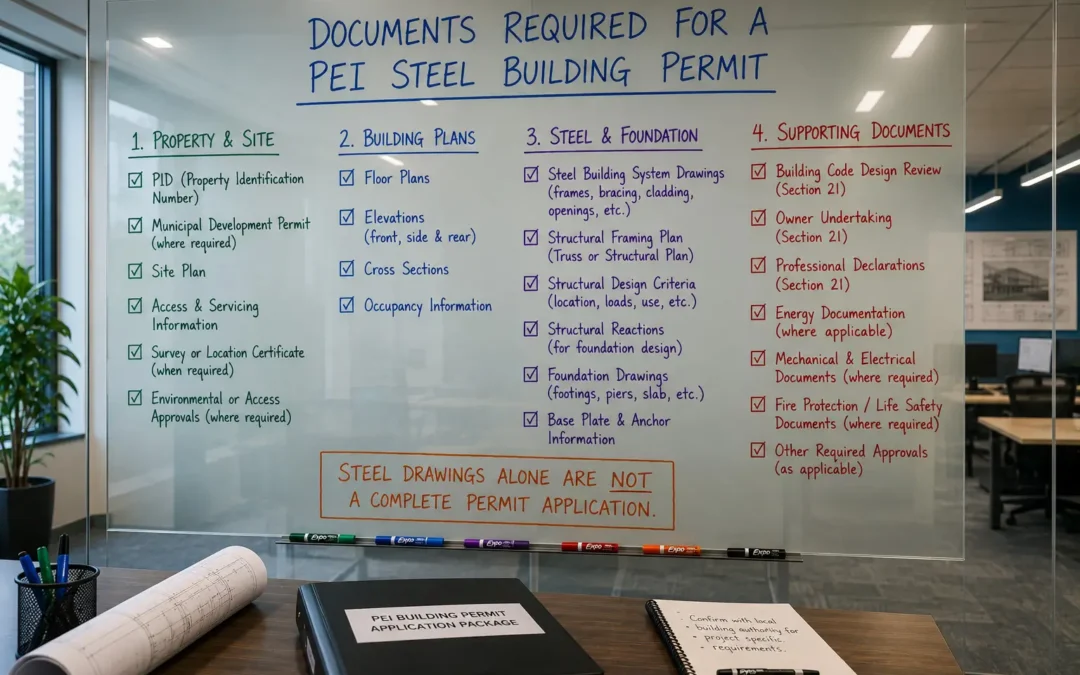
PEI’s provincial building-permit application asks for project information and plans such as:
- Foundation plans
- Front, side, and rear elevations
- Floor plans
- Cross-sections
- Site plan
- Truss or structural-framing information
PEI specifically states that the structural-framing plan must be provided before the framing inspection can be completed.
The application may also require information about:
- The owner and applicant
- Property identification number
- Current and proposed use
- Building dimensions
- Estimated construction value
- Foundation type
- Heating source
- Electrical service
- Exterior materials
- Contractors
- Municipal development permit where applicable
An online form can be accepted without the technical package being complete enough for approval.
Document problems can include:
- Floor plans without overall dimensions
- Elevations that do not match the proposed eave height
- Cross-sections that omit important assemblies
- Foundation drawings without current steel reactions
- Site plans without dimensions or setbacks
- Structural drawings without project location or design criteria
- Openings shown differently across drawings
- Missing professional seals or declarations where required
- Preliminary drawings submitted as final permit documents
- Documents from different revision dates
The documents required for a PEI steel building permit should be identified before the submission is treated as complete.
The Site Plan Does Not Describe the Real Project
A development-permit site sketch is not a decorative drawing.
PEI asks provincial applicants to show information such as:
- Property lines
- Roads
- Existing buildings
- Proposed development
- Watercourses
- Wetlands
- Streams
- Waterfront top of bank
- Sand dunes
- Natural slope
Access, parking, servicing, and operating information may also be required.
A steel building site plan can delay review when it omits:
- The exact building location
- Distances to property lines
- Road setback
- Wetland or watercourse constraints
- Driveway location
- Parking and loading
- Septic and well areas
- Utility services
- Existing structures
- Drainage direction
- Truck-turning space
- Building entrances and overhead-door approaches
The site plan should also account for the work around the building, including foundation excavation, concrete aprons, fill, utilities, drainage, delivery access, and erection equipment.
The authority must review the proposed development, not only the steel frame.
The Steel Package Is Still Preliminary
Permit review slows when the steel-building information is not stable.
Preliminary quotations and concept drawings are useful for budgeting, but they may not be suitable for final foundation engineering or permit approval.
Information that can change during steel-system design includes:
- Building dimensions
- Eave height
- Roof slope
- Frame spacing
- Bay layout
- Column and bracing locations
- Base plates
- Anchor geometry
- Structural reactions
- Openings
- Mezzanine, crane, or collateral loads
- Snow-drift conditions
A foundation designed from preliminary reactions may need to be revised after final engineering.
A site plan based on approximate dimensions may also conflict with the final building envelope or door arrangement.
Tower’s guidance on site-specific steel building engineering explains why the location, use, dimensions, openings, and design loads must be confirmed before the steel system is treated as final.
Steel and Foundation Drawings Do Not Match
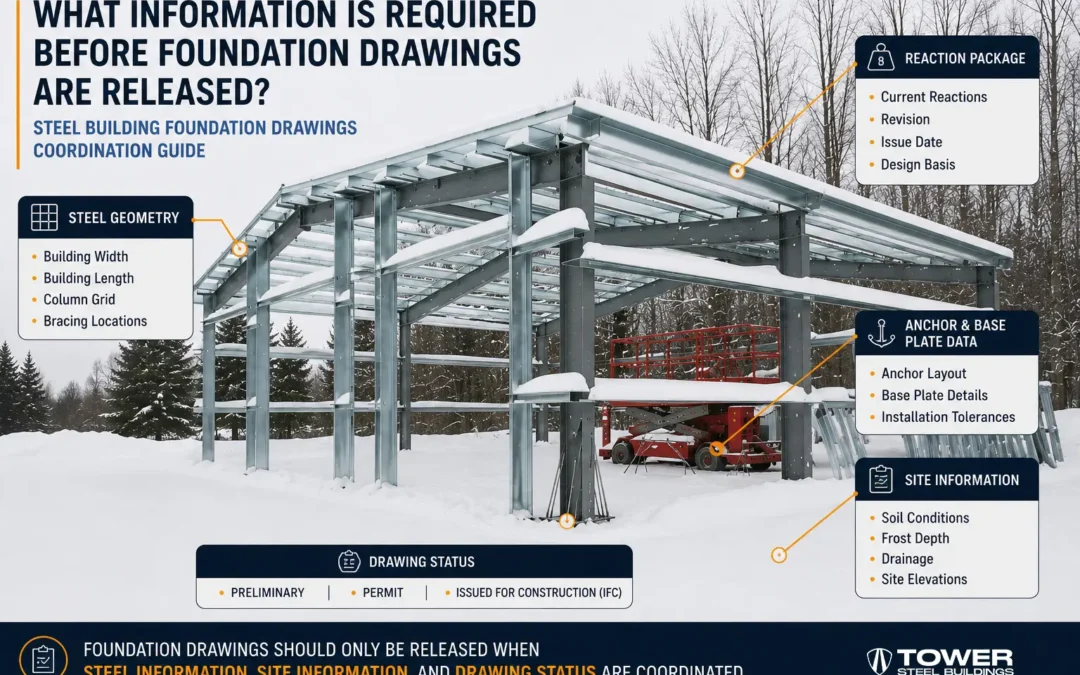
The steel system and concrete foundation are separate technical scopes, but they must function as one structural load path.
The steel supplier may provide:
- Column grid
- Structural reactions
- Base-plate dimensions
- Anchor geometry
- Frame layout
- Bracing locations
The foundation engineer combines that information with the soil, frost, groundwater, concrete, reinforcing, slab, elevation, and drainage requirements of the property.
Permit delay occurs when:
- Foundation drawings use an old reaction set
- Column locations differ
- Base plates or anchors have changed
- The foundation plan uses different building dimensions
- Openings conflict with bracing or concrete
- Equipment or mezzanine loads were added later
- Soil assumptions are unsupported
- Revised foundation drawings were not sent to every reviewer
Tower’s steel building foundation-design guidance explains why final reactions, anchors, soil, frost, drainage, and concrete design must remain coordinated.
A permit reviewer should not have to determine which drawing is current.
Design Loads or Code Information Are Incomplete
PEI adopted Tier 1 of the 2020 National Building Code of Canada and the 2020 National Energy Code for Buildings effective March 31, 2024.
A steel building designed from incomplete or outdated criteria may require clarification or revision.
Depending on the project, the structural package may need to address:
- Project location
- Building use
- Importance category
- Snow, rain, and wind loads
- Exposure
- Roof slope
- Snow drifting
- Collateral loads
- Mezzanines or cranes
- Solar equipment
- Interior liners or ceilings
- Large openings
- Bracing
A general statement such as “designed for PEI” is not a substitute for project-specific design information.
Energy review can also be delayed when a heated building does not clearly define its insulated assemblies, doors, windows, air-barrier approach, mechanical systems, conditioned area, and intended occupancy.
The authority cannot complete a code review while the design basis remains unresolved.
Door, Window, and Interior Layout Changes Arrive Late
Openings affect more than appearance.
A large overhead door can affect:
- Frame design
- End-wall framing
- Bracing
- Foundation loads
- Vehicle approach
- Energy performance
Interior additions such as an office, washroom, mezzanine, mechanical room, welding area, public counter, or storage-rack system may also create new code or professional-design requirements.
One possible delay sequence is:
- A basic shell is submitted.
- The owner later defines the actual operating layout.
- Structural, architectural, mechanical, electrical, plumbing, fire, or energy documents must change.
- The revised package must be reviewed again.
The operating layout should be developed before the permit drawings are treated as complete.
Driveway and Highway Access Are Unresolved
A building cannot operate without lawful and practical access.
PEI requires an entrance-way permit for relevant access connections to provincial highways, including certain commercial, industrial, and institutional uses.
The province also states that an entrance-way permit must be obtained before a driveway culvert permit.
A project may be delayed when:
- The driveway location is selected after the building
- Sightline or access requirements force the entrance to move
- The culvert application begins before entrance approval
- Truck-turning geometry is not shown
- A second access is assumed but not approved
- The driveway crosses an environmental buffer
- The site plan and highway application show different entrances
The access decision can affect building orientation, overhead-door placement, loading, parking, grading, and drainage.
It should be resolved early enough that the steel package and site plan use the same access strategy.
Wetlands, Watercourses, and Buffer Zones Are Discovered Late
Environmental review can become a major project schedule driver because it may involve separate fieldwork, applications, seasonal constraints, and provincial decisions.
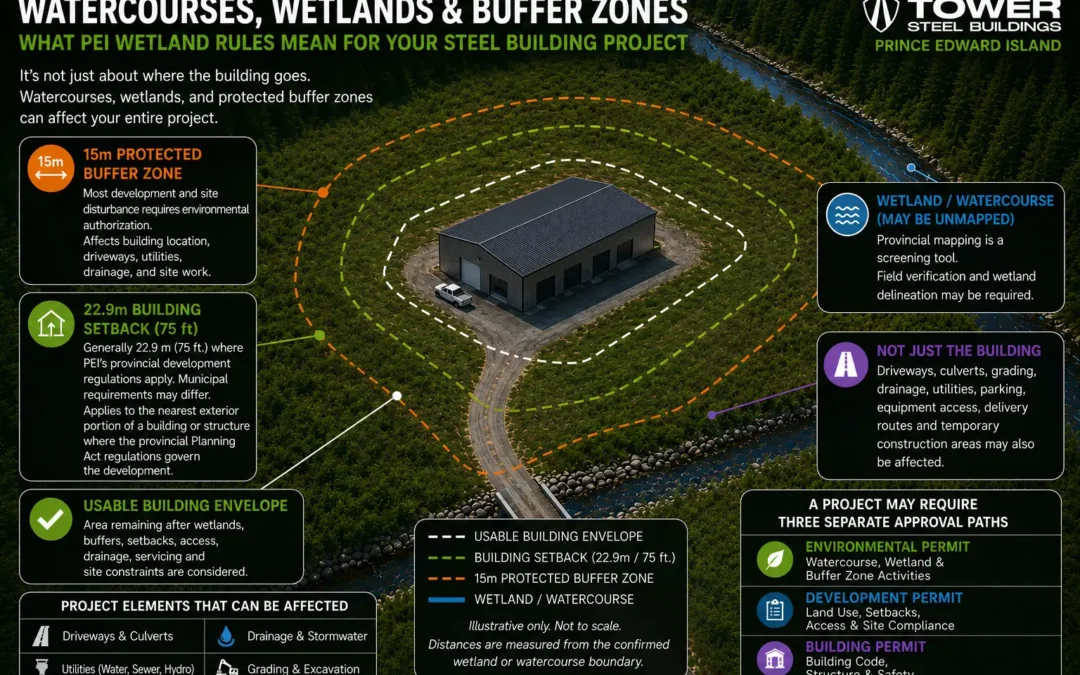
PEI protects watercourses, wetlands, and 15-metre buffers. Unmapped wetlands receive the same legal protection as mapped wetlands.
A protected feature can affect:
- Building location
- Driveway and culvert
- Fill and grading
- Drainage outlet
- Utility routes
- Temporary crossings
- Construction equipment
- Material storage
PEI advises that Watercourse, Wetland and Buffer Zone Activity Permit applications be submitted at least six weeks before the expected start. Processing typically takes at least six weeks, and separate forms are required for separate regulated activities.
Submission and payment do not authorize work.
Wetland delineation can create additional timing constraints. Provincial guidance states that:
- Staff may determine a boundary for a wetland of approximately 0.5 hectares or less
- Larger wetlands generally require a trained delineator retained by the owner or developer
- Delineation normally occurs from June 1 to September 30
- Work more than two weeks outside that period requires provincial pre-approval
- The delineation must be reviewed and approved before it is treated as valid
PEI’s Watercourse, Wetland and Buffer Zone Activity Permit guidance explains why environmental screening should occur before the site, foundation, driveway, and steel package are treated as final.
Separate Departments and Agencies Need to Complete Their Reviews
A development or building permit may depend on information or decisions from other authorities.
Depending on the project, coordination may involve:
- Municipal planning
- Provincial Lands Division
- Environmental review
- Highway access
- Culvert approval
- Septic or sewer servicing
- Electrical and plumbing permits
- LP gas or regulated-equipment approvals
- Fire-protection design
- Engineers, architects, surveyors, or geotechnical consultants
PEI states that complex development applications can require collaboration with other departments and agencies.
The main permit authority cannot always complete its decision while a related approval remains unresolved.
| Approval or document | Responsible party | Authority | Current status | Dependency |
| Development permit | Owner or consultant | Municipality or Lands Division | Not started, submitted, approved | Establishes use and location |
| Building permit | Owner or applicant | Municipality or province | Not started, submitted, approved | Requires coordinated documents |
| Environmental activity permit | Owner or consultant | Province | Not required, submitted, approved | May control site work |
| Highway entrance | Owner or civil consultant | Responsible highway authority | Not required, submitted, approved | May control driveway |
| Foundation drawings | Foundation engineer | Permit review | Preliminary or final | Requires current reactions |
| Trade permits | Licensed trades | Province | Later-stage or submitted | Depends on system scope |
A project is delayed when everyone assumes another party is handling an approval that no one has submitted.
Site Inspection or Field Confirmation Is Required
PEI states that a site inspection may be required before a provincial development permit is issued.
The inspection may confirm:
- Property conditions
- Existing development
- Access
- Setbacks
- Slope
- Wetlands or watercourses
- Proposed work location
- Servicing
- Consistency with the submitted sketch
Delay can occur when the property is inaccessible, proposed building corners are not marked, seasonal conditions prevent observation, or the site does not match the application.
Applicants should not assume that an online submission always removes the need for field confirmation.
Permit Revisions Are Submitted Without Revision Control
Revision confusion is a major but avoidable source of delay.
A steel building permit package can include the site plan, steel drawings, reactions, anchor plan, foundation plan, floor plan, elevations, sections, energy documents, and trade designs.
When one document changes, dependent information may also need to change.
Revision problems can include:
- File names without revision dates
- Old and new drawings submitted together
- Revised reactions without a revised foundation
- A new site plan without updated dimensions
- Opening changes missing from elevations
- Reviewer comments answered by email but not corrected on the drawings
- Contractors receiving a different revision from the permit authority
Every resubmission should include:
- A clear revision date
- A drawing index
- A response to each review comment
- Identified or clouded changes
- Confirmation of superseded drawings
- Updated dependent documents
- One complete current package
Sending only one corrected page may create another review cycle when the rest of the package still conflicts.
Premature Construction Creates Enforcement and Rework
Starting work before the required approvals are issued does not accelerate the permit process.
It can create:
- An enforcement or work-suspension direction from the responsible authority
- Additional permit or enforcement charges where authorized by the applicable jurisdiction
- Required exposure or removal of completed work
- Reinspection
- Engineering review of field changes
- Foundation or anchor correction
- Schedule disruption
- Contractor remobilization
- Difficulty proving compliance
A foundation poured from preliminary drawings may not match the final steel package.
Fill, driveway, culvert, clearing, or environmental work may also require separate authorization before it begins.
Permit submission, payment, steel ordering, or contractor availability should never be treated as approval to begin regulated work.
A Published 30-Day Reference Is Not a Steel Building Guarantee
PEI’s provincial building-permit page states that a permit may be issued within 30 days for routine residential construction.
The provincial development-permit page similarly says a decision may be issued within 30 days for some routine residential developments.
Those statements should not be converted into a universal expectation for a steel building.
Commercial, industrial, institutional, agricultural, and mixed-use projects can involve:
- More complex occupancy questions
- Larger structural systems
- Professional design
- Energy review
- Fire and life-safety requirements
- Site servicing
- Parking and loading
- Environmental constraints
- Other agency approvals
- Several drawing disciplines
PEI states that processing time varies according to the nature of the project and required assessments and that complex applications require more time.
A realistic project schedule should include:
- Pre-application confirmation
- Development review
- External approvals
- Steel-system engineering
- Foundation engineering
- Building-permit review
- Responses and revisions
- Final permit issuance
A preferred erection date does not control the authority’s review requirements.
Ten Steel Building Permit Delay Triggers
| Delay trigger | What remains unresolved |
| Wrong permit office | Correct development and building authority |
| Payment incomplete | Full payment before provincial processing begins |
| Use unclear | Precise operational and occupancy description |
| Site plan incomplete | Location, access, servicing, environmental features, and setbacks |
| Steel package preliminary | Final geometry, openings, loads, and reactions |
| Foundation mismatch | Design based on current steel information and site conditions |
| External approval missing | Environmental, access, culvert, septic, or trade decision |
| Late design change | Revised coordinated permit package |
| Partial review response | Complete response and corrected drawings |
| Work started early | Compliance review, correction, and possible reinspection |
How to Reduce PEI Steel Building Permit Delays
Confirm the Authority Before Preparing the Package
Determine who issues the development permit and who issues the building permit for the property.
Define the Building Use in Operational Terms
Do not rely only on a general label such as shop, garage, or storage building.
Screen the Property Early
Review zoning, setbacks, access, servicing, wetlands, watercourses, drainage, septic, and existing development before selecting the final building location.
Build One Coordinated Drawing Set
The site plan, floor plan, elevations, steel drawings, reactions, foundation drawings, and trade documents must describe the same project.
Separate Preliminary Pricing From Permit Release
A preliminary quotation can support budgeting. Final permit and fabrication decisions require stable site, use, dimensions, openings, and load information.
Identify Every External Approval
Do not assume the building permit includes highway access, culvert, environmental, septic, electrical, plumbing, LP gas, or regulated-equipment approvals.
Submit Payment Promptly
For provincial applications, processing begins after full payment is received.
Respond With One Complete Revision Package
Answer every review comment, revise every affected drawing, and identify the current revision clearly.
Do Not Start Regulated Work Early
Wait until the required permits and separate authorizations have been issued.
The PEI steel building permit application guide explains the wider submission sequence, while Tower’s steel building permit checklist can help identify missing information before the package is released.
How Tower Steel Buildings Supports Permit Coordination
Tower Steel Buildings primarily supplies project-specific steel building kits and packages.
Depending on the written quotation, Tower may provide or coordinate steel-system information such as:
- Building dimensions
- Eave height
- Roof slope
- Frame spacing
- Bay layout
- Openings
- Column grid
- Structural reactions
- Base plates
- Anchor geometry
- Steel-building-system drawings
- Revisions affecting foundation inputs
- Delivery or erection information where quoted
This information can support the owner, applicant, foundation engineer, architect, site planner, and contractor.
Tower does not control:
- Permit-processing time
- Development approval
- Municipal or provincial review
- Environmental decisions
- Zoning or variances
- Highway access
- Wetland delineation
- Septic approval
- Trade permits
- Permit review or acceptance of the foundation design
- Contractor scheduling
These responsibilities remain separate unless expressly included in the written quotation or contract.
Reviewed by Engineering Team
This content has been reviewed by the Tower Steel Buildings Engineering Team.
Official References
This guide was prepared using current information from:
- Government of Prince Edward Island, Building and Development in PEI
- Government of Prince Edward Island, Apply for a Building Permit
- Government of Prince Edward Island, Apply for a Development Permit
- Government of Prince Edward Island, Building and Development Permit Status
- Government of Prince Edward Island, Entrance Way Permit Information
- Government of Prince Edward Island, Apply for a Watercourse, Wetland and Buffer Zone Activity Permit
- Government of Prince Edward Island, Wetland Identification
- Government of Prince Edward Island, Wetland Delineation Information and Standards
- PEI Building Codes Regulations
- Government of Prince Edward Island, Apply for an Electrical Permit
- Government of Prince Edward Island, Request a Plumbing Permit
- Government of Prince Edward Island, Apply for an LP Gas Installation or Alteration Permit
Regulations, municipal procedures, document requirements, staffing, project complexity, and processing conditions can change. Confirm current requirements and application status directly with the responsible permit authority.
Reduce Permit Delays Before Releasing the Steel Package
Tower Steel Buildings can prepare a project-specific steel building kit quotation around the confirmed location, use, dimensions, openings, loads, insulation, and required scope. Resolve the permit route, site constraints, external approvals, foundation responsibility, and required documents before releasing the project for final engineering or fabrication.
1. Why Is My PEI Steel Building Permit Taking Longer Than Expected?
For provincial applications, first confirm the date full payment was received because PEI states that processing begins after payment. The authority may also be waiting for missing documents, development approval, revised drawings, a site inspection, clarification of the building use, or a decision from another department.
2. Does PEI Guarantee a Building Permit Within 30 Days?
No universal 30-day guarantee applies to steel buildings. PEI states that some routine residential permits may be issued within 30 days, while processing time varies with the project and required assessments.
3. When Does the Provincial Permit-Processing Period Begin?
PEI states that processing begins after full payment is received. The date the application was first uploaded may not be the official start date.
4. Can a Missing Development Permit Delay the Building Permit?
Yes. Most PEI construction projects require both approvals. Where a municipality issues the development permit and the province issues the building permit, the provincial application may require the municipal development approval.
5. Can an Unclear Building Use Delay Approval?
Yes. Use can affect land-use approval, occupancy, fire safety, exits, accessibility, energy compliance, ventilation, plumbing, parking, and professional-design requirements.
6. Can Preliminary Steel Drawings Cause Permit Delays?
Yes. Preliminary dimensions, openings, reactions, frame spacing, or anchors may change during final engineering. Dependent foundation and permit drawings may then require revision.
7. Why Must Foundation Drawings Match the Steel Reactions?
The foundation engineer uses the reactions, column grid, base plates, and anchor geometry to design the concrete system. If the steel information changes, the foundation may no longer represent the actual loads or layout.
8. Can Wetlands Delay a PEI Steel Building Project?
Yes. Unmapped wetlands remain protected. A site inspection, boundary determination, professional delineation, or environmental activity permit may be required before the building location or site work can be approved.
9. Can a Driveway Delay the Permit?
Yes. The driveway can affect highway access, culverts, wetlands, grading, truck turning, loading, and building orientation. PEI states that entrance-way approval must precede a driveway culvert permit.
10. Does Paying the Permit Fee Mean Construction Can Begin?
No. Payment starts the provincial processing period but does not mean the permit has been issued. Payment for an environmental application also does not authorize work.
11. Can Changing an Overhead Door Delay the Permit?
Yes. A large opening can affect framing, bracing, reactions, foundations, elevations, access, and energy performance. Dependent drawings may need to be revised.
12. What Is the Best Way to Prevent a PEI Steel Building Permit Delay?
Confirm the authority, building use, site constraints, external approvals, final steel information, foundation scope, and required documents before submission. Respond to review comments with one coordinated revision package.