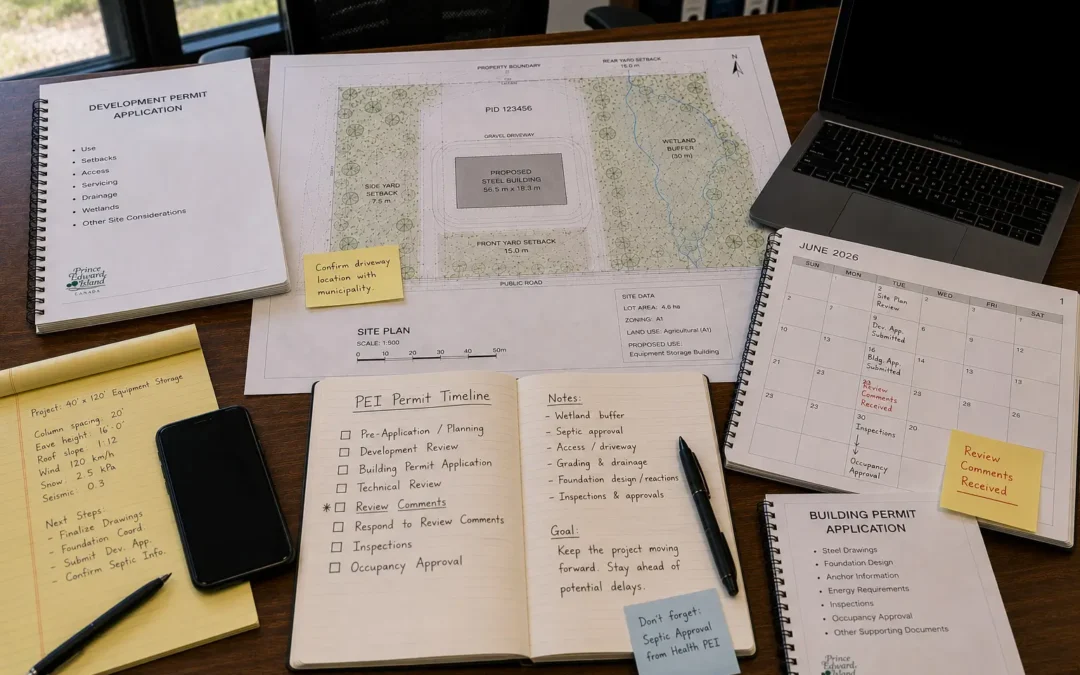
A steel building permit application in Prince Edward Island does not always go to one government office.
The correct route depends on:
- Where the property is located
- Whether it is inside a municipality
- Whether that municipality administers local land-use planning
- Whether the municipality issues its own building permits
- Which approvals the proposed project requires
In some PEI municipalities, the same municipal office issues both the development permit and the building permit.
In many other municipalities, the municipality issues the development permit, but the provincial Lands Division issues the building permit.
Outside municipal planning jurisdictions, the Lands Division generally handles both applications.
This distinction matters because a development permit and a building permit approve different parts of the project.
The authority that approves the land use is not always the authority that approves the building construction.
The broader Prince Edward Island steel building permit guide explains how property jurisdiction, site constraints, steel-system information, foundation inputs, inspections and occupancy responsibilities fit together after the correct authorities are identified.
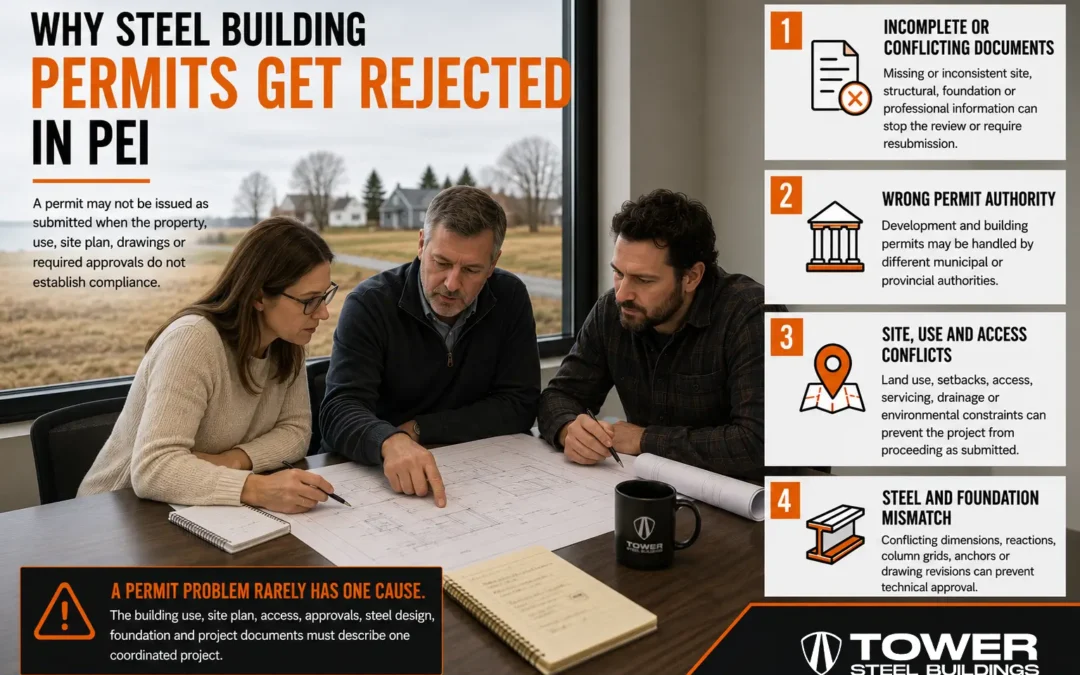
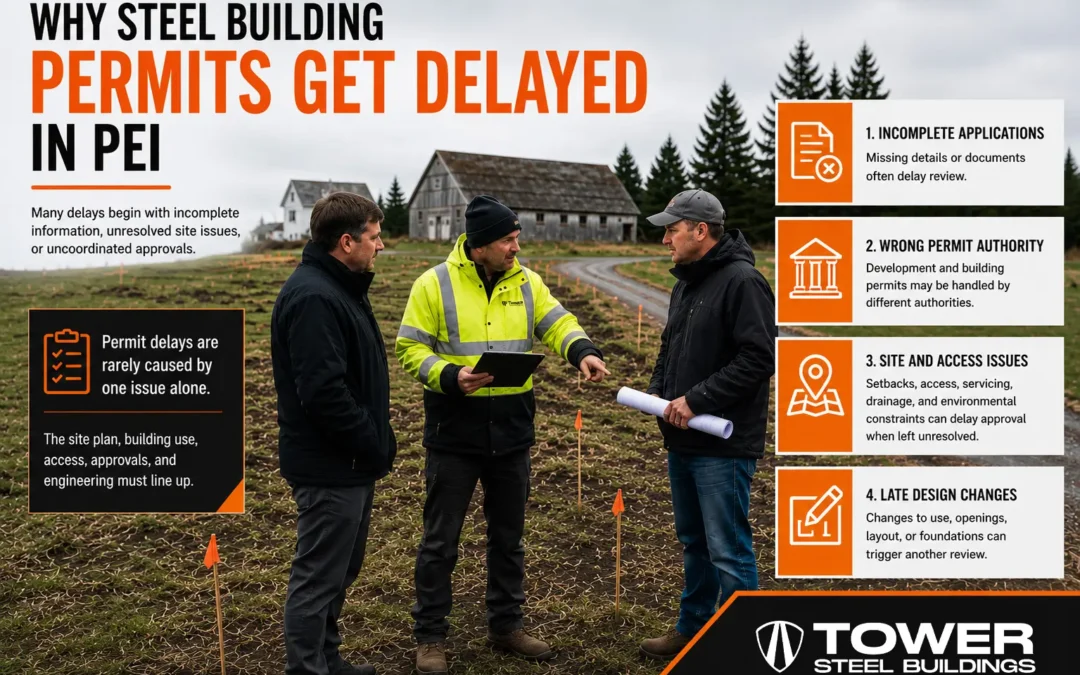
Submitting to the wrong office, assuming one permit covers both approvals, or sending different drawings to the municipality and province can delay the project before construction begins.
Quick Answer
| Property Location | Development Permit Authority | Building Permit Authority |
| Charlottetown | City of Charlottetown | City of Charlottetown |
| Stratford | Town of Stratford | Town of Stratford |
| Summerside | City of Summerside | City of Summerside |
| St. Felix | Confirm with St. Felix or the provincial Lands Division | Municipality of St. Felix |
| Other municipality with an official plan and land-use bylaws | Municipality | Provincial Lands Division |
| Municipality without an official plan and land-use bylaws | Provincial Lands Division | Provincial Lands Division |
| Property outside a municipality | Provincial Lands Division | Provincial Lands Division |
The current PEI building-permit authorities are:
- City of Charlottetown
- Town of Stratford
- City of Summerside
- Municipality of St. Felix
- Provincial Lands Division for all other areas
PEI’s official building and development guidance confirms that Charlottetown, Stratford and Summerside issue both development and building permits within their municipal boundaries.
St. Felix issues building permits within its municipal boundary. Applicants should separately confirm whether the development permit is issued by St. Felix or the provincial Lands Division.
Other municipalities with approved official plans and land-use bylaws generally administer their own development permits. The building-permit application for those municipalities goes to the provincial Lands Division.
If the property is outside a municipality, or within a municipality that does not have an official plan and land-use bylaws, the Lands Division generally administers both permits.
The Core PEI Permit-Routing Rule
The permit route is determined by the property jurisdiction, not by:
- The nearest town
- The mailing address
- The contractor’s location
- The steel supplier’s location
- The property owner’s preferred office
- Where similar projects were submitted
- Whether the project is agricultural, commercial, or private
Start with the property’s:
- Property Identification Number
- Civic address
- Municipal boundary
- Local planning status
- Development-permit authority
- Building-permit authority
Do not order the steel package for fabrication or start foundation work until the correct approval path is known.
After identifying the correct authorities, follow the complete process for applying for a steel building permit in Prince Edward Island, including site review, coordinated drawings, professional design, foundation information, inspections and occupancy approval.
Why PEI Uses Municipal and Provincial Permit Authorities
PEI separates land-use approval from construction-code approval.
Municipal or Provincial Development Review
PEI’s official development permit guidance explains that a development permit addresses how the land will be used, where the building will be located, how it will be serviced and what site impacts must be reviewed.
The review can include:
- Proposed building use
- Zoning or land-use compliance
- Building location
- Property-line setbacks
- Road setbacks
- Driveway access
- Parking
- Loading
- Water and sewer servicing
- Septic and well locations
- Existing structures
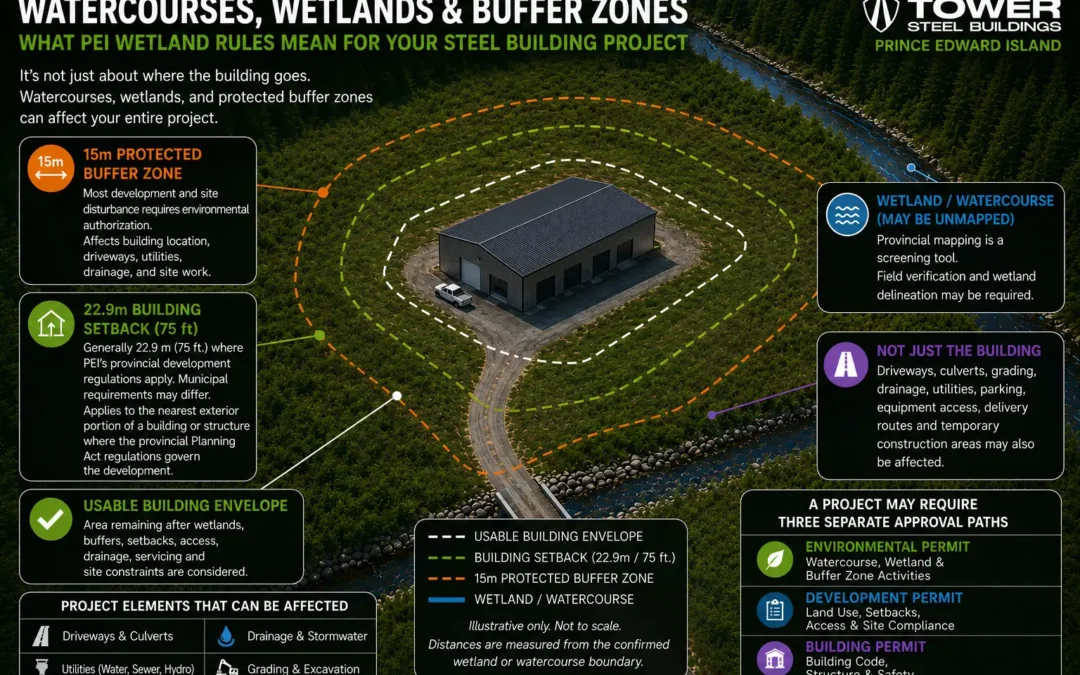
- Wetlands
- Watercourses
- Buffer zones
- Coastal constraints
- Site drainage
- Other planning requirements
A municipality with an approved official plan and land-use bylaws generally makes these decisions within its planning jurisdiction.
Where local planning services are not in place, the provincial Lands Division generally administers the development application.
Municipal or Provincial Building Review
A building permit addresses how the building will be designed, constructed, inspected, and approved for use.
The review can include:
- Building use and occupancy
- Structural design
- Steel framing
- Foundation design
- Building plans
- Fire and life safety
- Accessibility
- Energy requirements
- Professional design
- Field reviews
- Inspections
- Completion documents
- Occupancy approval
Charlottetown, Stratford, Summerside, and St. Felix administer building permits within their municipal boundaries.
The provincial Lands Division administers building permits for all other areas.
What Does the Provincial Lands Division Do?
The Lands Division administers provincial land-development and building-permit functions where the province has jurisdiction.
Depending on the property location, it may handle:
- The development-permit application
- The building-permit application
- Both permit applications
- Building-code review after municipal development approval
- Provincial building inspections
- Permit-status tracking
- Occupancy administration
- Other land-development decisions
In a split-authority project, the Lands Division does not replace the municipality’s development decision.
The municipality may approve the proposed use and site arrangement, while the Lands Division reviews the building plans and construction-code requirements.
Both submissions must describe the same project.
Conflicting municipal and provincial submissions create the same review uncertainty described in common steel building permit rejection mistakes, especially when the use, location, dimensions, foundation information or drawing revisions do not match.
What Does a Municipal Planning Authority Do?
Under PEI’s municipal land-use planning framework, a municipality with an approved official plan and land-use bylaws can administer local planning decisions within its boundaries.
Its planning documents can establish:
- Permitted uses
- Prohibited uses
- Conditional or discretionary uses
- Development standards
- Property setbacks
- Parking requirements
- Loading requirements
- Access requirements
- Landscaping
- Site-plan requirements
- Variance procedures
- Rezoning procedures
- Subdivision requirements
- Public-notification processes
The municipality decides whether the proposed steel building’s use and location comply with its planning rules.
That does not necessarily mean the municipality also issues the building permit.
Except for Charlottetown, Stratford, Summerside, and St. Felix, the building-permit application generally goes to the provincial Lands Division.
The Four PEI Steel Building Permit Routes
Route 1: Charlottetown, Stratford, or Summerside
Charlottetown, Stratford, and Summerside issue both development permits and building permits within their municipal boundaries.
Applicants generally work with the municipality for:
- Development review
- Building-code review
- Municipal permit fees
- Required drawings
- Inspections
- Permit conditions
- Occupancy approval
- Application status
Each municipality has its own:
- Forms
- Checklists
- Fee schedules
- Bylaws
- Submission procedures
- Inspection requirements
- Contact process
Use the municipality’s current application documents rather than submitting the provincial Lands Division forms.
Charlottetown
The City of Charlottetown administers development and building permits for properties within the city, and applicants should use the City’s current permit applications and submission requirements.
A proposed steel building may be reviewed for zoning, use, site layout, parking, access, servicing, structural documents, building-code requirements, inspections, and occupancy.
Stratford
The Town of Stratford administers development and building permits within the town through its current building permit and development application process.
Applicants should use Stratford’s current planning and building application process and confirm any site-plan, servicing, access, inspection, and occupancy requirements before finalizing the building.
Summerside
The City of Summerside administers development and building permits within the city through its current Building and Development department.
Projects should follow Summerside’s current forms, drawing requirements, review procedures, fees, and inspections.
Route 2: Municipality Issues Development Permit, Province Issues Building Permit
This is the most important split-authority route.
It generally applies when the property is inside a municipality that has:
- An approved official plan
- Land-use bylaws
- Local development-permit authority
In this situation:
- The municipality reviews the proposed use and site arrangement.
- The municipality issues the development permit.
- The applicant submits the building-permit application to the provincial Lands Division.
- The Lands Division reviews the building and construction documents.
- Provincial building officials administer the applicable inspections and occupancy process.
The provincial building-permit application may require a copy of the municipal development permit.
The municipality generally reviews
- Proposed use
- Zoning
- Building location
- Setbacks
- Access
- Parking
- Loading
- Servicing
- Landscaping
- Site design
- Variances or rezoning
- Other local planning requirements
The Lands Division generally reviews
- Building use and occupancy
- Building plans
- Structural documents
- Steel framing
- Foundation documents
- Professional-design requirements
- Energy information
- Inspections
- Completion documents
- Occupancy requirements
The municipality and province are reviewing different parts of the same project.
Route 3: Lands Division Issues Both Permits
The provincial Lands Division generally administers both applications when the property is:
- Outside a municipality, or
- Inside a municipality without an official plan and land-use bylaws
The applicant may submit both the development and building applications through the provincial process.
The two approvals remain separate even though the same provincial division handles them.
The development application addresses the land and site.
The building application addresses the design and construction.
Submitting one does not automatically approve the other.
Route 4: St. Felix Issues the Building Permit
St. Felix is a PEI-specific exception.
PEI’s official building permit guidance identifies St. Felix as one of the four municipalities that issues building permits within its boundary.
However, the applicant should separately confirm which authority handles the development permit.
The correct route may involve:
- A development application to St. Felix
- A development application to the provincial Lands Division
- A building-permit application to St. Felix
- Other site-related provincial approvals
Do not assume that the authority issuing the building permit automatically issues the development permit.
How to Determine the Correct Permit Authority
Step 1: Find the Property Identification Number
The PID identifies the legal parcel.
It is more reliable than a community name or mailing address when confirming:
- Municipal location
- Permit jurisdiction
- Property records
- Application status
- Development decisions
The PID can usually be found on the property tax statement, deed, or survey.
Step 2: Confirm the Municipal Boundary
Determine whether the property is:
- Inside Charlottetown
- Inside Stratford
- Inside Summerside
- Inside St. Felix
- Inside another municipality
- Outside every municipality
A property can use the name of a nearby community without legally being inside that municipality.
The official PEI municipal directory can help identify the applicable municipality and contact office, but applicants should still obtain direct confirmation of development-permit and building-permit responsibility.
Step 3: Confirm Whether the Municipality Administers Land-Use Planning
Ask:
- Does the municipality have an approved official plan?
- Does it have land-use bylaws?
- Does it issue development permits?
- Does the provincial Lands Division issue the development permit?
- Who issues the building permit?
- Which authority performs inspections?
- Who administers occupancy approval?
PEI government guidance indicates that municipalities with approved official plans and land-use bylaws generally issue their own development permits.
Step 4: Confirm the Route in Writing
For a commercial, agricultural, industrial, or otherwise substantial steel building, obtain written confirmation of:
- Development-permit authority
- Building-permit authority
- Required application sequence
- Whether concurrent submission is accepted
- Required supporting permits
- Inspection authority
- Occupancy authority
- Status-tracking method
This confirmation can be a municipal email, Lands Division email, meeting record, or application instruction from the authority.
Municipal vs Provincial Responsibilities
| Project Issue | Municipal Development Authority | Provincial Lands Division as Building Authority |
| Proposed land use | Reviews under municipal planning rules | Uses the approved use for building review |
| Zoning | Reviews | Does not replace municipal zoning approval |
| Building location | Reviews setbacks and site arrangement | Uses the approved site information |
| Parking and loading | Reviews where applicable | May review related building and life-safety implications |
| Access and servicing | Reviews planning and site requirements | Reviews information relevant to building approval |
| Site plan | Reviews for development approval | Requires coordinated site information |
| Steel framing | Not normally the primary structural review | Reviews applicable building-permit documents |
| Foundation documents | May affect site approval | Reviewed as part of the building-permit submission |
| Professional design | May require planning-related documents | Reviews applicable building-code requirements |
| Inspections | Only where the municipality issues building permits | Provincial when the Lands Division issues the building permit |
| Occupancy | Municipal when it issues the building permit | Provincial when the Lands Division issues the building permit |
The exact division should still be confirmed for the individual property and project.
Can the Municipal and Provincial Applications Be Submitted Together?
Concurrent submission may be possible, but it should not be assumed.
In a split-authority project, a practical sequence is:
- Confirm the proposed use and site requirements with the municipality.
- Prepare and submit the municipal development application.
- Prepare the building documents while the development review proceeds, where appropriate.
- Obtain the municipal development permit or confirmation required by the province.
- Submit or complete the provincial building-permit application.
- Respond to comments from both authorities.
- Obtain both approvals before beginning construction.
The provincial building-permit application may require a copy of the municipal development permit.
Ask whether the Lands Division will:
- Begin its review before municipal approval
- Hold the application until the development permit is issued
- Accept concurrent submissions
- Require revised documents after municipal conditions are imposed
What Happens if the Municipality Changes the Site Plan?
A municipality may require changes to:
- Building location
- Setbacks
- Driveway access
- Parking
- Loading
- Landscaping
- Drainage
- Exterior site layout
- Building dimensions
- Proposed use
Those changes may affect the provincial building submission.
Moving the building can change:
- Site elevations
- Soil conditions
- Foundation assumptions
- Drainage
- Utility routes
- Fire access
- Crane access
- Delivery access
Changing the building dimensions, use, or openings can affect:
- Steel framing
- Bracing
- Structural reactions
- Foundation design
- Occupancy classification
- Fire and life safety
- Energy requirements
- Mechanical systems
Do not revise only the municipal site plan.
Update every affected municipal, provincial, steel-system, foundation, and service document.
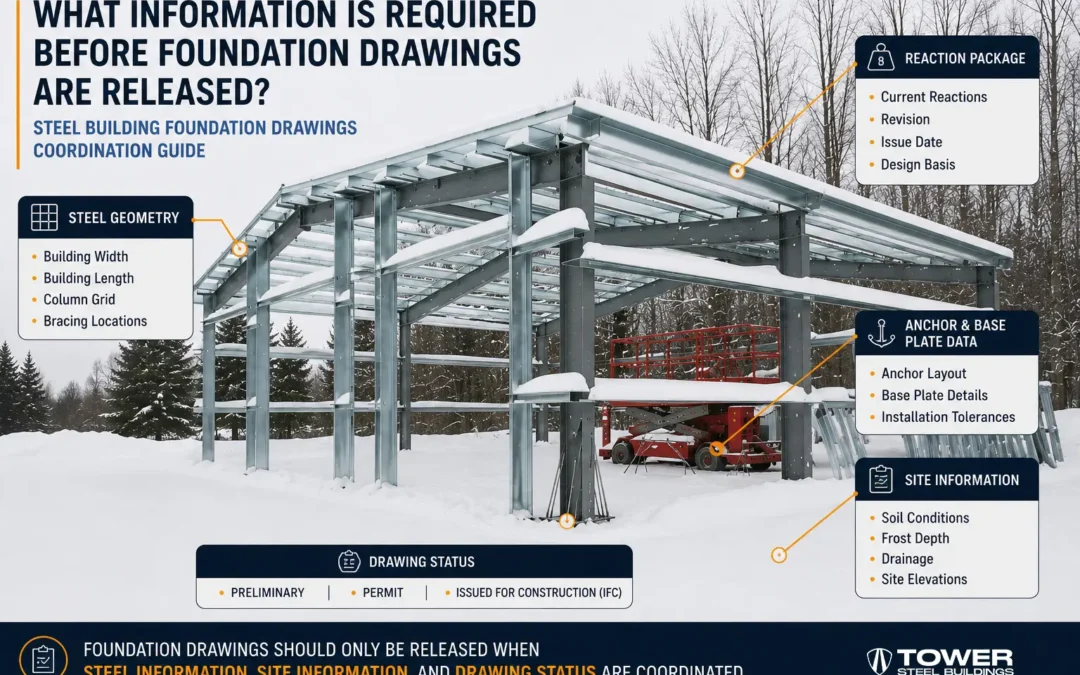
Where municipal review changes the approved location, footprint, access or site elevations, the steel building foundation design should also be checked against the revised site plan, soil assumptions, drainage, structural reactions and anchor information.
What Documents Go to Each Authority?
The exact requirements vary, but the basic division is:
| Municipal Development Submission | Provincial Building Submission |
| Property and owner information | Property and owner information |
| Proposed land use | Confirmed building use and occupancy |
| Site plan | Coordinated site plan |
| Building location and setbacks | Building plans |
| Access, parking, and loading | Floor plans, elevations, and sections |
| Water, sewer, septic, and well information | Structural-framing documents |
| Existing buildings | Foundation documents |
| Drainage and site constraints | Professional-design documents |
| Variance, rezoning, or subdivision information | Energy, fire, mechanical, or electrical information where required |
| Other municipal planning information | Inspection, field-review, and occupancy information |
Project-specific requirements may be added by either authority.
The detailed drawing and engineering requirements belong in the main PEI application process, not in the routing decision itself.
The essential routing rule is that the municipal development package and provincial building package must describe the same:
- Building
- Use
- Location
- Dimensions
- Revision
- Site arrangement
What if the Municipality Requires a Variance or Rezoning?
A municipal planning issue can control the schedule even when the steel building is structurally straightforward, which is why buyers should understand how approval uncertainty and design changes can affect steel building lead times and total project cost.
A variance, rezoning, subdivision, discretionary-use review, or other planning decision may change:
- Whether the proposed project is allowed
- Where the building can be located
- Building dimensions
- Access
- Parking
- Site requirements
- Project timing
Do not release the steel package for fabrication while a municipal decision could still change the building or site.
The provincial building-permit process does not eliminate municipal planning requirements.
How Permit Status Tracking Differs
Municipal and provincial applications may use different tracking systems.
Lands Division permit status
PEI’s provincial Building and Development Permit Status service includes only permits issued by the Lands Division, so municipal applications must be tracked separately with the responsible municipality.
The applicant generally needs:
- Property Identification Number
- Date the full application fee was received
Municipal permit status
A municipal development or building-permit application should be followed up directly with the municipality’s planning, development, or administrative office.
A municipal application may not appear in the Lands Division status portal.
PEI Planning Decisions
The PEI Planning Decisions service can provide information on certain development decisions, subdivisions and municipal planning decisions, but it does not replace direct confirmation with the authority handling the application.
It is not a replacement for direct status confirmation with the responsible authority.
For a split-authority project, maintain separate records for:
- Municipal development application
- Provincial building application
- Environmental approvals
- Highway or access approvals
- Septic or servicing approvals
- Other required permits
Can Construction Start After One Permit Is Issued?
No.
A municipal development permit does not authorize structural construction when a separate building permit is required.
A provincial building permit does not override missing municipal development approval.
Construction should begin only after the applicable approvals have been received.
PEI’s provincial permit-status guidance states that construction can begin only after the required development and building permits have been issued.
Written partial authorization may be available for limited work in specific circumstances.
Partial authorization:
- Is project-specific
- Should be obtained in writing
- Applies only to the stated work
- Does not guarantee approval of the remaining project
Do Farm-Building Exemptions Change the Permit Route?
A qualifying farm-building or resource-use exemption may change the building-permit requirement.
It does not automatically remove:
- Municipal development approval
- Provincial development approval
- Zoning compliance
- Setbacks
- Wetland or buffer-zone authorization
- Highway access approval
- Septic or servicing requirements
- Electrical permits
- Other site-related permissions
The exemption must be confirmed based on the actual building use, classification, and applicable legal definitions.
Agricultural ownership alone does not determine the permit authority or eliminate the development-permit route.
For a detailed explanation of PEI farm-building and resource-use exemptions, refer to Tower’s broader PEI permit application guide rather than relying on a routing assumption.
Common Municipal vs Provincial Routing Mistakes
1. Applying to the nearest municipality
The nearest town may not have jurisdiction over the property.
Confirm the PID and municipal boundary.
2. Assuming every municipality issues building permits
Only Charlottetown, Stratford, Summerside, and St. Felix currently issue building permits within their municipal boundaries.
The Lands Division issues building permits in all other areas.
3. Assuming the province issues every PEI building permit
The four municipalities named above issue their own building permits.
4. Treating municipal development approval as construction approval
A separate Lands Division building permit may still be required.
5. Sending different drawings to the municipality and province
Both authorities must review the same building, use, location, dimensions, and revision.
6. Tracking a municipal permit through the provincial status portal
The Lands Division status service includes only Lands Division permits.
Contact the municipality for municipal application status.
7. Starting construction after receiving only one approval
Obtain every required permit before beginning the related work.
8. Assuming farm ownership eliminates permit routing
The actual use, classification, exemption, and property jurisdiction control the requirements.
9. Ordering the steel package before development approval is resolved
A municipal planning condition can change the building location, use, access, or dimensions.
10. Failing to identify the inspection and occupancy authority
The authority issuing the building permit generally administers the associated building inspections and occupancy process.
PEI Steel Building Permit-Routing Checklist
Before finalizing the steel package, confirm:
- Property PID
- Civic address
- Municipal boundary
- Whether the municipality has an official plan
- Whether the municipality has land-use bylaws
- Development-permit authority
- Building-permit authority
- Current application forms
- Submission sequence
- Whether concurrent submission is accepted
- Municipal development requirements
- Provincial building requirements
- Variance, rezoning, or subdivision requirements
- Environmental and access approvals
- Required professional team
- Inspection authority
- Occupancy authority
- Application status method
- Current drawing revision
- Whether any unresolved planning decision can change the steel package
Tower’s steel building permit checklist can help identify missing jurisdiction, site, engineering, foundation, inspection and construction information before either application advances.
How Tower Steel Buildings Supports a Split-Authority PEI Project
Tower Steel Buildings primarily supplies project-specific steel building kits and packages.
Depending on the written quotation, Tower can provide or coordinate steel-building-system information such as:
- Building dimensions
- Eave height
- Framing layout
- Door and window openings
- Project design criteria
- Steel-building-system drawings
- Current structural reactions
- Column grid
- Base-plate information
- Anchor-layout information
- Steel-package revisions affecting foundation inputs
- CSA A660 documentation where applicable
- Delivery or erection scope where quoted
This information can help keep the steel package aligned with the approved use, building dimensions, site plan, and foundation inputs.
Where applicable, CSA A660 certification supports the manufacturer’s steel-building-system quality documentation, but it does not determine the permit authority or replace municipal planning approval, provincial building review, foundation engineering, inspections or occupancy approval.
Tower does not determine the final municipal or provincial jurisdiction.
Tower also does not issue:
- Development permits
- Building permits
- Variances
- Rezoning approvals
- Environmental approvals
- Inspections
- Occupancy permits
The final jurisdiction and approval decisions remain with the applicable municipality, provincial Lands Division, building official, environmental authority, and appointed professionals.
Planning a Steel Building in PEI?
Confirm the permit route before finalizing the steel building.
Start with:
- PID
- Municipal boundary
- Development-permit authority
- Building-permit authority
- Proposed building use
- Site constraints
- Required professional team
Then coordinate the municipal development approval, provincial building submission, steel package, foundation, inspections, and occupancy requirements around one current project.
Send Tower Steel Buildings the project location, building use, dimensions, height, opening schedule, and desired package scope through the steel building quote request form.
A clear permit route reduces duplicate submissions, conflicting drawings, missed approvals, and preventable construction delays.
Reviewed by Engineering Team
This content has been reviewed by the Tower Steel Buildings Engineering Team.
The review concentrated on the permit-jurisdiction problem specific to Prince Edward Island. Depending on the property location and municipal planning status, one authority may review the proposed land use while another reviews the building construction.
This distinction can affect more than the application address. A development decision may change the approved building use, location, setbacks, access, parking, servicing, drainage or site layout. Any of those changes may affect the building dimensions, openings, foundation location, steel reactions, base plates, anchor information and construction sequence.
The municipality and Lands Division do not necessarily require identical submission packages. They must, however, receive consistent information about the same project. The building use, location, dimensions, site arrangement and current revision should not differ between the development file, building-permit package, steel drawings and foundation documents.
St. Felix should be handled carefully because it issues building permits within its municipal boundary, while the development-permit authority should be confirmed separately for the property.
Before the project advances, the owner should know:
- which authority issues the development permit;
- which authority issues the building permit;
- whether the applications may be submitted concurrently;
- which authority conducts the required inspections;
- which authority administers occupancy requirements;
- whether another approval could change the building or site; and
- how each application will be tracked.
This review supports buyer education and permit-routing planning. Final jurisdiction, application requirements, development decisions, building-permit reviews, inspections and occupancy requirements remain with the applicable municipality, Lands Division, building official, planning authority and appointed professionals.
Official References
This guide was prepared using current information from:
- Government of Prince Edward Island, Building and Development in PEI
- Government of Prince Edward Island, Apply for a Development Permit
- Government of Prince Edward Island, Apply for a Building Permit
- Government of Prince Edward Island, Municipal Land Use Planning
- Government of Prince Edward Island, Building and Development Permit Status
- PEI Planning Decisions
- Current municipal permit information from Charlottetown, Stratford, Summerside, and St. Felix
1. What is the difference between a municipal permit and a Lands Division permit in PEI?
A municipal development permit generally addresses land use, zoning, setbacks, access, parking, servicing, and site layout.
A provincial Lands Division building permit generally addresses building-code compliance, construction drawings, structural design, professional requirements, inspections, and occupancy.
The exact authority depends on the property location and municipal planning status.
2. Who issues development permits in Prince Edward Island?
Charlottetown, Stratford, and Summerside issue development permits within their boundaries.
Other municipalities with approved official plans and land-use bylaws generally issue their own development permits.
The provincial Lands Division generally issues development permits outside municipalities and within municipalities that do not administer local land-use planning.
3. Who issues building permits in Prince Edward Island?
Charlottetown, Stratford, Summerside, and St. Felix issue building permits within their municipal boundaries.
The provincial Lands Division issues building permits for all other areas of Prince Edward Island.
4. Which PEI municipalities issue both development and building permits?
Charlottetown, Stratford, and Summerside issue both development and building permits within their municipal boundaries.
Applicants should use each municipality’s current forms, fees, submission procedures, inspection requirements, and occupancy process.
5. Does St. Felix issue steel building permits?
St. Felix issues building permits within its municipal boundaries.
Applicants must separately confirm whether the development permit is issued by St. Felix or the provincial Lands Division.
6. What happens when a PEI municipality has an official plan and land-use bylaws?
The municipality generally administers the development permit.
Unless the property is in Charlottetown, Stratford, Summerside, or St. Felix, the building-permit application generally goes to the provincial Lands Division.
St. Felix’s development-permit path should be confirmed separately.
7. How do I confirm which authority governs my PEI property?
Find the property PID, confirm the municipal boundary, and determine whether the municipality has an approved official plan and land-use bylaws.
Then contact the municipality or provincial Lands Division to confirm who issues the development permit, building permit, inspections, and occupancy approval.
Do not rely only on the mailing address or nearest community.
8. Can municipal and provincial permit applications be submitted together?
Concurrent submission may be possible, but it depends on the municipality, Lands Division, and project.
The provincial building-permit application may require the municipal development permit. Confirm whether the Lands Division will begin its review before municipal approval is complete.
9. Does a municipal development permit authorize steel building construction?
No.
A development permit approves the use and site arrangement. A separate provincial or municipal building permit may still be required before excavation, foundation work, anchor installation, or steel erection begins.
10. Can a provincial building permit override municipal zoning?
No.
A provincial building permit does not replace municipal zoning, development approval, setbacks, parking, access, servicing, or other local planning requirements.
Both permits must describe the same approved project.
11. Can I track a municipal permit through the PEI Lands Division status portal?
No.
The provincial Building and Development Permit Status service includes only permits issued by the Lands Division.
Contact the applicable municipality directly for the status of a municipal development or building-permit application.
12. Do farm-building exemptions change the municipal-versus-provincial permit route?
A confirmed farm-building or resource-use exemption may change whether a building permit is required.
It does not automatically remove development approval, zoning, setbacks, wetlands, access, septic, electrical, or other site-related permissions.
The exemption and permit route should be confirmed with the applicable municipality or Lands Division.
13. Who performs inspections and issues occupancy approval for a PEI steel building?
The authority issuing the building permit generally administers the associated inspection and occupancy process.
For a municipal building permit, confirm the requirements with the municipality. For a Lands Division building permit, confirm them with the provincial building authority.
14. Can Tower Steel Buildings determine which PEI authority issues the permits?
Tower can help organize the project information needed for steel-package and permit coordination, but the final jurisdiction must be confirmed by the municipality or provincial Lands Division.
Tower does not issue permits or guarantee a municipal or provincial approval decision.