Applying for a steel building permit in Prince Edward Island involves more than submitting a form and a set of structural drawings.
Most permanent steel building projects must be checked for two separate approvals:
- A development permit, which addresses the use of the land, building location, access, servicing, setbacks, and site constraints.
- A building permit, which addresses how the building will be designed, constructed, inspected, and approved for occupancy.
Depending on the property location, these permits may be issued by the same authority or by two different authorities.
A municipality may approve the land use and site layout while the provincial Lands Division separately reviews the building permit. That split is one of the most important Prince Edward Island permit issues to understand before ordering a steel building package, preparing foundation drawings, or beginning site work.
A permit-ready project is one in which the property, proposed use, site plan, steel building, structural reactions, foundation, anchor system, servicing, professional responsibilities, and construction documents all describe the same buildable project.
It does not mean permit approval is guaranteed.
Quick Answer
To apply for a steel building permit in Prince Edward Island:
- Confirm the property address, PID, and municipal jurisdiction.
- Determine who issues the development permit.
- Determine who issues the building permit.
- Confirm that the proposed building use is allowed on the property.
- Check whether a specific farm-building or resource-use exemption may apply.
- Discuss the project with the reviewing authority before final design.
- Prepare a complete site plan and development-permit application.
- Resolve access, water, sewer, septic, drainage, wetland, and coastal constraints.
- Finalize the steel building dimensions, height, use, and openings.
- Determine which architects and professional engineers are required.
- Prepare coordinated building, structural, foundation, and supporting documents.
- Submit the applications to the correct authorities.
- Respond to review comments across the complete drawing set.
- Obtain the required permits before construction begins.
- Complete the required inspections and professional field reviews.
- Obtain the required occupancy approval before using the building.
Charlottetown, Stratford, and Summerside issue their own development and building permits.
St. Felix issues building permits within its municipal boundaries, but the development-permit path should be confirmed separately.
In many other municipalities with an official plan and land-use bylaws, the municipality issues the development permit while the provincial Lands Division issues the building permit.
Outside a municipality, or within a municipality without an official plan and land-use bylaws, the Lands Division generally handles both permits.
According to PEI’s official building and development guidance, Prince Edward Island adopted Tier 1 of the 2020 National Model Codes effective March 31, 2024. The provincial permit process identifies the 2020 National Building Code of Canada and the 2020 National Energy Code of Canada for Buildings as the applicable model-code references.
PEI’s Building Codes Regulations contain exemptions for certain qualifying farm buildings and some buildings used for a defined resource use. These exemptions are specific and should not be assumed to apply merely because the property is agricultural or the owner operates a farm.
A building-code or building-permit exemption also does not automatically remove development-permit, environmental, highway-access, servicing, or other approval requirements.
Who This Guide Helps
This guide is written for PEI buyers planning:
- Agricultural steel buildings
- Equipment-storage buildings
- Farm workshops
- Private garages
- Commercial workshops
- Truck garages
- Warehouses
- Contractor shops
- Commercial storage buildings
- Light-industrial buildings
- Municipal equipment buildings
- Heated service buildings
- Mixed office and shop buildings
- Custom steel building packages
For a broader explanation of municipal and provincial responsibilities, site constraints, foundation coordination, and permit-readiness planning, review the Prince Edward Island steel building permit guide.
Development Permit vs Building Permit in PEI
A development permit and a building permit answer different questions.
What a Development Permit Reviews
PEI’s official development permit guidance explains that a development permit addresses land use, building location, water and sewer servicing, highway access, setbacks and potential effects arising from the proposed development.
The review may include:
- Proposed use
- Property zoning or land-use rules
- Building location
- Property-line setbacks
- Road setbacks
- Access and driveway location
- Water and sewer servicing
- Septic and well requirements
- Existing buildings
- Parking and loading
- Watercourses
- Wetlands
- Protected buffer zones
- Coastal conditions
- Site drainage
- Natural slope
- Other planning requirements
A development permit may approve the building use and location without approving the structural design or construction details.
What a Building Permit Reviews
PEI’s official building permit guidance explains that a building permit addresses whether the structure is designed and constructed in accordance with the applicable National Building Code and, where applicable, the National Energy Code for Buildings.
The review may include:
- Building use and occupancy
- Applicable code pathway
- Building dimensions
- Building height
- Floor plans
- Elevations
- Cross-sections
- Structural framing
- Foundation design
- Anchor information
- Building-envelope design
- Energy requirements
- Fire and life-safety requirements
- Accessibility
- Professional design
- Field reviews
- Inspections
- Completion documents
- Occupancy approval
A development permit does not replace the building permit.
A building permit also does not override unresolved land-use, environmental, access, or servicing issues.
Who Issues Steel Building Permits in Prince Edward Island?
The correct permit authority depends on the property location.
| Property Location | Development Permit | Building Permit |
| Charlottetown | City of Charlottetown | City of Charlottetown |
| Stratford | Town of Stratford | Town of Stratford |
| Summerside | City of Summerside | City of Summerside |
| St. Felix | Confirm with the municipality or Lands Division | Municipality of St. Felix |
| Municipality with an official plan and land-use bylaws | Municipality | Provincial Lands Division unless the municipality issues its own building permits |
| Municipality without an official plan and land-use bylaws | Provincial Lands Division | Provincial Lands Division |
| Property outside a municipality | Provincial Lands Division | Provincial Lands Division |
Do not rely only on the mailing address, community name, or nearest town.
Confirm:
- Property Identification Number
- Civic address
- Municipal boundary
- Municipal planning status
- Development-permit authority
- Building-permit authority
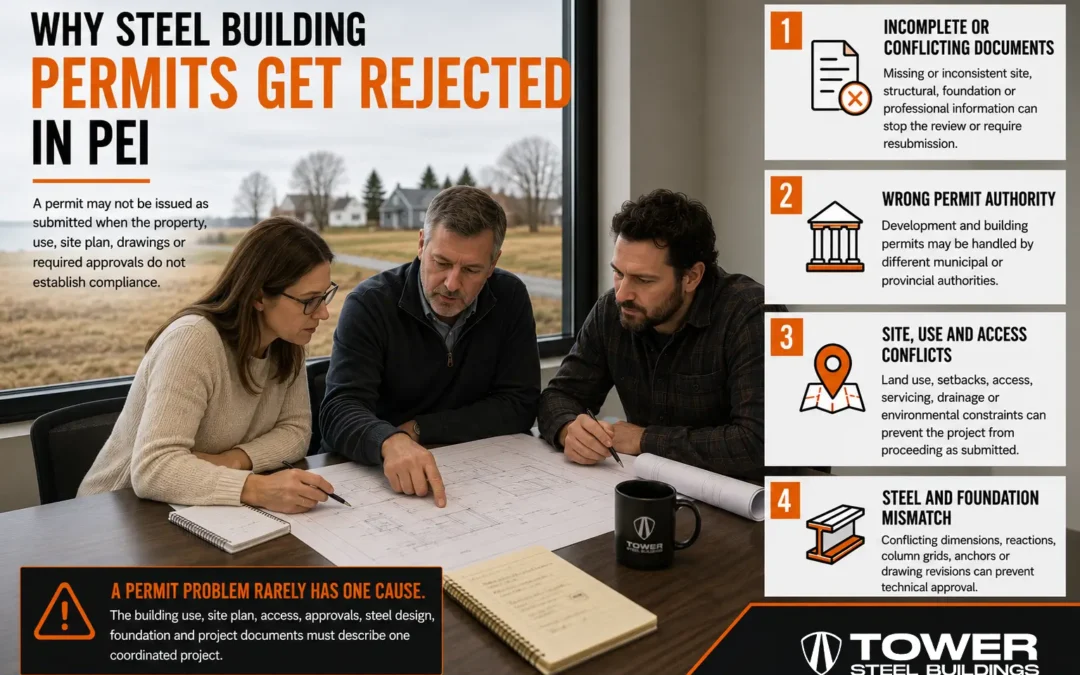
Applying to the wrong office can delay the project before the technical review begins.
Step 1: Confirm the Property Information
Start with the property, not the building catalogue.
Collect:
- Property Identification Number
- Civic address
- Registered owner information
- Deed or survey information
- Lot number, where applicable
- Existing property use
- Municipal jurisdiction
- Existing buildings
- Easements and rights-of-way
- Road access
- Well information
- Sewer or septic information
- Previous development approvals
- Known watercourses or wetlands
The PID is important because provincial applications and permit-status records are connected to the property.
If the applicant is not the registered owner, written authorization may be required.
Why the property must be checked first
A properly engineered steel building can still be unsuitable for a particular parcel.
Problems may arise when:
- The proposed use is not allowed.
- The building cannot meet the required setbacks.
- The driveway location is unacceptable.
- A septic field conflicts with the proposed building.
- A well setback limits the available building area.
- A wetland or buffer zone restricts development.
- An easement crosses the proposed foundation.
- The lot requires subdivision or another planning approval.
- Fire or service access cannot be provided.
- The site cannot support delivery and erection equipment.
These issues should be identified before the building package and foundation are finalized.
Step 2: Confirm Both Permit Authorities
Determine who reviews the development permit and who reviews the building permit.
Ask:
- Is the property inside a municipality?
- Does the municipality have an official plan and land-use bylaws?
- Does the municipality issue development permits?
- Does the municipality issue building permits?
- Does the building permit go to the provincial Lands Division?
- Is another planning approval required first?
- Is a rezoning, variance, subdivision, or discretionary-use process involved?
In many PEI jurisdictions, municipal and provincial authorities perform different parts of the review.
Do not treat approval from one office as approval of the complete project.
Step 3: Confirm the Actual Building Use
Do not describe the project only as a “steel building.”
The reviewer needs to understand how the building will operate.
Examples include:
- Agricultural storage
- Farm workshop
- Equipment storage
- Private garage
- Heated vehicle garage
- Truck-maintenance building
- Warehouse
- Contractor shop
- Commercial storage
- Manufacturing space
- Municipal equipment building
- Mixed office and shop
- Cold-storage facility
The building use can affect:
- Land-use approval
- Occupancy classification
- The applicable Part 3 or Part 9 code pathway and any Part 4 structural-design requirements
- Professional-design requirements
- Fire separations
- Exits
- Accessibility
- Washrooms
- Heating and ventilation
- Energy compliance
- Floor drainage
- Parking
- Loading
- Fire access
- Inspections
- Occupancy approval
A building permitted as storage should not later be operated as a repair garage without confirming whether additional approvals are required.
The proposed use should remain consistent across the development application, site plan, steel drawings, foundation design, mechanical scope, electrical scope, and occupancy documentation.
Do Farm Steel Buildings Need a Permit in PEI?
Agricultural land or farm ownership does not automatically make every steel building permit-exempt.
PEI’s Building Codes Regulations contain an exemption for a farm building that falls within the scope identified by the regulations. The regulations also exempt certain buildings used for a defined resource use where the expected normal occupant load does not exceed one person for every 40 square metres of floor area.
Whether a proposed building qualifies depends on matters such as:
- Actual building use
- Applicable legal definition
- Code classification
- Normal occupant load
- Whether the building contains public, commercial, industrial, assembly, office, retail, processing, repair, or other non-farm functions
- Whether the structure remains within the scope of the applicable farm-building provisions
- Whether the project includes uses or areas that fall outside the exemption
Do not assume that the following automatically qualify:
- Farm workshops
- Machinery-repair buildings
- Equipment-storage buildings
- Livestock buildings
- Riding arenas
- Produce or material storage buildings
- Farm retail areas
- Offices
- Employee facilities
- Mixed-use agricultural buildings
A building used partly for storage and partly for repair, processing, retail, public events, offices, or another occupancy may need to be assessed differently from a building used only for a qualifying farm or resource use.
A qualifying exemption under the Building Codes Regulations does not automatically remove the need for:
- Development approval
- Municipal planning approval
- Setback compliance
- Highway or driveway approval
- Watercourse, wetland, or buffer-zone authorization
- Septic or servicing approval
- Electrical permits
- Environmental approval
- Other provincial or municipal permissions
PEI’s development-permit process generally applies to the construction or placement of new buildings and structures, including projects that may qualify for a building-code exemption.
Confirm the proposed classification and all required approvals with the municipality or provincial Lands Division before ordering the steel package or beginning work.
Step 4: Arrange a Pre-Application Discussion
A pre-application discussion can identify major obstacles before money is spent on final engineering.
Provide the municipal planning office or provincial permit coordinator with:
- PID and property address
- Proposed use
- Approximate building dimensions
- Expected eave height
- Proposed location
- Door and vehicle-access requirements
- Existing structures
- Water and sewer approach
- Septic and well information
- Nearby wetlands or watercourses
- Proposed construction scope
Questions to ask
- Is the proposed use permitted?
- Who issues each permit?
- Can both applications be submitted at the same time?
- Does a farm-building or resource-use exemption potentially apply?
- Is a variance, rezoning, subdivision, or public process required?
- What must the site plan show?
- Is a survey or location certificate likely to be required?
- Is a driveway or highway-access approval required?
- Are septic, sewer, or well approvals required?
- Are wetland, buffer-zone, or coastal reviews required?
- What building drawings are required?
- Which professional undertakings or declarations are required?
- What inspections will be required?
- What completion documents are required?
- What occupancy approval is required before the building can be used?
The answers may change the building location, dimensions, openings, services, foundation, or schedule.
Where the proposed driveway connects with a provincial highway, the owner should also confirm whether PEI’s entrance way permit requirements apply before access, culvert, delivery and site-circulation assumptions are finalized.
Step 5: Prepare the Development-Permit Application
A provincial development-permit application commonly requests:
- Owner and applicant information
- PID
- Property location
- Lot number, where applicable
- Current property use
- Proposed development
- Building dimensions
- Proposed building use
- Staff and parking information for non-residential projects
- Driveway or access information
- Water and sewer information
- Site-assessment information
- Foundation type
- Siding and roofing materials
- Detailed property sketch
If the property is used for agricultural purposes and livestock are present, additional project information may be required.
Municipal requirements may differ, so use the current checklist issued by the authority reviewing the development permit.
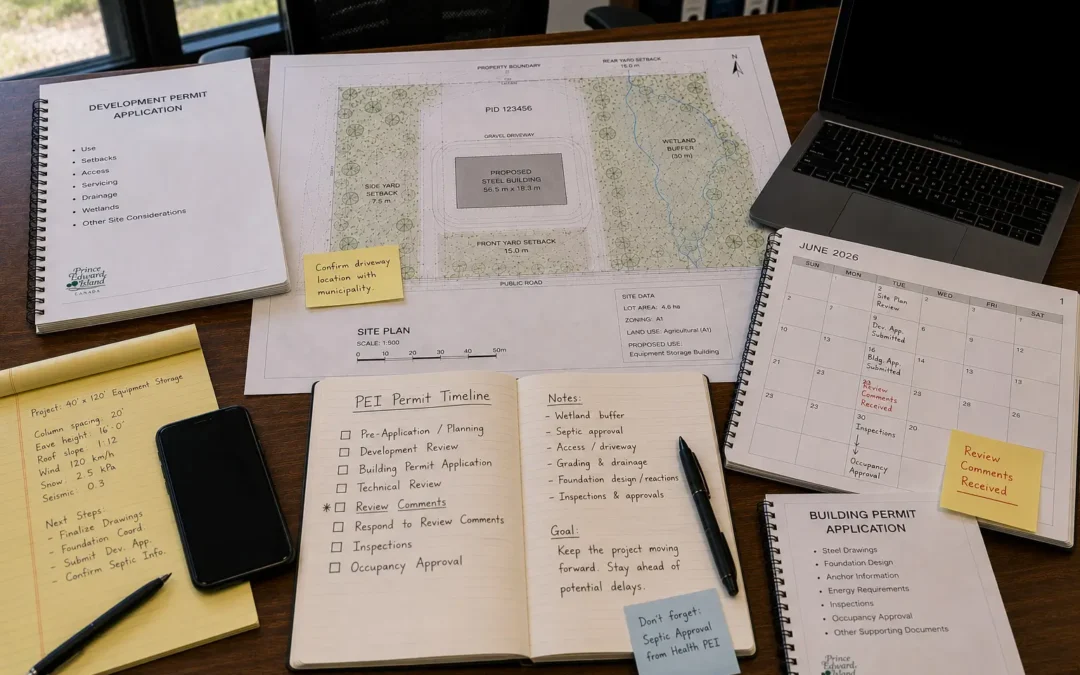
Step 6: Prepare a Reviewable Site Plan
The site plan should show how the project fits on the property.
Depending on the site and reviewing authority, include:
- Property boundaries and dimensions
- Road frontage and road name
- Proposed and existing driveways
- Proposed steel building
- Existing buildings
- Building dimensions
- Distances to property lines
- Parking areas
- Loading areas
- Fire access
- Wells
- Septic systems
- Sewer and water connections
- Utility routes
- Easements
- Drainage direction
- Natural slope
- Watercourses
- Wetlands
- Waterfront top of bank
- Sand dunes
- Protected buffer zones
- Other constrained areas
When a survey may be required
Under PEI’s Building Codes Regulations, a building official may require an up-to-date lot survey or surveyor’s location certificate prepared by a member of the Association of Prince Edward Island Land Surveyors.
This may be required to verify the proposed location before construction and confirm compliance after construction.
A survey becomes particularly important when:
- Setbacks are tight.
- Property boundaries are unclear.
- The building is close to an easement.
- Existing buildings limit the site.
- A wetland or watercourse is nearby.
- The property has significant slope.
- Access or servicing requires precise coordination.
Do not construct a foundation using an assumed property line.
Step 7: Resolve Wetlands, Watercourses, and Coastal Constraints
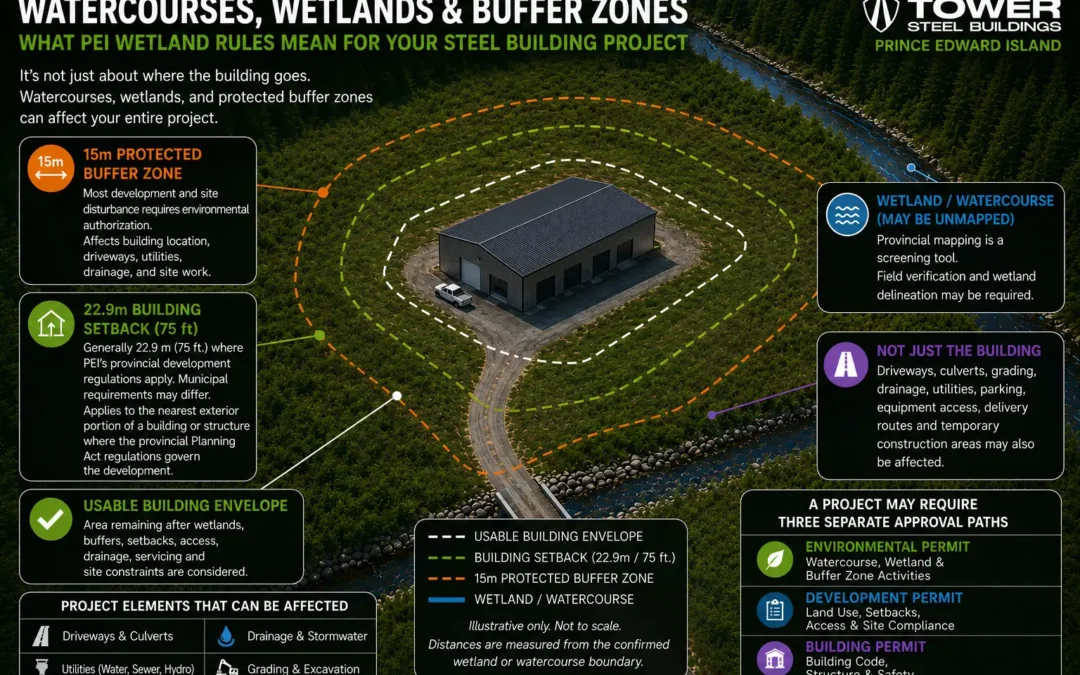
PEI protects watercourses, wetlands, and the 15-metre buffer zones around them.
Work in a watercourse, wetland, or 15-metre buffer zone requires provincial review.
A provincial Watercourse, Wetland and Buffer Zone Activity Permit is required before regulated work begins in a watercourse, wetland or 15-metre buffer zone.
Do not begin:
- Clearing
- Excavation
- Grading
- Drainage work
- Culvert installation
- Road construction
- Utility installation
- Shoreline work
- Building work
within or near these areas until the required environmental authorization has been confirmed.
Wetland mapping is not final proof
PEI’s official wetland delineation guidance confirms that wetlands can remain protected even when they do not appear on the provincial Wetland Inventory.
A wetland delineation may be required when a commercial, industrial, residential, subdivision, clearing, or other project could affect a wetland.
Public mapping should be treated as an initial screening tool, not a substitute for an on-site determination.
Why environmental constraints affect the steel building
A wetland, watercourse, buffer zone, dune, or coastal condition can change:
- Building location
- Driveway alignment
- Culvert location
- Drainage
- Utility routes
- Clearing limits
- Foundation strategy
- Construction access
- Project schedule
Resolve these conditions before the steel-building layout is finalized.
Step 8: Confirm Access, Servicing, and Site Function
A steel building cannot be reviewed only as a structure.
Confirm:
- Driveway location
- Highway access
- Steel-delivery access
- Crane setup
- Fire access
- Vehicle circulation
- Parking
- Loading
- Water service
- Sewer service
- Septic system
- Well location
- Electrical service
- Heating fuel
- Site drainage
- Stormwater management
- Snow storage
How servicing changes the design
A septic field may conflict with the building, driveway, or parking area.
A well setback may reduce the usable building area.
A utility route may conflict with the foundation.
A floor drain may affect plumbing, wastewater, and slab design.
A truck garage may need more turning space and access than a storage building.
Resolve these issues before treating the steel and foundation drawings as final because drainage and grading mistakes that delay steel building projects can change building elevations, foundation assumptions, access, slab details, inspection readiness and construction sequencing.
Step 9: Finalize the Steel Building Configuration
Once the land-use path and site constraints are understood, finalize:
- Width
- Length
- Eave height
- Required clear height
- Roof slope
- Frame spacing
- Bay layout
- Door sizes
- Door locations
- Personnel doors
- Windows
- Canopies
- Overhangs
- Mezzanines
- Cranes
- Equipment loads
- Future expansion
- Insulation
- Interior liner
- Corrosion exposure
- Actual building use
Why late changes are expensive
Changing the building height can affect:
- Frame design
- Wind demand
- Wall cladding
- Bracing
- Structural reactions
- Foundation design
- Freight
- Erection equipment
Changing a large door can affect:
- Header framing
- Jamb framing
- Bracing
- Bay layout
- Structural reactions
- Anchor forces
- Foundation drawings
- Cladding
- Erection sequence
The permit application should use the building the owner intends to order and construct.
For Island sites exposed to salt air, coastal moisture or road-salt spray, salt exposure and corrosion protection for steel buildings should also be considered before coatings, cladding, fasteners and long-term maintenance assumptions are finalized.
Step 10: Determine the Required Professional Design Team
This is one of the most important PEI-specific permit requirements.
Under PEI’s Building Codes Regulations, an owner constructing a building or part of a building to which Part 3 or Part 4 of Division B of the Building Code applies must:
- Consult an architect and professional engineers to determine which professionals are appropriate for the work.
- Ensure that the appropriate professionals are appointed to design the building or relevant part.
The same requirement applies to a Part 9 building exceeding 300 square metres in building area.
Do not misunderstand the 300 m² threshold
The regulations do not mean that professional involvement applies only when a building exceeds 300 m².
Professional design may still be required because:
- Part 3 applies.
- Part 4 structural-design requirements apply.
- A structural component cannot be sized through the Part 9 prescriptive provisions.
- The building official considers the site, size, or complexity to require professional design and field reviews.
- The building includes a sprinkler system requiring professional engineering.
- Another building system or discipline requires professional design.
Non-prescriptive Part 9 structural components
Where a structural component in a Part 9 building is not sized through the prescriptive provisions and its dimensions must be determined by calculation, testing, or another evaluation method, the owner must engage a professional engineer to design that component.
This is directly relevant to many pre-engineered steel building systems, which commonly rely on calculated structural design.
Site conditions, size, and complexity
A building official may require the owner to engage appropriate professionals where the site conditions, building size, building complexity, or component complexity warrant professional design and inspection.
The building official may also require professional declarations related to field reviews.
Confirm responsibilities before submission
The project may require some combination of:
- Prime consultant
- Architect
- Steel-building structural engineer
- Foundation engineer
- Mechanical engineer
- Electrical engineer
- Civil or site consultant
- Energy-code professional
- Fire-protection engineer
- Land surveyor
- Geotechnical consultant
- Field-review professionals
The required disciplines depend on the project use, size, code pathway, systems, and site conditions.
A detailed steel building engineering review checklist can help the owner confirm structural, foundation, envelope, mechanical, electrical, fire-protection, energy, site and field-review responsibilities before the permit package is submitted.
Step 11: Prepare the Building-Permit Documents
The provincial building-permit process identifies plans including:
- Foundation plan
- Front, side, and rear elevations
- Floor plans
- Cross-sections
- Site plan
- Truss or structural-framing plan
A serious steel building application may require additional coordinated information.
| Document or Information | Why It Matters |
| Site plan | Connects the building to setbacks, access, servicing, drainage, and environmental constraints |
| Floor plan | Shows use, layout, doors, exits, rooms, equipment, and occupancy functions |
| Elevations | Shows building height, roof form, openings, and exterior configuration |
| Cross-sections | Shows structural, foundation, slab, and envelope relationships |
| Steel-building drawings | Defines primary framing, secondary framing, bracing, cladding, and framed openings |
| Design criteria | Identifies location, loading, importance category, use, and structural assumptions |
| Structural reactions | Provides the forces required for foundation design |
| Base-plate information | Coordinates the steel columns, foundation, and anchorage |
| Anchor-layout information | Identifies anchor locations associated with the steel system |
| Foundation drawings | Defines footings, piers, grade beams, slab, reinforcement, and construction details |
| Energy documentation | Supports energy-code review where applicable |
| Professional undertakings | Identifies responsibility for design and field reviews |
| Mechanical and electrical documents | Supports review of building services where required |
| Development permit | Confirms the applicable land-use and site approval |
Supplier drawings are not the complete permit package
Steel-building-system drawings do not automatically include:
- Site planning
- Architectural coordination
- Foundation engineering
- Wetland review
- Septic design
- Drainage design
- Mechanical design
- Electrical design
- Fire-protection design
- Complete energy-code documentation
- Every professional undertaking
- Every permit requirement
Confirm the boundary of every supplier and professional scope in writing, including what CSA A660 certification supports within the steel-building-system package and what remains outside the manufacturer’s scope, such as site planning, foundation engineering, environmental review, servicing and other professional design work.
Step 12: Coordinate the Foundation and Anchor System
The foundation must be designed around the final steel-building system and actual site conditions.
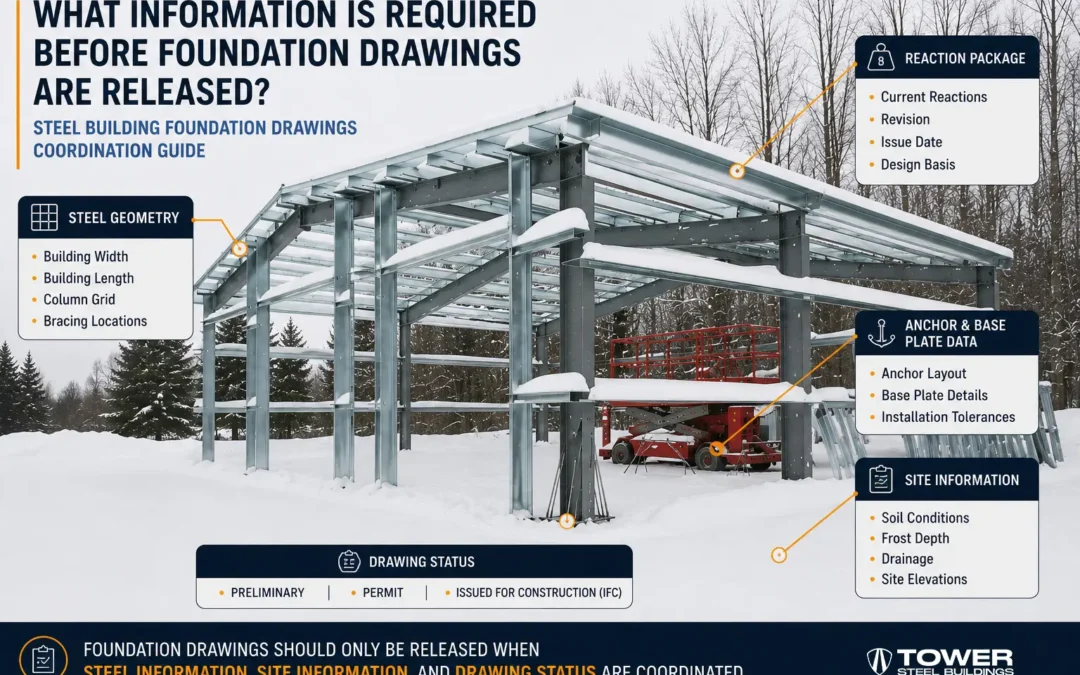
The foundation designer may need:
- Current column grid
- Final structural reactions
- Base-plate dimensions
- Anchor-layout information
- Gravity reactions
- Uplift reactions
- Horizontal reactions
- Load combinations
- Building use
- Soil assumptions
- Frost conditions
- Drainage
- Slab use
- Equipment loads
Depending on the quoted scope, Tower may provide or coordinate steel-system information such as:
- Current structural reactions
- Column grid
- Base-plate information
- Anchor-layout information
- Steel-package revisions affecting foundation inputs
These items support foundation design but do not automatically constitute project-specific foundation engineering.
Foundation engineering, geotechnical work, excavation, formwork, reinforcement, concrete construction, anchor supply, anchor installation, and field verification remain separate unless expressly included in the written scope.
Tower’s steel building foundation-design guidance explains why the steel system, final reactions, base plates, anchorage, soil assumptions, drainage, slab use and concrete work must remain coordinated.
Why preliminary reactions are dangerous
If the foundation drawings and final steel package do not match, the project may face:
- Misplaced anchor bolts
- Incorrect pier dimensions
- Insufficient footing design
- Elevation conflicts
- Misaligned columns
- Field drilling or welding
- Steel erection delays
- Concrete removal
- Engineering revisions
- Inspection problems
Do not pour concrete until the foundation designer has the current steel information.
Confirm anchor-bolt responsibilities
Confirm:
- Who provides the anchor layout
- Who designs the anchorage
- Who supplies the bolts
- Who supplies the templates
- Who installs the bolts
- Who verifies embedment
- Who checks edge distances
- Who surveys final placement
- What tolerances apply
- Who corrects misplaced anchors
An anchor layout does not automatically include the bolts, templates, design, installation, inspection, or survey.
Step 13: Submit the Applications
Municipal applications
For projects in Charlottetown, Stratford, and Summerside, use the municipality’s current forms, checklists, fee schedules, and submission process.
For St. Felix, confirm the building-permit process with the municipality and confirm the separate development-permit authority.
Provincial applications
A provincial building-permit application can be submitted online or through the Lands Division.
The application requests information such as:
- Owner and applicant contacts
- PID and property location
- Current property use
- Proposed structure type
- Building dimensions
- Estimated construction value
- Foundation type
- Heating source
- Electrical service
- Siding and roofing materials
- Contractor information
- Municipal development permit, where applicable
- Required plans
Submit one coordinated drawing set.
A larger number of drawings does not improve an application when the drawings disagree.
Step 14: Respond to Permit Comments Across the Full Project
Permit comments are a normal part of technical review.
Each response should be coordinated across every affected document.
A door change may require revisions to:
- Floor plan
- Elevations
- Steel drawings
- Bracing
- Structural reactions
- Foundation drawings
- Anchor layout
- Cladding
A building-use comment may affect:
- Occupancy classification
- Exits
- Accessibility
- Washrooms
- Heating
- Ventilation
- Energy compliance
- Fire protection
- Parking
- Inspections
Maintain:
- A document register
- Revision dates
- Response log
- Current drawing set
- Superseded drawing archive
Do not allow construction from drawings replaced during permit review.
Step 15: Obtain Authorization Before Starting Work
Submitting an application does not authorize construction.
PEI’s Building Codes Regulations require the owner to obtain the permits and approvals that apply before beginning the related work.
Do not begin:
- Excavation
- Foundation construction
- Anchor installation
- Steel erection
- Building-envelope work
- Occupancy
until the applicable permit, exemption confirmation, or written authorization has been issued or confirmed by the authority having jurisdiction.
Partial construction authorization
A building official may permit excavation or part of the construction to proceed before all building plans have been submitted.
The official may impose conditions and require the plans related to the authorized work.
Permission to proceed with part of the work does not guarantee that a permit will be issued for the remainder of the project.
The owner must not continue beyond the authorized work until the required permit has been issued.
Any partial authorization should be obtained in writing and followed exactly.
Step 16: Complete Inspections and Professional Field Reviews
Permit issuance is not the end of the process.
Required inspections may include:
- Footings
- Foundations
- Reinforcement
- Anchor placement
- Foundation before backfill
- Under-slab work
- Structural framing
- Building envelope
- Insulation
- Air and vapour control
- Plumbing
- Electrical
- Mechanical systems
- Fire and life-safety systems
- Final completion
For professionally designed buildings or components, the appointed professionals may be required to complete field reviews and submit declarations or confirmations.
Ask the authority:
- Which inspections are required?
- How much notice is required?
- What work must remain exposed?
- Which approved drawings must remain on site?
- What professional field-review reports are required?
- What completion certificates are required?
- What deficiencies must be resolved before occupancy?
Do not cover work that must be inspected.
Step 17: Obtain the Occupancy Permit Before Use
An occupancy permit is generally required under PEI’s Building Codes Regulations for the initial occupancy of a building or part of a building, subject to specific exemptions.
An occupancy permit is also required when:
- The occupancy classification changes.
- A building remains occupied during certain alterations or partial demolition.
- Occupancy is requested before all work is complete.
Before using the steel building, confirm that:
- Final inspections are complete.
- Required professional declarations are submitted.
- Required trade certificates are available.
- Life-safety systems are operational.
- Outstanding permit conditions are resolved.
- Conditional occupancy requirements are documented.
- The occupancy permit has been issued where required.
A building permit allows authorized construction. It does not automatically authorize the building to be occupied.
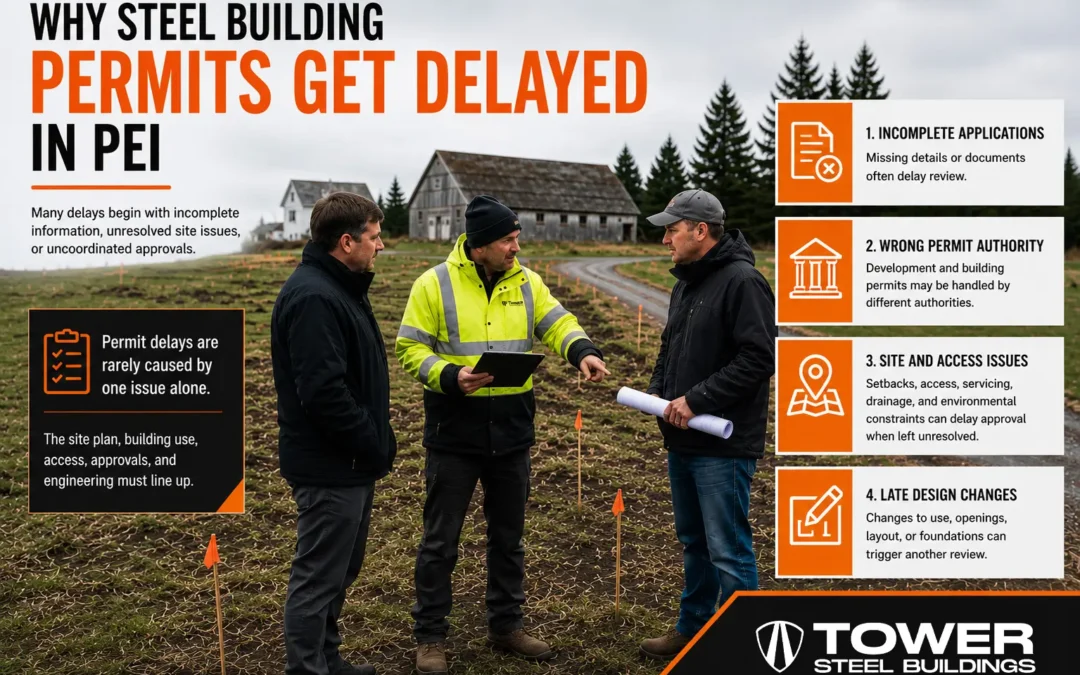
What Commonly Delays a PEI Steel Building Permit?
Common delay causes include:
- Applying to the wrong authority
- Confusing development approval with building approval
- An unclear building use
- Assuming an agricultural exemption without confirmation
- Missing PID or ownership information
- Incomplete site plans
- Unresolved setbacks
- Missing access or servicing information
- Wetland, buffer-zone, or coastal constraints
- Missing professional undertakings
- Failure to recognize Part 3, Part 4, or the 300 m² Part 9 requirements
- Non-prescriptive structural components without professional engineering
- Preliminary steel drawings submitted as final
- Foundation drawings based on outdated reactions
- Anchor layouts that do not match the column grid
- Conflicting dimensions
- Late changes to height, use, doors, or equipment
- Incomplete responses to review comments
- Starting construction before authorization
- Missing inspections
- Missing occupancy or completion documents
The strongest application is not necessarily the longest. It is the one in which every document describes the same project.
What Should Be Confirmed Before Ordering the Steel Package?
Before releasing fabrication, confirm:
- The proposed use is acceptable.
- Any claimed farm-building or resource-use exemption has been confirmed.
- The development-permit path is clear.
- The building-permit authority is confirmed.
- The site location is workable.
- Setbacks are understood.
- Access and servicing can be provided.
- Wetland and environmental constraints are resolved.
- Width, length, height, and roof slope are final.
- Door and window openings are final.
- Actual project-location design criteria are being used.
- Required professionals are appointed.
- Steel drawings are coordinated.
- Structural reactions are current.
- Base plates and anchor information are current.
- Foundation responsibility is assigned.
- Permit-document responsibility is assigned.
- Field-review responsibility is assigned.
- Freight, unloading, and erection scope are clear.
- Inspection and occupancy requirements are understood.
Tower’s steel building permit checklist can help buyers identify missing jurisdiction, site, engineering, foundation, servicing, environmental and construction information before submitting an application or ordering the package.
A steel quote is not the same as a permit-ready project.
How Tower Steel Buildings Supports Permit Readiness
Tower Steel Buildings primarily supplies project-specific steel building kits and packages.
Depending on the written scope, Tower can provide or coordinate steel-building-system information such as:
- Building dimensions
- Eave height
- Framing arrangement
- Door and window openings
- Project design criteria
- Steel-building-system drawings
- Current structural reactions
- Column grid
- Base-plate information
- Anchor-layout information
- Steel-package revisions affecting foundation inputs
- CSA A660 documentation where applicable
- Delivery and erection scope where quoted
Project-specific foundation engineering, site planning, environmental approval, architectural work, mechanical design, electrical design, permit decisions, inspections, and occupancy approval remain separate unless expressly included.
Tower does not determine whether a proposed building legally qualifies for a farm-building or resource-use exemption.
That determination remains with the applicable municipality, provincial Lands Division, building official, authority having jurisdiction, and appointed professionals.
Tower does not issue PEI development permits or building permits and cannot guarantee approval.
Planning a Steel Building in Prince Edward Island?
Start with the property PID, municipal jurisdiction, proposed use, development-permit path, building-permit authority, and site constraints.
For an agricultural project, confirm whether the building qualifies for a farm-building or resource-use exemption rather than relying on the property’s farm ownership or zoning alone.
Then coordinate the steel package, professional design, structural reactions, foundation, anchors, servicing, inspections, and occupancy requirements around the confirmed project.
Send Tower Steel Buildings the project location, intended use, required size and height, opening schedule, site information and desired scope through the steel building quote request form.
Tower can prepare a project-specific steel building package quotation while helping define the steel-system information needed for permit and foundation coordination.
Reviewed by Engineering Team
This content has been reviewed by the Tower Steel Buildings Engineering Team.
The review focused on the PEI-specific permit route that steel building buyers should establish before finalizing a building package. This includes confirming the property PID, municipal jurisdiction, development-permit authority, building-permit authority, proposed use, site constraints and required professional responsibilities.
Prince Edward Island projects can involve different reviewing authorities for land-use approval and construction approval. A municipal development permit does not automatically complete the provincial building-permit process, and a building-permit application does not resolve outstanding land-use, access, servicing, environmental or site-location issues.
The review also considered how PEI site conditions can affect the proposed steel building. Watercourses, wetlands, protected buffers, additional development setbacks, driveway access, septic systems, wells, utility routes, drainage, coastal conditions and property boundaries can affect building placement before structural and foundation information is finalized.
For the construction portion of the project, the steel-building drawings, final reactions, column grid, base plates and anchor information must be coordinated with the site-specific foundation design and current permit documents. The applicable professional-design and field-review responsibilities should also be established before submission and construction.
This review does not determine whether a specific project qualifies for a farm-building, resource-use or other regulatory exemption. That determination remains with the applicable municipality, provincial Lands Division, building official, authority having jurisdiction and appointed professionals.
This content is intended to support buyer education and application planning. Final permit requirements, development decisions, exemption determinations, professional responsibilities, inspections and occupancy approvals remain under the authority of the applicable municipality, provincial Lands Division, building official, environmental authority, engineer, architect, land surveyor, geotechnical professional, trade contractor or other qualified professional involved in the project.
Official References
This guide was prepared using current information from:
- Government of Prince Edward Island, Building and Development in PEI
- Government of Prince Edward Island, Apply for a Development Permit
- Government of Prince Edward Island, Apply for a Building Permit
- Prince Edward Island Building Codes Act and Building Codes Regulations
- Government of Prince Edward Island, Watercourse, Wetland and Buffer Zone Activity Permit
- Government of Prince Edward Island, Wetland Identification
- Government of Prince Edward Island, Wetland Delineation Information and Standards
- National Research Council of Canada, National Building Code of Canada 2020
- National Research Council of Canada, National Energy Code of Canada for Buildings 2020
1. Do steel buildings need a permit in Prince Edward Island?
Most permanent steel buildings in Prince Edward Island require both a development permit and a building permit before construction begins, unless a specific exemption applies.
PEI identifies industrial, institutional, commercial, and other non-residential structures as requiring building permits. Accessory buildings larger than 20 square metres, or approximately 215 square feet, also require a building permit.
PEI’s Building Codes Regulations contain exemptions for certain qualifying farm buildings and some buildings used for a defined resource use. Even where a building-code or building-permit exemption applies, development approval and other site-specific permissions may still be required.
2. What is the difference between a development permit and a building permit in PEI?
A development permit approves how the land will be used and where the steel building can be placed. It can address zoning, setbacks, access, servicing, parking, drainage, wetlands, watercourses, and other site conditions.
A building permit reviews how the steel building will be designed and constructed. It can address structural framing, foundations, energy requirements, professional design, inspections, fire and life safety, accessibility, and occupancy.
Obtaining one permit does not automatically provide the other.
3. Where do I apply for a steel building permit in Prince Edward Island?
The correct permit office depends on the property location.
Charlottetown, Stratford, and Summerside issue their own development and building permits. St. Felix issues building permits within its municipal boundaries. In many other municipalities, the municipality issues the development permit while the PEI Lands Division issues the building permit. Outside a municipality, or within a municipality without an official plan and land-use bylaws, the Lands Division generally handles both permits.
Confirm the PID and jurisdiction before applying.
4. How do I apply for a steel building permit in PEI?
Start by confirming the property jurisdiction, proposed use, development-permit authority, building-permit authority, and whether any specific exemption may apply.
Prepare the site plan, development information, steel-building drawings, foundation documents, structural reactions, anchor information, professional undertakings, and any required servicing or environmental approvals. Submit the coordinated application to the applicable municipality or PEI Lands Division and respond to review comments before construction begins.
5. What documents are required for a PEI steel building permit?
A provincial building-permit application commonly requires:
- Foundation plans
- Front, side, and rear elevations
- Floor plans
- Cross-sections
- Site plan
- Truss or structural-framing plans
- Property and owner information
- Building dimensions and proposed use
- Construction-value information
- Foundation, heating, electrical, roofing, and siding details
- Municipal development permit, where applicable
Commercial, industrial, agricultural, or technically complex steel buildings may require additional engineering, energy, mechanical, electrical, fire-protection, or professional field-review documents.
6. What must a steel building site plan show in Prince Edward Island?
A PEI steel building site plan should clearly show property boundaries, roads, driveway access, the proposed building, existing structures, setbacks, parking, servicing, and drainage.
Depending on the site, it may also need to show wells, septic systems, water and sewer connections, easements, wetlands, watercourses, the waterfront top of bank, sand dunes, natural slope, and protected buffer zones.
A building official may require a current survey or surveyor’s location certificate where precise location verification is needed.
7. Do I need an engineer for a steel building in PEI?
Pre-engineered steel buildings commonly rely on professional structural engineering because their structural components are designed through calculation rather than ordinary prescriptive sizing.
PEI regulations also require the owner to consult and appoint the appropriate architects and professional engineers when Part 3 or Part 4 applies, when a Part 9 building exceeds 300 square metres, or when the authority requires professional design because of the project’s site conditions, size, or complexity.
The required professional disciplines depend on the project.
8. Does the PEI 300-square-metre engineering rule apply to a steel building?
A Part 9 building exceeding 300 square metres in building area triggers the PEI requirement to consult and appoint the appropriate architects and professional engineers.
A steel building below 300 square metres can still require professional engineering. Engineering may be required because Part 4 structural design applies, a structural component falls outside the Part 9 prescriptive provisions, or the building official determines that the site, building, or component requires professional design and field review.
The 300-square-metre threshold is not a general engineering exemption.
9. Are steel supplier drawings enough for a PEI building permit?
Not always. Steel supplier drawings generally describe the supplied steel-building system, including framing, bracing, cladding, openings, design criteria, and structural reactions.
They may not include site planning, foundation engineering, architectural coordination, wetland information, drainage, energy compliance, mechanical design, electrical design, fire protection, septic design, or every professional undertaking required by the authority.
Confirm the complete permit-document scope before submitting.
10. Do I need engineered foundation drawings for a steel building in PEI?
A steel building foundation should be designed for the final column grid, structural reactions, base plates, anchorage, soil conditions, frost conditions, drainage, slab use, and equipment loads.
Tower may provide current structural reactions, column-grid information, base-plate information, and anchor-layout information within the steel-package scope. Those inputs do not automatically constitute project-specific foundation engineering.
Do not construct the foundation from preliminary steel information.
11. Does an anchor-bolt layout include the anchor bolts and installation?
No. An anchor-bolt layout identifies required anchor locations associated with the steel-building system, but it does not automatically include the physical bolts, templates, anchorage design, installation, surveying, or inspection.
The project team should confirm who designs the anchorage, supplies the bolts and templates, installs them, verifies placement, and corrects any errors.
12. Does a farm steel building require a permit in Prince Edward Island?
Not every farm steel building follows the same permit path.
PEI’s Building Codes Regulations contain exemptions for certain qualifying farm buildings. They also contain an exemption for a building used for a defined resource use where the expected normal occupant load does not exceed one person per 40 square metres of floor area.
Whether an equipment-storage building, farm workshop, livestock building, riding arena, processing building, retail area, or other agricultural structure qualifies depends on its actual use, code classification, occupant load, and the definitions that apply to the project.
Agricultural land or farm ownership alone does not establish the exemption.
A building-code or building-permit exemption also does not automatically eliminate development approval, environmental authorization, highway access, septic, servicing, electrical, or other requirements.
Confirm the classification and required approvals with the municipality or PEI Lands Division before ordering the steel package.
13. Can I build a steel building near a wetland or watercourse in PEI?
The proposed building, driveway, grading, drainage, utilities, or clearing may be restricted if the work affects a watercourse, wetland, or 15-metre buffer zone.
Provincial review is required, and an activity permit is required before conducting regulated work in these areas. Wetlands can remain legally protected even when they do not appear on the public PEI Wetland Inventory.
Confirm the environmental boundary before finalizing the site plan.
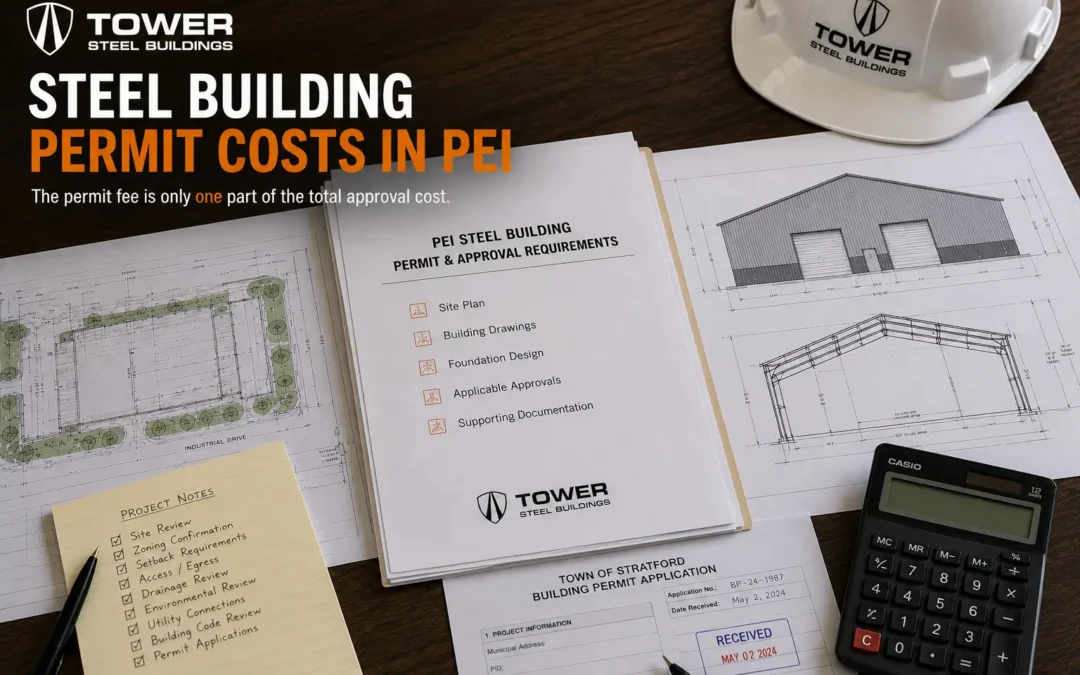
14. How much does a steel building permit cost in Prince Edward Island?
Permit cost depends on the reviewing authority, project type, construction value, and applicable provincial or municipal fee schedule.
Provincial building-permit fees are established under PEI’s Building Codes Regulations. Development-permit fees are addressed separately. Municipalities that issue their own permits may use different schedules.
Permit fees normally do not include engineering, surveying, foundation design, environmental assessments, trade permits, or other professional services.
15. How long does a steel building permit take in PEI?
There is no guaranteed province-wide timeline for a steel building permit.
Provincial processing begins after the full permit fee is received. Routine residential permits may sometimes be issued within 30 days, but that timing should not be applied automatically to commercial, agricultural, industrial, warehouse, truck-garage, or other steel building projects.
Timing depends on application completeness, development approval, professional documents, environmental issues, servicing, and responses to permit comments.
16. Can I start building after submitting a PEI permit application?
No. Submitting a development-permit or building-permit application does not authorize construction.
Do not begin excavation, foundation work, anchor installation, steel erection, or occupancy until the required permit, confirmed exemption, or written partial authorization has been issued. Limited partial construction may be authorized in specific circumstances, but it does not guarantee approval of the remaining project.
17. What inspections are required for a steel building in Prince Edward Island?
The required inspections depend on the project and authority, but they may include:
- Footings and foundations
- Reinforcement
- Anchor placement
- Foundation before backfill
- Under-slab work
- Structural framing
- Building envelope
- Insulation and vapour control
- Plumbing
- Electrical
- Mechanical systems
- Fire and life-safety work
- Final completion
Professionally designed buildings may also require field-review declarations from appointed architects or engineers.
18. Is an occupancy permit required for a steel building in PEI?
An occupancy permit is generally required before the initial occupancy of a building or part of a building, subject to the exemptions in PEI’s Building Codes Regulations.
Before using the building, confirm that final inspections are complete, required professional documents have been submitted, life-safety systems are operational, outstanding permit conditions are resolved, and the occupancy permit has been issued where required.
A building permit does not automatically authorize occupancy.
19. Does CSA A660 certification replace a PEI building permit?
No. CSA A660 addresses quality certification for manufacturers of steel building systems.
It does not replace development approval, building-permit review, site planning, foundation engineering, environmental authorization, mechanical or electrical design, inspections, or occupancy approval.
The complete PEI project still requires its applicable approvals and professional work.
20. Can Tower Steel Buildings guarantee permit approval in Prince Edward Island?
No steel-building supplier can guarantee permit approval because final decisions remain with the applicable municipality, PEI Lands Division, building official, environmental authority, and appointed professionals.
Tower Steel Buildings can support permit readiness by coordinating the steel-package dimensions, openings, design criteria, structural drawings, reactions, column grid, base-plate information, and anchor-layout information within its written scope.
A coordinated package can reduce preventable review comments, but it does not replace regulatory approval.