

Permit trouble rarely starts at the counter. It starts earlier with the wrong land-use assumption, a weak site plan, missing field review documents, uncoordinated anchor bolts, unknown foundation reactions, or a steel package that does not answer the questions the municipality will ask.
Important: Nova Scotia building permits are issued by the local municipality. Tower Steel Buildings supports permit-ready steel building system coordination. Final permit acceptance, inspections, occupancy and local approvals remain with the municipality and applicable authorities.
Get a Free Steel Building Quote
Your information will only be used to prepare and follow up on your quote.
Approval sequence matters
Most Nova Scotia permit delays happen before structural review even begins. Problems usually start when zoning, land use, setbacks, driveway access, servicing, drainage, or development approval requirements are not fully confirmed before the steel building package moves forward.
Approval problems discovered late usually create redesign pressure, permit revisions, and unnecessary project delays before construction can proceed.
Site conditions change structural design
Snow loads, coastal wind exposure, openings, soil conditions, frost depth, drainage patterns, moisture exposure, and building use directly affect frame sizing, structural reactions, foundation requirements, anchor bolts, and cladding strategy.
A steel building should be engineered for the actual site, not assumed conditions or generic design inputs carried over from another location.
Early permit assumptions create redesign risk
Incomplete permit information often leads to redesign, resubmission, delayed approvals, foundation changes, anchor bolt conflicts, contractor confusion, and higher construction costs later in the project.
The cheapest early decision can become the most expensive correction after drawings, foundations, and site coordination are already moving forward.
On This Page
Use this page as a permit-readiness checklist before ordering steel or finalizing foundation drawings.
2020 Code Adoption
Municipality
CSA A660
CSA A660 steel building system documentation helps support permit-review confidence.
Schedule A
Professional field review documents may affect permit and occupancy closeout.
Site Conditions
Coastal exposure, drainage, wet soils, rural servicing and access need early review.
This page is for serious buyers. If the building use, site layout, loads, foundation reactions, servicing and documents are not aligned early, the problem usually shows up later as a permit comment, engineer revision, anchor bolt conflict, inspection delay or cost increase.
Reviewed for steel building permit-readiness, documentation, and approval-path clarity
We support permit-ready systems for:
- Garages, workshops and truck garages
- Commercial steel buildings and retail/service facilities
- Warehouses, storage buildings and distribution spaces
- Farm buildings, equipment storage and agricultural facilities
- Aircraft hangars, riding arenas and long clear-span buildings
- Mining buildings, cannabis buildings and controlled-use facilities
- Cold storage, custom buildings and container roof systems
What controls approval in practice
- Municipal land-use by-law and zoning compliance
- Development permit, site plan, variance or planning approval where required
- Nova Scotia Building Code and adopted national code requirements
- CSA A660 manufacturer certification and conformance documentation where applicable
- Schedule A field review documents where professional consultants are engaged
- Foundation design, anchor bolts, site grading, drainage and servicing
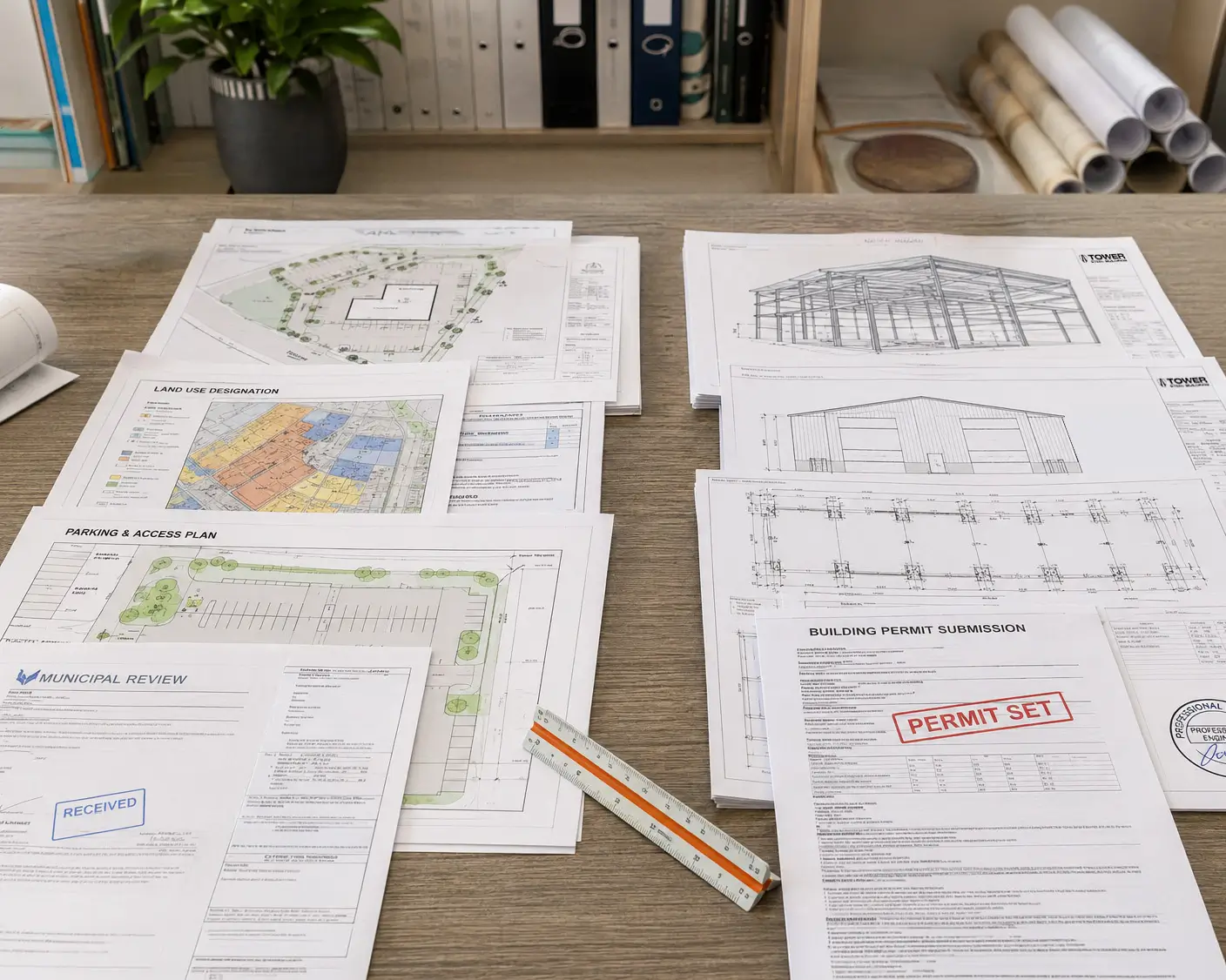
| Approval Layer | What It Checks | Why Steel Building Buyers Should Care |
|---|---|---|
| Zoning / Land-Use Check | Permitted use, setbacks, lot coverage, height, site placement, parking, access and local restrictions. | If the use or location is not allowed, engineered drawings will not fix the problem. |
| Development Permit / Planning Review | Site layout, development rules, variances, site plan expectations, access, servicing and local planning requirements. | This can control whether the project can proceed before the building permit is issued. |
| Building Permit | Code compliance, structural drawings, foundation design, life safety, energy, accessibility and other technical requirements where applicable. | This is where incomplete steel package data, missing reactions, unclear use and weak documentation cause review comments. |
| Trade / Related Permits | Electrical, plumbing, mechanical, fire protection, driveway, grading, demolition or right-of-way work where applicable. | A shell building can still be delayed if services, fire access, occupancy or site work are not coordinated. |
| Inspections / Field Review | Municipal inspections and consultant field reviews during construction. | Occupancy can be delayed if required inspections, Schedule A closeout documents or consultant reviews are missing. |
Most avoidable delays come from:
- Wrong assumptions about permitted land use
- Development approval missed or addressed too late
- CSA A660 or manufacturer conformance documents not available when needed
- Schedule A or field review obligations not understood early
- Generic steel kit documents that do not match the project location
- Foundation design not coordinated with steel reactions and anchor bolts
- Drainage, grading, driveway or rural servicing questions discovered late
- Coastal wind exposure, corrosion risk or moisture conditions ignored
- Unclear occupancy classification for commercial, agricultural or industrial use
Clear-span frames
Large open interiors push loads into fewer frame lines. The municipality may need more than brochure drawings. They need design intent, loads, reactions and stamped documentation where applicable.
Foundation reactions
Column loads, uplift, shear, anchor bolts, slab edges, footings, frost protection and soil assumptions must be coordinated before the foundation package is finalized.
Snow and wind exposure
Nova Scotia projects can face wet snow, drifting, coastal wind, uplift and wind-driven rain. Site-specific design inputs matter.
Corrosion and moisture
Near-coastal and wet sites need attention to coatings, cladding strategy, fasteners, drainage, condensation and long-term service life.
Use and occupancy
Storage, farm, workshop, commercial, industrial, cannabis, mining and public-use buildings can trigger different review expectations.
Documentation quality
Permit-ready packages reduce vague review comments, resubmissions, contractor confusion and construction-stage uncertainty.
CSA A660 and Steel Building System Documentation
CSA A660 matters because a steel building system is not just a pile of parts. It is an integrated assembly of primary steel, secondary structural components and cladding designed and manufactured as a total building system.
CSA A660 certification supports confidence in the manufacturer process, design and engineering controls, materials control, fabrication, shipping and erection documentation. It does not replace municipal approval, professional engineering, foundation design or site-specific code review.
- Primary frames, secondary steel and cladding must be treated as one system
- Design criteria should match the project location and intended use
- Foundation reactions must be available to the foundation designer
- Generic kit information should not replace project-specific engineering data
Schedule A and Field Review of Construction
When engineers, architects, interior design professionals or other consultants are used, Nova Scotia projects may require Schedule A Letters of Undertaking and field review of construction documents as part of the permit and occupancy process.
This is different from a municipal inspection. Municipal inspectors review the project under their authority. Professional field review is the consultant’s review of construction related to their professional scope.
- Schedule A Letters of Undertaking may be required with the building permit application when professional field review is part of the project scope
- Closeout documentation may be required before occupancy depending on consultant scope and municipal requirements
- Structural, geotechnical, mechanical, electrical or other scopes may apply
- Missing closeout documents can delay occupancy even after construction work is advanced
Buyer Warning: Schedule A Can Become an Occupancy Problem
For projects involving professional engineers, architects, interior designers or other consultants, Schedule A documents are not just paperwork. They can affect permit acceptance, field review responsibilities and occupancy closeout.
A project can be physically built and still face closeout delays if required field review documentation is incomplete, missing or not coordinated with the accepted drawings.
Buyer Warning: A Cheap Kit Can Become an Expensive Permit File
A low-cost steel package can look attractive until the municipality asks for project-specific reactions, sealed drawings, CSA A660-related manufacturer documentation, drainage information or a clearer use classification.
The cheapest quote is not always the cheapest building if the permit file has to be rebuilt after design, foundation or site assumptions were already made.
Zoning and Land-Use Check
Confirm the proposed use, size, height, setbacks, lot coverage, parking, access and site layout under the local land-use by-law.
Development or Planning Approval
Identify whether a development permit, site plan approval, variance, rezoning, subdivision or other planning clearance is required.
Steel Building System Design
Coordinate frame type, clear span, snow and wind loads, exposure, bracing, cladding, doors, openings and design criteria.
Foundation Coordination
Align column reactions, uplift, shear, anchor bolts, footings, slab requirements, frost protection, soil assumptions and drainage.
Permit Package Submission
Submit site plan, building drawings, steel documentation, foundation drawings, Schedule A documents where required and supporting information.
Review, Inspections and Closeout
Respond to review comments, coordinate construction inspections, consultant field reviews and occupancy documentation where applicable.
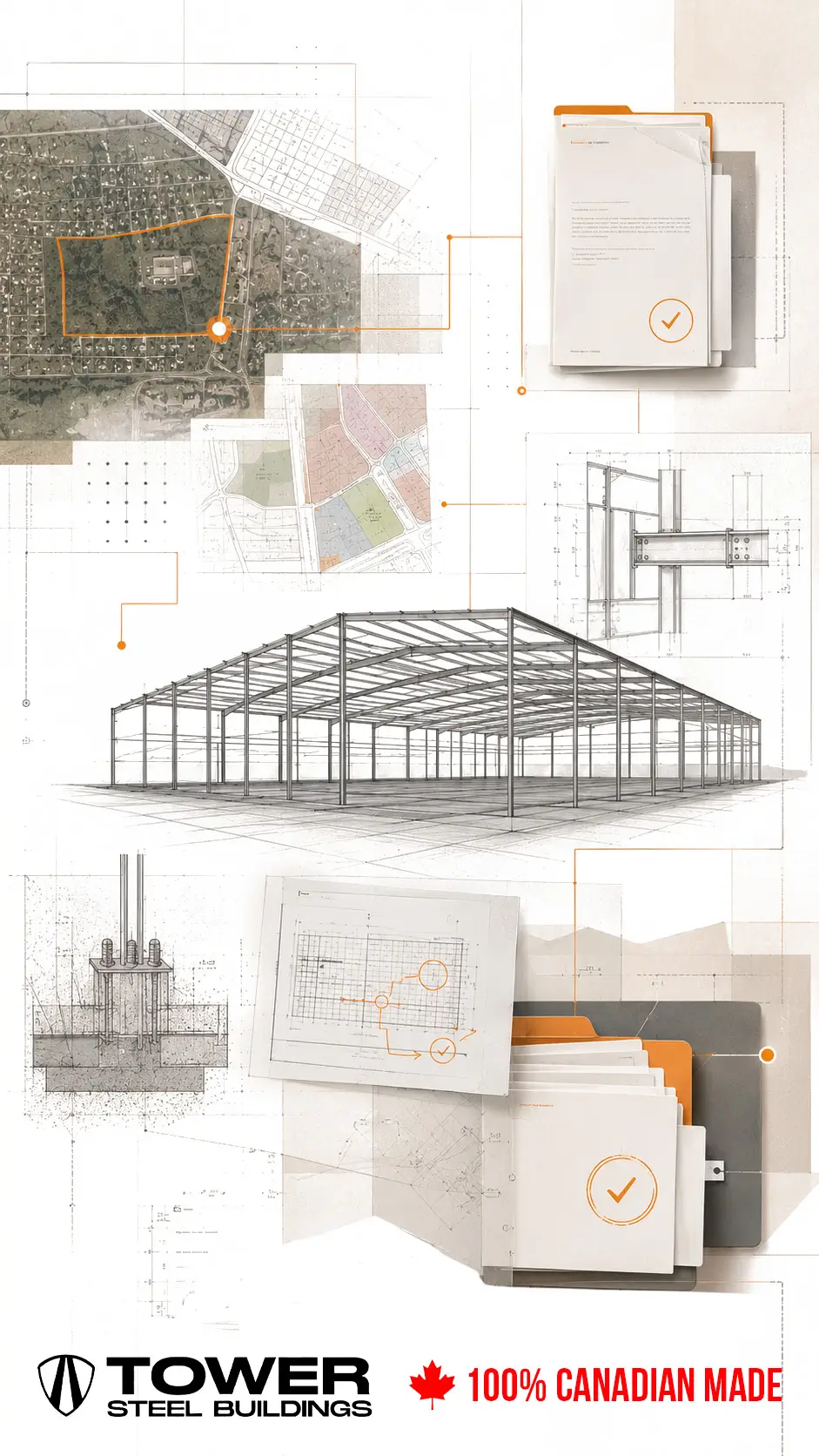
| Document or Input | Why it matters |
|---|---|
| Site plan | Shows building location, setbacks, driveway access, existing structures, grading direction, drainage, utilities and site layout. |
| Building drawings | Communicates building size, use, elevations, sections, doors, wall systems, roof systems, fire/life safety items and access where applicable. |
| Engineered steel package | Confirms the structural steel system is designed for site-specific snow, wind, exposure, use, openings and support conditions. |
| CSA A660 / manufacturer documents | Supports confidence that the steel building system manufacturer and package documentation align with quality and code-related expectations where applicable. |
| Foundation drawings | Coordinates footings, slab, anchor bolts, frost protection, soil assumptions, column reactions, uplift and drainage. |
| Schedule A documents | Used where professional field review commitments are required for engineering, architectural, geotechnical or other professional scopes. |
| Drainage / grading information | Addresses stormwater, runoff direction, erosion risk, site grading and potential conflicts with neighbouring properties. |
| Servicing and access details | May include septic, well, utility, road access, driveway, fire access, truck movement or right-of-way information for rural and commercial sites. |
Each municipality may apply planning, development, site servicing, inspection and documentation requirements differently. Review the approval path before final building design and foundation planning move too far.
- Halifax Regional Municipality
- Cape Breton Regional Municipality
- Truro
- New Glasgow
- Kentville
- Bridgewater
- Yarmouth
- Amherst
- Antigonish
- Rural Nova Scotia
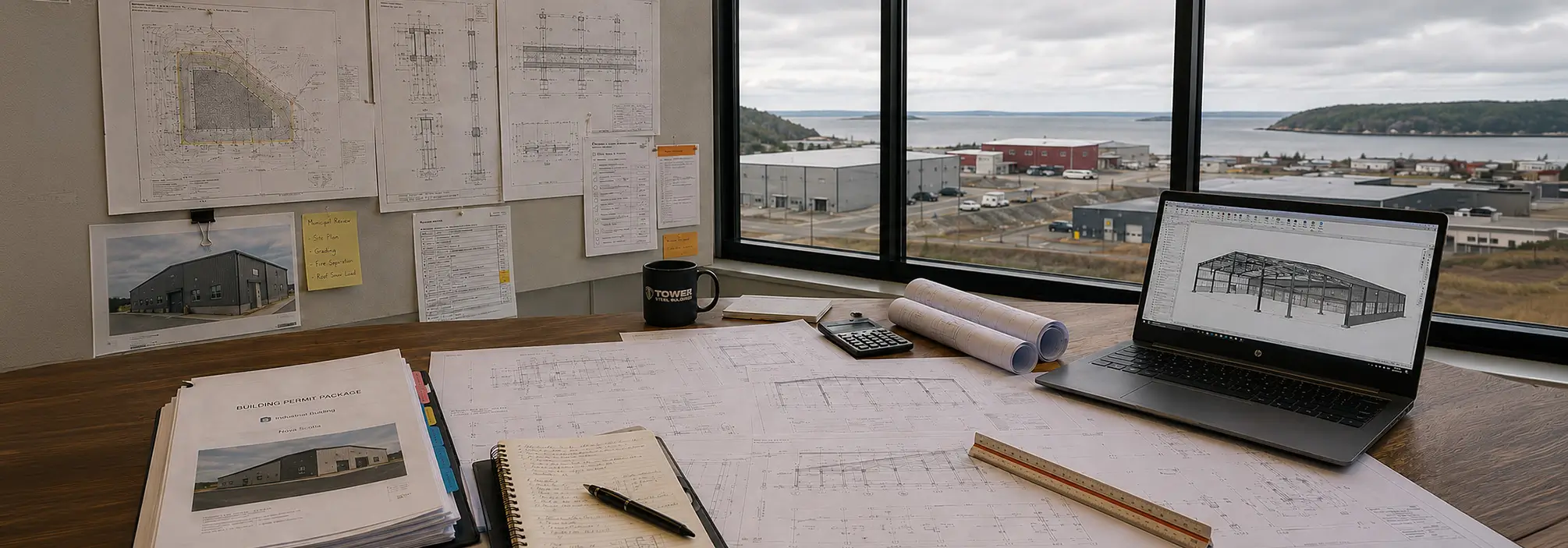
| Area / Situation | What Can Slow Approval | What Buyer Should Confirm |
|---|---|---|
| Halifax Regional Municipality | Land-use by-law compliance, development permit requirements, commercial/mixed-use review, lot grading, access and related permits. | Confirm zoning and development path before finalizing drawings or ordering the steel package. |
| Cape Breton Regional Municipality | Building/development application completeness, site plan requirements, building use, servicing, access, industrial or commercial classification and local inspection requirements. | Define occupancy, site function and required drawings clearly before the permit package is prepared. |
| Antigonish and Eastern District areas | Building official review, municipal engineer review and possible Transportation, Environment or Fire Marshal involvement where necessary. | Ask which outside approvals are needed before permit submission. |
| Yarmouth and southwest Nova Scotia | Development permit and building permit sequencing, land-use by-law compliance, access, servicing and site documentation. | Confirm whether development approval is needed even when the building appears simple. |
| Rural and coastal sites | Septic, wells, driveway access, drainage, fire access, wind exposure, corrosion and moisture management. | Resolve site services and exposure assumptions before locking the frame, foundation and cladding strategy. |
Garages
Size, setbacks, driveway access, slab design, openings, storage use and heating plans should be defined early.
Workshops
Equipment, ventilation, occupancy, fire separation, services and slab loads can change the permit package.
Truck Garages
Bay heights, large doors, drainage, floor loading, vehicle movement and service areas require coordination.
Commercial Buildings
Parking, accessibility, fire/life safety, energy, occupancy and site planning usually add approval layers.
Warehouses
Clear span, storage height, loading, truck access, fire protection and drainage shape both design and permit review.
Farm Buildings
Agricultural use, zoning, ventilation, moisture, livestock/equipment storage and rural servicing must be clear.
Aircraft Hangars
Large openings, door loads, wind exposure, clearances, foundations and operational movement must be integrated.
Mining Buildings
Heavy equipment, industrial use, fire access, ventilation, structural loads and site access can increase review complexity.
Cannabis Buildings
Size, setbacks, driveway access, slab design, openings, storage use and heating plans should be defined early.
Cold Storage
Thermal envelope, condensation, slab details, door strategy, energy and moisture control affect design and review.
Container Roofs
Support conditions, anchorage, uplift, site use, foundations and code treatment must be confirmed before ordering.
Custom Buildings
Custom spans, unusual openings, mezzanines, cranes, mixed uses and site constraints need stronger documentation.
What Tower Steel Buildings Can Help Coordinate
- Steel building system scope, use and size
- Design criteria discussions for snow, wind, exposure and openings
- Foundation reaction and anchor bolt coordination
- CSA A660 steel building system documentation planning
- Permit-readiness questions before the file is submitted
- Drawing package alignment with the buyer, contractor and foundation designer
What Remains With the Municipality or AHJ
- Final zoning, development permit and building permit decisions
- Application acceptance and review comments
- Permit fees, timelines and submission rules
- Required municipal inspections
- Occupancy approval where applicable
- Any required outside agency approvals
Nova Scotia Building Code Regulations
Current provincial regulations under the Building Code Act and adopted national code requirements.
Schedule A Letters
Letters of Undertaking and field review documents used when professional consultants are engaged.
2020 Code Adoption
Nova Scotia announcement confirming the 2020 National Building Codes adoption timeline.
CSA A660 Manufacturer Certification
Steel building system manufacturer certification information for permit-review support.
1. What is a steel building permit in Nova Scotia?
A steel building permit is municipal approval to construct a steel building based on the proposed use, site, drawings, foundation design, and applicable code requirements.
It confirms that the local authority having jurisdiction has reviewed the project before construction proceeds. The permit is issued by the municipality, not by the steel building supplier.
2. Should zoning and site plan issues be checked before ordering a steel building?
Yes. This is one of the biggest buyer mistakes. Before ordering a steel building, confirm whether the property allows the intended use, building size, setbacks, height, access, parking, drainage, servicing, and site layout.
This matters differently in Halifax Regional Municipality, Cape Breton Regional Municipality, Kings County, Colchester County, Truro, rural municipalities, and coastal municipalities. CBRM requires a site plan for new construction, additions, and place/locate projects, while Colchester permit materials reference plot/site plans, detailed building plans, sewer/septic approval, and driveway approval for different permit types.
3. Do steel buildings need a building permit in Nova Scotia?
In most real construction situations, yes. A new permanent steel building commonly requires a building permit, especially if it is placed on a foundation or used for vehicles, equipment, farm operations, commercial work, industrial use, cold storage, warehousing, or public/business occupancy.
The exact permit trigger depends on the municipality, building use, size, servicing, foundation work, and site conditions. Nova Scotia’s Building Code Regulations place permit application requirements under the applicable municipality or authority having jurisdiction.
4. Who approves a steel building permit in Nova Scotia?
The local municipality or authority having jurisdiction approves the building permit. The steel building supplier does not approve the project.
Tower Steel Buildings can help prepare the steel building package, engineered drawings, CSA A660-related documentation, foundation coordination, and permit-readiness information. The municipality still controls permit review, approval, inspections, occupancy, and local requirements.
5. What building code applies to steel buildings in Nova Scotia?
Nova Scotia adopted the 2020 National Building Codes starting April 1, 2025, with provincial regulations and amendments. Nova Scotia’s 2020 code adoption affects building, plumbing, and energy-related requirements depending on project type and occupancy.
For steel buildings, the applicable review can change based on occupancy, use, size, structure, fire/life safety, accessibility, energy performance, plumbing, mechanical systems, and municipal requirements.
6. What is the difference between a development permit and a building permit?
A development permit usually deals with land use. It may review zoning, setbacks, lot coverage, building height, driveway access, parking, drainage, servicing, and whether the proposed use is allowed on that property.
A building permit deals with construction compliance. It reviews the drawings, structural design, foundation details, professional documents, fire/life safety requirements, and code-related construction information.
7. How long does a steel building permit take in Nova Scotia?
There is no safe fixed timeline. Permit timing depends on the municipality, application completeness, zoning status, development approval, site servicing, drainage, foundation documentation, occupancy complexity, and whether outside-agency review is needed.
Halifax Regional Municipality publishes permit volume and processing-time information, while Kings County says it makes every effort to issue a building and development permit within 14 business days once the application is complete as determined by the Building Official. That does not mean every steel building permit in Nova Scotia takes the same time.
8. Are stamped steel building drawings enough for permit approval?
Not always. Stamped steel building drawings are important, but they may only cover the steel building system.
A complete permit file may also need a site plan, foundation drawings, anchor bolt details, CSA A660 manufacturer documents, Schedule A documents where professional design and field review apply, grading information, drainage details, servicing information, and municipal forms.
9. What is CSA A660, and why does it matter for steel building permits?
CSA A660 is the Canadian certification standard for manufacturers of steel building systems. It supports confidence that the manufacturer has controlled quality and code-compliance processes for steel building systems.
CSA A660 supports permit review, but it does not approve the whole project. It does not replace site-specific engineering, foundation design, zoning review, municipal approval, inspections, fire/life safety review, or required professional field review.
10. When is Schedule A required for a steel building project in Nova Scotia?
Schedule A documents may be required where professional design and field review apply. They are commonly required when engineers, architects, or interior design professionals are involved in the permit application and field review process.
For steel buildings, this may involve structural, architectural, geotechnical, mechanical, electrical, plumbing, fire suppression, energy, or other professional scopes depending on the building type, complexity, and authority having jurisdiction.
11. Do I need engineered foundation drawings for a steel building in Nova Scotia?
In many steel building projects, yes. Foundations for steel buildings are commonly engineered around actual column reactions, anchor bolt layouts, soil assumptions, frost protection, slab loading, drainage, wind uplift, and the intended building use.
A generic slab sketch may not satisfy municipal review where structural coordination or professional design is required. For commercial, industrial, larger agricultural, truck garage, warehouse, clear-span, or large-door steel buildings, foundation drawings coordinated with the steel building system are commonly expected or requested.
12. Can I order a steel building or pour the foundation before permit approval?
Ordering early can be done at the buyer’s risk, but it can create problems if zoning, development approval, foundation design, site conditions, drainage, occupancy, or municipal documentation are not confirmed.
Do not pour the foundation unless the municipality or authority having jurisdiction has issued the required permit or written approval for that stage. If the final building reactions, anchor bolt layout, frost protection, soil assumptions, or foundation dimensions change, the concrete may need correction before erection can proceed.
13. Why do municipalities reject or question generic steel building kits?
Municipalities question generic kit packages when the documents do not prove how the building fits the site, use, foundation, snow load, wind exposure, occupancy, drainage, fire access, or local approval requirements.
The problem is usually not that the steel frame is impossible to approve. The problem is that the package does not give the authority having jurisdiction enough project-specific information.
14. Why do steel building projects get redesigned after purchase?
Redesign usually happens when the buyer orders the building before confirming zoning, site plan requirements, foundation reactions, opening sizes, insulation needs, occupancy, drainage, servicing, or municipal review conditions.
Common triggers include larger doors, changed use, missing foundation data, different snow or wind exposure, field review requirements, cold storage needs, or a municipality asking for documents the original kit package did not include.
15. Why do steel building projects become more expensive after permit review starts?
Costs often increase when major project decisions were not coordinated before permit submission.
Common causes include zoning conflicts, foundation redesign, larger door openings, changed occupancy classification, drainage revisions, additional engineering requirements, fire/life safety upgrades, energy-code requirements, revised snow or wind loading, servicing changes, and site-plan changes.
Most steel building cost overruns do not start with steel price alone. They start when the building, foundation, site, use, and permit package are not aligned early.
16. How do coastal corrosion, snow, and wind exposure affect Nova Scotia steel buildings?
Nova Scotia steel buildings should be designed for the actual site, not a generic Canadian assumption. Coastal municipalities, exposed rural sites, waterfront properties, and open industrial yards can create different wind, moisture, salt-air, drainage, and corrosion risks.
These conditions can affect cladding, fasteners, coatings, bracing, frame reactions, anchor bolts, ventilation, maintenance expectations, and foundation design.
17. Do garages, workshops, warehouses, farm buildings, and truck garages follow the same permit path?
No. A residential garage, farm equipment building, contractor workshop, truck garage, warehouse, aircraft hangar, cannabis building, cold storage facility, mining building, custom building, and container roof system can all trigger different review concerns.
A truck garage may involve bay height, slab loading, drainage, ventilation, and vehicle movement. A cold storage building may require envelope and mechanical coordination. A container roof may need review for anchorage, wind uplift, drainage, snow load, and permanence.
18. Can I use a steel building for commercial occupancy in Nova Scotia?
Yes, if the property zoning allows the use and the permit package satisfies the applicable municipal and code requirements.
A warehouse, contractor shop, fleet building, manufacturing facility, retail support building, commercial garage, or storage building may all follow different review paths depending on use, occupant load, site layout, access, servicing, fire/life safety, and the authority having jurisdiction.
19. What commercial code issues can affect a steel building permit?
Commercial steel buildings commonly require coordination for occupancy classification, barrier-free accessibility, fire separations, exits, emergency lighting, washrooms, mechanical ventilation, energy compliance, fire protection, loading, and inspections.
Nova Scotia’s adoption of the 2020 National Building Codes includes updated accessibility and energy-efficiency direction, so commercial steel building buyers should not treat energy compliance, accessibility, or fire/life safety as afterthoughts.
20. What can Tower Steel Buildings help with during the permit process?
Tower Steel Buildings can support the steel building package, engineered building drawings, CSA A660-related documentation, foundation design coordination, permit-readiness questions, and documentation planning before submission.
The municipality or authority having jurisdiction still controls zoning decisions, development approval, permit issuance, inspections, occupancy approval, and any outside-agency requirements.
- Commercial, agricultural, industrial and municipal buildings
- Site-specific snow and wind load coordination
- Foundation reactions and anchor bolt planning
- CSA A660 steel building system documentation
- Schedule A and field review awareness where applicable
- Nova Scotia site and exposure conditions considered early