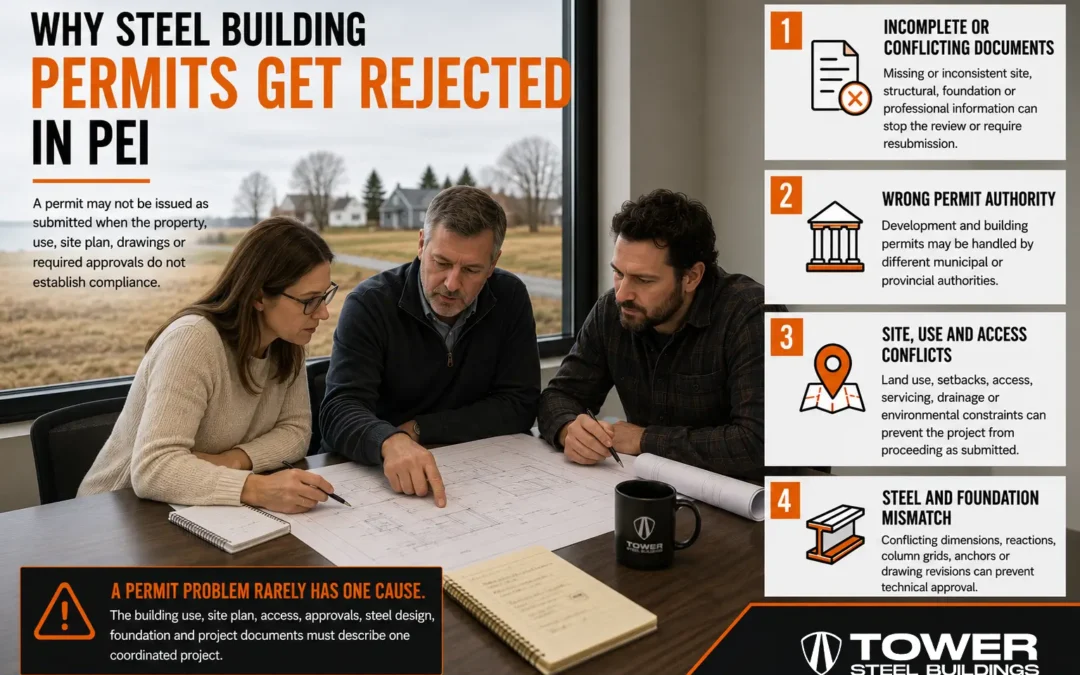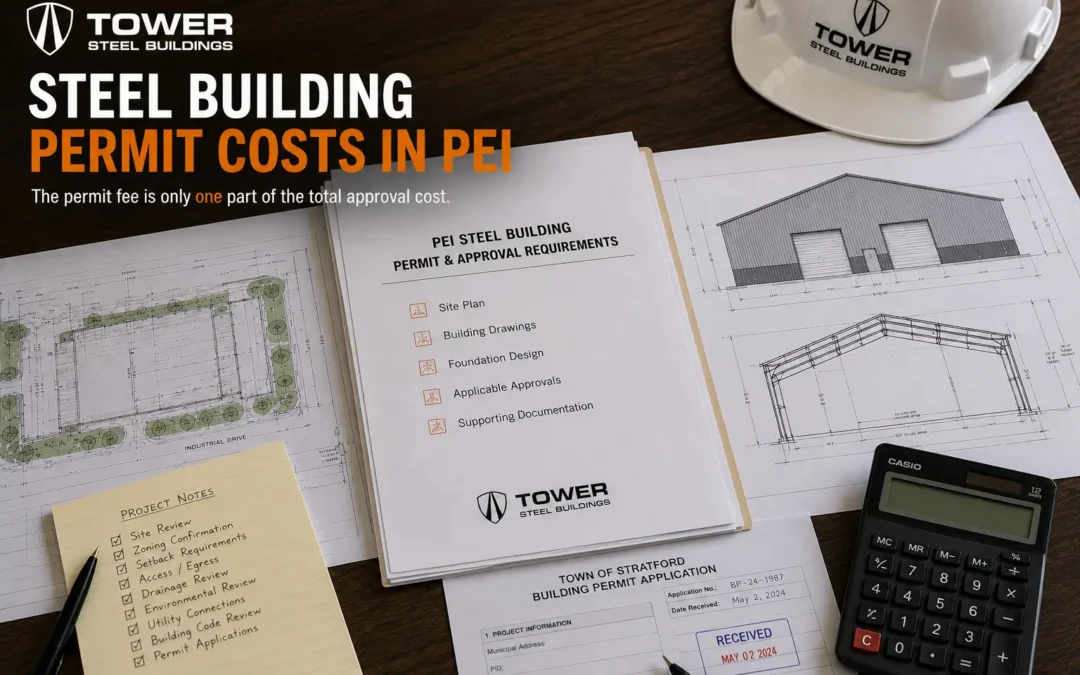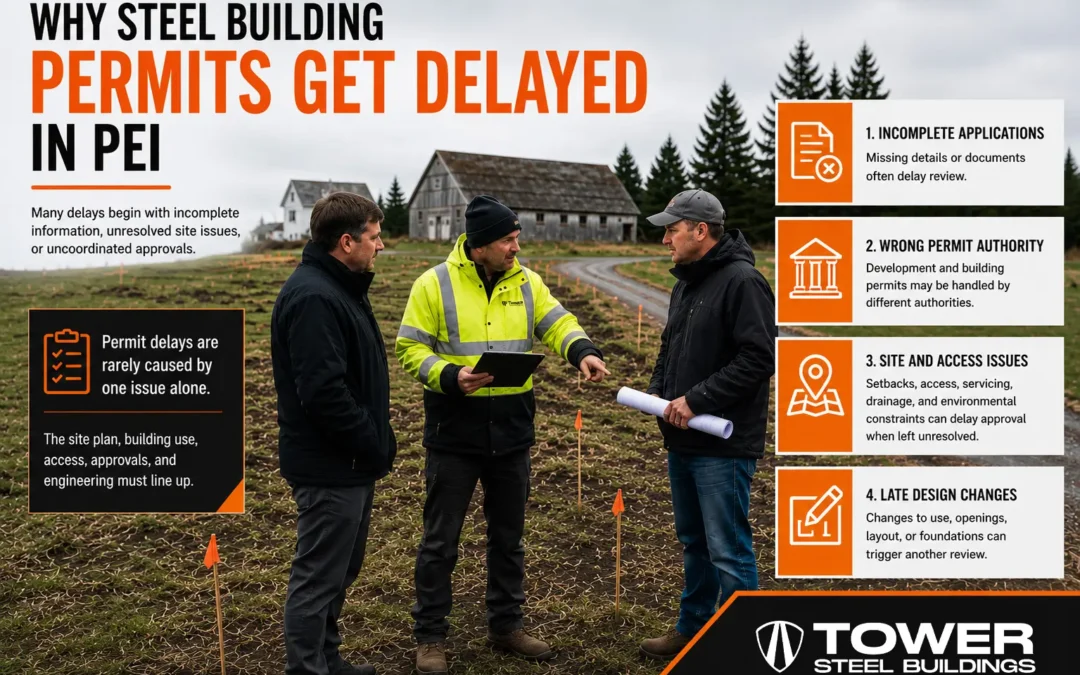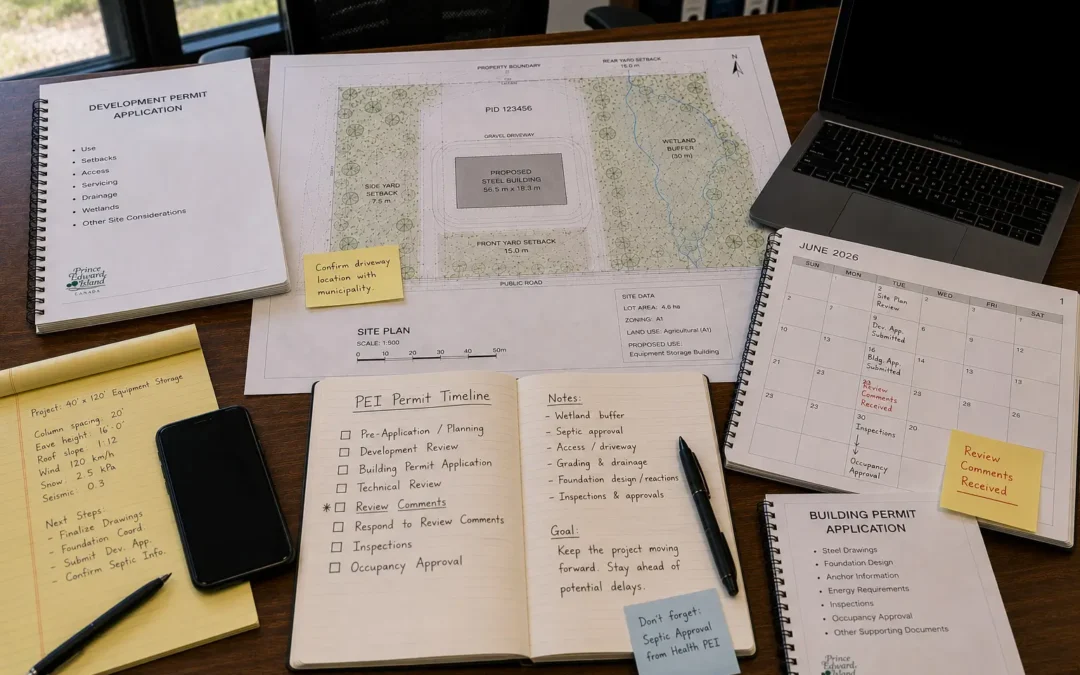
A development permit and a building permit are not two names for the same approval in Prince Edward Island.
A development permit determines whether the proposed land use, building location, access, servicing, setbacks, and site arrangement are acceptable.
A building permit determines whether the proposed building is designed and constructed in accordance with the applicable building, structural, energy, fire, life-safety, and accessibility requirements.
PEI’s official building and development guidance states that most construction projects require both a development permit and a building permit before construction begins.
Receiving a development permit does not mean the structural steel, foundation, anchorage, or construction drawings have been approved.
Receiving a building permit does not override municipal zoning, property setbacks, environmental constraints, access requirements, or a missing development permit.
The simplest distinction is:
The development permit approves the project on the land. The building permit approves the design and construction of the building.
Quick Answer
| Question | Development Permit | Building Permit |
| What does it approve? | Land use, location, access, servicing, setbacks, and site impacts | Building design, structural systems, construction, inspections, and occupancy |
| What legislation governs it? | PEI Planning Act and applicable provincial regulations or municipal bylaws | PEI Building Codes Act and Building Codes Regulations |
| Does it review the proposed use? | Yes | Uses the confirmed use to determine applicable construction requirements |
| Does it review the building location? | Yes | Uses the approved site information during building review |
| Does it review structural steel? | Not as the primary structural approval | Yes, through the required structural documents |
| Does it review the foundation? | May consider its location and site impact | Reviews the required foundation and construction documents |
| Does it approve setbacks? | Yes | Does not replace setback approval |
| Does it authorize construction by itself? | No, where a building permit is also required | No, where development or other approvals remain outstanding |
| Can both permits be required? | Yes | Yes |
| Can different authorities issue them? | Yes | Yes |
A steel building project should not advance to fabrication or concrete construction merely because one of the two permits has been issued.
The final development and building documents must describe the same:
- Building use
- Site location
- Width and length
- Height
- Access
- Openings
- Services
- Drawing revision
Why PEI Uses Two Different Permits
Development approval and building approval protect different public interests.
The development-permit process considers whether the proposed project is appropriate for the property and surrounding area.
The building-permit process considers whether the proposed structure can be designed, constructed, inspected, and occupied in accordance with the applicable construction requirements.
A steel building may be structurally sound but unacceptable in the proposed location.
For example:
- The proposed commercial use may not be permitted.
- The building may not meet a property-line setback.
- The driveway location may be unacceptable.
- A septic field may conflict with the building location.
- A wetland or protected buffer zone may restrict development.
- Required parking or loading space may not fit.
- A rezoning, variance, subdivision, or other planning decision may still be outstanding.
The reverse is also possible.
The proposed use and site location may be acceptable, but the building-permit application may still lack:
- Structural drawings
- Foundation drawings
- Current structural reactions
- Anchor information
- Energy documentation
- Fire and life-safety information
- Required professional design
- Field-review commitments
- Complete construction details
One approval does not prove that the requirements of the other approval have been satisfied.
What Does a Development Permit Approve in PEI?
PEI’s official development-permit guidance explains that a development permit specifies how the property will be used, where the proposed structure will be located, how it will be serviced, and how the development may affect the site.
For a steel building project, development review may consider:
- Existing property use
- Proposed building use
- Zoning or land-use classification
- Building location
- Property-line setbacks
- Road setbacks
- Driveway location
- Highway access
- Parking
- Loading
- Vehicle circulation
- Water supply
- Sewer servicing
- Septic system
- Well location
- Existing buildings
- Site drainage
- Natural slope
- Watercourses
- Wetlands
- Protected buffer zones
- Waterfront top of bank
- Sand dunes
- Other environmental or planning constraints
A development permit may also be required when:
- Constructing or locating a new building or structure
- Moving a structure to another location on the lot
- Making structural changes that alter exterior dimensions
- Changing the use of a building, property, or structure
- Intensifying certain non-conforming uses
The development authority is primarily deciding:
Is this use, building location, and site arrangement acceptable on this property?
What Does a Development Permit Not Approve?
A development permit does not normally establish that the steel building is ready to manufacture or construct.
It does not automatically approve:
- Primary steel framing
- Secondary framing
- Structural connections
- Bracing
- Structural reactions
- Foundation design
- Anchor design
- Fire-resistance assemblies
- Energy-code compliance
- Mechanical systems
- Electrical systems
- Professional field reviews
- Building inspections
- Occupancy
A site plan showing a 60×100 workshop does not prove that the building structure, foundation, anchorage, envelope, and services comply with the applicable construction requirements.
Development approval should not be treated as permission to order an unchangeable steel package or pour concrete without confirming the remaining building-permit requirements.
What Does a Building Permit Approve in PEI?
A building permit confirms that the proposed structure has been reviewed under the applicable building-code and construction requirements.
The review may consider:
- Proposed building use and occupancy
- Applicable Part 3 or Part 9 code pathway
- Part 4 structural-design requirements
- Building dimensions
- Building height
- Floor plans
- Elevations
- Cross-sections
- Structural framing
- Design loads
- Steel-building-system drawings
- Foundation drawings
- Structural reactions
- Base-plate information
- Anchor information
- Building-envelope design
- Energy requirements
- Fire and life safety
- Exits
- Accessibility
- Mechanical and electrical information
- Professional design
- Field reviews
- Inspections
- Completion documents
- Occupancy approval
PEI’s provincial building-permit process identifies plans such as:
- Foundation plans
- Front, side, and rear elevations
- Floor plans
- Cross-sections
- Site plan
- Truss or structural-framing plans
A steel building may require additional information depending on its use, size, structural system, foundation, fire-protection scope, energy requirements, and professional-design obligations.
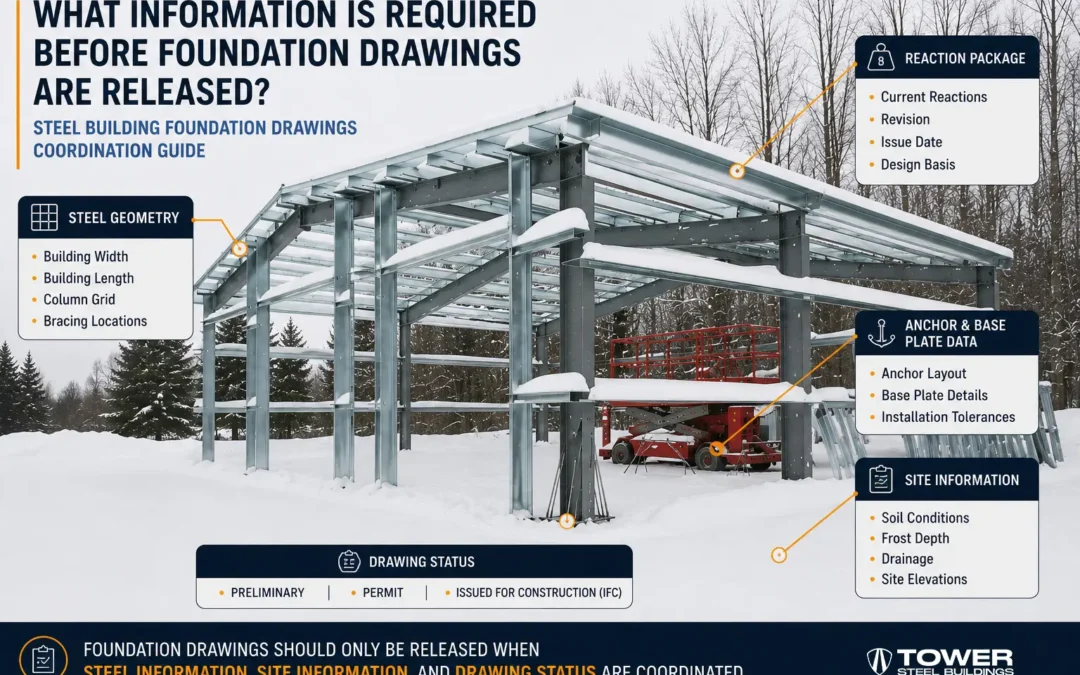
A steel building engineering review checklist can help determine whether the structural system, foundation inputs, professional responsibilities, energy requirements, fire and life-safety information, and supporting documents are sufficiently coordinated for building-permit review.
The building authority is primarily deciding:
Can this building be designed, constructed, inspected, and occupied in accordance with the applicable requirements?
What Does a Building Permit Not Approve?
A building permit does not automatically approve the proposed land use or building location.
It does not replace:
- Municipal zoning approval
- Development approval
- Variance approval
- Rezoning
- Subdivision approval
- Wetland or watercourse authorization
- Environmental approval
- Highway-access approval
- Septic approval
- Utility approval
- Other required provincial or municipal permissions
PEI’s provincial building-permit application states that a building permit may be withheld until confirmation of a development permit is provided.
A technically compliant steel building cannot proceed on a site where its use or location has not been approved.
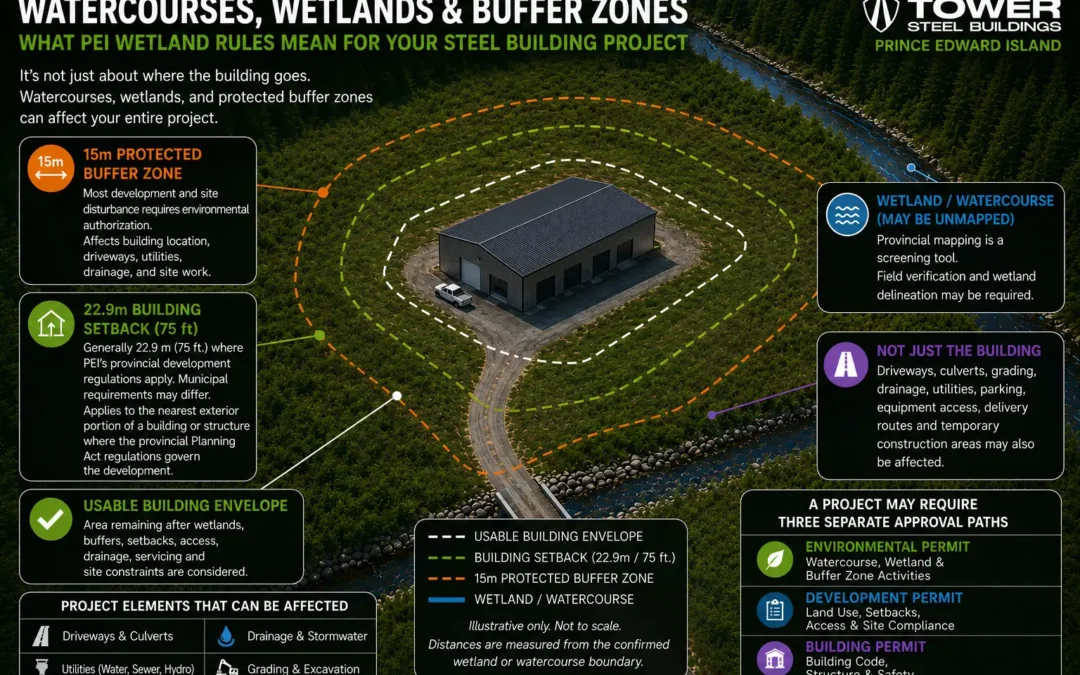
Where a proposed building, driveway, utility route, grading operation, or drainage work affects a watercourse, wetland, or 15-metre buffer zone, a separate Watercourse, Wetland and Buffer Zone Activity Permit may be required before regulated work begins.
Development Permit vs Building Permit: Detailed Comparison
| Project Issue | Development Permit | Building Permit |
| Proposed use | Determines whether the use is acceptable under planning rules | Uses the confirmed use to determine applicable construction requirements |
| Zoning | Reviews compliance with provincial or municipal planning rules | Does not replace zoning approval |
| Building location | Approves the proposed location on the property | Uses the approved location during building review |
| Property setbacks | Reviews required setbacks | Does not replace development-setback approval |
| Road and water setbacks | Reviews where applicable | Does not override development or environmental requirements |
| Access | Reviews driveway and site-access implications | May consider fire access, exits, and construction-related requirements |
| Parking and loading | Reviews where required | May consider related building and life-safety implications |
| Water and sewer | Reviews how the development will be serviced | Reviews building systems where applicable |
| Wetlands and watercourses | Identifies site constraints and separate approval requirements | Does not replace environmental authorization |
| Building dimensions | Reviews planning and site implications | Reviews code, structural, and occupancy implications |
| Steel framing | Not the primary structural approval | Reviews the required structural documentation |
| Foundation | May consider its location and site impact | Reviews the required foundation documents |
| Anchor system | Generally outside the planning approval | Reviewed through structural and foundation coordination where required |
| Energy compliance | Not the primary energy review | Reviewed where the applicable energy requirements apply |
| Fire and life safety | May consider access and planning implications | Reviews applicable fire and life-safety requirements |
| Inspections | Development or location inspections may occur | Construction inspections occur through the building-permit process |
| Occupancy | Does not authorize occupancy | Leads to the applicable completion and occupancy process |
Which Permit Should Be Addressed First?
The development-permit path should normally be understood before the steel building and foundation are finalized.
That does not always mean the entire building-permit package must wait until the development permit has been issued.
On a straightforward project, some building, steel, and foundation design work may proceed while the development application is under review.
The risk depends on how certain the following matters are:
- Proposed use
- Building location
- Footprint
- Height
- Setbacks
- Access
- Parking
- Servicing
- Environmental constraints
A practical sequence is:
- Confirm the property PID and permit authorities.
- Confirm that the proposed use is permitted or supportable.
- Prepare the development site plan.
- Submit the development-permit application.
- Advance steel and foundation design only to the level justified by the planning certainty.
- Resolve development-review comments.
- Update the site, steel, foundation, and service documents where necessary.
- Submit or complete the building-permit application.
- Obtain both permits and any other required approvals.
- Begin construction only after the applicable authorizations have been issued.
The important issue is not whether the two applications overlap.
The important issue is whether the final approved documents describe one coordinated project.
The step-by-step guide to applying for a steel building permit in PEI explains how jurisdiction confirmation, site review, professional design, foundation information, inspections, and occupancy approval fit into the complete application sequence.
Can Both Applications Be Submitted at the Same Time?
Concurrent submission may be possible, depending on:
- Property location
- Responsible authorities
- Proposed use
- Planning complexity
- Required site approvals
- Completeness of the building documents
Where a municipality issues the development permit and the provincial Lands Division issues the building permit, the provincial application may require the municipal development permit to be uploaded.
Before submitting both applications together, ask:
- Will the building review begin before development approval is issued?
- Will the building application remain on hold?
- Can municipal conditions change the building plans?
- Will revised documents be required?
- Which permit must be issued first?
- Are separate fees payable at different stages?
Concurrent submission can reduce idle time on a straightforward project.
It can also create duplicated engineering and drawing revisions when the use, location, footprint, or access remains uncertain.
Who Issues the Development Permit and Building Permit?
The permit authority depends on the property location, so applicants should confirm the correct municipal or provincial Lands Division steel building permit route in PEI before submitting either application.
| Property Location | Development Permit | Building Permit |
| Charlottetown | City of Charlottetown | City of Charlottetown |
| Stratford | Town of Stratford | Town of Stratford |
| Summerside | City of Summerside | City of Summerside |
| St. Felix | Confirm with St. Felix or the provincial Lands Division | Municipality of St. Felix |
| Other municipality with an official plan and land-use bylaws | Municipality | Provincial Lands Division |
| Municipality without an official plan and land-use bylaws | Provincial Lands Division | Provincial Lands Division |
| Property outside a municipality | Provincial Lands Division | Provincial Lands Division |
This article focuses on what the two permits approve rather than the complete jurisdiction-routing process.
For broader PEI permit authority and planning guidance, review Tower Steel Buildings’ Prince Edward Island steel building permit guide.
What Information Goes Into Each Application?
The two applications may request some of the same project information, but they use it for different purposes.
| Development-Permit Information | Building-Permit Information |
| Property owner and applicant | Property owner and applicant |
| PID and property location | PID and property location |
| Existing property use | Existing and proposed building use |
| Proposed development | Proposed structure and construction scope |
| Building footprint and dimensions | Building dimensions and height |
| Driveway and access | Foundation type |
| Parking and loading | Heating and electrical information |
| Water, sewer, septic, and well information | Foundation plans |
| Property map or site plan | Floor plans |
| Property lines and roads | Elevations |
| Existing and proposed structures | Cross-sections |
| Wetlands, watercourses, slopes, and shoreline features | Site plan |
| Setbacks and site arrangement | Structural-framing plans |
| Other planning information | Professional and technical documents where required |
The same site plan may appear in both applications.
The development reviewer uses it to assess the project’s relationship to the land.
The building reviewer uses it to connect the construction documents to the approved property and building location.
How the Development Decision Can Change the Building Permit
A development decision may require changes to:
- Building location
- Footprint
- Height
- Driveway
- Parking
- Loading
- Site access
- Drainage
- Landscaping
- Servicing
- Proposed use
Those changes can affect the steel-building and foundation documents.
Building Location Changes
Moving the building may change:
- Site elevation
- Soil conditions
- Foundation assumptions
- Drainage
- Utility routes
- Steel delivery
- Crane access
- Fire access
Building Dimensions Change
Reducing or enlarging the footprint may change:
- Frame layout
- Bay spacing
- Column locations
- Cladding quantities
- Structural reactions
- Foundation design
- Anchor layout
Building Use Changes
Changing from unheated storage to a heated vehicle-repair shop may affect:
- Occupancy classification
- Professional-design requirements
- Fire and life safety
- Ventilation
- Energy requirements
- Plumbing
- Floor drains
- Electrical systems
- Foundation and slab use
A development condition should not be updated only on the site plan while the steel-system documents, structural reactions, anchor information, and steel building foundation design remain unchanged.
How Building-Permit Review Can Affect the Approved Development
Building review can also identify changes that affect the development permit.
Examples include:
- Required fire access changing the site layout
- A larger mechanical room changing the footprint
- Additional exits changing walkways or parking
- An accessible entrance changing grading or site circulation
- A revised foundation affecting drainage
- A use change requiring a new planning review
- Larger doors affecting loading and vehicle movements
When the building design changes after development approval, confirm whether the development permit must be amended.
Do not assume that a technically necessary building change is covered by the original site approval.
Can One Permit Be Approved While the Other Is Refused?
Yes.
The two applications are reviewed under different legal and technical frameworks.
A development permit may be approved while the building permit remains incomplete because:
- Structural drawings are missing.
- Foundation documents are incomplete.
- Professional design has not been provided.
- Fire or energy requirements remain unresolved.
- The building drawings conflict with the approved site plan.
- The proposed construction cannot yet be verified.
A building design may be technically capable of complying with construction requirements while development approval is refused because:
- The use is not permitted.
- Setbacks cannot be met.
- Access is unacceptable.
- Parking or loading is insufficient.
- The site is environmentally constrained.
- A required planning decision has not been obtained.
A project cannot proceed merely because one part of the review is acceptable.
Development-Permit Appeals and Building-Code Reviews Follow Different Processes
Development-permit decisions and building-official decisions do not use the same appeal system.
Development-Permit Appeals
PEI’s IRAC planning-appeal guidance states that an appeal under the Planning Act generally must be filed within 21 days of the date of the decision.
The right to appeal, standing, calculation of the deadline, required filing documents, and applicable procedure should be confirmed immediately from:
- The decision notice
- Current Planning Act requirements
- Applicable regulations
- IRAC instructions
Building-Code Reviews and Appeals
The IRAC planning appeal process does not apply to building permits in the same way.
Under section 24 of PEI’s Building Codes Act, a person aggrieved by:
- A building official’s decision under section 10, or
- Certain orders issued under section 15 or subsection 16(2)
may request a review by the Chief Building Official.
Under PEI’s Building Codes Act review and appeal provisions, the request must be submitted in the approved form within 10 days after receiving the applicable decision or order.
The Chief Building Official reviews the matter and provides recommendations. The original building official then confirms or varies the decision or order and notifies the person who requested the review.
Where the applicable decision or order is confirmed or varied, section 25 allows an appeal to the Building Standards Council Appeal Board within 30 days after receiving the decision or order.
A decision or order originally made by the Chief Building Official may follow the direct appeal route described in the Act.
The Appeal Board may:
- Confirm the appealed decision or order
- Revoke it
- Vary it
Not every disagreement or permit issue necessarily follows these provisions.
The correct route, deadline, standing, and required form should be confirmed immediately from the decision or order and the current legislation. This section explains the existence of the two separate systems and is not legal advice.
Does a Small Steel Building Need Both Permits?
Size alone does not determine whether development approval is required.
PEI’s official building-permit guidance identifies accessory buildings larger than 20 square metres, approximately 215 square feet, as requiring a building permit.
A smaller accessory building may not require the same building permit, but it may still need:
- Development approval
- Setback compliance
- Wetland or buffer review
- Access approval
- Other municipal or provincial permission
Confirm both requirements before buying or placing a small steel structure.
Do Farm-Building Exemptions Remove Both Permits?
No.
PEI’s Building Codes Regulations contain exemptions for certain qualifying farm buildings and some defined resource-use buildings.
A confirmed exemption may change whether a building permit is required.
It does not automatically eliminate:
- Development approval
- Zoning compliance
- Setback requirements
- Wetland or watercourse authorization
- Highway-access approval
- Septic or servicing requirements
- Electrical permits
- Other site-related permissions
The exemption must be confirmed from the actual building use, classification, occupant load, and applicable legal definitions.
Agricultural ownership alone does not eliminate the development-permit process.
Can Construction Start After One Permit Is Issued?
No, where both permits are required.
A development permit does not authorize:
- Building excavation
- Foundation construction
- Anchor installation
- Steel erection
- Building-envelope work
A building permit does not override missing development approval or another required permission.
Written partial authorization may be available for limited work in specific circumstances.
Partial authorization:
- Is project-specific
- Should be obtained in writing
- Applies only to the identified work
- Does not guarantee approval of the complete project
How Permit Status Tracking Differs
The PEI Building and Development Permit Status service displays only permits issued by the provincial Lands Division, so municipal applications must be tracked separately with the applicable municipal office.
Municipal applications must be followed up with the applicable municipal planning or administrative office.
Where a project involves separate municipal and provincial approvals, track each application independently rather than assuming one status record represents the entire project.
Common Development-Permit and Building-Permit Mistakes
1. Treating the two permits as interchangeable
They approve different parts of the project.
2. Assuming a development permit authorizes construction
A separate building permit may still be required.
3. Finalizing the building before the site and use are settled
Development review may change the footprint, location, access, or permitted use.
4. Submitting different project versions
The site, steel, foundation, and service documents should identify the same building and revision.
5. Changing the building without reviewing the development approval
A different use, footprint, height, or location may require an amendment.
6. Changing the site without updating the building documents
A relocation can affect the foundation, utilities, drainage, delivery, and crane access.
7. Assuming farm ownership removes both approvals
Any exemption must be confirmed and may not remove development approval.
8. Starting work after receiving only one permit
Every applicable authorization must be issued before the related work begins.
9. Ordering steel while a planning decision remains unresolved
A development condition may make the ordered package unsuitable for the approved project.
PEI Steel Building Permit Coordination Checklist
Before releasing a steel package for fabrication, confirm:
- Property PID and civic address
- Development-permit authority
- Building-permit authority
- Proposed use
- Approved building location
- Property and road setbacks
- Access, parking, and loading
- Water, sewer, septic, and well requirements
- Wetland, watercourse, coastal, and buffer requirements
- Final width, length, and height
- Door and window openings
- Current steel-system drawings
- Current structural reactions
- Coordinated foundation drawings
- Coordinated anchor information
- Required professional design
- Development permit
- Building permit
- Other required approvals
- Inspection and occupancy requirements
Tower’s steel building permit checklist can help identify missing site, structural, foundation, and approval information before fabrication or construction.
How Tower Steel Buildings Supports Permit Coordination
Tower Steel Buildings primarily supplies project-specific steel building kits and packages.
Depending on the written quotation, Tower may provide or coordinate steel-building-system information such as:
- Building dimensions
- Eave height
- Framing arrangement
- Door and window openings
- Project design criteria
- Steel-building-system drawings
- Current structural reactions
- Column grid
- Base-plate information
- Anchor-layout information
- Steel-package revisions affecting foundation inputs
- CSA A660 documentation where applicable
- Delivery or erection scope where quoted
This information can help keep the steel package aligned with the approved use, location, dimensions, foundation, and permit documents.
Project-specific foundation engineering remains separate unless expressly included in the written scope.
Tower does not issue:
- Development permits
- Building permits
- Variances
- Rezoning approvals
- Environmental approvals
- Building inspections
- Occupancy permits
Tower cannot guarantee that either permit will be approved.
Final decisions remain with the applicable municipality, provincial Lands Division, building official, environmental authority, and appointed professionals.
Planning a Steel Building in Prince Edward Island?
Confirm both approval paths before finalizing the building.
Start with:
- Property PID
- Proposed use
- Development-permit authority
- Building-permit authority
- Building location
- Site constraints
- Required professional team
Then coordinate the site plan, steel package, structural reactions, foundation, anchor system, and permit documents around one current project.
Send Tower Steel Buildings the project location, intended use, proposed dimensions, required height, opening schedule, and desired package scope through the steel building quote request form.
A coordinated project is easier to review, easier to price, and less likely to require expensive changes after steel or concrete work begins.
Reviewed by Engineering Team
This content has been reviewed by the Tower Steel Buildings Engineering Team.
The review focused on the interaction between development approval and building-permit review in Prince Edward Island.
A development permit addresses whether the proposed use, building location, setbacks, access, servicing, drainage, and site arrangement are acceptable for the property. A building permit addresses whether the proposed structure can be designed, constructed, inspected, and occupied under the applicable building, structural, energy, fire, life-safety, accessibility, and professional-design requirements.
These two reviews are separate, but they are not independent of each other. A development decision can change the building location, footprint, access, parking, drainage, servicing, or approved use. Those changes may affect the steel framing, reactions, foundation design, anchor layout, openings, fire access, energy scope, mechanical systems, and permit drawings.
The reverse can also occur. Building-code review may identify a need for additional exits, fire access, accessible routes, mechanical space, changed grading, or a revised building use. Those changes may require the development approval or site plan to be reviewed again.
For that reason, the site plan, development application, steel-system drawings, foundation drawings, reactions, anchor information, service documents, and building-permit submission should continue to describe the same current project after every review comment or design change.
This content is intended to support buyer education and permit-planning decisions. Final development approvals, building permits, amendments, appeal rights, professional responsibilities, inspections, and occupancy decisions remain with the applicable municipality, Prince Edward Island Lands Division, building official, planning authority, environmental authority, and appointed professionals.
1. What is the difference between a development permit and a building permit in PEI?
A development permit addresses whether the proposed land use, building location, setbacks, access, servicing, and site arrangement are acceptable.
A building permit addresses whether the building’s design and construction comply with the applicable structural, energy, fire, life-safety, accessibility, inspection, and occupancy requirements.
2. Do I need both a development permit and a building permit in Prince Edward Island?
Most construction projects in Prince Edward Island require both permits before construction begins.
A specific exemption may change one requirement, but it does not automatically eliminate the other permit or separate approvals involving zoning, access, servicing, wetlands, septic systems, or electrical work.
3. Which permit should I apply for first in PEI?
The development-permit path should normally be confirmed first because it determines whether the proposed use, building location, setbacks, access, servicing, and site arrangement are acceptable.
Some building, steel, and foundation design work may proceed at the same time when the development outcome is sufficiently certain.
4. Can I apply for a PEI development permit and building permit at the same time?
Concurrent submission may be possible, depending on the property location, responsible authorities, proposed use, planning complexity, and completeness of the building documents.
Confirm whether the building review will begin immediately, remain on hold, or require revised documents after development conditions are issued.
5. Does a PEI development permit allow construction to start?
No, not when a separate building permit is also required.
A development permit approves the project’s use and site arrangement. Excavation, foundation construction, anchor installation, steel erection, and building-envelope work should not begin until the required building permit and other applicable approvals have been issued.
6. Can a PEI building permit be issued before development approval?
A building-permit application may be submitted before the development decision is complete, but the permit may be withheld until the required development approval has been confirmed.
Submitting the building documents does not authorize construction or eliminate the development-permit requirement.
7. Can a PEI development permit be approved while the building permit remains incomplete or is refused?
Yes.
The land use, building location, and site arrangement may be acceptable while the structural drawings, foundation documents, professional design, energy information, fire-safety details, or other construction documents remain incomplete or non-compliant.
Approval of the development permit does not guarantee approval of the building permit.
8. Can a code-compliant steel building still be refused development approval in PEI?
Yes.
A steel building may be capable of meeting structural and construction-code requirements but still conflict with zoning, setbacks, access, parking, servicing, environmental restrictions, or another planning requirement.
Building-code compliance does not create an automatic right to use or develop the property.
9. What happens if a PEI steel building changes after development approval?
A change to the use, location, footprint, height, access, parking, servicing, or site arrangement may require the development permit to be amended.
The site plan, steel-system drawings, structural reactions, foundation design, anchor information, and building-permit documents should be updated together before construction proceeds.
10. Can a PEI development-permit decision be appealed?
Interested parties generally have 21 days from the date the development-permit decision is issued to appeal the decision to the Island Regulatory and Appeals Commission.
Standing, the exact filing deadline, required documents, and current procedure should be confirmed immediately from the decision notice, applicable legislation, and IRAC instructions.
11. Can a PEI building-permit decision be reviewed or appealed?
Applicable building-official decisions and orders follow the separate review and appeal process established by PEI’s Building Codes Act.
A review request may need to be submitted to the Chief Building Official within 10 days of receiving the decision or order. An applicable confirmed or varied decision may then be appealed to the Building Standards Council Appeal Board within 30 days of receipt.
The exact route and deadline should be confirmed from the decision notice and current legislation.
12. Does a steel building under 20 square metres need a permit in PEI?
PEI’s provincial guidance identifies accessory buildings larger than 20 square metres, approximately 215 square feet, as requiring a building permit.
A smaller steel building may still require development approval and must comply with applicable setbacks, environmental restrictions, access requirements, and other municipal or provincial rules.
13. Do farm steel buildings need both permits in PEI?
Certain qualifying farm buildings and defined resource-use buildings may be exempt from specific building-permit requirements.
That exemption does not automatically remove development approval, zoning, setbacks, wetland or watercourse authorization, highway access, septic requirements, electrical permits, or other site-related permissions.
The exemption must be confirmed from the building’s actual use, classification, occupant load, and applicable legal definitions.
14. What documents are required for a PEI development permit versus a building permit?
A PEI development-permit application generally focuses on:
- Property Identification Number
- Property map or site plan
- Proposed use
- Building location and setbacks
- Roads and access
- Parking and loading
- Water, sewer, well, and septic information
- Wetlands, watercourses, slope, and other site constraints
A building-permit application generally focuses on:
- Floor plans
- Building elevations
- Cross-sections
- Structural-framing drawings
- Foundation drawings
- Structural reactions and anchor information
- Professional design documents
- Energy information
- Fire and life-safety information
- Inspection and occupancy requirements
Both submissions must describe the same building, use, location, dimensions, and current revision.
15. Can I track both PEI permits through the provincial permit-status portal?
No.
PEI’s provincial Building and Development Permit Status service displays only permits issued by the Lands Division.
Applications submitted to Charlottetown, Stratford, Summerside, St. Felix, or another municipal planning authority must be tracked directly through the applicable municipality.
16. Who is responsible for obtaining the development permit and building permit in PEI?
The property owner, applicant, consultant, or authorized project representative is normally responsible for confirming the permit route and obtaining the required approvals.
A supplier or consultant may assist when that service is expressly included in a written contract.
Tower Steel Buildings can coordinate steel-building-system information within its quoted scope, but it does not issue development permits or building permits and cannot guarantee either approval.