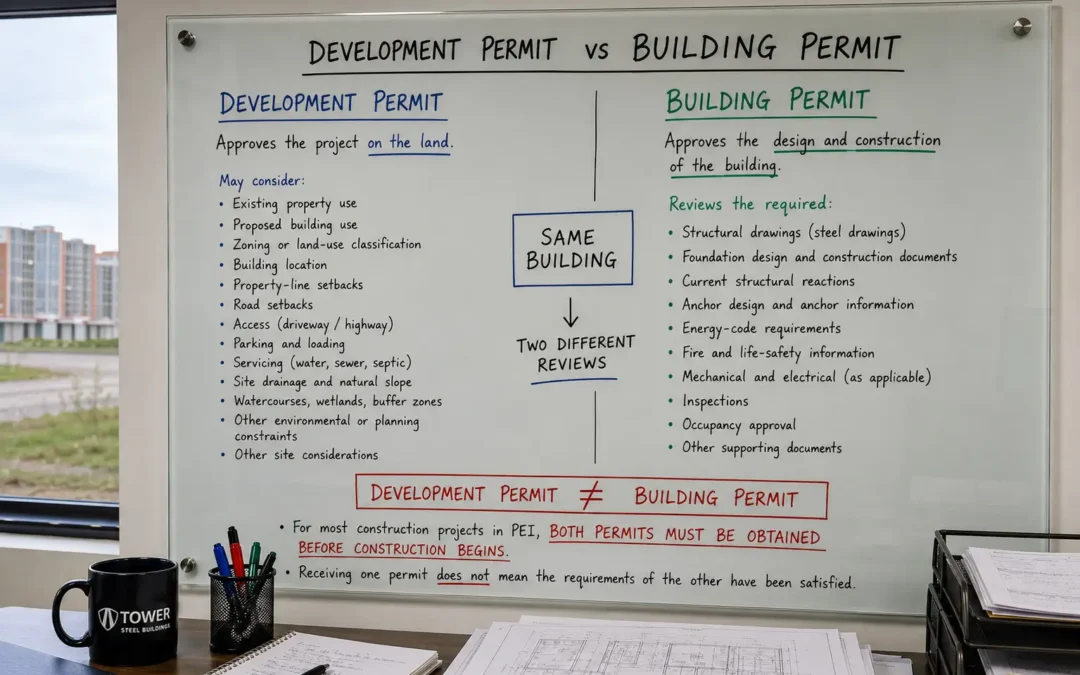
The cost of permitting a steel building in Prince Edward Island is not limited to the amount paid when the building-permit application is submitted.
The application fee is only one part of the permit budget.
A complete permit-related budget can include:
- Development-permit fees
- Building-permit fees
- Municipal deposits or application payments
- Site plans and surveys
- Steel-building-system drawings
- Foundation engineering
- Geotechnical investigation
- Grading and drainage information
- Environmental permits
- Driveway and culvert approvals
- Trade and equipment permits where applicable
- Professional field reviews
- Additional inspections
- Drawing revisions
The amount depends on the property location, responsible permit authority, approved building use, accepted value of construction, required documents, and site conditions.
A commercial warehouse in Charlottetown, an agricultural equipment-storage building in Stratford, and a workshop reviewed by the provincial Lands Division may follow different fee schedules even when the buildings have similar dimensions.
For the broader approval framework, review Tower Steel Buildings’ Steel Building Permits Prince Edward Island guide.
Sources reviewed: June 2026
Quick Answer
There is no single province-wide price for every PEI steel building permit.
A value-based permit fee is generally calculated using the following approach:
Permit fee = accepted value of construction ÷ $1,000 × the applicable authority rate
That calculation remains subject to:
- Minimum permit fees
- Building classification
- The responsible authority’s fee schedule
- The authority’s accepted construction value
- Deposits or separate development fees
- Additional review or inspection charges
Where PEI’s provincial fee schedule applies to a project in the Fees for All Other Projects category:
- A project with an accepted value of construction above $200,000 is charged $4.50 per $1,000.
- A project valued at $200,000 or less follows the listed minimum fees, including $900 for a principal building over 20 square metres.
The applicant’s submitted value is not automatically final. A building official may establish the value of the proposed work using the accepted costing standard of the authority having jurisdiction.
There is no verified universal PEI steel-building cost-per-square-foot figure that applies to every permit authority. A municipality may use its own valuation method, which could involve contract value, building area, an authority costing schedule, or another accepted standard.
The regulatory permit fee also does not include every cost required to prepare a complete application.
Current PEI Permit-Fee Snapshot
|
Permit authority |
Published approach relevant to steel buildings |
Source status |
|
PEI Lands Division |
$4.50 per $1,000 of accepted value of construction above $200,000, with minimum project-type fees at $200,000 or less |
PEI’s building-permit service continues to direct applicants to Schedule C; the regulation PDF is marked current to March 31, 2024 |
|
Provincial development permit |
$600 for industrial, commercial, institutional, or recreational development; $500 for resource development |
Provincial planning regulations are marked current to August 16, 2025 |
|
Charlottetown |
Commercial, industrial, institutional, and multi-unit construction rates are listed as Phase I, II, and III at $7, $8, and $9 per $1,000 |
City fee schedule revised March 31, 2026; the table does not explain the phase-payment mechanics |
|
Stratford |
The Town’s development-permit schedule lists $7 per $1,000 for commercial, industrial, or institutional work, $5 per $1,000 for agricultural work, and $3 per $1,000 for accessory buildings |
Current Town of Stratford Bylaw 39, Schedule A for 2026–27 |
|
Summerside |
One current City page states $5 per $1,000, while another states $3 per $1,000 |
Official City pages conflict; confirm the applicable building and development charges before budgeting |
|
St. Felix |
St. Felix issues building permits for applicable projects within its municipal boundaries |
A current detailed public fee schedule was not verified |
These are published regulatory rates and charges. They do not automatically include engineering, surveys, foundation design, environmental work, trade permits, site design, contractor costs, or revisions.
Permit Fee and Permit-Related Cost Are Different
A steel building buyer may ask:
How much is the permit?
The more useful budgeting question is:
What will it cost to prepare, submit, coordinate, revise, inspect, and complete the approval process?
The permit authority charges for its review, administration, and included inspections. It does not normally prepare the owner’s engineering or project documents.
A $900 building-permit fee does not mean the complete permit package costs $900.
A practical cost plan should separate four categories:
|
Cost category |
Typical examples |
|
Regulatory fees |
Development permit, building permit, environmental permit, trade permit, and occupancy fee |
|
Application deposits or upfront payments |
Refundable or non-refundable deposits and fees payable at submission, depending on the authority |
|
Permit-document costs |
Engineering, foundation drawings, site plan, survey, drainage, energy, fire, mechanical, and electrical documents |
|
Avoidable coordination costs |
Redesign, repeated review, failed inspections, concrete correction, anchor relocation, and delayed erection |
The regulatory fee is normally the easiest category to calculate.
The other categories depend on the property, building use, professional scope, construction systems, and quality of coordination before submission.
Who Sets the Permit Fee?
The property location determines which authority sets and collects the building-permit fee.
Charlottetown, Stratford, Summerside, and St. Felix issue building permits within their municipal boundaries. For other locations, the provincial government generally issues the building permit.
Development-permit responsibility can follow a different route.
Municipalities with an official plan and land-use bylaws generally issue their own development permits. The provincial Lands Division may still issue the building permit in those jurisdictions.
Outside a municipality, or within a municipality without local planning authority, the Lands Division may issue both permits.
Tower’s guide to municipal versus provincial Lands Division permits in PEI explains why the two applications may go to different offices.
Before estimating a fee, confirm:
- The property municipality
- The development-permit authority
- The building-permit authority
- The actual building classification
- The accepted value-of-construction method
- Deposits or additional planning applications
- Included and additional inspections
A calculation based on the wrong authority’s schedule is not a usable project budget.
Provincial PEI Building-Permit Fees
As of June 2026, PEI’s building-permit service continues to direct applicants to Schedule C of the Building Codes Regulations.
The published regulation PDF is marked current to March 31, 2024. Applicants should confirm that no later fee amendment applies before relying on the figures for a final project budget.
Projects With a Value of Construction Above $200,000
For projects listed under Fees for All Other Projects, where the accepted value of construction is more than $200,000, the provincial permit fee is:
$4.50 for every $1,000 of accepted value of construction
Examples:
|
Accepted value of construction |
Calculation |
Provincial building-permit fee |
|
$250,000 |
250 × $4.50 |
$1,125 |
|
$500,000 |
500 × $4.50 |
$2,250 |
|
$1,000,000 |
1,000 × $4.50 |
$4,500 |
These examples show only the provincial building-permit fee.
They do not include development approval, professional documents, trade permits, environmental authorization, foundation work, or site preparation.
Projects Valued at $200,000 or Less
Where the value of construction is $200,000 or less, the provincial schedule lists minimum fees:
|
Project type |
Provincial minimum fee |
|
Principal building over 20 m² or 215 ft² |
$900 |
|
Addition |
$720 |
|
Renovation |
$540 |
|
Leasehold improvements |
$540 |
|
Insulated accessory building |
$540 |
|
Uninsulated accessory building |
$360 |
|
Barrier-free ramp |
$360 |
The applicable category must be confirmed by the authority.
A structure should not be classified as an accessory building merely because it is called a garage, storage building, or workshop in a sales quotation.
The approved use, relationship to the principal use, property conditions, and regulatory classification control the fee category.
Additional Provincial Inspection and Occupancy Fees
The provincial schedule states that an additional inspection fee of $160 per inspection applies where further inspections are needed to determine whether ordered deficiencies have been corrected acceptably.
It also lists a $25 occupancy-permit fee for projects covered by the schedule.
A failed inspection may create costs beyond the authority’s charge, including:
- Contractor remobilization
- Delayed concrete placement
- Removal of covered work
- Revised engineering
- Additional professional review
- Rescheduled delivery or erection
The regulatory inspection fee can be small compared with the field cost of correcting the deficiency.
What Does Value of Construction Include?
PEI’s provincial regulations define value of construction as the total cost to the owner for the completed building construction.
The definition includes:
- Design fees
- Building work
- Construction materials
- Building systems
- Labour
- Contractor and subcontractor overhead
- Contractor and subcontractor profit
The steel-building kit price may therefore represent only one part of the accepted construction value.
A complete value may also include:
- Excavation and site preparation
- Footings, piers, grade beams, and slab
- Steel erection
- Cladding and roofing
- Insulation
- Doors and windows
- Mechanical systems
- Electrical work
- Plumbing
- Interior construction
- Fire-protection work
- Professional design
The amount entered on the permit application should not be limited to the structural steel price when the declared scope is the completed building.
Can the Authority Change the Declared Construction Value?
Yes.
PEI’s Building Codes Regulations state that a building official may place a value on the proposed work using the accepted costing standard of the authority having jurisdiction.
Where the provincial Minister is the authority, the accepted standard is Schedule C.
Where a municipal council is the authority, the accepted costing standard is the standard established by that municipality.
This means the amount submitted by the applicant is not automatically accepted.
An authority may question a declared value that appears inconsistent with:
- Gross floor area
- Building use
- Construction type
- Foundation scope
- Level of finish
- Insulation
- Heating and ventilation
- Plumbing and electrical systems
- Fire-protection systems
- Labour and erection
- Professional design
- The authority’s normal costing data
Before fixing the permit budget, ask the responsible authority:
- Will the fee use the submitted contract value?
- Does the authority maintain a costing schedule?
- Does it use an area-based benchmark?
- Are foundations, services, labour, and professional fees included?
- How are owner-supplied labour and materials valued?
- Can the authority adjust the value after review?
This should be resolved before treating an online permit calculation as final.
Is a PEI Building Permit Calculated Per Square Foot?
Not necessarily.
The provincial fee for an applicable project above $200,000 is expressed as a rate per $1,000 of accepted construction value, not as one published steel-building fee per square foot.
However, the authority may use an accepted costing standard to establish or verify that value. A municipal method could use building area or a cost-per-square-foot benchmark as part of its valuation.
There is no verified universal PEI steel-building dollar-per-square-foot rate that applies across all provincial and municipal permit authorities.
Do not estimate the official permit fee by selecting a generic online cost-per-square-foot number.
Confirm whether the responsible authority uses:
- Submitted contract value
- A municipal valuation schedule
- Building area
- Occupancy or use
- Construction type
- Another accepted costing method
A permit fee can be expressed per $1,000 while the underlying accepted value is still established using building area and project characteristics.
Provincial Development-Permit Fees
A development permit and building permit are separate approvals.
The development permit reviews whether the use, location, access, servicing, setbacks, and site arrangement are acceptable.
The building permit reviews how the building will be designed, constructed, inspected, and approved for occupancy.
Tower’s development permit versus building permit guide explains the distinction in detail.
Where the Lands Division issues the development permit, Table 12 of the Planning Act Subdivision and Development Regulations, marked current to August 16, 2025, lists:
|
Provincial development category |
Fee |
|
Residential development, including new construction, additions, moving, or accessory development |
$250 |
|
Industrial, commercial, institutional, or recreational development, including new construction, additions, or renovations |
$600 |
|
Resource development, including new construction, additions, or renovations |
$500 |
|
Small deck or shed |
$100 |
The correct category depends on the approved use.
A farm-owned property does not automatically place every structure in the resource-development category. A repair shop, retail operation, processing facility, public building, or mixed-use project may be classified differently.
Provincial $500,000 Example
Consider a hypothetical $500,000 commercial or industrial steel building for which the Lands Division issues both permits.
|
Regulatory fee |
Calculation |
Amount |
|
Provincial building permit |
$500,000 ÷ $1,000 × $4.50 |
$2,250 |
|
Provincial industrial or commercial development permit |
Fixed fee |
$600 |
|
Combined published provincial fees |
|
$2,850 |
This example assumes:
- The accepted construction value is $500,000
- The provincial fee schedule applies
- The development is classified as industrial or commercial
- No separate planning or environmental applications are required
It excludes engineering, foundations, surveys, site planning, trade permits, environmental work, professional reviews, and construction costs.
Charlottetown Steel Building Permit Fees
Source status: Charlottetown’s fee bylaw schedules were revised March 31, 2026.
The City’s current Planning and Heritage fee schedule lists the following for new or renovated commercial, industrial, institutional, and multi-unit residential projects:
|
Permit phase |
Published rate |
|
Phase I |
$7 per $1,000 of construction value |
|
Phase II |
$8 per $1,000 of construction value |
|
Phase III |
$9 per $1,000 of construction value |
|
Minimum |
$50 for all phases |
The fee table identifies the three phases, but it does not explain:
- How a project is assigned to a phase
- Whether the rates are cumulative
- Whether earlier payments are credited
- Whether one rate represents the total fee
- How phased submissions are handled
Do not calculate the final Charlottetown fee by assuming how the phase rates interact.
Confirm the applicable phase, payment structure, and total charge directly with the City before budgeting.
The same schedule also lists:
- A $4,000 development deposit for commercial, industrial, institutional, and multi-unit residential development
- A $100 building-inspection follow-up fee for each additional request beyond the required inspection
- No fee for the occupancy permit
- Double permit fees for late filing or starting construction without a permit
A deposit should be tracked separately from a non-refundable regulatory fee. Confirm the deposit release conditions and required closeout documents directly with the City.
Stratford Permit Fees
Source status: The Town of Stratford’s current Bylaw 39, Schedule A for 2026–27 lists the applicable construction-value rates under its development-permit fee schedule.
|
Project category |
Published rate |
Minimum |
|
Commercial, industrial, or institutional, new construction, addition, or renovation |
$7 per $1,000 of construction cost |
$100 |
|
Agricultural, new construction, addition, or renovation |
$5 per $1,000 of construction cost |
$100 |
|
Accessory building or structure |
$3 per $1,000 of estimated project value |
$50 |
For a $500,000 accepted construction cost, the published arithmetic would be:
- Commercial, industrial, or institutional project: $3,500
- Agricultural project: $2,500
These calculations are useful only after Stratford confirms the correct project classification and accepted construction value.
A building located on agricultural land is not automatically classified as agricultural. Repair, processing, retail, rental, office, commercial-storage, or public uses may affect the applicable category.
Stratford publishes these construction-value rates under its development-permit fee schedule. The Town’s application process also includes building-code review and building-permit issuance.
Confirm with Stratford whether the published development fee represents the complete municipal construction-permit charge for the proposed project or whether additional building-review, inspection, or occupancy charges apply.
The current schedule also requires a $100 non-refundable application deposit unless the applicable permit fee is paid in full when the application is submitted.
Confirm how the deposit is applied to the final amount for the specific project.
Summerside Steel Building Permit Fees
Source status: Current official Summerside pages publish conflicting construction rates.
The City’s Building, Renovating or Demolition Permit Fees page states:
Construction: $5 per $1,000 of construction value, with a $15 minimum.
A separate Development Fees page states:
Construction: $3 per $1,000 of construction value, with a $15 minimum.
The public pages do not clearly establish whether:
- One rate is outdated
- The $5 rate is the building-permit fee
- The $3 rate is a separate development charge
- Both rates may apply
- Another bylaw interpretation controls
Do not rely on a final Summerside calculation until the City confirms the applicable rate and whether separate building and development charges apply.
Ask Summerside to confirm in writing:
- The current building-permit rate
- The current development-permit fee
- Whether both charges apply to the project
- The accepted construction-value method
- Additional planning or inspection charges
The City pages also list charges for matters such as major development, zoning amendments, discretionary uses, variances, and changes of use. Those fees apply only where the project requires the corresponding approval.
What About St. Felix?
PEI’s current building-permit service states that St. Felix issues building permits for applicable projects within its municipal boundaries.
A current detailed public fee schedule was not verified for this review.
Confirm directly:
- The building-permit fee
- The development-permit authority
- The accepted value method
- Included inspections
- Occupancy requirements
- Deposits or additional charges
Do not substitute another municipality’s rate or the provincial schedule without confirmation.
Environmental Permit Costs
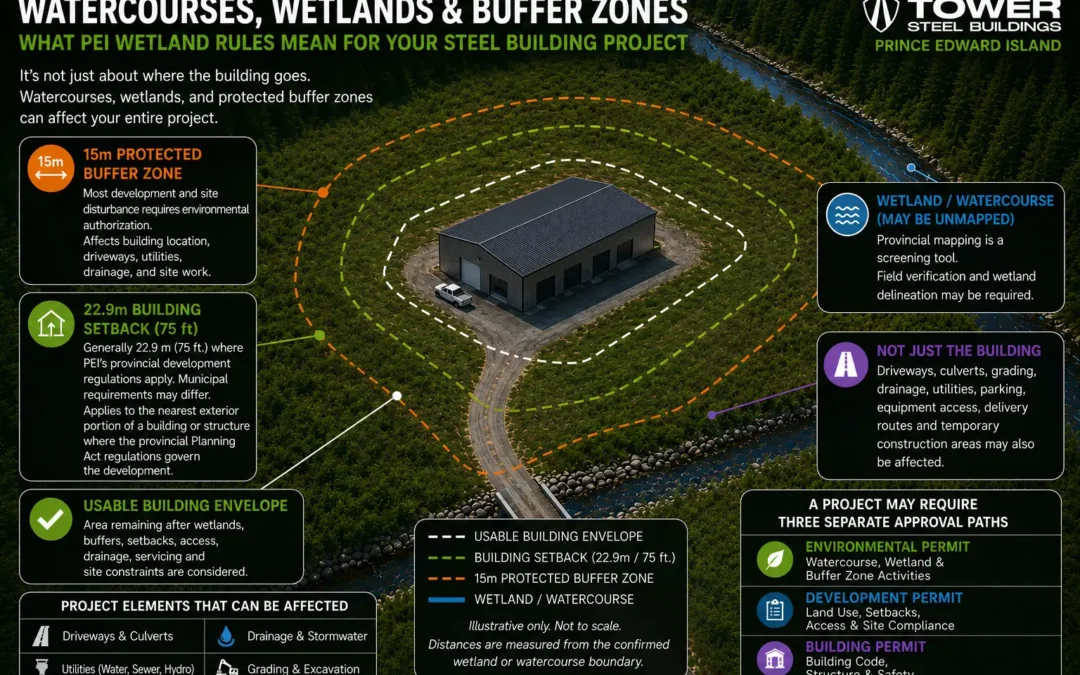
A steel building project may require separate environmental authorization where a driveway, culvert, road, grading operation, fill area, utility route, or equipment activity affects a watercourse, wetland, or protected 15-metre buffer.
PEI’s Watercourse, Wetland and Buffer Zone Activity Permit service lists fees including:
|
Activity relevant to steel-building site work |
Published fee |
|
New culvert |
$100 |
|
Culvert repair |
$100 |
|
Road construction |
$100 |
|
Temporary crossing |
$100 |
|
Wetland alteration or other listed $100 activity |
$100 |
|
Landscaping |
$100 |
|
Tree cutting for forest management |
$50 |
|
Other listed lower-fee activity |
$50 |
Separate applications may be required for separate regulated activities.
The application fee does not include:
- Wetland delineation
- Environmental-consultant work
- Engineering
- Erosion and sediment-control planning
- Culvert materials
- Road construction
- Site restoration
Environmental constraints should be resolved before the building location, driveway, foundation, and steel package are treated as final.
Trade and Equipment Permit Costs
A heated or serviced steel building may require permits beyond the development and building permits.
Electrical Work
PEI’s electrical-permit service states that the fee depends on the installation type and the ampacity of the electrical service.
The cost must be calculated from the applicable Electrical Unit Schedule of Fees. There is no single electrical-permit price for every steel building.
Plumbing Work
PEI’s plumbing-permit service currently lists:
- $50 minimum for an installation
- $20 per fixture where three or more fixtures are installed
- $20 for connection to a municipal water or sewage system
- $50 for an alteration where no fixtures are added
These amounts do not include plumbing design, fixtures, piping, labour, sewer service, septic work, or water connections.
Other Regulated Equipment
Depending on the building, separate approval may apply to:
- LP gas installations
- Boilers
- Pressure vessels
- Pressure piping
- Fire-protection systems
- Other regulated equipment
PEI requires a permit to install or alter an LP gas appliance. Certain boilers and pressure vessels also require separate installation or alteration permits.
Use trade and equipment permits where applicable rather than assuming every project has one general mechanical permit.
What Usually Costs More Than the Permit Fee?
For many steel building projects, the regulatory fee is not the largest approval-related cost.
The larger costs often come from preparing the documents and correcting coordination problems.
Steel-Building-System Information
Depending on the written quotation, the steel package may include or coordinate:
- Structural-framing drawings
- Building dimensions
- Design criteria
- Frame spacing
- Bay layout
- Column grid
- Structural reactions
- Base-plate information
- Anchor geometry
- Openings
- Bracing
- CSA A660 documentation where applicable
These documents describe the steel building system.
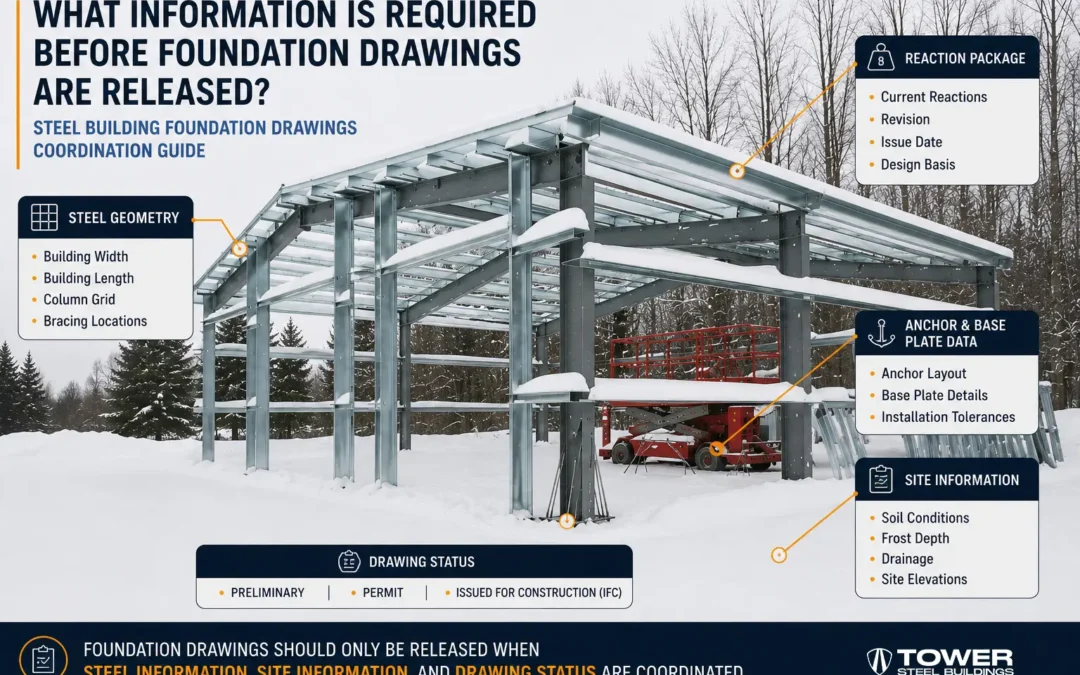
They do not automatically include the complete project-specific concrete foundation design.
Foundation Engineering and Concrete Documents
Foundation engineering is a separate project-specific scope unless expressly included in the quotation.
It may include:
- Foundation plan
- Footing, pier, or grade-beam design
- Concrete strength
- Reinforcement
- Anchor resistance and concrete interface
- Soil-bearing assumptions
- Frost protection
- Groundwater considerations
- Slab design
- Elevations
- Drainage coordination
Tower’s steel building foundation-design guidance explains why structural reactions, column locations, anchors, soil, frost, drainage, and concrete design must remain coordinated.
Site and Professional Documents
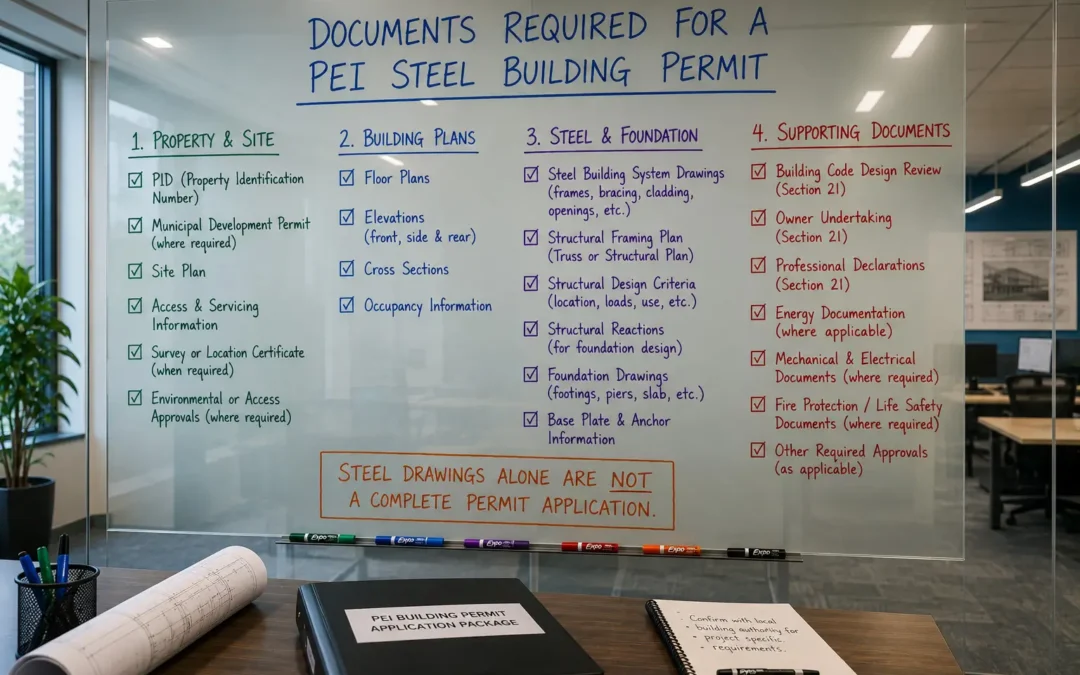
Depending on the project, the permit package may also require:
- Property survey
- Site plan
- Grading or drainage plan
- Geotechnical report
- Architectural drawings
- Energy documentation
- Mechanical and electrical design
- Fire-protection design
- Professional undertakings
- Field-review commitments
For a detailed PEI document breakdown, review Documents Required for a Steel Building Permit in Prince Edward Island.
Building Use and Occupancy
The description “steel shop” is not enough for reliable permit budgeting.
The authority may need to know whether the building includes:
- Storage
- Vehicle repair
- Welding
- Manufacturing
- Public access
- Offices
- Washrooms
- Heating
- Hazardous materials
- High-piled storage
- Agricultural processing
- Employees or customers
Use can affect professional design, fire safety, exits, accessibility, ventilation, energy compliance, plumbing, parking, inspections, and occupancy requirements.
Revisions and Failed Coordination
Late changes can affect:
- Steel drawings
- Structural reactions
- Bracing
- Foundation design
- Anchor layout
- Site plan
- Drainage
- Professional declarations
- Permit fees where the accepted construction value changes
The expensive part is often not an authority’s revision charge. It is the concrete, steel, labour, engineering, and schedule consequence.
Build a Project-Specific Permit Budget
|
Budget category |
Confirm before committing |
|
Development approval |
Authority, base fee, amendment, variance, deposit, and site requirements |
|
Building permit |
Rate, minimum, accepted value, classification, inspections, and occupancy fee |
|
Steel-system documents |
Drawings, reactions, column grid, base plates, anchors, and revisions |
|
Foundation engineering |
Concrete design, soil basis, frost, drainage, slab, and current reactions |
|
Site requirements |
Survey, access, culvert, grading, environment, septic, well, and utilities |
|
Professional scope |
Architect, engineers, surveyor, consultant, energy, fire, and trade design |
|
Construction review |
Inspections, field reviews, testing, deficiencies, and closeout |
|
Contingency |
Review comments, site discoveries, value adjustments, and design changes |
A permit budget is not complete until responsibility for each required document has been assigned.
How to Control Costs Before Submission
Confirm the authority first
Do not calculate the project using a municipal schedule until the property jurisdiction and permit route have been confirmed.
Ask how construction value will be accepted
Ask whether the authority uses submitted contract value, an area-based benchmark, an internal costing schedule, or another method.
Define the actual use
Keep the building use consistent across the quotation, development application, site plan, engineering, and building-permit application.
Resolve the site
Confirm access, setbacks, servicing, wetlands, drainage, and the usable building area before final engineering.
Separate the professional scopes
Identify who supplies:
- Steel-building-system drawings
- Structural reactions
- Foundation engineering
- Site plan
- Energy documents
- Mechanical and electrical design
- Fire-protection design
- Field reviews
Coordinate before fabrication
The site plan, steel drawings, foundation design, structural reactions, and anchor information must describe the same project.
Tower’s PEI steel building permit application guide explains how these decisions fit into the submission sequence.
Before releasing the package, Tower’s steel building permit checklist can help identify missing site, engineering, foundation, and approval information.
Frequently Asked Questions
1. How much does a steel building permit cost in Prince Edward Island?
There is no single PEI-wide price.
Where the provincial Fees for All Other Projects schedule applies and the accepted value exceeds $200,000, the fee is currently $4.50 per $1,000. Municipal rates differ, and development permits, supporting documents, deposits, inspections, and other approvals can add separate costs.
2. Is the PEI development-permit fee included in the building-permit fee?
No.
They are separate approvals with separate fee structures. Depending on the property, they may also be issued by different authorities.
3. What is the provincial development-permit fee for a commercial steel building?
The provincial schedule currently lists $600 for new, added, or renovated industrial, commercial, institutional, or recreational development.
The responsible authority must confirm the correct project category.
4. Is the steel kit price the same as value of construction?
No.
Provincial value of construction includes the completed building cost, including design, materials, labour, building systems, overhead, and contractor and subcontractor profit.
The steel kit may be only one part of that amount.
5. Can the permit authority change my declared construction value?
Yes.
A building official may value the proposed work using the accepted costing standard of the authority having jurisdiction. An unrealistically low submitted value is not automatically accepted.
6. Is a PEI steel building permit calculated per square foot?
Not necessarily.
The provincial fee may be charged per $1,000 of accepted construction value, but an authority may use building area or another costing method to establish that value. No universal PEI steel-building cost-per-square-foot permit rate has been verified.
7. Do all PEI municipalities charge the same permit fee?
No.
Charlottetown, Stratford, Summerside, and St. Felix issue municipal building permits, but their fee schedules, deposits, classifications, and valuation methods are not identical.
8. What are Stratford’s current published permit rates for steel building projects?
Stratford’s 2026–27 development-permit fee schedule lists $7 per $1,000 for commercial, industrial, or institutional work, $5 per $1,000 for agricultural work, and $3 per $1,000 for accessory buildings.
The Town also requires a $100 non-refundable application deposit unless the applicable fee is paid in full at submission. Confirm whether additional building-review, inspection, or occupancy charges apply.
9. What is the current Summerside construction permit rate?
Summerside currently publishes conflicting official figures.
One City page states $5 per $1,000, while another states $3 per $1,000. Confirm the building and development fees directly with the City before calculating the project.
10. Are foundation drawings included with steel-building-system drawings?
Not automatically.
Steel-system information may provide reactions, column grids, base plates, and anchor geometry. The project-specific concrete foundation normally requires a separate engineering scope unless expressly included in writing.
11. Can environmental and trade permits add to the budget?
Yes.
Culverts, roads, wetlands, plumbing, electrical work, LP gas systems, boilers, pressure vessels, and other regulated work can require separate applications, documents, and fees.
12. How can I reduce permit-related costs?
Confirm the authority, accepted-value method, building use, site constraints, professional responsibilities, and current drawing revisions before submission.
The largest savings usually come from avoiding redesign, foundation changes, anchor conflicts, incomplete applications, repeated review comments, and failed inspections.
Reviewed by Engineering Team
This content has been reviewed by the Tower Steel Buildings Engineering Team.
Official References
This guide was prepared using current information from:
- Government of Prince Edward Island, Apply for a Building Permit
- PEI Building Codes Regulations
- Government of Prince Edward Island, Apply for a Development Permit
- PEI Planning Act Subdivision and Development Regulations
- City of Charlottetown Fee Bylaw and Planning Fee Schedule
- Town of Stratford Bylaw 39, Schedule A, 2026–27
- City of Summerside Building, Renovating or Demolition Permit Fees
- City of Summerside Development Fees
- PEI Watercourse, Wetland and Buffer Zone Activity Permit
- PEI Electrical Permit
- PEI Plumbing Permit
- PEI LP Gas Installation or Alteration Permit
- PEI Boiler and Pressure Vessel Installation or Alteration Permit
Fee schedules, regulations, deposits, costing standards, and municipal procedures can change. Confirm the current rate, classification, and valuation method with the responsible authority before submitting an application or committing the project budget.
Confirm the Permit Budget Before Final Steel Engineering
Tower Steel Buildings can prepare a project-specific steel building kit quotation around the confirmed location, use, dimensions, openings, loads, insulation, and required scope. Confirm the permit authority, accepted construction-value method, site requirements, and professional responsibilities before releasing the project for final engineering or fabrication.
1. How long does a steel building permit take in Prince Edward Island?
PEI does not publish one guaranteed approval period for every steel building.
A complete application may move through review in several weeks, but the actual timeline depends on the proposed use, site approvals, steel and foundation documents, professional requirements, external agencies, and requested revisions.
2. Does PEI guarantee a steel building permit within 30 days?
No.
PEI states that some routine residential development decisions and routine residential building permits may be issued within 30 days after full payment.
That service benchmark is not a guaranteed deadline for commercial, agricultural, industrial, or other steel buildings.
3. When does the provincial PEI permit-processing period begin?
Provincial processing begins after the full application fee has been received.
Submitting the online form alone does not necessarily start the published processing period.
Record the full-payment date because it is also used with the PID to check permit status.
4. What is the average provincial PEI building-permit processing time?
PEI's 2024-2025 housing progress report recorded an average building-permit processing time of 24 calendar days for approved provincial permits.
The figure excludes permits issued by municipalities and identified statistical outliers. It is an historical average, not a guaranteed steel-building timeline.
5. What is the average provincial PEI development-permit processing time?
The same report recorded an average of 20 calendar days for approved routine residential development permits issued provincially.
The figure does not automatically apply to commercial, agricultural, industrial, complex, or municipally issued applications.
6. Do development- and building-permit timelines have to be added together?
Not always.
Some design work and application review may overlap. However, the building permit may be withheld until development approval is confirmed, and early design may require revision if the planning decision changes the project.
7. Can I submit the PEI development- and building-permit applications together?
Concurrent submission may be possible depending on the authorities and project.
Confirm whether building review will begin, remain on hold, or require the issued development permit before the building permit can be completed.
8. What makes a PEI steel building permit application complete?
A complete application may require:
- Application form and fee
- Property information
- Development approval
- Site plan
- Floor plans and elevations
- Cross-sections
- Structural-framing plans
- Steel-system drawings
- Foundation documents
- Professional forms
- Energy and fire information
- Project-specific outside approvals
The exact checklist depends on the authority, use, building size, code pathway, and property.
9. How long does a commercial or industrial steel building permit take in PEI?
PEI does not publish one guaranteed commercial or industrial steel-building timeline.
These applications can take longer than routine projects because they may require additional review of occupancy, professional design, structure, foundations, fire safety, accessibility, energy compliance, mechanical systems, parking, loading, and environmental conditions.
The actual period depends on application completeness and the number of authorities and professionals involved.
10. How long does a building permit take in Stratford, PEI?
Stratford states that certain building permits are normally issued within 10 to 15 business days after all supporting documents have been received.
Confirm whether that estimate applies to the proposed steel-building use, size, code pathway, drainage requirements, and professional scope.
11. How long does a building permit take in Summerside, PEI?
Summerside states that code review usually takes a few days after the necessary zoning, subdivision, and other approvals are obtained and all required plans are submitted.
The complete process takes longer when Council, public consultation, missing plans, or technical revisions are involved.
12. How long does a steel building permit take in Charlottetown?
Charlottetown does not publish one universal steel-building processing period that should be applied to every project.
Contact the City with the property, proposed use, building size, site plan, professional scope, and submission status for a current estimate.
13. Do permit corrections restart the PEI approval timeline?
A correction request does not necessarily create a new application, but it extends the total calendar time.
The authority cannot finish the review until the requested information has been submitted, coordinated, and accepted.
14. Can I order the steel building while the permit is under review?
Pricing and preliminary planning can proceed, but releasing the package for fabrication before the use, location, dimensions, openings, structural requirements, and foundation inputs are settled creates commercial risk.
Permit changes may require redesign, replacement material, or field modifications.
15. Can foundation construction begin before the full PEI permit is issued?
Only where the building official has granted the applicable written authorization.
Section 14 of PEI's Building Codes Regulations allows a building official to provide permission to proceed in part for specified excavation or partial construction after receiving the required documents for that work.
The permission does not guarantee approval of the remaining building and does not authorize work outside its stated limits.
16. How do I check the status of a provincial PEI permit?
Use the provincial Building and Development Permit Status service with the PID and the date full payment was received.
The service displays only permits issued by the Lands Division. Municipal applications must be tracked directly with the applicable municipality.
17. Do rezoning, wetland, access, or septic approvals affect the permit timeline?
Yes.
The development or building decision may depend on zoning, environmental, highway-access, septic, servicing, subdivision, or utility approvals.
An unresolved outside approval can prevent the permit process from being completed.
18. Does receiving the building permit complete the entire approval timeline?
No.
The project may still require construction inspections, trade approvals, professional field reviews, deficiency corrections, final documents, and occupancy approval before the building can be used.
19. Who is responsible for responding to PEI permit-review comments?
The owner or applicant should assign one person to coordinate the response.
That person should obtain updated information from the steel supplier, foundation engineer, architect, consultants, and contractors and submit one complete, internally consistent revision package.
20. How can a steel-building supplier help reduce permit delays?
A steel-building supplier can provide accurate building dimensions, openings, design criteria, structural drawings, reactions, base-plate information, and anchor-layout information within its contracted scope.
Tower Steel Buildings can coordinate these steel-system inputs, but planning decisions, foundation engineering, environmental approvals, permit review, inspections, and authority processing times remain outside the supplier's control.