

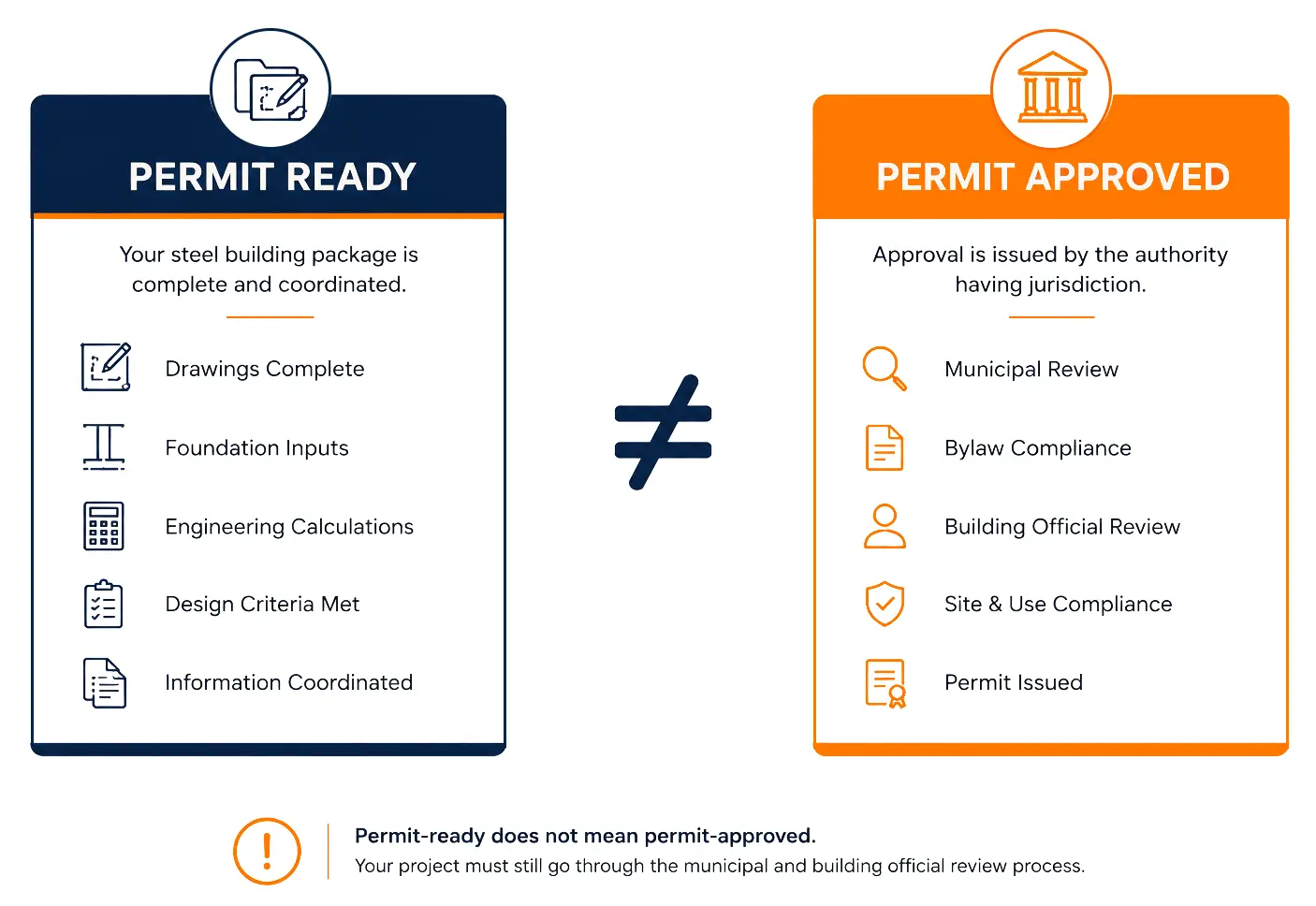
The expensive mistake is assuming one approval means the whole project is ready. In PEI, the development permit path and building permit path may not be handled by the same office.
Important: Final permit approval, inspections, timelines, and local requirements remain with the applicable municipality, Province of Prince Edward Island, PEI Lands Division, authority having jurisdiction, submitted documents, and site-specific conditions.
Get a Free Steel Building Quote
Your information will only be used to prepare and follow up on your quote.
The correct application path depends on property location, municipality, official plan or land-use bylaw status, building use, site servicing, building size, code scope, and whether the project is handled by Charlottetown, Stratford, Summerside, another municipality, or the PEI Lands Division.
A building permit confirms that the structure is designed and constructed in compliance with construction codes such as the National Building Code and, where applicable, the National Energy Code for Buildings. PEI building permit guidance also explains that the provincial application requires project, property, servicing, and construction information before review can move forward.
Check both permit paths
Most projects should be checked for development permit and building permit requirements before construction.
Confirm the office
Charlottetown, Stratford, Summerside, St. Felix, other municipalities, and the PEI Lands Division may involve different paths.
Do not treat a quote as approval
Site details matter
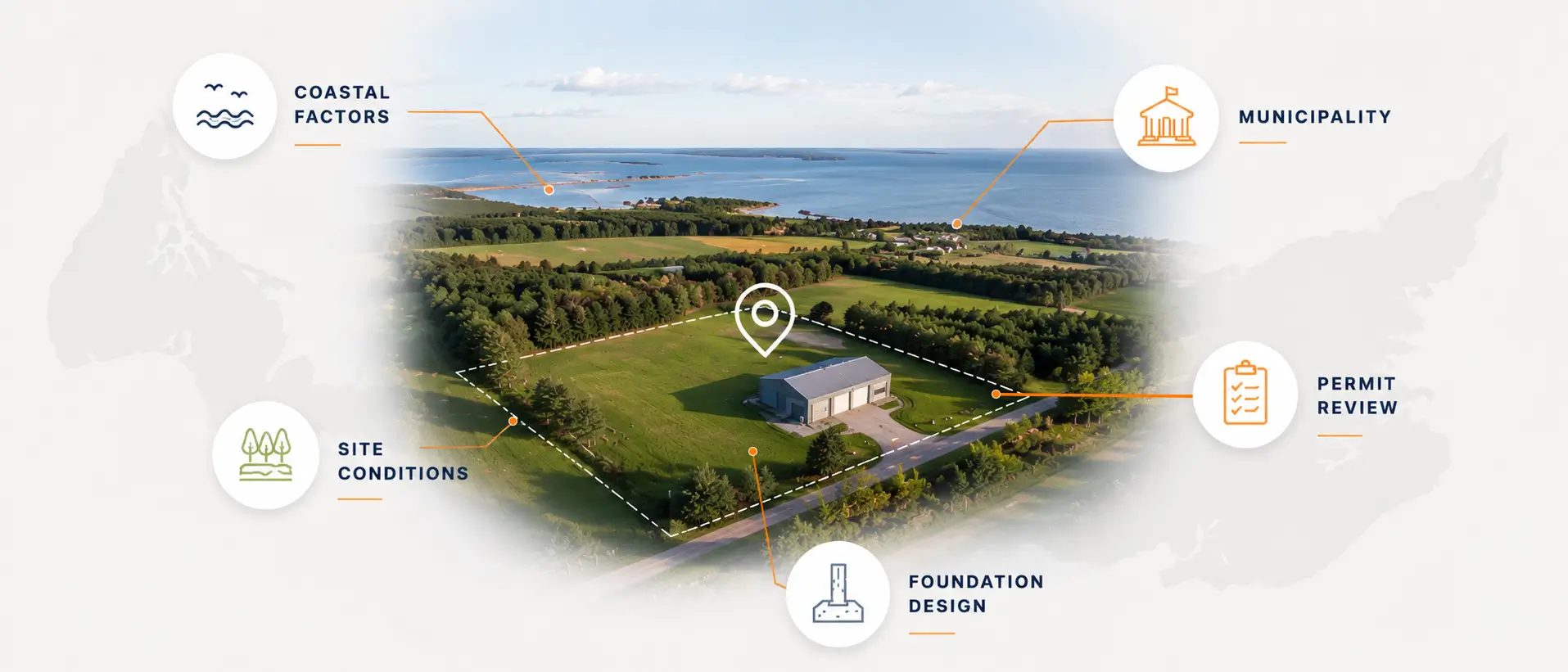
Access, servicing, septic, wells, drainage, slope, wetlands, watercourses, sand dunes, and coastal exposure can change the file.
Coordinate foundations early
Foundation reactions, anchor bolts, frost protection, slab/footings, soils, and drainage should align before concrete is treated as final.
PEI Permit Split
See who handles development permits and building permits based on property location.
Permit Path Decision Map
Compare Charlottetown, Stratford, Summerside, St. Felix, other municipalities, and the PEI Lands Division path.
Before Ordering Steel
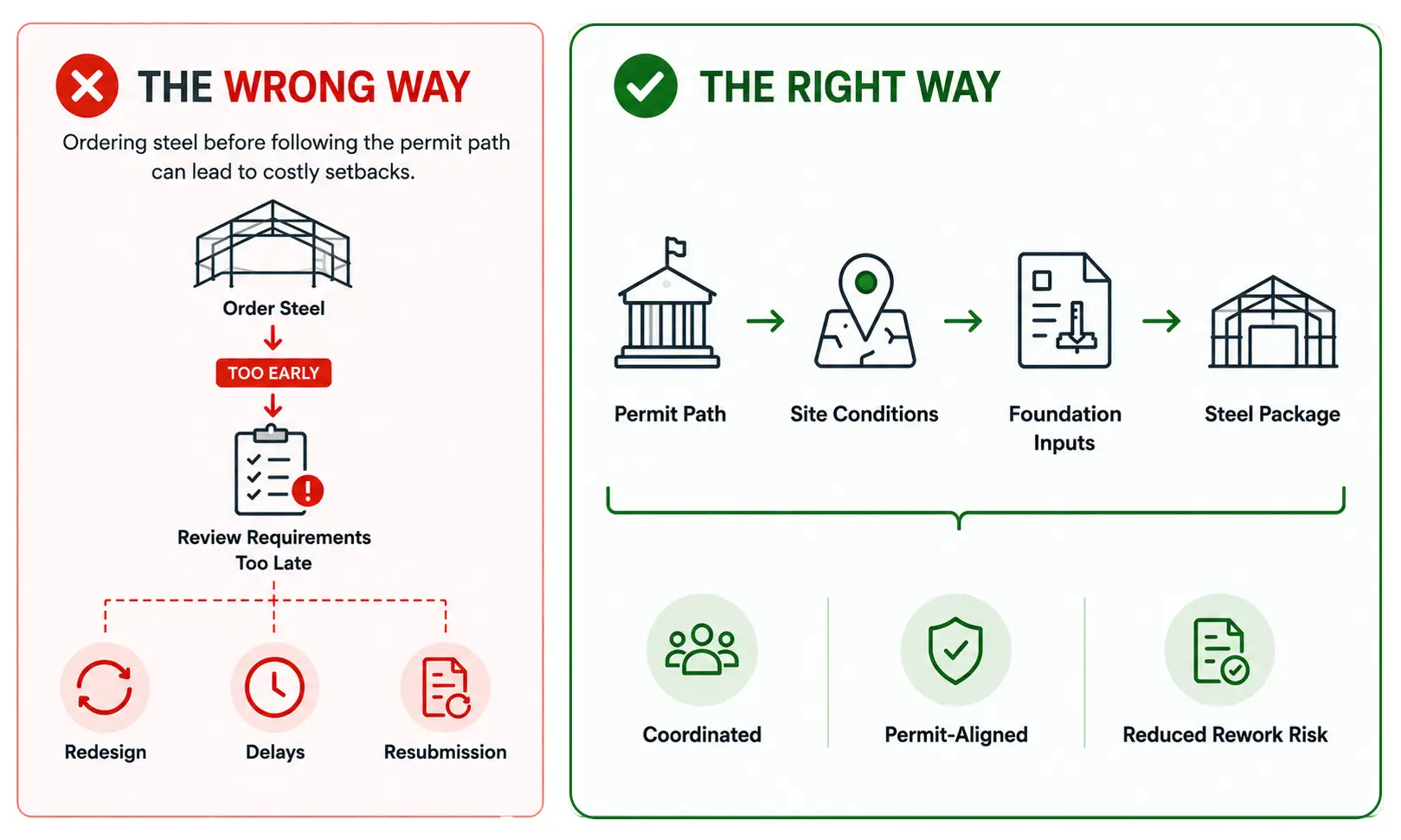
Understand why the steel package should follow the permit path, not the other way around.
Site Conditions
Review coastal exposure, drainage, septic, wells, wetlands, slope, and site sketch risks.
Documents Needed
Check common PEI permit inputs, steel drawings, foundation reactions, and CSA A660 documentation.
Permit Sequence
Follow the safest order from location check to submission, review, construction, and closeout.
Delay Triggers
See the real issues that create review comments, redesigns, and construction-stage confusion.
Commercial / Rural Issues
Review permit considerations for warehouses, truck garages, cold storage, farm, and rural buildings.
FAQs
Read direct answers for serious PEI steel building buyers.
| Property Location | Development Permit | Building Permit |
|---|---|---|
| Charlottetown, Stratford, or Summerside | Municipality | Municipality |
| Municipality with official plan and land-use bylaw | Municipality | PEI Lands Division |
| Outside a municipality | PEI Lands Division | PEI Lands Division |
| Municipality without official plan and land-use bylaw | PEI Lands Division | PEI Lands Division |
Important St. Felix note: PEI building permit guidance identifies St. Felix as a municipality that issues building permits within its municipal boundaries. Buyers should confirm the current development permit and building permit responsibilities directly with St. Felix or the PEI Lands Division before submitting.
Charlottetown / Stratford / Summerside
These municipalities are the clearest municipal path because they issue their own development and building permits. Buyers still need project-specific drawings, site information, servicing details, foundation coordination, and inspection requirements before construction moves forward.
- Confirm local municipal process
- Prepare site plan and servicing details
- Coordinate steel drawings and foundations
- Build only after required approvals are clear
PEI steel building permit-readiness
Property location + land use + site plan + building use + foundations + steel documentation
Before ordering steel
Confirm the permit path, site constraints, foundation reactions, anchor bolts, and CSA A660 documentation where applicable.
St. Felix
PEI building permit guidance identifies St. Felix as issuing building permits within its municipal boundaries. Because the development permit path may still need confirmation, buyers should verify both responsibilities with St. Felix or the PEI Lands Division before submitting.
- Confirm municipal building permit responsibility
- Confirm development permit path separately
- Check site plan, services, access, and drawings
- Do not assume the same path as Charlottetown, Stratford, or Summerside
Municipality with official plan and land-use bylaw
The development permit may be municipal while the building permit may still go to the PEI Lands Division. Buyers often confuse one approval path for the whole project here.
Outside municipality / no municipal land-use planning
The PEI Lands Division path may apply to both development permit and building permit review. Confirm current requirements before finalizing the building footprint, foundation layout, or steel package.
Decision-map takeaway
If the location path is wrong, the steel package can be right on paper and still become wrong for the site. Permit-readiness starts by confirming who reviews the development permit, who reviews the building permit, and what site/foundation information each path needs.
The steel package should follow the permit path, not the other way around.
When the path is checked early, the frame layout, openings, foundation reactions, anchor bolts, site plan, servicing, and CSA A660 documentation can be coordinated before fabrication pressure starts. When it is skipped, the buyer may face redesign, revised foundation drawings, new anchor bolt layouts, delayed concrete, or resubmission after the project has already spent money.
Use it before the project moves too far
It helps buyers understand the approval path before ordering steel, finalizing foundation drawings, setting anchor bolts, or scheduling construction.
Before requesting a quote, confirm the information that can affect both pricing and permit-readiness.
Information to prepare
- Property location and municipality
- Whether the property is in Charlottetown, Stratford, Summerside, another municipality, or outside a municipality
- Official plan and land-use bylaw status
- Intended building use, size, height, doors, and openings
- Development permit path and building permit path
- Site plan or property sketch requirements
- Driveway access, fire access, septic, well, sewer, water, and utilities
- Drainage, grading, slope, stormwater, watercourses, wetlands, waterfront bank, sand dunes, and environmental features
- Coastal wind, salt exposure, snow, frost, soil, foundation, and anchor bolt assumptions
Do not assume one approval covers both permits
A development permit and a building permit answer different questions. Municipal development approval does not automatically mean the building permit path, code review, foundation design, or inspections are complete.
Do not assume the site is simple
PEI site sketches can involve access, slope, watercourses, wetlands, waterfront bank, sand dunes, drainage, septic, wells, and nearby structures. Those details can change building placement, foundation planning, and review comments.
Do not assume concrete can wait for later coordination
Steel reactions, base plates, anchor bolts, frost protection, slab edges, soil assumptions, and drainage planning should be aligned before the foundation designer or contractor treats the layout as final.

Before requesting a quote
- Property location and permit office
- Building use and approximate size
- Municipality or PEI Lands Division path
- Known servicing, access, drainage, and site constraints

Before ordering steel
- Development permit path checked
- Building permit path checked
- Openings, clear span, height, and use confirmed
- Site plan and environmental constraints reviewed

Before foundation work
- Foundation reactions received
- Anchor bolt layout coordinated
- Frost, soil, slope, and drainage assumptions reviewed
- Required approvals or written direction confirmed

Before construction
- Required permit approvals understood
- Reviewer comments addressed
- Inspection path known
- Construction sequence aligned with approved documents
Development Permit

Building Permit

Charlottetown / Stratford / Summerside

Municipality With Land-Use Planning

PEI Lands Division

2020 National Model Codes

NBC 2020 / NECB 2020

CSA A660 Documentation
The first serious PEI question is not only “what size building do I want?”
It is: where is the property, who controls the development permit, who handles the building permit, and what site conditions must be resolved before the steel package is final?
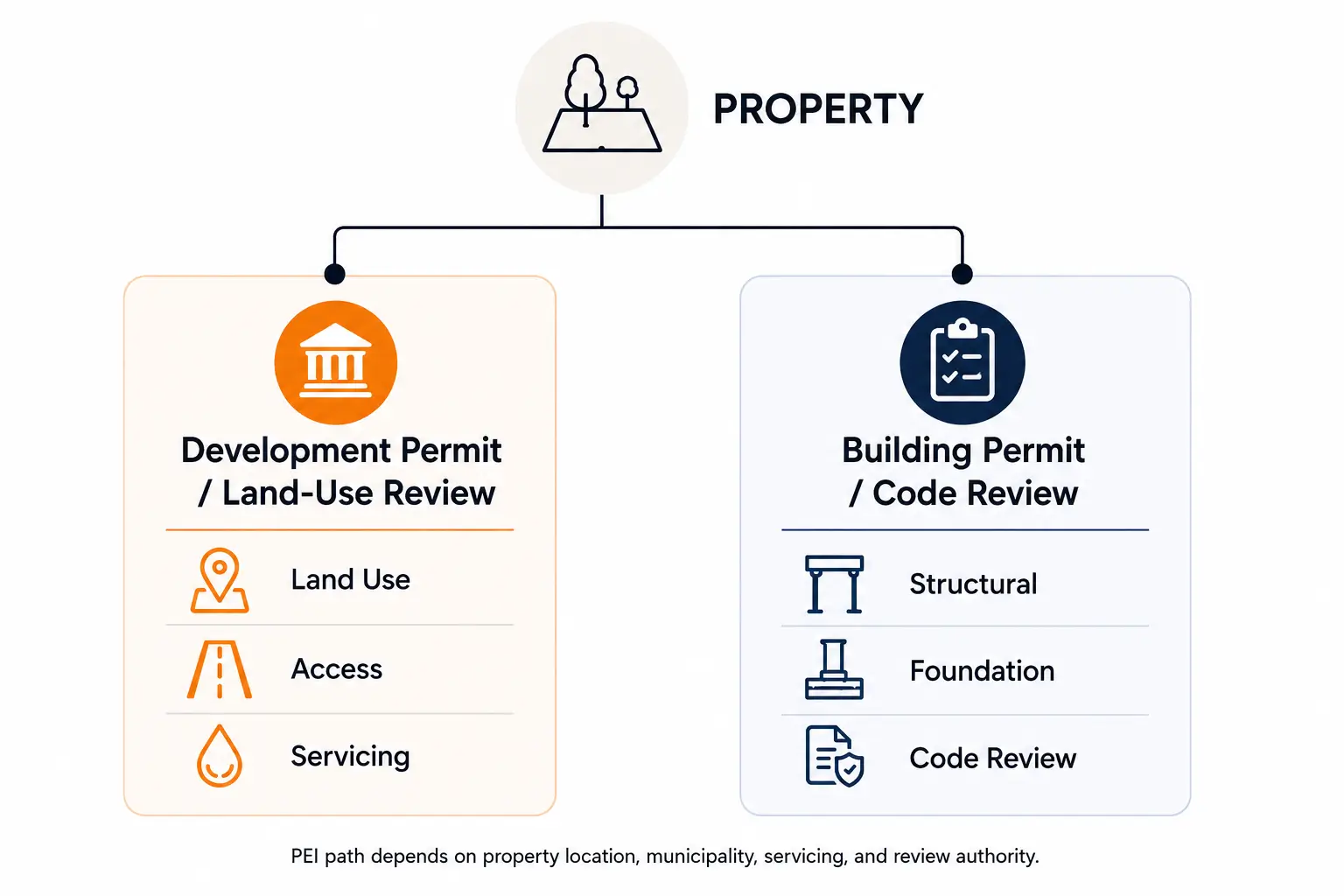
Development Permit
Checks whether the use, location, land-use path, site layout, access, servicing, setbacks, slope, and planning conditions are acceptable.
Building Permit
Checks construction documents, structural design, foundation details, code compliance, energy requirements where applicable, inspections, and building details.
| Project Situation | Likely Review Issue | Why It Matters |
|---|---|---|
| Charlottetown, Stratford, or Summerside | Municipality handles development and building permits | These municipalities are treated differently from other municipal areas because they issue both types of permits within their own process. |
| St. Felix | PEI building permit guidance identifies municipal building permit issuance | Confirm the current development permit path and building permit path directly before submission, because St. Felix should not be treated the same as all other municipalities without verification. |
| Municipality with official plan and land-use bylaw | Municipality handles development permit | Land use, setbacks, site layout, access, and planning approval may be municipal. |
| Same municipality | PEI Lands Division handles building permit | The building permit path may still be provincial. |
| Outside a municipality | PEI Lands Division handles both permits | The province may be the main permit contact. |
| Commercial or industrial project | Deeper review | Occupancy, parking, access, servicing, energy, fire/life safety, and inspections may apply. |
| Rural or agricultural project | Site and land-use risk | Farm use, storage, septic/well, access, drainage, and environmental constraints should be checked early. |
Do not treat a steel quote as a PEI permit.
Final approval can still depend on development review, municipal land-use requirements, provincial building permit review, site plan completeness, servicing, foundation design, inspections, review comments, and outside-agency requirements.
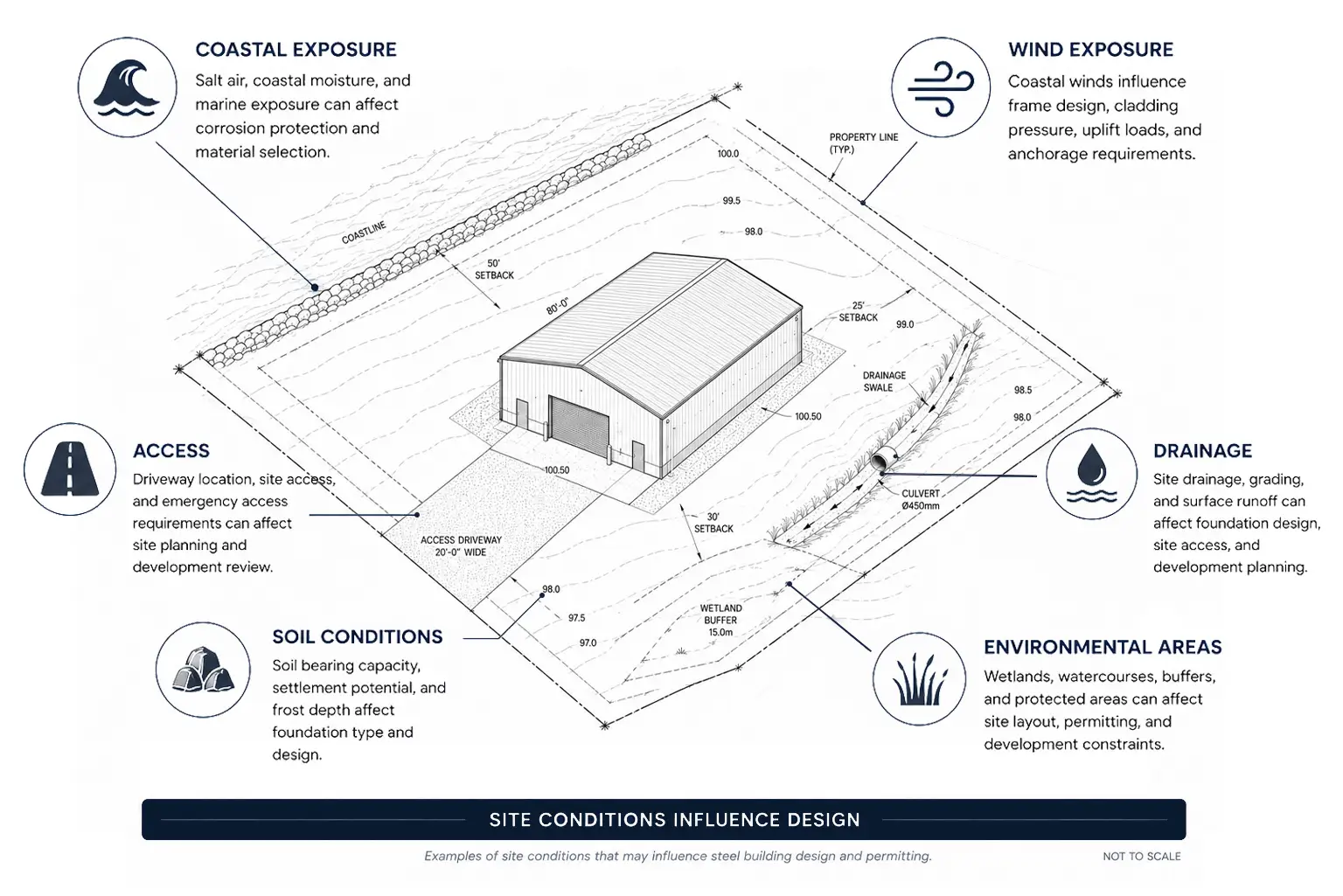
Important PEI site inputs can include coastal wind exposure, salt and corrosion exposure, snow and drifting, frost and foundation protection, soil bearing assumptions, drainage and grading, surface runoff, driveway and fire access, septic, well, water, sewer, utility layout, lot size, setbacks, watercourses, wetlands, waterfront bank, sand dunes, and environmentally sensitive areas. PEI development permit guidance specifically asks for property sketch information such as watercourses, wetlands, waterfront top of bank, sand dunes, and natural slope, which is why site planning belongs near the front of this page. Review PEI development permit guidance.
Design consequences
- Frame design and cladding strategy
- Corrosion protection and material assumptions
- Foundation reactions and anchor bolts
- Slab/footing design, frost protection, and soil assumptions
- Access planning, drainage, and permit documentation

Property and Review Path
- Property identification and location
- Municipality or PEI Lands Division review path
- Existing and proposed use
- Building dimensions and height

Site and Servicing
- Site plan or property map sketch
- Access and driveway location
- Water, sewer, septic, well, and utilities
- Watercourses, wetlands, waterfront bank, sand dunes, and slope

Building Package
- Foundation type
- Siding and roof material
- Steel drawings and design criteria
- Foundation reactions and CSA A660 documentation where applicable
PEI development permit guidance asks applicants to provide a property sketch showing important site features. For a steel building buyer, that sketch is where the project begins to connect land use, access, servicing, drainage, environmental constraints, foundation planning, and building placement. See PEI development permit requirements.
What this means for steel building planning
- Do not finalize the building footprint before setbacks and site constraints are checked.
- Do not assume access, septic, well, or drainage issues are separate from the permit path.
- Do not treat foundation design as independent from site slope, frost, drainage, and soil assumptions.
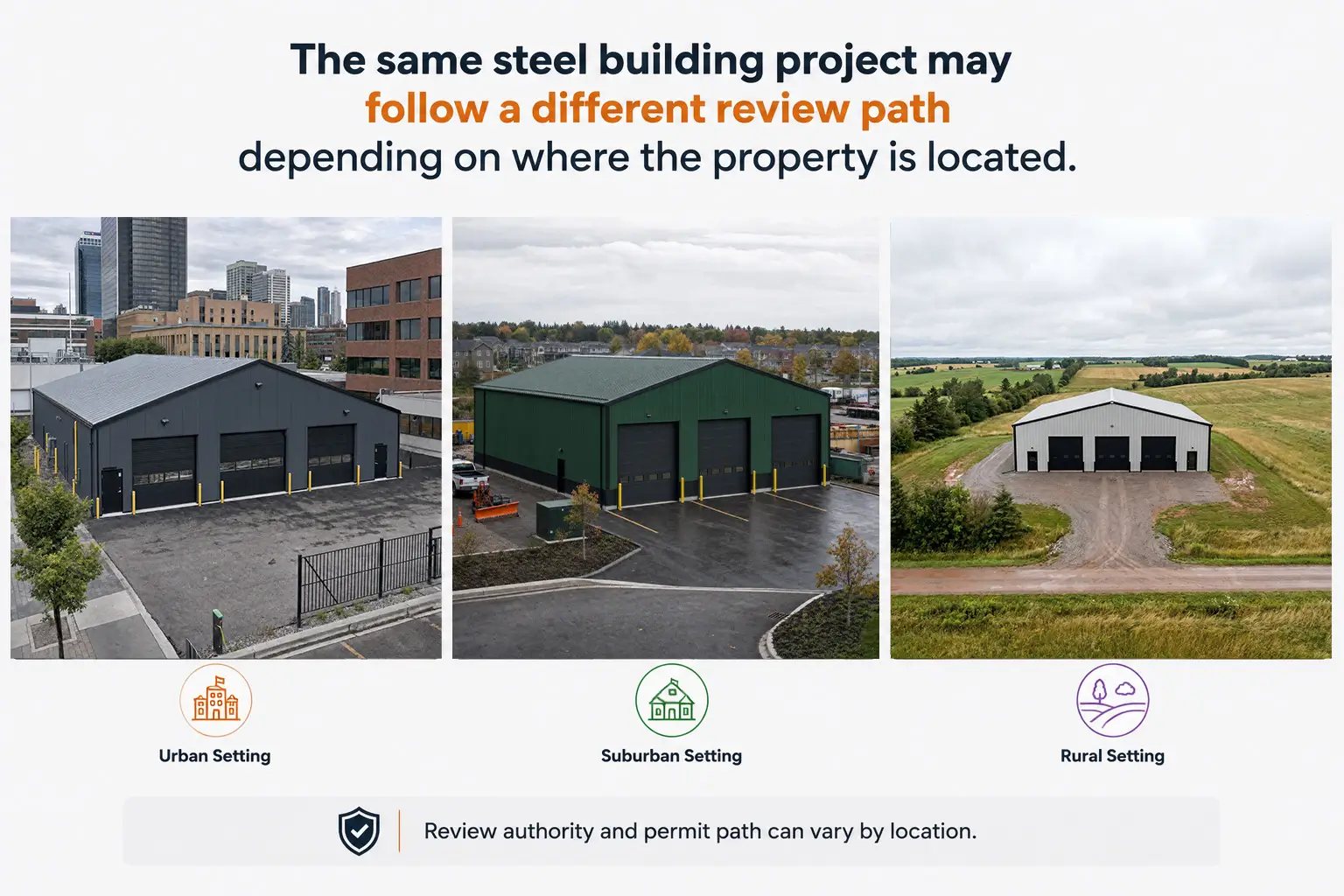
- Do not assume a rural or coastal property has fewer review risks than an urban property.
| Document / Input | Why It Matters |
|---|---|
| Property number / location | Confirms jurisdiction and review path. |
| Development permit information | Confirms planning and land-use path. |
| Site plan or property sketch | Shows building location, setbacks, access, services, environmental features, and site conditions. |
| Building drawings | Shows use, layout, elevations, openings, and code-related details. |
| Steel building drawings | Shows frame layout, bracing, cladding, openings, and design criteria. |
| Foundation reactions | Needed to coordinate foundations and anchor bolts. |
| Anchor bolt plan | Helps prevent field layout conflicts. |
| Foundation drawings | Coordinates footings, slab, frost protection, drainage, and soils. |
| Servicing information | Helps address septic, well, water, sewer, utilities, and drainage. |
| Energy information where applicable | Supports NECB-related or other applicable energy-code review depending on building type, size, occupancy, systems, and scope. |
| CSA A660 documentation | Supports steel building system review where applicable. |

Confirm the property location
Identify whether the project is in Charlottetown, Stratford, Summerside, another municipality, or outside a municipality.

Confirm the development permit path
Check whether development approval is handled by the municipality or the PEI Lands Division.

Confirm the building permit path
Confirm whether the building permit is handled locally or through the PEI Lands Division.

Prepare site and servicing inputs
Show access, drainage, grading, septic, well, utilities, environmental features, and site constraints.

Coordinate steel and foundations
Align frame layout, reactions, anchor bolts, frost protection, slab/footings, soil assumptions, and loading.

Submit, respond, build, close out
Submit the package, answer comments, build after approvals, and complete required inspections or closeout.
Failure Pattern 01
The buyer assumes the project is allowed before land use, site layout, setbacks, servicing, environmental constraints, and municipal or provincial development approval are confirmed.
Failure Pattern 02
The buyer assumes municipal development approval covers the full project, but the building permit may still need to go through PEI Lands Division unless the property is in Charlottetown, Stratford, or Summerside.
Failure Pattern 03
Septic, well, drainage, access, foundation reactions, anchor bolts, frost protection, soil assumptions, and steel design criteria are not coordinated until after the steel package is moving.
Development permit not confirmed
Land-use, setbacks, site layout, or approval authority is unclear.
Building permit path misunderstood
The buyer assumes the municipality handles everything when the building permit may still go through PEI Lands Division.
Site plan incomplete
The property sketch does not clearly show access, buildings, slope, environmental features, services, or proposed placement.
Servicing, septic, or well not resolved
Water, sewer, septic, well, utilities, drainage, or access information is missing.
Foundation reactions missing
The foundation designer cannot coordinate footings, slab, uplift, shear, frost protection, soil assumptions, or anchor bolts.
CSA A660 misunderstood
CSA A660 supports steel system documentation, but does not replace development approval, building permit review, or foundation design.
Timeline problems usually start before submission.
Missing site information, unclear use, weak drawings, outside-agency requirements, or foundation assumptions can create review comments before the project reaches construction.
Issues can include occupancy classification, exits, emergency access, accessibility, washrooms, ventilation, heating and energy compliance where applicable, fire access, parking, loading areas, servicing, inspections, site drainage, and foundation design.
A warehouse may need clearer information about storage height, loading, truck access, fire access, and floor use. A truck garage may need more attention to vehicle movement, bay height, slab loading, drainage, ventilation, and door strategy. A cold storage building may change the envelope, mechanical, condensation-control, slab-edge, and energy conversation. These are not minor sales details; they can change the permit package and the foundation conversation.
What can change the package?
- Building layout and door locations
- Wall assemblies and fire/life safety details
- Mechanical systems and servicing
- Foundation design and inspection path
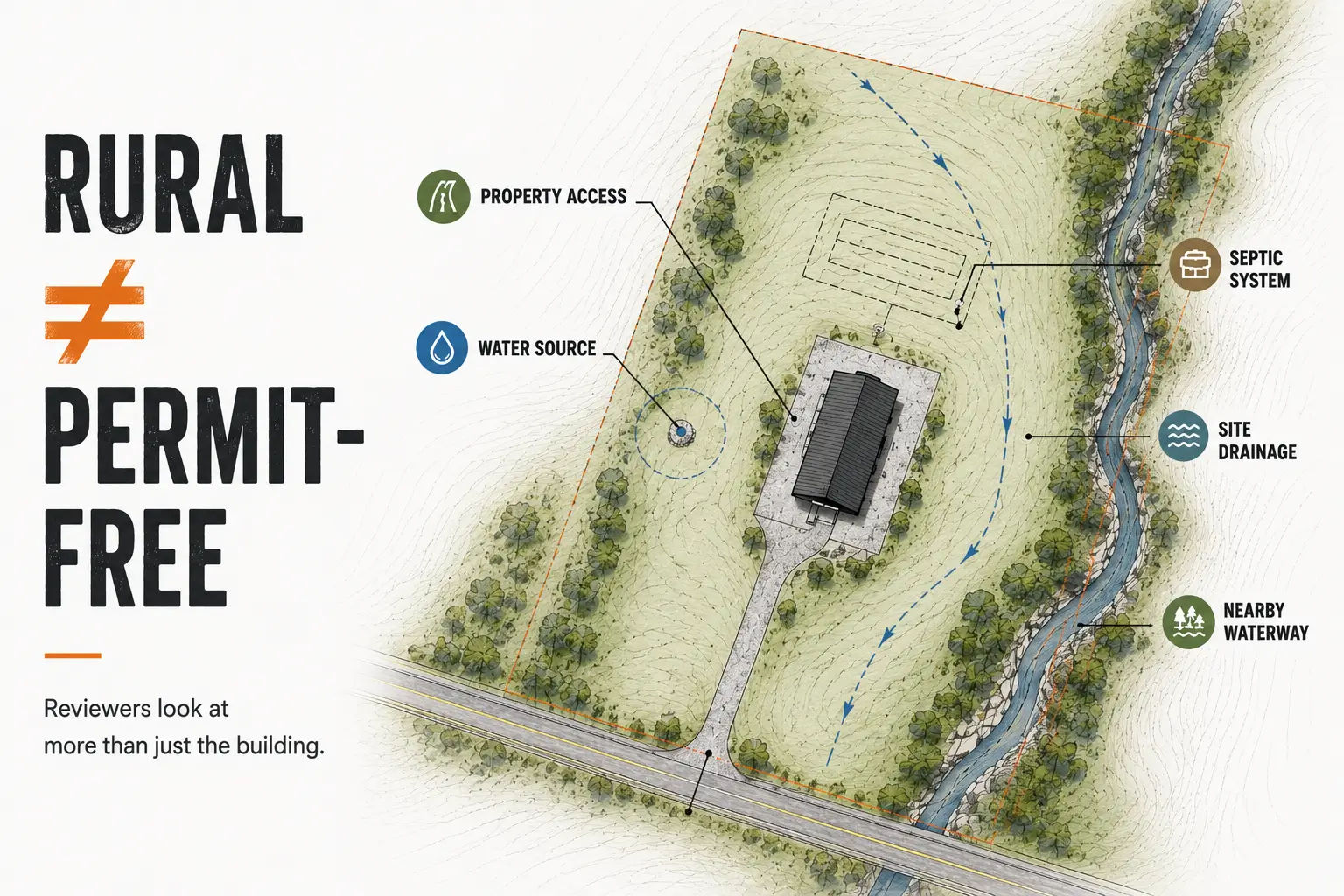
Rural land does not automatically mean permit-free.
Agricultural, farm storage, equipment storage, livestock, crop storage, and rural workshop buildings still need careful review for land-use path, building use, size, site access, servicing, septic/well locations, drainage, environmental constraints, and foundation coordination.
Garages
Workshops
Truck Garages
Warehouses
Farm Buildings
Equipment Storage
Commercial Buildings
Industrial Buildings
Cold Storage
Aircraft Hangars
Custom Steel Buildings
Container Roof Systems
What Tower Steel Buildings Helps Coordinate
Tower Steel Buildings can help coordinate the steel building package and the design inputs connected to that package, within its project scope. That support is strongest when it happens before the buyer treats the quote, foundation layout, or anchor bolt plan as final.
- Steel building scope, size, and use
- Design criteria, frame layout, and opening locations
- Steel reactions, column grid, base plate information, and anchor bolt information for the foundation designer
- CSA A660 steel building system documentation where applicable
- Permit-readiness questions connected to the steel package
- Drawing package alignment with the buyer, contractor, foundation designer, and reviewer
Tower Steel Buildings does not issue PEI development permits, building permits, municipal approvals, PEI Lands Division approvals, inspection approvals, or occupancy sign-offs.
What Remains With the Municipality / Province / PEI Lands Division
Final approval, development permits, building permits, inspections, occupancy, timelines, local interpretation, site servicing approval, and outside agency requirements remain with the applicable municipality, Province of Prince Edward Island, PEI Lands Division, authority having jurisdiction, or project consultants.
The safest buyer approach is to treat Tower Steel Buildings as a steel building system and permit-readiness coordination resource, while treating the applicable reviewing authority as the final source for approval requirements, inspection conditions, timelines, and site-specific decisions.
PEI Building and Development
Official PEI guidance on building and development permit requirements and the 2020 National Model Codes adoption.
PEI Development Permit
Official PEI guidance for development permit application paths, location-based review, and site sketch information.
PEI Building Permit
Official PEI guidance for provincial building permit application information and municipal building permit exceptions, including St. Felix.
PEI Building and Development Permits
Official topic hub for building and development permit information in Prince Edward Island.
PEI Civic Address / Property Information
Useful for confirming property information before permit-path planning and site review.
CSA A660 Certification
CWB guidance on CSA A660 quality certification for steel building systems.
How to Apply for a Steel Building Permit in Prince Edward Island
Municipal vs Provincial Land Division Steel Building Permits in PEI
Documents Required for a Steel Building Permit in Prince Edward Island
PEI Site Plan and Property Sketch Requirements for Steel Building Permits
Development Permit vs Building Permit in Prince Edward Island
Watercourses, Wetlands, Buffer Zones, and PEI Steel Building Permits
1. What is a steel building permit in Prince Edward Island?
A steel building permit is part of the approval process used to review whether a proposed steel building can be constructed based on the submitted drawings, building use, structural information, foundation details, code requirements, inspections, and applicable local or provincial review conditions.
In PEI, a steel building project should also be checked for development permit requirements before construction. Land use, site location, access, servicing, drainage, environmental constraints, and property conditions can affect whether the building can be placed and used as proposed.
2. Do steel buildings need permits in Prince Edward Island?
New permanent steel buildings in Prince Edward Island should generally be checked for both development permit and building permit requirements before construction. The correct approval path depends on the property location, municipality, land-use authority, building use, site servicing, environmental constraints, and project scope.
PEI says that in almost all instances, both a development permit and a building permit are required before construction begins. Permits may be issued by a municipality or by the provincial Land Division depending on the property location.
3. Where do I start for a PEI steel building permit?
Start by confirming the property location. The permit path can differ if the project is in Charlottetown, Stratford, Summerside, St. Felix for building-permit purposes, another municipality with an official plan and land-use bylaw, a municipality without local land-use planning, or an area outside a municipality.
After location is confirmed, identify who handles the development permit and who handles the building permit. That should happen before treating the steel package, foundation drawings, anchor bolt layout, or construction schedule as final.
4. How long does a steel building permit take in PEI?
There is no single fixed timeline for every PEI steel building permit. Timing can depend on the development permit path, building permit completeness, municipal or provincial Land Division review, site plan quality, servicing information, environmental constraints, code scope, foundation coordination, inspection requirements, and review comments.
Buyers should avoid locking fabrication, concrete, crane, or erection dates around an assumed approval date before the development path, building permit path, and submission package are clear.
5. What is a development permit in PEI?
A development permit deals with land use and site planning. It helps confirm whether the proposed use, building location, setbacks, access, servicing, slope, environmental features, and planning conditions are acceptable for the property before the project moves too far.
For steel buildings, this matters because development review can affect the building location, footprint, driveway, drainage, servicing, foundation layout, anchor bolt plan, and construction sequence.
6. What is a building permit in PEI?
A building permit deals with construction review. It can involve construction-code compliance, building drawings, structural information, foundation details, energy requirements where applicable, inspection requirements, and the building information needed before construction proceeds.
For steel buildings, a building permit path may involve the steel package, foundation drawings, reactions, anchor bolt layout, energy documentation where applicable, trade scope, and inspection timing.
7. What is the difference between a development permit and a building permit in PEI?
A development permit deals with whether the project fits the land. A building permit deals with whether the building can be constructed as proposed.
A PEI steel building can be delayed if one path is understood but the other is not. Development approval can affect site location, setbacks, servicing, access, drainage, and environmental constraints. Building permit review can affect drawings, foundations, steel reactions, anchor bolts, energy documentation where applicable, trade scope, and inspections.
8. Can municipal development approval mean the whole PEI project is ready?
Not always. In many PEI municipalities, the development permit can be handled locally while the building permit still goes through the provincial Land Division. PEI says Charlottetown, Stratford, and Summerside issue their own development and building permits. Municipalities with official plans and land-use bylaws issue development permits, while the provincial Land Division handles building permits for those jurisdictions.
For steel building buyers, development approval should not automatically be treated as permission to order steel, pour concrete, set anchor bolts, or begin construction. The building permit path, foundation coordination, reactions, anchor bolts, servicing, inspections, and trade scope still need to be confirmed.
9. Who issues development and building permits in PEI?
Charlottetown, Stratford, and Summerside issue their own development and building permits. PEI building permit guidance also identifies St. Felix as issuing building permits within its municipal boundaries.
Municipalities with an official plan and land-use bylaws issue their own development permits, while the provincial Land Division handles the building permit. If the property is outside a municipality, or inside a municipality without an official plan and land-use bylaws, the provincial Land Division handles both development and building permits. Buyers should confirm the current path before submitting.
10. Does St. Felix issue building permits?
PEI building permit guidance identifies St. Felix as a municipality that issues building permits within its municipal boundaries. Buyers should still confirm the current development permit and building permit path directly with St. Felix, the applicable municipality, or the provincial Land Division before submitting.
This is important because municipal roles, forms, intake requirements, and review sequences can change, and the correct process depends on the property location and project scope.
11. What does the provincial Land Division review for steel building projects?
The provincial Land Division may be involved in development permits, building permits, or both, depending on the property location and municipal land-use authority. For steel building projects, this can affect the application path, required site information, building permit review, inspections, and approval conditions.
Buyers should confirm whether the provincial Land Division, a municipality, or both are involved before treating the project as permit-ready.
12. What code applies to steel buildings in Prince Edward Island?
PEI adopted Tier 1 of the 2020 National Model Codes effective March 31, 2024. PEI’s building permit guidance identifies the 2020 National Building Code of Canada and the 2020 National Energy Code of Canada for Buildings as applicable code references in the updated permit process.
For steel buildings, code review can depend on building use, size, occupancy, energy scope, trade systems, foundation design, and the authority reviewing the project.
13. Do PEI steel building permits depend on whether the property is inside or outside a municipality?
Yes. In PEI, the permit path depends heavily on property location. Charlottetown, Stratford, and Summerside issue their own development and building permits. Municipalities with official plans and land-use bylaws issue development permits, while the provincial Land Division handles building permits.
Outside a municipality, or inside a municipality without an official plan and land-use bylaws, the provincial Land Division handles both development and building permits. This should be confirmed before the steel package, foundation drawings, or construction schedule are treated as final.
14. Does PEI require a site plan or property sketch for a steel building?
PEI development permit guidance asks for property information and a detailed property map sketch showing property lines, roads, buildings or structures, watercourses, wetlands, streams, waterfront top of bank and/or sand dunes, and the natural slope of the land.
This information should be prepared early because site constraints can affect steel building location, foundation layout, access, drainage, servicing, anchor bolt coordination, and permit review.
15. What site and servicing details should be checked before ordering steel in PEI?
Before ordering steel, buyers should check driveway access, highway access, fire access where applicable, water, sewer, septic, wells, utilities, drainage, grading, slope, stormwater, watercourses, wetlands, waterfront bank, sand dunes, nearby buildings, easements, and other property constraints.
For steel buildings, these details can affect the site plan, building footprint, foundation reactions, anchor bolt layout, door locations, drainage strategy, servicing penetrations, and construction schedule.
16. Does driveway or highway access matter for a PEI steel building permit?
Yes. Driveway access, highway access, fire access where applicable, truck movement, loading areas, and site circulation should be confirmed early. PEI development permit guidance includes access and servicing information as part of the development review process.
For steel buildings, access can affect the site plan, building placement, delivery route, fire access where applicable, drainage, parking, loading, and construction sequencing.
17. How can PEI waterfront, wetland, watercourse, slope, or sand dune conditions affect a steel building permit?
PEI development permit guidance asks applicants to identify watercourses, wetlands, streams, waterfront top of bank, sand dunes, and natural slope on the property sketch. These conditions can affect site placement, setbacks, access, drainage, foundation planning, erosion exposure, and whether additional review is needed before the steel package or foundation layout is treated as final.
Work in a watercourse, wetland, or 15 m buffer zone may require a Watercourse, Wetland and Buffer Zone Activity Permit. That environmental activity permit is separate from the general steel building permit path and should be confirmed early if the site has those constraints.
18. Can the PEI site sketch change the steel building layout?
Yes. If the property sketch or development review identifies setback, access, drainage, slope, watercourse, wetland, waterfront bank, sand dune, servicing, or driveway issues, the building location or footprint may need to change.
For steel buildings, that can affect the foundation layout, anchor bolt plan, column grid, door locations, bracing, steel reactions, and construction schedule.
19. How do PEI coastal conditions affect steel building design?
PEI coastal conditions can affect more than appearance. Coastal wind exposure, salt and corrosion exposure, snow, frost, drainage, soil assumptions, slope, water proximity, and site access can influence frame design, cladding selection, corrosion protection, foundation reactions, anchor bolts, drainage planning, and permit documentation.
Buyers should confirm the actual site conditions before treating a steel building quote or preliminary drawing as final.
20. Do rural or agricultural steel buildings in PEI need permits?
Rural land does not automatically mean the project can proceed without local or provincial review. Rural and agricultural steel buildings should be checked for land-use path, development permit requirements, building permit requirements, site access, servicing, septic or well locations, drainage, environmental constraints, foundation coordination, and inspection expectations.
A basic storage building, farm workshop, equipment building, commercial ag-service building, or serviced building may not follow the same approval path.
21. What documents are commonly needed for a PEI steel building permit?
Common inputs may include property location, PID, development permit information, site plan or property sketch, building-use description, building drawings, steel building drawings, foundation reactions, anchor bolt plan, foundation drawings, servicing details, energy information where applicable, trade scope, inspection information, and CSA A660 documentation where applicable.
The exact package depends on the location, municipality, provincial Land Division involvement, building use, site conditions, and project scope.
22. Do I need foundation drawings for a PEI steel building?
For serious permanent steel buildings, foundation drawings are commonly needed to coordinate footings, slab, frost protection, anchor bolts, base plates, steel reactions, soil assumptions, drainage, and inspection expectations.
Whether stamped or professionally prepared foundation documents are required depends on building use, size, site conditions, local or provincial review, and project scope. Buyers should not assume supplier drawings automatically replace foundation drawings.
23. Why do steel reactions matter for PEI foundation drawings?
Steel reactions tell the foundation designer what loads the steel frame transfers into the foundation. These can include vertical loads, lateral loads, uplift, shear, snow effects, wind effects, large-door effects, equipment loads, and other project-specific forces.
If reactions are missing or preliminary, foundation drawings may be based on assumptions. That can create redesign, resubmission, anchor bolt conflicts, concrete changes, inspection problems, and construction delays.
24. Can a PEI development permit change the foundation or anchor bolt layout?
Yes. If development review changes the building location, footprint, driveway, drainage, servicing, or site constraints, the foundation layout and anchor bolt plan may also need review.
For steel buildings, the site plan, foundation drawings, reactions, base plates, and anchor bolt layout should match the final approved building location before concrete is poured.
25. What should PEI buyers confirm before relying on supplier drawings?
PEI steel building buyers should confirm that supplier drawings match the approved site location, building use, development permit path, foundation design, reactions, base plates, anchor bolt layout, energy requirements where applicable, servicing, trade scope, and inspection expectations.
Supplier drawings are important, but they should not be treated as the full permit package by themselves.
26. Can I order steel before permit approval in PEI?
Ordering steel before the development permit path, building permit path, site constraints, servicing, foundation reactions, and property conditions are clear can create redesign, resubmission, foundation changes, and anchor bolt conflicts.
For steel buildings, early ordering can become expensive if the site plan, building use, door locations, bracing, reactions, base plates, or anchor bolt layout changes during review.
27. Can I pour concrete before permit approval in PEI?
Do not pour concrete unless the required approvals, staged direction, foundation design, anchor bolt layout, inspection timing, and permit conditions are clear. Pouring too early can create costly correction work if reactions, layout, frost assumptions, soils, drainage, or approved drawings change.
Concrete should be placed from coordinated information, not assumptions.
28. Should inspection timing be confirmed before pouring concrete for a PEI steel building?
Yes. Before concrete placement, buyers should confirm whether the authority or inspector must review excavation, forms, reinforcement, foundation layout, anchor bolts, or other required stages.
Steel buildings depend on accurate reactions, base plates, anchor bolt layout, foundation drawings, drainage, and site location. Concrete should not be placed from preliminary drawings or assumptions.
29. Do PEI steel building permits involve inspections?
They can. Inspection requirements depend on the authority, building type, permit conditions, and project scope. Buyers should confirm inspection timing before foundation work, concrete placement, steel erection, trade work, and final use or close-out requirements where applicable.
Inspection requirements should be confirmed with the authority handling the building permit before construction proceeds, especially where foundation, structural, trade, or final-stage inspections may apply.
30. What commercial issues can affect PEI steel building permits?
Commercial steel buildings may need coordination for occupancy classification, exits, emergency access where applicable, accessibility, washrooms, ventilation, heating and energy compliance where applicable, fire access where applicable, parking, loading areas, servicing, inspections, drainage, foundation design, and trade permits.
In PEI, commercial projects should also be checked for municipal vs provincial Land Division review, site servicing, highway or driveway access, wastewater or septic constraints, watercourse or wetland conditions, stormwater, coastal exposure, and local development requirements.
31. Does CSA A660 replace a PEI building permit?
No. CSA A660 documentation, where applicable, can support steel building system documentation and manufacturer quality processes, but it does not replace development approval, building permit review, site-specific engineering, foundation design, local or provincial approval, inspections, or project-specific professional responsibility.
For steel buildings, CSA A660 documentation should be treated as one part of the project file, not the full permit package.
32. Why do PEI steel building projects get delayed?
Common delay triggers include an unconfirmed development permit path, misunderstood building permit path, incomplete site plan, unresolved servicing, unclear septic or well information, missing foundation reactions, preliminary anchor bolt layout, incomplete energy or trade scope where applicable, and misunderstanding CSA A660 documentation.
Delays often happen when the building, site, use, steel package, foundation, reactions, anchor bolts, servicing, and permit path do not describe one coordinated project.
33. What should I confirm before submitting a PEI steel building permit package?
Before submitting, confirm the correct development and building permit path, property location, PID, site sketch, building use, servicing, access, drainage, environmental constraints, steel drawings, foundation drawings, steel reactions, anchor bolt plan, CSA A660 documentation where applicable, energy requirements where applicable, trade scope, inspections, and professional documents where required.
This is the point where the project should be checked as one package, not separate pieces.
34. Can Tower Steel Buildings help with PEI permit-readiness?
Tower Steel Buildings can help coordinate steel building system documentation and key project inputs connected to the building package, within its project scope. That may include building layout, use planning, supplier documentation, design criteria, reactions, base plate information, anchor bolt coordination, and quote-to-permit planning.
Tower Steel Buildings does not issue PEI development permits, building permits, municipal approvals, provincial Land Division approvals, inspection approvals, or occupancy sign-offs. Final permit approval, inspections, timelines, and local requirements remain with the applicable municipality, provincial Land Division, authority having jurisdiction, or project reviewers.
Buyers should request guidance before finalizing building size, foundation planning, steel fabrication, anchor bolt layout, concrete scheduling, or trade coordination.
Bring the property location, building use, approximate dimensions, site plan status, servicing questions, and any comments from the municipality or PEI Lands Division. That gives the building conversation a real permit-readiness starting point instead of a price-only starting point.
Good timing
- Before ordering steel
- Before foundation drawings are finalized
- Before anchor bolts are set
- Before permit comments create redesign pressure
- Before the project assumes the wrong development or building permit path