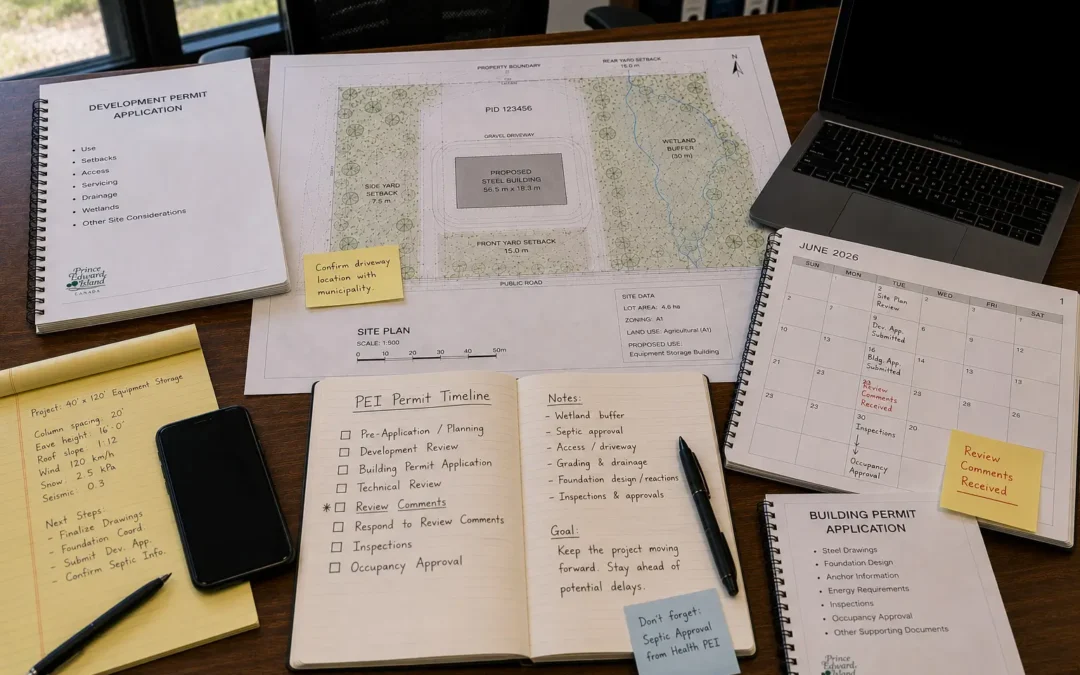
A steel building permit application in Prince Edward Island is not approved simply because the building was purchased from an established supplier or because structural drawings were included.
The permit authority must be able to verify that the proposed building:
- Is permitted on the property
- Is located correctly on the site
- Has the required development approval
- Uses the applicable site-specific design criteria
- Matches the intended use and occupancy
- Has a coordinated steel and foundation design
- Addresses applicable fire, accessibility, energy, servicing, and environmental requirements
- Is supported by the required professional documents
When those matters cannot be confirmed, the application may be returned for correction, withheld, denied, or unable to proceed in its submitted form.
For steel building buyers, the central issue is not whether the structure is made of steel. The issue is whether the proposed use, property, site plan, steel system, foundation, services, and permit documents describe one compliant project.
Tower’s Steel Building Permits Prince Edward Island guide explains the wider approval framework. This article focuses specifically on the conditions that can prevent a PEI steel building permit from being issued as submitted.
Sources reviewed: June 2026
Quick Answer
A steel building permit in Prince Edward Island may not be issued as submitted when the responsible authority cannot verify compliance with the applicable land-use, building-code, site, structural, professional, or approval requirements.
Issues can include:
- The proposed use is not permitted on the property
- The building location does not satisfy applicable development requirements
- The development permit is missing, denied, no longer supports the project, or is inconsistent with the building application
- The application was submitted through the wrong permit authority
- The stated use does not match the drawings or intended operation
- The site plan omits access, servicing, setbacks, property information, or environmental constraints
- Steel drawings use incomplete, generic, or incorrect design criteria
- Foundation drawings do not match the current steel reactions, column grid, base plates, or anchors
- Required professional design, declarations, or responsibilities are missing
- Fire, accessibility, energy, plumbing, electrical, or equipment requirements remain unresolved
- Drawings from different revisions conflict
- The project changes during or after permit review
- Required external approvals have not been obtained
Not every review comment means the permit has been formally rejected. An authority may request additional information or revised documents before making a final decision.
The correct response depends on whether the file has received:
- A request for additional information
- A correction notice
- A withheld permit
- A formal development-permit denial
- A building-permit decision or order subject to a separate review or appeal process
Obtain the written status, decision, and outstanding requirements before deciding whether to correct, resubmit, request a review, or appeal.
What Does “Permit Rejected” Mean in PEI?
Applicants, contractors, and suppliers often use the word “rejected” to describe several different permit outcomes.
A file may instead be:
- Incomplete
- Awaiting payment
- Awaiting a development permit
- Awaiting an external approval
- Under technical review
- Returned for corrections
- Withheld pending information
- Approved with conditions
- Denied
- Issued but later affected by unauthorized changes
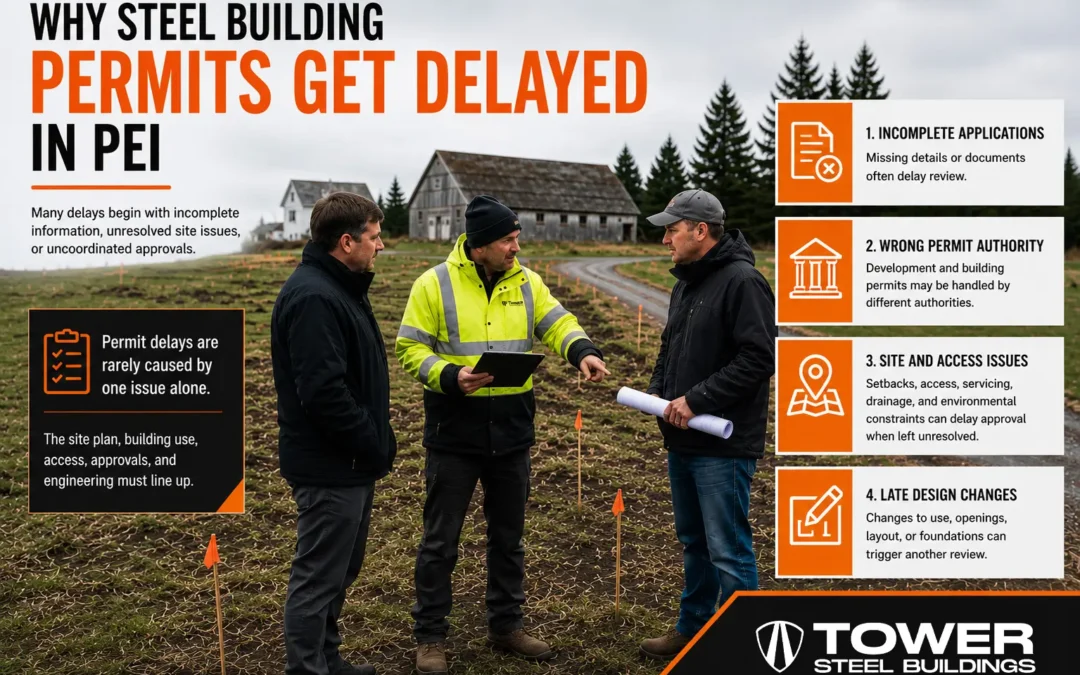
These outcomes are not interchangeable. The guide to PEI steel building permit delays explains when a file may still be awaiting information, payment, another approval, revised engineering, or coordinated documents rather than having received a formal denial.
Information Request
The authority may be willing to continue the review after receiving corrected or additional information.
Permit Withheld
PEI’s provincial building application states that a building permit may be withheld until confirmation of the required development permit is provided.
The building documents may therefore be under review while the project still lacks the land-use approval needed to proceed.
Development-Permit Denial
A development permit may be denied where the project does not comply with the applicable planning framework, use, site location, access, servicing, setbacks, or other development requirements.
Building-Permit Decision
A building permit may not be issued where the authority cannot verify compliance with the applicable building and energy codes, the Building Codes Act and Regulations, professional-design obligations, or permit conditions.
Before redesigning the project, ask the authority to identify whether the issue is:
- Administrative
- Planning-related
- Site-related
- Structural
- Building-code related
- Professional-responsibility related
- Dependent on another approval
A project can lose time and money when every permit status is treated as the same problem.
Development and Building Permits Approve Different Things
PEI states that most construction projects require both a development permit and a building permit before construction begins.
The development permit addresses matters such as:
- Land use
- Building location
- Setbacks
- Highway access
- Water and sewer servicing
- Septic conditions
- Site impacts
- Property layout
The building permit addresses whether the structure is designed and constructed in compliance with the applicable construction codes.
Receiving one permit does not guarantee the other.
A development permit does not approve:
- Structural steel
- Foundation design
- Anchor bolts
- Fire separations
- Exits
- Energy compliance
- Professional structural design
- Required building inspections
A building permit does not override:
- Zoning or land-use requirements
- Development conditions
- Property setbacks
- Environmental restrictions
- Access requirements
- Servicing requirements
- A missing or denied development permit
Tower’s guide to development permits versus building permits in PEI explains why a project can satisfy one review while still failing the other.
The Application Was Sent Through the Wrong Permit Route
PEI does not use one permit office for every property.
Charlottetown, Stratford, and Summerside issue their own development and building permits. St. Felix issues building permits for applicable projects within its municipal boundaries.
In other municipalities with official plans and land-use bylaws, the municipality generally issues the development permit while the provincial Lands Division handles the building permit.
Outside a municipality, or within a municipality without local planning authority, the Lands Division may handle both approvals.
| Property situation | Development permit | Building permit |
| Charlottetown, Stratford, or Summerside | Municipality | Municipality |
| St. Felix | Confirm the current development authority | St. Felix for applicable building permits |
| Municipality with an official plan and land-use bylaws | Municipality | Provincial Lands Division, unless otherwise assigned |
| Outside a municipality or within a municipality without local planning bylaws | Provincial Lands Division | Provincial Lands Division |
Confirm the correct route using:
- Property identification number
- Civic address
- Municipal boundary
- Municipal planning status
- Development-permit authority
- Building-permit authority
A mailing address or community name does not necessarily establish permit jurisdiction.
An application may be unable to proceed when the applicant assumes the municipality handles the complete process but the building permit must be submitted provincially.
Tower’s guide to municipal versus Lands Division steel building permits in PEI explains how to confirm the correct route before assembling the submission.
The Proposed Use Is Not Permitted on the Property
A structurally compliant steel building can still be denied at the development stage if its actual use is not permitted.
The project should be described by its operation, not only by the building’s appearance.
Terms such as garage, shop, storage building, farm building, warehouse, or equipment building may not provide enough information.
The authority may need to know whether the building will contain:
- Private vehicle storage
- Commercial vehicle repair
- Welding or fabrication
- Manufacturing
- Agricultural storage or processing
- Retail sales
- Public access
- Rental storage
- Offices
- Hazardous materials
- High-piled storage
- Livestock or food processing
A private accessory garage and a commercial truck-repair facility are not the same land use simply because both contain overhead doors.
The actual use can affect:
- Whether the project is allowed
- Development classification
- Parking and loading
- Highway access
- Septic and servicing
- Fire and life safety
- Accessibility
- Ventilation
- Energy requirements
- Occupancy
- Professional-design responsibilities
A permit application should not describe the building as storage when the intended operation includes repair, fabrication, retail, processing, or public use.
The Development Approval and Building Drawings Describe Different Projects
The development permit may approve one project while the building-permit drawings show another.
Conflicts can include:
- Different building dimensions or height
- A different site location
- A changed use
- A relocated driveway
- Added offices, washrooms, parking, or loading
- Different overhead-door locations
- A mezzanine added after development approval
- Additional exterior storage
- A changed servicing arrangement
The development approval, site plan, steel drawings, foundation drawings, and building application should use the same current information.
| Project information | Development documents | Building documents |
| Use | Approved use | Same intended use |
| Dimensions | Approved footprint | Final building dimensions |
| Height | Approved development | Elevations and steel drawings |
| Site location | Approved site plan | Foundation and building plans |
| Access | Approved driveway | Doors, parking, and loading |
| Services | Approved approach | Plumbing and building scope |
| Revision | Current approval | Current drawing package |
A building application cannot correct a development permit that approved a materially different project.
The Site Plan Does Not Prove the Building Fits
A site plan must show more than a rectangle labelled “proposed building.”
PEI’s provincial development process can require information about:
- Property lines and roads
- Existing structures
- Proposed development
- Watercourses and wetlands
- Waterfront top of bank
- Sand dunes
- Natural slope
- Access and parking
- Water, sewer, or septic
- Relevant site conditions
For a steel building, the plan may also need to coordinate:
- Exact exterior dimensions
- Property-line and road setbacks
- Entrances and overhead-door approaches
- Truck movement and loading
- Outdoor and snow storage
- Drainage
- Utility routes
- Foundation excavation
- Construction access
The application may fail where the frame fits on the lot but the complete operation does not.
Examples include:
- Trucks cannot turn into the overhead doors
- Parking occupies the septic area
- The building conflicts with a protected feature
- The driveway cannot obtain the required entrance approval
- Drainage is directed toward neighbouring land
- The loading area crosses a property line
- The building covers an existing utility
- Setbacks were measured from the wrong reference
A survey or location certificate may be required where accurate information is needed to establish compliance.
Setbacks, Access, or Servicing Cannot Be Approved
Development approval depends on more than building dimensions.
The project may be unable to proceed where:
- The building is too close to a property boundary
- Road setbacks are not satisfied
- The driveway lacks acceptable highway access
- Sight-distance requirements cannot be met
- Water or sewer servicing is unavailable
- The septic arrangement cannot be accepted
- Parking or loading is inadequate
- A required variance or planning decision has not been obtained
- The lot cannot support the proposed development as submitted
PEI’s development-permit guidance explains that development review includes land use, structure location, servicing, highway access, setbacks, and potential impacts.
Moving the building to solve a development issue may change:
- Door orientation
- Drainage and utility routes
- Erection access
- Wind exposure or snow drifting
- Foundation elevation
- Column and anchor coordinates
A development problem should be resolved before final steel and foundation information is released.
A Required Entrance or Culvert Approval Is Missing
A project may require separate approval for access to a provincial highway.
PEI states that an entrance-way permit must be obtained before a driveway culvert permit.
A development application may be unable to proceed where:
- A required entrance-way permit has not been granted
- The access location changes during review
- The site plan and highway application show different entrances
- Sightlines are inadequate
- A second entrance is assumed but not approved
- The driveway conflicts with drainage or a protected buffer
- Truck turning cannot be accommodated
The driveway can control the building orientation, overhead-door placement, loading side, parking, grading, culvert location, drainage, delivery, and erection access.
A steel package finalized before access approval may need revision even where the frame itself remains structurally acceptable.
Environmental Constraints Prevent the Site Plan From Proceeding
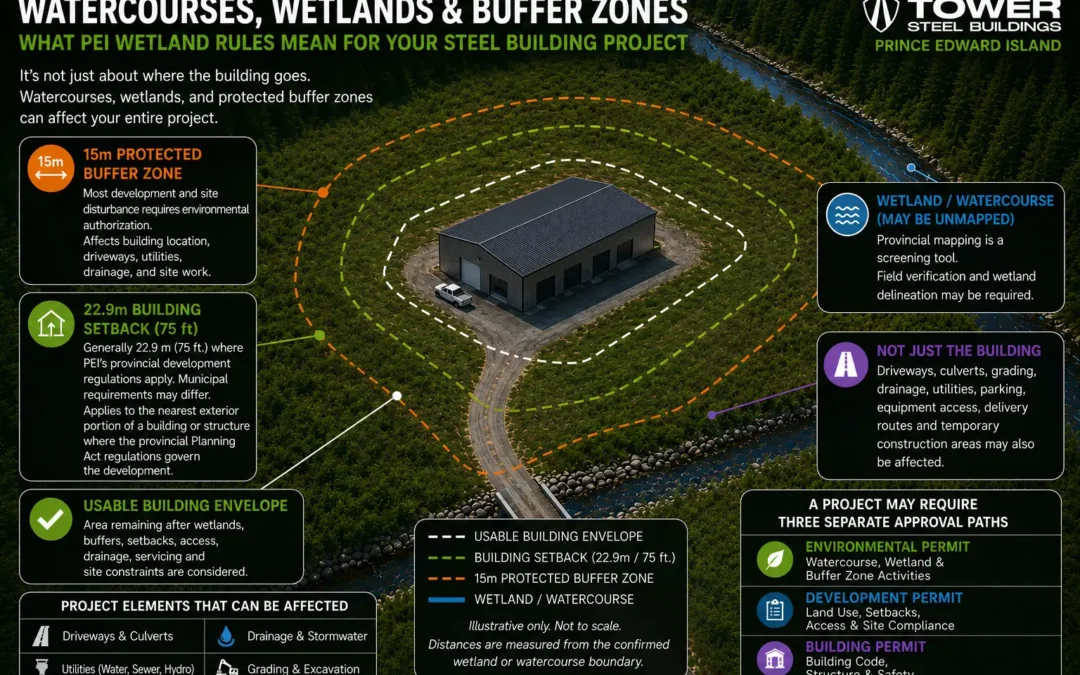
PEI protects watercourses, wetlands, and 15-metre buffer zones. Unmapped wetlands remain protected.
A project can encounter a serious approval problem where the building, driveway, fill, grading, drainage, utility route, culvert, or temporary access affects a protected area without the required authorization.
The issue may not be the building footprint itself.
Related work can trigger environmental review, including:
- Road or culvert construction
- Wetland alteration
- Fill or landscaping
- Tree removal
- Drainage outlets
- Temporary crossings
- Utility installation
A development or building application does not replace a separate Watercourse, Wetland and Buffer Zone Activity Permit.
Tower’s guide to watercourses, wetlands, buffer zones, and PEI steel building permits explains how environmental boundaries can affect the location, access, foundation assumptions, and site design.
Where a protected feature is discovered after engineering, the project may require:
- Field confirmation or delineation
- A revised site plan
- Environmental authorization
- Relocation of the building or driveway
- Revised grading and drainage
- Updated foundation and steel coordination
Environmental authorization does not confirm building-code compliance. The approval paths remain separate.
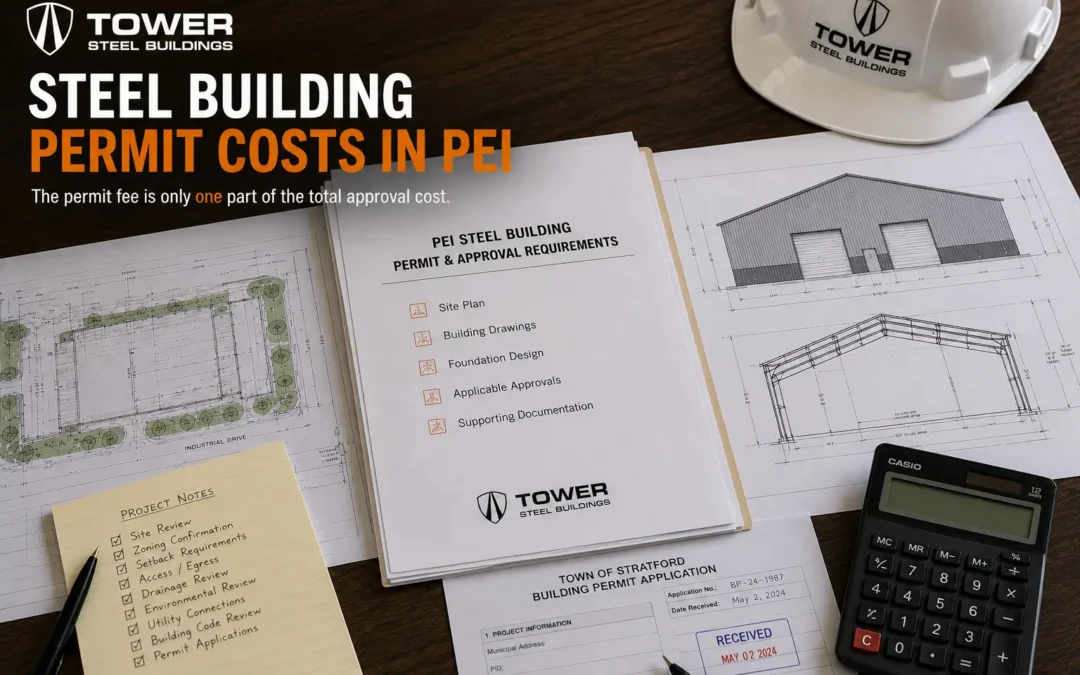
The Permit Package Is Incomplete
PEI’s provincial building-permit process identifies core plans such as:
- Foundation plans
- Elevations
- Floor plans
- Cross-sections
- Site plan
- Truss or structural-framing plan
Those documents may not be the entire package for every steel building.
Depending on the use, size, complexity, and site, the authority may also require:
- Structural calculations
- Professional declarations or undertakings
- Energy information
- Fire and life-safety details
- Accessibility information
- Mechanical, electrical, or plumbing information
- Fire-protection design
- Geotechnical or survey information
- Field-review commitments
- External approvals
An application may contain a file in every upload field and still fail technically because the documents do not establish compliance.
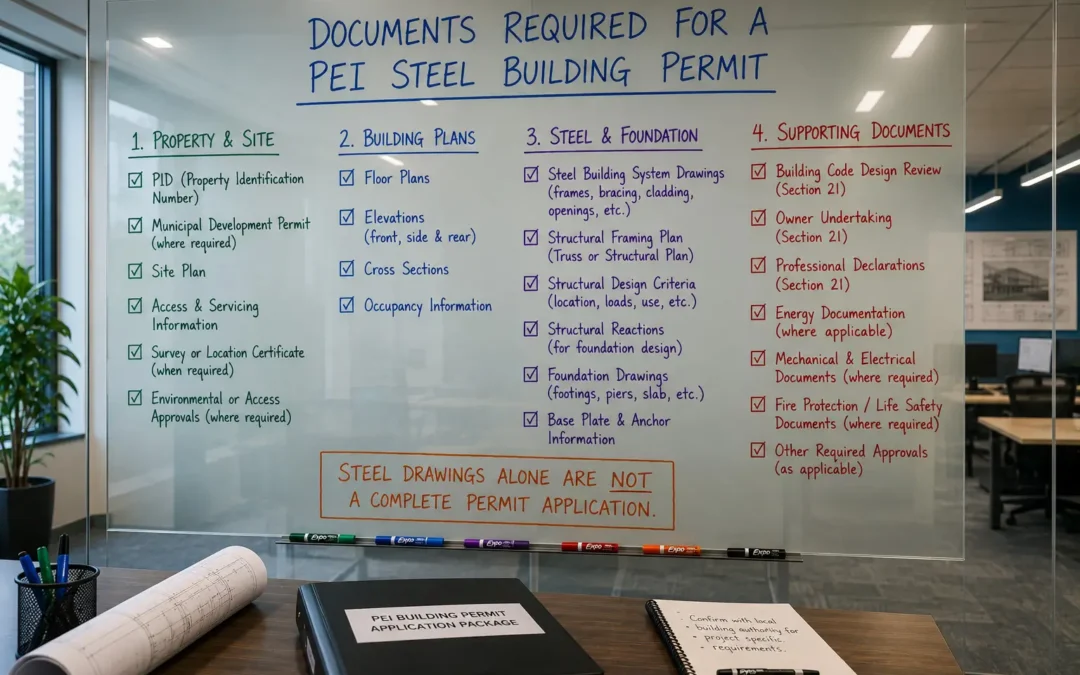
Tower’s guide to the documents required for a PEI steel building permit explains how the property, use, site plan, steel system, foundation, and professional documents must connect.
Supplier Drawings Are Treated as the Complete Permit Package
Steel-building-system drawings are important, but they do not automatically address every part of the permit review.
Depending on the written quotation, steel-system information may include:
- Building dimensions and frame spacing
- Bay layout and structural framing
- Bracing and openings
- Column grid
- Structural reactions
- Base plates and anchor geometry
- Project design criteria
- CSA A660 documentation where applicable
Those documents do not automatically replace:
- Development approval
- Site planning
- Foundation engineering
- Architectural or occupancy information
- Fire, accessibility, and energy documentation
- Mechanical, electrical, or plumbing design
- Environmental or highway approvals
A steel building can be properly engineered within the supplier’s scope and still be insufficient as a complete permit submission.
The authority reviews the entire project, not only the steel frame.
The Steel Building Is Not Designed for the Actual PEI Site
PEI adopted Tier 1 of the 2020 National Model Codes effective March 31, 2024, including the 2020 National Building Code of Canada and the 2020 National Energy Code for Buildings.
The steel building design must use the criteria applicable to the actual project.
Relevant inputs can include:
- Project location and use
- Importance category
- Snow, rain, and wind loads
- Exposure and roof slope
- Snow drifting
- Openings and bracing
- Mezzanine, crane, or collateral loads
- Solar equipment
- Interior ceilings or liners
Statements such as “engineered for Canada” or “designed for PEI” do not provide enough project-specific information for review.
The application may be unable to proceed where:
- The project location or design criteria are missing
- Generic loads were used
- Snow drifting was not addressed where applicable
- The occupancy differs from the design basis
- Large openings or equipment loads were added later
- The steel drawings remain preliminary
The site-specific design basis should be established before the steel system is released for permit or fabrication.
The Foundation Design Does Not Match the Steel System
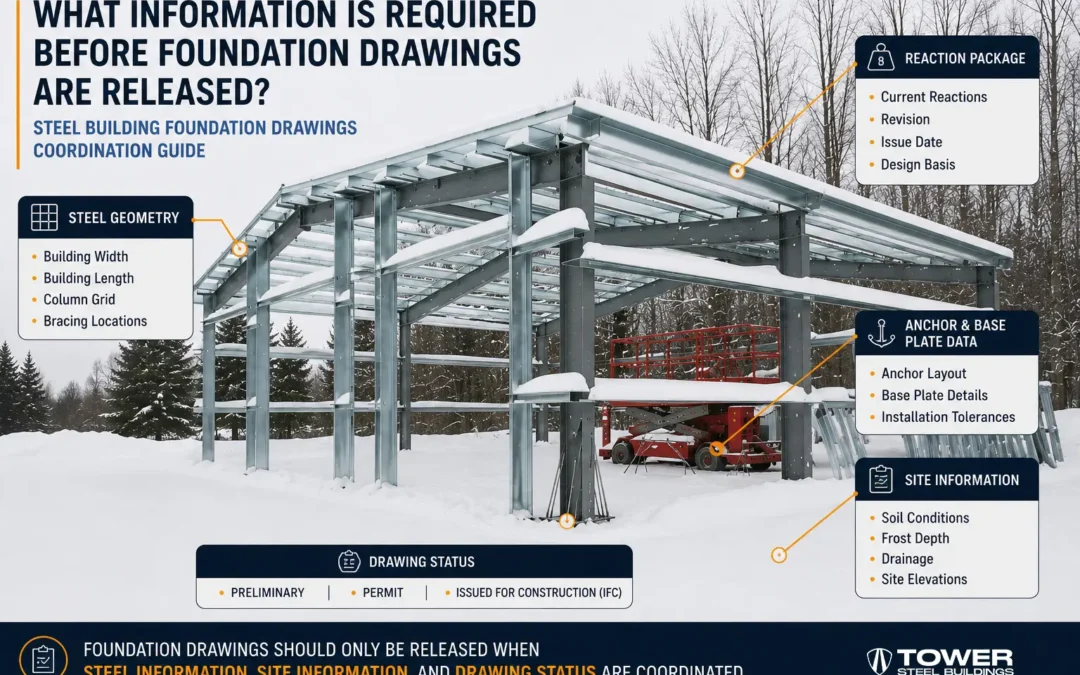
The steel frame and concrete foundation are separate professional scopes, but they must form one continuous load path.
Steel-system information can include:
- Column locations
- Vertical, lateral, uplift, and shear reactions
- Base-plate dimensions
- Anchor geometry
- Bracing locations
The foundation engineer must coordinate those inputs with:
- Soil-bearing capacity
- Frost and groundwater
- Concrete and reinforcement
- Footings, piers, or grade beams
- Slab use and elevation
- Drainage and site conditions
Permit review may fail where:
- Preliminary reactions were used
- Steel and foundation grids differ
- Base plates or anchors changed
- Bracing reactions are missing
- A mezzanine, crane, or equipment load was added
- Soil assumptions are unsupported
- The foundation is generic
- Current revisions were not coordinated
Tower’s steel building foundation-design guidance explains why reactions, anchors, soil, frost, drainage, and concrete design must remain aligned.
A permit reviewer should not have to decide which reaction set or drawing revision is valid. The guide to foundation drawings for steel buildings in PEI explains how drawing status, current reactions, anchors, site assumptions, professional authentication, construction release, and revision control should be resolved before concrete work proceeds.
Anchor Bolts and Base Plates Are Not Coordinated
The foundation drawings, anchor plan, base plates, and steel information should agree on:
- Quantity and diameter
- Spacing and embedment
- Projection and orientation
- Edge distances
- Column locations
- Concrete geometry
- Uplift and shear resistance
Substantial revision may be required where a generic anchor layout was used, steel and concrete dimensions differ, anchors conflict with reinforcement, or responsibility for anchor design is unclear.
Anchor bolts should not be ordered, positioned, or cast from preliminary information.
A field correction after concrete placement may require engineering, testing, revised details, or concrete alteration.
Professional Design Responsibility Is Missing or Unclear
PEI’s Building Codes Regulations contain professional-design, declaration, undertaking, inspection, and responsibility requirements.
Depending on the project, appropriate architects and professional engineers may be required.
A permit package may fail where:
- Required professional authentication is missing
- Structural responsibility is divided but not defined
- The steel engineer’s scope ends at the base plate and no one accepts responsibility for the foundation
- Architectural, structural, mechanical, or electrical scopes conflict
- Required declarations or undertakings are absent
- Field-review responsibility has not been assigned
- Design changes were made without professional review
The authority’s review does not transfer design responsibility to the building official.
The owner, constructor, prime consultant, and involved professionals retain their respective responsibilities.
| Scope | Responsible party |
| Site and development information | Owner, planner, surveyor, or qualified consultant |
| Architectural and code design | Architect or qualified designer where applicable |
| Steel building system | Steel-system engineer or supplier within written scope |
| Concrete foundation | Foundation engineer |
| Mechanical systems | Mechanical professional or licensed contractor as applicable |
| Electrical work | Licensed electrical contractor and professional where required |
| Plumbing | Licensed plumbing contractor and professional where required |
| Fire protection | Qualified fire-protection professional where required |
| Field reviews | Identified professionals within their respective scopes |
Unclear responsibility is not resolved by placing unrelated professional stamps in one submission.
Fire and Life-Safety Information Is Incomplete
Commercial, industrial, institutional, agricultural, storage, and mixed-use steel buildings can involve different fire and life-safety requirements.
The permit review may need information about:
- Occupancy and occupant load
- Exits and travel distance
- Fire separations and resistance ratings
- Spatial separation
- Fire department access
- Alarm or sprinkler systems
- Hazardous materials
- High-piled storage
- Emergency lighting and exit signage
A basic shell drawing may not provide this information.
The authority cannot verify fire and life safety while the owner has not defined who will use the building, what will be stored, whether repair or welding will occur, how storage racks will be arranged, or whether the building will contain offices, customers, or multiple tenancies.
Accessibility Requirements Are Missing
A commercial or public building cannot be treated as a private storage shed simply because both use steel framing.
Depending on the project, accessibility review may involve:
- Barrier-free entrances and routes
- Door widths and hardware
- Washrooms
- Parking
- Interior circulation
- Service counters
- Changes in elevation
- Signage and controls
The permit application may require revision where an office, customer area, employee facility, or public use is added after the shell layout was prepared.
Accessibility should be addressed during planning, before the openings, floor elevations, and foundation are finalized.
Energy-Code Information Is Missing or Based on the Wrong Use
PEI’s current permit framework includes the 2020 National Energy Code for Buildings where applicable.
A heated steel building may require coordinated information about:
- Wall, roof, slab, and foundation insulation
- Doors and windows
- Thermal bridging
- Air-barrier continuity
- Heating and ventilation
- Conditioned floor area
- Use and operating conditions
The application may fail when an unheated shell becomes heated, the envelope values are undocumented, large openings change, or the architectural, mechanical, energy, and steel documents do not agree.
Energy compliance is not established simply by stating that insulation or insulated panels are included.
The proposed assembly and applicable performance requirements must be demonstrated.
Trade and Equipment Requirements Are Unresolved
A building permit does not automatically authorize all electrical, plumbing, fuel, or regulated-equipment work.
Separate permits or approvals may apply to:
- Electrical work
- Plumbing
- LP gas
- Boilers
- Pressure vessels or pressure piping
- Fire-protection systems
- Other regulated equipment
A building application may be unable to proceed where the proposed operation depends on systems that remain undefined.
Examples include a repair building without ventilation information, a heated shop without a confirmed system, a public building without washroom design, or a processing facility without defined equipment loads and services.
Trade information should be developed early enough that it does not contradict the structural, architectural, energy, or foundation design.
The Drawings Do Not Match Each Other
Conflicting documents prevent the authority from identifying the project being proposed.
A permit package may contain a development site plan, building plans, steel drawings, structural calculations, reaction drawings, anchor plans, foundation drawings, energy documents, and trade designs.
The application may not proceed where:
- The site plan and steel drawings show different footprints
- Elevations use a different height
- Openings appear on only some drawings
- The foundation grid does not match the columns
- The energy documents use different door or window areas
- A mezzanine appears on only one plan
- Title blocks identify different locations
- Revision dates conflict
Every drawing does not need to repeat all information, but the documents cannot contradict each other.
One coordinated project set is stronger than a collection of individually complete drawings.
Review Comments Are Answered Without Correcting the Drawings
A written explanation does not always replace a drawing revision.
A resubmission may fail again when:
- The response says an issue was corrected but the drawing remains unchanged
- Only one affected document is revised
- Old and new documents are submitted together
- Structural calculations change but the plans do not
- New openings are added without revising the steel system
- Foundation changes are made without updated reactions
A controlled resubmission should include:
- A response to every review comment
- A revised drawing index
- Clear revision dates
- Identified changes
- Updated dependent documents
- Confirmation of superseded drawings
- One complete current package
Partial responses can lead to another review cycle or leave the authority unable to establish compliance.
The Project Changed After Approval or During Review
A permit decision is based on the submitted project.
Additional review may be required where changes affect:
- Use or occupancy
- Building size, height, or location
- Openings or bracing
- Foundations or anchors
- Fire safety or accessibility
- Energy performance
- Mechanical systems
- Drainage or access
- Environmental conditions
PEI’s Building Codes Regulations state that an owner must not deviate from the codes, regulations, or permit conditions without first obtaining written permission from the building official.
A permit is not general authorization to construct any version of the project.
Approved documents should remain available at the site, and changes should be processed through the authority and responsible professionals before the work proceeds.
Construction Started Before the Required Permits Were Issued
PEI states that construction can begin only after the applicable development and building permits have been received.
Starting early can create:
- An enforcement or work-suspension direction
- Additional charges where authorized
- Required exposure or removal of completed work
- Reinspection
- Engineering review of field conditions
- Revised foundation or anchor details
- Difficulty proving compliance
- Delayed occupancy
Payment, application submission, steel ordering, or contractor scheduling should not be treated as permit issuance.
Permission to proceed with partial excavation or construction should not be treated as approval for the remaining work or the project as a whole.
Proceed only within the exact written authorization issued by the responsible authority.
Ten Reasons a Steel Building Permit May Not Be Issued as Submitted
| Issue | What cannot be verified |
| Proposed use is not permitted | Land-use compliance |
| Development permit is missing or inconsistent | Approved use and building location |
| Site plan is incomplete | Setbacks, access, servicing, environmental features, and layout |
| Steel design is generic or preliminary | Site-specific structural compliance |
| Foundation does not match the steel system | Coordinated load transfer |
| Professional responsibility is unclear | Design accountability and required field review |
| Fire, accessibility, or energy information is incomplete | Building-code compliance |
| External approval is missing | Environmental, access, septic, or regulated-work compliance |
| Drawings conflict | The actual project being proposed |
| Review comments are only partly addressed | Whether identified deficiencies were corrected |
What to Do After a PEI Permit Is Rejected, Withheld, or Denied
Do not immediately order a different building or submit the same package again.
First determine the exact decision.
1. Request the Written Decision
Ask for:
- The decision type
- The authority responsible
- Outstanding requirements
- Relevant drawing references
- Identified code or planning concerns
- Whether the file remains open
- Whether a new application is required
- Whether revised documents can be submitted under the existing file
2. Separate Planning Issues From Building Issues
A land-use, access, or setback problem requires a different response from a steel-reaction, foundation, or fire-safety problem.
3. Assign Every Comment
| Review issue | Responsible party |
| Land use, variance, or development condition | Owner, planner, or municipality |
| Site plan or survey | Surveyor, planner, or civil consultant |
| Steel framing or reactions | Steel-system engineer |
| Foundation | Foundation engineer |
| Architectural or occupancy issue | Architect or qualified designer |
| Energy | Applicable energy professional |
| Mechanical, electrical, or plumbing | Respective professional or licensed trade |
| Environmental issue | Environmental consultant or owner |
| Access | Civil consultant, owner, or highway authority |
4. Confirm Whether the Project Must Change
A document correction is not enough where the use, building location, size, access, or site arrangement is not acceptable.
5. Revise Every Dependent Document
Changing the footprint, door, column, use, or site location can affect multiple drawings and professional scopes.
6. Resubmit One Controlled Package
Remove obsolete information and identify the current revision.
7. Do Not Fabricate or Pour Concrete Against Unresolved Drawings
A permit problem becomes more expensive after steel, concrete, foundations, or anchors have been committed.
Should You Revise the Application, Request a Review, or Appeal?
The correct route depends on the exact written decision.
Development-Permit Decisions
PEI’s Building and Development in PEI guidance states that interested parties generally have 21 days from the development-permit decision date to appeal to the Island Regulatory and Appeals Commission.
IRAC also states that not every Planning Act decision is appealable. The applicable right of appeal should be confirmed under the Act.
This Planning Act appeal route does not apply to building-permit decisions made under the Building Codes Act.
Before filing a development appeal:
- Read the written decision
- Confirm the decision date
- Determine whether the matter is appealable
- Confirm the filing and service requirements
- Consider whether a compliant revision is more practical
- Obtain planning or legal advice where appropriate
Building-Permit Decisions and Orders
The applicable review or appeal path depends on who made the decision and what type of decision or order was issued.
Under the PEI Building Codes Act, a person aggrieved by a qualifying decision of a building official, or by certain orders issued by a building official, may request a review by the Chief Building Official.
For a decision or order covered by section 24 of the Building Codes Act, the review request must be submitted in the approved form to the Chief Building Official within 10 days after receiving the decision or order.
The Chief Building Official reviews the matter, makes recommendations, and provides the recommendations and reasons to the original building official and the person who requested the review.
The building official whose decision or order was reviewed then confirms or varies it and gives notice to the person who requested the review.
A decision or order confirmed or varied through that process may be appealed to the Building Standards Council Appeal Board by serving the required notice within 30 days after receiving the decision or order.
Where the original decision or order was made by the Chief Building Official, it may be appealed to the Appeal Board in accordance with the Act.
The Appeal Board may confirm, revoke, or vary the decision or order.
Filing an appeal does not automatically suspend an order unless the chairperson of the Appeal Board or the chairperson of the Building Standards Council directs otherwise.
Because the available procedure and deadline depend on the exact written decision, promptly confirm:
- Who made the decision or issued the order
- Whether a Chief Building Official review is required first
- Whether the applicable deadline is 10 days or 30 days
- The required form and service procedure
- Whether the order remains in effect during the review or appeal
- Whether professional or legal advice is appropriate
An appeal is not a substitute for incomplete drawings, missing engineering, or an application that does not establish compliance.
Where the project clearly lacks required information, correcting the package may be more effective than disputing the decision.
How to Reduce the Risk Before Submission
Confirm the Permit Route
Identify both the development-permit and building-permit authorities.
Define the Actual Use
Describe what will happen inside and around the building, not only what the structure will look like.
Resolve Development Feasibility
Check land use, location, setbacks, access, parking, servicing, septic, and environmental conditions.
Stabilize the Building Design
Confirm dimensions, height, roof slope, openings, frame spacing, loads, bracing, and interior use.
Coordinate the Foundation
Use the current reactions, column grid, base plates, anchor geometry, and site information.
Identify Professional Responsibilities
Assign architectural, structural, foundation, energy, fire, mechanical, electrical, plumbing, and field-review responsibilities where applicable.
Review the Complete Document Set
Compare the use, location, dimensions, openings, grids, title blocks, and revision dates across every document.
Identify External Approvals
Confirm access, culvert, environmental, septic, trade, and equipment requirements.
Submit One Current Package
Remove obsolete documents and provide a clear drawing index.
Keep Fabrication and Concrete Decisions Aligned With Approval
Do not release work against unresolved preliminary information.
Tower’s PEI steel building permit application guide explains the wider submission sequence. Tower’s steel building permit checklist can also help identify missing site, engineering, foundation, and approval information before submission.
How Tower Steel Buildings Supports Permit Coordination
Tower Steel Buildings primarily supplies project-specific steel building kits and packages.
Depending on the written quotation, Tower may provide or coordinate steel-system information such as:
- Building dimensions
- Eave height and roof slope
- Frame spacing and bay layout
- Structural framing and bracing
- Openings
- Column grid
- Structural reactions
- Base plates and anchor geometry
- Steel-system drawings
- CSA A660 documentation where applicable
- Revisions affecting foundation inputs
This information can support the owner, permit applicant, foundation engineer, architect, site planner, and contractor.
Tower does not control:
- Development approval
- Building-permit approval
- Municipal or provincial decisions
- Zoning or variances
- Environmental authorization
- Highway access
- Septic approval
- Permit review or acceptance of the foundation design
- Trade permits
- Inspections
- Occupancy approval
- Reviews or appeals
These responsibilities remain separate unless expressly included in the written quotation or contract.
Reviewed by Engineering Team
This content has been reviewed by the Tower Steel Buildings Engineering Team.
The review focused on the technical and coordination conditions that can prevent a Prince Edward Island steel building permit from being issued as submitted.
A permit refusal does not necessarily mean that the steel framing system is structurally unsuitable. The unresolved issue may involve land use, building location, access, servicing, environmental constraints, foundation coordination, professional responsibility, fire and life safety, energy information or another approval outside the steel supplier’s scope.
The review also considered the difference between steel-building-system documents and a complete permit package. Steel drawings may establish framing, loads, reactions, base plates and anchor geometry within the supplier’s written scope. They do not automatically establish development compliance, site suitability, concrete foundation design, complete anchorage resistance, architectural compliance, trade design or permit approval.
Foundation drawings should use the current steel reactions, column grid, base plates and anchor information. When the steel design changes, the responsible professionals should determine whether the foundation, anchorage and permit documents must also be revised.
A controlled response should address the written decision, assign each issue and update every affected document. Resubmitting the same package or changing only one drawing can leave the original compliance problem unresolved.
Final development decisions, building-permit decisions, reviews, appeals and statutory interpretations remain with the applicable authorities, appointed professionals and legal advisers.
Official References
This guide was prepared using current information from:
- Government of Prince Edward Island, Building and Development in PEI
- Government of Prince Edward Island, Apply for a Development Permit
- Government of Prince Edward Island, Apply for a Building Permit
- Government of Prince Edward Island, Building Permit Application
- PEI Building Codes Act
- PEI Building Codes Regulations
- PEI Planning Act
- PEI Planning Act Subdivision and Development Regulations
- Government of Prince Edward Island, Building Standards Council Appeal Board
- Island Regulatory and Appeals Commission, Planning Appeal FAQs
- Government of Prince Edward Island, Entrance Way Permit Information
- Government of Prince Edward Island, Watercourse, Wetland and Buffer Zone Activity Permit
- Government of Prince Edward Island, Wetland Identification
- Government of Prince Edward Island, Wetland Delineation Information and Standards
Permit requirements, municipal procedures, regulations, appeal rights, and project-specific interpretations can change. Confirm the exact decision, current requirements, statutory deadline, and available review or appeal procedure directly with the responsible authority.
1. Does “Permit Rejected” Always Mean My PEI Application Was Formally Denied?
No. Applicants often use “rejected” to describe an incomplete application, request for revisions, withheld permit, unresolved external approval or formal denial.
Obtain the written status from the responsible authority before deciding what to do next. A correctable information request is different from a development-permit denial or an appealable building-permit decision or order.
2. Why Would a Steel Building Permit Not Be Issued in Prince Edward Island?
A permit may not be issued as submitted when the authority cannot verify the proposed land use, building location, development approval, site conditions, structural design, foundation, professional responsibility or compliance with applicable building requirements.
Missing external approvals, conflicting drawings, incomplete fire or accessibility information and unresolved environmental or access conditions can also prevent the application from proceeding.
3. Can Applying Through the Wrong Permit Authority Stop the Application?
Yes. The correct development-permit and building-permit authorities depend on the property location and municipal planning status.
Charlottetown, Stratford and Summerside administer their own development and building permits. Other projects may require municipal development approval followed by a provincial building permit. An application submitted through the wrong route may need to be redirected, supplemented or resubmitted.
4. Can a Missing Development Permit Stop a PEI Building Permit?
Yes. Most PEI construction projects require both development and building approval before construction begins.
The provincial building-permit application states that a building permit may be withheld until confirmation of the required development permit is provided. A building-permit application cannot correct an unresolved land-use, setback, access, servicing or site-location problem.
5. Can the Proposed Building Use Cause a Permit Denial?
Yes. A structurally acceptable building can still fail development or building review when its actual operation is not permitted or is not clearly described.
Terms such as garage, shop, warehouse or storage building may be insufficient. Commercial repair, welding, manufacturing, public access, offices, hazardous materials, high-piled storage, livestock or processing activities can change the land-use, occupancy, fire, accessibility, ventilation and servicing requirements.
6. Are Steel-Supplier Drawings Enough for a PEI Building Permit?
Not necessarily. Steel-building-system drawings may provide building geometry, framing, openings, design criteria, reactions, base plates and anchor information within the supplier’s scope.
A complete application may also require development approval, a site plan, project-specific foundation drawings, architectural information, fire and life-safety details, accessibility information, energy documentation, trade designs and separate environmental or highway approvals.
7. Why Must the Foundation Drawings Match the Final Steel Information?
The foundation engineer relies on the current structural reactions, column grid, base plates, anchor geometry and bracing information to design the concrete foundation.
If the steel dimensions, loads, openings, anchors or reactions change, the existing foundation design may no longer represent the final building. Preliminary steel information should not be used for final concrete construction without confirmation and coordination.
8. Can Missing Fire, Accessibility, Energy or Professional Information Prevent Approval?
Yes. Depending on the building’s size, use and complexity, the authority may require fire and life-safety information, accessibility details, energy documentation, professional authentication, declarations, undertakings or field-review commitments.
A basic steel shell drawing may not establish occupancy, exits, fire separations, barrier-free access, envelope performance or responsibility for the complete design.
9. Can Wetlands or Watercourses Prevent a PEI Steel Building Project From Proceeding?
Yes. The building, driveway, culvert, grading, fill, drainage, utilities or temporary construction access may affect a protected wetland, watercourse or 15-metre buffer.
Unmapped wetlands remain protected. The project may require field confirmation, delineation, environmental authorization, relocation or revised site, foundation and steel information before it can proceed.
10. Can a Driveway or Culvert Problem Stop Development Approval?
Yes. Access location, sight distance, highway approval, culvert requirements, truck turning, parking, grading and drainage can affect whether the proposed site plan is acceptable.
PEI requires the applicable entrance-way approval before a driveway culvert permit. A changed access location may also require revisions to the building orientation, overhead doors, loading area, drainage and site plan.
11. Can a Permit Be Withheld Because the Drawings Do Not Match?
Yes. Conflicting uses, dimensions, heights, building locations, openings, column grids, reactions, anchors, foundations or revision dates prevent the authority from confirming what project is being proposed.
Every resubmission should include one current coordinated package, a revision index, responses to the review comments and removal or clear identification of superseded documents.
12. What Should I Do After a PEI Steel Building Permit Is Rejected or Withheld?
First, obtain the written decision or information request and confirm whether the file is incomplete, withheld, denied or still under review.
Identify every outstanding item, assign it to the appropriate owner, designer, engineer, consultant or contractor, and revise every affected document. Do not release steel for fabrication or pour concrete against unresolved or preliminary information.
13. Should I Revise the Application or Appeal the Permit Decision?
That depends on the reason and legal status of the decision.
Where the application lacks drawings, engineering, approvals or coordinated information, correcting and resubmitting the package may be more practical than appealing. Where the dispute concerns an interpretation, order or decision that carries a review or appeal right, obtain professional or legal advice and follow the applicable statutory procedure.
An appeal does not replace missing or non-compliant project information.
14. How Long Do I Have to Challenge a PEI Permit Decision?
The deadline depends on the type of decision and who issued it.
Development-permit decisions generally have a 21-day appeal period to the Island Regulatory and Appeals Commission, although not every planning decision is necessarily appealable.
For a qualifying building-official decision or order covered by section 24 of the Building Codes Act, a review request must be submitted to the Chief Building Official within 10 days after receiving it. An applicable decision later confirmed or varied through that process, or a decision made directly by the Chief Building Official, may have a 30-day Appeal Board deadline.
Confirm the exact written decision, decision date, authority, form and service requirements immediately.
15. How Can I Reduce the Risk of a PEI Steel Building Permit Rejection?
Confirm the correct permit authorities, actual building use, development feasibility, site location, setbacks, access, servicing, environmental constraints and external approvals before finalizing the building.
Use final steel information, coordinate the foundation with the current reactions and anchors, assign all professional responsibilities and submit one complete drawing package that describes one consistent project.