A steel building can be properly engineered for Prince Edward Island snow, wind, structural loads, and intended use but still be unsuitable for the proposed property.
The problem may not be the steel building. It may be the usable area of the site.
A wetland, watercourse, protected buffer, driveway crossing, culvert, drainage outlet, or required development setback can affect where the building can be located and how it can be accessed, constructed, drained, serviced, and operated.
For a PEI steel building project, environmental constraints should be investigated before the building location is treated as fixed and before the steel package is released for final engineering or fabrication.
For broader permit-planning context, review the Steel Building Permits Prince Edward Island guide.
Sources reviewed: June 2026
Quick Answer
Prince Edward Island protects a 15-metre buffer around watercourses and wetlands, but that environmental buffer is not necessarily the minimum setback for the steel building itself.
Where PEI’s provincial Planning Act Subdivision and Development Regulations apply, the nearest exterior portion of a building or structure must generally be at least 75 feet, or 22.9 metres, from the inland boundary of a wetland or watercourse. Municipal bylaws and project-specific approval conditions may create different or additional requirements.
The two distances address different parts of the project:
| PEI requirement | Practical meaning |
| 15-metre environmental buffer | Regulated clearing, excavation, fill, equipment operation, structures, culverts, utilities, drainage work, or other disturbance within the buffer may require environmental authorization |
| 75-foot or 22.9-metre building setback | Generally controls how close the nearest exterior portion of a building or structure may be located where the provincial development regulations apply |
| Municipal and project-specific requirements | May add zoning, servicing, road, septic, drainage, access, or other site restrictions |
Neither distance can be measured reliably until the actual wetland or watercourse boundary has been established.
Provincial mapping is useful for early screening, but it does not prove that a property is free of wetlands. PEI confirms that unmapped wetlands receive the same legal protection as wetlands shown on the provincial inventory.
Why Watercourses and Wetlands Matter to a Steel Building Project
A steel building affects more than the ground directly below the columns, walls, and floor slab.
A complete project may require:
- Clearing and grubbing
- Excavation
- Imported fill
- Footings, piers, grade beams, and slabs
- Concrete aprons
- Driveways and roads
- Culverts or temporary crossings
- Parking and loading areas
- Utility trenches
- Drainage swales
- Roof-water outlets
- Equipment staging
- Crane or telehandler setup
- Delivery-truck access
Any of these activities can affect a watercourse, wetland, or protected buffer even when the building footprint appears to remain outside it.
For example, a building may fit on the upland portion of a property, but the only practical driveway may cross a regulated buffer. A drainage outlet may direct water toward a wetland. Imported fill may extend beyond the building pad. Construction equipment may need to operate inside an area that the permanent building avoids.
Environmental review should therefore consider the full construction and operating footprint, not only the four corners of the proposed building.
What Is a Watercourse in PEI?
A PEI watercourse is not limited to a large river or permanently flowing stream.
Under PEI’s Watercourse and Wetland Protection Regulations, a watercourse can include an area with a sediment bed that may or may not contain water.
Potential watercourses include:
- Streams
- Springs
- Creeks
- Brooks
- Rivers
- Lakes
- Ponds
- Bays
- Estuaries
- Coastal water bodies
A channel should not be dismissed because it is narrow, wooded, seasonal, modified, or dry during one site visit.
For a non-tidal watercourse, the relevant boundary is generally the edge of the sediment bed. For a tidal watercourse, it is generally the top of the bank or, where no discernible bank exists, the mean high-water mark.
Where a channel, depression, ditch, or drainage feature could affect the building, driveway, grading, culvert, utilities, or drainage design, its status should be confirmed through the applicable provincial process.
What Is a Wetland in PEI?
A wetland is not identified only by open water.
PEI’s Wetland Identification guidance describes three environmental parameters used when determining whether an area is a wetland:
- Hydric soil
- Hydrophytic, or water-tolerant, vegetation
- Wetland hydrology
A wooded or seasonally dry area may still meet the wetland criteria. Historical clearing, mowing, farming, vehicle travel, or other disturbance does not automatically remove its protected status.
Possible warning signs include:
- Poorly drained soil
- Saturated ground
- Low-lying terrain
- Water-tolerant plants
- Seasonal standing water
- Slow drainage after rainfall or snowmelt
- Grey or rust-coloured soil indicators
These observations may indicate that further investigation is required, but they do not replace a provincial determination or professional wetland delineation.
The 15-Metre Buffer Zone
PEI’s environmental regulations establish a 15-metre buffer around watercourses and wetlands.
For wetlands, provincial guidance explains that the buffer is measured from the edge of wetland vegetation.
It should not be measured from:
- The centre of the wet area
- The visible edge of standing water
- A line estimated from an online map
- A drainage ditch that has not been assessed
- A boundary selected by the owner or contractor
Work within a watercourse, wetland, or 15-metre buffer may require a Watercourse, Wetland and Buffer Zone Activity Permit unless a specific exemption or eligible licensed-contractor process applies.
A 15-Metre Buffer Is Not the Same as the Building Setback
The 15-metre environmental buffer and the development setback for the building are related but separate requirements.
The environmental buffer regulates activities near the protected feature. It may affect clearing, fill, excavation, equipment operation, culverts, drainage work, utilities, and temporary access.
The building setback regulates how close the proposed building or structure can be placed.
A project may satisfy one requirement and still fail the other.
Placing a steel building exactly 15 metres from a confirmed wetland boundary does not automatically make the building location acceptable.
Provincial Building Setback From a Wetland or Watercourse
Under section 39 of PEI’s Planning Act Subdivision and Development Regulations, the nearest exterior portion of a building or structure must generally be located at least 75 feet, or 22.9 metres, from the inland boundary of a wetland or watercourse where the provincial regulations apply.
The setback is measured to the nearest exterior portion of the proposed building or structure, not automatically to the column line or foundation wall. The controlling building element should be confirmed through the site plan and responsible development authority.
The regulations also allow a greater setback to be required where the standard distance is considered insufficient to protect the wetland or watercourse from adverse impacts of contaminants discharged from the proposed building or structure.
Municipal bylaws, road setbacks, septic requirements, drainage conditions, environmental approvals, and other site-specific restrictions may create additional limits.
Why Provincial Mapping Is Only a Screening Tool
PEI’s mapping systems can help identify known watercourses, wetlands, and environmental constraints during early property review.
However, a map showing no wetland does not prove that:
- The property contains no wetlands
- The mapped boundary is exact
- The 15-metre buffer has been plotted correctly
- The proposed building pad is suitable
- The driveway can be constructed without environmental approval
- Grading or drainage work is unrestricted
PEI states that unmapped wetlands receive the same legal protection as mapped wetlands.
The property should be walked during the planning stage. Areas showing possible wetland conditions should be investigated before the project relies on a particular building location.
A buyer following the PEI steel building permit application process should address environmental constraints during site planning, not after the structural and foundation drawings are complete.
When Is a Wetland Delineation Required?
A wetland delineation may be required when a proposed residential, commercial, industrial, agricultural, subdivision, clearing, or other activity will affect or is likely to affect a wetland.
PEI’s current Wetland Delineation Information and Standards explain that the provincial process may begin with:
- Review of provincial mapping and property information
- Photographs or other information supplied by the owner
- A desktop assessment
- A site inspection where necessary
- A decision on whether a boundary determination or formal delineation is required
Wetland status must ultimately be determined on the ground by government staff and/or an appropriately trained wetland delineator.
Wetlands of Approximately 0.5 Hectares or Less
Current provincial guidance states that PEI staff may carry out a boundary determination for a wetland of approximately 0.5 hectares or less.
This process does not provide the owner with a complete private wetland delineation report.
The owner may still need suitable boundary and site information for:
- Development applications
- Environmental permit applications
- Site planning
- Foundation design
- Grading and drainage
- Construction layout
Wetlands Larger Than Approximately 0.5 Hectares
For wetlands larger than approximately 0.5 hectares, the landowner or developer must generally retain a trained wetland delineator and pay the associated cost.
The delineation must be completed by a person with the required wetland-delineation training.
The resulting report must be submitted to the province for review and approval. A field assessment should not be treated as an accepted boundary merely because the delineator has finished the site visit.
Provincial guidance states that an approved delineation will generally be valid for five years.
Wetland Delineation Timing and Seasonal Limits
PEI’s recognized wetland-delineation period is June 1 to September 30.
A delineator proposing to work more than two weeks outside this period must obtain provincial pre-approval.
A delineation completed more than two weeks outside the recognized period without pre-approval may be rejected without review.
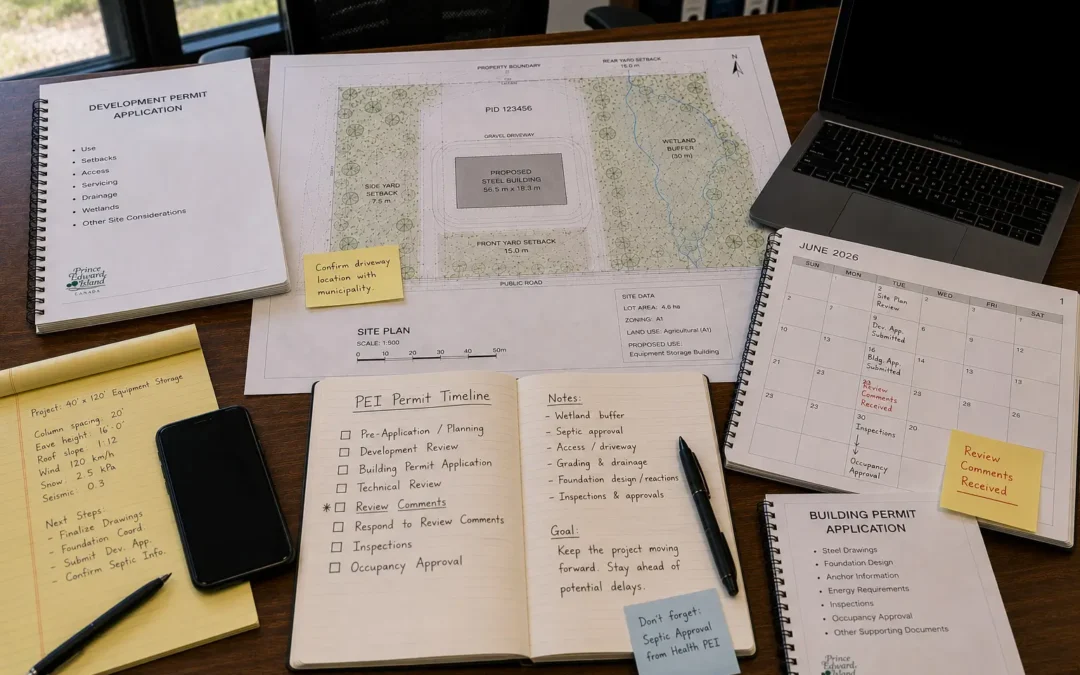
The broader PEI steel building permit timeline should account for seasonal delineation work, provincial environmental review, site-plan revisions, permit coordination, and any resulting steel or foundation changes.
A project that starts site planning late in the year may therefore need to account for:
- Seasonal fieldwork
- Consultant availability
- Report preparation
- Provincial review
- Site-plan revisions
- Permit revisions
- Steel and foundation changes
What Work Requires a Watercourse, Wetland and Buffer Zone Activity Permit?
PEI generally requires an activity permit before regulated work is carried out in a watercourse, wetland, or 15-metre buffer unless a specific exemption or eligible licensed-contractor process applies.
Potential permit triggers for a steel building project include:
- Excavating or disturbing soil
- Depositing or removing fill
- Altering vegetation
- Cutting live trees or shrubs
- Constructing a driveway or road
- Installing or repairing a culvert
- Creating a temporary crossing
- Trenching for utilities
- Installing a drainage outlet
- Constructing or removing a structure
- Operating vehicles or heavy equipment in the regulated area
- Altering a wetland edge or watercourse
The permit is activity-specific.
PEI’s application process directs applicants to submit a separate application for each activity. Approval of one activity should not be treated as permission for unrelated work elsewhere on the property.
What Activities May Not Require Environmental Approval?
PEI’s regulations and public guidance identify limited buffer-zone activities that may be completed without an activity permit, including:
- Cutting dead trees or pruning live trees using hand-held tools and manual labour, provided no other prohibited activity occurs
- Planting grass, trees, or shrubs using only hand tools, provided no other prohibited activity occurs
- Mowing existing grass
These limited exemptions do not create general permission to prepare a construction site.
They do not automatically authorize:
- Mechanized land clearing
- Excavation
- Imported fill
- Building-pad construction
- New driveway work
- Utility trenching
- Drainage alteration
- Heavy-equipment operation
The permit requirement should be confirmed before work extends beyond the limited exempt activity.
Licensed-Contractor Notification Route
PEI’s Contractor Earth-Mover Licensing Program permits qualified contractors to use an expedited notification process for a limited list of eligible activities.
The current eligible activities include:
- Shoreline stabilization
- Landscaping in a buffer zone
- Operation of machinery on a beach or shoreline
- Minor bridge repairs
The company must hold an Activity Business Licence, and the person supervising the work must hold the required Activity Certificate.
The contractor must register the individual project with the province. Work may begin only after the department acknowledges that the registration has been received.
Hiring an excavator, landscaper, or general contractor does not automatically make the work eligible.
A new steel building pad, driveway, utility trench, culvert, or broad grading operation should not be assumed to qualify. The contractor credentials, activity type, registration, acknowledgement, and construction conditions must be verified.
How Long Does a PEI Wetland Activity Permit Take?
PEI advises applicants to submit the activity-permit application at least six weeks before the anticipated project start date.
The province states that processing typically takes at least six weeks.
Additional time may be required where:
- The wetland or watercourse boundary is uncertain
- The application is incomplete
- Engineered information is required
- Several activities are proposed
- Environmental effects require additional review
- The site sketch does not accurately describe the work
- Provincial staff require more information or a site inspection
Submitting an application and paying the fee do not authorize work.
Do not schedule clearing, excavation, culvert installation, foundation construction, steel delivery, or erection on the assumption that the environmental permit will be approved by a preferred date.
One Project May Require Three Separate Approvals
A PEI Watercourse, Wetland and Buffer Zone Activity Permit does not replace a development permit or building permit.
Each approval answers a different question.
Environmental Activity Permit
The environmental permit addresses regulated activity in a watercourse, wetland, or protected 15-metre buffer.
It may control:
- Clearing
- Soil disturbance
- Fill
- Culverts and crossings
- Drainage outlets
- Equipment operation
- Vegetation removal
- Temporary access
- Work methods
- Erosion and sediment controls
Development Permit
A development permit addresses whether the project is acceptable on the property.
It may review:
- Proposed land use
- Building location
- Setbacks
- Access
- Parking and loading
- Water and sewer servicing
- Septic and well arrangements
- Environmental constraints
- Existing buildings
- Site slope
- Other land-use requirements
PEI’s official development-permit service requires applicants to identify relevant site features such as wetlands, watercourses, streams, waterfront top of bank, and sand dunes.
For a fuller explanation of the two approval systems, review Development Permit vs Building Permit in PEI.
Building Permit
A building permit addresses how the proposed building will be designed and constructed.
It may review:
- Building use and occupancy
- Floor plans and elevations
- Structural framing
- Foundation design
- Anchors and base plates
- Fire and life safety
- Energy compliance
- Accessibility
- Professional design
- Inspections
- Occupancy requirements
Completion or acceptance of the steel drawings, and issuance of a building permit, do not authorize disturbance of a protected environmental area.
Environmental approval also does not confirm that the steel building complies with the applicable building-code requirements.
Who Issues the Permits?
The responsible permit authority depends on the property.
Charlottetown, Stratford, Summerside, and St. Felix issue building permits for projects within their municipal boundaries.
Municipalities with an official plan and land-use bylaws generally issue their own development permits.
For other locations, the provincial Lands Division generally issues the building permit and may also issue the development permit depending on the municipality’s planning status.
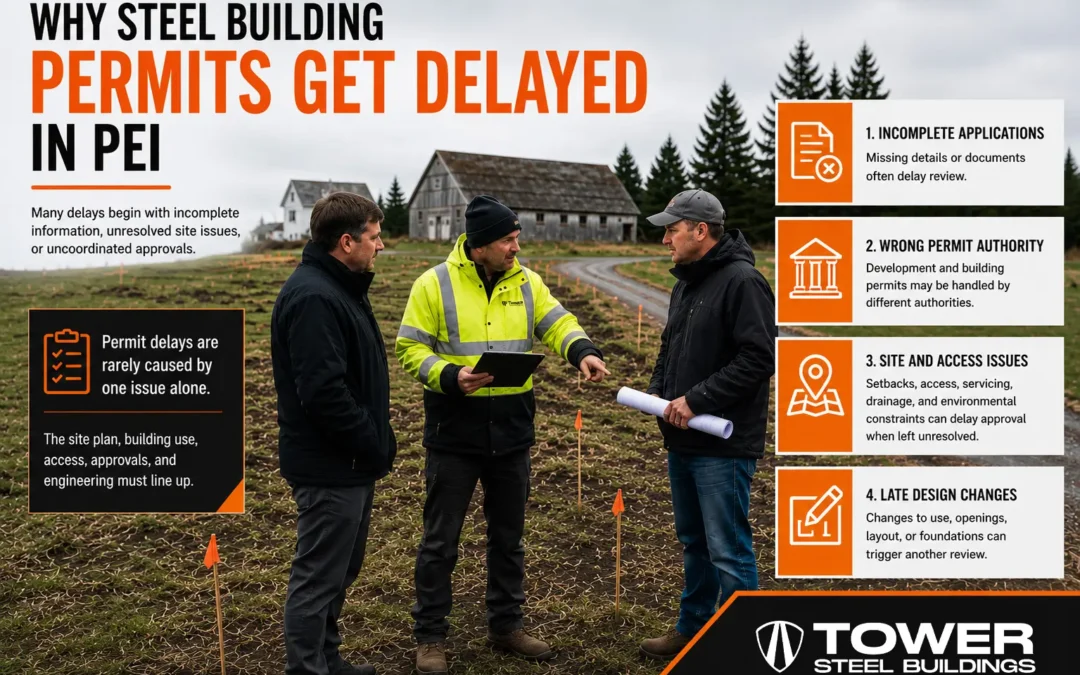
Confirm both authorities for the property before preparing the applications. The Municipal vs Provincial Lands Division Steel Building Permits in PEI guide explains the routing differences in more detail.
What Documents Are Required for the Activity-Permit Application?
PEI’s online activity-permit service identifies the following supporting information:
- A location map, such as an aerial image or GIS map
- Pre-construction colour photographs
- A sketch showing the proposed work, dimensions, and construction details
- A written description of the activity
Depending on the proposed work, engineered drawings and an erosion and sediment-control plan may also be relevant.
The applicant must also have the registered property owner’s authorization when applying on the owner’s behalf.
The Sketch Should Show More Than the Building Footprint
For a steel building project, the environmental sketch should show the complete activity that could affect the protected area.
Relevant information may include:
- Confirmed wetland or watercourse boundary
- The 15-metre buffer
- Proposed building and foundation
- Driveway
- Culvert or crossing
- Parking and loading
- Fill limits
- Excavation limits
- Utility routes
- Drainage swales
- Outlet points
- Temporary construction access
- Equipment working areas
- Erosion and sediment controls
A rectangle labelled “new steel building” is not enough when the regulated work occurs around the building.
The environmental authority, development authority, foundation engineer, steel supplier, and contractor should all be working from the same current site information.
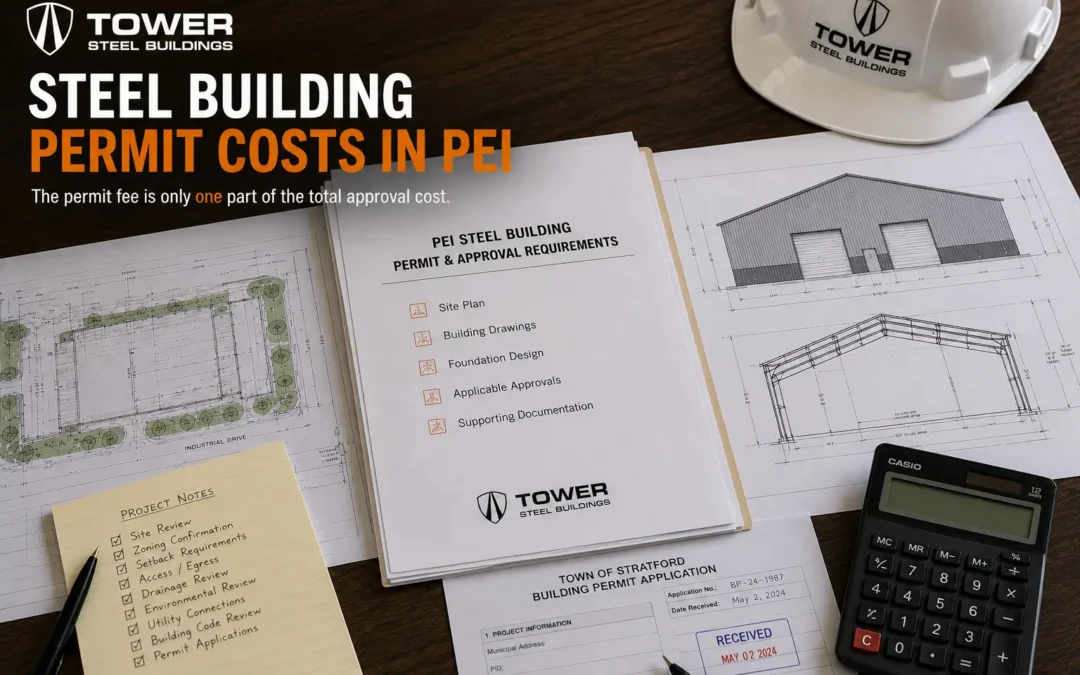
For the broader permit document package, see Documents Required for a Steel Building Permit in PEI.
How Environmental Constraints Affect the Steel Building Location
A wetland or watercourse can reduce the practical building area much more than a buyer expects.
The project may also need room for:
- Property-line and road setbacks
- Septic system and well
- Parking and loading
- Truck turning
- Fire access
- Snow storage
- Drainage
- Utilities
- Delivery access
- Crane or telehandler setup
- Foundation excavation
- Future maintenance
A large rural property can therefore have a much smaller usable building envelope.
Before fixing the steel building dimensions, confirm that the site has enough room for:
- The complete structure
- Exterior projections
- Door approaches
- Concrete aprons
- Foundation work
- Delivery vehicles
- Erection equipment
- Operational access
A building that appears to fit on an online map may not fit after the protected boundary, environmental buffer, development setback, access, and operational space are accurately plotted.
Driveways, Culverts, and Crossings
The steel building may remain outside the protected area while the access route creates the environmental issue.
A driveway may require:
- Vegetation removal
- Imported fill
- Ditch work
- Culvert installation
- Stream or wetland crossing
- Grading
- Heavy-equipment operation
PEI’s activity-permit service identifies road construction, new culverts, culvert repairs, bridges, and temporary crossings as regulated activity types.
A driveway connecting to a provincial highway may also require separate access approval.
Environmental authorization does not replace highway-access approval, and highway approval does not authorize work in a wetland, watercourse, or protected buffer.
The access route should be established before fixing:
- Building orientation
- Overhead-door locations
- Loading side
- Truck-turning area
- Delivery route
- Crane or telehandler access
Grading, Fill, and Stormwater
A steel building normally requires positive drainage away from the foundation.
The site work may include:
- Imported granular fill
- Cut-and-fill grading
- Foundation excavation
- Perimeter drainage
- Swales
- Eavestroughs and downspouts
- Stable outlet areas
- Parking or loading runoff controls
- Erosion and sediment protection
A large steel roof can collect substantial water during rainfall and snowmelt. Concentrating that runoff toward a wetland, watercourse, neighbouring property, unstable slope, or foundation can create environmental and building-performance problems.
Do not assume that roof or parking runoff can be discharged toward a protected feature.
The drainage direction, outlet location, erosion protection, site elevations, and required environmental authorization should be confirmed for the actual project.
Review the drainage and grading mistakes that delay steel buildings before finalizing roof-water outlets, swales, imported fill, exterior grades, parking runoff, and discharge paths near a protected feature.
The environmental plan, grading information, and foundation design should use the same approved boundaries and elevations.
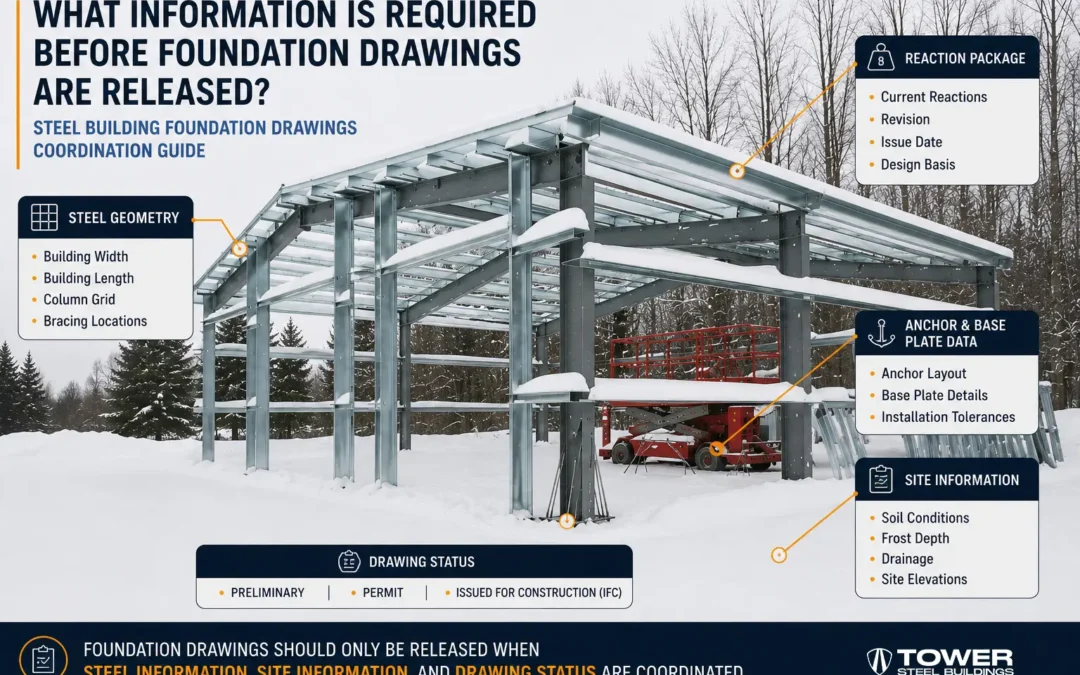
If those boundaries, elevations, soil assumptions, or drainage conditions change, the foundation drawings for the PEI steel building should be reviewed against the current steel reactions, foundation inputs, and construction elevations before concrete work is released.
Soil, Groundwater, and Foundation Risk Near Wetlands
Remaining outside the wetland boundary does not establish suitable foundation conditions.
Land near wetlands can contain:
- High groundwater
- Organic or compressible soil
- Poor drainage
- Frost-susceptible material
- Variable fill
- Low bearing resistance
- Settlement risk
- Difficult construction access
A steel building transfers concentrated structural reactions through its columns, base plates, anchors, and foundation system.
Depending on the project, the foundation engineer may require:
- Test pits
- Boreholes
- Groundwater observations
- Geotechnical recommendations
- Engineered fill
- Frost-protection measures
- Site-specific drainage design
Moving the building away from a wetland can place it on different soil or at a different elevation. The original foundation assumptions should not be reused automatically.
Tower’s steel building foundation-design service explains why structural reactions, column locations, anchors, soil conditions, frost protection, drainage, and concrete design must remain coordinated.
Construction Access and Temporary Disturbance
Environmental limits apply to the work required to construct the building, not only the completed development.
Temporary disturbance can include:
- Crane or telehandler setup
- Steel delivery
- Equipment travel
- Material storage
- Spoil placement
- Dewatering
- Temporary roads
- Temporary crossings
- Construction drainage
- Erosion and sediment controls
A site plan that protects the permanent building but directs equipment through a regulated buffer does not describe the actual construction process.
Before mobilization, contractors should receive:
- Approved environmental permit
- Approved activity sketch
- Current site plan
- Clearly marked buffer
- Limits of disturbance
- Erosion-control requirements
- Prohibited equipment areas
- Current drawing revisions
Can a Farm Steel Building Ignore Wetland Rules?
No blanket environmental exemption applies because a property is agricultural or the proposed structure is described as a farm building.
The exact activity, land use, environmental feature, equipment, and regulatory provision must be considered.
A farm steel building project may still require:
- Environmental activity authorization
- Development approval
- Highway-access approval
- Septic or servicing approval
- Electrical or other trade permits
- Site-specific foundation design
- Other property-related approvals
Agricultural use should not be treated as permission to begin clearing, fill placement, culvert installation, ditch work, or building construction near a protected area without confirming the requirements.
What Happens if an Unmapped Wetland Is Found After Design?
Stop treating the original building location as final.
The project team may need to:
- Prevent further disturbance of the affected area.
- Contact the responsible provincial environmental section.
- Determine whether an inspection or delineation is required.
- Establish the wetland boundary and 15-metre buffer.
- Recheck the applicable building setback.
- Reassess the building, driveway, grading, drainage, and utilities.
- Revise environmental or development applications.
- Update steel drawings and structural reactions where the building changes.
- Redesign the foundation where location or soil conditions change.
- Confirm that every authority and contractor is using the same revision.
A relocation can affect:
- Frame layout
- Door locations
- Structural reactions
- Foundation elevations
- Wind exposure
- Snow accumulation
- Drainage
- Delivery access
- Erection planning
Changing only the building footprint on the site plan is not sufficient.
Can the Environmental Permit Be Tracked or Appealed?
PEI provides an online Watercourse, Wetland and Buffer Zone Activity Permit Status service.
The service displays approved and denied permits processed after May 15, 2024. It also displays whether a Contractor Licensing Program notification has been registered.
PEI states that appeals to the Island Regulatory and Appeals Commission must be filed within 21 days of the decision in question.
Anyone considering an appeal should immediately confirm:
- Whether the person has standing to appeal
- The date the appeal period begins
- The final filing date
- Required documents
- Current IRAC procedures
This article provides general project-planning information and is not legal advice.
Common PEI Steel Building Mistakes Near Wetlands and Watercourses
1. Treating the Online Map as Final
Provincial mapping is a screening tool. Unmapped wetlands receive the same legal protection as mapped wetlands.
2. Confusing the 15-Metre Buffer With the Building Setback
The environmental buffer and the 75-foot or 22.9-metre building setback control different aspects of the project.
3. Reviewing Only the Building Footprint
Driveways, culverts, fill, grading, utilities, drainage, parking, equipment travel, and temporary construction access can also trigger review.
4. Leaving the Driveway Until Later
The building may fit while the only workable access route crosses the protected area.
5. Starting Work Before Authorization
Submitting an application, paying a fee, or hiring a contractor does not automatically authorize work.
6. Releasing Fabrication Before the Site Is Stable
A location change can affect dimensions, openings, frame layout, reactions, foundations, anchors, delivery, and erection.
PEI Environmental and Permit Coordination Checklist
| Coordination area | What should be confirmed |
| Protected features | Watercourse, wetland, confirmed boundary, and 15-metre buffer |
| Development envelope | Applicable building setback, property lines, zoning, roads, septic, and usable building area |
| Site work | Driveway, culvert, grading, fill, utilities, drainage, temporary access, and equipment limits |
| Building coordination | Dimensions, orientation, openings, foundation, structural reactions, delivery, and erection access |
| Approvals | Environmental permit, development permit, building permit, conditions, and approved drawing revisions |
Preliminary pricing can begin before every approval has been issued, provided the assumptions and unresolved site conditions are clearly identified.
Before submission or fabrication, Tower’s steel building permit checklist can help identify gaps between the site plan, steel package, foundation information, and permit documents.
How Tower Steel Buildings Supports Environmental Site Coordination
Tower Steel Buildings primarily supplies project-specific steel building kits and packages.
Depending on the written quotation, Tower may provide or coordinate steel-system information such as:
- Building width and length
- Eave height
- Roof slope
- Frame spacing and bay layout
- Door and window openings
- Column grid
- Steel-building-system drawings
- Structural reactions
- Base-plate information
- Anchor-layout information
- Revisions affecting foundation inputs
- Delivery or erection information where quoted
This information can support coordination among the owner, site planner, foundation engineer, permit team, and contractor.
Tower does not automatically provide:
- Wetland identification
- Wetland delineation
- Environmental activity permits
- Legal boundary surveys
- Civil site plans
- Grading plans
- Stormwater design
- Erosion-control plans
- Culvert or road approval
- Septic design
- Development-permit approval
- Building-permit approval
These services remain separate unless expressly included in the written quotation or contract.
Reviewed by Engineering Team
This content has been reviewed by the Tower Steel Buildings Engineering Team.
The review focused on how watercourses, wetlands, protected buffers and development setbacks can affect the practical location, access and construction of a Prince Edward Island steel building.
The project footprint includes more than the walls and foundation. Driveways, culverts, parking, loading, imported fill, grading, utility trenches, drainage outlets, equipment staging, steel delivery and temporary construction access may extend into areas that the completed building avoids.
The review also considered the difference between the protected 15 m environmental buffer and the separate building setback that generally applies where PEI’s provincial development regulations govern the property. These distances should be established from the confirmed wetland or watercourse boundary rather than estimated from visible water, aerial photography or an unverified mapping line.
Changes to the usable project area can also affect the steel package. Moving or rotating the building may change the footprint, openings, frame arrangement, structural reactions, foundation elevations, drainage, delivery route and erection plan. The site plan, steel documents, foundation information and approval packages should remain aligned after any environmental boundary or permit condition changes.
This review does not determine the wetland boundary, approve regulated activity or establish the final building location for a specific property. Those decisions remain with the applicable PEI authorities, trained delineators and qualified project professionals.
Official References
This article was prepared using current information from:
- PEI Watercourse and Wetland Protection Regulations
- PEI Planning Act Subdivision and Development Regulations
- PEI Wetland Identification
- PEI Wetland Delineation Information and Standards
- Apply for a Watercourse, Wetland and Buffer Zone Activity Permit
- PEI Contractor Earth-Mover Licensing Program
- Apply for a PEI Development Permit
- Apply for a PEI Building Permit
- Building and Development in PEI
- Watercourse, Wetland and Buffer Zone Activity Permit Status
Regulations, operational guidance, municipal bylaws, and project conditions can change. Property owners should confirm current requirements with the responsible PEI authority and qualified project professionals before beginning work.
1. What Is the Required Wetland Buffer in Prince Edward Island?
PEI protects a 15-metre buffer around wetlands. Provincial guidance describes it as a no-development buffer, although limited exempt or authorized activities may still be permitted. The buffer is measured from the confirmed wetland boundary, identified in provincial guidance as the edge of wetland vegetation.
2. Is There Also a 15-Metre Buffer Around PEI Watercourses?
Yes. PEI's environmental regulations establish a 15-metre buffer around watercourses and wetlands. Regulated activity within that area may require environmental authorization before work begins.
3. How Far Must a Steel Building Be From a Wetland or Watercourse in PEI?
Where PEI's provincial Subdivision and Development Regulations apply, the nearest exterior portion of a building or structure must generally be at least 75 feet, or 22.9 metres, from the inland boundary of the wetland or watercourse. Municipal or project-specific requirements may create additional restrictions.
4. Is the 15-Metre Buffer the Same as the 22.9-Metre Building Setback?
No. The 15-metre buffer regulates activity near the protected environmental feature. The 22.9-metre distance generally controls the building location where the provincial development regulations apply. A project may need to comply with both.
5. Are Unmapped Wetlands Protected in PEI?
Yes. PEI states that wetlands not shown on the provincial inventory receive the same legal protection as mapped wetlands. Provincial mapping should be used for early screening, followed by on-site confirmation where conditions are uncertain.
6. How Is a PEI Wetland Boundary Confirmed?
The process may involve provincial mapping, photographs, desktop review, a site inspection, a provincial boundary determination, or a delineation completed by a trained wetland delineator. The required process depends on the site and proposed activity.
7. When Is a Private Wetland Delineator Required in PEI?
Current PEI guidance states that provincial staff may determine the boundary of a wetland of approximately 0.5 hectares or less. For wetlands larger than approximately 0.5 hectares, the owner or developer must generally retain and pay a trained wetland delineator.
8. Can a Driveway or Culvert Require an Activity Permit?
Yes. Road construction, culvert work, bridges, and temporary crossings are identified activity types under PEI's permit process. A separate highway-access permit may also be required.
9. Can a Licensed Contractor Begin Work Without a Regular Activity Permit?
Only for activities eligible under PEI's Contractor Licensing Program. The company and supervisor must hold the required credentials, the activity must qualify, the project must be registered, and the province must acknowledge the registration before work begins.
10. Can Work Begin While the Environmental Permit Is Being Reviewed?
No. Submitting the application and paying the fee do not authorize work. Construction can begin only after the required activity permit or qualifying contractor acknowledgement has been received.
11. Does Farm Status Exempt a Steel Building From PEI Wetland Requirements?
No. Agricultural ownership or use does not create a general exemption from PEI's environmental protection requirements. The exact activity and applicable authorization must be confirmed.
12. How Long Does a PEI Watercourse, Wetland and Buffer Zone Activity Permit Take?
PEI advises submitting the application at least six weeks before the anticipated project start and states that processing typically takes at least six weeks. Additional time may be required when the boundary, activity, engineered details, or environmental effects require further review.