How long does it take to obtain a steel building permit in Prince Edward Island?
There is no single guaranteed approval time for every steel building project.
The total timeline depends on:
- Property location
- Development- and building-permit authorities
- Proposed use
- Zoning and site constraints
- Application completeness
- Steel and foundation documents
- Required professional design
- Environmental, access, septic, and servicing approvals
- Review comments
- Applicant response time
- Changes made during review
The permit authority’s review period is only one part of the schedule. Time spent confirming the site, preparing drawings, coordinating engineering, obtaining outside approvals, responding to comments, completing inspections, and securing occupancy approval also affects when the building can be used.
Quick Answer
PEI does not guarantee one approval timeline for commercial, agricultural, industrial, or other steel buildings.
The provincial government states that some routine residential development decisions and routine residential building permits may be issued within 30 days after full payment is received. That benchmark is not specific to steel buildings and is not a guaranteed deadline.
A complete and coordinated steel building application may move through review in several weeks. A project involving zoning, municipal decisions, wetlands, highway access, septic systems, incomplete engineering, or repeated revisions can take substantially longer.
| Project Stage | What Controls the Timeline? |
| Permit-authority confirmation | Property location, municipal boundary, and local planning authority |
| Site and land-use planning | Proposed use, zoning, setbacks, access, servicing, wetlands, and drainage |
| Development application | PID, site plan, property information, approvals, and application completeness |
| Development review | Planning complexity, inspections, referrals, and revisions |
| Steel-building design | Final dimensions, height, openings, loads, and supplier scope |
| Foundation coordination | Current reactions, column grid, anchors, soil, frost, drainage, and elevations |
| Building application | Complete plans, professional documents, energy information, and development approval |
| Technical review | Code pathway, structure, foundation, fire safety, accessibility, and completeness |
| Resubmission | Speed and accuracy of applicant and consultant responses |
| Construction and occupancy | Inspections, field reviews, corrections, trade approvals, and completion documents |
Published PEI Permit Timelines and Their Limits
Published timing figures must be read with their qualifications.
| Authority | Published Timing Information | What It Does Not Mean |
| Provincial development permit | Some routine residential decisions may be issued within 30 days after full payment | It is not a guaranteed timeline for commercial, agricultural, or industrial steel-building development |
| Provincial building permit | A routine residential building permit may be issued within 30 days after full payment | It is not a statutory deadline or a universal steel-building approval period |
| Provincial 2024-2025 average | Average of 20 calendar days for approved routine residential development permits and 24 calendar days for approved provincial building permits | Municipal permits are excluded, statistical outliers were excluded, and the figures do not guarantee future processing time |
| Stratford | Certain building permits are normally issued within 10 to 15 business days after all supporting documents are received | The estimate should not be applied automatically to every commercial or engineered steel building |
| Summerside | Code review usually takes a few days after other approvals are obtained and all required plans are submitted | It does not include time for zoning changes, subdivision, Council involvement, public consultation, incomplete plans, or revisions |
| Charlottetown | No universal steel-building approval period should be assumed | A current estimate should be obtained for the actual application |
| St. Felix | No universal steel-building approval period should be assumed | Application requirements and current timing should be confirmed directly |
The provincial development-permit service and building-permit service both state that processing begins after full payment and varies with the proposed work and required assessments.
PEI’s 2024-2025 housing progress report reports the 20-day and 24-day provincial averages. Those figures cover approved provincial applications and exclude municipalities that issue their own permits.
Why a 30-Day Statement Is Not a Steel-Building Guarantee
The provincial 30-day statements refer to some routine residential applications.
They do not mean:
- Every steel building must be approved within 30 days.
- Commercial and industrial applications receive residential timing.
- An incomplete application starts a guaranteed review period.
- Applicant revision time is included.
- Outside-agency approvals are included.
- Development and building approvals are completed together.
- A permit must be approved because 30 days have passed.
A warehouse, workshop, truck garage, farm building, equipment-storage facility, or industrial building may require review of:
- Occupancy classification
- Part 3, Part 4, or Part 9 requirements
- Structural steel
- Foundation engineering
- Professional responsibility
- Fire separations
- Exits and accessibility
- Energy compliance
- Sprinkler or fire-alarm systems
- Mechanical and electrical systems
- Parking and loading
- Environmental and servicing conditions
Published timing should be used as a qualified planning reference, not a promised delivery date.
What Counts Toward the Total Project Timeline?
A permit-processing figure does not represent the full time from the first building idea to legal occupancy.
A realistic schedule includes four different periods.
1. Pre-Application Preparation
This can include:
- Confirming the property PID
- Confirming permit authorities
- Checking the proposed use
- Preparing the site plan
- Resolving setbacks and access
- Investigating wetlands or watercourses
- Confirming septic and servicing
- Selecting the building size and height
- Preparing steel drawings
- Obtaining structural reactions
- Designing the foundation
- Appointing professionals
- Preparing energy and fire documents
2. Authority Review
This includes the time the municipality or provincial Lands Division spends assessing the submitted application.
The review may not begin until:
- The application is received.
- Required documents are provided.
- The fee is paid.
- The application reaches the appropriate reviewer.
3. Applicant and Consultant Response Time
When review comments are issued, the authority may be waiting for:
- Revised site plan
- Updated steel drawings
- New reactions
- Coordinated foundation drawings
- Professional stamps
- Energy information
- Fire-safety details
- Clarification of the proposed use
- Another permit or approval
This period is controlled largely by the applicant and project team.
4. Construction, Inspections, and Occupancy
Permit issuance does not complete the project.
The schedule may still include:
- Excavation and foundation inspections
- Structural-framing inspection
- Fire and building-envelope inspections
- Trade inspections
- Professional field reviews
- Correction of deficiencies
- Final documents
- Occupancy approval
How the PEI Steel Building Permit Timeline Works
Stage 1: Confirm the Correct Permit Route
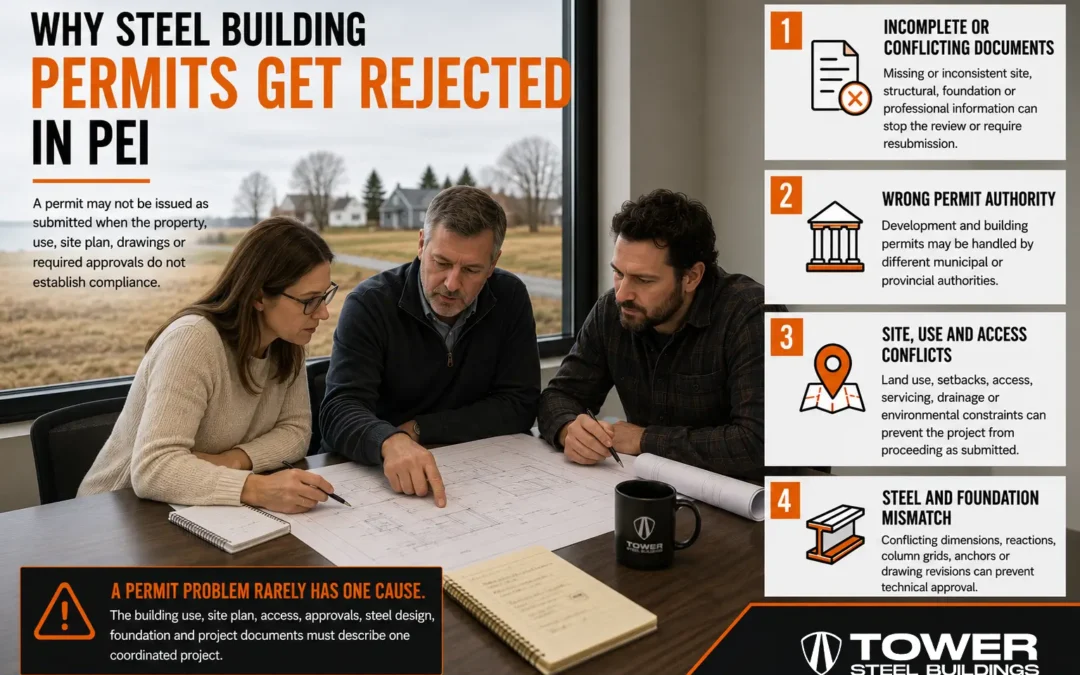
The first scheduling risk is submitting to the wrong authority.
Charlottetown, Stratford, Summerside, and St. Felix issue building permits within their municipal boundaries. The provincial Lands Division issues building permits in other areas.
Development-permit authority can differ from building-permit authority.
A project may involve:
- One municipality issuing both permits
- A municipality issuing the development permit and the province issuing the building permit
- The provincial Lands Division issuing both permits
- Felix issuing the building permit while the development route is separately confirmed
Confirm:
- PID
- Municipal boundary
- Development-permit authority
- Building-permit authority
- Current application forms
- Current document checklist
- Fee procedure
- Inspection authority
- Occupancy authority
Tower’s Prince Edward Island steel building permit guide provides broader planning context for the provincial and municipal permit paths.
Stage 2: Resolve the Proposed Use and Site Constraints
A technically simple steel kit can become a lengthy permit project when the use or site remains unresolved.
Confirm:
- Proposed building use
- Current zoning or land-use designation
- Building location
- Property and road setbacks
- Driveway access
- Parking and loading
- Truck circulation
- Well and septic systems
- Central water and sewer
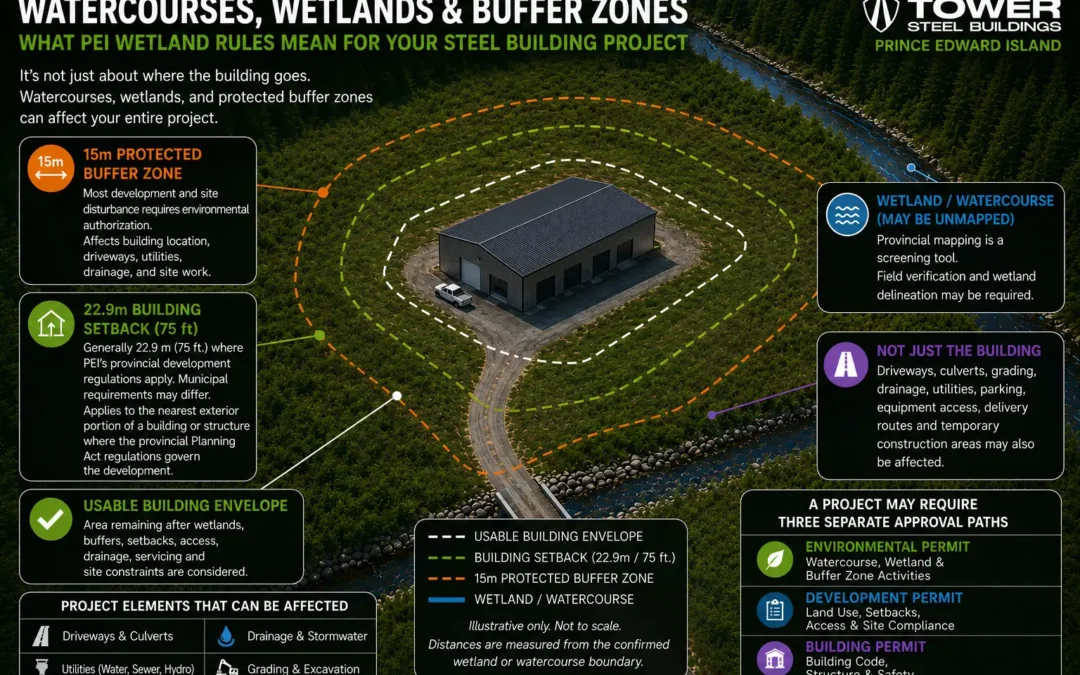
- Wetlands and watercourses
- Coastal or buffer restrictions
- Easements
- Drainage and grading
- Existing structures
- Variance or rezoning requirements
Changing a building from equipment storage to a vehicle-repair shop can affect:
- Permitted use
- Occupancy classification
- Parking
- Access
- Floor drains
- Wastewater
- Ventilation
- Fire protection
- Energy compliance
- Electrical systems
The intended use should be settled before the building documents are treated as final.
Stage 3: Prepare the Development-Permit Application
A provincial development application may require:
- Owner and applicant information
- PID
- Existing and proposed use
- Building dimensions
- Parking and staffing information for non-residential development
- Driveway information
- Water and sewer information
- Foundation and exterior-material information
- Detailed property sketch
- Agricultural information where applicable
- Supporting approvals
The property sketch may need to show:
- Every property line and its length
- Roads and road names
- Existing and proposed structures
- Wetlands
- Watercourses
- Streams
- Waterfront top of bank
- Sand dunes
- Natural slope
An incomplete site plan can delay the project before structural review begins.
Stage 4: Development Review
For a provincial application, a Permit Coordinator reviews the submission and a Client Service Officer arranges fee payment. Processing begins after full payment is received.
Development review may address:
- Land-use compliance
- Building location
- Setbacks
- Access
- Parking and loading
- Water and wastewater servicing
- Wetlands and coastal conditions
- Site inspection
- External-agency referrals
- Requested corrections
Additional time may be needed for:
- Variance
- Rezoning
- Subdivision
- Highway access
- Septic approval
- Wetland review
- Public consultation
- Council decision
- Major grading or drainage issues
Stage 5: Advance the Steel Package Carefully
Preliminary steel-building planning can often continue during development review.
Work may proceed on:
- Preliminary dimensions
- Eave and clear height
- Door and window layout
- Frame-spacing concepts
- Insulation planning
- Mezzanine or crane requirements
- Equipment loads
- Pricing and package scope
Do not treat the following as fixed while the planning decision remains uncertain:
- Final use
- Final footprint
- Building location
- Orientation
- Height
- Door arrangement
- Parking and loading
- Foundation location
The goal is to advance useful design work without committing to a package that may conflict with the approved site.
Stage 6: Prepare the Building-Permit Package
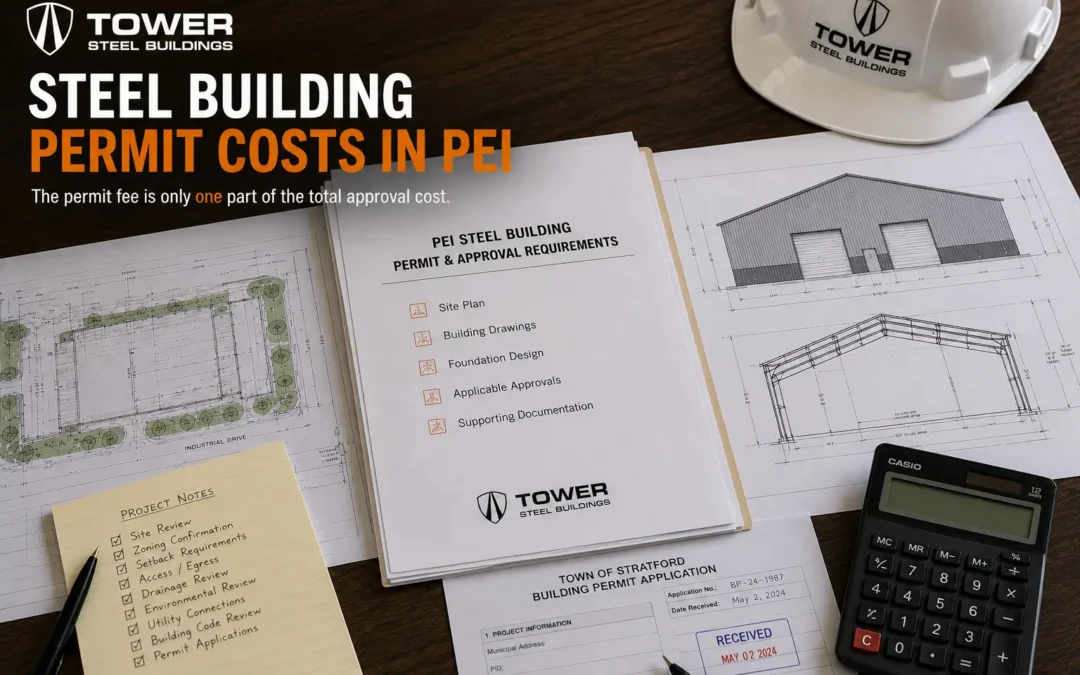
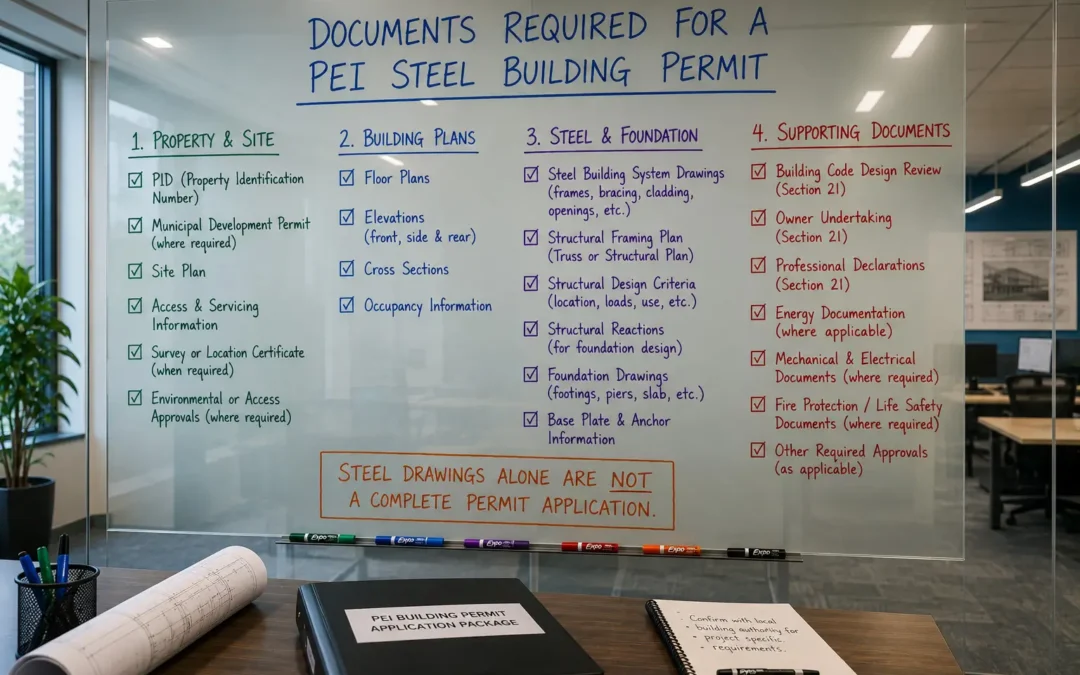
The building-permit submission may include:
- Building-permit application
- Development approval
- Site plan
- Floor plans
- Elevations
- Cross-sections
- Structural-framing plans
- Steel-building-system drawings
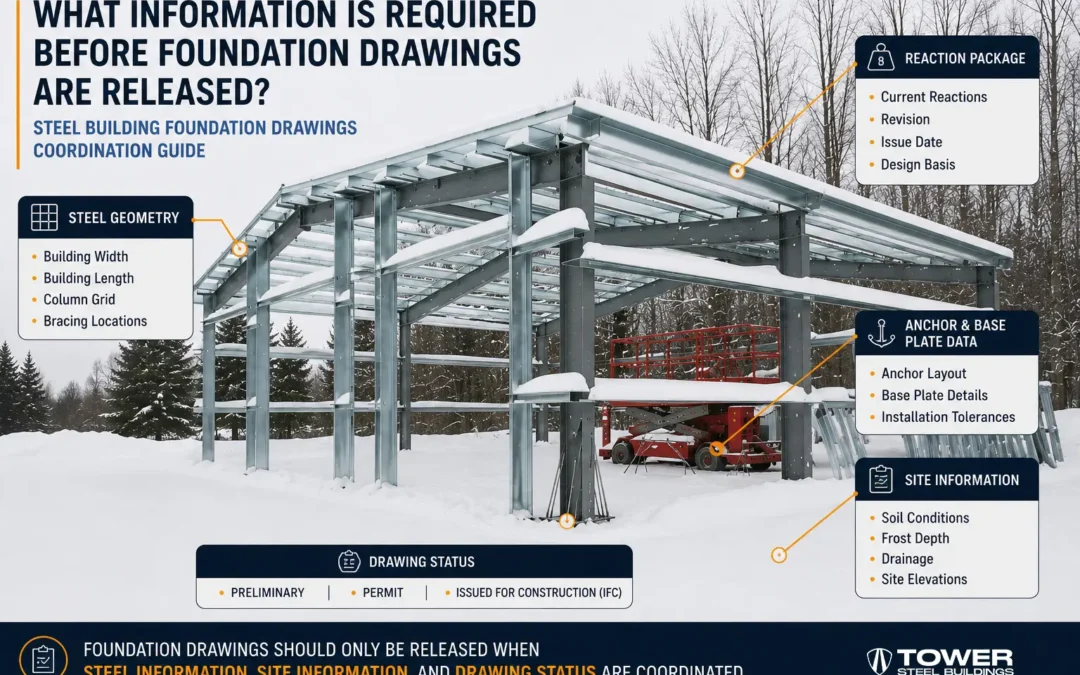
- Structural reactions
- Foundation drawings
- Base-plate and anchor information
- Professional stamps
- Building Code design review
- Owner undertaking
- Professional declarations
- Energy documents
- Fire-protection information
- Mechanical or electrical documents
The building, foundation, and site information must use the same revision.
A common delay occurs when:
- The steel frame changes.
- Structural reactions change.
- The foundation drawings remain unchanged.
- The anchor information no longer matches.
- A coordinated resubmission becomes necessary.
Tower’s steel building foundation-design guidance explains why current reactions, anchors, soil, frost, drainage, and foundation details must remain coordinated.
Stage 7: Submit the Building Application and Pay the Fee
For a provincial building-permit application:
- Submit the application and supporting documents.
- Wait for the Client Service Officer to review the submission.
- Pay the required fee.
- Record the date full payment was received.
- Use the PID and payment date to track the application.
Provincial processing begins after full payment.
The building permit may also be withheld until the required development permit has been confirmed.
Stage 8: Building-Code and Technical Review
The building official may review:
- Use and occupancy
- Applicable code pathway
- Building area and height
- Structural framing
- Foundation
- Design loads
- Anchors and base plates
- Fire separations
- Exits
- Accessibility
- Energy compliance
- Mechanical and electrical systems
- Sprinkler or fire-alarm systems
- Professional responsibility
- Field-review requirements
- Inspections
- Occupancy requirements
Additional coordination is often needed where:
- Part 3 or Part 4 applies.
- Professional documents are incomplete.
- A sprinkler system is required or intended.
- The site plan and building drawings differ.
- The foundation does not match the reactions.
- The energy pathway is incomplete.
- Several professionals must revise their work together.
Stage 9: Respond to Review Comments
A request for additional information is not necessarily a permit refusal.
The authority may request:
- Missing plans
- Corrected dimensions
- Revised site plan
- Updated steel drawings
- Current reactions
- Coordinated foundation drawings
- Revised anchor information
- Professional documents
- Energy information
- Fire-safety details
- Clarification of use
- Confirmation of another approval
A strong response package should include:
- A numbered response to every comment
- Revised drawings
- Current revision dates
- Clearly identified changes
- Updated calculations where required
- Coordinated steel and foundation documents
- Removal of superseded documents
Submitting isolated replacement pages without explaining the complete revision can create another review cycle.
Can Development and Building Reviews Overlap?
They may overlap, but they do not always run fully in parallel.
Possible concurrent work includes:
- Preparing steel drawings during development review
- Beginning foundation design after preliminary reactions are available
- Preparing building documents before development approval is issued
- Submitting both applications where the authorities allow it
Before relying on an overlapping schedule, ask:
- Will building review begin before development approval?
- Will the building application be held?
- Is the issued development permit required?
- Could development conditions change the building?
- Which design decisions remain financially reversible?
- Will revised site, steel, and foundation documents be required?
The fastest schedule is not the one that advances the most work at risk.
It is the schedule that prevents avoidable redesign.
Provincial Lands Division Timeline
A provincial application should be viewed as several separate stages.
Application Preparation
Applicant-controlled.
The duration depends on site information, engineering, professional forms, and outside approvals.
Submission and Payment
Provincial processing starts after full payment.
Record the payment date.
Authority Review
Some routine residential applications may be issued within 30 days, but complex steel-building projects can require additional time.
Revisions
Applicant- and consultant-controlled.
The authority cannot complete the review until requested information is submitted and accepted.
Issuance
A permit is issued only after the applicable requirements, approvals, fees, and documents have been satisfied.
Stratford Building-Permit Timeline
Stratford’s Planning FAQs state that certain building permits are normally issued within 10 to 15 business days after all supporting documents have been received.
For a substantial steel building, confirm whether that estimate applies to the actual:
- Use
- Size
- Code pathway
- Development approval
- Drainage-plan requirements
- Professional-design scope
Incomplete applications and seasonal workload can affect timing.
Summerside Building-Permit Timeline
Summerside’s Building Permit FAQ states that plan review usually takes a few days once:
- Required zoning and subdivision approvals are obtained
- Other applicable approvals are in place
- All required plans have been submitted
The complete approval path can take longer when:
- A zoning change is required.
- Subdivision is required.
- Council or public consultation is involved.
- Plans are missing.
- The project changes.
- Technical revisions are required.
The “few days” statement applies to the code-review stage, not the entire project timeline.
Charlottetown Building-Permit Timeline
Charlottetown administers its own development and building permits.
A current project estimate should be obtained directly from the City based on:
- Property and proposed use
- Zoning
- Building size
- Part 3 or Part 9 pathway
- Site plan
- Surface drainage and grading
- Parking and loading
- Municipal servicing
- Fire review
- Professional documents
- Application completeness
Do not apply provincial average processing figures to a Charlottetown permit.
The provincial report excludes permits issued by municipalities.
St. Felix Building-Permit Timeline
St. Felix issues building permits within its municipal boundary.
Applicants should confirm directly:
- Development-permit route
- Current forms
- Supporting documents
- Application-completeness rules
- Current review estimate
- Inspection process
- Permit conditions
A provincial or neighbouring municipal timeline should not be substituted for a current St. Felix estimate.
Permission to Proceed in Part Before the Full Permit Is Issued
Section 14 of PEI’s Building Codes Regulations uses the term permission to proceed in part.
A building official may permit specified excavation or construction of part of a building before the plans for the complete building have been submitted.
This permission is discretionary. It is not an applicant entitlement.
Before granting it, the building official may require:
- Plans and specifications for the proposed partial work
- Conditions considered necessary for code compliance
- Clear limits on the work that may proceed
Permission to proceed in part:
- Applies only to the specified excavation or construction
- Does not guarantee a permit for the rest of the building
- Does not guarantee approval of the project as a whole
- Requires the owner to notify the building official when the authorized work is complete
- Does not allow further work until the required permit for that work is issued
This is different from a conditional building permit under section 16.
A conditional building permit may be issued where additional information is not available at the time of application and the building official considers it unreasonable to withhold the permit until that information becomes available.
Neither process should be assumed.
Before performing early work, obtain the building official’s written decision and confirm:
- Exact work authorized
- Conditions
- Required inspections
- Required professional involvement
- Documents still outstanding
- Work that remains prohibited
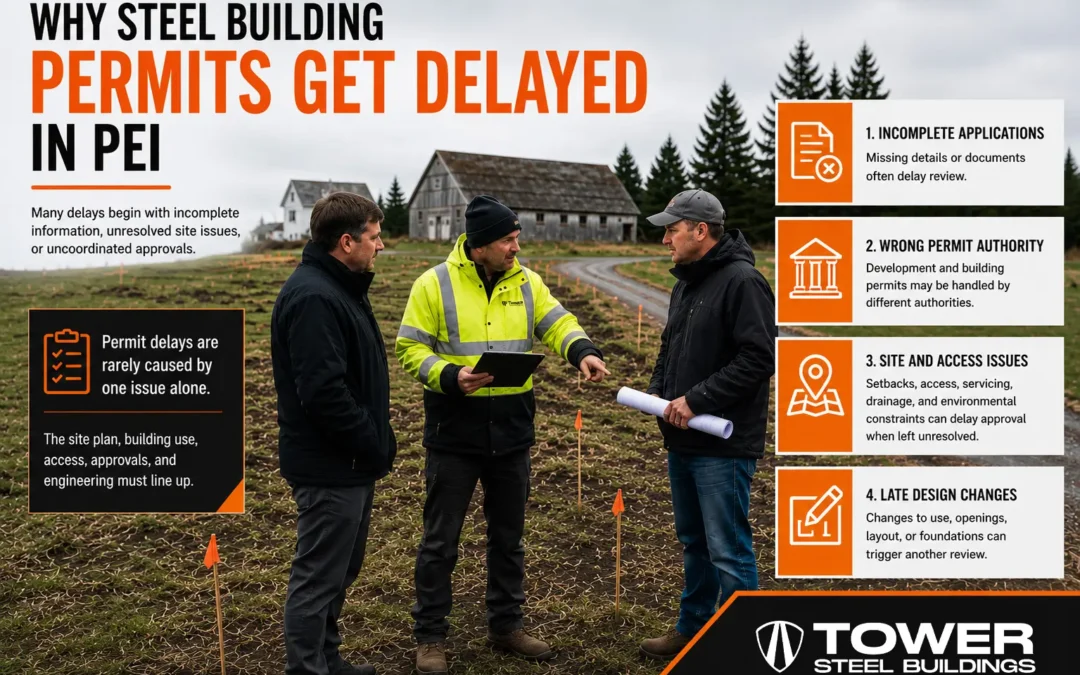
What Commonly Extends a PEI Steel Building Timeline?
Wrong Permit Authority
Submitting to the wrong municipality or provincial office does not create a valid application with the correct authority.
Incomplete Site Information
Missing boundaries, dimensions, setbacks, existing buildings, access, services, wetlands, slope, or drainage can prevent development review.
Unresolved Land Use
A structurally compliant building cannot proceed where the proposed use or location has not been approved.
Missing Development Approval
A provincial building permit may be withheld until the required development permit is confirmed.
Preliminary or Conflicting Drawings
Conceptual steel layouts, old reactions, mismatched foundations, and inconsistent anchor information can trigger a coordinated resubmission.
Missing Professional Documents
Applicable projects may require:
- Professional stamps
- Building Code design review
- Owner undertaking
- Professional declarations
- Field-review commitments
External Approvals
Wetland, highway-access, septic, subdivision, utility, or environmental decisions may need to be resolved before permit completion.
Changes During Review
Changes to the use, dimensions, location, height, openings, parking, or services can affect both permits and several drawing disciplines.
How to Reduce Avoidable Scheduling Problems
The authority’s workload cannot be controlled, but the project team can improve submission readiness.
Before filing:
- Confirm the permit route.
- Verify the PID and municipal boundary.
- Confirm the proposed use.
- Address zoning concerns.
- Prepare a complete site plan.
- Identify wetland, access, septic, and servicing issues.
- Finalize dimensions, height, and major openings.
- Obtain current steel-system drawings.
- Obtain current structural reactions.
- Coordinate the foundation and anchors.
- Appoint required professionals.
- Prepare required professional forms.
- Confirm energy and fire requirements.
- Use one revision register.
- Review the complete package before submission.
- Pay provincial fees promptly.
- Assign one review-comment coordinator.
- Respond with one coordinated revision package.
The active steel building permit checklist can help identify unresolved site, structural, foundation, and document issues before submission.
Can Steel Be Ordered While the Permit Is Under Review?
Pricing, concept planning, and scope development can proceed before approval.
Releasing the steel package for fabrication creates greater risk when matters that can change the building remain unresolved.
Development review can affect:
- Use
- Footprint
- Height
- Location
- Orientation
- Door arrangement
- Parking and loading
- Access
Building review can affect:
- Openings
- Structural details
- Fire separations
- Exits
- Accessibility
- Energy systems
- Professional requirements
Foundation coordination can affect:
- Column locations
- Reactions
- Base plates
- Anchors
- Piers
- Grade beams
Ordering before permit approval is a commercial and contractual risk decision.
A quote, preliminary drawing, or engineering input is not permit approval.
Permit Issuance Is Not the End of the Timeline
After permit issuance, the project may require inspections at stages such as:
- Excavation
- Footings
- Reinforcement
- Foundation before backfill
- Underground services
- Structural framing
- Fire separations
- Insulation or air barrier
- Mechanical or plumbing work
- Final construction
Confirm:
- Required inspection stages
- Booking procedure
- Minimum notice
- Work that must remain visible
- Professional field-review requirements
- Completion documents
- Occupancy requirements
Covering work before the required inspection can result in removal, exposure, correction, or professional-verification requirements.
Occupancy Can Be a Separate Final Stage
Completing steel erection does not necessarily authorize the building’s use.
Occupancy may depend on:
- Final inspections
- Correction of deficiencies
- Professional field-review letters
- Structural completion confirmation
- Fire-alarm or sprinkler documentation
- Mechanical completion
- Electrical approval
- Plumbing approval
- Accessibility completion
- Grading or drainage confirmation
- Surveyor’s location certificate
- Occupancy documentation
The project schedule should extend through lawful occupancy, not stop at permit issuance.
How to Track a Provincial PEI Permit
The Building and Development Permit Status service shows only permits issued by the provincial Lands Division.
The applicant generally needs:
- Property Identification Number
- Date the full fee payment was received
Municipal applications must be tracked through the applicable municipality.
For a project involving several authorities, maintain separate records for:
- Development permit
- Building permit
- Wetland or environmental approval
- Highway access
- Septic or servicing approval
- Trade permits
- Inspections
- Occupancy
One status result does not confirm that every required approval has been issued.
PEI Steel Building Timeline Checklist
Before setting a firm construction, delivery, or erection date, confirm:
- Correct permit authority
- PID and municipal boundary
- Proposed use
- Development-permit requirements
- Building-permit requirements
- Zoning and setbacks
- Complete site plan
- Access, parking, and loading
- Well and septic requirements
- Wetland and watercourse review
- External approvals
- Final building dimensions
- Final height and openings
- Current steel-system drawings
- Structural design criteria
- Current reactions
- Coordinated foundation drawings
- Current anchor information
- Professional appointments
- Professional forms
- Energy documents
- Fire and life-safety documents
- Submission date
- Full-payment date
- Review-comment coordinator
- Revision register
- Permit issuance
- Inspection schedule
- Completion documents
- Occupancy approval
Do not schedule steel delivery or erection solely from the application-submission date.
Use the approvals, coordinated documents, site readiness, foundation schedule, and inspection requirements that apply to the actual project.
How Tower Steel Buildings Supports Schedule Coordination
Tower Steel Buildings primarily supplies project-specific steel building kits and packages.
Depending on the written quotation, Tower may provide or coordinate:
- Building dimensions
- Eave height
- Frame spacing
- Bay layout
- Door and window openings
- Project design criteria
- Steel-building-system drawings
- Structural-framing information
- Current structural reactions
- Column grid
- Base-plate information
- Anchor-layout information
- Steel-package revisions affecting foundation inputs
- CSA A660 documentation where applicable
- Delivery or erection information where quoted
These steel-system inputs can help the foundation designer and permit team work from current project information.
Tower does not control:
- Municipal or provincial review time
- Zoning decisions
- Development approval
- Building-permit approval
- Environmental approvals
- Consultant response time
- Inspection scheduling
- Occupancy approval
Site planning, project-specific foundation engineering, environmental work, and third-party professional services remain separate unless expressly included in the written scope.
Planning a Steel Building in Prince Edward Island?
Build the schedule around the actual property, use, approvals, engineering, and site conditions rather than a generic permit promise.
Provide Tower Steel Buildings with:
- Project location and PID
- Intended use
- Building dimensions
- Required height
- Door and window schedule
- Heating and insulation requirements
- Equipment, mezzanine, or crane loads
- Foundation responsibility
- Permit-document responsibility
- Target delivery period
- Required package scope
Tower can prepare a project-specific steel building kit quotation and identify the steel-system information needed for permit and foundation coordination through the steel building quote request form.
Reviewed by Engineering Team
This content has been reviewed by the Tower Steel Buildings Engineering Team.
The review focused on how scheduling decisions for a Prince Edward Island steel building move through property review, land-use approval, steel-system documentation, foundation coordination, building-permit review, construction inspections and occupancy.
A permit timeline should not be treated as one uninterrupted period controlled only by the reviewing authority. Property information, outside approvals, steel-building decisions, reaction tables, foundation drawings, professional documents and responses to review comments may each be controlled by different parties.
The review also considered when overlapping work is useful and when it creates redesign risk. Preliminary pricing and layout planning may continue while site and development questions are being resolved. However, decisions involving the final building use, footprint, location, height, openings, reactions, anchors or foundation should remain reversible while an approval could still change them.
Development and building reviews may overlap where the responsible authorities permit it. Overlap does not guarantee that the two approvals will be completed together. A development condition affecting the use, location, dimensions, access, parking or servicing may require changes to steel, foundation or supporting documents.
Review comments should be handled as coordinated project changes. A revised steel frame may change the reactions. Changed reactions may affect the foundation. A revised foundation may affect anchorage, site elevations or construction timing. Every affected document should therefore be checked before resubmission.
The project schedule should continue beyond permit issuance. Required inspections, professional field reviews, trade completion, deficiency correction, final documents and occupancy requirements can determine when the building may legally and practically be used.
This content is intended to help serious steel-building buyers establish a realistic planning sequence rather than rely on a generic approval promise. Final permit requirements, review periods, permissions for partial work, inspection scheduling and occupancy decisions remain with the applicable municipality, provincial Lands Division, building official and appointed professionals.
Official References
This guide was prepared using current information from:
- Government of Prince Edward Island, Apply for a Development Permit
- Government of Prince Edward Island, Apply for a Building Permit
- Government of Prince Edward Island, Building and Development in PEI
- Government of Prince Edward Island, Building and Development Permit Status
- Government of Prince Edward Island, Building Together: PEI Housing Strategy 2024-2029, 2024-2025 Progress Report
- Prince Edward Island Building Codes Regulations
- Town of Stratford, Planning FAQs
- City of Summerside, Building Permit FAQ
- City of Charlottetown, Applications and Requirements
- Prince Edward Island Planning Act and applicable regulations
- National Building Code of Canada 2020
- National Energy Code of Canada for Buildings 2020
1. How long does a steel building permit take in Prince Edward Island?
PEI does not publish one guaranteed approval period for every steel building.
A complete application may move through review in several weeks, but the actual timeline depends on the proposed use, site approvals, steel and foundation documents, professional requirements, external agencies, and requested revisions.
2. Does PEI guarantee a steel building permit within 30 days?
No.
PEI states that some routine residential development decisions and routine residential building permits may be issued within 30 days after full payment.
That service benchmark is not a guaranteed deadline for commercial, agricultural, industrial, or other steel buildings.
3. When does the provincial PEI permit-processing period begin?
Provincial processing begins after the full application fee has been received.
Submitting the online form alone does not necessarily start the published processing period.
Record the full-payment date because it is also used with the PID to check permit status.
4. What is the average provincial PEI building-permit processing time?
PEI's 2024-2025 housing progress report recorded an average building-permit processing time of 24 calendar days for approved provincial permits.
The figure excludes permits issued by municipalities and identified statistical outliers. It is an historical average, not a guaranteed steel-building timeline.
5. What is the average provincial PEI development-permit processing time?
The same report recorded an average of 20 calendar days for approved routine residential development permits issued provincially.
The figure does not automatically apply to commercial, agricultural, industrial, complex, or municipally issued applications.
6. Do development- and building-permit timelines have to be added together?
Not always.
Some design work and application review may overlap. However, the building permit may be withheld until development approval is confirmed, and early design may require revision if the planning decision changes the project.
7. Can I submit the PEI development- and building-permit applications together?
Concurrent submission may be possible depending on the authorities and project.
Confirm whether building review will begin, remain on hold, or require the issued development permit before the building permit can be completed.
8. What makes a PEI steel building permit application complete?
A complete application may require:
- Application form and fee
- Property information
- Development approval
- Site plan
- Floor plans and elevations
- Cross-sections
- Structural-framing plans
- Steel-system drawings
- Foundation documents
- Professional forms
- Energy and fire information
- Project-specific outside approvals
The exact checklist depends on the authority, use, building size, code pathway, and property.
9. How long does a commercial or industrial steel building permit take in PEI?
PEI does not publish one guaranteed commercial or industrial steel-building timeline.
These applications can take longer than routine projects because they may require additional review of occupancy, professional design, structure, foundations, fire safety, accessibility, energy compliance, mechanical systems, parking, loading, and environmental conditions.
The actual period depends on application completeness and the number of authorities and professionals involved.
10. How long does a building permit take in Stratford, PEI?
Stratford states that certain building permits are normally issued within 10 to 15 business days after all supporting documents have been received.
Confirm whether that estimate applies to the proposed steel-building use, size, code pathway, drainage requirements, and professional scope.
11. How long does a building permit take in Summerside, PEI?
Summerside states that code review usually takes a few days after the necessary zoning, subdivision, and other approvals are obtained and all required plans are submitted.
The complete process takes longer when Council, public consultation, missing plans, or technical revisions are involved.
12. How long does a steel building permit take in Charlottetown?
Charlottetown does not publish one universal steel-building processing period that should be applied to every project.
Contact the City with the property, proposed use, building size, site plan, professional scope, and submission status for a current estimate.
13. Do permit corrections restart the PEI approval timeline?
A correction request does not necessarily create a new application, but it extends the total calendar time.
The authority cannot finish the review until the requested information has been submitted, coordinated, and accepted.
14. Can I order the steel building while the permit is under review?
Pricing and preliminary planning can proceed, but releasing the package for fabrication before the use, location, dimensions, openings, structural requirements, and foundation inputs are settled creates commercial risk.
Permit changes may require redesign, replacement material, or field modifications.
15. Can foundation construction begin before the full PEI permit is issued?
Only where the building official has granted the applicable written authorization.
Section 14 of PEI's Building Codes Regulations allows a building official to provide permission to proceed in part for specified excavation or partial construction after receiving the required documents for that work.
The permission does not guarantee approval of the remaining building and does not authorize work outside its stated limits.
16. How do I check the status of a provincial PEI permit?
Use the provincial Building and Development Permit Status service with the PID and the date full payment was received.
The service displays only permits issued by the Lands Division. Municipal applications must be tracked directly with the applicable municipality.
17. Do rezoning, wetland, access, or septic approvals affect the permit timeline?
Yes.
The development or building decision may depend on zoning, environmental, highway-access, septic, servicing, subdivision, or utility approvals.
An unresolved outside approval can prevent the permit process from being completed.
18. Does receiving the building permit complete the entire approval timeline?
No.
The project may still require construction inspections, trade approvals, professional field reviews, deficiency corrections, final documents, and occupancy approval before the building can be used.
19. Who is responsible for responding to PEI permit-review comments?
The owner or applicant should assign one person to coordinate the response.
That person should obtain updated information from the steel supplier, foundation engineer, architect, consultants, and contractors and submit one complete, internally consistent revision package.
20. How can a steel-building supplier help reduce permit delays?
A steel-building supplier can provide accurate building dimensions, openings, design criteria, structural drawings, reactions, base-plate information, and anchor-layout information within its contracted scope.
Tower Steel Buildings can coordinate these steel-system inputs, but planning decisions, foundation engineering, environmental approvals, permit review, inspections, and authority processing times remain outside the supplier's control.