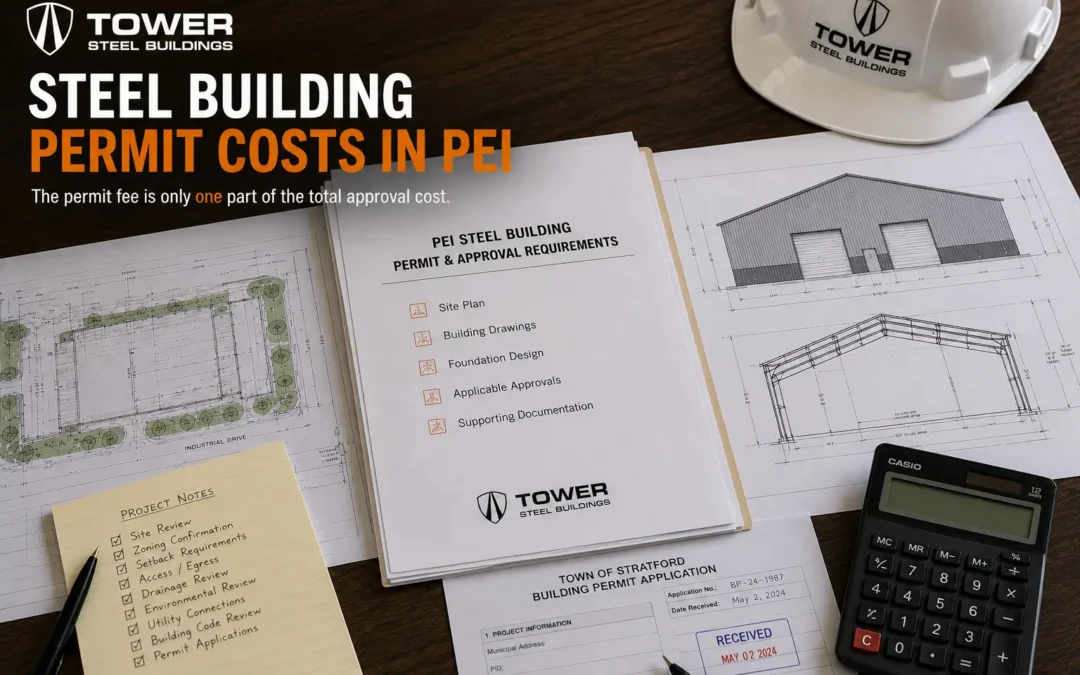
A steel building permit application in Prince Edward Island requires more than a supplier drawing showing the building width, length, and frame layout.
The permit authority must be able to connect four parts of the project:
- The approved property and building location
- The intended use and occupancy
- The steel building and foundation design
- The professional, energy, fire, service, and inspection documents required for that specific project
PEI’s provincial building-permit process identifies several core plans, including:
- Foundation plan
- Front, side, and rear elevations
- Floor plans
- Cross-sections
- Site plan
- Truss or structural-framing plan
Those plans are the starting point, not necessarily the complete package for every steel building.
The broader Prince Edward Island steel building permit guide explains how jurisdiction, site constraints, structural information, foundation coordination, professional responsibilities, inspections, and occupancy requirements fit around the document package.
A commercial workshop, farm building, warehouse, truck garage, equipment-storage building, municipal facility, or light-industrial building may also require structural calculations, professional declarations, foundation engineering, energy information, fire and life-safety details, mechanical or electrical documents, environmental approvals, or other supporting information.
The correct document package depends on:
- Project location
- Development-permit authority
- Building-permit authority
- Building use
- Occupancy classification
- Building size
- Structural system
- Foundation conditions
- Heating and insulation
- Fire-protection systems
- Site access
- Water and sewer servicing
- Wetlands, watercourses, and other site constraints
The safest approach is not to ask only:
What drawings does the steel supplier provide?
The better question is:
What documents does the permit authority need to approve the complete site, building, foundation, and construction scope?
Quick Answer
A PEI steel building permit application may require the following documents and information:
| Document or Information | Common Requirement or Trigger | Primary Purpose |
| Completed building-permit application | Core application requirement | Identifies the owner, property, use, building, contractors, value, and construction scope |
| Property Identification Number | Core application requirement | Connects the application to the correct legal parcel |
| Municipal development permit | Where issued by a municipality | Confirms the approved use, location, and site arrangement |
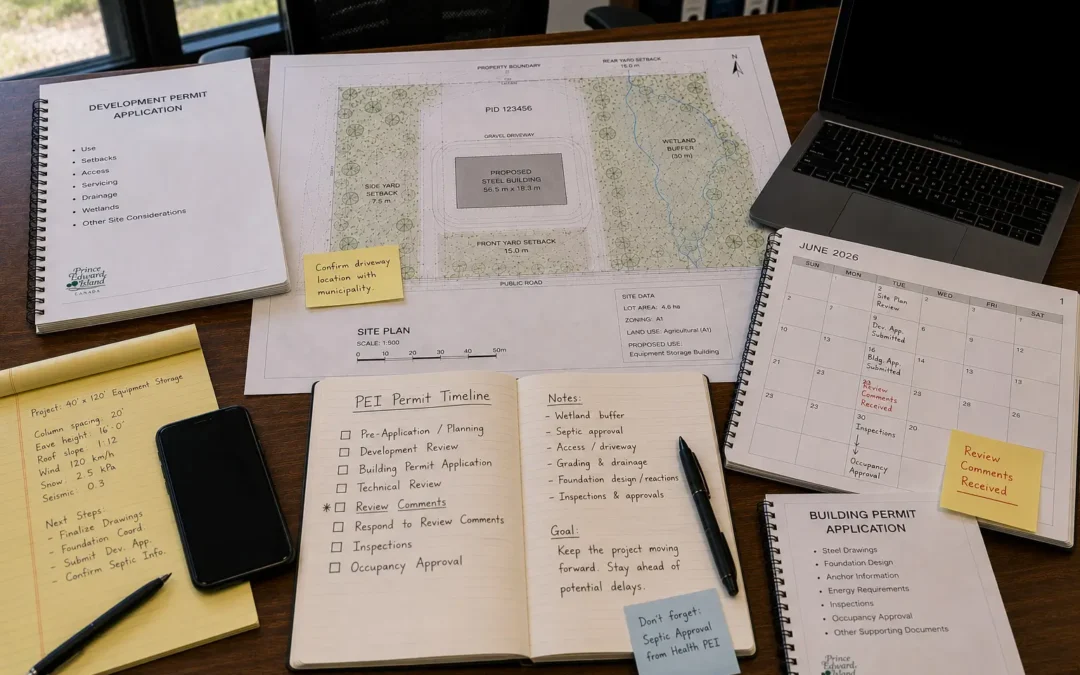
| Site plan | Core plan requirement | Shows the building on the property with access, setbacks, services, and site constraints |
| Floor plan | Core plan requirement | Shows use, rooms, exits, openings, equipment, and interior arrangement |
| Building elevations | Core plan requirement | Shows height, roof form, openings, and exterior configuration |
| Cross-sections | Core plan requirement | Shows vertical relationships between foundation, structure, envelope, and interior |
| Structural-framing plan | Core structural requirement | Shows the primary and secondary structural system |
| Steel-building-system drawings | Common for pre-engineered steel buildings | Defines frames, bracing, cladding, openings, and supplier scope |
| Structural design criteria | Common for engineered steel buildings | Identifies location, loads, importance category, use, and design assumptions |
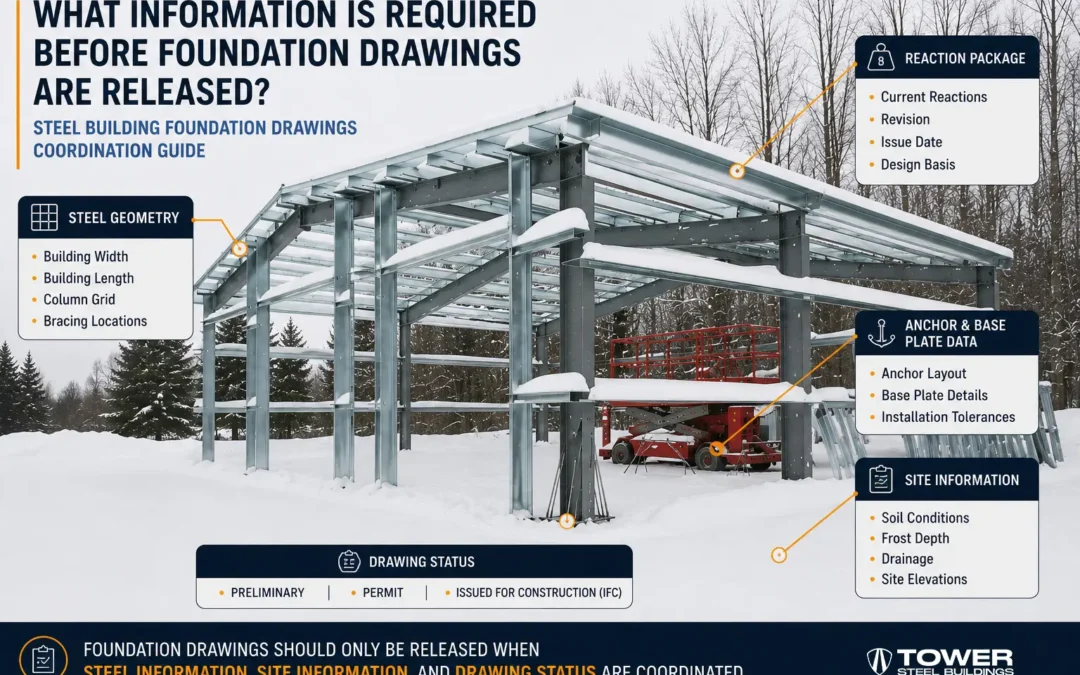
| Structural reactions | Required for coordinated foundation design | Provides the forces transferred into the foundation and anchorage |
| Foundation drawings | Core plan requirement | Defines footings, piers, grade beams, slab, reinforcement, and construction details |
| Base-plate and anchor information | Required for steel-to-foundation coordination | Coordinates steel columns, anchorage, and concrete work |
| Professionally stamped drawings | Mandatory where PEI’s professional-design provisions apply | Confirms professional responsibility for the relevant design |
| Building Code design review | Mandatory for a section 21 building application | Documents the professional’s Building Code review |
| Owner undertaking | Mandatory for a section 21 building application | Confirms the owner’s professional-design and field-review responsibilities |
| Professional declarations | Mandatory for a section 21 building application | Defines each professional’s responsibility, design commitments, and field-review obligations |
| Energy documentation | Where the applicable energy requirements apply | Demonstrates compliance with the applicable energy pathway |
| Mechanical and electrical documents | Where required by the building use and systems | Defines building services and code-related systems |
| Fire-protection documents | Where required or intended | Addresses sprinklers, fire separations, alarms, exits, and related systems |
| Survey or location certificate | When required by the building official | Confirms boundaries, setbacks, and final building location |
| Environmental or access approvals | Where site conditions or access trigger them | Addresses wetlands, watercourses, buffer zones, roads, driveways, or servicing |
Important: This table reflects the provincial Lands Division application requirements and documents commonly needed for steel building projects. Charlottetown, Stratford, Summerside, and St. Felix administer their own building-permit processes and may require different or additional forms, plans, fees, declarations, and supporting documents.
Not every project requires every item in the table.
The applicable building authority may request additional information where it is needed to review the proposed project.
1. Completed Building-Permit Application
The permit application is not only an administrative cover sheet.
It establishes the basic scope that the drawings and professional documents must support.
PEI’s provincial application requests information such as:
- Property owner contact information
- Applicant information, where different from the owner
- Property Identification Number
- Property location
- Lot number, where applicable
- Current use of the property
- Proposed structure type
- Building dimensions
- Estimated construction value
- Foundation type
- Heating source
- Electrical service
- Siding material
- Roofing material
- Contractor information
- Development-permit information
- Required plans
If the applicant is not the registered property owner, written authorization from the owner may be required.
The Application Description Must Match the Drawings
Do not describe the project as “storage” on the application while the plans show:
- Repair bays
- Vehicle lifts
- Offices
- Washrooms
- Floor drains
- Manufacturing equipment
- Public areas
- Retail activity
The stated use can affect:
- Applicable Part 3 or Part 9 code pathway
- Part 4 structural-design requirements
- Professional responsibilities
- Fire and life safety
- Accessibility
- Ventilation
- Energy compliance
- Plumbing
- Electrical systems
- Inspections
- Occupancy approval
2. Property and Ownership Documents
The permit authority must be able to identify the correct parcel and confirm who is authorized to make the application.
Common property information includes:
- Property Identification Number
- Civic address
- Lot number
- Owner name
- Deed or survey information where needed
- Municipal jurisdiction
- Existing property use
- Existing buildings
- Owner authorization where the applicant acts for another person
The PID connects provincial development and building applications to the property record.
A mailing address or community name may not be sufficient to confirm:
- Municipal boundaries
- Permit jurisdiction
- Property setbacks
- Existing approvals
- Site constraints
3. Development Permit or Development-Approval Documents
For most PEI construction projects, the building-permit application must be coordinated with the applicable development approval.
Where a municipality issues the development permit, the provincial building-permit application may require a copy of that municipal permit.
Applicants should confirm the correct municipal or provincial Lands Division permit route in PEI before relying on one authority’s forms or submission checklist.
The development documentation may include:
- Approved development permit
- Approved site plan
- Development conditions
- Variance decision
- Rezoning decision
- Subdivision approval
- Access conditions
- Parking or loading conditions
- Servicing conditions
- Environmental conditions
- Other municipal or provincial planning approvals
Why the Development Documents Matter
The steel and foundation drawings must use the building approved for the property.
Check that the development documents and building drawings show the same:
- Building use
- Width
- Length
- Height
- Site location
- Driveway
- Parking
- Loading area
- Servicing arrangement
- Revision date
A municipal development permit for a storage building should not be paired with building drawings for a repair garage without confirming whether a new development review is required.
For a detailed explanation of what each approval covers, review Tower Steel Buildings’ guide to development permits versus building permits in Prince Edward Island.
4. Site Plan
The site plan connects the steel building to the property.
It should be detailed enough for the reviewer to understand where the building will be located and how the site will function.
Depending on the project and reviewing authority, the site plan may need to show:
- Property boundaries
- Property-line dimensions
- Road frontage
- Road names
- Proposed building location
- Proposed building dimensions
- Existing buildings
- Distances to property lines
- Distance to roads
- Driveway location
- Highway entrance
- Parking
- Loading
- Fire access
- Vehicle circulation
- Wells
- Septic systems
- Water connections
- Sewer connections
- Utility routes
- Easements
- Natural slope
- Drainage direction
- Watercourses
- Wetlands
- Streams
- Waterfront top of bank
- Sand dunes
- Protected buffer zones
- Other constrained areas
A Property Sketch Is Not Always Enough
A basic sketch may be accepted for some straightforward applications.
A current survey or surveyor’s location certificate may be required when:
- Property boundaries are uncertain.
- Setbacks are tight.
- The building is close to an easement.
- The site has several existing buildings.
- A wetland or watercourse is nearby.
- The proposed location is disputed.
- Precise placement must be verified.
- The building official needs proof of the completed location.
PEI’s Building Codes Regulations allow a building official to require an up-to-date lot survey or surveyor’s location certificate.
Do not set anchor bolts or pour concrete using an assumed boundary.
5. Floor Plans
A floor plan should show how the building will be used, not only its exterior dimensions.
Depending on the project, the floor plan may need to identify:
- Overall dimensions
- Interior rooms
- Offices
- Washrooms
- Mechanical rooms
- Storage areas
- Work areas
- Vehicle bays
- Equipment locations
- Mezzanines
- Stairs
- Exits
- Personnel doors
- Overhead doors
- Windows
- Interior partitions
- Fire separations
- Barrier-free routes
- Plumbing fixtures
- Floor drains
- Vehicle lifts
- Racking
- Cranes or special equipment
Why the Floor Plan Affects Structural Design
The floor plan must coordinate with:
- Steel frame spacing
- Bracing locations
- Door headers and jambs
- Column locations
- Mezzanine loads
- Crane loads
- Equipment loads
- Foundation reactions
- Slab requirements
A large door shown on a floor plan but missing from the steel drawings can create a serious structural conflict.
6. Building Elevations
PEI’s provincial application identifies front, side, and rear elevations among the required plans.
The elevations should show the exterior building configuration, including:
- Overall building height
- Eave height
- Roof slope
- Roof ridge
- Finished grade
- Wall cladding
- Roof cladding
- Overhead doors
- Personnel doors
- Windows
- Canopies
- Overhangs
- Louvres
- Exterior equipment
- Significant changes in grade
The building dimensions and opening locations should match:
- Floor plans
- Steel-building drawings
- Site plan
- Development approval
- Foundation drawings
7. Cross-Sections
Cross-sections show how the building is assembled vertically.
A useful cross-section may identify:
- Footing depth
- Foundation wall or pier
- Grade beam
- Floor slab
- Granular base
- Frost protection
- Slab insulation
- Wall assembly
- Roof assembly
- Interior liner
- Eave height
- Clear height
- Roof slope
- Ceiling or mezzanine
- Structural frame
- Finished grade
Cross-sections can expose conflicts that are not obvious on a floor plan.
For example:
- The required clear height may not fit below the frame.
- A door opening may conflict with the eave.
- Wall insulation may not coordinate with the cladding system.
- The slab elevation may conflict with door thresholds.
- The foundation elevation may not match the steel base plate.
8. Steel-Building-System Drawings
Steel supplier drawings are a key part of the application, but they should be identified accurately as steel-building-system documents.
Depending on the supplied scope, the drawing package may include:
- General arrangement
- Building dimensions
- Eave height
- Roof slope
- Frame spacing
- Bay layout
- Primary frames
- End-wall framing
- Secondary framing
- Purlins
- Girts
- Eave struts
- Bracing
- Framed openings
- Roof and wall cladding
- Connection details
- Base plates
- Anchor-layout information
- Assembly details
- Component identification
Supplier Drawings Are Not Automatically the Complete Permit Package
Steel-building drawings may not include:
- Site planning
- Foundation engineering
- Architectural coordination
- Energy-code documentation
- Mechanical design
- Electrical design
- Plumbing design
- Fire-protection design
- Septic design
- Drainage design
- Environmental approval
- Every professional undertaking
- Every municipal or provincial requirement
The permit package must identify who is responsible for the work outside the steel supplier’s scope.
9. Structural Design Criteria
The steel-building documents should identify the design assumptions used for the project.
These may include:
- Project location
- Applicable code
- Building use
- Occupancy
- Importance category
- Snow load
- Rain load
- Wind load
- Seismic criteria
- Exposure
- Terrain
- Topographic effects
- Snow-drift conditions
- Roof slope
- Collateral loads
- Mezzanine loads
- Crane loads
- Equipment loads
- Future expansion assumptions
The project postal code and site conditions matter.
A steel building designed for one PEI location should not be transferred to another property without confirming that the design criteria remain applicable.
10. Structural-Framing Plan
PEI’s provincial building-permit guidance identifies a truss or structural-framing plan as part of the application information.
It also states that the structural-framing plan is required before a framing inspection can be completed.
For a steel building, the structural-framing plan should coordinate:
- Main frames
- Secondary framing
- Bracing
- Openings
- Columns
- End walls
- Roof framing
- Wall framing
- Load paths
- Connection locations
- Foundation support points
Do not submit a conceptual sales layout as if it were the final structural-framing plan.
11. Structural Reactions
Structural reactions transfer the steel-building loads into the foundation.
The foundation engineer may need reactions such as:
- Gravity loads
- Uplift
- Horizontal forces
- Moments
- Load combinations
- Service-level information where relevant
- Reactions at each column or support
The reactions must correspond to the final:
- Building dimensions
- Height
- Frame spacing
- Door openings
- Bracing
- Roof loads
- Equipment loads
- Design criteria
Preliminary Reactions Must Be Identified Clearly
If reactions are preliminary, the foundation drawings should not be treated as final construction documents.
A later change to:
- Building height
- Bay spacing
- Door size
- Bracing
- Snow load
- Wind load
- Equipment loads
can change the foundation forces.
12. Foundation Drawings
The provincial building-permit process identifies a foundation plan as a core application document.
For a steel building, foundation drawings may include:
- Footing sizes
- Pier sizes
- Grade beams
- Foundation walls
- Slab thickness
- Reinforcement
- Concrete strength
- Anchor locations
- Anchor embedment
- Base-plate interface
- Elevations
- Frost protection
- Drainage
- Granular base
- Slab insulation
- Vapour barrier
- Floor drains
- Control joints
- Construction notes
- Equipment foundations
The foundation should be designed using:
- Current steel reactions
- Final column grid
- Base-plate information
- Anchor information
- Soil conditions
- Frost conditions
- Slab use
- Equipment loads
- Site drainage
Tower’s steel building foundation-design guidance explains why the steel system, anchorage, soil, frost, slab, and concrete scope must remain coordinated.
What Tower May Provide
Depending on the written quotation, Tower Steel Buildings may provide or coordinate:
- Current structural reactions
- Column grid
- Base-plate information
- Anchor-layout information
- Steel-package revisions affecting foundation inputs
These items support the work of the foundation designer.
They do not automatically constitute project-specific foundation engineering.
Foundation engineering remains separate unless it is expressly included in the written scope.
13. Anchor-Bolt and Base-Plate Information
The anchor system connects the steel columns to the foundation.
The permit and construction documents should make the following responsibilities clear:
- Who provides the anchor layout
- Who designs the anchorage
- Who supplies the physical bolts
- Who supplies the templates
- Who checks embedment
- Who checks edge distances
- Who installs the anchors
- Who surveys or verifies placement
- What tolerances apply
- Who corrects misplaced anchors
An anchor-layout drawing does not automatically include:
- Physical anchor bolts
- Anchor templates
- Anchorage engineering
- Installation
- Survey
- Inspection
- Field correction
The anchor information, base plates, column grid, steel drawings, and foundation drawings must all use the same revision.
14. Professionally Designed and Stamped Drawings
PEI’s Building Codes Regulations require the owner to consult and appoint the appropriate architects and professional engineers where:
- Part 3 of Division B of the Building Code applies
- Part 4 of Division B applies
- A Part 9 building exceeds 300 square metres in building area
These are mandatory professional-responsibility requirements for the buildings or portions of buildings they cover.
Professional engineering is also required where a structural component in a Part 9 building cannot be sized using the prescriptive provisions and its dimensions must instead be established through:
- Calculation
- Testing
- Another method of evaluation
A building official may also require appropriate professional design, undertakings, inspections, and field-review declarations where the following warrant professional involvement:
- Site conditions
- Building size
- Building complexity
- Complexity of a building component
Where a building is required or intended to contain a sprinkler system, the owner must engage a professional engineer to design that sprinkler system and provide the required undertaking.
For an applicable professionally designed building, the permit application requires:
- Professionally designed and stamped drawings or plans
- Building Code design review
- Owner’s letter of undertaking
- Applicable declarations from the responsible professionals
- Defined areas of professional responsibility
- Commitments relating to design changes
- Field-review commitments
- Final confirmation that the work substantially complies with the design
One Engineer Does Not Automatically Cover Every Discipline
A steel-building structural engineer may be responsible for the steel system but not:
- Foundation engineering
- Architectural design
- Mechanical design
- Electrical design
- Fire-protection design
- Civil or drainage design
- Geotechnical work
- Energy-code documentation
The permit package should identify each appointed professional and the limits of that professional’s responsibility.
15. Building Code Design Review
For an application involving a building or part of a building to which section 21 of PEI’s Building Codes Regulations applies, subsection 9(2) requires a Building Code design review prepared by the professional.
The Building Code design review must be submitted together with:
- Professionally designed and stamped drawings or plans
- Owner’s letter of undertaking in the approved form
- Applicable declarations from the professional responsible for the design
- Applicable declarations from each professional involved in the design
The professional declarations address matters including:
- The professional’s area of responsibility
- Whether the design meets or exceeds applicable code requirements
- How design changes will remain code compliant
- The professional’s undertaking to inspect or review the work at appropriate intervals
- Final confirmation that the work substantially complies with the design
The Building Code design review should reflect the actual project.
It should not be a generic letter that ignores:
- Occupancy
- Building size
- Building area
- Fire separations
- Exits
- Accessibility
- Energy requirements
- Structural design
- Professional responsibilities
- Required systems
The code review and the project drawings must be revised together when the design changes.
16. Owner Undertaking and Professional Declarations
Where the section 21 professional-design provisions apply, the owner must submit a letter of undertaking in the form approved by the Minister.
The responsible professionals must also submit the applicable declarations in the approved forms.
These documents establish:
- Each professional’s area of responsibility
- Whether the design satisfies the applicable code requirements
- Responsibility for later design changes
- Field-review obligations
- Final professional confirmation
These are not optional trust letters or decorative attachments.
They identify who accepts professional responsibility for:
- Design
- Revisions
- Field reviews
- Completion confirmation
Do not leave these documents until the end of construction.
Missing professional undertakings or declarations can prevent the permit authority from confirming responsibility for the design and required reviews.
17. Energy and Building-Envelope Documents
PEI’s official building and development guidance confirms the province’s adoption of the National Energy Code of Canada for Buildings 2020 where it applies.
A heated or conditioned steel building may require documentation related to:
- Roof insulation
- Wall insulation
- Slab or foundation insulation
- Thermal bridging
- Air barrier
- Vapour control
- Doors
- Windows
- Heating equipment
- Ventilation
- Lighting
- Controls
- Energy calculations
- Compliance path
The exact requirements depend on:
- Building use
- Occupancy
- Conditioned floor area
- Heating
- Applicable code pathway
- Available exemptions
- Permit authority
Do not treat insulation as only a supplier option.
The proposed insulation and envelope must coordinate with:
- Roof panels
- Wall panels
- Secondary framing
- Interior liner
- Doors
- Windows
- Air sealing
- Condensation control
- Mechanical systems
18. Mechanical, Electrical, Plumbing, and Fire-Protection Documents
The building-permit authority may require additional trade or engineering information depending on the use and complexity of the building.
Possible documents include:
- Heating layout
- Ventilation calculations
- Make-up air design
- Exhaust systems
- Plumbing layout
- Floor-drain design
- Washroom layout
- Water and sewer connections
- Septic information
- Electrical service information
- Lighting layout
- Emergency lighting
- Exit signs
- Fire-alarm information
- Sprinkler drawings
- Fire-separation details
- Fire-extinguisher locations
- Equipment specifications
Separate trade permits may also be required.
Electrical and plumbing work are not automatically authorized solely because a building permit has been issued.
19. Survey or Location Certificate
A building official may require an up-to-date lot survey or surveyor’s location certificate.
This document may be needed to verify:
- Property boundaries
- Building location
- Setbacks
- Easements
- Road distance
- Location after foundation construction
- Final compliance before occupancy
A survey is especially important where:
- The proposed building is close to a property line.
- The lot shape is irregular.
- Existing markers are missing.
- The building is near a wetland or watercourse.
- Several buildings occupy the property.
- The site plan depends on precise measurements.
20. Environmental and Site-Specific Supporting Documents
Some properties require approvals and supporting documents outside the standard building-plan package.
Wetlands, Watercourses, and Buffer Zones
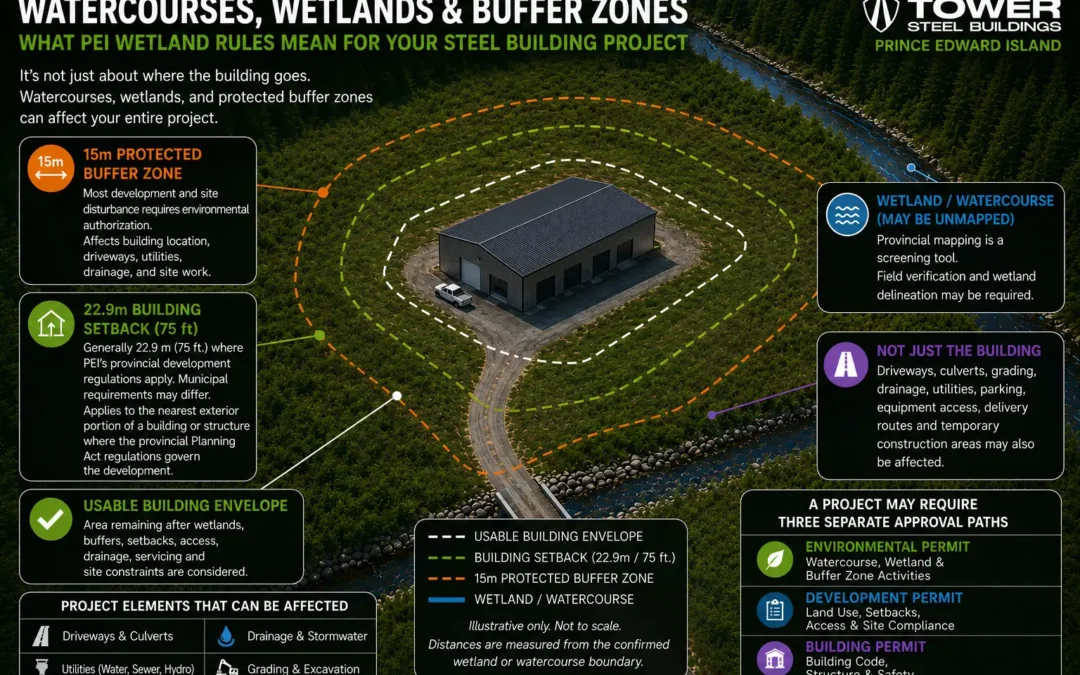
Work in a watercourse, wetland, or 15-metre buffer zone requires a Watercourse, Wetland and Buffer Zone Activity Permit before the regulated work begins.
The permit application requires supporting information such as:
- Location map, aerial photograph, or GIS map
- Pre-construction colour photographs
- Sketch of the proposed work showing construction details and dimensions
- Written description of the proposed activity
Additional supporting information may include:
- Engineered plans or drawings where available
- Erosion and sediment-control plan where applicable
Under PEI’s official wetland-identification guidance, a wetland that does not appear on public mapping may still be protected.
A wetland delineation may be required before the project location is finalized.
Highway and Driveway Access
An entrance-way permit may be required for access along a main or seasonal highway.
Commercial, industrial, or institutional access may require a separate transportation review.
An entrance-way permit is not necessarily the same as approval for every culvert, drainage, or site-access component.
Septic, Water, and Wastewater Information
Depending on the property and proposed use, required documents may include:
- Site-suitability information
- Septic-system design
- Well information
- Water-service information
- Sewer connection information
- Wastewater-system approval
- Floor-drain discharge details
- Central water or wastewater permits
Resolve servicing before the site plan, foundation, and floor slab are finalized.
Who Prepares Each Steel Building Permit Document?
| Document | Typical Responsible Party |
| Building-permit application | Owner, applicant, consultant, or authorized representative |
| Development permit | Municipality or Lands Division issues it following the applicable application |
| Site plan | Owner, consultant, designer, surveyor, or civil professional depending on complexity |
| Floor plans and elevations | Designer, architect, engineer, supplier, or coordinated project team |
| Steel-building drawings | Steel-building-system supplier and responsible steel engineer |
| Structural design criteria | Steel engineer and other project professionals |
| Structural reactions | Steel-building-system engineer |
| Foundation drawings | Foundation engineer or other appropriate professional |
| Anchor-layout information | Steel supplier or steel engineer within the stated scope |
| Anchorage design | Foundation or structural engineer as assigned |
| Building Code design review | Professional responsible under the applicable PEI professional-design provisions |
| Owner undertaking | Property owner using the approved form |
| Professional declarations | Each appointed professional for that professional’s area of responsibility |
| Energy documents | Architect, engineer, energy professional, or other qualified party |
| Mechanical documents | Mechanical engineer or licensed contractor where permitted |
| Electrical documents | Electrical engineer or licensed electrical contractor as applicable |
| Fire-protection documents | Appropriate fire-protection professional |
| Survey or location certificate | PEI land surveyor |
| Environmental applications | Owner, consultant, engineer, or licensed contractor depending on the activity |
The project should have a written responsibility matrix.
A steel building engineering review checklist can help the project team identify responsibility for the steel system, foundation, anchorage, professional documents, energy compliance, fire protection, site information, and construction-stage review.
Do not assume another party is providing a document merely because that document is required.
Document Coordination Rules
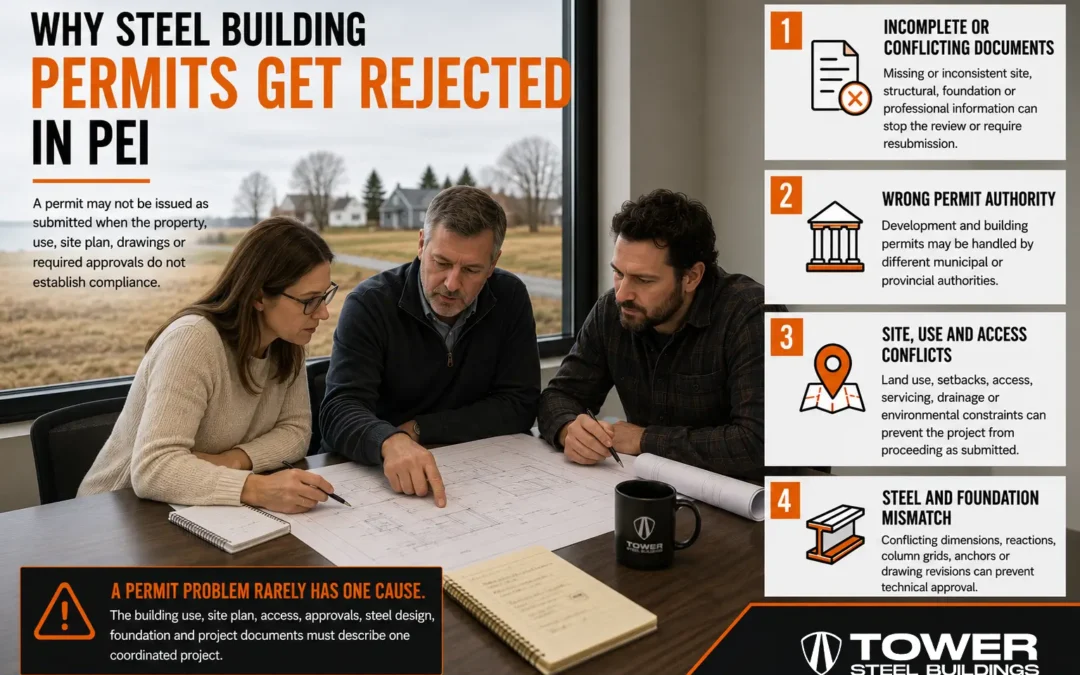
A submission can contain every required document and still fail review when those documents contradict each other.
Complete the following coordination checks before submission.
Building Dimensions
The width, length, and height should match across:
- Development permit
- Site plan
- Floor plans
- Elevations
- Steel drawings
- Foundation drawings
Door and Window Openings
The sizes and locations should match across:
- Floor plans
- Elevations
- Steel-framing drawings
- Bracing plans
- Cladding layouts
- Foundation reactions
Column Grid and Anchors
The following should use the same grid:
- Steel drawings
- Base plates
- Anchor layout
- Foundation plan
- Pier locations
- Grade beams
Building Use
The use should remain consistent across:
- Development application
- Building application
- Floor plans
- Building Code design review
- Energy documents
- Mechanical design
- Occupancy documents
Revision Dates
Every drawing should have:
- Drawing number
- Revision number
- Revision date
- Clear title
- Responsible party
Remove superseded documents from the active permit submission and construction set.
Common Missing or Conflicting Documents
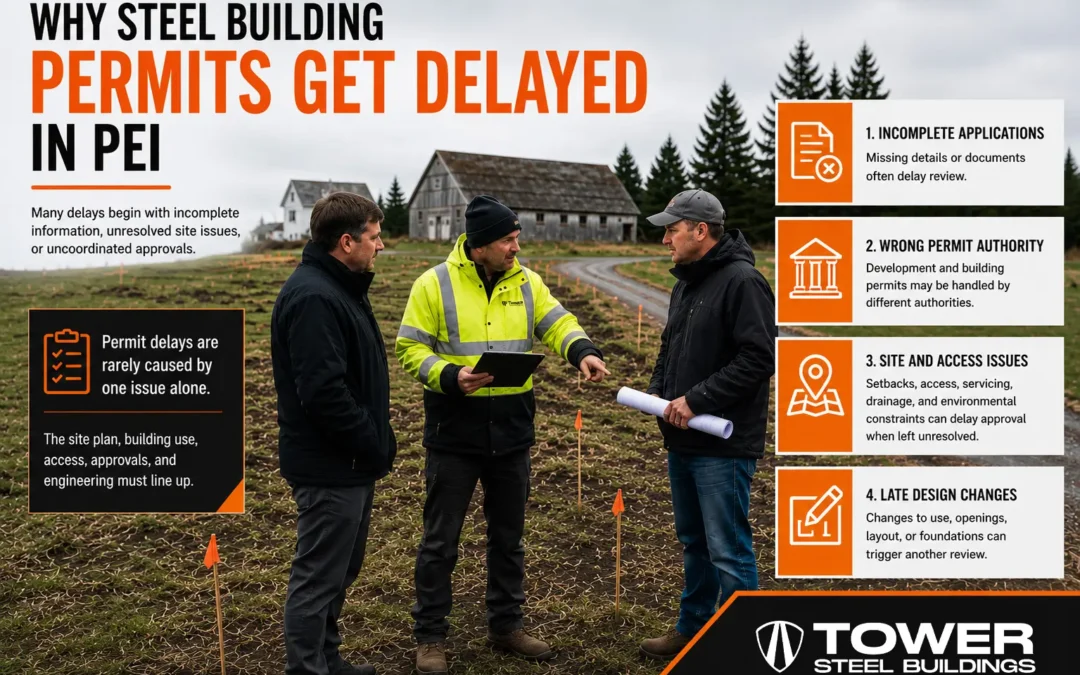
Steel building permit applications are commonly delayed by:
- Missing development permit
- Incomplete site plan
- Missing PID or ownership authorization
- Missing foundation plan
- Preliminary steel drawings submitted as final
- Missing structural-framing plan
- Missing current structural reactions
- Foundation drawings based on outdated reactions
- Anchor layout that does not match the column grid
- Door openings that differ between plans
- Missing professional stamps
- Missing owner undertaking
- Missing professional declarations
- Missing Building Code design review for a section 21 building
- Missing energy documentation
- Missing fire or service documents
- Missing survey where precise location must be verified
- Missing environmental or access approval
- Drawings carrying different revision dates
- Building use described differently across applications
The number of documents is not the main measure of quality.
A strong submission is one in which every document describes the same project.
The guide to applying for a steel building permit in PEI explains how jurisdiction confirmation, development approval, site information, structural documents, professional responsibilities, inspections, and occupancy requirements fit into the full application sequence.
Documents to Confirm Before Ordering the Steel Package
Before releasing the steel package for fabrication, confirm that the project team has:
- Approved or supportable development site plan
- Confirmed building use
- Final building dimensions
- Final eave and clear height
- Final door and window schedule
- Confirmed project location and design criteria
- Current steel drawings
- Current structural reactions
- Current base-plate information
- Current anchor-layout information
- Assigned foundation engineer
- Coordinated foundation drawings
- Assigned professional responsibilities
- Required Building Code design review
- Required owner undertaking
- Required professional declarations
- Identified energy requirements
- Identified fire and service requirements
- Resolved site access and servicing
- Identified environmental constraints
- Confirmed permit-document responsibility
A steel package quote is not the same as a complete permit-document package.
Use the steel building permit checklist to confirm that the project authority, building use, site information, structural drawings, foundation documents, professional responsibilities, approvals, and current revisions are aligned before fabrication.
How Tower Steel Buildings Supports the Document Package
Tower Steel Buildings primarily supplies project-specific steel building kits and packages.
Depending on the written quotation, Tower may provide or coordinate steel-building-system documents and information such as:
- Building dimensions
- Eave height
- Frame spacing
- Bay layout
- Door and window openings
- Project design criteria
- Steel-building-system drawings
- Structural-framing information
- Current structural reactions
- Column grid
- Base-plate information
- Anchor-layout information
- Steel-package revisions affecting foundation inputs
- CSA A660 documentation where applicable
- Delivery or erection information where quoted
Tower’s standard steel-package scope does not automatically include:
- Development-permit application
- Site survey
- Complete site plan
- Foundation engineering
- Environmental approval
- Septic design
- Mechanical design
- Electrical design
- Fire-protection design
- Every professional undertaking or declaration
- Building Code design review outside Tower’s assigned professional scope
- Permit approval
- Inspections
- Occupancy permit
Any additional service must be expressly identified in the written quotation or contract.
Where CSA A660 certification documentation is included, it supports the manufacturer’s steel-building-system quality program but does not replace project-specific foundation engineering, site information, professional documents, environmental approvals, or permit review.
Planning a Steel Building in Prince Edward Island?
Start the document process before the steel package is finalized.
Provide Tower Steel Buildings with:
- Project location
- Property PID
- Intended building use
- Required width, length, and height
- Door and window schedule
- Insulation requirements
- Equipment loads
- Future expansion plans
- Site constraints
- Foundation responsibility
- Permit-document responsibility
- Delivery and erection scope
Tower can prepare a project-specific steel building package quotation and help define the steel-system documents needed for foundation and permit coordination.
Request a Steel Building Quote
Reviewed by Engineering Team
This content has been reviewed by the Tower Steel Buildings Engineering Team.
The review focused on the document responsibilities that can affect a Prince Edward Island steel building permit submission.
A permit package may include several types of information prepared by different parties. The steel-building supplier may provide the current building dimensions, framing arrangement, design criteria, structural reactions, column grid, base-plate information and anchor-layout information within the written package scope. Those documents do not automatically include the site plan, development approval, foundation engineering, environmental authorization, architectural design, energy documentation, trade design or every professional form required for the project.
The review also considered PEI’s professional-design requirements. Depending on the applicable code pathway, building area, structural system and project complexity, the submission may require professionally authenticated drawings, a Building Code design review, an owner undertaking, professional declarations and commitments relating to field reviews and completion. These documents should identify each professional’s actual area of responsibility rather than implying that one seal covers the complete project.
Structural reactions, foundation drawings, base plates and anchor information must be coordinated through current revisions. A foundation package based on preliminary reactions, an earlier column grid or outdated anchor information may no longer support the steel building described in the permit application.
Site-related documents also require project-specific attention. The applicable authority may require development approval, an approved site plan, survey information, access approval, environmental documentation, septic or servicing information, grading or drainage information, or other supporting records depending on the property.
The purpose of this review is to help buyers distinguish between documents supplied with the steel-building system and documents that remain under the responsibility of the owner, applicant, consultant, engineer, architect, surveyor, energy professional, trade designer, contractor or reviewing authority.
Final submission requirements, professional responsibilities, document formats, inspections and approval decisions remain with the applicable municipality, Prince Edward Island Lands Division, building official, environmental authority and appointed professionals.
1. What documents are required for a steel building permit in Prince Edward Island?
A PEI steel building permit application commonly requires:
- Completed building-permit application
- Property Identification Number
- Development permit where applicable
- Site plan
- Floor plans
- Building elevations
- Cross-sections
- Foundation plan
- Structural-framing plan
Depending on the building, the authority may also require steel-system drawings, structural reactions, anchor information, professional stamps, a Building Code design review, owner undertaking, professional declarations, energy documents, fire-protection information, mechanical or electrical drawings, a survey, or environmental approvals.
Municipal requirements may differ from the provincial Lands Division checklist.
2. Are steel supplier drawings enough for a PEI building permit?
Not usually by themselves.
Steel supplier drawings may define the primary frames, secondary framing, bracing, cladding, framed openings, design criteria, base plates, and structural reactions.
They may not include:
- Site planning
- Foundation engineering
- Energy compliance
- Architectural coordination
- Mechanical or electrical design
- Fire-protection design
- Environmental approvals
- Professional undertakings
- Municipal supporting documents
The complete permit package must identify responsibility for every required part of the project.
3. Is a foundation plan required for a PEI steel building permit?
PEI’s provincial Lands Division process identifies a foundation plan as a core building-permit document.
The foundation design should coordinate with:
- Final structural reactions
- Column grid
- Base plates
- Anchor information
- Soil conditions
- Frost requirements
- Site drainage
- Slab use
- Equipment loads
A municipal building authority may have its own application checklist or additional foundation-document requirements.
4. What must a PEI steel building site plan show?
A site plan may need to show:
- Complete property boundaries
- Property-line dimensions
- Roads and driveways
- Proposed steel building
- Existing structures
- Building setbacks
- Parking and loading
- Well and septic information
- Water and sewer services
- Drainage direction
- Natural slope
- Wetlands and watercourses
- Shoreline or protected features
- Other relevant site constraints
Commercial or complex projects may also require grading, stormwater, truck circulation, fire access, easements, utility routes, and professionally prepared elevation information.
5. Do I need to submit a municipal development permit with a PEI building-permit application?
Where a municipality issued the development permit and the provincial Lands Division is reviewing the building permit, a copy of the municipal development permit may be required.
The development permit, approved site plan, and building-permit drawings must describe the same:
- Building use
- Site location
- Width and length
- Height
- Access
- Servicing
- Current revision
A change to the approved project may require the development documents to be amended.
6. When do PEI steel building drawings require an engineer’s stamp?
Professional involvement is required where:
- Part 3 of Division B applies
- Part 4 of Division B applies
- A Part 9 building exceeds 300 square metres in building area
Professional engineering is also required where a Part 9 structural component cannot be sized through the prescriptive provisions and must instead be established through calculation, testing, or another evaluation method.
Additional professional design may be required because of site conditions, building size, building complexity, component complexity, or a required or intended sprinkler system.
7. What professional documents are required for a section 21 building application in PEI?
For a building or part of a building to which section 21 of PEI’s Building Codes Regulations applies, the permit submission requires:
- Professionally designed and stamped drawings or plans
- Building Code design review
- Owner’s letter of undertaking
- Applicable declarations from the responsible professionals
The declarations identify each professional’s area of responsibility, code-compliance commitments, responsibility for design changes, field-review obligations, and final completion confirmation.
8. Why are structural reactions needed for a PEI steel building permit and foundation design?
Structural reactions identify the forces transferred from the steel building into the foundation, anchors, and supporting soil.
They may include:
- Gravity loads
- Uplift
- Horizontal forces
- Moments
- Load combinations
- Reactions at individual columns
The foundation engineer uses the current reactions to design the footings, piers, grade beams, anchorage, and other supporting elements.
Preliminary reactions should not be treated as final construction information.
9. Is an anchor-bolt layout required for a PEI steel building permit?
Anchor-layout information is commonly needed to coordinate the steel columns with the foundation.
The layout should match the final:
- Column grid
- Base plates
- Steel drawings
- Foundation plan
- Pier locations
- Grade beams
An anchor layout does not automatically include the physical bolts, templates, anchorage engineering, installation, surveying, inspection, or correction of misplaced anchors.
Those responsibilities should be assigned separately.
10. Do I need a soil report for a PEI steel building?
A geotechnical report is not automatically required for every steel building.
Soil investigation may be required where there are concerns involving:
- Bearing capacity
- Uncontrolled fill
- Groundwater
- Settlement
- Frost
- Slope stability
- Organic soil
- Significant building loads
- Complex foundation conditions
The foundation engineer and building official should determine the level of soil information needed for the project.
11. Are energy-code documents required for a heated steel building in PEI?
Energy documentation may be required where the National Energy Code of Canada for Buildings or another applicable energy pathway applies.
A heated or conditioned steel building may require information covering:
- Roof insulation
- Wall insulation
- Slab or foundation insulation
- Thermal bridging
- Air barrier
- Vapour control
- Doors and windows
- Heating
- Ventilation
- Lighting
- Controls
- Energy calculations
The required pathway depends on the building’s use, size, occupancy, heating, and applicable exemptions.
12. Are mechanical and electrical drawings required for a PEI steel building permit?
They may be required depending on the building use, systems, and complexity.
A heated workshop, repair garage, warehouse, commercial building, or industrial facility may require documents for:
- Heating
- Ventilation
- Exhaust
- Make-up air
- Plumbing
- Floor drains
- Electrical service
- Lighting
- Emergency lighting
- Exit signs
- Fire alarms
- Sprinkler systems
Separate plumbing, electrical, or other trade permits may also be required.
13. Is a land survey or surveyor’s location certificate required for a PEI steel building permit?
A survey is not automatically required for every project.
A building official may require an up-to-date lot survey or surveyor’s location certificate to verify:
- Legal property boundaries
- Building setbacks
- Easements
- Road distances
- Foundation location
- Completed building location
A survey is especially important when property lines are uncertain, setbacks are tight, the lot is irregular, easements are present, or the proposed building is close to a regulated boundary.
14. What permit documents are required if a PEI steel building site is near a wetland or watercourse?
Work in a watercourse, wetland, or regulated 15-metre buffer zone requires a Watercourse, Wetland and Buffer Zone Activity Permit before the regulated work begins.
The environmental application generally requires:
- Location map, aerial image, or GIS map
- Pre-construction photographs
- Sketch showing the proposed work and dimensions
- Written activity description
Engineered drawings and an erosion and sediment-control plan may also be required or submitted where applicable.
Public wetland mapping is only a screening tool. Unmapped wetlands may still be protected.
15. Do farm steel buildings require the same permit documents in PEI?
Not always.
A qualifying farm building or defined resource-use building may be exempt from specific building-permit requirements.
That exemption does not automatically remove:
- Development approval
- Site-plan requirements
- Zoning and setbacks
- Wetland or watercourse permits
- Access approval
- Septic requirements
- Electrical permits
- Other site-related documents
The exemption should be confirmed from the actual building use, occupant load, classification, and applicable legal definitions.
16. Can I submit a PEI building-permit application without final structural-framing drawings?
PEI’s provincial process identifies the truss or structural-framing plan as part of the required plan information and states that it is required before a framing inspection can be completed.
An authority may accept preliminary information during an earlier review stage, but this can result in:
- Review comments
- Permit conditions
- Updated submissions
- Engineering revisions
- Delayed inspections
Confirm what the applicable permit authority will accept before submitting an incomplete structural package.
17. What happens if the steel drawings and foundation drawings do not match?
The permit reviewer may require coordinated revisions before approval, and construction should not proceed using conflicting documents.
Conflicts can result in:
- Misplaced anchors
- Incorrect pier locations
- Insufficient footings
- Misaligned columns
- Incorrect grade beams
- Field modifications
- Inspection failures
- Erection delays
- Additional engineering costs
The steel drawings, reactions, base plates, anchor layout, and foundation drawings should all use the same current revision.
18. Who is responsible for preparing a complete PEI steel building permit package?
Responsibility depends on the project contracts and the permit authority’s requirements.
The owner or applicant should confirm who prepares:
- Permit application
- Site plan
- Steel-building drawings
- Structural reactions
- Foundation drawings
- Anchor information
- Building Code design review
- Owner undertaking
- Professional declarations
- Energy documents
- Mechanical and electrical drawings
- Environmental applications
- Completion documents
A written responsibility matrix should be established before the permit package is prepared.
Do not assume the steel supplier provides every required document.
19. Must approved PEI permit drawings remain at the construction site?
Yes.
PEI’s Building Codes Regulations require the plans, specifications, and related documents on which the permit was based to remain available at the work site for inspection during working hours.
The building permit or a true copy must also be posted conspicuously during the work.
Construction should follow the approved documents rather than superseded, preliminary, or unapproved drawings.
20. What are the most common missing documents in a PEI steel building permit application?
Common missing or incomplete documents include:
- Development permit
- Complete site plan
- Property Identification Number
- Owner authorization
- Foundation plan
- Final structural-framing plan
- Current structural reactions
- Coordinated anchor information
- Required professional stamps
- Building Code design review
- Owner undertaking
- Professional declarations
- Energy documents
- Fire-protection information
- Mechanical or electrical documents
- Survey or location certificate
- Wetland, access, or other site-specific approval
A permit package can also be delayed when the documents are present but show different building dimensions, uses, locations, openings, column grids, or revision dates.
Tower Steel Buildings can provide or coordinate steel-building-system documents within its written scope. Site planning, foundation engineering, environmental approvals, trade design, professional documents, and permit decisions may remain separate unless expressly included in the contract.