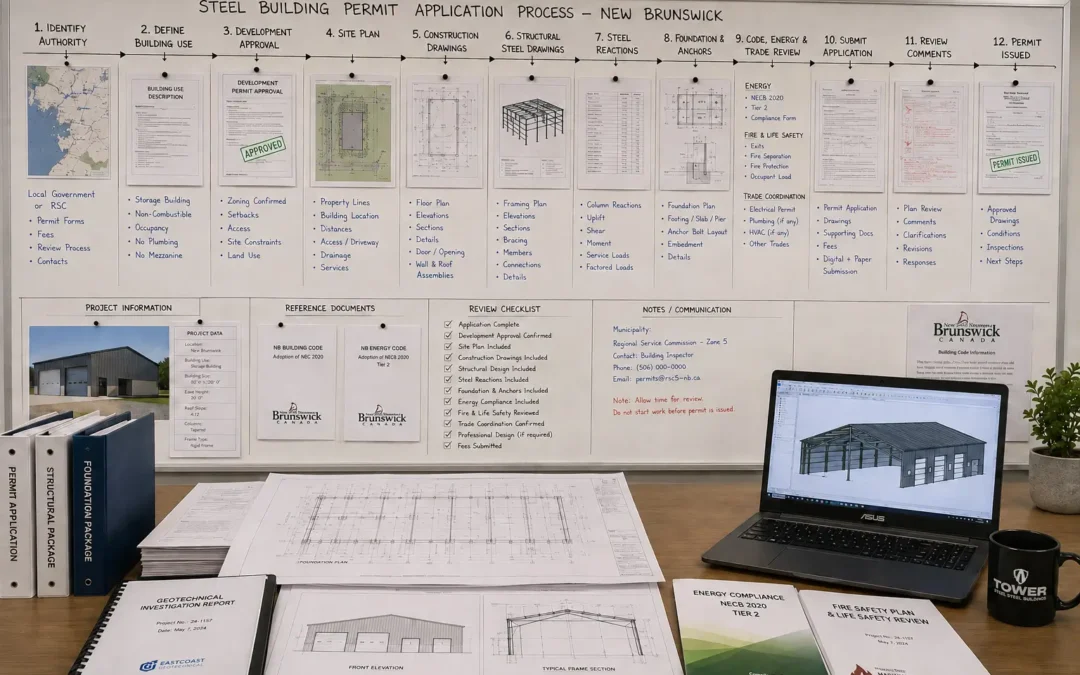
Foundation drawings are where a steel building project either becomes buildable or starts accumulating hidden risk. In New Brunswick, the mistake is often not that the owner forgot to apply for a permit. The more expensive mistake is assuming that a steel building supplier drawing, a rough slab sketch, or a generic concrete detail is enough to support a real building on a real site.
A steel building foundation has to receive the loads from the frame, hold the columns in the correct location, manage frost-related movement and protect against frost effects, transfer forces into the soil, coordinate anchor bolts before concrete is placed, and satisfy the authority reviewing the permit package. When those responsibilities are split between the building supplier, foundation designer, contractor, owner, and local authority, small missing details can become major construction problems.
This guide explains what foundation drawings for steel buildings in New Brunswick should do, what information must be coordinated before they are finalized, why Regional Service Commissions and local governments matter, and how serious buyers can reduce the risk of redesigns, permit delays, anchor bolt conflicts, concrete rework, and field disputes.
Quick Answer
Foundation drawings for a steel building in New Brunswick should show how the proposed foundation supports the specific steel building on the specific site. They normally depend on the building layout, column grid, reactions, base plate information, anchor bolt information, soil conditions, frost exposure, drainage, slab use, building occupancy, and the reviewing authority. GNB’s land-use planning guidance explains that local governments provide land-use planning, development services, and building inspection, while Regional Service Commissions provide those services for rural districts and some local governments receiving RSC services.
A building permit application is not simply a request to pour concrete. The National Research Council’s National Building Code of Canada 2020 publication page describes the NBC as setting technical requirements for design and construction. New Brunswick’s building-code information identifies NBC 2020 and NECB 2020 as the applicable code framework adopted at energy efficiency tier two.
For a buyer, the safest early step is to confirm permit path, site constraints, loads, foundation responsibility, and drawing scope before ordering steel or booking concrete. Tower Steel Buildings helps coordinate foundation-related design inputs, including steel reactions, column grids, base plate information, and anchor bolt information, so the foundation designer can prepare project-specific foundation drawings before review. For a broader readiness check, use the steel building permit checklist before you apply.
Why Foundation Drawings Matter More Than Buyers Think
A steel building foundation drawing is not just a concrete drawing. It is the transfer point between the engineered steel frame and the ground. The building can be well manufactured, the columns can be straight, and the roof system can be properly designed, but if the foundation information is incomplete or mismatched, the site team can still face serious problems before the first frame is lifted.
In the field, foundation mistakes usually show up late. The anchor bolts are already cast into concrete. The excavation is already complete. The steel package has arrived. The erector has a crane booked. Then someone discovers that the column grid is wrong, base plates do not fit, reactions changed after the foundation was designed, slab thickness was assumed without knowing use, or frost and soil conditions were not properly addressed. At that point, the problem is no longer a drafting issue. It becomes schedule risk, engineering risk, cost risk, and sometimes safety risk.
New Brunswick adds another practical layer because the approval path depends on location. A project in Fredericton, Moncton, Saint John, a rural district, or a community served by an RSC may not move through the same office or follow the same document expectations. GNB states that local governments provide local land-use planning, development services, and building inspection, while RSCs provide those services for rural districts and certain local governments. That means the first foundation question is not only, ‘What size footing do I need?’ It is also, ‘Who is reviewing this project and what do they need to see before construction can proceed?’
What a Foundation Drawing Must Prove
A good foundation drawing should prove that the proposed foundation is coordinated with the actual steel building and the actual site conditions. It should not force the building official, inspector, contractor, or owner to guess where loads go or how the concrete work relates to the steel package.
For a steel building, the foundation drawing should generally identify the foundation system, footing locations, slab information where applicable, column grid, dimensions, elevations, reinforcement, anchor bolt locations, embedment and projection information when required, concrete specifications, relevant construction notes, and details needed for the contractor to build the foundation as designed. The exact content depends on project type, size, use, authority requirements, and professional responsibility, but the core purpose is always the same: the drawing must connect design intent to buildable concrete work.
The foundation drawing also has to answer the structural load path question. Roof snow, wind, dead load, live load, door loads, mezzanine loads, crane or equipment loads where present, and frame reactions must all find their way into the ground through a designed system. If the foundation drawing only shows a generic slab without identifying column loads or anchor bolt requirements, the project may look simple on paper but become risky in construction.
New Brunswick Approval Context: Local Governments, RSCs, and Building Review
New Brunswick buyers should not assume one permit path applies everywhere. GNB’s public guidance explains that local governments provide local land-use planning, development services, and building inspection, and that Regional Service Commissions provide those services to rural districts and some local governments that receive RSC services. This matters because foundation drawings are usually part of a wider review package, not an isolated document.
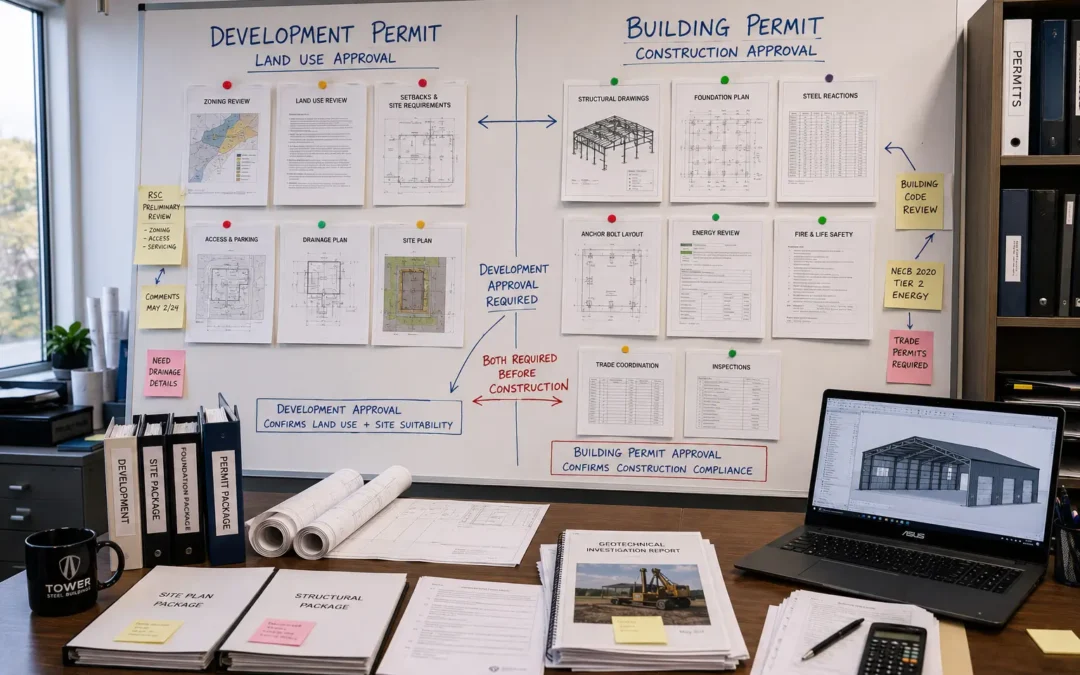
Plan360, the land planning division of the Southeast Regional Service Commission, describes a building permit as formal permission to begin construction, demolition, addition, renovation, or a change in use. It also explains that building permits help ensure construction and development conform to building by-laws, the National Building Code, other regulations, and acceptable health and safety standards. That is a practical reminder: the reviewing authority is not only checking whether concrete exists. It is checking whether the proposed work is acceptable in context.
Fredericton states that building permits are required before developing a new building, addition, or significant alteration, and that permits help ensure the work meets the National Building Code and other municipal and provincial standards. Moncton identifies its Planning and Development Department as responsible for providing building permits within the city. Fundy Regional Service Commission’s permit information states that building and development permits are required for new structures, major excavation, demolition, relocation, alteration, replacement, or change of use, and buyers should confirm the exact requirement with the authority serving their property. These examples show why the same steel building concept may require different submission coordination depending on where the project sits.
Before foundation drawings are finalized, the owner should confirm the authority having jurisdiction, development approval requirements, zoning or land-use constraints, driveway or access issues, stormwater/drainage expectations, servicing, building use, and any environmental or site-specific constraints that can change the location, size, or design of the foundation system.
Foundation Drawings Are Not the Same as Supplier Drawings
A common buyer mistake is treating supplier drawings and foundation drawings as interchangeable. They are connected, but they do not do the same job.
Steel building supplier drawings normally communicate the building system: frame layout, member sizes, building dimensions, bracing, column locations, base plate information, reactions, anchor bolt data, connection requirements, and erection-related details. They are essential inputs for the foundation designer, but they do not automatically replace a project-specific foundation design.
Foundation drawings translate those steel building inputs into site-specific concrete and support design. The foundation designer has to consider soil bearing, frost exposure, drainage, groundwater, grade, slab use, local code context, construction sequence, and any special loads or use conditions. A foundation cannot be responsibly designed only from a marketing size such as 40×60 or 60×100. The exact frame, reactions, openings, doors, mezzanines, equipment, and site conditions matter.
This is why buyers should not finalize concrete before steel reactions and anchor bolt information are coordinated. When the steel design changes after the foundation is drawn, the concrete design may also need review. The issue is not paperwork. It is whether the finished foundation can safely and accurately receive the building that will arrive on site.
The Inputs Needed Before Foundation Drawings Are Finalized
1. Building Size, Use, and Occupancy
The foundation designer needs more than width, length, and height. A farm storage building, repair shop, warehouse, municipal garage, equipment wash facility, and commercial building can all create different foundation demands. Use affects slab loads, door openings, interior pits, wash bays, drainage, insulation, fire separation, accessibility, and sometimes energy-code coordination.
A buyer who says ‘I just need a storage building’ may still be planning racking, forklifts, heated workspace, equipment repair, mezzanine storage, or truck access. Those details must surface early because they affect more than the steel package. They can affect slab design, footing design, drainage, and permit review.
2. Column Grid and Frame Layout
The column grid is one of the most important pieces of information for foundation drawings. It tells the foundation designer where vertical and horizontal forces enter the concrete. If the grid changes after foundation design, the footing layout and anchor bolt locations may also need to change.
This is especially important for buildings with large doors, lean-tos, interior partitions, cranes, mezzanines, or future expansion plans. A small layout change can move a frame line, change reactions, or change base plate requirements.
3. Steel Reactions
Steel reactions tell the foundation designer what loads the frame is sending into the foundation. These may include vertical reactions, horizontal reactions, uplift, shear, and moment where applicable. A foundation drawing prepared before final reactions are available may be based on assumptions that later prove wrong.
For serious buyers, reactions are not an afterthought. They are one of the main pieces of coordination between the steel building engineer and the foundation designer. If reactions increase because of snow, wind exposure, larger openings, mezzanine loads, or a different frame system, the foundation may need revision.
4. Base Plates and Anchor Bolts
Anchor bolts are a small part of the project by size and a large part of the project by risk. If anchor bolt locations, diameters, embedment, projection, edge distances, or templates are not coordinated, the erector may arrive to find that columns cannot be set correctly.
Incorrect anchor bolts can lead to drilling, epoxy fixes, rejected work, engineering review, delayed erection, crane standby, and disputes over responsibility. In some cases, the repair can be acceptable only after engineering review. In other cases, concrete may need removal or replacement. The cheapest time to fix anchor bolt information is before the pour.
5. Soil Conditions and Bearing Capacity
Foundation drawings need soil assumptions or geotechnical information appropriate to the project. Not every steel building automatically requires the same level of geotechnical reporting, but every foundation is still supported by soil. Weak fill, organic material, frost-susceptible soil, poor drainage, sloping grades, or groundwater can change foundation design and construction cost.
For this reason, buyers should treat soil as an early project question, not a surprise discovered during excavation. The Tower Steel Buildings guide on soil conditions explains why bearing capacity, drainage, frost, and site preparation can change foundation decisions for steel buildings.
6. Frost, Drainage, and Grade
New Brunswick projects must be planned for freeze-thaw conditions. Frost depth, drainage, backfill, finished grade, and water movement can all affect foundation performance. A foundation that looks adequate in a dry drawing can perform poorly if water collects around footings or if frost movement is not handled correctly.
Drainage is often underestimated because it is not as visible as steel framing. But poor grading can soften subgrade, create frost heave risk, delay inspections, affect slab performance, and increase maintenance problems after occupancy.
7. Slab Use and Interior Loads
A slab for light storage is not the same as a slab for forklifts, trucks, lifts, racking, wash bays, or heavy equipment. Buyers often focus on frame price and overlook the slab, even though the slab may be where the building has to perform every day.
If the slab will support vehicle lifts, racking posts, interior partitions, trench drains, floor heating, or equipment anchors, those details should be coordinated before foundation drawings are issued. Adding them later can trigger revisions and field compromises.
For more background on site conditions, review soil conditions and steel building foundations and frost depth and steel building foundations.
What Commonly Goes Wrong When Foundation Drawings Are Rushed
Most foundation problems are not dramatic at the design meeting. They look like harmless assumptions. The owner assumes the building size will not change. The contractor assumes anchor bolts can be adjusted later. The supplier assumes the foundation designer has final reactions. The foundation designer assumes the site plan is fixed. The permit reviewer assumes the drawings submitted reflect the actual building. The trouble starts when those assumptions collide.
The most common failures are mismatched drawings, incomplete reactions, generic foundation details, wrong anchor bolt layouts, slab designs that do not match actual use, frost or drainage details that are too weak for the site, and foundation drawings prepared before development review confirms the building location. The project may still move forward, but it moves forward with risk hidden inside the concrete scope.
One of the worst field scenarios is pouring foundations from early information and then receiving final steel drawings that do not match. That can happen when openings change, eave height changes, framed openings are added, loads are revised, or the building is shifted to satisfy setbacks, access, drainage, or utility constraints. Once concrete is placed, every change becomes harder and more expensive.
A Real-World Scenario: The Anchor Bolt Problem That Should Have Been Prevented
Imagine a New Brunswick business owner planning a 60×100 steel building for equipment storage and light repair. The owner wants to move quickly before winter. A contractor marks out the foundation based on an early layout. The steel package is still being finalized, but everyone believes the final drawings will be close enough.
During review, the owner adds a wider overhead door and changes the interior layout to allow larger equipment to turn inside the building. That change affects the frame layout and reactions. The foundation drawing is not updated because the concrete schedule is already booked. Anchor bolts are placed using the older template.
When the steel arrives, several base plates do not match the bolt pattern. The erector cannot safely set frames as planned. The site needs engineering review, layout verification, possible remedial anchor design, and schedule resequencing. The owner pays for delay, the contractor loses crew productivity, the erector loses confidence in site readiness, and the project becomes tense before the structure is standing.
This is not a rare type of failure. It is the predictable result of treating foundation drawings as an early placeholder instead of a coordinated construction document. The prevention is straightforward: freeze critical steel building inputs, coordinate reactions and anchor bolt details, confirm site plan constraints, and issue foundation drawings only when the information is ready for construction and review.
What New Brunswick Buyers Should Confirm Before Ordering Concrete
Before a buyer allows excavation, forming, reinforcing, or concrete placement to begin, several items should be confirmed in writing. The project should have a clear authority path, a defined building use, a confirmed site location, a coordinated column grid, current steel reactions, base plate and anchor bolt information, soil/frost/drainage assumptions, slab requirements, and responsibility boundaries between the supplier, foundation designer, contractor, and owner.
The buyer should also confirm whether the project is subject to development approval, zoning restrictions, setbacks, environmental constraints, driveway or access approvals, stormwater expectations, or other requirements that can change where the building sits. If the building location changes after the foundation design is complete, the foundation work may no longer align with the approved site plan or the final construction layout.
Plan360 advises applicants to review forms and documents so the application package is complete and accurate before submission. Southwest New Brunswick Service Commission identifies a permit application process for planning, development, subdivision, and building permit applications. Kings Regional Service Commission notes that where a rural plan is in place, a proposed development or structure may require rezoning or a variance. These are not foundation details by themselves, but they can affect the foundation because they can affect whether the building can be placed where the owner wants it.
How Foundation Drawings Fit Into the Permit Package
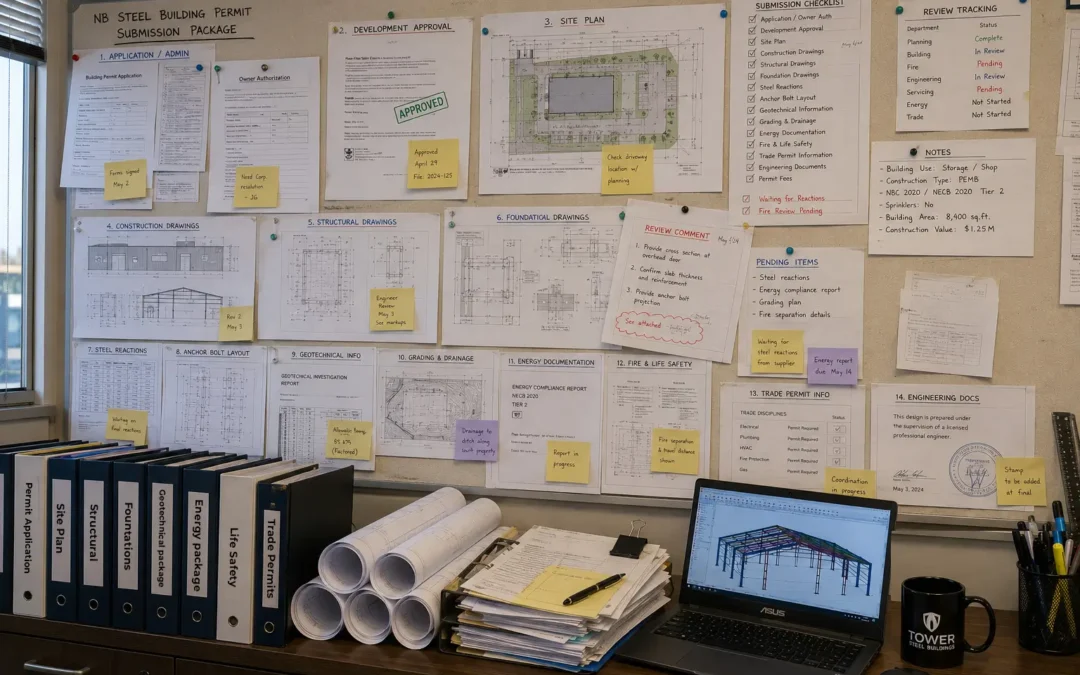
For a steel building, foundation drawings usually sit inside a broader permit package. That package may include application forms, site plan, building drawings, structural drawings, foundation drawings, energy information where applicable, occupancy/use information, drainage or grading information, and any additional documents requested by the authority having jurisdiction. The exact package varies by project and location.
The reviewing authority may need to understand how the building is located on the property, how it meets land-use requirements, whether the proposed construction complies with applicable building-code requirements, and whether the drawings are complete enough for review and inspection. A strong foundation drawing helps because it reduces uncertainty around the support system, load path, and construction details.
For buyers, the practical rule is simple: supplier drawings, foundation drawings, site plan, and permit application should tell the same story. If the site plan shows one building location, the foundation drawing shows another grid, and the steel drawings show a different opening layout, the review can slow down or the field work can fail. Permit readiness depends on coordination, not document volume.
Professional Responsibility and Stamped Drawings
Some projects require professional involvement because of building type, scope, complexity, occupancy, structural design, or authority requirements. Buyers should not assume that a stamp on one drawing automatically covers every other part of the project. A steel building package may have engineered building drawings, while the foundation may require separate project-specific design by the appropriate professional.
APEGNB provides professional seal information for engineers and geoscientists in New Brunswick. The key buyer lesson is not to chase a stamp as a formality. The important question is whether the professional responsibility matches the actual scope being reviewed and built. If a foundation drawing is required, it should be based on correct building inputs and site assumptions, not copied from a different building or reused from an unrelated project.
Tower Steel Buildings does not need to overstate this point. The right wording is practical: Tower Steel Buildings helps coordinate foundation-related design inputs, including steel reactions, column grids, base plate information, and anchor bolt information, so the foundation designer can prepare project-specific foundation drawings before review. That coordination reduces the risk of foundation drawings being developed from incomplete steel information.
Foundation Drawings for Farm, Commercial, Warehouse, and Municipal Steel Buildings
Different steel building uses create different foundation risks. A farm equipment building may need wide doors, durable slabs, corrosion-aware detailing, drainage planning, and heavy equipment movement. A commercial steel building may bring accessibility, egress, fire separation, energy, mechanical, and occupancy questions. A warehouse may involve racking layouts, forklift movement, loading doors, dock areas, and slab flatness or load considerations. A municipal or emergency services building may demand long-term durability, operational reliability, clear vehicle movement, and careful coordination with utilities and site access.
The foundation drawing should not ignore these differences. A building that only stores hay is not the same as a repair shop with vehicle lifts. A warehouse that stores light materials is not the same as a racked storage facility with forklifts. A municipal garage is not the same as a private shed. The foundation designer needs to know the real use because the concrete and support system must serve the actual operation.
Buyers planning commercial, agricultural, or warehouse projects can review Tower Steel Buildings resources for commercial steel buildings, farm steel buildings, and warehouses to understand how use affects layout and coordination. The early building-use conversation should happen before the foundation is designed, not after the permit reviewer or inspector asks questions.
What Not to Assume
Do not assume that a generic slab is enough because the building is made of steel. Do not assume that the local authority will accept incomplete foundation information. Do not assume that every RSC or local government will ask for the exact same package. Do not assume that an early steel quote contains final reactions. Do not assume anchor bolt layouts can be fixed in the field without consequence.
Do not assume that a rural site has fewer risks than an urban site. Rural sites may involve private access, drainage, undeveloped land, frost exposure, fill, septic or well separation, and land-use plan constraints. Urban or serviced sites may involve zoning, stormwater, fire access, setbacks, servicing, and site plan requirements. Both can affect foundation planning.
Do not assume that a building permit application means approval. A permit application is a submission for review. Plan360 describes the building permit as formal permission to begin construction. That distinction matters. Concrete should not be treated as ready simply because documents are being assembled. Work should be sequenced around actual approvals and coordinated drawings.
A Practical Foundation Drawing Readiness Checklist
Use this checklist before finalizing foundation drawings or starting concrete work. It is not a substitute for professional design or authority review, but it helps identify coordination gaps early.
Confirm the authority having jurisdiction: local government, RSC, or specific municipal department. Confirm whether development approval, rezoning, variance, site plan review, driveway/access approval, environmental review, or other approvals may affect the building location. Confirm the building use in plain terms, including future use if known. Confirm final building size, height, bay spacing, door locations, framed openings, mezzanines, cranes, racking, lifts, wash bays, or equipment loads.
Confirm current steel reactions and whether they are final for foundation design. Confirm column grid, base plate information, anchor bolt diameter, pattern, projection, embedment, and template requirements. Confirm soil assumptions, geotechnical information where required, frost design approach, drainage, grading, groundwater, and subgrade preparation. Confirm slab thickness and reinforcement approach based on actual use. Confirm who is responsible for foundation design, foundation review, anchor bolt layout, inspection coordination, and field changes.
Finally, confirm that the permit package, site plan, steel drawings, and foundation drawings match before submission and before construction. If any one of those documents changes, the others may need review.
How Tower Steel Buildings Supports Better Foundation Coordination
A steel building supplier cannot control New Brunswick permit approval, RSC decisions, local government review, inspections, site conditions, or the work of third-party professionals. But a supplier can help reduce avoidable coordination problems by giving the right project information to the right people at the right time.
Tower Steel Buildings helps coordinate the building-side information that foundation designers need: column grids, reactions, base plate information, anchor bolt information, layout coordination, and design inputs connected to the steel building package. This helps the foundation designer prepare project-specific foundation drawings before review and before concrete work begins.
That coordination is especially valuable when buyers are comparing quotes. The lowest steel price can become expensive if reactions, foundations, anchors, permits, site work, or installation assumptions are missing. A serious buyer should compare not only the frame price, but also how clearly the supplier supports the design and construction path. For early project planning, review Tower Steel Buildings’ building design guide and request a quote when you have enough site and use information to make the quote meaningful.
Useful starting points: building design guide, foundation design, and request a steel building quote.
Related New Brunswick Steel Building Permit Resources
- Steel Building Permits New Brunswick
- Documents Required for a Steel Building Permit in New Brunswick
- How to Apply for a Steel Building Permit in New Brunswick
- Development Permit vs Building Permit New Brunswick
- Steel Building Permit Timeline New Brunswick
- Steel Building Permit Cost New Brunswick
- Why Steel Building Permits Get Delayed New Brunswick
- Why Steel Building Permits Get Rejected New Brunswick
Related Steel Building Design Resources
- Steel Building Permit Checklist Before You Apply
- Site-Specific Steel Building Engineering
- Steel Building Foundation Design
- Soil Conditions and Steel Building Foundations
- Frost Depth and Steel Building Foundations
- Coordinating Trades During Steel Building Construction
- Request a Quote
Sources Reviewed
- Government of New Brunswick – Land use planning and regulations for property owners
- Government of New Brunswick – Building code
- Building Code Administration Act, New Brunswick
- National Research Council Canada – National Building Code of Canada 2020
- Plan360 – Building permit guidance
- Plan360 – Apply for a permit
- Southwest New Brunswick Service Commission – Permit application
- Kings Regional Service Commission – Building and planning
- Fundy Regional Service Commission – Permit information
- City of Fredericton – Building permits
- City of Moncton – Building and development permits
- APEGNB – Professional seals, stamps and signatures
Reviewed by Engineering Team
This content has been reviewed by the Tower Steel Buildings Engineering Team.
The review focused on practical foundation drawing coordination for steel buildings in New Brunswick, including steel reactions, column grids, base plate information, anchor bolt layout, soil assumptions, frost exposure, drainage, slab use, site constraints, permit path, development approval, local government or Regional Service Commission review, and construction sequencing before concrete placement.
Foundation drawings are one of the highest-risk coordination points in a steel building project. They are not generic concrete sketches. They show how the steel building loads, column locations, base plates, anchor bolts, soil conditions, frost considerations, drainage strategy, slab use, and construction sequence work together before excavation, forming, reinforcing, concrete placement, or steel erection begins.
For New Brunswick steel building projects, foundation problems often start when supplier drawings are mistaken for complete foundation drawings, reactions are not final, anchor bolt layouts are treated as flexible, site plans change after design, soil assumptions are weak, frost and drainage are not addressed, or concrete is poured before the permit path and approved drawings are clear.
This review focused on one practical question: is the foundation information coordinated enough to support the actual steel building on the actual site?
A steel building foundation is ready when the site, building use, permit path, steel reactions, column grid, base plates, anchor bolts, soil and frost assumptions, drainage, foundation design, professional responsibility, and construction sequence all describe the same buildable project.
This content is intended to support buyer education and foundation-readiness planning. Final foundation design requirements, permit submission expectations, inspections, approvals, stamped engineering responsibilities, geotechnical requirements, and field-review responsibilities remain under the authority of the applicable local government, Regional Service Commission, building official, inspector, foundation designer, engineer, geotechnical professional, or other licensed professional involved in the project.
1. Do steel buildings in New Brunswick need foundation drawings?
Most permanent steel buildings in New Brunswick should be planned with foundation drawings that match the specific building, site, soil conditions, frost exposure, slab use, and permit path. The exact submission requirement depends on the building type, location, use, authority having jurisdiction, and project scope.
A steel building foundation is not just a generic slab. It must receive frame loads, support columns, coordinate anchor bolts, manage frost and drainage risk, and provide enough information for review, construction, and inspection. Even when a smaller project has a simpler approval path, the owner still needs coordinated foundation information before concrete work begins.
2. Are supplier drawings enough for a steel building foundation?
No. Supplier drawings are important inputs, but they are not automatically a complete foundation design. Supplier drawings may show frame layout, column locations, base plate information, steel reactions, anchor bolt requirements, building dimensions, and erection-related details.
Foundation drawings translate that steel-building information into a project-specific concrete support system. The foundation designer must also consider soil assumptions, frost, drainage, site grading, slab use, local permit expectations, construction sequence, and professional responsibility. Supplier drawings tell the foundation designer what the steel building needs; foundation drawings show how the site and concrete support those needs.
3. Who prepares foundation drawings for a steel building in New Brunswick?
Foundation drawings should be prepared by the party responsible for foundation design under the project scope. Depending on the building size, use, complexity, site conditions, and authority requirements, that may involve a qualified foundation designer, professional engineer, or other properly authorized design professional.
The key issue is not only who draws the foundation. It is whether the responsible designer has the correct information: final steel reactions, column grid, base plate details, anchor bolt layout, soil assumptions or geotechnical information, frost considerations, drainage conditions, slab use, site plan, and permit context.
4. Who reviews steel building foundation drawings in New Brunswick?
Foundation drawings are typically reviewed as part of the broader permit package by the authority serving the property. Depending on location, that may involve a local government, Regional Service Commission, building department, building inspector, development officer, or other review path.
The reviewer may look at foundation drawings alongside the site plan, building drawings, structural steel drawings, development approval information, drainage or grading details, professional documents, and inspection requirements. Buyers should confirm the authority having jurisdiction before treating foundation design as final.
5. What should steel building foundation drawings show?
Steel building foundation drawings should show how the building loads transfer safely into the ground and how the concrete work should be built. Depending on the project, they may include footing or pier locations, slab information, column grid, dimensions, elevations, reinforcement, concrete specifications, anchor bolt locations, base plate coordination, embedment or projection details, frost protection approach, drainage or grade notes, construction details, and references to design criteria or reactions.
They should also match the site plan and steel building drawings. The purpose is not to make the permit package look complete. The purpose is to prove how the steel building is supported on that specific property.
6. Why do steel reactions matter for foundation drawings?
Steel reactions matter because they tell the foundation designer what forces the steel frame transfers into the foundation. These can include vertical loads, lateral loads, uplift, shear, moments, snow-load effects, wind effects, framed-opening loads, mezzanine loads, equipment loads, or other project-specific forces.
Without accurate reactions, the foundation designer may size footings, piers, slab thickening, reinforcement, and anchors from assumptions instead of actual building loads. That can lead to redesign, permit comments, inspection problems, anchor bolt conflicts, concrete rework, or long-term performance issues.
7. Can I pour concrete before final steel building drawings are ready?
Pouring concrete before final steel building drawings are ready is a high-risk decision. The foundation depends on final column locations, frame layout, base plate dimensions, anchor bolt patterns, reactions, uplift, shear, and other building-specific information.
If any of those items change after concrete is placed, the project can face drilling, epoxy anchor review, concrete repair, rejected work, engineering redesign, erection delays, crane standby, or responsibility disputes. Concrete should not proceed from assumptions unless the responsible project team has confirmed that the information is final and suitable for construction.
8. What happens if anchor bolts do not match the steel building base plates?
If anchor bolts do not match the steel building base plates, erection can stop quickly. The columns may not align, bolt holes may not match, edge distances may be wrong, and the frame may not be safely set without review.
Field fixes are not simple because anchor bolts resist real structural forces. Drilling, slotting, welding, epoxy anchors, plate modifications, or relocation may require engineering review and may not be accepted without proper verification. The safest time to solve anchor bolt issues is before concrete is poured.
9. Does every steel building foundation need a geotechnical report?
No. It is not accurate to say every steel building foundation automatically needs a geotechnical report. Requirements depend on the project type, building size, use, soil conditions, site history, authority expectations, professional design judgment, insurer requirements, and risk level.
However, every foundation design needs a defensible understanding of soil support, frost exposure, groundwater, fill, drainage, bearing conditions, and settlement risk. The unsafe assumption is believing soil does not matter because the building is “just steel.” Soil controls how loads transfer and how the foundation performs over time.
10. Can a generic slab drawing be used for a steel building?
A generic slab drawing is usually not enough for a permanent steel building unless the responsible designer and reviewing authority accept it for that specific project. Steel buildings concentrate loads at columns and anchors, and those loads must be transferred through a foundation system designed for the actual frame, soil, frost, slab use, and site conditions.
A generic slab may ignore column reactions, uplift, base plate locations, anchor bolt requirements, thickened areas, reinforcement, drainage, vehicle loads, racking loads, or equipment loads. For a basic storage use, the foundation may be simpler, but it still needs to match the building.
11. Can development approval change steel building foundation drawings?
Yes. Development approval can affect foundation drawings because it may control where the building can sit on the property. Setbacks, land-use rules, access, driveway location, drainage, environmental constraints, easements, parking, fire access, servicing, and site layout can all affect the approved building location.
If development review requires the building to shift, rotate, shrink, change access, or adjust finished floor elevation, the foundation drawings may need to change. This is why excavation, forming, anchor bolt templates, and concrete placement should not be treated as final until the site approval path and construction documents are coordinated.
12. Should I confirm the municipality or RSC before foundation design?
Yes. New Brunswick buyers should confirm the municipality, Regional Service Commission, or authority having jurisdiction before treating foundation design as final. The review path can affect development approval, building permit requirements, site plan expectations, setbacks, use classification, driveway or access requirements, drainage expectations, inspection sequencing, and required documents.
A foundation layout can be technically strong but still become a problem if the approved building location, use, access, grading, or development conditions change during review. Confirming the authority path early helps prevent foundation design from being based on a site layout that later has to move.
13. Does Tower Steel Buildings provide stamped foundation engineering?
Do not assume stamped foundation engineering is included unless it is specifically confirmed in the project scope. Tower Steel Buildings helps coordinate foundation-related building inputs, including steel reactions, column grids, base plate information, anchor bolt information, and layout details that the foundation designer may need.
That coordination is valuable because foundation designers need accurate steel-building information. However, stamped foundation engineering, geotechnical work, permit submission, professional responsibility, and third-party review responsibilities must be confirmed for each project.
14. What is the biggest foundation mistake steel building buyers make?
The biggest mistake is treating the foundation as separate from the steel building. In a real project, the foundation must match the frame reactions, column grid, base plates, anchor bolts, soil conditions, frost conditions, drainage, slab use, site plan, permit path, and construction sequence.
Buyers get into trouble when they order steel, sketch a slab, book concrete, and assume the details can be fixed later. The safer approach is to coordinate the steel supplier, foundation designer, contractor, owner, and reviewing authority before money is committed to concrete work that may not match the final approved building.
15. What should I confirm before starting concrete work for a steel building?
Before starting concrete work, confirm the authority path, development approval status, building location, real building use, site plan, final steel reactions, column grid, base plate information, anchor bolt layout, soil assumptions, frost approach, drainage, slab use, foundation drawings, professional responsibility, inspection requirements, and current approved drawings.
Concrete is expensive to correct after placement. If the site plan, reactions, anchors, or foundation details change after the pour, the project may face engineering review, repair, delays, inspection issues, and erection problems.
16. How can Tower Steel Buildings help with foundation drawing coordination?
Tower Steel Buildings can help buyers organize the steel-building inputs needed for better foundation coordination, including building layout, column grid, reactions, base plate information, anchor bolt information, and quote-to-permit planning.
This helps the foundation designer work from clearer project information before permit review and concrete work begin. Better coordination does not replace the authority having jurisdiction or the foundation designer, but it can reduce avoidable redesign, anchor bolt conflicts, concrete rework, erection delays, and cost surprises.