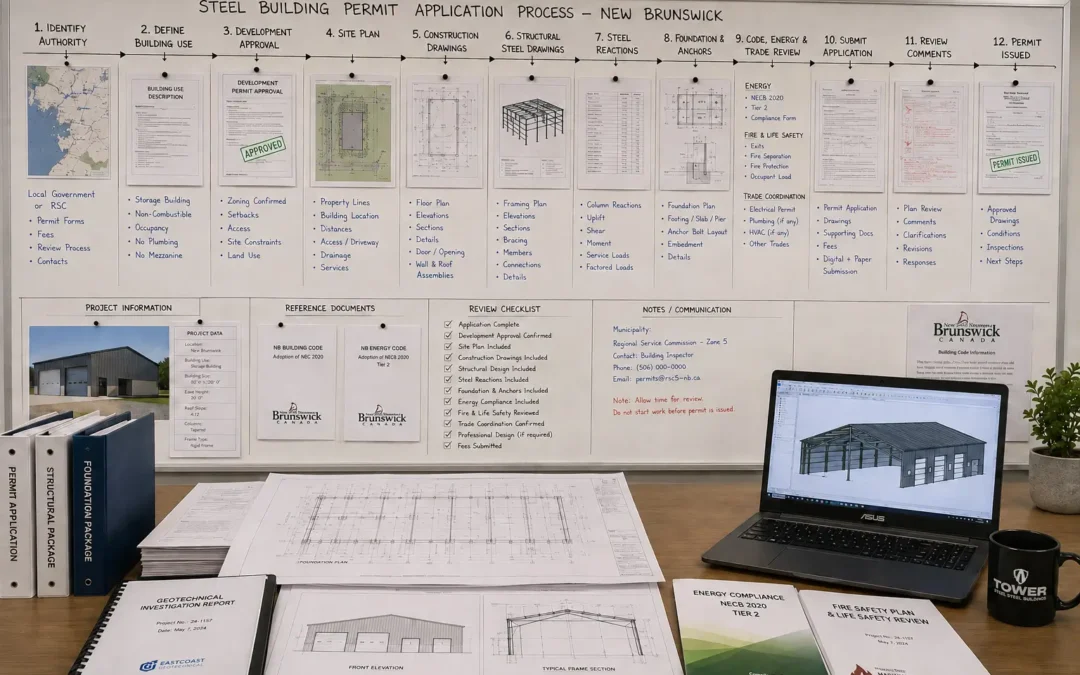
A steel building permit timeline is built in layers, not one deadline
A steel building permit timeline in New Brunswick is not controlled by one date on a municipal website. It is shaped by the approval path, the property location, the reviewing authority, the building use, the completeness of the application, the quality of the site plan, the development permit path, the structural design, the foundation information, the energy scope, the trade scope, and how quickly review comments are answered.
For serious steel building buyers, this matters because the permit timeline begins before the application is submitted. It begins when the buyer defines the real building use, confirms the local authority or Regional Service Commission, checks development approval requirements, prepares the site information, and coordinates the steel building design with the foundation before committing to fabrication or concrete work.
A steel building permit timeline is not simply waiting for the municipality. It is the time required to prove that the project is allowed, site-specific, code-aware, coordinated, and ready to inspect.
New Brunswick’s building code information confirms that the National Building Code of Canada 2020 and the National Energy Code for Buildings 2020 set technical provisions for new buildings, alterations, changes of use, and demolition. It also states that both documents are adopted at energy efficiency tier two.
The practical lesson is direct: the fastest steel building permit applications are not the ones rushed into review. They are the ones that arrive with fewer unresolved questions.
Quick Answer
There is no single fixed steel building permit timeline in New Brunswick. A simple project with clear land use, a complete site plan, coordinated drawings, and no outside approval issues may move faster. A commercial, industrial, agricultural processing, truck garage, warehouse, or heated workshop project can take longer because development approval, site servicing, drainage, structural review, foundation coordination, NECB energy documentation, trade permits, professional documents, and review comments may need to be resolved.
For planning purposes, serious buyers should think in stages, not one number: authority confirmation, development approval, drawing coordination, permit intake, technical review, comment response, permit issuance, and inspections. The timeline expands when any stage is unclear or when the documents do not describe the same project.
For the full provincial approval path, see our main guide to steel building permits in New Brunswick.
For broader preparation before submission, review this steel building permit checklist before you apply.
What This Guide Covers
This guide explains the real timeline drivers for steel building permits in New Brunswick. It focuses on what serious buyers should understand before spending money on engineering, fabrication, foundations, delivery, or construction scheduling.
- how permit timelines work in New Brunswick
- why the correct local authority or RSC must be confirmed first
- how development approval affects building permit timing
- why site plans, servicing, and drainage can change the schedule
- how steel reactions, foundation drawings, and anchor bolts affect review
- why NECB, fire/life safety, accessibility, and trade scope can add time
- what happens after the application is submitted
- why review comments must be answered as a coordinated system
- why steel fabrication and concrete work should not move ahead on assumptions
Buyer Warning
The biggest timeline mistake is treating permit submission as the starting line.
For steel buildings, the real timeline often begins before submission, when the buyer confirms whether the use is allowed, whether development approval is needed, whether the site plan works, whether the foundation can be designed from final reactions, and whether the building will trigger energy, fire, accessibility, or trade requirements.
The most expensive timeline problem is not a slow review comment; it is when steel building lead times and total project cost are affected after steel has been released, concrete has been poured, anchor bolts have been set, or crews have been scheduled.
It is a late review comment after steel has been released, concrete has been poured, anchor bolts have been set, or crews have been scheduled.
At that point, the project is no longer only waiting; it is exposed to steel building erection timeline delays caused by rework, rescheduling, foundation conflicts, anchor bolt issues, inspection delays, or fabrication changes.
It is being corrected.
Steel Building Permit Timeline Snapshot
The ranges below are practical planning estimates, not official New Brunswick approval timelines and not guaranteed permit times. Actual timing must be confirmed with the local government, Regional Service Commission, building department, or authority having jurisdiction.
| Timeline Stage | Planning Range | What Usually Controls the Time |
| Authority and property confirmation | 1 to 5 business days | Confirming the correct local government, RSC, development officer, building inspector, property location, and intake process. |
| Development approval / land-use check | 1 to 8+ weeks | Zoning, rural plan rules, use, setbacks, access, variances, rezoning, or development approval requirements. |
| Site plan and servicing preparation | 1 to 4+ weeks | Building location, access, parking/loading, drainage, utilities, wells, septic, watercourses, wetlands, slopes, or site constraints. |
| Steel building design coordination | 1 to 4+ weeks | Building size, use, openings, snow and wind design, bracing, loads, reactions, and structural drawings. |
| Foundation and anchor coordination | 1 to 4+ weeks | Final steel reactions, column grid, base plates, anchor bolt layout, soil assumptions, frost, slab use, and foundation drawings. |
| Energy, fire/life safety, accessibility, and trade scope | 1 to 6+ weeks | NECB modelling where applicable, occupancy, exits, fire access, plumbing, HVAC, electrical, gas, fire protection, or professional documents. |
| Building permit intake and review | Varies by authority and project | Completeness of the package, review workload, building type, and whether comments are issued. |
| Comment response and resubmission | 1 to 8+ weeks per cycle | How completely the applicant answers comments and updates affected drawings together. |
| Permit issuance and inspections | Varies by project sequence | Fee payment, final approval, inspection booking, construction readiness, and staged inspections. |
What Actually Controls the Timeline
A New Brunswick steel building permit timeline is usually controlled by readiness, not by optimism. The project moves faster when the reviewer can understand the land-use path, site plan, structure, foundation, energy scope, trade scope, and inspection path without guessing.
The timeline grows when the authority has to ask basic questions: What is the real use? Is the use allowed? Where is the building located? Do the setbacks work? Does the foundation match the steel reactions? Are the anchor bolts coordinated? Is the building heated or conditioned? Are trade permits involved? Is a professional responsible for the design?
This is why buyers should understand how national and provincial steel building codes interact with local permit administration before assuming one timeline applies everywhere.
Step 1: Confirm the Correct Authority First
The first timeline step is not preparing drawings. It is confirming who actually reviews the file.
New Brunswick permit review can involve local governments, rural districts, Regional Service Commissions, planning staff, development officers, building inspectors, trade permit reviewers, fire and life safety reviewers, servicing reviewers, and professional designers depending on the location and building use.
GNB land-use guidance states that local governments provide local land-use planning, development services, and building inspection, while Regional Service Commissions provide those services to all rural districts and some local governments receiving RSC services. It also advises property owners to contact a development officer at the local government or RSC to determine whether a development permit is required.
This matters for timelines because applying to the wrong authority, using the wrong form, or skipping the development officer conversation can waste time before technical review even starts.
Step 2: Define the Real Building Use
The second timeline step is defining the building honestly. A steel building described as “storage” may follow a different path than a heated commercial workshop, truck garage, equipment repair building, agricultural processing building, warehouse, public-access building, or industrial facility.
Building use can affect zoning, development approval, occupancy, fire and life safety, energy requirements, trade permits, accessibility, ventilation, plumbing, parking, loading, inspections, and professional documents.
A vague use creates review time because the authority cannot confirm the right approval path. A buyer may want a quick permit, but the reviewer needs the real building, not the easiest label.
Step 3: Confirm Development Approval Before Treating the Building as Final
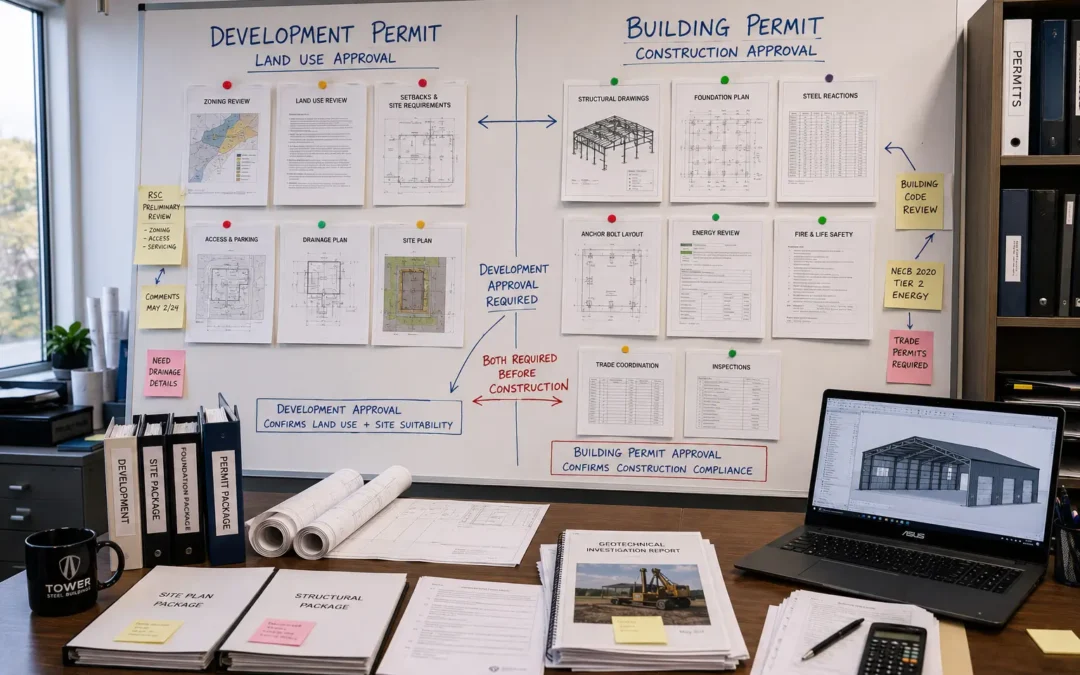
Development approval deals with whether the project is acceptable on the land. It can involve zoning, rural plan rules, setbacks, use, lot requirements, building placement, access, parking, loading, site constraints, and variances or rezoning where applicable.
Development review can change the steel building itself. If the building must move on the lot, the site plan changes. If the footprint changes, the foundation layout can change. If the permitted use changes, fire, energy, trade, and occupancy information may change.
A development issue discovered after steel design or foundation design is not only a planning delay. It can become redesign time.
For serious buyers, the safe sequence is to confirm the development path before treating the building layout, foundation, or anchor bolt plan as final.
Step 4: Prepare a Site Plan That Can Actually Be Reviewed
A weak site plan is one of the fastest ways to slow down a steel building permit timeline. The site plan shows where the building sits and how it interacts with the property.
Depending on the project, the site plan may need to show property lines, proposed building location, existing buildings, distances to lot lines, access, parking, loading, services, wells, septic, utilities, easements, watercourses, wetlands, slopes, drainage, grading, and exterior operational areas.
Moncton’s building and development permit guidance gives examples of site plan sketches showing property lines, buildings on the property, proposed building dimensions, and distances to surrounding property lines.
For steel buildings, the site plan must match the structural and foundation drawings. If the site plan shows one location and the foundation drawings show another, the review cannot move cleanly.
Step 5: Coordinate the Steel Building Design Early
Steel building design affects the permit timeline because it controls loads, openings, bracing, foundations, anchor bolts, and sometimes energy and fire/life safety coordination.
A wider span, larger doors, higher eave height, mezzanine, equipment load, truck access, crane-related use, or commercial occupancy can change the review path. Even when the building appears simple, the design still needs to reflect the actual New Brunswick location, snow, wind, exposure, and use.
For more detail, see why site-specific steel building engineering matters before permit submission.
Step 6: Confirm Steel Reactions Before Final Foundation Design
Steel reactions are the forces transferred from the steel frame into the foundation. They can include vertical reactions, lateral reactions, uplift, shear, moments, and column base forces.
The foundation designer needs these reactions to prepare a foundation that matches the actual steel building. If reactions are missing or preliminary, the foundation is being designed from assumptions.
That can add time during review because foundation drawings may need to be revised after final reactions are issued. It can add even more time if the mismatch is found after concrete work has started.
Step 7: Prepare Foundation and Anchor Bolt Information Before Submission
Foundation drawings and anchor bolt layout are timeline-critical for steel buildings.
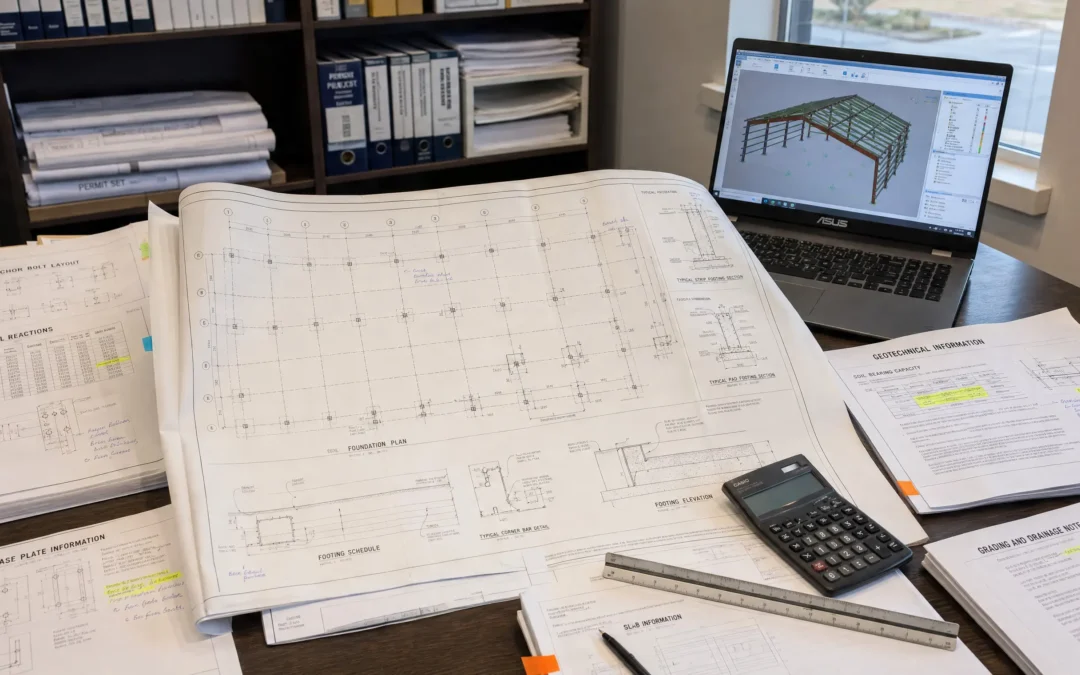
The foundation must match steel reactions, column grid, base plates, soil assumptions, frost considerations, drainage, grading, slab use, and building use. The anchor bolt layout must match the column grid, base plate holes, bolt size, spacing, projection, embedment, and foundation layout.
Tower Steel Buildings helps coordinate foundation-related design inputs, including steel reactions, column grids, base plate information, and anchor bolt information, so the foundation designer can prepare project-specific foundation drawings before review.
The timeline risk is simple: if the foundation or anchor bolt layout is wrong before submission, it becomes review time. If it is wrong after concrete is poured, it becomes field correction time.
Step 8: Check Soil, Frost, Drainage, and Site Constraints
Not every steel building needs a geotechnical report, but soil conditions always matter. Larger buildings, commercial buildings, truck garages, heavy equipment buildings, industrial buildings, agricultural processing buildings, wet sites, sloped sites, filled sites, and unknown bearing conditions can make geotechnical input important or required.
Soil can affect bearing capacity, settlement, frost response, slab performance, footing size, and foundation type. This is why soil conditions and steel building foundation design should be reviewed early.
Drainage also affects permit timing. Water movement can affect foundations, slabs, access, erosion, adjacent properties, and long-term performance.
Poor site water planning can also delay steel building projects when drainage and grading issues are not addressed before submission.
Step 9: Confirm NECB, Fire, Accessibility, and Trade Scope
Energy, fire/life safety, accessibility, and trade scope can add time when they are discovered late.
Southwest New Brunswick Service Commission states that buildings subject to the National Energy Code require modelling to document how the proposed structure will meet Tier 2 of the 2020 NECB, and that applications must include energy modelling documents in addition to plans from the registered design professional.
For commercial, conditioned, or NECB-subject buildings, buyers should understand energy-code requirements before submission.
Commercial, industrial, warehouse, truck garage, repair, or public-access buildings may also involve exits, fire separations, fire access, accessibility, plumbing, HVAC, electrical, gas, or fire protection. Coordinating trades during steel building construction helps reduce late conflicts and inspection delays.
Step 10: Submit Only When the Package Tells One Story
A steel building permit application should not be submitted just because the form is filled out. It should be submitted when the package can be reviewed as one coordinated project.
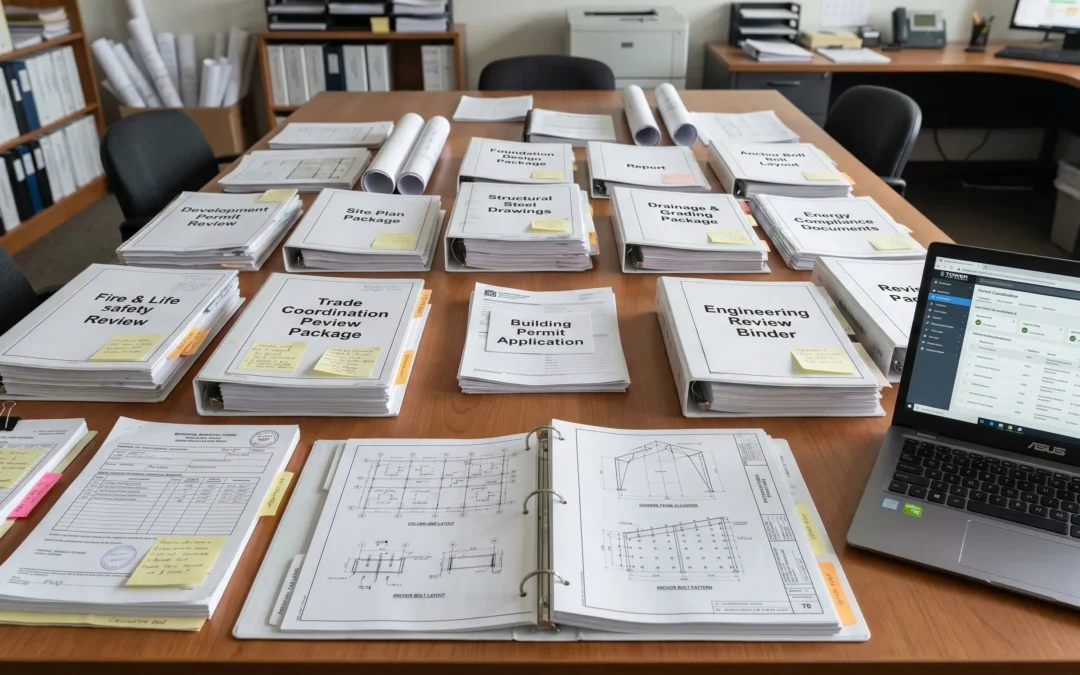
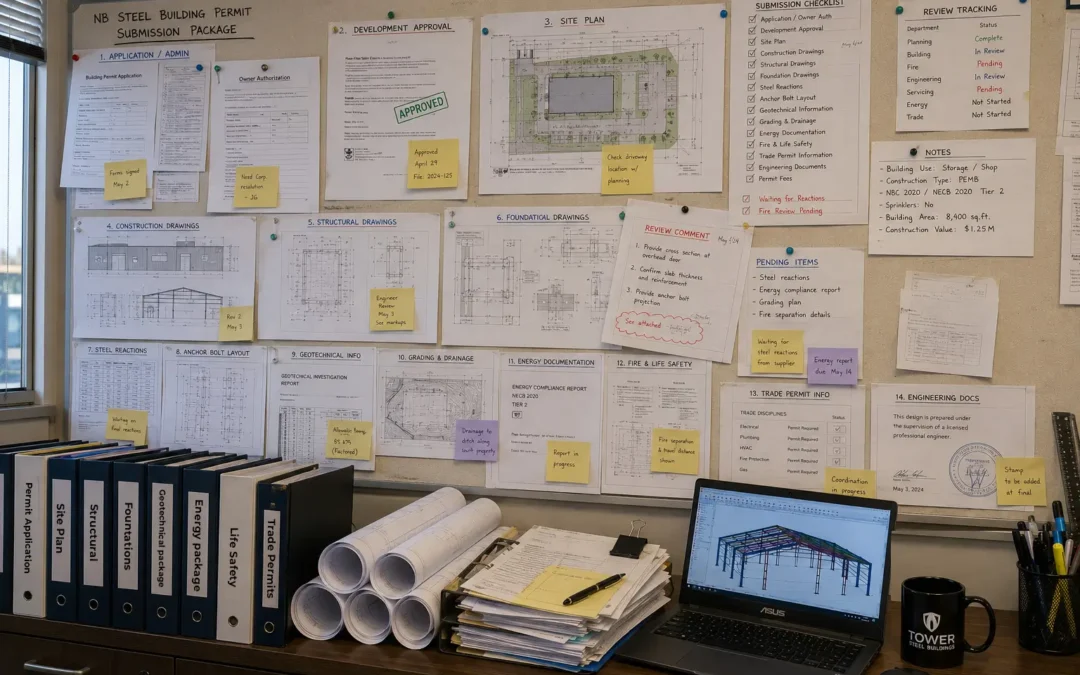
The application, development information, site plan, construction drawings, structural drawings, steel reactions, foundation drawings, anchor bolt layout, energy documents, trade scope, and professional documents should describe the same building.
If the documents disagree, the file may enter review, but the timeline will likely be spent resolving conflict rather than moving toward approval.
Step 11: Understand What Happens After Submission
After submission, the authority reviews the application and supporting documents. The review may involve planning, development, building code, site, servicing, fire/life safety, trade, or professional design considerations depending on the project.
Fredericton’s building permit page notes that builders can track applications, inspection status, and past application history online through Access Fredericton. This is a reminder that permit timing is not only the first review; it also includes status tracking, comments, inspections, and follow-up.
Some files move quickly because the application is clear. Others slow down because the reviewer needs missing information, revised drawings, additional approvals, or clarification from a design professional.
Step 12: Respond to Review Comments as a System
Review comments are normal. The timeline problem begins when comments are answered too narrowly.
If the reviewer asks for foundation coordination, do not revise only one foundation sheet if the steel reactions, anchor bolt layout, or site plan also need updates. If the building use changes, review energy, fire/life safety, accessibility, trade scope, parking, and inspections. If the site plan changes, review setbacks, drainage, grading, foundation layout, and access.
A comment response should remove uncertainty from the whole package, not only silence one line in a review letter.
Partial answers create second and third review cycles. That is where weeks are lost.
Step 13: Start Work Only After Approval Is Clear
Submitting an application is not the same as receiving a permit. A development conversation is not the same as building permit approval. A review comment is not approval to pour concrete. A supplier package is not approval to fabricate.
For steel buildings, early construction decisions can be expensive because the permit review may still affect frame layout, door openings, reactions, base plates, anchor bolts, foundation design, building location, trade scope, or inspections.
Ordering steel before approval may be done at the buyer’s risk, but fabrication should not move ahead on assumptions that permit review may still change.
If review comments change the frame layout, openings, reactions, base plates, anchor bolts, or building location, the project can move from paperwork correction into cost-heavy field correction.
Timeline Delay Triggers in New Brunswick Steel Building Projects
Most timeline delays are not caused by one issue. They are caused by unresolved decisions that reach review too late.
- the wrong reviewing authority is contacted
- development approval is not confirmed early
- the building use is vague or understated
- the site plan is incomplete
- access, parking, loading, drainage, or servicing is unclear
- steel reactions are preliminary or missing
- foundation drawings are based on assumptions
- anchor bolt layout is not coordinated
- soil or frost assumptions are unsupported
- NECB energy modelling is discovered late
- fire/life safety or accessibility requirements are not addressed
- trade permits are ignored until after submission
- professional documents are missing where required
- review comments are answered one sheet at a time
Real Timeline Scenario: The Permit Was Not Slow – the Project Was Not Ready
A buyer plans a steel building in a rural New Brunswick area. At first, the building is described as storage. The buyer wants to move quickly and asks for pricing before confirming the permit authority, development path, site plan requirements, soil conditions, drainage, or final building use.
The building is later clarified as a heated equipment repair and storage building with large overhead doors, commercial activity, electrical work, ventilation, and possible washroom service.
Now the timeline changes.
The authority needs to confirm the development path. The site plan needs more detail. The steel design needs final reactions. The foundation designer needs those reactions. The anchor bolt layout must match the base plates. Energy and trade scope must be reviewed. Fire and life safety may need clarification.
The permit was not slow because the building was steel. It slowed down because the real project was not defined before submission.
Regional Timeline Context Across New Brunswick
New Brunswick timelines vary because local governments, Regional Service Commissions, rural districts, and project types vary.
Fredericton, Moncton, Saint John, and larger municipalities
Larger municipalities may involve more formal intake systems, application tracking, development review, building permit review, servicing, plumbing or trade review, fire/life safety review, accessibility, and professional documents. Commercial and industrial steel buildings may require more coordination than small accessory-style projects.
Regional Service Commission areas
Regional Service Commissions can handle planning, development, building permit applications, inspections, and advisory services for communities and rural districts. For example, Kings Regional Service Commission states that building permits are required throughout the province for new construction, demolition, relocation, alteration, or replacement, and that commercial, industrial, or public buildings may take longer because they can require different approvals.
Rural and agricultural properties
Rural does not automatically mean faster. Rural steel buildings can still involve development approval, rural plan rules, access, drainage, septic, wells, wetlands, watercourses, commercial use, agricultural use, or public-facing activity.
Coastal, river-adjacent, wet, and site-sensitive areas
Site-sensitive areas can add time because drainage, foundation design, environmental constraints, watercourses, wetlands, slopes, fill, erosion, and access may need more review before construction can proceed cleanly.
Application Readiness Checklist
Before planning around a New Brunswick steel building permit timeline, confirm:
- the correct local government or RSC is identified
- development permit requirements are known
- the real building use is defined
- zoning, rural plan, variance, or rezoning issues are checked
- site plan information is complete enough for review
- access, parking, loading, servicing, drainage, and site constraints are understood
- structural steel drawings reflect the actual project
- final steel reactions are available
- foundation drawings match the reactions
- anchor bolt layout is coordinated
- soil assumptions are reliable
- NECB energy requirements are checked where applicable
- fire/life safety and accessibility requirements are considered
- trade permit scope is identified
- professional documents are included where required
- construction is not scheduled on assumed approval
Related New Brunswick Steel Building Permit Resources
For a complete New Brunswick permit cluster, buyers should also review these related resources:
- Steel Building Permits New Brunswick
- Documents Required for a Steel Building Permit in New Brunswick
- How to Apply for a Steel Building Permit in New Brunswick
- Development Permit vs Building Permit New Brunswick
- Steel Building Permit Cost New Brunswick
- Foundation Drawings New Brunswick
- Why Steel Building Permits Get Delayed New Brunswick
- Why Steel Building Permits Get Rejected New Brunswick
Plan Your New Brunswick Steel Building Timeline Before You Apply
Most steel building permit timeline problems are caused by decisions made too late: unclear use, missed development approval, weak site plans, incomplete engineering, missing reactions, uncoordinated foundation drawings, anchor bolt conflicts, soil assumptions, drainage gaps, energy requirements, trade scope, and construction scheduling before approval is clear.
Tower Steel Buildings helps New Brunswick buyers prepare steel building projects with permit-readiness in mind, including project-specific design inputs, structural coordination, foundation-related information, steel reactions, anchor bolt coordination, and quote-to-permit planning.
Request pricing and permit-readiness guidance before finalizing your building size, foundation, fabrication schedule, or construction timeline.
The earlier these timeline risks are identified, the easier they are to control.
Final Perspective
A steel building permit timeline in New Brunswick is not only the time spent inside municipal or RSC review. It is the full path from land-use confirmation to site plan readiness, structural coordination, foundation design, energy and trade review, comment response, permit issuance, and inspections.
The timeline becomes shorter when the project is clear before submission.
The timeline becomes longer when the reviewer must solve uncertainty that should have been resolved during planning.
A New Brunswick steel building permit timeline becomes realistic when the local authority, RSC where applicable, development reviewer, building inspector, steel supplier, foundation designer, trades, and owner can follow the same project from approval path to construction sequence without guessing what changed.
Reviewed by Engineering Team
This content has been reviewed by the Tower Steel Buildings Engineering Team.
The review focused on practical steel building permit timeline planning in New Brunswick, including local government and Regional Service Commission review paths, development approval, building use confirmation, site plan readiness, structural drawings, steel reactions, foundation drawing coordination, anchor bolt layout, geotechnical assumptions, grading and drainage, NECB energy documentation, trade permit scope, review comments, resubmissions, permit issuance, and inspection readiness.
The purpose of this review is to help serious steel building buyers understand that a permit timeline does not begin only when the application is submitted. For steel buildings, timeline risk often begins earlier, when the project use, site constraints, development path, structural design, foundation assumptions, reactions, anchors, energy scope, and trade requirements are not confirmed before submission.
For New Brunswick steel building projects, timeline delays often happen when the wrong reviewing authority is contacted, the development approval path is unclear, the site plan is incomplete, steel reactions are missing or preliminary, foundation drawings are based on assumptions, anchor bolts are not coordinated, NECB requirements are discovered late, trade scope is ignored, or review comments are answered one sheet at a time.
This content is intended to support buyer education and permit-readiness planning. Final timelines, submission requirements, review comments, inspections, approvals, and professional responsibilities remain under the authority of the applicable local government, Regional Service Commission, building official, development officer, inspector, or licensed professional involved in the project.
1. How long does a steel building permit take in New Brunswick?
There is no single fixed steel building permit timeline in New Brunswick. A simple project with clear land use, a complete site plan, coordinated drawings, and no development issues may move faster. A commercial, industrial, agricultural processing, truck garage, warehouse, or heated workshop project can take longer because development approval, technical documents, foundation coordination, energy requirements, trade scope, and review comments may need to be resolved.
The safest way to plan the timeline is by stages: authority confirmation, development approval, site plan preparation, steel design coordination, foundation and anchor bolt coordination, permit intake, technical review, comment response, permit issuance, and inspections.
2. What is a realistic steel building permit timeline in New Brunswick?
A realistic steel building permit timeline depends on how ready the project is before submission. Buyers should not plan around one approval number. They should plan around the full path: confirming the reviewing authority, checking development approval, preparing a reviewable site plan, coordinating steel and foundation drawings, confirming energy and trade requirements, answering comments, receiving approval, and preparing for inspections.
A permit timeline becomes shorter when those items are resolved before submission. It becomes longer when the reviewer must ask basic questions that should have been answered during planning.
3. Why is there no standard steel building permit timeline in New Brunswick?
There is no standard timeline because steel building permits are reviewed based on the property location, building use, local authority, site conditions, development path, application quality, structural design, foundation information, energy scope, trade scope, and reviewer comments.
Two buildings of the same size can follow different timelines if one is cold storage and the other is a heated commercial workshop with washrooms, ventilation, large overhead doors, drainage concerns, trade permits, and NECB documentation. The faster project is usually the one that is clearer before submission.
4. What usually delays a steel building permit in New Brunswick?
Steel building permits are usually delayed by unclear building use, missed development approval, incomplete site plans, missing steel reactions, uncoordinated foundation drawings, anchor bolt conflicts, weak drainage information, late NECB energy documentation, missing trade scope, incomplete professional documents, or partial responses to review comments.
The permit is not always slow because the authority is slow. In many cases, the project was submitted before the reviewer could clearly understand the use, site, structure, foundation, code path, and inspection sequence.
5. Does development approval affect the steel building permit timeline?
Yes. Development approval can strongly affect the timeline because it deals with whether the building is allowed on the property and whether the proposed use, location, setbacks, access, parking, loading, drainage, and site layout meet local planning requirements.
If development approval is missed or discovered late, the building permit timeline can stretch before technical review is complete. A development issue can also change the site plan, building footprint, foundation layout, drainage plan, or building use, which can create redesign time.
6. Should I confirm the local authority or RSC before preparing drawings?
Yes. The correct local government or Regional Service Commission should be confirmed before preparing or submitting drawings. The reviewing authority controls the forms, intake process, development approval path, fee requirements, inspection process, and document expectations.
Applying to the wrong authority, using the wrong form, or skipping the development officer conversation can waste time before technical review even starts. For rural districts or properties outside major municipalities, confirming the correct RSC path early is especially important.
7. Why does building use affect the permit timeline?
Building use affects the permit timeline because it can change zoning, development approval, occupancy, fire and life safety, NECB energy requirements, accessibility, plumbing, ventilation, parking, loading, trade permits, inspections, and professional document requirements.
A steel building described as storage may move differently than a heated truck garage, commercial workshop, equipment repair building, warehouse, agricultural processing building, public-access building, or industrial facility. The reviewer needs the real use, not the easiest label.
8. Can a weak site plan slow down a steel building permit?
Yes. A weak site plan can slow down a steel building permit because reviewers need to understand where the building sits and how it fits the property.
Depending on the project, the site plan may need to show property lines, setbacks, existing buildings, proposed building dimensions, access, parking, loading, services, wells, septic, utilities, easements, watercourses, wetlands, drainage, grading, and exterior operating areas. For steel buildings, the site plan must also match the structural drawings and foundation drawings. If the documents disagree, the review cannot move cleanly.
9. Why do steel reactions affect the permit timeline?
Steel reactions affect the timeline because the foundation designer needs them to design a foundation that matches the actual steel building loads. Reactions can include vertical loads, lateral loads, uplift, shear, moments, and column base forces.
If steel reactions are missing, preliminary, or changed late, the foundation drawings may need to be revised. That can create additional review time, resubmission time, anchor bolt coordination issues, and construction delay if concrete work has already been planned.
10. Can foundation drawings delay steel building permit approval?
Yes. Foundation drawings can delay permit approval if they do not match the final steel reactions, column grid, base plates, anchor bolt layout, soil assumptions, frost conditions, drainage, building use, and site plan.
For steel buildings, the foundation is not separate from the steel package. The reviewer, foundation designer, steel supplier, and owner need one coordinated project. If the foundation is designed from assumptions instead of final steel information, the permit timeline can turn into a revision cycle.
11. Why does anchor bolt layout matter for the permit timeline?
Anchor bolt layout matters because anchor bolts connect the steel columns to the concrete foundation. If the anchor bolt layout does not match the final column grid, base plates, and steel drawings, the building may not fit during erection.
A wrong or outdated anchor bolt layout can delay permit review, foundation work, inspections, and construction scheduling. If the mistake is found after concrete is poured, the delay can become more serious because correction may involve drilling, repair, engineering review, inspection delay, crane standby, or idle erection crews.
12. Can soil, frost, or drainage issues delay a steel building permit?
Yes. Soil, frost, and drainage issues can delay a steel building permit because they affect foundation design, slab performance, site access, grading, water movement, and long-term building performance.
Not every steel building automatically needs a geotechnical report, but unknown soil conditions, filled sites, wet sites, sloped sites, coastal or river-adjacent sites, heavy equipment buildings, truck garages, and industrial buildings can require more review. Drainage problems can also trigger site plan revisions or foundation design changes.
13. Can NECB energy requirements affect the permit timeline?
Yes. NECB energy requirements can affect the permit timeline for buildings subject to the National Energy Code of Canada for Buildings. Heated, conditioned, commercial, industrial, warehouse, office, or shop buildings may require energy modelling, envelope coordination, insulation details, mechanical coordination, and supporting documentation.
A cold, unconditioned storage building and a heated commercial steel building may not follow the same timeline. Energy requirements should be checked before finalizing wall systems, roof systems, doors, insulation, mechanical design, and permit submission.
14. Can trade permits slow down a steel building project?
Yes. Trade permits can slow down a steel building project when electrical, plumbing, HVAC, gas, fire protection, septic, servicing, washrooms, ventilation, or process equipment are part of the real building use.
Trade permits may be separate from the main building permit, but they still affect inspections, scheduling, and readiness for use. A building priced as an empty shell can take longer when the actual project includes heat, washrooms, ventilation, fire protection, commercial use, or equipment repair.
15. What happens after a steel building permit application is submitted?
After submission, the authority reviews the application and supporting documents. Depending on the project, the review may involve planning, development, building code, structural information, site servicing, fire and life safety, energy documentation, trade scope, inspections, and professional design responsibility.
If the package is complete, the review can move more cleanly. If information is missing or documents conflict, the authority may issue comments. The timeline then depends on how completely the applicant and project team answer those comments.
16. Why do review comments add weeks to a permit timeline?
Review comments add weeks when they are answered too narrowly or when one correction affects multiple parts of the project. For example, a change to building use can affect zoning, site layout, fire and life safety, energy documents, trade permits, inspections, and professional drawings.
The fastest comment response is not just a quick reply. It is a coordinated correction. If only one sheet is changed while the site plan, foundation drawings, reactions, anchor bolts, or trade scope remain inconsistent, the file may need another review cycle.
17. Should I order steel before the permit is approved?
Ordering steel before permit approval can create timeline and cost risk because the permit review may still affect the building layout, openings, reactions, base plates, anchor bolts, foundation design, site location, drainage, energy path, or trade scope.
Some buyers may choose to move early at their own risk, but fabrication should not be released on assumptions that could still change during review. If approval comments change the frame, foundation, or anchor bolt layout, the project can move from paperwork correction into expensive field correction.
18. Should I pour concrete before the steel building permit is approved?
Concrete should not be poured until the permit path, foundation drawings, final steel reactions, anchor bolt layout, and approval status are clear. Pouring too early can create major timeline and cost risk.
If the reviewer requires changes to the foundation, reactions, column grid, anchor bolts, building location, drainage, or site plan after concrete is placed, the project may face repair, redesign, drilling, engineering re-review, inspection delays, and erection problems.
19. What is the fastest way to reduce steel building permit delays?
The fastest way to reduce delays is to submit a coordinated package that tells one clear story. Confirm the correct authority, development path, real building use, site plan, structural drawings, final steel reactions, foundation drawings, anchor bolt layout, soil assumptions, drainage, NECB requirements where applicable, fire and life safety needs, trade scope, and professional documents before submission.
Rushing an incomplete package into review does not usually save time. It often moves the delay from planning into formal review, where every correction can become a new cycle.
20. When should I start planning my steel building permit timeline?
Planning should start before the building is treated as final, not after drawings are already priced or steel is close to fabrication. Buyers should confirm the authority, development approval path, building use, site constraints, drawing requirements, foundation information, energy path, and trade scope before committing too far to engineering, fabrication, concrete, or construction scheduling.
The permit timeline begins when the project is defined. If the project is not defined until review comments arrive, the timeline is already under pressure.
21. How can Tower Steel Buildings help with permit timeline planning?
Tower Steel Buildings can help buyers plan steel building projects with permit readiness, building use, pricing, structural coordination, steel reactions, foundation-related information, anchor bolt layout, and quote-to-permit planning in mind.
This helps serious buyers understand what should be confirmed before submission, fabrication, delivery, excavation, concrete work, or construction scheduling. Better planning does not guarantee a specific approval date, but it can reduce avoidable delays caused by incomplete drawings, unclear use, missing reactions, uncoordinated foundations, anchor bolt conflicts, or rushed submissions.