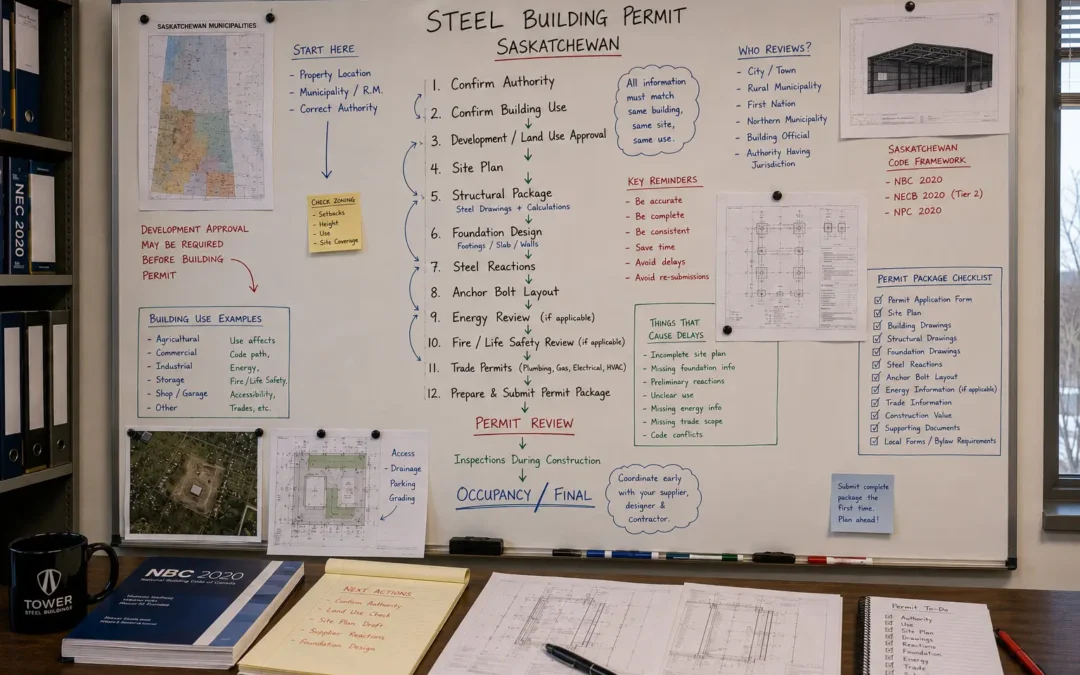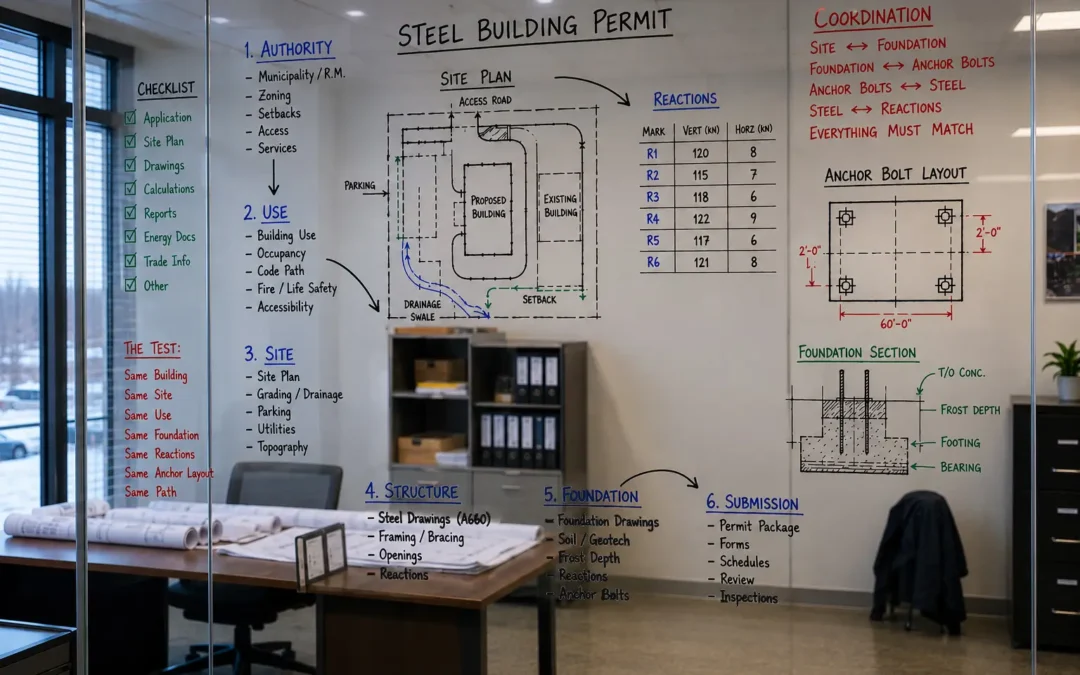
Many steel building permit delays in Saskatchewan come down to one practical problem: the project is not clear enough for review.
The delay is not always caused by the municipality, rural municipality, building official, or local authority. Many delays start earlier, when the buyer treats the steel building as ready because the quote is done, the supplier drawings are started, or the building size has been chosen.
A steel building is not ready for permit review just because one drawing exists.
For a serious steel building, a strong permit file should clearly explain the building use, site location, development path, zoning or land-use fit, structural design, foundation design, steel reactions, anchor bolt layout, energy requirements where applicable, trade scope, drainage, inspections, and professional responsibility where required.
If those items are missing, unclear, preliminary, or conflicting, the review can slow down.
This matters in Saskatchewan because permit requirements are not controlled by one single province-wide counter. The practical review path can depend on the municipality, rural municipality, local authority, building bylaw, zoning bylaw, development approval process, building official process, building use, site conditions, and project scope.
For steel buildings, delay risk is higher because the building shell, foundation, anchor bolts, site plan, and construction schedule are tied together. A small review comment can become a larger redesign problem if steel has already been ordered, concrete is scheduled, or anchor bolts are based on preliminary information.
Quick Answer
Steel building permits in Saskatchewan often get delayed because the application package does not clearly show the real building use, correct local authority path, development approval status, site plan, zoning or land-use fit, structural steel drawings, foundation drawings, final steel reactions, anchor bolt layout, soil and drainage assumptions, energy requirements where applicable, trade scope, professional documents where required, and inspection readiness.
The most common delay causes include treating supplier drawings as the full permit package, submitting before development approval is understood, describing the building use too vaguely, missing final steel reactions, using foundation drawings that do not match the steel package, relying on preliminary anchor bolt layouts, ignoring farm or rural-use conditions, and failing to answer review comments as one coordinated project.
A practical way to reduce delays is to confirm the local authority path, real building use, site plan, foundation responsibility, final reactions, anchor bolts, trade scope, and drawing version control before submission, fabrication, concrete placement, or erection scheduling.
What This Guide Covers
This guide explains why steel building permits get delayed in Saskatchewan from a practical buyer and construction-coordination perspective.
It covers:
- Why permit files stall during review.
- Why delay is not always the same as rejection.
- Why local authority requirements vary.
- How development permit issues delay building permit review.
- Why vague building-use descriptions create problems.
- Why supplier drawings are not always enough.
- How missing reactions delay foundation review.
- Why anchor bolt layouts create field and review risk.
- How soil, frost, drainage, and grading affect permit timing.
- Why energy and trade scope can slow down heated or serviced buildings.
- How farm and rural assumptions create delays.
- Why drawing version control matters.
- Why review comments can affect more than one drawing.
- Who should be coordinated before submission.
- What buyers should confirm before submission.
- Why schedules should not be built around assumed approval dates.
- How Tower Steel Buildings can help organize steel-building inputs before major decisions are made.
Buyer Warning
The biggest mistake is assuming the permit delay starts after submission.
Most steel building permit delays start before the application is filed.
The buyer may choose a building size. The supplier may prepare preliminary drawings. The concrete contractor may be asked to price the slab. The owner may want to order steel quickly. The project may feel like it is moving.
But the local authority may not yet have confirmed the development path. The building use may still be vague. The site plan may not show enough information. Final reactions may not be available. Foundation drawings may be based on assumptions. Anchor bolts may be preliminary. Energy and trade requirements may not be checked.
Then the file enters review, and the questions begin.
At that point, the delay looks like a permit problem. In reality, it is a coordination problem that reached the permit desk.
Permit Delay Is Not the Same as Permit Rejection
A delayed permit file is not always a failed project. In many cases, the authority is asking for clarification, missing information, corrected drawings, updated calculations, trade scope, site plan details, or proof that the submitted documents describe one coordinated project.
A rejection or refusal is more serious because the submitted project may not meet the required land-use path, code path, documentation standard, or local review requirement as presented.
For steel building buyers, the goal is to prevent small clarification comments from turning into repeated review cycles, redesign, foundation changes, anchor bolt conflicts, or construction delay.
This distinction matters because a delay usually means the file needs more coordination. A rejection may mean the project, as submitted, does not fit the required path.
Saskatchewan Permit Delay Context
Saskatchewan adopted the 2020 editions of the National Building Code, National Energy Code for Buildings, and National Plumbing Code effective January 1, 2024 under The Construction Codes Act. The construction-code framework matters, but the practical permit process still depends on the local authority, municipality, rural municipality, building bylaw, building official process, building use, site conditions, and scope of work.
Saskatchewan zoning bylaws also matter because land use, setbacks, development rules, site layout, access, and local planning requirements can affect whether a steel building can be placed and used as proposed.
For steel building buyers, the important point is simple: a permit delay may come from land-use review, building-code review, foundation coordination, site planning, trade permits, energy requirements, inspection sequencing, or missing professional documents.
That is why the project should be coordinated before submission, not repaired after review comments arrive.
Steel Building Permit Delay Summary
|
Delay Cause |
Why It Delays Review |
Steel Building Risk |
|
Wrong local authority path |
The file may be submitted to the wrong office or without the correct local process confirmed. |
Resubmission, lost time, wrong forms, wrong assumptions. |
|
Development approval not checked |
Land-use, setbacks, access, drainage, or zoning may not be resolved. |
Building location, size, use, or site layout may need revision. |
|
Vague building use |
Reviewers cannot determine the correct code, trade, energy, or inspection path. |
Cold storage may become heated shop, repair space, warehouse, or mixed-use review. |
|
Weak site plan |
The authority cannot confirm location, setbacks, access, drainage, or site constraints. |
Site plan revisions, foundation layout changes, drainage review. |
|
Supplier drawings treated as complete permit package |
Supplier drawings may not cover site, foundation, soil, drainage, energy, or trade scope. |
Missing documents, review comments, incomplete technical file. |
|
Missing steel reactions |
Foundation designer cannot confirm the loads transferred into the foundation. |
Foundation redesign, delayed concrete, revised anchor bolts. |
|
Foundation drawings not coordinated |
Foundation drawings may not match the steel package or site conditions. |
Permit comments, concrete rework, erection delays. |
|
Preliminary anchor bolt layout |
Concrete may be planned from outdated or incomplete information. |
Wrong bolts, drilling, epoxy review, inspection delay, crane standby. |
|
Energy or trade scope missing |
Heated, serviced, commercial, or industrial buildings may need additional information. |
Mechanical, electrical, gas, plumbing, septic, fire protection, or NECB-related delay. |
|
Farm or rural assumptions |
Buyer assumes rural or farm use makes the path simple. |
Exemption questions, local bylaw review, non-farm use issues, sleeping accommodation concerns. |
|
Drawing version conflicts |
Different teams work from different drawing versions. |
Wrong foundation assumptions, mismatched openings, anchor bolt conflicts. |
|
Weak response to comments |
One issue is answered without updating the full package. |
Second and third review cycles. |
1. The Local Authority Path Was Not Confirmed
Saskatchewan steel building permit delays often begin when the buyer does not confirm the correct local process.
A project may fall under a city, town, village, rural municipality, local authority, building official process, development officer, building department, or another local review path depending on the property.
The local path can affect:
- Which forms are required.
- Whether development approval is required.
- Whether zoning confirmation is needed.
- Whether a building-permit process applies.
- Whether a building official reviews the file.
- Whether trade permits are separate.
- Whether inspections are required.
- Whether professional documents are required.
- Whether farm-building treatment applies.
- How fees and construction value are handled.
Submitting before this is confirmed can delay the file before technical review even starts.
2. Development Approval Was Treated as Optional
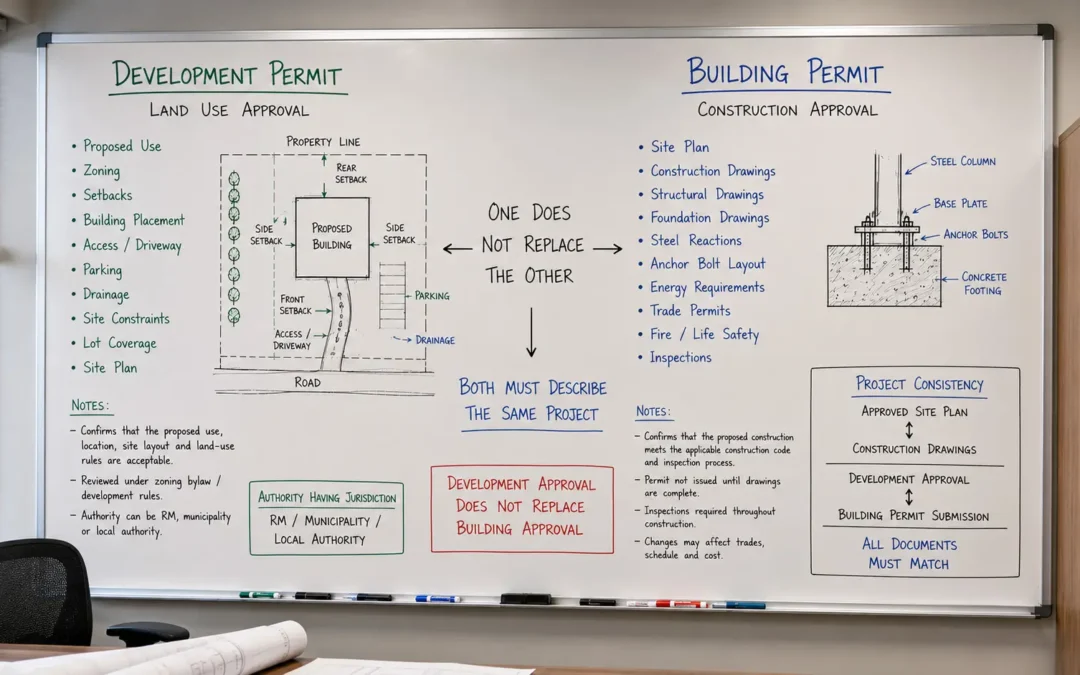
A development permit and a building permit are not the same thing.
Development approval deals with land use. It can involve zoning, permitted use, discretionary use, setbacks, lot coverage, building placement, access, parking, loading, outdoor storage, drainage, servicing, and site constraints.
Building permit review deals with construction. It can involve drawings, structure, foundation, energy requirements where applicable, trade scope, professional responsibility, and inspections.
If development approval is required and not addressed, the building permit may be delayed because the authority still needs to confirm whether the project is acceptable on the land.
For steel buildings, development review can change the building. If the location changes, the foundation layout may change. If the use changes, the energy, trade, fire/life safety, and inspection path may change. If the footprint changes, the steel frame and reactions may need review.
This is why the development path should be checked before the steel package and foundation drawings are treated as final.
3. The Building Use Was Too Vague
A vague building-use description is one of the fastest ways to slow down a permit review.
A buyer may write “storage” because that sounds simple. But the building may actually include heat, equipment repair, employee access, washrooms, offices, welding, commercial use, truck storage, ag-processing, floor drains, public access, or mixed use.
Those details matter.
Building use can affect:
- Development approval.
- Zoning or land-use review.
- Occupancy or building classification.
- Fire/life safety requirements.
- Exits and travel distance.
- Accessibility where applicable.
- Energy requirements.
- Plumbing and washrooms.
- Gas, electrical, mechanical, septic, or fire protection permits.
- Foundation and slab design.
- Inspection stages.
Reviewers cannot evaluate the correct path if the real use is hidden or unclear.
The safest approach is to describe the actual building use before submission.
4. The Site Plan Was Too Weak
A weak site plan can delay both development review and building permit review.
For a steel building, the site plan may need to show:
- Property lines.
- Proposed building location.
- Existing buildings.
- Building dimensions.
- Driveway and access.
- Parking or loading where applicable.
- Wells, septic, utilities, or servicing where applicable.
- Drainage and grading.
- Slopes, low areas, or site constraints.
- Outdoor storage or operating areas.
- Fire access where applicable.
- North arrow, scale, and key dimensions where required.
A site plan delay can become a foundation delay. If the building location changes during review, the foundation layout, column grid, anchor bolt layout, and drainage approach may need review.
A steel building should not be released for concrete from a site plan that may still change.
5. Supplier Drawings Were Treated as the Full Permit Package
Supplier drawings are important, but they are not always the full permit package.
Supplier drawings may show the steel frame, column grid, base plates, bracing, reactions, anchor bolt information, and erection details. That does not automatically cover the site plan, development approval, foundation drawings, soil assumptions, drainage, energy documents, trade permits, professional responsibility, or inspection requirements.
For many steel building projects, supplier drawings are one part of the submission. They are not the entire review file.
A permit can be delayed when the buyer submits the steel package but the reviewer still needs:
- Site plan.
- Building-use description.
- Development approval or zoning confirmation.
- Foundation drawings.
- Steel reactions.
- Anchor bolt layout.
- Soil or drainage information.
- Energy documents where applicable.
- Trade permit information.
- Professional documents where required.
The issue is not that supplier drawings are unimportant. The issue is that they must be coordinated with the rest of the project.
6. Final Steel Reactions Were Missing
Steel reactions are one of the most important inputs for foundation review.
Reactions tell the foundation designer what loads the steel frame transfers into the foundation. These can include vertical loads, lateral loads, uplift, shear, moments, snow-load effects, wind-load effects, large-door effects, equipment loads, mezzanine loads, bracing forces, or project-specific forces.
If reactions are missing, preliminary, or not coordinated, the foundation designer may be working from assumptions. The reviewer may not be able to confirm the foundation path. The concrete contractor may be pricing or scheduling from incomplete information.
If reactions change after foundation drawings are prepared, the foundation may need to be reviewed. If reactions change after concrete is placed, the project can become expensive quickly.
For steel buildings, missing reactions are not a small paperwork issue. They can stop the foundation path.
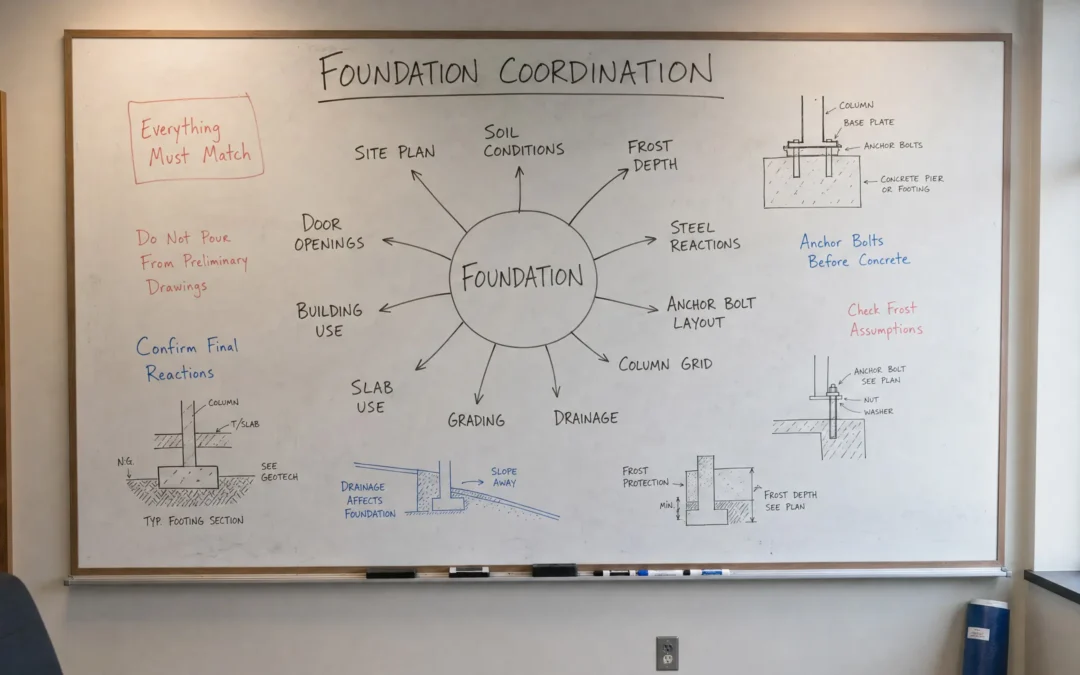
7. Foundation Drawings Did Not Match the Steel Package
Foundation drawings can delay a permit when they do not match the current steel package.
Common conflicts include:
- Column grid mismatch.
- Different building dimensions.
- Base plates not coordinated.
- Anchor bolt layout not updated.
- Final reactions not reflected.
- Door openings changed.
- Bracing locations changed.
- Slab use not considered.
- Soil assumptions unclear.
- Frost approach not shown.
- Drainage or grading not addressed.
- Foundation drawings based on old supplier information.
A foundation drawing is only useful when it supports the current building. If the steel package changes, the foundation may need review.
The safest rule is simple: do not treat foundation drawings as final until the latest steel package and final reactions are coordinated.
8. Anchor Bolt Information Was Preliminary
Anchor bolt delays are common because bolts are small, but the consequences are large.
Anchor bolts must match:
- Column grid.
- Base plate size.
- Bolt pattern.
- Bolt diameter.
- Edge distance.
- Foundation layout.
- Latest steel drawings.
- Erection requirements.
If anchor bolts are set from preliminary information, the steel frame may not fit. Field fixes are not automatically acceptable. Drilling, epoxy anchors, slotting, plate changes, welding, concrete repair, or bolt relocation may require engineering review and may not be accepted without proper verification.
Anchor bolt errors can cause inspection delay, crane standby, idle crews, concrete repair, and field disputes.
The safest time to fix anchor bolt issues is before concrete is poured.
9. Soil, Frost, Drainage, and Grading Were Ignored
Saskatchewan foundation issues are not only about concrete strength. Soil, frost, drainage, grading, groundwater, fill, and site use matter.
A permit file or foundation package may slow down if the soil assumptions are unclear, drainage is not addressed, or the site plan does not show how water will move around the building.
Foundation planning should consider:
- Soil bearing assumptions.
- Frost exposure and frost protection approach.
- Drainage around the building.
- Site grading.
- Fill or disturbed soil.
- Slab use.
- Heavy equipment or vehicle loads.
- Snow drifting and meltwater.
- Roof drainage.
- Long-term water movement around the foundation.
Not every steel building automatically needs a geotechnical report. But every foundation needs a defensible understanding of ground conditions. If the reviewer, foundation designer, or project team cannot understand those assumptions, delay is likely.
10. Energy Requirements Were Not Checked
Saskatchewan has adopted the 2020 National Energy Code for Buildings. Buildings subject to energy requirements may need additional information depending on use, size, conditioning, and scope.
A cold, unconditioned storage building and a heated commercial or industrial steel building may not follow the same path.
Energy-related delay can occur when the building includes:
- Conditioned space.
- Commercial use.
- Industrial use.
- Insulated walls or roofs.
- Large overhead doors.
- Mechanical systems.
If the energy path is discovered late, drawings, envelope details, mechanical coordination, insulation, doors, and trade scope may need review.
For steel buildings, energy review should be checked before the building envelope and mechanical assumptions are treated as final.
11. Trade Scope Was Treated as an Afterthought
Trade permits and trade scope can delay steel building permits when they are not identified early.
A building may start as a shell, but the real project may include:
- Electrical service.
- Mechanical ventilation.
- Fire protection.
- Floor drains.
- Process equipment.
- Fire alarm or sprinkler systems where applicable.
- Service penetrations through slab or foundation.
A heated truck garage, repair shop, warehouse with washrooms, commercial workshop, industrial building, or ag-processing facility may need more trade coordination than a basic cold storage structure.
Trade scope affects review, inspections, slab penetrations, foundation coordination, sequencing, and final use.
12. Farm or Rural Use Was Assumed to Be Simple
Farm and rural steel buildings need careful handling in Saskatchewan.
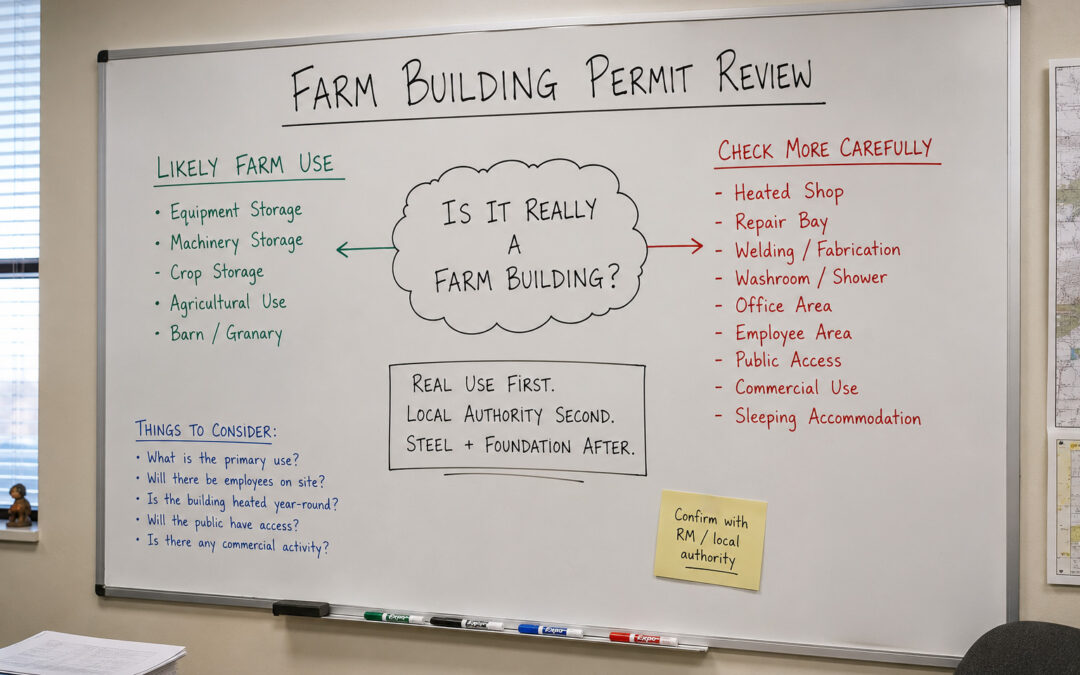
Saskatchewan farm-building guidance indicates that farm-building exemptions can apply when the principal use is farming and specific criteria are satisfied. But that does not mean every rural steel building can proceed without local review, confirmation, or a permit process.
Delay can happen when the buyer assumes a building is simple farm storage, but the real use includes:
- Heated repair work.
- Equipment servicing.
- Office space.
- Sleeping accommodation.
- Commercial or non-farm use.
- Public access.
- Employee use.
- Ag-processing.
- Fertilizer or chemical storage.
- Gas, plumbing, HVAC, electrical, septic, or fire protection work.
Local authorities may still require development confirmation, zoning review, site plan information, exemption forms, trade permits, inspection information, or a building-permit process depending on local bylaw, use, and scope.
The safest approach is to describe the real use and confirm the local path before ordering steel or pouring concrete.
13. Professional Responsibility Was Not Clear
Permit review can slow down when no one has clearly identified who is responsible for each technical part of the project.
For steel buildings, responsibility may need to be clear for:
- Structural steel design.
- Foundation design.
- Soil or geotechnical assumptions.
- Energy compliance where applicable.
- Mechanical systems.
- Electrical design where required.
- Plumbing design where required.
- Fire/life safety where applicable.
- Accessibility where applicable.
- Field review or inspection support where required.
A stamped steel drawing does not automatically mean the foundation is designed. A supplier package does not automatically solve soil, drainage, trade permits, energy requirements, or local authority responses.
The right question is not only, “Is there a stamp?” The right question is, “Who is responsible for each part of the submitted and constructed project?”
14. Drawing Versions Did Not Match
Drawing version control is one of the most practical reasons steel building permit files and job sites get into trouble.
The owner, supplier, foundation designer, concrete contractor, building official, trade contractor, and erection crew may all have different versions of the drawings.
That creates delay when:
- The site plan shows one location.
- The steel drawings show a revised grid.
- The foundation drawings are based on older reactions.
- The anchor bolt layout comes from a preliminary package.
- Door openings changed.
- Bracing locations changed.
- Approved drawings do not match construction drawings.
- The field crew builds from a version that is not the reviewed set.
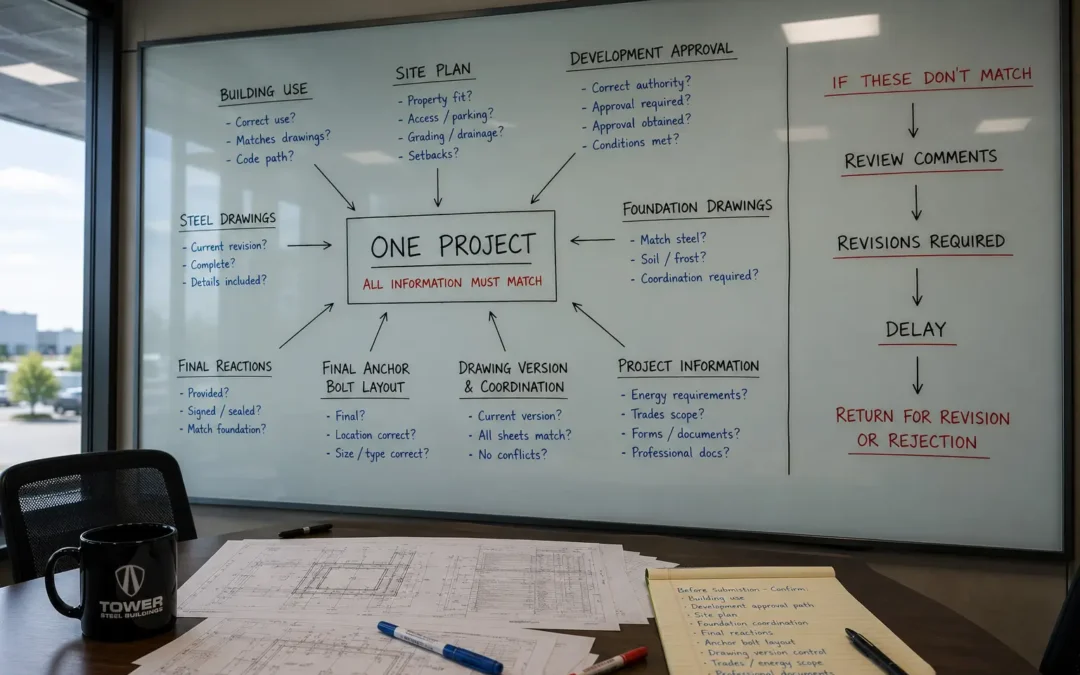
Before submission, confirm that the site plan, supplier drawings, foundation drawings, steel reactions, anchor bolt layout, and supporting documents are current.
Before concrete, confirm again.
Before erection, confirm again.
Version control is not paperwork housekeeping. It is a construction-risk control step.
15. Review Comments Were Answered One at a Time
Some permit files get delayed not because the first submission was weak, but because the response to review comments was incomplete.
A reviewer asks for clarification on use. The buyer answers only the use question. But that change affects energy, trade scope, fire/life safety, foundation, or inspections.
A reviewer asks for site plan correction. The site plan is revised, but the foundation drawings still show the old location.
A reviewer asks for reactions. Reactions are submitted, but the foundation drawings are not updated.
A review comment should be treated as a project coordination question, not just a note on one sheet. If the use changes, the energy path, trade scope, fire/life safety, foundation, slab penetrations, and inspections may also need review. If the site plan changes, the foundation layout, anchor bolt layout, drainage, access, and approved construction set may need review. If reactions change, the foundation drawings and anchor bolt design may need review.
A steel building permit file should be updated as a coordinated package. Partial answers can create second and third review cycles.
The goal is not just to reply quickly. The goal is to reply completely.
Who Should Be Coordinated Before Submission?
Before submitting, the owner should confirm who is responsible for each part of the project file. Depending on the project, that may include the steel supplier, foundation designer, geotechnical professional, site planner, trade contractors, energy professional where applicable, building official process, and the authority having jurisdiction.
The buyer does not need to become the designer, but the buyer should not assume the steel supplier, concrete contractor, or local authority will automatically solve missing information after submission.
For steel buildings, coordination before submission may involve:
- Owner or buyer.
- Steel building supplier.
- Foundation designer.
- Geotechnical professional where required.
- Site planner or survey-related professional where required.
- Concrete contractor.
- Mechanical, electrical, plumbing, gas, septic, or fire protection trades where applicable.
- Energy professional where applicable.
- Building official process.
- Municipality, rural municipality, local authority, or authority having jurisdiction.
The project does not need every party on every file. It does need the right responsibilities confirmed before the submission depends on them.
Delay Risk by Steel Building Type
|
Steel Building Type |
Common Delay Triggers |
|
Cold storage building |
Weak site plan, unclear development path, missing foundation coordination, drainage assumptions, anchor bolt version issues. |
|
Heated farm shop |
Farm-building assumptions, heat, gas, electrical, plumbing, washrooms, floor drains, ventilation, energy path, foundation and anchor coordination. |
|
Truck garage |
Large doors, slab loads, drainage, ventilation, wash bay, trade permits, fire/life safety, access, foundation design. |
|
Warehouse |
Site access, loading, parking, racking loads, slab use, fire access, energy scope, trade permits, drainage. |
|
Commercial workshop |
Use clarification, employee/public access, washrooms, energy, HVAC, electrical, fire/life safety, foundation responsibility. |
|
Agricultural processing building |
Use classification, processing scope, drainage, ventilation, trade permits, fire/life safety, development approval, professional documents. |
|
Riding arena |
Large-span framing, public access where applicable, ventilation, site grading, drainage, footing or pier layout, occupancy questions. |
|
Aircraft hangar |
Large door effects, clear span, reactions, anchors, apron/access coordination, drainage, fire/life safety where applicable. |
|
Industrial building |
Equipment loads, cranes where applicable, trade penetrations, fire protection, ventilation, slab thickening, professional design responsibility. |
This table is not a universal permit checklist. It shows why delay risks change with building use.
Approval Sequence to Reduce Delay
|
Stage |
What to Confirm Before Moving Forward |
|
Before pricing is treated as final |
Real building use, local authority, zoning, development path, farm-building status where relevant, site location, and major design assumptions. |
|
Before ordering steel |
Site plan, building dimensions, door layout, bracing, local review path, reactions plan, foundation responsibility, and energy/trade triggers. |
|
Before foundation drawings |
Final steel reactions, column grid, base plates, anchor bolt layout, soil assumptions, frost approach, drainage, grading, and slab use. |
|
Before permit submission |
Complete coordinated package, correct forms, site plan, use description, steel drawings, foundation drawings, trade scope, professional documents where required. |
|
Before concrete |
Current approved or reviewed drawings, inspection timing, final reactions, anchor bolt layout, soil/frost/drainage assumptions, and trade penetrations. |
|
Before erection |
Anchor bolts match the steel package, foundation dimensions are correct, drawings are current, and inspection issues are resolved. |
Do Not Build the Schedule Around an Assumed Approval Date
Permit timing can vary by authority, project complexity, completeness of documents, development review, professional documents, trade scope, inspection requirements, and review comments.
Buyers should avoid locking fabrication, concrete, crane, or erection dates around an assumed permit approval date before the local review path and submission package are clear.
This does not mean buyers should avoid planning. It means the schedule should be built around confirmed information, not hope.
For steel buildings, assumed approval dates can become expensive when fabrication, foundation work, concrete placement, anchor bolt setting, trade scheduling, or erection crews are committed before the permit file is ready.
What to Confirm Before Submission
Before submitting a Saskatchewan steel building permit package, confirm:
- Correct local authority.
- Development approval path.
- Zoning or land-use requirements.
- Real building use.
- Site plan.
- Setbacks and building location.
- Access, parking, loading, and driveway needs.
- Drainage and grading.
- Structural steel drawings.
- CSA A660 documentation and supplier steel package where applicable.
- Foundation drawings.
- Final steel reactions.
- Anchor bolt layout.
- Soil assumptions or geotechnical information where required.
- Energy requirements where applicable.
- Trade permit scope.
- Fire/life safety requirements where applicable.
- Accessibility requirements where applicable.
- Professional documents where required.
- Professional responsibility is clear for structural steel, foundation design, soil assumptions, energy documents where applicable, trade scope, and field review where required.
- Inspection timing.
- Drawing version control.
- Construction value or fee information where required.
If these items are not clear, the project may still be a useful concept, but it is not yet a strong permit submission.
What to Confirm Before Concrete Placement
Before concrete placement, confirm:
- Permit or local approval path is clear where required.
- Building location matches the site plan.
- Foundation drawings are current.
- Final steel reactions have been coordinated.
- Anchor bolt layout matches the latest base plates.
- Column grid matches the latest steel package.
- Soil assumptions are accepted by the responsible designer.
- Frost and drainage approach are addressed.
- Reinforcement and concrete details are clear.
- Trade penetrations are coordinated.
- Required inspections are scheduled or completed.
- The concrete contractor has the latest drawings.
- The erection team has no known conflict with the anchor layout.
Confirm whether the local authority or inspector must review excavation, forms, reinforcement, or anchor bolt placement before concrete is poured.
Concrete should not be placed from assumptions.
Real Scenario: The Permit Was Delayed Before It Was Submitted
A Saskatchewan buyer plans a 60×100 steel building for equipment storage. The supplier prepares preliminary drawings. The buyer asks for concrete pricing and wants to move quickly.
At first, the project sounds simple.
Then the real use becomes clearer. The building will be heated. It will include repair work, large overhead doors, electrical service, gas heat, ventilation, a washroom, and heavy equipment movement. The site plan does not fully show drainage. Development approval has not been confirmed. Final reactions are not available. Anchor bolt layout is based on preliminary base plates.
The permit file is submitted.
The reviewer asks for use clarification, site plan details, foundation coordination, trade scope, and energy information. The foundation designer needs final reactions. The concrete contractor cannot safely proceed from the old layout.
The project delay did not start at the permit desk. It started when the buyer treated the project as ready before the building use, site, steel package, foundation, and local path were coordinated.
Saskatchewan Accuracy Note
Saskatchewan adopted the 2020 editions of the National Building Code, National Energy Code for Buildings, and National Plumbing Code effective January 1, 2024 under The Construction Codes Act. The practical permit process still depends on the local authority, municipality, rural municipality, building bylaw, building official process, project use, site conditions, and scope of work.
Saskatchewan zoning bylaws regulate land use and development in municipalities, so development approval, building location, setbacks, site planning, access, and drainage can affect steel building permit timing.
Saskatchewan farm-building guidance indicates that farm-building exemptions can apply where the principal use is farming and specific criteria are satisfied. However, local bylaws, development requirements, trade permits, sleeping accommodation, commercial use, public access, servicing, and mixed-use conditions can change the review path.
Buyers should confirm current forms, fees, drawing requirements, inspections, development approval requirements, foundation expectations, and trade-permit requirements directly with the municipality, rural municipality, local authority, or authority having jurisdiction before relying on a quote, supplier drawing, preliminary foundation detail, or assumed exemption.
Plan Your Saskatchewan Steel Building Before Submission
Most steel building permit delays are preventable.
They happen because the project is rushed into review before the use is clear, the local authority path is confirmed, the site plan is complete, the steel package is current, the foundation is coordinated, the reactions are final, the anchor bolt layout is confirmed, and the trade scope is understood.
Tower Steel Buildings helps Saskatchewan buyers organize steel-building inputs before major project decisions are made. That can include building scope, use planning, design criteria, supplier documentation, steel reactions, base plate information, anchor bolt coordination, foundation-related inputs, and quote-to-permit readiness.
Request pricing and project guidance before finalizing your steel building size, foundation, fabrication timeline, concrete schedule, or trade plan.
The earlier these risks are identified, the easier they are to control. This is especially important before steel fabrication, concrete placement, anchor bolt setting, trade scheduling, or erection begins.
Final Perspective
Steel building permits in Saskatchewan get delayed when the project is not clear enough for review.
The delay may appear as a municipal comment, building official request, missing drawing, foundation issue, site plan correction, or trade-permit question. But the root cause is often the same: the building, site, use, steel package, foundation, reactions, anchor bolts, energy path, trade scope, and construction sequence were not coordinated early enough.
A strong permit file does not just contain more documents. It contains aligned project information that can be reviewed without guessing.
For serious steel building buyers, the safest path is to solve delay risks before submission, not after review comments arrive.
A Saskatchewan steel building permit file is stronger when the local authority path, development approval, site plan, building use, supplier drawings, foundation drawings, reactions, anchor bolts, trade scope, inspection timing, and drawing versions all support one coordinated project.
Reviewed by Engineering Team
This content has been reviewed by the Tower Steel Buildings Engineering Team.
This review focuses on helping Saskatchewan steel building buyers understand why permit applications get delayed and what should be coordinated before submission. For steel buildings, delay risk often appears when the local authority path, development approval, site plan, building use, supplier drawings, foundation drawings, steel reactions, anchor bolt layout, energy information, trade scope, inspection timing, and construction schedule are not aligned before major project decisions are made.
Tower Steel Buildings helps buyers organize the steel-building inputs needed for better quote-to-permit planning and permit-readiness coordination. This guidance is educational project-planning content and does not replace the authority having jurisdiction, municipal or rural municipality review, building official, foundation designer, engineer, geotechnical professional, trade contractor, or qualified design professionals responsible for the actual project.
1. Why do steel building permits get delayed in Saskatchewan?
Steel building permits in Saskatchewan often get delayed because the application does not clearly show the real building use, local authority path, development approval status, site plan, steel drawings, foundation drawings, final reactions, anchor bolt layout, energy requirements where applicable, trade scope, professional documents where required, and inspection readiness.
For steel buildings, delay usually happens when the project is submitted before the site, steel package, foundation, and construction sequence are coordinated.
2. What is the most common reason a steel building permit is delayed?
The most common reason is incomplete or conflicting project information. The site plan may not match the foundation drawings, supplier drawings may be preliminary, reactions may be missing, anchor bolts may not be final, or the building use may be too vague.
A strong permit package should give the reviewer aligned information, not separate documents that create new questions.
3. Is a permit delay the same as a permit rejection?
No. A permit delay usually means the authority needs clarification, corrected drawings, missing information, updated calculations, site plan details, trade scope, or proof that the documents describe one coordinated project.
A rejection or refusal is more serious because the submitted project may not meet the required land-use path, code path, documentation standard, or local review requirement as presented.
4. Can development approval delay a steel building permit?
Yes. Development approval can delay a steel building permit if zoning, land use, setbacks, building placement, access, parking, drainage, outdoor storage, or site layout are not confirmed before submission.
For steel buildings, development changes can affect the building location, foundation layout, column grid, steel reactions, anchor bolts, and construction schedule.
5. Do supplier drawings prevent permit delays?
Supplier drawings help, but they do not automatically prevent permit delays. Supplier drawings may show the steel frame, base plates, reactions, bracing, anchor information, and erection details.
The permit package may also need a site plan, development approval, foundation drawings, soil assumptions, drainage information, energy documents where applicable, trade scope, professional documents where required, and inspection information.
6. Why do missing steel reactions delay permits?
Missing steel reactions delay permits because the foundation designer needs them to understand what loads the steel frame transfers into the foundation. Reactions can include vertical loads, lateral loads, uplift, shear, moments, snow effects, wind effects, large-door effects, and other project forces.
Without final reactions, foundation drawings may be based on assumptions and may need revision later.
7. Why do foundation drawings delay steel building permits?
Foundation drawings delay permits when they are missing, incomplete, based on preliminary steel information, or not coordinated with final reactions, anchor bolts, soil assumptions, frost, drainage, site plan, and building use.
A foundation drawing must support the actual steel building, not just a rough building size.
8. Can anchor bolt issues delay a steel building project?
Yes. Anchor bolt issues can delay both permit review and construction. If anchor bolts are based on preliminary layouts or do not match base plates and column grid, concrete placement and erection can be delayed.
Wrong anchor bolts can lead to engineering review, drilling, epoxy anchors, concrete repair, inspection delay, crane standby, and field disputes.
9. Do farm steel buildings in Saskatchewan get delayed by permit questions?
They can. Some farm buildings may be exempt from certain construction standards when the principal use is farming and specific criteria are satisfied, but buyers should not assume every rural steel building can proceed without local review, confirmation, or a permit process.
Farm buildings with heat, repair use, washrooms, sleeping accommodation, commercial or non-farm use, public access, ag-processing, or trade systems may need closer review.
10. Can a weak site plan delay a steel building permit?
Yes. A weak site plan can delay a steel building permit because the local authority may need to confirm building location, setbacks, access, drainage, grading, existing structures, services, easements, parking, loading, outdoor storage, or site constraints.
For steel buildings, a site plan issue can also affect the foundation layout, anchor bolt layout, drainage approach, and inspection path.
11. Do energy requirements delay Saskatchewan steel building permits?
They can. Energy requirements may delay steel building permits when the building is heated, conditioned, commercial, industrial, or otherwise subject to applicable energy requirements.
If energy requirements are discovered late, the project may need updated envelope details, insulation information, mechanical coordination, overhead door review, or additional documentation.
12. Do trade permits delay steel building projects?
Trade permits can delay steel building projects when electrical, gas, plumbing, HVAC, septic, fire protection, ventilation, floor drains, washrooms, or mechanical systems are not identified early.
Trade scope can affect slab penetrations, inspections, energy review, fire/life safety, foundation coordination, and sequencing.
13. Who should be coordinated before submitting a steel building permit?
Depending on the project, the owner may need to coordinate with the steel supplier, foundation designer, geotechnical professional, site planner, trade contractors, energy professional where applicable, building official process, and the authority having jurisdiction.
The buyer does not need to become the designer, but the buyer should not assume missing information will be solved automatically after submission.
14. What happens if review comments are answered incorrectly?
If review comments are answered one at a time without updating the full package, the file can enter multiple review cycles. For example, changing the building use may also require updates to energy information, trade scope, fire/life safety, foundation drawings, or inspections.
The goal is not only to reply quickly. The goal is to submit a coordinated response.
15. Can I pour concrete while waiting for a steel building permit?
Pouring concrete while the permit path is unresolved is risky. If the reviewer requires changes to the building location, foundation drawings, reactions, anchor bolt layout, drainage, or site plan, the concrete may not match the final approved project.
Concrete should not be placed from assumptions. Buyers should confirm approval status, foundation drawings, final reactions, anchor bolts, inspection timing, and local authority requirements before concrete.
16. Should I schedule fabrication before permit approval is clear?
Scheduling fabrication before the approval path is clear can create risk. If review comments change the building size, use, door openings, bracing, reactions, base plates, or anchor layout, the steel package may need revision.
Buyers should avoid locking fabrication, concrete, crane, or erection dates around an assumed approval date before the local review path and submission package are clear.
17. What should I check before submitting a steel building permit in Saskatchewan?
Before submitting, confirm the local authority, development approval path, zoning, real building use, site plan, structural steel drawings, supplier documentation, foundation drawings, final steel reactions, anchor bolt layout, soil assumptions, drainage, energy requirements where applicable, trade scope, professional documents where required, inspection timing, and drawing versions.
Professional responsibility should also be clear for structural steel, foundation design, soil assumptions, energy documents where applicable, trade scope, and field review where required.
18. How can I reduce steel building permit delays in Saskatchewan?
Reduce delays by confirming the local review path early, defining the real building use, checking development approval, preparing a strong site plan, coordinating supplier drawings with foundation drawings, confirming final steel reactions, verifying anchor bolts before concrete, checking energy and trade scope where applicable, and responding to review comments as one coordinated package.
The best delay prevention happens before submission.
19. How can Tower Steel Buildings help reduce permit delays?
Tower Steel Buildings can help Saskatchewan buyers organize steel-building inputs before major project decisions are made. That includes building scope, use planning, supplier documentation, design criteria, steel reactions, base plate information, anchor bolt coordination, foundation-related inputs, and quote-to-permit readiness.
This support does not replace the authority having jurisdiction, building official, foundation designer, engineer, geotechnical professional, or trade contractors, but it can reduce avoidable confusion before submission, fabrication, concrete work, and erection.