Foundation drawings sit at the point where a steel building concept becomes a project-specific concrete design.
They connect the steel system to the actual property by coordinating the frame geometry, column reactions, base plates, anchor rods, soil, frost, drainage, slab use, and construction elevations. When any of those inputs are preliminary or inconsistent, the foundation may be impossible to price accurately, permit efficiently, or build without field changes.
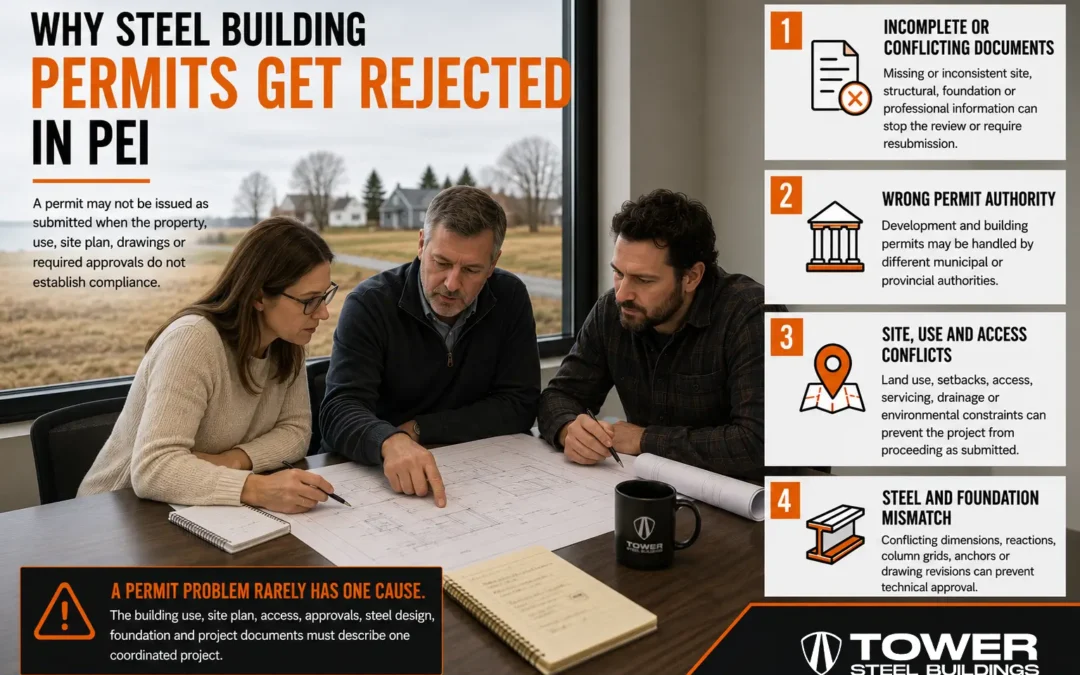
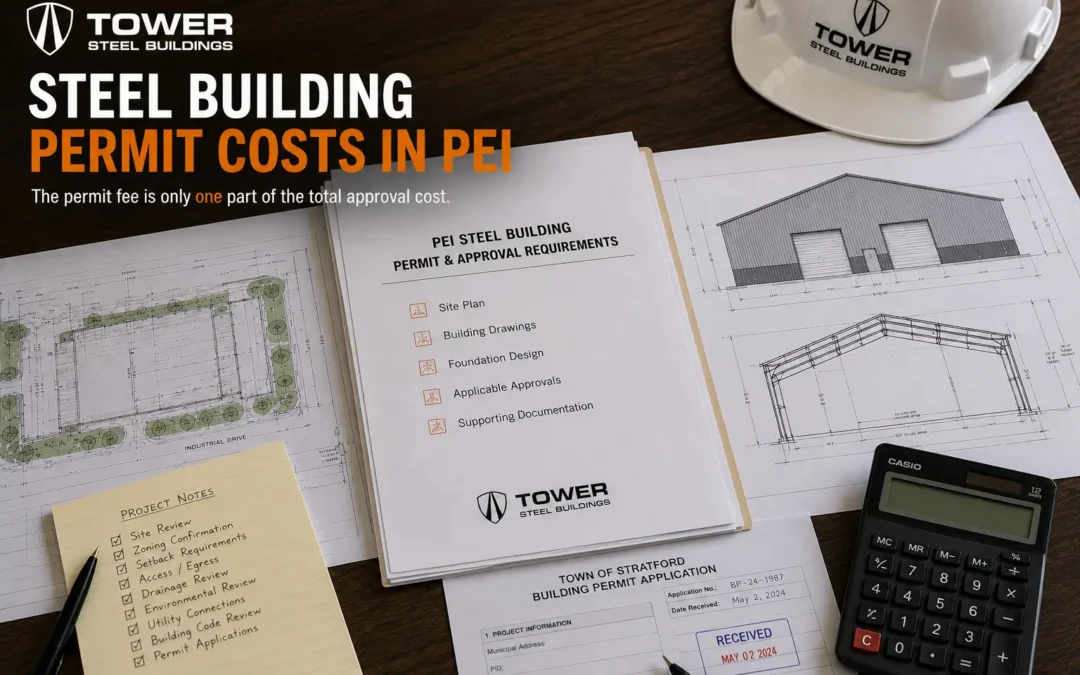
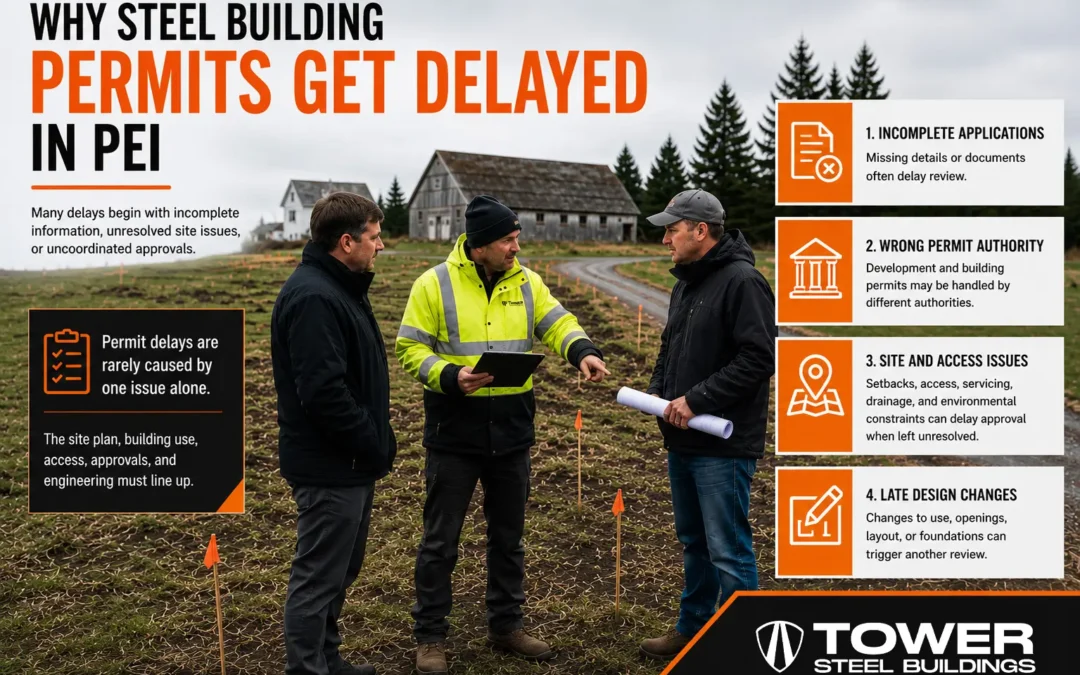
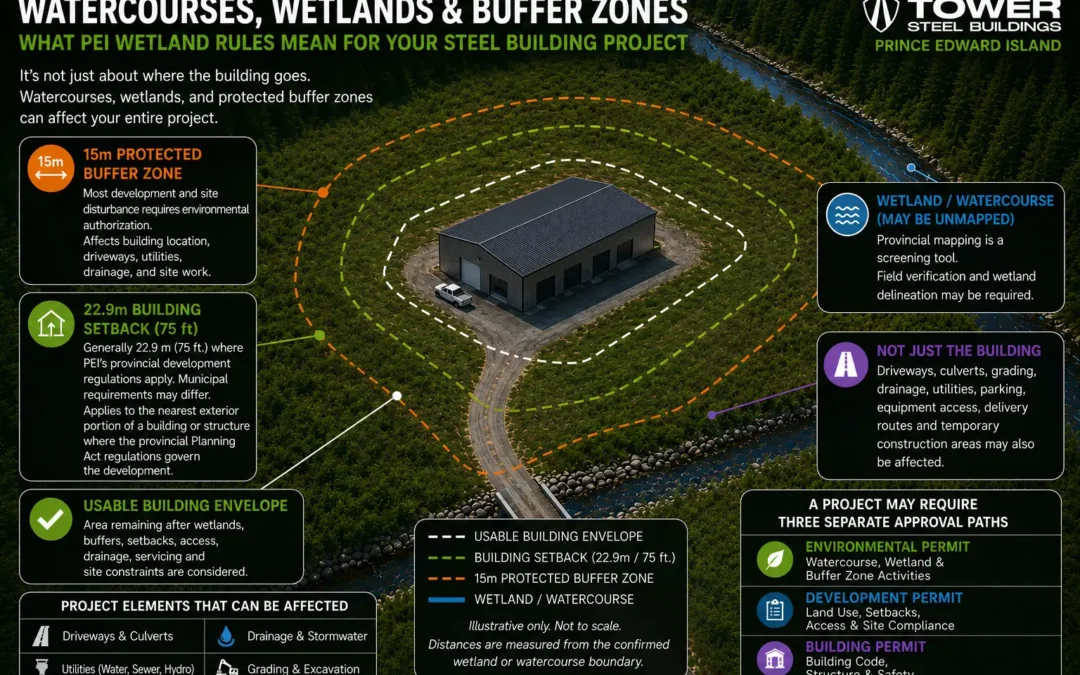
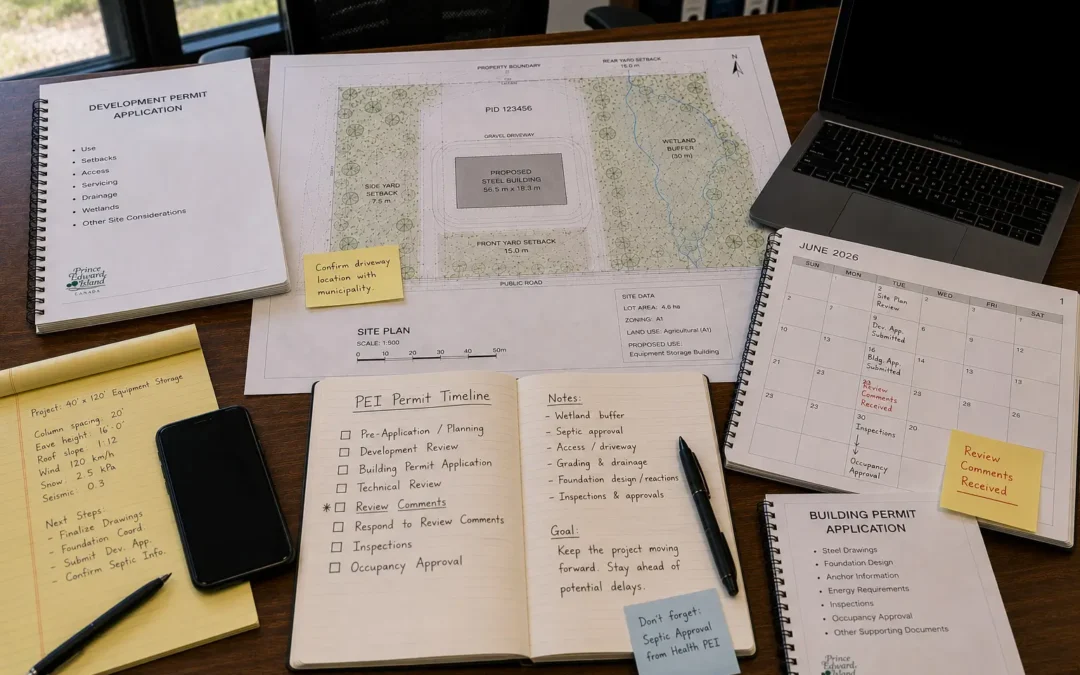
Prince Edward Island’s provincial building-permit service lists a foundation plan among the plans required with an application. The broader Prince Edward Island steel building permit guide explains how the permit authority, development path, site conditions, foundation inputs, inspections, and steel-package decisions fit together.
That does not mean every foundation plan is ready for construction. A preliminary drawing, a permit plan, and an issued-for-construction drawing can have different purposes and levels of completion.
The key buyer question is therefore not only, “Do I have foundation drawings?”
It is:
Have the foundation drawings been issued for the next intended stage using the current steel-system information, site assumptions, and assigned professional responsibilities?
Regulatory sources reviewed June 2026. The PEI Building Codes Regulations PDF cited below is marked current to March 31, 2024. Confirm subsequent amendments and project-specific requirements with the applicable authority.
Quick Answer
PEI lists a foundation plan among the documents required for a provincial building-permit application. The required detail depends on the project, permit authority, code pathway, and professional scope.
An anchor layout is not a foundation design. Final foundation engineering should be traceable to the current steel reactions, column grid, base plates, anchor information, soil basis, frost strategy, and site elevations.
Concrete work should proceed only from current issued-for-construction foundation drawings, coordinated steel information, and the required permit or written permission to proceed in part.
| Decision | Practical PEI Answer |
| Is a foundation plan required? | Yes, for a provincial PEI building-permit application. Municipal submission requirements may differ in format or detail. |
| Can an anchor layout replace it? | No. It coordinates steel geometry but does not design the concrete foundation or anchorage resistance. |
| When is professional engineering required? | PEI requires appropriate professionals for applicable Part 3, Part 4, and larger Part 9 work, and an engineer where structural components require calculation rather than prescriptive sizing. |
| Can concrete begin from a permit or preliminary drawing? | Not merely because the drawing exists. Use the current issued-for-construction set and obtain the required permit or written partial-work authorization. |
The PEI Foundation Drawing Decision Point
A foundation project normally passes through three distinct questions:
- Is the proposed foundation sufficiently developed for permit review?
- Is the design sufficiently coordinated for pricing and procurement?
- Has the responsible professional issued a current construction set that the contractor may rely on?
Those questions should not be answered with the same drawing status.
A permit reviewer may accept a foundation plan that demonstrates the intended structural system and professional responsibility. The concrete contractor, however, needs a construction set that resolves dimensions, reinforcement, elevations, anchors, materials, and the interfaces with the steel package.
The steel package also develops in stages. A preliminary sales layout may establish width, length, and approximate openings without fixing every reaction or base condition. Foundation construction should not be released until the design team has identified the exact steel revision on which the concrete design relies.
Preliminary, Permit, and Issued-for-Construction Drawings
A foundation plan may be prepared for permit review, construction, or both. Its title block and issue status should clearly state its intended use.
| Drawing Status | Appropriate Use | What It Should Not Be Used For |
| Preliminary or for review | Budgeting, feasibility, coordination, confirming assumptions | Concrete construction or anchor setting unless later reissued for construction |
| Issued for permitting | Demonstrating the proposed foundation design to the authority | Construction unless it is also clearly issued for construction |
| Issued for construction | Building the current coordinated foundation | Use with superseded steel drawings, reactions, or site information |
| Revised or addendum | Documenting an approved design change | Informal field changes that have not been reviewed and authenticated |
Engineers PEI’s current seal guideline states that preliminary documents should be identified as Draft or Preliminary and, where released for a limited purpose, marked with restrictions such as For Permitting Only or Not for Construction. Final engineering documents are authenticated for their intended purpose.
Issued-for-construction foundation drawings should provide the information required to build the designed foundation without field assumptions. Permit or preliminary drawings should not be used for construction unless expressly issued for that purpose.
What PEI Requires at the Permit and Professional Level
The Government of Prince Edward Island’s building-permit service lists a foundation plan among the required provincial permit drawings.
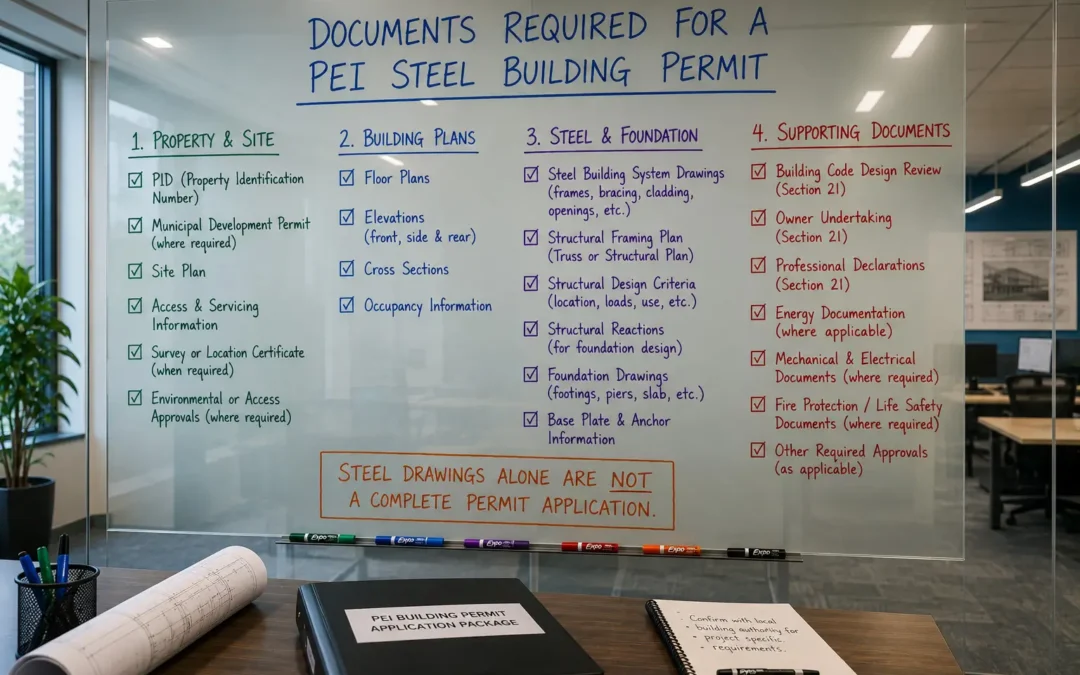
The guide to documents required for a steel building permit in PEI provides a broader breakdown of the site plan, structural drawings, foundation information, professional documents, energy information, services, and supporting approvals that may be needed.
The PEI Building Codes Regulations identify applicable foundation plans, floor plans, framing plans, elevations, cross-sections, and site information as permit documents. Charlottetown, Stratford, Summerside, and St. Felix issue building permits within their boundaries; PEI Lands Division administers building permits in other locations.
Appropriate Professional Involvement
PEI requires the appointment of appropriate professionals for buildings or portions governed by Part 3 or Part 4 and for Part 9 buildings over 300 square metres in building area.
A professional engineer is also required when a Part 9 structural component must be sized by calculation, testing, or another evaluation method. A building official may require additional professional design and field review because of site conditions, building size, or complexity.
The exact foundation-engineering scope depends on:
- The code pathway
- The structural work requiring calculation
- The site and soil conditions
- The appointed professionals
- The limits stated on each authenticated document
- The permit authority’s requirements
These rules should not be reduced to a claim that every section 21 project creates the same foundation scope. The owner and design team must assign the actual responsibilities.
Engineers PEI Authentication
Project-specific foundation engineering should be prepared by, or under the direct supervision of, a professional engineer registered or licensed to practise in Prince Edward Island.
Engineers PEI defines authentication as applying the professional seal, full signature, and date. Final engineering work products should be authenticated by the responsible professional for the stated scope.
Engineering documents prepared outside PEI for use in the province must be thoroughly reviewed and sealed by a responsible professional registered with Engineers PEI. The PEI registrant assumes responsibility for the authenticated work. A company providing engineering services to the public in its own name must also hold the applicable Certificate of Authorization.
The responsible professional’s status and a company’s authorization can be checked through the Engineers PEI member and company directory.
The Steel-to-Foundation Information Package
The most valuable coordination work occurs before the foundation engineer finalizes the concrete design.
The steel-building supplier or steel engineer should provide the current information included in its contracted scope. The foundation engineer should identify any missing assumptions and confirm which revision controls the design.
A steel building engineering review checklist can help the project team confirm the design basis, professional responsibilities, steel-to-foundation interfaces, current revisions, and unresolved construction-stage risks.
Steel Geometry
The package should establish:
- Building width and length
- Frame spacing and column grid
- Eave height and roof slope
- Bracing locations
- End-wall and interior support locations
- Door and framed-opening locations
- Base-plate dimensions and orientation
- Anchor layout and hole geometry
- Mezzanine, crane, equipment, or future-expansion requirements
A change in an opening or bracing location can alter the foundation design even when the overall footprint does not change.
Governing Reaction Package
The foundation design basis should be traceable to the governing steel reaction package.
Depending on the system, the reaction information may be provided in calculations, a schedule, design notes, or referenced steel documents. It does not need to be duplicated in full on every foundation drawing, but the foundation documents should identify the source, issue date, and revision used.
A usable reaction package commonly identifies:
- Gravity, uplift, horizontal shear, and moment reactions
- Support or grid reference
- Units
- Direction and sign convention
- Serviceability and ultimate-limit-state cases
- Governing load-combination identifiers
- Local or global moment axes
- Pinned, fixed, or partially restrained base assumptions
- Issue date and revision
Preliminary reactions can support early budgeting. They should not control concrete construction unless the responsible professionals have confirmed and released them for that purpose.
Anchor Rod and Base-Plate Information
The active steel and foundation documents should agree on:
- Anchor-rod quantity and diameter
- Material grade and specification
- Spacing and layout
- Embedment and projection
- Anchor plate, hook, or headed configuration
- Nut and washer requirements
- Corrosion protection or galvanizing where required
- Base-plate size, orientation, and hole diameter
- Grout thickness and grout requirements
- Top-of-concrete elevation
- Required templates
- Installation tolerances
- Survey or verification requirements
- Process for reporting and reviewing misplaced anchors
An anchor rod identified only by diameter and location is not fully specified.
The scope must also state who designs the anchorage, supplies the rods and templates, installs and braces the template, verifies the layout, and approves a field repair.
Site and Soil Inputs the Steel Package Cannot Supply
Steel reactions describe what the building delivers to the foundation. They do not establish what the property can support.
The foundation engineer may need:
- Legal building location and approved site plan
- Existing and proposed grades
- Finished-floor elevation
- Soil-bearing information
- Groundwater observations
- Fill history
- Frost-protection basis
- Drainage strategy
- Well, septic, and utility information
- Slab use and vehicle loads
- Equipment pads and concentrated loads
- Construction access and excavation constraints
A geotechnical report is not automatically required for every PEI project. It may be necessary or prudent where the available information cannot responsibly address bearing capacity, uncontrolled fill, groundwater, settlement, organic soil, slope, or variable conditions.
The foundation documents should identify the geotechnical basis or stated soil assumption. When actual conditions differ, work should stop in the affected area until the responsible professional provides direction.
Common drainage and grading mistakes that delay steel buildings should also be reviewed because finished elevations, surface-water movement, exterior grades, door thresholds, and foundation exposure can affect both the concrete design and site performance.
Tower’s foundation-design guidance explains why reactions, soil, frost, drainage, anchors, and concrete design must be coordinated for the actual project.
What Issued-for-Construction Foundation Drawings Need to Resolve
The exact drawing set depends on the foundation system, but a construction release should resolve the items needed to build and verify the work.
| Design Area | Information Commonly Required |
| Layout and system | Building grid, support locations, footing, pier, wall, grade-beam, slab, or combined-foundation arrangement |
| Dimensions and levels | Footing and pier dimensions, top and bottom elevations, finished floor, finished grade, door thresholds, base-plate elevation |
| Reinforcement and concrete | Bar sizes and spacing, cover, laps, dowels, ties, specified concrete strength, curing or testing requirements |
| Slab and interfaces | Thickness, thickened areas, granular base, vapour barrier, insulation, control/contraction or saw-cut joints, construction joints, drains, equipment pads |
| Frost, soil, and drainage | Frost-protection strategy, soil basis, groundwater considerations, grading, swales, perimeter drainage, downspout or stormwater coordination |
| Anchors and embeds | Anchor rods, templates, plates, sleeves, block-outs, service penetrations, grout, tolerances, and verification requirements |
| Traceability | Steel drawing reference, reaction-package revision, drawing status, professional authentication, and revision history |
A warehouse slab, truck-garage slab, farm-storage slab, and light workshop slab do not automatically share the same loading or service requirements.
The drawings should also coordinate service penetrations before reinforcement and concrete are placed. Cutting reinforcement or drilling through structural concrete should not become the routine solution for missed sleeves or drains.
Temporary Works and Construction Methods Are Separate
Unless expressly included in the engineering scope, permanent foundation drawings do not design:
- Excavation support
- Formwork
- Temporary shoring
- Dewatering
- Construction bracing
- Crane support
- Contractor access
- Construction sequencing
Those temporary works and methods must be assigned separately where required.
A completed foundation may be structurally adequate while the excavation, groundwater control, formwork, or temporary support used to construct it is unsafe or damaging. The contractor and project team should establish the temporary-work responsibilities before excavation begins.
Before Concrete: Release, Authorization, and Inspection
A foundation should not be released for concrete merely because an engineer has prepared a drawing.
The project team should confirm three separate conditions:
- The foundation drawings are current and issued for construction.
- The steel information and site assumptions referenced by those drawings remain valid.
- The required building permit or written permission to proceed in part has been issued.
Permission to Proceed in Part
PEI’s Building Codes Regulations allow a building official to grant permission to proceed in part for specified excavation or partial construction after receiving the plans and specifications required for that work.
The permission is discretionary, limited to the identified work, and does not guarantee approval of the remainder of the building. The owner must not proceed beyond the authorized scope until the required permit for further construction is issued.
The guide to applying for a steel building permit in PEI explains how development approval, building-permit submission, professional documents, review comments, inspections, and occupancy requirements fit around the construction sequence.
Foundation Inspection and Field Review
For applicable Part 9 construction, the building official must, at a minimum, inspect the footing and foundation stage before backfilling the laterally supported foundation and before placing the superstructure on it. The owner must provide the required notice not less than three days before completion of the stage to be inspected.
This minimum authority inspection does not replace:
- Pre-pour reinforcement review
- Anchor verification
- Concrete testing
- Geotechnical review
- Professional field review
- Other checks required by the permit, drawings, specifications, or professional undertaking
Inspection and field-review requirements should be confirmed before reinforcement is covered, concrete is placed, foundations are backfilled, or steel is erected.
Design Changes and Version Control
PEI prohibits deviation from code requirements, the regulations, or permit conditions without prior written permission from the building official.
Structural design changes should also be reviewed, documented, and authenticated by the responsible professional where required.
Changes that can affect the foundation include:
- Building location or elevation
- Frame spacing or bracing
- Door and opening locations
- Reactions or base restraint
- Footing, pier, or reinforcement dimensions
- Anchor type or position
- Slab loading
- Drainage and grading
- Equipment or mezzanine loads
Every active drawing should display its issue status, revision, and date. Superseded steel and foundation drawings should be removed from the construction set.
Where Steel Building Foundation Projects Commonly Fail
Most foundation failures in coordination begin before concrete is placed.
The Steel and Foundation Grids Differ
Piers and anchor rods are set from a drawing that does not match the current frame layout.
Preliminary Reactions Become the Design Basis
Later changes to height, bracing, openings, loads, or expansion assumptions invalidate the foundation calculations.
Anchor Responsibility Is Undefined
The supplier, engineer, contractor, and owner each assume another party designed, supplied, or verified the anchorage.
Site Assumptions Are Not Tested
The contractor encounters uncontrolled fill, groundwater, soft soil, or different elevations after excavation begins.
Permit and Construction Status Are Confused
A drawing marked for permitting is used to order reinforcement or place concrete without a construction release.
Door, Slab, and Exterior Grades Do Not Align
Thresholds, aprons, cladding, drainage, and base-plate elevations finish at incompatible levels.
Field Changes Bypass the Design Team
Anchor rods are bent, footings are resized, reinforcement is moved, or openings are cut without documented professional review.
Foundation Release Decision Table
Before releasing foundation construction, record the status of each group rather than relying on a single generic checklist.
| Release Group | Required Confirmation |
| Steel-system information | Current geometry, grid, bracing, base plates, anchor layout, reactions, design criteria, issue date, and revision |
| Site and soil information | Approved location, grades, soil or geotechnical basis, groundwater, frost strategy, drainage, utilities, and slab use |
| Foundation design | Current issued-for-construction drawings, dimensions, reinforcement, concrete, anchors, elevations, penetrations, and revision history |
| Permit and professional documents | Permit or written partial-work authorization, professional authentication, assigned field reviews, and applicable undertakings |
| Construction release and inspection | Contractor has current set, temporary-work responsibilities are assigned, inspections are booked, and superseded drawings are removed |
Concrete should not be released while a material item is unresolved or while the steel and foundation documents identify different revisions.
Use the steel building permit checklist to verify the permit authority, building use, site information, steel documents, foundation inputs, professional scope, approvals, inspections, and active drawing revisions before construction is released.
What Tower Steel Buildings Provides for Foundation Coordination
Tower Steel Buildings primarily supplies project-specific steel building kits and packages.
Depending on the written quotation, Tower may provide or coordinate:
- Building geometry and frame spacing
- Column grid and bracing layout
- Door and window openings
- Steel-building-system drawings
- Current structural reactions
- Base-plate information
- Anchor-layout information
- Steel-package revisions affecting foundation inputs
- The steel-building manufacturer’s current CSA A660 certification information, where applicable to the contracted system and requested permit documentation
CSA A660 certification supports the manufacturer’s quality program for the steel building system, but it does not certify the foundation or replace project-specific foundation engineering.
Tower does not automatically provide geotechnical investigation, legal survey, grading or drainage engineering, project-specific foundation design, concrete reinforcement design, anchor supply or installation, foundation construction, inspections, or permit approval unless a written quotation expressly assigns that scope.
Coordinate the Steel Package Before Concrete
Send Tower the project location, use, final dimensions, openings, height, and required package scope so the quotation can identify the steel-side information available for foundation coordination. Tower can provide project-specific kit information while the assigned PEI foundation professional completes the concrete design.
Request a steel building quote
Reviewed by Engineering Team
This content has been reviewed by the Tower Steel Buildings Engineering Team.
The review focused on the point at which a foundation drawing changes from an early coordination document into information that may be relied upon for permit review, pricing, procurement or construction.
A foundation plan can exist before all steel and site information is final. Its presence does not establish that the concrete design is ready for construction. The drawing title, issue status, revision, professional authentication and stated purpose determine how the document should be used.
For a steel building foundation, the controlling design inputs may include the building geometry, column grid, bracing locations, current structural reactions, base plates, anchor details, soil or geotechnical basis, frost-protection approach, site grades, finished-floor elevation, drainage and intended slab use.
The review also considered the distinction between an anchor layout and complete foundation or anchorage design. An anchor layout may communicate steel geometry and bolt locations, but it does not automatically establish the concrete resistance, reinforcement, embedment, edge distances, installation responsibilities, tolerances or field-repair procedure.
Issued-for-construction foundation drawings should identify the steel revision and reaction package used for design. Where those inputs change, the responsible professionals should determine whether the foundation drawings, anchorage or construction release must also be revised.
This content supports buyer education and steel-to-foundation coordination. Final foundation design, professional authentication, permit acceptance, partial-work authorization, inspections and field direction remain with the applicable authority, PEI-registered professionals and other parties assigned through the project scope.
Official References
This guide was prepared using current information from:
- Government of Prince Edward Island, Apply for a Building Permit
- Government of Prince Edward Island, Building and Development in PEI
- Prince Edward Island Building Codes Regulations
- Prince Edward Island Engineering Profession Act
- Engineers PEI, Guideline for Use of Professional Seal
- Engineers PEI, Certificate of Authorization
- Engineers PEI Member and Company Directory
- National Building Code of Canada 2020
1. Are foundation drawings required for a PEI steel building permit?
PEI's provincial building-permit service lists a foundation plan among the required application drawings.
The exact level of detail depends on the building, permit authority, code pathway, and whether the plan is being issued only for permitting or also for construction.
2. Can an anchor layout replace foundation drawings?
No.
An anchor layout coordinates steel-column and base-plate geometry. It does not design the footings, piers, grade beams, reinforcement, slab, soil resistance, frost protection, drainage, or anchorage resistance.
3. When must a PEI steel building foundation be designed by an engineer?
PEI requires appropriate professionals for buildings or portions governed by Part 3 or Part 4 and for Part 9 buildings over 300 square metres.
A professional engineer is also required where a Part 9 structural component must be sized by calculation, testing, or another evaluation method. The building official may require professional involvement because of site conditions, size, or complexity.
4. Can foundation drawings prepared outside PEI be used for a PEI project?
Yes, but imported engineering work products must be thoroughly reviewed and sealed by a responsible professional registered with Engineers PEI.
The PEI registrant assumes responsibility for the authenticated documents. A company offering engineering services to the public must also hold the applicable Certificate of Authorization.
5. Can foundation design begin before final steel reactions are available?
Preliminary design and budgeting may begin, provided the assumptions are identified.
The construction release should use the governing current reaction package and steel geometry. Later changes to bracing, openings, height, loads, or base restraint can change the foundation design.
6. Is a geotechnical report required for every PEI steel building foundation?
Not automatically.
A geotechnical investigation may be necessary where bearing capacity, uncontrolled fill, groundwater, settlement, frost, slope, organic soil, or variable conditions cannot be addressed responsibly from available information.
7. Who designs the anchor rods for a steel building foundation?
The written scope must assign responsibility.
The steel engineer may provide anchor forces and geometry, while the foundation engineer designs the anchorage and supporting concrete. Another arrangement may be used when each professional's limits are clearly defined.
8. Can foundation work begin before the full PEI building permit is issued?
Only when the responsible building official has issued the applicable building permit or written permission to proceed in part.
Completed foundation drawings alone do not authorize excavation, anchor installation, or concrete construction.
9. When does the PEI footing and foundation inspection occur?
For applicable Part 9 construction, the building official must inspect the footing and foundation stage before backfilling the laterally supported foundation and before placing the superstructure on it.
The owner must provide at least three days' notice before completion of the stage to be inspected. Additional professional or pre-pour reviews may also apply.
10. What information should the steel-building supplier provide to the foundation engineer?
Within its contracted scope, the supplier should provide current building geometry, frame and column grid, bracing locations, base-plate information, anchor layout, design criteria, structural reactions, reaction conventions, issue date, and drawing revision.
Tower Steel Buildings can provide or coordinate these steel-system inputs when included in the quotation. Project-specific foundation engineering remains a separately assigned professional responsibility unless expressly included.