Farm Building Permits in Saskatchewan: What Steel Building Buyers Should Confirm
Farm building permits in Saskatchewan are not something steel building buyers should guess about. A rural location, agricultural property, or farm business does not automatically mean the permit path is simple, exempt, or the same in every municipality or rural municipality.
For steel building buyers, the real question is not only, “Is this on farm land?” The better question is, “What is the actual building use, and what does the local authority require for this property?”
That difference matters.
A basic farm storage building may follow one path. A heated farm shop may follow another. A building used for equipment repair, ag-processing, seed cleaning, fertilizer storage, welding, employee space, public access, commercial work, rental use, or sleeping accommodation may raise different development, building-code, energy, trade, fire/life safety, zoning, foundation, and inspection questions.
Saskatchewan’s Construction Codes Act framework can allow farm-building exemption from certain construction standards where the principal use is farming and specific criteria are satisfied. But buyers should not treat that as a blanket exemption for every rural steel building. Local authorities may still require development review, zoning confirmation, setbacks, site plan information, exemption forms, trade permits, or a building-permit process depending on the use, location, local bylaw, and project scope.
For steel buildings, the risk is bigger than paperwork. If the buyer assumes the wrong permit path, the building location, steel package, foundation drawings, steel reactions, anchor bolt layout, concrete schedule, and inspection sequence can all be affected.
Quick Answer
Farm buildings in Saskatchewan may be exempt from certain construction standards when the principal use is farming and specific criteria are satisfied. However, buyers should not assume every farm or rural steel building can proceed without local review, confirmation, or a permit process. Local authorities, municipalities, and rural municipalities may still require development approval, zoning confirmation, site plan review, farm-building exemption forms, trade permits, inspections, or a building-permit process depending on the building use, local bylaw, and project scope.
Farm steel buildings with sleeping accommodation, non-farm commercial use, public access, ag-processing, repair activity, offices, washrooms, heat, plumbing, gas, electrical work, mechanical systems, or mixed use should be checked carefully before the steel package, foundation drawings, anchor bolt layout, concrete work, or construction schedule are treated as final.
The safest first step is to confirm the actual building use and review path with the municipality, rural municipality, local authority, or authority having jurisdiction before ordering steel or pouring concrete.
What This Guide Covers
This guide explains farm building permit questions in Saskatchewan from a steel building buyer’s point of view.
It covers:
- Why farm-building exemptions must be handled carefully.
- What “principal use for farming” means from a practical buyer perspective.
- Why rural land does not automatically remove permit concerns.
- The difference between a farm building, farm residence, and mixed-use building.
- Why exemption from certain construction standards does not mean no documentation.
- Who confirms whether the farm-building path applies.
- When a farm steel building may trigger more review.
- What local authorities may still require.
- How development permits and building permits can still matter.
- Why sleeping accommodation changes the risk.
- Why heated shops, repair buildings, ag-processing spaces, and commercial farm buildings need careful review.
- What documents may be needed before submission.
- What steel-building details must be coordinated before ordering, fabrication, concrete, and erection.
Buyer Warning
The biggest mistake is assuming “farm building” means “no permit problem.”
That assumption can become expensive.
A buyer may order a 60×100 steel building thinking it is just farm storage. Later, the real use becomes clearer: heated repair space, a washroom, welding, equipment servicing, employee access, ventilation, electrical work, gas heating, floor drains, office space, or occasional non-farm commercial activity.
Now the project may no longer be treated as simple farm storage. The local authority may ask for development confirmation, zoning review, building permit information, trade permits, energy details, foundation drawings, final steel reactions, anchor bolt layout, drainage information, or professional documents where required.
The steel building may still be possible. The problem is that the buyer made project decisions before the approval path was confirmed.
Saskatchewan Farm Building Permit Context
Saskatchewan uses provincial construction-code legislation, but local permit administration still matters. Saskatchewan adopted the 2020 editions of the National Building Code, National Energy Code for Buildings, and National Plumbing Code effective January 1, 2024 under The Construction Codes Act.
Saskatchewan’s farm-building advisory explains that The Construction Codes Act provides an exemption for farm buildings when the principal use of the building is for farming purposes and the building satisfies specific criteria.
That is the important starting point, but it is not the end of the review.
Local authorities can still matter because zoning bylaws regulate land use and development in municipalities, and municipal requirements can affect building location, permitted use, setbacks, access, drainage, servicing, and local permit expectations.
Farm Building Permit Questions Are Local
Saskatchewan buyers should not assume one province-wide farm building permit workflow.
A steel farm building may be reviewed through a municipality, rural municipality, local authority, development officer, building official, building bylaw process, zoning bylaw process, or permit office depending on the property.
Some rural municipalities may require a farm-building exemption form. Some may require development approval for setbacks and zoning confirmation. Some may require a building-permit process if the building includes sleeping accommodation or is used for commercial or non-farm purposes. Some may require separate trade permits even if the structure itself follows a farm-building exemption path.
Some local authorities may use their building bylaw to require information, forms, review, or permits for certain farm buildings even when a provincial farm-building exemption from certain construction standards may apply, and Saskatchewan’s building bylaw guidance confirms that municipalities must appoint a licensed Building Official to provide services for the local authority.
This means the first step is not ordering steel. The first step is confirming the local process.
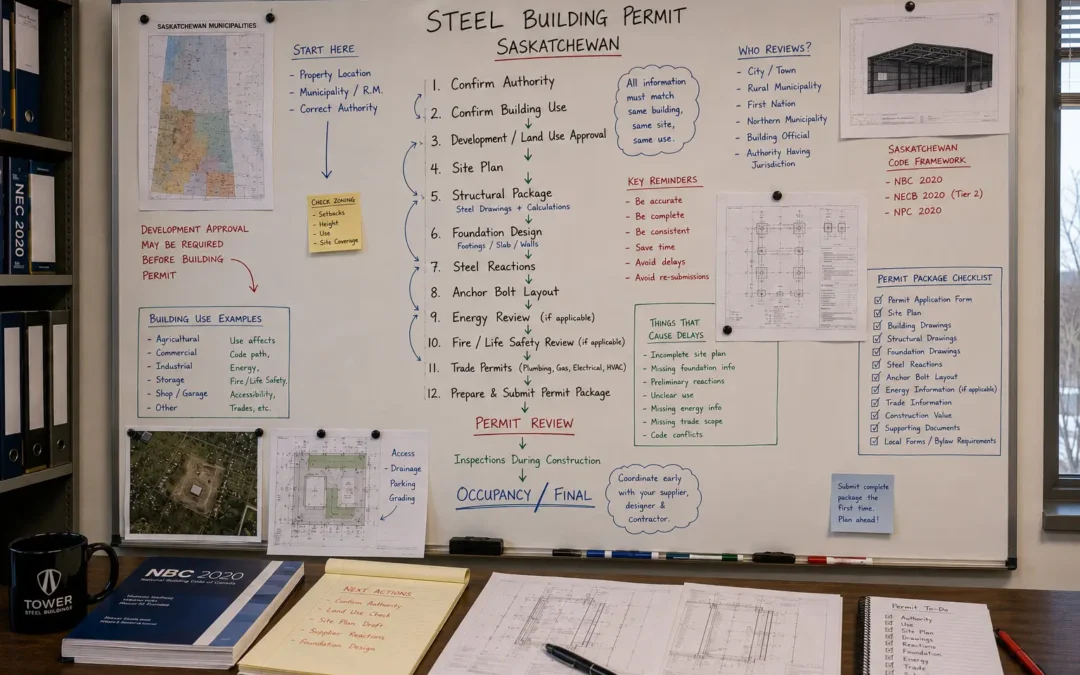
A buyer planning a farm or rural steel building should understand how to apply for a steel building permit in Saskatchewan before treating the local process, site plan, building use, or construction schedule as settled.
Farm Building Exemption Does Not Mean “No Questions”
A farm-building exemption from certain construction standards may reduce or remove certain construction-code requirements for qualifying farm buildings, but buyers should not treat it as a blanket pass.
A local authority may still need to confirm:
- Whether the principal use is farming.
- Whether the building includes sleeping accommodation.
- Whether the building includes commercial or non-farm use.
- Whether the building location meets setbacks.
- Whether the proposed structure fits zoning or land-use rules.
- Whether development approval is required.
- Whether drainage, access, or servicing must be reviewed.
- Whether plumbing, gas, electrical, septic, HVAC, or fire protection permits apply.
- Whether an exemption form or supporting information is required.
- Whether the building has public, employee, customer, or mixed-use elements.
The exemption question is only one part of the decision. The project still needs to fit the property, use, site, and local process.
Exemption Does Not Mean No Documentation
Even when a farm-building exemption path may apply, the local authority may still ask for information to confirm the building use, property location, setbacks, site plan, no sleeping accommodation, trade scope, drainage, or exemption eligibility.
A buyer should not confuse “exempt from certain construction standards” with “no one needs to see anything.” The local process may still require a form, site sketch, development approval, zoning confirmation, trade permits, or written confirmation before the project moves ahead.
This is important for steel buildings because site placement, foundation layout, steel reactions, anchor bolts, and trade work can still create risk even when a farm-building exemption from certain construction standards may apply.
Who Confirms Whether the Farm-Building Path Applies?
The local authority, municipality, rural municipality, or authority having jurisdiction should confirm whether the proposed building follows a farm-building exemption path, development permit path, building permit path, trade permit path, or another local process.
A supplier, contractor, or buyer should not make that decision alone. They can help prepare information, drawings, building-use descriptions, and project details, but the local authority controls the local review process.
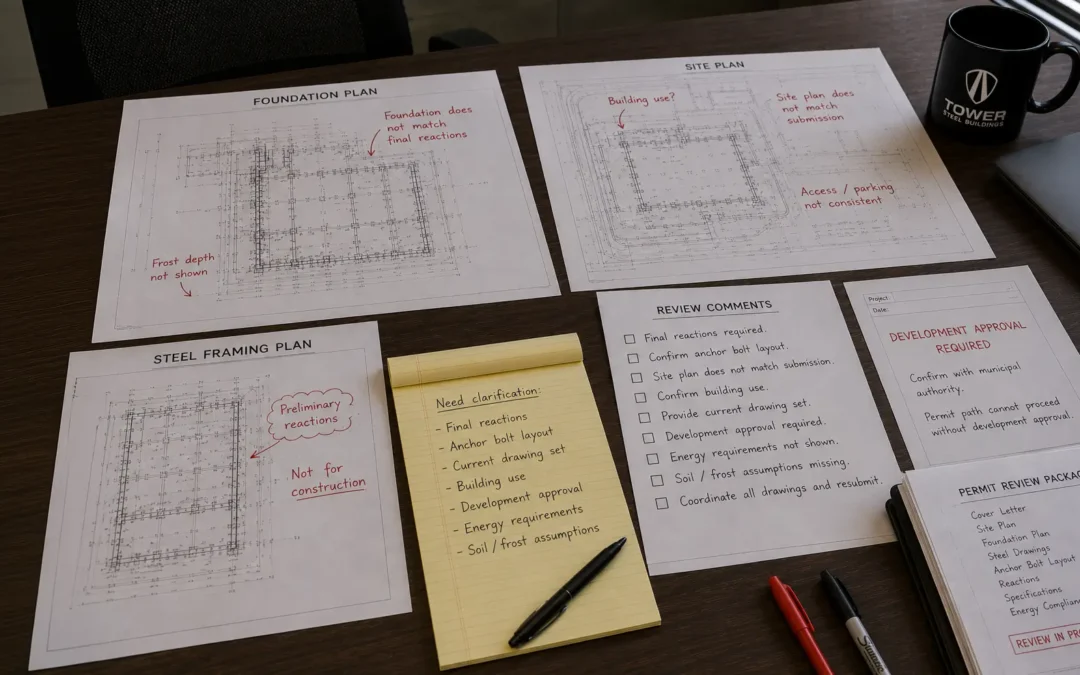
For steel building buyers, this matters before pricing is treated as final. If the authority determines that the project is not simple farm storage, the building layout, foundation drawings, steel reactions, anchor bolt layout, trade scope, and inspection path may need review.
What Counts as a Farm Building?
From a buyer’s perspective, the strongest farm-building case is usually a building whose principal use is directly tied to farming operations. Examples may include basic equipment storage, barns, granaries, crop storage, machinery storage, or agricultural-use structures, depending on the local authority and project facts.
But buyers should be careful. A building on farm land is not automatically a farm building for permit purposes.
The real use matters.
A structure may need closer review if it includes:
- Sleeping accommodation.
- Residential use.
- Retail activity.
- Commercial service activity.
- Non-farm income use.
- Public access.
- Employee areas.
- Offices.
- Washrooms.
- Heated repair space.
- Welding or mechanical repair.
- Ag-processing.
- Fertilizer or chemical storage.
- Seed cleaning or grain loading.
- Rental storage.
- Vehicle repair or truck servicing.
The safest approach is to describe the actual use plainly and ask the local authority how the building will be treated.
Farm Building vs Farm Residence vs Mixed-Use Building
A farm building, farm residence, and mixed-use rural steel building should not be treated as the same permit question.
A farm building is generally tied to farming use. A farm residence or building with sleeping accommodation raises a different level of review because people may sleep or live in the building. A mixed-use building can also change the path if part of the building is used for farming and another part is used for commercial service, public access, repair activity, rental storage, office use, or residential use.
For steel building buyers, this distinction matters before the building layout is finalized. Adding a mezzanine, office, washroom, staff room, sleeping area, retail counter, repair bay, or public-access area can change development review, building review, trade permits, fire/life safety, energy requirements, inspections, and professional responsibility.
The safe approach is to define the real use before treating the building as exempt, permit-ready, or ready for construction.
When a Farm Steel Building May Need More Review
A farm steel building may need more review when the actual use moves beyond basic agricultural storage.
More review may be needed for:
- Heated farm shops.
- Repair shops.
- Welding shops.
- Equipment service buildings.
- Buildings with washrooms.
- Buildings with office areas.
- Buildings with sleeping accommodation.
- Agricultural processing buildings.
- Seed cleaning facilities.
- Fertilizer or chemical storage buildings.
- Public-facing farm buildings.
- Employee-use buildings.
- Mixed-use buildings.
- Commercial farm-service buildings.
- Buildings with gas, plumbing, HVAC, septic, or fire protection systems.
- Buildings with heavy vehicle loading, cranes, wash bays, or floor drains.
These are not minor differences. They can affect zoning, development approval, trade permits, energy requirements, fire/life safety, foundation design, steel reactions, anchor bolt layout, inspections, and professional responsibility.
Special Farm Uses Need Earlier Review
Some farm steel buildings need earlier review because the use can introduce additional safety, environmental, fire, ventilation, drainage, or trade questions.
Examples include fertilizer storage, chemical storage, fuel-related areas, welding shops, equipment repair bays, wash bays, floor drains, seed cleaning, grain handling, ag-processing, and public-facing farm operations.
These uses should be described clearly before the steel package is treated as final. They may affect development approval, site placement, ventilation, drainage, fire/life safety, trade permits, foundation design, and professional documents where required.
Do not assume specific hazardous-material, fire, environmental, or trade requirements without confirming the exact use and authority having jurisdiction. The correct requirement can depend on the product stored, building use, quantity, location, ventilation, drainage, fire protection, and local review process.
Development Permit vs Building Permit for Farm Steel Buildings
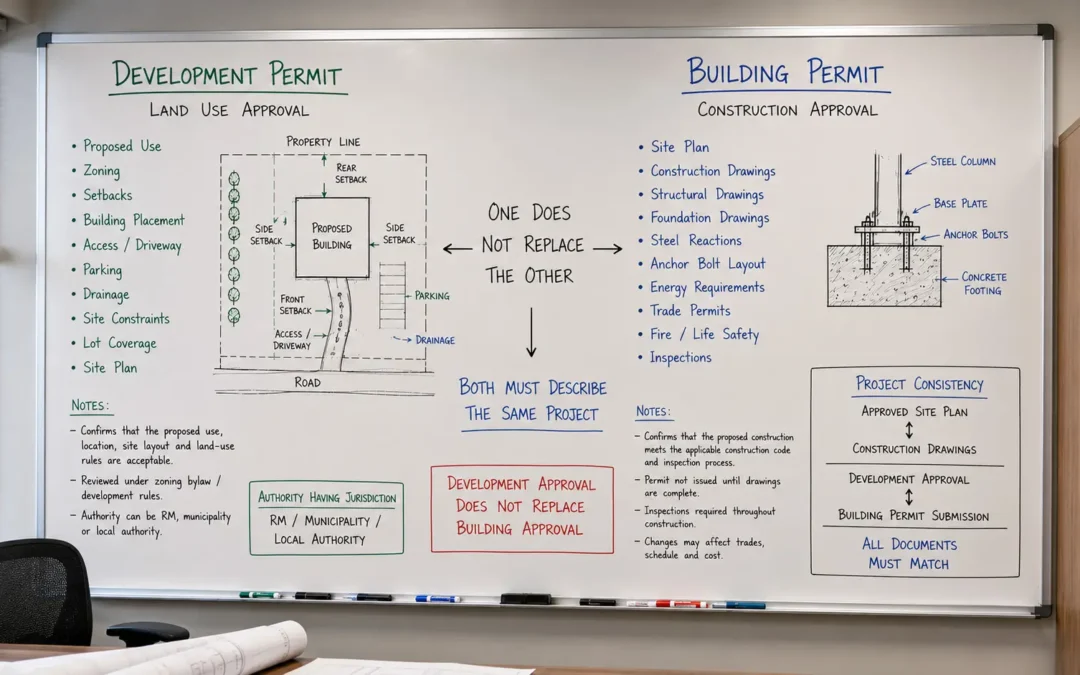
A development permit and a building permit answer different questions.
The difference between a development permit and building permit in Saskatchewan should be checked before the building location, setbacks, drainage, trade scope, or foundation layout are treated as final.
A development permit deals with land use. It may confirm whether the proposed farm building use, location, setbacks, access, lot layout, drainage, and local planning rules are acceptable for the property.
A building permit deals with construction. It may confirm whether the proposed construction can proceed under applicable construction-code review, approved drawings, foundation design, trade scope, professional documents where required, and inspections.
For farm steel buildings, the mistake is assuming one approval answers both questions.
A farm building may satisfy a local land-use question but still need trade permits. A building may be exempt from certain construction standards but still need zoning confirmation. A building may be acceptable as farm storage but change review path if it becomes a heated repair shop or includes sleeping accommodation.
Farm Building Permit Snapshot
| Question to Confirm | Why It Matters for Steel Buildings |
| Is the principal use farming? | Farm-building treatment may depend on the building’s actual principal use. |
| Is there sleeping accommodation? | Sleeping accommodation can change the permit and code path. |
| Is there commercial or non-farm use? | Non-farm income or public/commercial use can change the approval path. |
| Is development approval required? | Setbacks, zoning, access, drainage, and site layout may still need review. |
| Is a building-permit process required locally? | Local bylaws or project use may require a building-permit process or review. |
| Are trade permits required? | Electrical, gas, plumbing, HVAC, septic, or fire protection may be separate. |
| Is the building heated or conditioned? | Energy and mechanical requirements may apply depending on use and scope. |
| Are foundation drawings needed? | Steel reactions, soil assumptions, anchor bolts, frost, and drainage must be coordinated. |
| Is a farm-building exemption form required? | Some local authorities may request documentation even when a farm-building path applies. |
| Are inspections required? | Inspections can still apply depending on local requirements and trade scope. |
What a Farm-Building Exemption Does Not Confirm
A farm-building exemption from certain construction standards, where applicable, does not automatically answer every project question.
| It May Not Confirm | Why Buyers Still Need to Check |
| Zoning or land-use compliance | The building still needs to fit local land-use rules where applicable. |
| Setbacks and building location | The structure may need to meet placement requirements. |
| Access and drainage | Site layout can affect approval, construction, and long-term performance. |
| Trade permits | Electrical, gas, plumbing, HVAC, septic, and fire protection may still require permits. |
| Foundation coordination | The steel frame still needs a foundation that matches reactions, soil, frost, and anchor bolts. |
| Sleeping accommodation rules | Buildings with sleeping areas should never be assumed to follow the simple farm-building path. |
| Commercial or public-use review | Non-farm, public, employee, or commercial use can change requirements. |
| Insurance, lender, or professional expectations | Even if a permit path is simpler, other parties may still require documentation. |
For steel buildings, this matters because exemption from certain construction standards does not make the structure physically simpler. Loads, wind, snow, soil, drainage, anchor bolts, and construction sequencing still matter.
What Local Authorities May Ask For
Depending on the rural municipality, municipality, building bylaw, zoning bylaw, and project use, the local authority may ask for:
- Farm-building exemption form.
- Development permit application.
- Site plan.
- Building location and setbacks.
- Proposed use description.
- Confirmation of principal farming use.
- Confirmation of no sleeping accommodation.
- Confirmation of no commercial or non-farm use.
- Access or driveway information.
- Drainage or grading information.
- Servicing information.
- Building drawings.
- Foundation information.
- Trade permit information.
- Construction value.
- Inspection details.
- Professional documents where required.
This is why buyers should confirm local requirements before pricing decisions turn into construction commitments.
Farm Steel Building Approval Sequence
| Stage | What to Confirm Before Moving Forward |
| Before pricing is treated as final | Real use, farm-building status, local authority, zoning, setbacks, site location, and development path. |
| Before ordering steel | Building size, door layout, bracing, use, development approval, site plan, reactions path, and foundation responsibility. |
| Before concrete | Foundation drawings, final reactions, anchor bolt layout, soil and frost assumptions, drainage, and approved location. |
| Before trade scheduling | Electrical, gas, plumbing, HVAC, septic, ventilation, fire protection, and energy requirements where applicable. |
| Before erection | Current drawings, anchor bolt match, delivered steel package, inspection expectations, and approved conditions. |
This sequence helps buyers avoid the common mistake of treating a farm steel building as ready for construction before the local approval path, foundation information, and trade scope are clear.
Steel Building Details That Still Matter on Farm Projects
Even when a farm-building path is simpler, steel-building coordination still matters.
The building must still be planned around:
- Snow and wind exposure.
- Building width, length, and height.
- Frame layout.
- Bay spacing.
- Door openings.
- Bracing locations.
- Column grid.
- Base plates.
- Steel reactions.
- Anchor bolt layout.
- Foundation design.
- Soil assumptions.
- Frost conditions.
- Drainage and grading.
- Slab use.
- Heavy equipment movement.
- Future expansion.
- Construction access.
A farm steel building can be exempt from certain construction standards and still fail in the field if reactions, foundation, anchor bolts, or drainage are not coordinated.
Why Steel Reactions and Anchor Bolts Matter
Steel reactions tell the foundation designer what loads the steel frame transfers into the foundation. These can include vertical loads, lateral loads, uplift, shear, moments, snow effects, wind effects, large-door effects, equipment loads, and other project-specific forces.
Anchor bolts connect the steel columns to the foundation. If the anchor bolt layout does not match the base plates and column grid, erection can stop.
On farm projects, this risk is often underestimated because the buyer may think the building is “just a farm shed.” But steel reactions, base plates, anchor bolts, frost, soil, and drainage do not disappear because the property is rural.
Concrete should not be poured from assumptions. Anchor bolts should not be set from preliminary layouts.
Foundation Drawings and Farm Steel Buildings
Foundation drawings may still be needed or strongly recommended depending on the project, even when a farm-building exemption from certain construction standards is being considered.
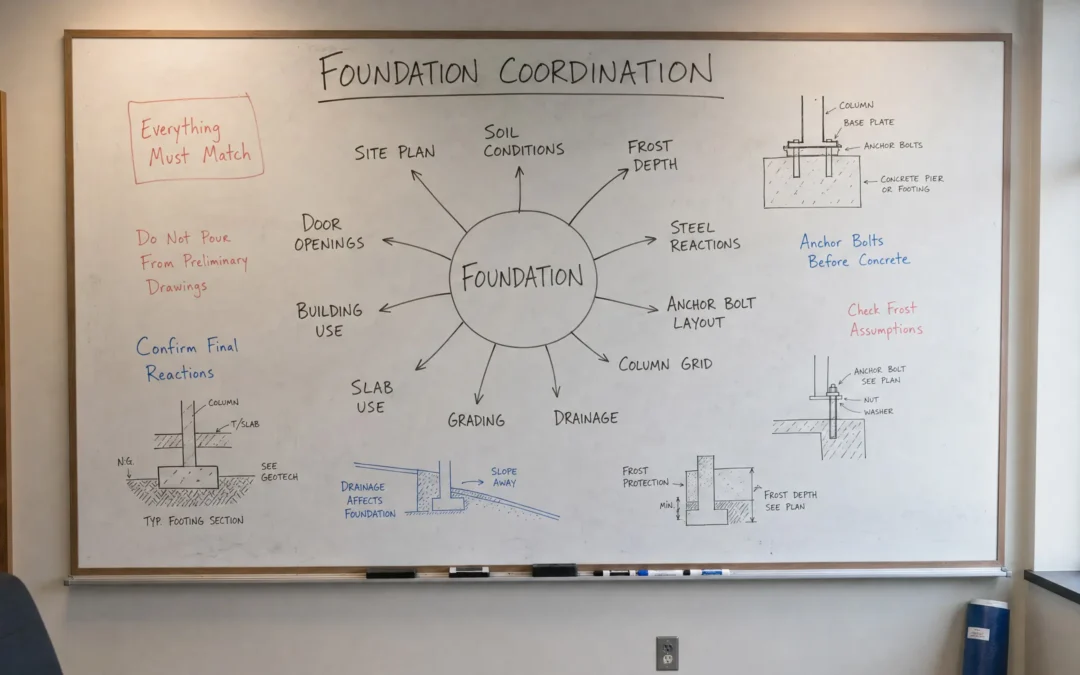
The foundation should match:
- Final steel reactions.
- Column grid.
- Base plates.
- Anchor bolt layout.
- Soil assumptions.
- Frost conditions.
- Drainage.
- Slab use.
- Heavy equipment loads.
- Building location.
- Site grading.
- Construction sequence.
A generic slab sketch is risky for a permanent steel building. Farm machinery, trucks, loaders, wash bays, heated shops, repair areas, and large overhead doors can all affect foundation and slab design.
The safest time to coordinate the foundation is before concrete, not after the building arrives.
For farm steel buildings, foundation drawings in Saskatchewan should be coordinated with final reactions, base plates, anchor bolt layout, soil assumptions, frost conditions, drainage, slab use, and the real building use before concrete is placed.
Heated Farm Shops Need Extra Care
A heated farm shop is not always the same as cold farm storage.
Serious buyers planning farm steel buildings should confirm whether heat, repair work, washrooms, offices, employee use, trade systems, or mixed use changes the permit and documentation path.
Heat can introduce energy, mechanical, ventilation, gas, electrical, insulation, overhead door, and condensation-control questions.
For heated, conditioned, commercial, or NECB-subject farm buildings, Saskatchewan’s National Energy Code for Buildings information should be checked before insulation, envelope, heating, mechanical, and permit assumptions are treated as final.
A washroom can introduce plumbing, septic, accessibility, inspection, or servicing questions. Repair work can introduce ventilation, fire/life safety, drainage, floor loading, and trade permit questions.
A heated farm shop may still be part of a farming operation, but the buyer should not assume it follows the same path as an unheated machinery storage building.
Before ordering a heated steel farm shop, confirm:
- Whether the local authority treats it as a farm building.
- Whether a building-permit process or exemption form is required.
- Whether development approval is required.
- Whether energy documents apply.
- Whether gas, electrical, plumbing, HVAC, or septic permits apply.
- Whether foundation drawings are required.
- Whether inspections are required.
- Whether professional documents are required.
Farm Buildings With Sleeping Accommodation
Farm buildings with sleeping accommodation must be handled very carefully.
A building with living space, sleeping quarters, staff housing, seasonal worker accommodation, loft sleeping areas, or residential use should never be assumed to follow the simple farm-building path.
Sleeping accommodation can change the code path, fire/life safety requirements, plumbing, ventilation, egress, energy requirements, inspections, and professional design expectations.
Buyers should confirm this directly with the local authority before pricing the building as a simple agricultural structure.
Ag-Processing, Commercial, and Public-Access Farm Buildings
Agricultural processing, commercial farm-service buildings, public-facing farm buildings, and non-farm income buildings need careful review.
Examples may include:
- Seed cleaning buildings.
- Grain loading terminals.
- Fertilizer storage buildings.
- Chemical storage buildings.
- Farm retail buildings.
- Public event buildings.
- Equipment repair businesses.
- Welding or mechanic shops.
- Rental storage buildings.
- Buildings used by customers or the public.
- Mixed-use farm/commercial spaces.
These projects can raise development, zoning, building permit, energy, fire/life safety, hazardous material, trade, accessibility, foundation, inspection, and professional document questions.
A building may be on a farm and still not be treated as a simple farm building.
Site Plan, Setbacks, and Drainage
Farm steel buildings still need site planning.
A local authority may need to understand:
- Property boundaries.
- Building location.
- Setbacks.
- Existing structures.
- Driveway and access.
- Drainage direction.
- Grading.
- Wells.
- Septic.
- Utilities.
- Easements.
- Watercourses or low areas.
- Outdoor storage.
- Fire access where applicable.
Even if the structure itself follows a simpler farm-building path, site placement can still create problems. A building in the wrong location can affect setbacks, drainage, access, snow drifting, equipment movement, foundation performance, and future expansion.
Documents to Confirm Before Ordering a Farm Steel Building
Before ordering a farm steel building in Saskatchewan, confirm whether the local authority requires:
- Farm-building exemption form.
- Development permit or zoning confirmation.
- Building permit application or local building-permit process.
- Site plan.
- Construction drawings.
- Supplier steel drawings.
- CSA A660 documentation and supplier steel package where applicable.
- Foundation drawings.
- Steel reactions.
- Anchor bolt layout.
- Soil or geotechnical information where required.
- Drainage or grading information.
- Energy documents where applicable.
- Trade permit information.
- Professional documents where required.
- Inspection information.
- Construction value or fee information.
For the steel-building-system portion, CSA A660 certification can support supplier documentation, but it does not replace local authority review, development confirmation, foundation coordination, trade permits, or site-specific project responsibility.
A dedicated documents required for a steel building permit in Saskatchewan checklist can help buyers confirm whether exemption forms, site plans, supplier drawings, foundation drawings, reactions, anchor bolts, trade permits, and inspection information belong in the same review package.
The goal is not to prepare unnecessary paperwork. The goal is to confirm what the actual project requires before major money is committed.
Drawing Version Control for Farm Steel Buildings
Farm steel building projects can fail when the owner, supplier, foundation designer, concrete contractor, and erection crew are working from different drawing versions.
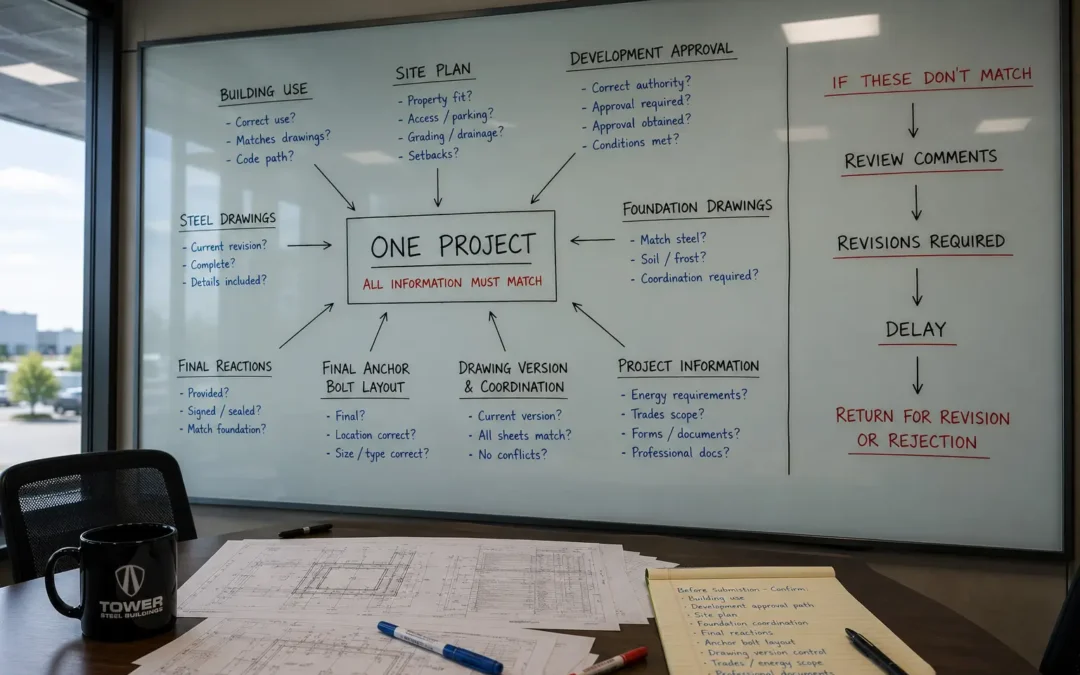
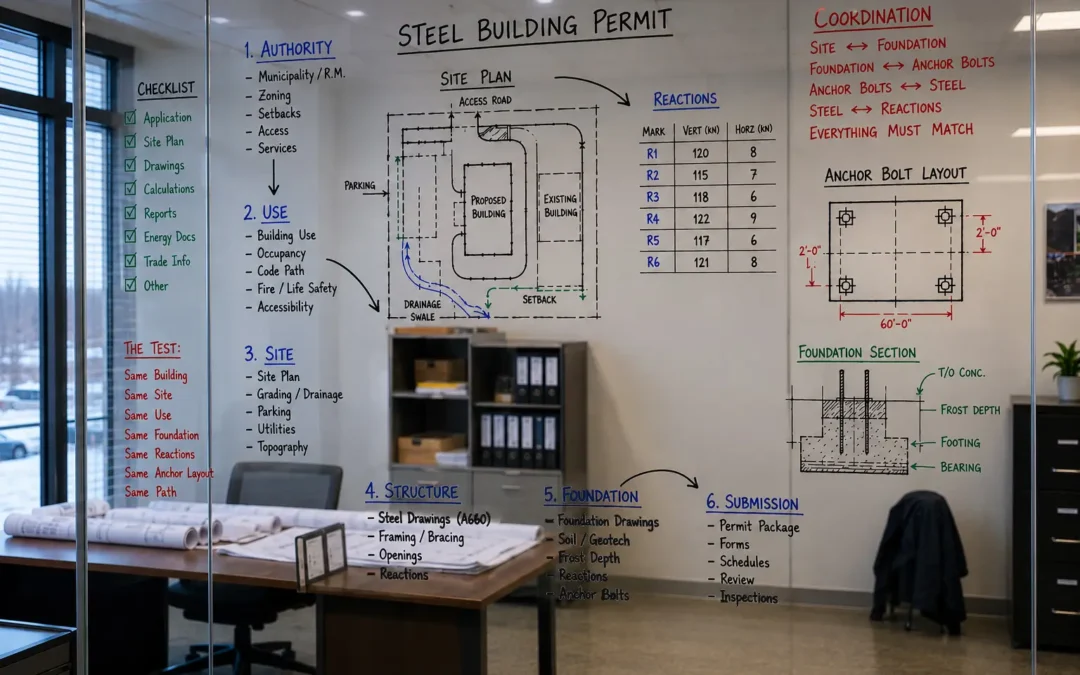
Before submission or local review, confirm that the site plan, supplier drawings, foundation drawings, steel reactions, anchor bolt layout, and supporting documents are current.
Before concrete, confirm again that the anchor bolt layout, base plates, column grid, foundation drawings, and latest steel package match.
Before erection, confirm the steel delivered matches the current drawings and the anchor bolts in the concrete.
Outdated drawings can create wrong anchor bolts, incorrect foundation assumptions, mismatched openings, inspection confusion, concrete rework, and erection delays.
Common Mistakes Farm Steel Building Buyers Make
- Assuming rural land means no permit concern.
- Calling the building farm storage when it includes repair, commercial, or mixed use.
- Ignoring development approval.
- Skipping zoning confirmation.
- Assuming a farm-building exemption from certain construction standards applies without checking local requirements.
- Forgetting about sleeping accommodation.
- Treating supplier drawings as the full permit package.
- Pouring concrete before final reactions.
- Setting anchor bolts from preliminary layouts.
- Ignoring trade permits for gas, electrical, plumbing, HVAC, septic, or fire protection.
- Treating a heated farm shop like a cold storage shed.
- Ignoring drainage and grading.
- Not confirming who is responsible for foundation design.
- Scheduling fabrication before the approval path is clear.
- Assuming local requirements are the same across every rural municipality.
Real Scenario: The “Farm Storage” Building Was Not Just Storage
A Saskatchewan buyer plans a steel building on a farm property. The first description is simple: equipment storage.
The buyer gets a quote, chooses a size, and starts planning concrete.
Then the real use becomes clearer. The building will be heated. It will include repair work, welding, a washroom, large overhead doors, electrical work, gas heat, ventilation, and heavy equipment movement. There may also be occasional non-farm equipment service.
Now the local review path may change. The project may need development confirmation, building permit clarification, trade permits, energy review, foundation coordination, final steel reactions, anchor bolt layout, and inspection planning.
Buyers should review the broader Saskatchewan steel building permit path before assuming a farm, rural, commercial, or mixed-use steel building follows a simple approval route.
The issue is not that the building cannot be built. The issue is that the buyer treated the farm-building question as simple before the real use was defined.
What to Confirm Before Steel Fabrication or Concrete
Before steel fabrication, confirm:
- The real building use.
- Farm-building status where relevant.
- Development approval or zoning path.
- Local authority requirements.
- Building dimensions.
- Door locations.
- Bracing locations.
- Final reactions.
- Foundation requirements.
- Anchor bolt layout.
Before concrete, confirm:
- Foundation drawings.
- Column grid.
- Base plates.
- Anchor bolt layout.
- Steel reactions.
- Soil assumptions.
- Frost approach.
- Drainage.
- Slab use.
- Inspection requirements.
Before trade scheduling, confirm:
- Electrical permit path.
- Gas permit path.
- Plumbing or septic requirements.
- HVAC requirements.
- Fire protection requirements.
- Ventilation requirements.
- Energy requirements where applicable.
These steps reduce the risk of building a farm steel structure from assumptions that later change.
Saskatchewan Accuracy Note
The province’s farm-building guidance indicates that farm-building exemptions can apply where the principal use is farming and specific criteria are satisfied.
However, local bylaws, development requirements, zoning rules, trade permits, sleeping accommodation, commercial use, public access, servicing, and mixed-use conditions can change the review path. Buyers should confirm current requirements directly with the municipality, rural municipality, local authority, or authority having jurisdiction before relying on a quote, supplier drawing, preliminary site plan, or assumed exemption.
Plan Your Saskatchewan Farm Steel Building Before You Order
Most farm steel building problems do not start with the steel. They start with an assumption.
The buyer assumes the building is exempt. The buyer assumes the use is simple. The buyer assumes the foundation can be figured out later. The buyer assumes the anchor bolts are flexible. The buyer assumes a rural municipality will not ask questions. The buyer assumes trade permits can be handled after the building is up.
Those assumptions can become expensive.
Tower Steel Buildings helps Saskatchewan farm and rural buyers think through building use, steel scope, design criteria, foundation reactions, anchor bolt coordination, supplier documentation, and quote-to-permit readiness before major project decisions are made.
Request project-specific steel building quotes and project guidance before finalizing your farm steel building size, foundation, fabrication timeline, concrete schedule, or trade plan.
The earlier these risks are identified, the easier they are to control. This is especially important before steel fabrication, concrete placement, anchor bolt setting, or trade scheduling begins.
Final Perspective
Farm building permits in Saskatchewan are not a simple yes-or-no question.
Some farm buildings may qualify for exemption from certain construction standards. Others may require development approval, a building-permit process, trade permits, inspections, professional documents, or local forms. The difference depends on the actual building use, property location, local authority, building bylaw, zoning rules, sleeping accommodation, commercial or public use, servicing, and project scope.
For steel building buyers, the safest path is to confirm the real use and local requirements before the steel package, foundation drawings, anchor bolt layout, fabrication, concrete, or construction schedule are treated as final.
A Saskatchewan farm steel building is ready to move forward when the local authority path, building use, site plan, steel package, foundation information, reactions, anchor bolts, and trade scope are clear enough to support one coordinated project.
Reviewed by Engineering Team
This content has been reviewed by the Tower Steel Buildings Engineering Team.
This review focused on one practical question that affects Saskatchewan farm steel building projects: is the proposed structure truly being used as a farm building, or does the actual use create a different review path?
For farm and rural steel buildings, the risk is not only whether the property is agricultural. The real issue is how the building will be used. Equipment storage, machinery storage, crop storage, barns, granaries, and direct agricultural use may be reviewed differently from heated farm shops, repair bays, welding areas, washrooms, offices, employee spaces, public-access buildings, ag-processing spaces, commercial activity, rental use, or sleeping accommodation.
The review also focused on why buyers should not treat a farm-building exemption from certain construction standards as a blanket approval. Local authority requirements, rural municipality processes, development approval, zoning, setbacks, site plans, trade permits, inspections, foundation coordination, steel reactions, anchor bolt layouts, drainage, and servicing can still affect the project depending on the actual use and location.
For Saskatchewan steel building buyers, the safest sequence is to confirm the real use first, confirm the local authority path second, and coordinate the steel package, foundation information, reactions, anchor bolts, and trades after the review path is understood.
This content is intended to support buyer education and farm-building planning decisions. Final farm-building treatment, exemption eligibility, permit requirements, development requirements, trade permits, inspections, professional responsibilities, and local approval decisions remain under the authority of the applicable municipality, rural municipality, local authority, building official, inspector, engineer, trade contractor, or other qualified professional involved in the project.
1. Do farm buildings need permits in Saskatchewan?
Some farm buildings in Saskatchewan may be exempt from certain construction standards when the principal use is farming and specific criteria are satisfied. However, buyers should not assume every farm or rural building can proceed without local review, confirmation, or a permit process.
Local authorities may still require development approval, zoning confirmation, site plan information, exemption forms, trade permits, inspections, or a building-permit process depending on the building use, local bylaw, sleeping accommodation, servicing, and project scope.
2. Are all rural steel buildings exempt from building permits in Saskatchewan?
No. Rural location alone does not automatically make a steel building exempt. The real use of the building, local authority requirements, zoning, building bylaw, trade work, sleeping accommodation, commercial use, and public access can all affect the review path.
A basic farm storage building may be treated differently from a heated repair shop, ag-processing space, farm retail building, equipment service building, or mixed-use rural steel building.
3. What is considered a farm building in Saskatchewan?
A farm building is generally tied to farming use, but the exact treatment depends on the project facts and local authority. Buildings used for agricultural storage, livestock, machinery, or other farming purposes may be treated differently than buildings used for commercial, public, residential, or mixed purposes.
The safest approach is to describe the real use to the municipality or rural municipality and ask how the building will be treated before ordering steel.
4. Does a farm-building exemption mean I do not need development approval?
Not necessarily. A farm-building exemption from certain construction standards does not automatically remove zoning, land-use, setback, access, drainage, or development review requirements.
Some local authorities may still require development approval, site plan information, or a farm-building exemption form to confirm the proposed building location and use.
5. Who confirms whether a farm-building exemption applies?
The municipality, rural municipality, local authority, or authority having jurisdiction should confirm whether the proposed building follows a farm-building exemption path, development permit path, building-permit path, trade permit path, or another local process.
A supplier, contractor, or buyer should not make that decision alone. They can help prepare information, but the local authority controls the local review process.
6. Do farm buildings with sleeping accommodation need special review?
Yes. Buildings with sleeping accommodation should never be assumed to follow the simple farm-building path. Sleeping areas, residential use, staff housing, seasonal worker accommodation, or living space can change code, fire/life safety, plumbing, ventilation, energy, inspection, and professional document requirements.
Buyers should confirm this directly with the local authority before pricing or designing the building.
7. Does a heated farm shop need a building permit in Saskatchewan?
A heated farm shop may need closer review than cold farm storage. Requirements depend on the principal use, local authority, building bylaw, heating system, electrical work, gas, ventilation, plumbing, washrooms, commercial use, and project scope.
Before ordering a heated steel farm shop, buyers should confirm whether a building-permit process, exemption form, development approval, trade permits, energy documents, inspections, or professional documents are required.
8. Do ag-processing or commercial farm buildings qualify as simple farm buildings?
Not always. Ag-processing, seed cleaning, fertilizer storage, grain loading, farm retail, equipment repair, welding, public-facing, or commercial farm-service buildings can raise different development, building permit, energy, trade, fire/life safety, environmental, foundation, and inspection questions.
A building can be on farm land and still need a more detailed approval path if the use is not simple farming storage.
9. Can I order a farm steel building before confirming the permit path?
Ordering before confirming the permit path can create risk. If the local authority requires a different location, size, use, access route, drainage approach, or document package, the steel building design may need to change.
For steel buildings, those changes can affect frame dimensions, bay spacing, overhead door locations, bracing, column grid, foundation layout, steel reactions, base plates, and anchor bolt layout.
10. Can I pour concrete before confirming farm building approval requirements?
Pouring concrete before confirming the approval path is risky. If the building location, foundation drawings, steel reactions, anchor bolt layout, drainage, or site plan changes during review, the concrete may not match the final project.
Concrete corrections can involve drilling, epoxy anchor review, concrete repair, redesign, inspection delay, and erection problems. Concrete should not be placed from assumptions.
11. Are supplier drawings enough for a farm steel building?
Supplier drawings are useful, but they are not always enough by themselves. They may show the steel frame, base plates, reactions, anchor bolts, bracing, and erection information, but the local authority or project team may also need site plan information, foundation drawings, development confirmation, trade scope, drainage information, and professional documents where required.
A supplier package should be coordinated with the actual site and use before construction decisions are made.
12. Why do steel reactions matter for farm buildings?
Steel reactions matter because they tell the foundation designer what loads the steel frame transfers into the foundation. Farm steel buildings still face snow, wind, uplift, shear, equipment loads, door openings, and other forces.
If reactions are missing or preliminary, the foundation may be designed from assumptions. That can create concrete rework, anchor bolt problems, permit comments, or long-term performance issues.
13. Do farm steel buildings need foundation drawings?
Foundation drawing requirements depend on the project, local authority, building size, use, soil, frost, drainage, and professional judgment. Even where a permit path is simpler, a permanent steel building still needs foundation information that matches the steel reactions, column grid, base plates, anchor bolts, soil assumptions, and slab use.
A generic slab sketch can be risky for a steel farm building, especially when heavy equipment, heated use, wash bays, large overhead doors, or repair activity are involved.
14. Do trade permits still apply to farm buildings?
They may. Electrical, gas, plumbing, HVAC, septic, fire protection, ventilation, and other trade work may require separate permits or inspections depending on the local process and project scope.
A farm-building exemption from certain construction standards does not automatically remove trade-permit responsibilities.
15. What should I confirm before building a farm steel building in Saskatchewan?
Confirm the local authority, real building use, farm-building status, development approval, zoning, setbacks, site plan, drainage, building-permit process, trade permit requirements, foundation information, steel reactions, anchor bolt layout, sleeping accommodation, commercial or public use, and inspection expectations.
These items should be confirmed before ordering steel, releasing fabrication, pouring concrete, or scheduling construction.
16. How can Tower Steel Buildings help with farm building planning?
Tower Steel Buildings can help Saskatchewan farm and rural buyers think through steel building scope, real use, building layout, reactions, base plate information, anchor bolt coordination, supplier documentation, foundation-related information, and quote-to-permit readiness.
This support does not replace the local authority, municipality, rural municipality, building official, engineer, foundation designer, or trade professionals, but it can reduce avoidable confusion before ordering, fabrication, concrete work, and construction scheduling.