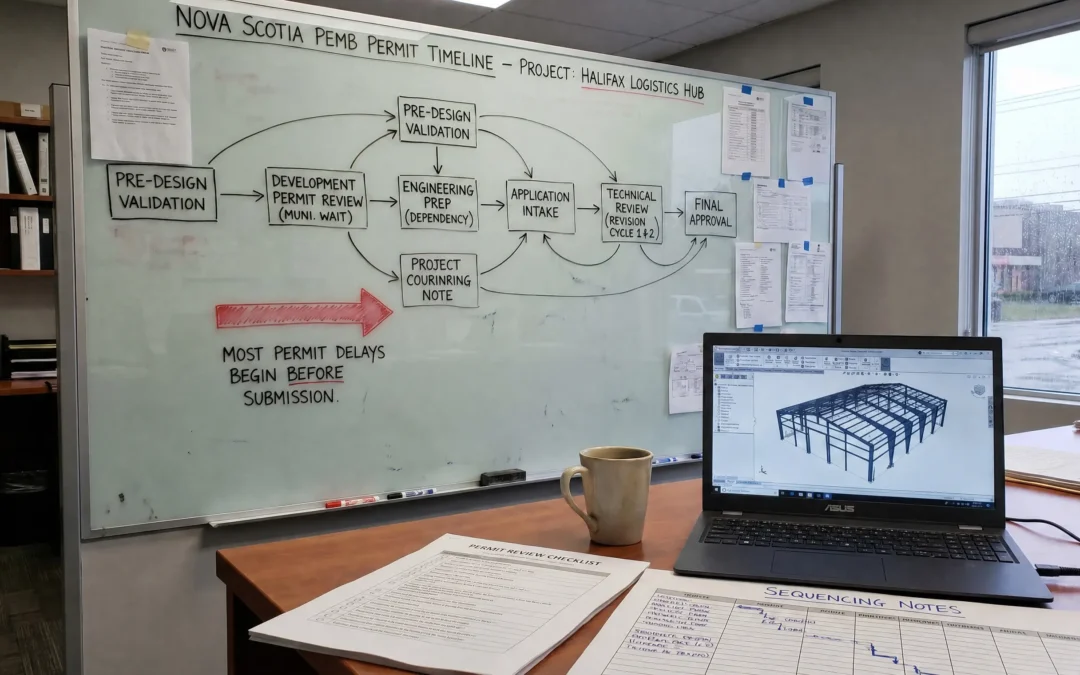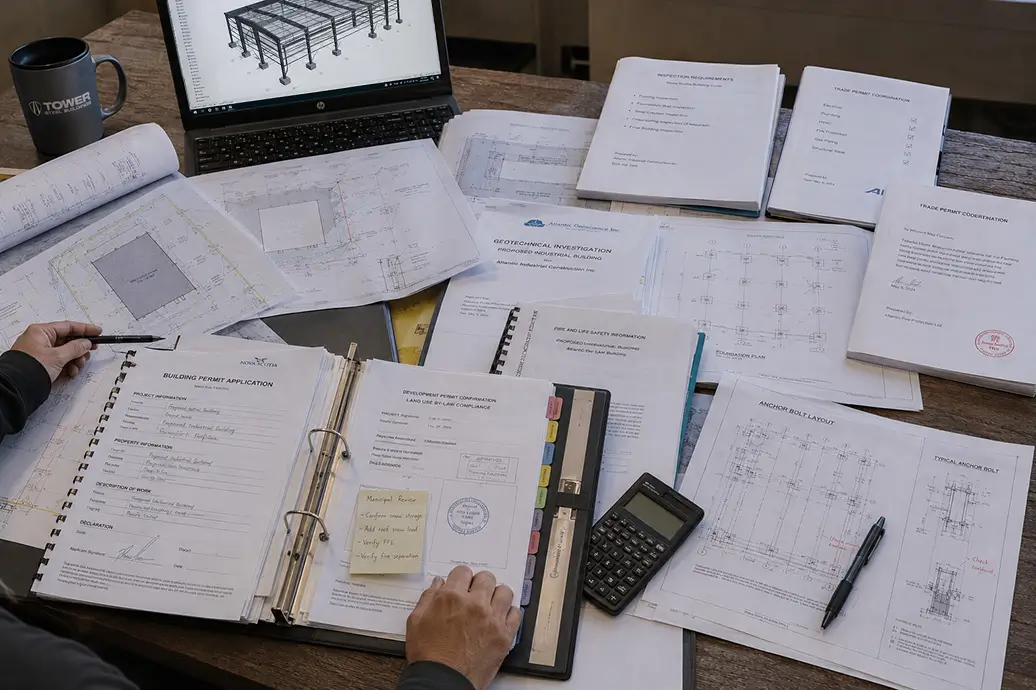
A development permit decides whether the project is allowed on the land. A building permit decides whether the building can be constructed safely.
A development permit and a building permit are not the same thing in Nova Scotia.
For steel building buyers, this difference matters because the wrong assumption can delay the entire project before engineering review even begins.
A buyer may ask:
Do I need a development permit or a building permit?
The better question is:
Has the project been approved both as a land-use decision and as a construction/code-compliance decision?
That difference controls timeline, cost, design, documentation, and construction sequence.
A development permit usually deals with land use, zoning, setbacks, lot requirements, development restrictions, building placement, and whether the proposed use is allowed on the property.
A building permit deals with construction, structural safety, national and provincial steel building code compliance, technical drawings, inspections, and whether the building can be built according to Nova Scotia Building Code requirements.
For a steel building, both approvals can matter.
A warehouse can be structurally correct and still fail the development side. A farm storage building can be allowed on the land but still need proper foundation drawings, steel reactions, anchor bolt coordination, and building permit documents. A truck garage can look simple at the quote stage but trigger use, access, drainage, fire, energy, plumbing, and inspection questions once the municipality reviews the real project.
Nova Scotia’s Building Code Regulations adopted the 2020 National Building Code, 2020 National Energy Code for Buildings, 2020 National Plumbing Code, and 1995 National Farm Building Code, as amended by Nova Scotia, under the current Nova Scotia Building Code framework effective April 1, 2025, with later staged amendments scheduled after the initial adoption period.
For serious steel building buyers, the practical lesson is simple:
Development approval answers “Can this project happen here?”
Building permit approval answers “Can this building be constructed safely here?”
You usually need both questions answered before the project is truly ready.
Quick Answer
A development permit in Nova Scotia confirms that a proposed project complies with municipal land-use rules, such as zoning, use, setbacks, lot requirements, building placement, and development restrictions. A building permit confirms that the construction work complies with building code, technical drawings, structural safety, foundation design, inspections, and other construction requirements.
For steel buildings, the development permit should usually be confirmed before finalizing the building permit package. If the land-use side is wrong, the building location, use, size, access, parking, drainage, or site layout may need to change. If the building permit side is incomplete, the project may be delayed because drawings, foundation details, steel reactions, anchor bolts, energy documents, trade permits, or professional letters are missing.
Development Permit vs Building Permit Nova Scotia: Simple Definition
A development permit is a land-use approval. It confirms whether the proposed building use, location, size, setbacks, lot coverage, access, and development conditions are acceptable under local municipal planning rules.
A building permit is a construction approval. It confirms whether the proposed building can be constructed according to applicable building code requirements, approved drawings, structural design, foundation design, inspections, and construction standards.
For steel buildings, development approval and building permit approval must work together. Land-use approval without coordinated construction documents is not enough. Construction drawings without land-use approval can still be stopped.
What This Guide Covers
This guide explains the difference between a development permit and a building permit in Nova Scotia for steel building buyers.
In this guide, you will understand:
- what a development permit does
- what a building permit does
- why steel buildings may need both
- which permit usually comes first
- how land-use issues affect steel building design
- how building code issues affect construction approval
- why “farm building,” “storage,” or “shop” must be defined carefully
- how foundation drawings, steel reactions, site plans, drainage, and trade permits fit into the process
- how to avoid delays caused by confusing development approval with building permit approval
This page is written for buyers planning steel buildings in Nova Scotia, including garages, workshops, farm buildings, warehouses, truck garages, commercial buildings, industrial facilities, storage buildings, marine-related buildings, and custom steel building projects.
Buyer Warning
The most expensive permit mistake is assuming the building permit is the only approval that matters.
A steel building can be priced, engineered, and ready to order, but if the use or location does not fit the land-use rules, the project can still be delayed or redesigned.
The second mistake is assuming development approval means construction can start.
Development approval may confirm the project is allowed on the land, but it does not automatically prove that the structure, foundation, anchor bolts, drainage, energy details, trade scope, and inspections are ready.
One permit does not replace the other.
Development Permit vs Building Permit Snapshot
| Permit Type | Main Purpose | What It Usually Reviews | Steel Building Risk if Missed |
| Development Permit | Confirms land-use permission | Zoning, use, setbacks, placement, lot requirements, access, development restrictions | Building may need relocation, redesign, use change, or planning review |
| Building Permit | Confirms construction/code compliance | Drawings, structure, foundation, code, safety, inspections, trade scope | Building may be delayed, returned, revised, or stopped before construction |
| Site Plan Review / Site Requirements | Confirms how the building fits the property | Access, grading, drainage, servicing, parking, setbacks, existing conditions | Site conflicts can delay both development and building review |
| Trade Permits | Confirms specific building systems | Electrical, plumbing, HVAC, fire protection, sewage or servicing where applicable | Heated, serviced, or occupied buildings may face inspection delays |
| Professional Letters / Field Review | Confirms professional responsibility where required | Structural, foundation, geotechnical, fire, mechanical, electrical, plumbing, energy | Missing responsibility can hold review or inspection stages |
The Core Difference: Land Use vs Construction
A development permit is about the land.
A building permit is about the building.
That is the simplest way to understand the difference.
The development side asks:
- Is this use allowed on this property?
- Is the proposed building location acceptable?
- Are setbacks met?
- Is the building size acceptable for the lot?
- Does the project fit zoning and land-use rules?
- Are there development restrictions?
- Is the access, site layout, or placement acceptable?
- Does the project need additional planning review?
The building permit side asks:
- Are the construction drawings complete?
- Does the building meet the applicable building code?
- Is the steel structure designed for the site?
- Do the foundation drawings match the steel reactions?
- Is the anchor bolt layout coordinated?
- Are fire and life safety requirements addressed?
- Are energy requirements addressed where applicable?
- Are trade permits or inspections required?
- Are professional letters required?
If buyers confuse these two approvals, they often order the wrong building too early.
A building can be allowed on the land but not ready to build.
A building can be engineered well but not allowed in that location or use.
Both sides matter.
What Is a Development Permit in Nova Scotia?
A development permit confirms whether a proposed development complies with the applicable municipal land-use rules.
For steel buildings, this can include:
- proposed use
- zoning
- setbacks
- lot coverage
- building placement
- building height
- access
- parking or loading
- development restrictions
- site layout
- change of use
- accessory building rules
- agricultural, commercial, industrial, or rural use classification
Antigonish County development permit guidance states that where a Land Use By-law is in effect, a development permit is necessary to receive a building permit, and that the development permit confirms compliance with zoning, use, lot requirements, and development restrictions.
That is the key point.
Development approval is not a structural approval.
It does not prove that the foundation is correct.
It does not prove that anchor bolts match.
It does not prove that energy, fire, plumbing, or HVAC documents are complete.
It proves the project can proceed from a land-use perspective.
What Is a Building Permit in Nova Scotia?
A building permit is the approval that allows construction to proceed after the municipality is satisfied that the proposed work meets applicable requirements.
For steel buildings, the building permit review can include:
- building permit application
- construction drawings
- structural drawings
- foundation drawings
- steel reactions
- anchor bolt layout
- site plan
- geotechnical information where required
- grading or drainage information where required
- energy documentation where applicable
- fire and life safety information where applicable
- trade permit information
- professional letters where required
- inspections
CBRM building and development permit guidance states that in Nova Scotia, a building permit is legally required before construction and that permits and inspections help ensure minimum standards for health, fire protection, structural safety, and property protection.
The building permit is where the construction package must prove the building can be built safely.
For steel buildings, that proof must include coordination.
The steel drawings, foundation drawings, site plan, reactions, anchor bolts, use, and trade scope must describe the same project.
Which Permit Comes First?
In many Nova Scotia steel building projects, the development permit path should be confirmed before the building permit package is finalized.
That does not always mean every project follows the exact same sequence in every municipality. Municipal processes vary. Some municipalities may combine building and development review in one application path. Others may require development approval before building permit issuance. Some may process parts of the file together but still need land-use issues resolved before approval.
The practical sequence is:
- Confirm the proposed use
- Confirm zoning and land-use rules
- Confirm development permit requirements
- Confirm site plan requirements
- Prepare steel building design
- Coordinate structural and foundation drawings
- Confirm steel reactions and anchor bolt layout
- Submit building permit package
- Respond to comments as a coordinated system
- Build only after approval is clear
The mistake is not asking which form comes first.
The mistake is designing or ordering the building before the land-use path is understood.
If the development review changes the building location, use, footprint, height, access, or site layout, the building permit package may also need to change.
When a Development Permit Can Affect Steel Building Design
A development permit is not only a planning form. It can change the building itself.
Development review can affect:
- building location
- setbacks
- lot coverage
- access
- driveway position
- parking or loading
- building height
- outdoor storage
- drainage
- development restrictions
- allowed use
- change of use
- relation to nearby properties
- site constraints
For steel buildings, these items can affect more than the site plan.
If the building shifts on the property, foundation drawings may change.
If the access changes, overhead door placement may change.
If the allowed use changes, fire, energy, trade, ventilation, plumbing, and occupancy requirements may change.
If the building height or footprint changes, frame design and reactions may change.
A land-use issue can become an engineering issue.
That is why development permit confirmation must happen early.
When a Building Permit Can Affect the Project
A building permit review can also change the project.
Building permit review can identify issues such as:
- incomplete drawings
- unclear building use
- missing foundation drawings
- missing steel reactions
- anchor bolt mismatch
- unsupported soil assumptions
- missing geotechnical information
- drainage or grading gaps
- missing energy documentation
- incomplete fire and life safety information
- missing trade permits
- missing professional letters
- inspection sequencing problems
For steel buildings, the building permit review often exposes site-specific steel building engineering and coordination problems.
The building may look ready because the steel package exists.
But the municipality may still need to confirm how the building connects to the site, the foundation, the code requirements, and the inspection process.
A steel building permit package is not complete because the building supplier issued drawings.
It is complete when the full project is coordinated.
Why Steel Building Buyers Confuse the Two Permits
Steel building buyers often confuse development permits and building permits because the project is sold as one building.
But municipalities review different parts of the project through different lenses.
The buyer thinks:
I am buying a steel building.
The municipality thinks:
What is the proposed use?
Is it allowed here?
Where is it going?
Does it meet setbacks?
Does the site work?
Do the drawings match?
Does the structure comply?
Does the foundation match the steel?
Are inspections possible?
The buyer sees one project.
The approval system sees land use, site design, building code, structure, foundation, drainage, trades, and inspections.
That is why permit planning must happen before fabrication or concrete work begins.
Common Steel Building Examples
Farm storage building
A farm storage building may appear simple, but the municipality may still need to confirm land use, setbacks, access, building size, site placement, and whether the proposed use is truly agricultural storage.
If the building includes repair work, public access, washrooms, heat, processing, or business use, the review path may change.
Commercial workshop
A commercial workshop may need development review for use, parking, access, and site layout. It may also need building permit documents for occupancy, fire safety, energy, ventilation, plumbing, foundation design, and trade permits.
Truck garage
A truck garage can trigger questions around large doors, slab loads, ventilation, drainage, fire access, vehicle-related use, servicing, and trade permits.
The land-use approval may confirm whether the garage use is allowed. The building permit must still confirm the structure can be built safely.
Warehouse
A warehouse may involve site layout, truck access, loading, parking, fire access, storage use, slab loading, racking loads, energy requirements, and trade permits.
The development side and building side both matter.
Marine or coastal storage building
A coastal steel building can involve land-use, shoreline, drainage, corrosion exposure, wind exposure, foundation, and site disturbance questions.
The building may need both planning clarity and stronger technical coordination.
Development Permit Mistakes That Delay Steel Buildings
Common development permit mistakes include:
- assuming the proposed use is allowed
- ignoring zoning before pricing the building
- assuming rural land automatically means approval is simple
- using the wrong building category
- not checking setbacks
- not checking lot coverage
- not confirming driveway or access requirements
- not reviewing parking or loading needs
- not checking change-of-use requirements
- placing the building before confirming restrictions
- ignoring watercourses, wetlands, slopes, drainage, or site constraints
A development mistake can force the building to move, shrink, change use, or go through additional review.
That can affect the steel design, foundation drawings, and permit timeline.
Building Permit Mistakes That Delay Steel Buildings
Common building permit mistakes include:
- treating supplier drawings as the full permit package
- submitting without final steel reactions
- using foundation drawings based on outdated information
- missing anchor bolt layout
- missing site-specific structural design information
- unclear occupancy or building use
- missing energy details for heated or conditioned buildings
- missing fire and life safety information
- missing trade permit scope
- weak drainage or grading information
- unsupported soil assumptions
- missing professional letters where required
- partial responses to review comments
A building permit mistake can trigger review comments, resubmission, re-engineering, inspection delays, and construction changes.
If the issue is found after concrete is poured, the cost grows fast.
The Site Plan Connects Both Permits
The site plan is the bridge between development permit review and building permit review.
Development review uses the site plan to understand:
- building placement
- setbacks
- lot layout
- access
- use
- site constraints
- development restrictions
Building permit review uses the site plan to understand:
- building location
- construction context
- drainage
- foundation relationship to site
- access for construction and inspection
- relation to existing structures
- servicing or utility constraints
CBRM site plan requirements state that a site plan must be submitted with a completed application for new construction, additions, or place/locate projects.
For steel buildings, the site plan must match the structural drawings and foundation drawings.
If the site plan shows one location and the foundation drawings show another, the approval process slows down.
Foundation Drawings Belong to the Building Permit Side
Foundation drawings are usually part of the building permit and construction approval side, not the development permit side.
They show how the building loads transfer into the ground.
For steel buildings, foundation drawings must coordinate with:
- steel reactions
- base plates
- anchor bolt layout
- column grid
- soil assumptions
- frost considerations
- slab loads
- site plan
- grading and drainage
- building use
County of Kings building permit guidance states that a full set of construction drawings should include a foundation plan, floor plan, cross-section, and an informal site plan showing the proposed location and setbacks.
This matters because the foundation cannot be designed in isolation.
A steel building foundation depends on the steel frame.
If the steel reactions change, the foundation may change.
If the site location changes, the foundation layout may change.
If anchor bolts are wrong, erection can stop.
Trade Permits and Building Services
Some steel building projects may require separate trade permits or trade-related documentation.
This can include:
- electrical permits
- plumbing permits
- mechanical permits
- HVAC permits
- fire protection permits
- private sewage or servicing permits where applicable
Trade scope is usually tied to the building permit and inspection side, but it can also affect development decisions if the use, servicing, parking, access, or occupancy changes.
A cold storage building may have a simpler path than a heated commercial shop with washrooms, ventilation, process equipment, and public access.
The permit strategy must reflect the real building, not just the shell.
Development Permit vs Building Permit: What Changes Cost?
Development permit issues can increase cost when they require:
- site plan revision
- zoning review
- variance or planning process
- relocation of building
- change in size or height
- driveway or access changes
- parking or loading changes
- drainage or servicing changes
- redesign before building permit submission
Building permit issues can increase cost when they require:
- revised construction drawings
- structural re-engineering
- foundation redesign
- updated steel reactions
- anchor bolt changes
- geotechnical work
- energy documentation
- fire and life safety review
- trade permit coordination
- inspection corrections
The cost is not only the municipal fee.
The cost is the redesign, delay, coordination, and rework caused by the wrong approval sequence.
Development Permit vs Building Permit: What Changes Timeline?
Development permit delays usually happen when land-use or site questions are unresolved.
Common triggers include:
- zoning uncertainty
- unclear building use
- setback conflicts
- site access issues
- lot coverage questions
- site constraints
- change of use
- development restrictions
Building permit delays usually happen when construction documents are incomplete or inconsistent.
Common triggers include:
- missing drawings
- missing steel reactions
- foundation mismatch
- anchor bolt conflicts
- missing energy details
- missing fire/life safety information
- missing professional letters
- trade permit gaps
- incomplete responses to comments
The fastest steel building projects are not the ones submitted earliest.
They are the ones submitted after the land-use path and construction package are both ready.
What Happens If You Skip the Development Permit Step?
If development approval is required and skipped, the building permit may be delayed, returned, or unable to proceed.
That can lead to:
- revised site plan
- changed building location
- changed building size
- changed access
- changed use
- delayed building permit review
- added planning review
- redesign of foundation drawings
- changes to steel drawings
- construction schedule disruption
This is dangerous for steel buildings because early design decisions affect fabrication, foundation, and anchor bolt layout.
If the land-use review changes the building after the steel package is prepared, the project can lose time and money.
What Happens If You Treat Development Approval as Permission to Build?
Development approval does not automatically mean construction can start.
A development permit may confirm that the project fits the land-use rules, but the building permit still needs to confirm the construction.
The building permit package must still address:
- construction drawings
- structural drawings
- foundation drawings
- steel reactions
- anchor bolt layout
- code compliance
- energy requirements where applicable
- fire and life safety where applicable
- trade permits where applicable
- professional letters where required
- inspections
Starting work before the building permit is issued can create serious risk.
CBRM permit application guidance states that an application is not a permit and does not authorize work until the permit is issued.
For steel buildings, early concrete, anchor bolts, and fabrication are especially risky.
If the permit review changes the layout, foundation, reactions, or anchors, early work may not match the approved project.
Real Scenario: The Buyer Had the Wrong Permit Assumption
A buyer plans a steel building in rural Nova Scotia.
The building is described as agricultural storage. The buyer assumes the process is simple because the land is rural. The supplier prepares steel drawings. The site plan is basic. The buyer wants to move quickly before winter.
During municipal review, questions come up.
The building is not only farm storage. It includes a heated work bay, large overhead doors, equipment service, business storage, and occasional customer access.
Now the project needs:
- development permit clarification
- use confirmation
- revised site plan
- parking or access review
- fire and life safety clarification
- energy documentation
- foundation coordination
- final steel reactions
- anchor bolt layout
- trade permit planning
- revised building permit documents
The issue was not that the steel building was impossible.
The issue was that the development side and building permit side were not separated early enough.
The project needed both land-use clarity and construction-code readiness.
How to Plan the Correct Permit Sequence
A strong steel building permit strategy starts before the quote is treated as final.
Before design:
- define the real building use
- confirm zoning and land-use requirements
- confirm whether a development permit is required
- review setbacks, lot coverage, access, parking, loading, and site constraints
- identify environmental, drainage, servicing, watercourse, or wet-site issues
- confirm whether the building will be heated, occupied, commercial, industrial, or agricultural
Before building permit submission:
- prepare the site plan
- coordinate structural drawings
- confirm steel reactions
- prepare foundation drawings
- coordinate anchor bolt layout
- identify trade permit scope
- include energy documentation where required
- include fire and life safety information where applicable
- include professional letters where required
- verify that all documents describe the same building
Before construction:
- confirm approval is issued
- use the current approved drawings
- do not pour concrete from old drawings
- do not set anchor bolts from outdated templates
- do not release fabrication if permit comments may change the frame
The correct sequence prevents the same mistake from appearing three times: once in planning, once in review, and once in the field.
Permit Readiness Checklist
Before moving ahead with a steel building in Nova Scotia, confirm:
- proposed use is clearly defined
- development permit requirements are known
- zoning and land-use rules are checked
- building location is confirmed
- setbacks are confirmed
- site plan is complete
- access, parking, and loading are considered
- drainage and grading are addressed
- construction drawings show the real building
- structural drawings are site-specific
- foundation drawings match steel reactions
- anchor bolt layout is coordinated
- soil assumptions are documented
- trade permit scope is identified
- energy requirements are considered
- fire and life safety requirements are considered
- professional letters are included where required
- construction is not scheduled before approval
If these are not complete, the project is not ready.
It may be a quote.
It may be a drawing package.
It may be a good idea.
But it is not yet a permit-ready steel building project.
Regional Differences Across Nova Scotia
Development permit and building permit expectations vary across Nova Scotia because municipalities, land-use bylaws, site conditions, and project types vary.
Halifax Regional Municipality and urban centres
Urban and suburban projects may involve more formal application systems, commercial documentation, site servicing, parking, access, fire access, right-of-way coordination, water service coordination, and professional design expectations.
Cape Breton and industrial areas
Cape Breton projects may involve building and development permit documents, site plan requirements, industrial or commercial classifications, marine-related uses, equipment buildings, storage buildings, and inspection coordination.
Annapolis Valley and agricultural regions
Kings County, Annapolis County, and nearby agricultural regions may involve farm storage, agricultural processing, equipment buildings, rural commercial use, driveway access, septic, drainage, and farm-use classification.
Northern, inland, and rural Nova Scotia municipalities
Rural and inland projects may look simple but can involve development permits, access, drainage, servicing, wetlands, watercourses, environmental constraints, and inspection logistics.
Rural does not automatically mean easier approval.
Coastal and site-sensitive locations
Coastal, wet, sloped, shoreline, flood-prone, or drainage-sensitive sites can create stronger review focus on development restrictions, foundation design, erosion, grading, access, drainage, corrosion exposure, and site disturbance.
Nova Scotia’s climate and coastal exposure can affect both development review and building permit review.
Related Nova Scotia Permit Resources
For a complete Nova Scotia permit cluster, buyers should also review these related topics:
- Steel Building Permit Guide Nova Scotia
- How to Apply for a Steel Building Permit in Nova Scotia
- Documents Required for Steel Building Permit Nova Scotia
- Steel Building Permit Timeline Nova Scotia
- Steel Building Permit Cost Nova Scotia
- Foundation Drawings Nova Scotia
- Why Steel Building Permits Get Delayed in Nova Scotia
- Why Steel Building Permits Get Rejected in Nova Scotia
These resources should connect the full approval path, including development approval, document readiness, timeline planning, cost risk, rejection causes, foundation coordination, and final permit requirements.
Permit-Ready Steel Building Support in Nova Scotia
Most permit problems are not caused by one missing form. They are caused by unclear approval sequence, weak land-use confirmation, incomplete building documents, foundation conflicts, trade permit gaps, drainage assumptions, and construction decisions made before approval is clear.
Tower Steel Buildings helps Nova Scotia buyers prepare steel building projects with the right technical information before submission. That includes development-path awareness, structural coordination, foundation drawing alignment, project-specific engineering inputs, supplier documentation, steel reactions, anchor bolt coordination, and quote-to-permit planning.
For serious buyers, the goal is not simply to ask whether a development permit or building permit is needed.
The goal is to confirm the correct approval path before engineering, fabrication, concrete, delivery, or construction scheduling create risk.
The earlier these risks are identified, the easier they are to control.
Final Perspective
A development permit and a building permit solve different problems.
A development permit confirms whether the project is acceptable for the land.
A building permit confirms whether the building can be constructed safely and inspected properly.
For steel buildings in Nova Scotia, both sides must be understood early.
Land-use approval can change the building location, size, access, use, or site layout.
Building permit review can change the foundation, reactions, anchor bolts, energy details, fire/life safety requirements, trade permits, and inspection sequence.
The real mistake is not choosing the wrong form.
The real mistake is treating land-use approval and construction approval as the same thing.
A steel building project is permit-ready when the land-use path is clear and the construction package describes one coordinated, code-compliant, site-specific, buildable structure.
Reviewed by Engineering Team
This content has been reviewed by the Tower Steel Buildings Engineering Team.
It reflects real Nova Scotia steel building permit coordination issues, including development permit requirements, building permit requirements, land-use review, site plan requirements, construction drawings, structural drawings, foundation drawings, steel reactions, anchor bolt layouts, geotechnical assumptions, drainage and grading, energy documentation, fire and life safety review, trade permits, professional letters, inspections, and field-cost risk.
The guidance is based on real project conditions where steel building approvals are delayed or corrected: unclear building use, missed development permit path, weak site plans, uncoordinated structural and foundation drawings, missing reactions, anchor bolt conflicts, soil assumptions, drainage gaps, missing energy details, trade permit gaps, and concrete work started before approval.
This content is intended to help serious buyers understand the difference between land-use approval and construction approval before committing to engineering, fabrication, delivery, excavation, concrete work, or construction scheduling.
1. What is the difference between a development permit and a building permit in Nova Scotia?
A development permit confirms whether the proposed use, location, setbacks, lot requirements, and development restrictions comply with municipal land-use rules.
A building permit confirms whether the proposed construction complies with building code, technical drawings, structural design, foundation design, inspections, and other construction requirements.
For steel buildings, both approvals can matter.
2. Do I need both a development permit and a building permit?
Many projects need both, but the exact requirement depends on the municipality, zoning, proposed use, building type, and project scope.
Some municipalities combine parts of the process, but the land-use question and construction/code question still need to be answered.
A buyer should confirm the development permit path before finalizing steel building design or permit drawings.
3. Which permit should be confirmed first?
The development permit path should usually be confirmed before the building permit package is finalized.
If the use, building location, setbacks, access, lot coverage, or site layout changes during development review, the building drawings, foundation drawings, steel reactions, and anchor bolt layout may also need to change.
Confirming land-use issues early reduces redesign risk.
4. Does a development permit allow construction to start?
No. A development permit does not automatically authorize construction.
It may confirm that the project is acceptable from a land-use perspective, but the building permit must still confirm construction/code compliance.
Starting construction before the building permit is issued can create serious risk, especially for steel buildings where concrete, anchor bolts, and fabrication must match the approved drawings.
5. Does a building permit prove the use is allowed?
A building permit is tied to the approved project, but the land-use side must be resolved before approval can move cleanly.
If the proposed use does not comply with zoning or development rules, the building permit can be delayed or refused even if the construction drawings are technically strong.
A structurally correct steel building can still fail the land-use side.
6. Why does building use matter so much?
Building use controls both development review and building permit review.
A farm storage building, commercial workshop, truck garage, warehouse, marine service building, industrial building, and public-access facility can trigger different requirements.
Use can affect zoning, parking, access, fire safety, energy documentation, ventilation, plumbing, trade permits, foundation design, and inspections.
7. Can rural steel buildings avoid development permit issues?
Not always.
Rural land does not automatically mean simple approval.
Rural steel buildings can still involve land-use rules, setbacks, access, drainage, servicing, septic, watercourses, wetlands, environmental constraints, agricultural-use classification, or commercial-use questions.
A farm storage building and a rural commercial repair shop may not follow the same path.
8. Why does the site plan matter for both permits?
The site plan connects land-use approval and construction approval.
Development review uses the site plan to confirm placement, setbacks, access, lot layout, and use.
Building permit review uses the site plan to understand construction context, drainage, foundation location, existing structures, servicing, and inspection access.
If the site plan does not match the building and foundation drawings, the permit package is not coordinated.
9. Are supplier drawings enough for a building permit?
Not always.
Supplier drawings may describe the steel building system, but a permit package may also need site plans, development approval, construction drawings, foundation drawings, steel reactions, anchor bolt layout, geotechnical information, energy documents, fire/life safety information, trade permit coordination, and professional letters where required.
The supplier package must be coordinated with the site and permit path.
10. Can development review change foundation drawings?
Yes.
If development review changes the building location, size, access, setbacks, elevation, or site layout, the foundation drawings may need to change.
For steel buildings, foundation drawings must match the site plan, steel reactions, anchor bolt layout, and final approved building location.
A site change can become a foundation change.
11. What happens if I skip the development permit step?
If development approval is required and missed, the building permit may be delayed, returned, or unable to proceed.
The project may need a revised site plan, changed building location, changed use, development review, or redesign.
For steel buildings, that can affect foundation drawings, steel reactions, anchor bolt layout, and construction schedule.
12. How do I avoid permit confusion?
Start by defining the real building use, confirming zoning and development permit requirements, preparing a complete site plan, coordinating structural and foundation drawings, confirming steel reactions, verifying anchor bolt layout, identifying trade permit scope, and including professional letters where required.
The goal is not to submit quickly.
The goal is to submit a coordinated project where land-use approval and construction approval support the same building.