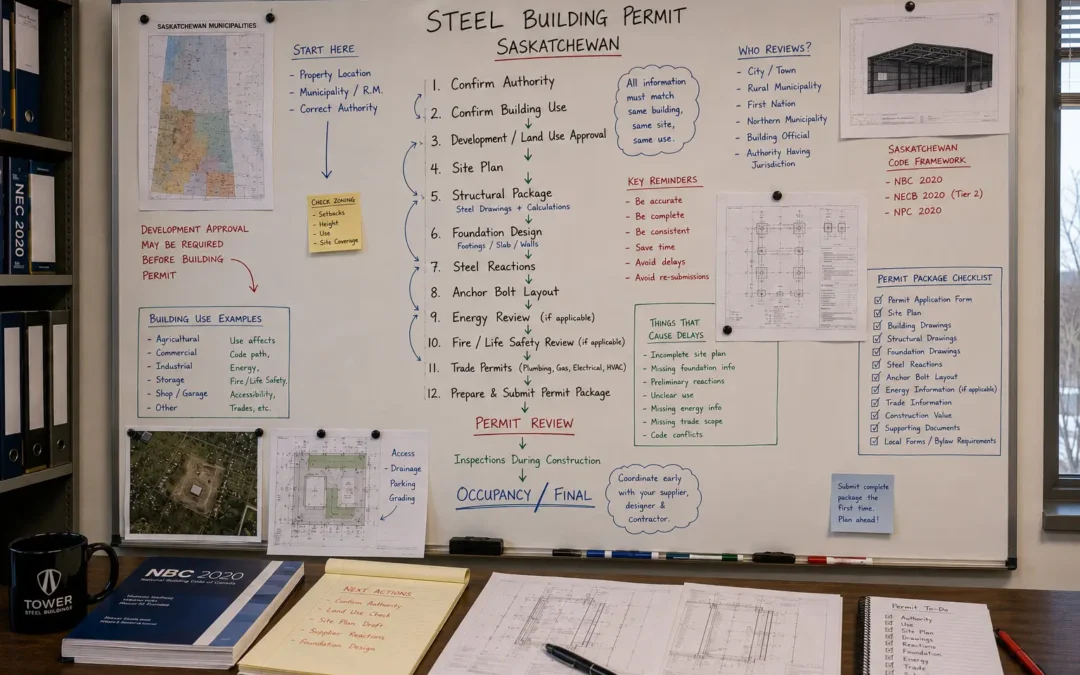
The documents required for a steel building permit in Saskatchewan are not just paperwork. They are proof that the project has been defined clearly enough for local review, construction, and inspection.
A serious steel building permit package should help the municipality, rural municipality, local authority, building official, owner, supplier, foundation designer, contractor, and inspector understand the project without guessing. The documents should show what is being built, where it is being built, how it will be used, how the steel frame is designed, how the foundation supports it, how anchor bolts are coordinated, how the site drains, whether energy or trade requirements apply, and what must be inspected.
The mistake many buyers make is assuming the package is only a permit form, a site sketch, and supplier drawings.
That may not be enough.
A cold storage building, heated farm shop, commercial workshop, truck garage, agricultural processing building, warehouse, riding arena, aircraft hangar, or industrial steel building can each trigger different document expectations. The exact requirements depend on the local authority, municipality, rural municipality, building bylaw, zoning path, site conditions, building use, construction scope, professional responsibility, and authority having jurisdiction.
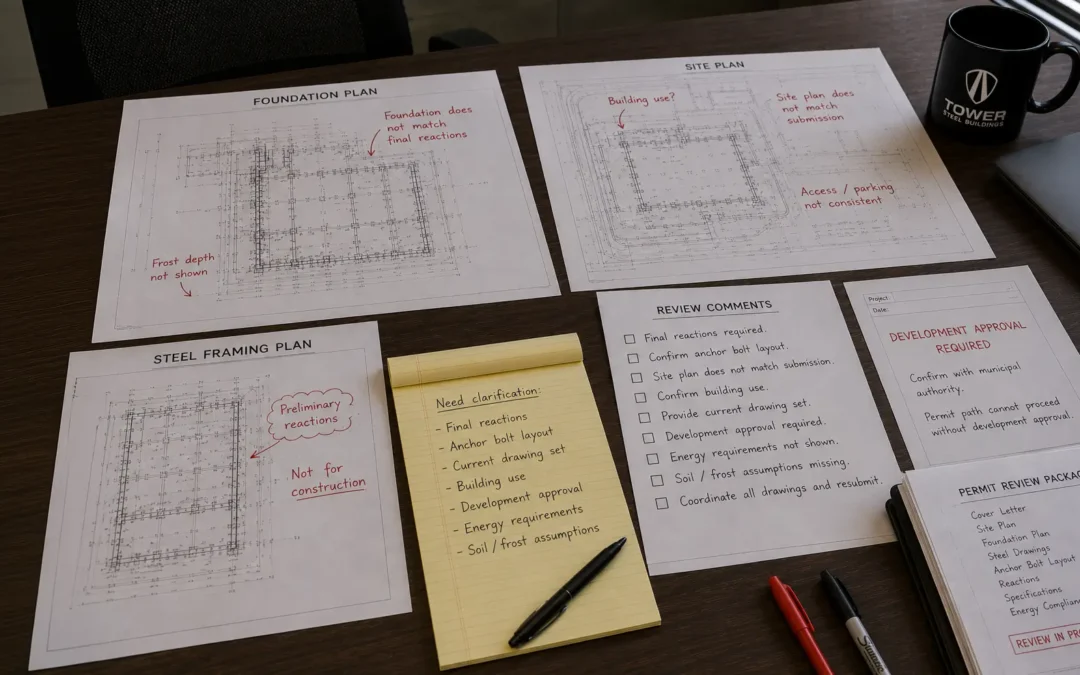
For steel buildings, the real issue is coordination. A permit package can include many documents and still be weak if the site plan, supplier drawings, foundation drawings, reactions, anchor bolt layout, building-use description, energy path, and trade scope do not align.
Quick Answer
Documents required for a steel building permit in Saskatchewan may include a building permit application, development approval or zoning confirmation where required, site plan, construction drawings, structural steel drawings, CSA A660 documentation and supplier steel package where applicable, foundation drawings, steel reactions, anchor bolt layout, building use and occupancy information, soil or geotechnical information where required, grading or drainage information where required, energy documents where applicable, trade permit information where applicable, fire/life safety or accessibility information where applicable, professional documents where required, construction value information, and inspection-related information requested by the local authority.
The exact document package depends on the municipality, rural municipality, local authority, building bylaw, project size, building use, site conditions, code path, and authority having jurisdiction.
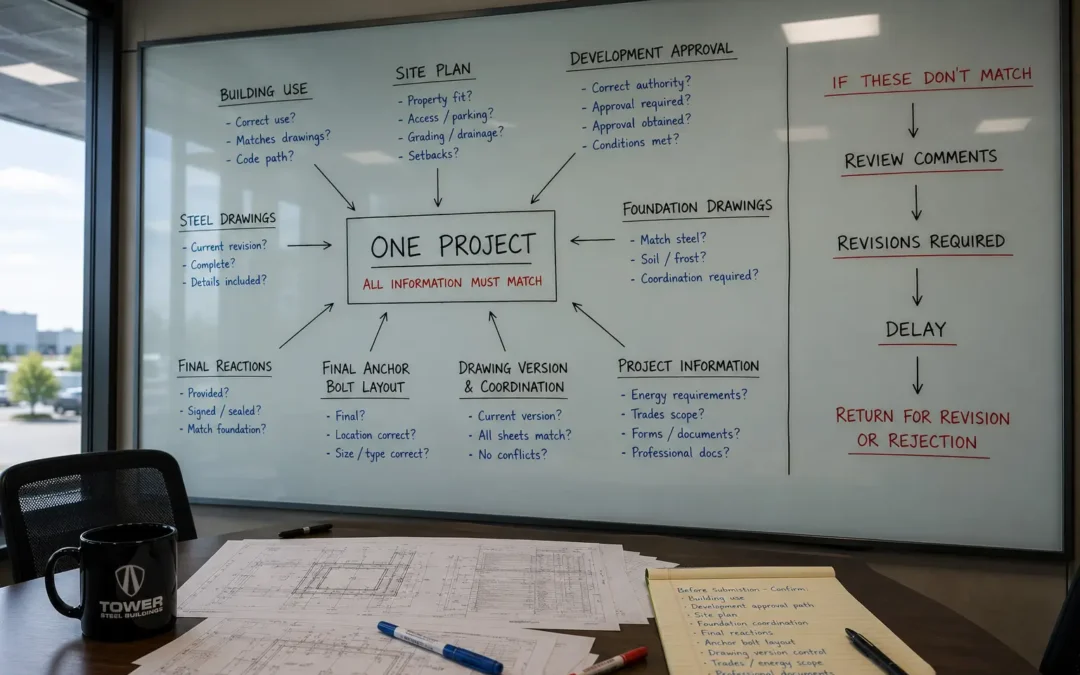
For steel buildings, the most important test is not whether the buyer has a long list of documents. The test is whether those documents describe the same building, on the same site, for the same use, with the same foundation, same reactions, same anchor bolt layout, and same construction path.
Saskatchewan Steel Building Permit Document Summary
The table below is a practical planning guide. It is not a universal legal checklist. Buyers should confirm the actual submission requirements with the municipality, rural municipality, local authority, building department, building official, or authority having jurisdiction.
The final document list should be confirmed with the authority having jurisdiction and the qualified professionals responsible for the specific project.
| Document Type | Usually Needed? | Why It Matters for Steel Buildings |
| Building permit application | Commonly required | Starts the formal review and identifies owner, property, use, scope, value, contacts, and project description. |
| Development approval or zoning confirmation | Project-dependent | Confirms whether the proposed use, location, setbacks, access, and site layout are acceptable. |
| Site plan | Commonly required | Shows the proposed building location, setbacks, access, drainage, existing structures, and site constraints. |
| Construction drawings | Commonly required | Explain the building layout, dimensions, openings, assemblies, use, and construction scope. |
| Structural steel drawings | Commonly required for permanent steel buildings | Show the steel frame, column grid, bracing, openings, base plates, reactions, and anchor information. |
| CSA A660 documentation and supplier steel package where applicable | Project-dependent but important for steel building systems | Supports the steel-building-system portion of the submission but does not replace the full permit package. |
| Foundation drawings | Commonly required for serious permanent steel buildings | Show how the building is supported and how loads transfer into the ground. |
| Steel reactions | Coordination-critical | Tell the foundation designer what forces the steel frame transfers into the foundation. |
| Anchor bolt layout | Coordination-critical | Connects the steel base plates to the foundation before concrete is placed. |
| Soil, frost, grading, or drainage information | Project-dependent | Helps confirm foundation assumptions, site drainage, frost exposure, bearing, and long-term performance. |
| Energy documents | Where applicable | May be needed for buildings subject to NECB review, especially conditioned commercial or industrial space. |
| Trade permit information | Where applicable | Identifies electrical, plumbing, HVAC, gas, fire protection, septic, ventilation, or servicing requirements. |
| Fire, accessibility, and life safety information | Where applicable | Helps confirm exits, travel distance, access, occupancy, public use, fire separations, and related code path. |
| Professional documents | Where required | May be needed for structural, foundation, geotechnical, energy, mechanical, electrical, fire, or field-review responsibility. |
| Construction value and fee information | Commonly requested | Helps the local authority calculate permit fees and understand project scope. |
| Inspection information | Project-dependent | Helps the owner and contractor understand what must be ready at each inspection stage. |
Buyer Warning
The biggest document mistake is treating supplier drawings as the full permit package.
Supplier drawings may be essential, but they usually do not answer every question a local authority, building official, foundation designer, or inspector may need answered.
A supplier drawing may show the steel frame, building dimensions, base plates, reactions, anchor bolt information, bracing, and erection details. The permit package may also need a site plan, development approval, zoning confirmation, foundation drawings, soil assumptions, drainage information, energy documents, trade scope, professional responsibility, and inspection information.
A steel building project can be delayed when one document is correct but the package is not coordinated.
Examples:
- The site plan shows one location, but the foundation drawings assume another.
- The steel reactions are preliminary, but the foundation is treated as final.
- The building is described as storage, but it will actually be heated repair space.
- Anchor bolts are placed from an old layout.
- Energy or trade requirements are discovered after submission.
- Development approval changes the building footprint after design work has started.
The permit problem is not always a missing document. Often, the real problem is that the documents do not describe one reviewable package.
Why Saskatchewan Document Requirements Vary by Local Authority
Saskatchewan has provincial construction-code legislation, but the permit package is usually reviewed through the local authority, municipality, rural municipality, building department, or building official process serving the property. That means buyers should not assume one universal steel building checklist applies everywhere in the province.
A steel building in Saskatoon, Regina, Prince Albert, Moose Jaw, Yorkton, Swift Current, North Battleford, a rural municipality, or a farm site may require different forms, drawings, development review, trade information, inspection steps, or professional documents depending on local bylaws, building use, site conditions, and project scope.
The local authority may ask for documents differently depending on whether the project is a cold storage building, heated farm shop, commercial warehouse, truck garage, riding arena, aircraft hangar, ag-processing structure, repair shop, or industrial building.
The safest first step is to confirm the exact authority having jurisdiction before treating supplier drawings, foundation drawings, pricing, or construction scheduling as final.
What the Permit Documents Must Prove
A strong Saskatchewan steel building permit package should help the reviewer confirm:
- The building is proposed in the correct location.
- The use is described honestly and matches the code path.
- The site plan matches the building drawings.
- The steel drawings match the foundation drawings.
- The foundation design is based on the correct reactions.
- The anchor bolt layout matches the latest base plates and column grid.
- The building envelope and mechanical assumptions match the energy path where applicable.
- The trade scope is not hidden.
- Professional responsibility is clear where required.
- The inspection sequence can be followed without guessing.
This is why a document checklist alone is not enough. The package must prove that the project is coordinated for review and construction.
1. Building Permit Application Form
The building permit application form is the administrative starting point. It identifies the owner, applicant, property, project description, construction value, building use, contact information, and sometimes designer or contractor information.
For a steel building, the project description must be accurate. Do not describe the building only as “storage” if it will include repair work, heat, washrooms, office space, commercial activity, public access, industrial use, vehicle service, racking, heavy equipment, or process equipment.
The application form should match the site plan, drawings, development path, construction value, and intended use.
If the form says one thing and the drawings show another, the review can slow down before the technical issues are even reached.
2. Development Permit, Zoning, or Land-Use Documents
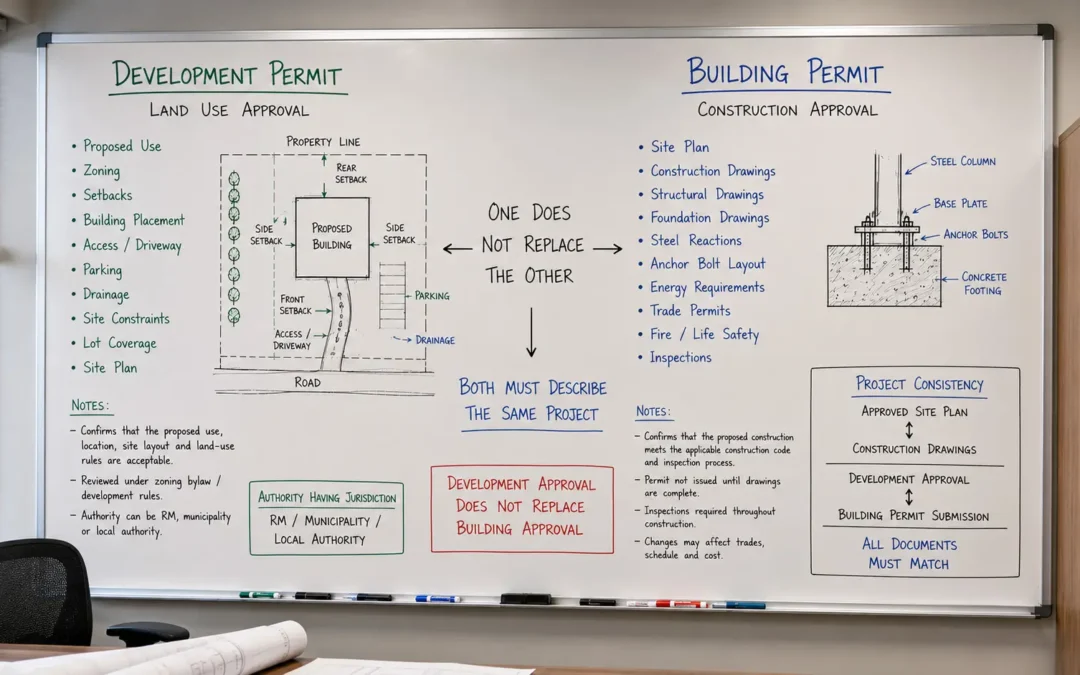
Development approval and building permit approval are not the same thing.
Development documents deal with whether the proposed steel building is acceptable on the land. This can involve zoning, permitted use, discretionary use, setbacks, lot coverage, building location, height, access, parking, loading, outdoor storage, drainage, and site constraints.
Depending on the municipality or rural municipality, the buyer may need development approval, zoning confirmation, site plan approval, land-use review, discretionary-use approval, variance information, or other planning documents before or alongside the building permit.
For steel buildings, the development path should be checked early because it can change the actual building. If the building must move on the property, the foundation layout may change. If the use is not allowed as proposed, the building design may need to change. If access, parking, or drainage conditions are added, the site plan and construction scope may need updates.
Development documents are not minor paperwork. They can control whether the building can happen where and how the buyer wants.
3. Site Plan
The site plan is one of the most important documents in a Saskatchewan steel building permit package.
A site plan may need to show:
- Property lines.
- Proposed building location.
- Existing buildings.
- Setbacks.
- Building dimensions.
- Driveways and access.
- Parking and loading areas.
- Easements.
- Wells, septic, utilities, or servicing where applicable.
- Drainage and grading direction.
- Slopes, watercourses, or site constraints where applicable.
- Outdoor storage or operation areas.
- Fire access where applicable.
- North arrow, scale, and key dimensions where required.
For steel buildings, the site plan must match the foundation drawings and building drawings. If the site plan shows one location and the foundation drawings show another layout, the package is not coordinated.
A weak site plan can trigger review comments, development delays, foundation redesign, drainage revisions, access changes, and inspection problems.
4. Building Use and Occupancy Information
The real building use should be clearly described.
A steel building used for cold storage may follow a different review path than a heated farm shop, commercial workshop, truck garage, warehouse, riding arena, aircraft hangar, industrial building, repair shop, agricultural processing building, or building with public access.
Building use can affect:
- Development approval.
- Zoning or land-use classification.
- Occupancy classification.
- Fire and life safety review.
- Exits and travel distance.
- Accessibility.
- Energy requirements.
- Heating and ventilation.
- Plumbing and washrooms.
- Electrical, gas, mechanical, or fire protection permits.
- Foundation and slab design.
- Inspection sequence.
A buyer may think a simple label makes the permit easier. It often does the opposite. Reviewers need the actual use to determine the correct document path.
5. Construction Drawings
Construction drawings help the reviewer understand the building that will be constructed.
Depending on the project, construction drawings may include floor plans, elevations, sections, building dimensions, wall and roof assemblies, door and window locations, occupancy information, fire/life safety information, accessibility information, energy information, foundation references, and other technical details.
For a steel building, the construction drawings should not conflict with the supplier drawings, site plan, foundation drawings, or building-use description.
If the construction drawings show one door layout and the steel drawings show another, the reviewer may need clarification. If the drawings show a cold shell but the application describes a heated commercial shop, the package may be incomplete.
6. Structural Steel Drawings
Structural steel drawings are a core part of the steel building permit package.
They may include:
- Building dimensions.
- Frame layout.
- Bay spacing.
- Column locations.
- Bracing locations.
- Member information.
- Base plate information.
- Framed openings.
- Door and opening coordination.
- Design criteria.
- Steel reactions.
- Anchor bolt information.
- Erection-related details.
These drawings help explain the steel building system, but they should not be confused with foundation drawings or full project coordination.
Structural steel drawings become most useful when they are coordinated with the site plan, foundation design, final reactions, anchor bolt layout, building use, and local authority requirements.
7. CSA A660 Documents and Supplier Documentation
CSA A660 certification documentation can support the steel-building-system portion of a submission, but it does not replace the full permit package.
For pre-engineered steel building systems, CSA A660 certification and manufacturer documentation may help show that the manufacturer has a certified quality system for steel building systems. That can be important for the steel package, but it does not replace local authority review, development approval, site plan, foundation design, soil assumptions, energy documents, trade permits, or project-specific professional responsibility where required.
For buyers, the key question is not only whether the steel package is certified. The key question is whether the certified steel package is coordinated with the actual site, building use, foundation drawings, final reactions, anchor bolt layout, and permit submission requirements.
This is where serious project coordination separates itself from buying a steel kit without confirming the site, foundation, and permit path.
8. Foundation Drawings
Foundation drawings show how the steel building loads are supported by the concrete and transferred into the ground.
For steel buildings, foundation drawings may need to show:
- Footing or pier locations.
- Slab information.
- Column grid.
- Dimensions.
- Reinforcement.
- Concrete specifications.
- Base plate coordination.
- Anchor bolt locations.
- Embedment and projection information where required.
- Frost protection approach.
- Soil assumptions.
- Drainage or grade notes.
- Construction details.
- References to steel reactions or design criteria.
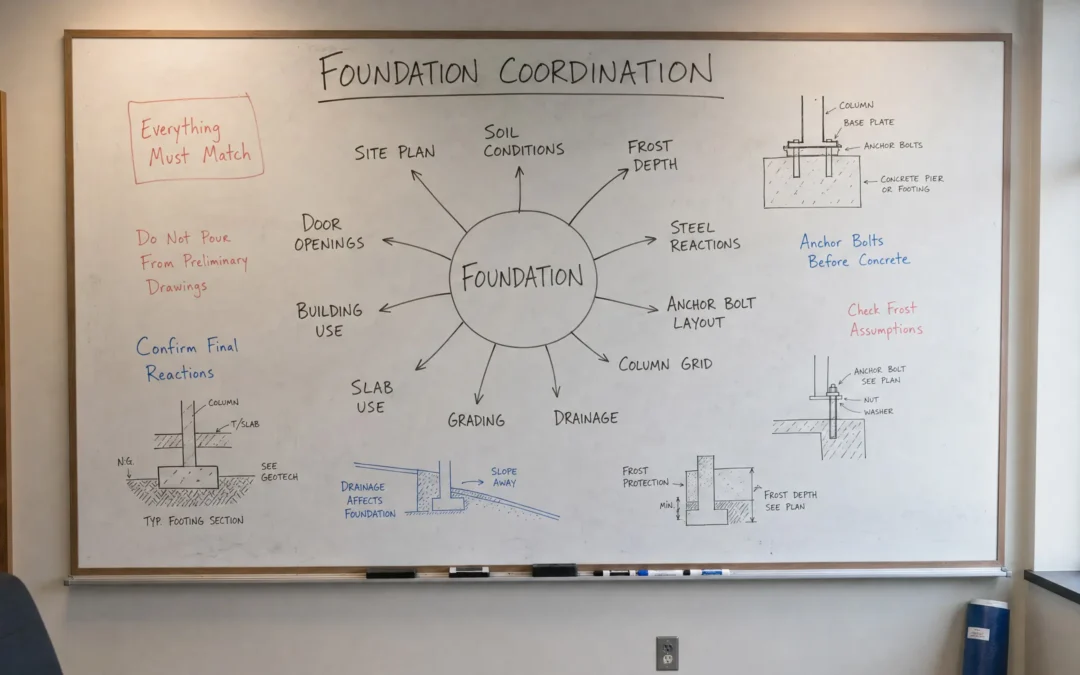
The foundation must match the actual steel building, not a rough building size. A 60×100 building size is not enough information by itself. The frame system, column grid, reactions, openings, use, soil, frost, slab loads, and anchor bolts matter.
Foundation drawings prepared from incomplete steel information can create redesign, permit comments, concrete rework, and erection problems.
9. Steel Reactions
Steel reactions are one of the most important coordination inputs for a steel building foundation.
Reactions tell the foundation designer what forces the steel frame transfers into the foundation. These can include vertical loads, lateral loads, uplift, shear, moments, snow-load effects, wind-load effects, large-door effects, mezzanine loads, equipment loads, or other project-specific forces.
Without final reactions, the foundation designer may be working from assumptions. If reactions change after foundation drawings are prepared, the foundation, anchor bolts, reinforcement, footing sizes, or slab details may need review.
For buyers, the practical rule is direct: do not treat foundation drawings as final until reactions are coordinated.
10. Anchor Bolt Layout
Anchor bolt layout is a small document with major consequences.
The anchor bolt layout should match:
- Column grid.
- Base plate dimensions.
- Bolt diameter.
- Bolt pattern.
- Projection.
- Embedment.
- Edge distance.
- Foundation layout.
- Latest steel drawings.
- Erection requirements.
If anchor bolts do not match the base plates, the steel frame may not fit during erection. Fixes may involve drilling, epoxy anchor review, concrete repair, base plate modification, engineering review, inspection delay, crane standby, idle crews, and responsibility disputes.
Anchor bolt information should be confirmed before concrete is poured, not after the steel arrives.
11. Geotechnical, Soil, Frost, and Drainage Information
Not every steel building automatically needs the same level of geotechnical reporting, but every foundation depends on soil.
The permit package may need soil assumptions, geotechnical information, subgrade information, drainage details, grading information, groundwater information, or frost-related design information depending on the project and authority requirements.
Soil and site conditions matter because they affect:
- Bearing capacity.
- Settlement risk.
- Frost movement.
- Footing design.
- Slab design.
- Drainage.
- Groundwater.
- Fill or disturbed soil.
- Heavy equipment loads.
- Long-term foundation performance.
For Saskatchewan projects, frost depth and steel building foundation conditions should be treated as early design questions, not construction surprises, especially when drainage, soil assumptions, slab use, and bearing conditions can affect the final permit package.
12. Energy Documents Where Applicable
Saskatchewan has adopted the 2020 National Energy Code for Buildings.
Buildings subject to the NECB may need energy-related design information, envelope coordination, insulation details, mechanical coordination, or supporting documentation.
A cold unconditioned storage building and a heated commercial or industrial steel building may not require the same energy documents.
Energy documents may become relevant when the steel building includes:
- Heating.
- Conditioned space.
- Offices.
- Shops.
- Warehouses.
- Commercial use.
- Industrial use.
- Mechanical systems.
- Insulated wall and roof assemblies.
- Large overhead doors or envelope transitions.
Energy code compliance for commercial steel buildings should be checked before the roof system, wall system, insulation package, doors, mechanical design, and permit submission are treated as final.
13. Trade Permit Information Where Applicable
Trade permits can affect the main permit package when the steel building includes systems beyond the basic shell.
Depending on the project, separate trade permits or supporting documents may be needed for:
- Electrical work.
- Plumbing.
- HVAC.
- Gas.
- Fire protection.
- Septic.
- Servicing.
- Mechanical ventilation.
- Washrooms.
- Process equipment.
- Fire alarm or sprinkler systems where applicable.
A heated truck garage, repair shop, warehouse with washrooms, commercial workshop, industrial building, or ag-processing facility may need more trade coordination than a basic cold storage structure.
Ignoring trade scope can delay review, inspections, and readiness for use.
14. Fire, Accessibility, and Life Safety Information Where Applicable
Some steel buildings may need fire/life safety or accessibility information depending on building use, occupancy, size, and public or employee access.
Documents may need to address:
- Exits.
- Travel distance.
- Fire separations.
- Fire department access.
- Occupancy.
- Accessibility.
- Washrooms.
- Alarms.
- Sprinklers where applicable.
- Hazardous materials or processes where applicable.
- Vehicle repair or storage risks.
- Public access or assembly use.
The key issue is building use. A private farm storage building may not follow the same path as a commercial workshop, public-access warehouse, repair garage, riding arena, or industrial facility.
15. Professional Documents Where Required
Some projects may require professional documents depending on building size, use, complexity, occupancy, structural design, foundation design, authority requirements, or project risk.
Professional documents may relate to:
- Structural steel design.
- Foundation design.
- Geotechnical information.
- Energy compliance.
- Fire/life safety.
- Mechanical design.
- Electrical design.
- Plumbing design.
- Accessibility.
- Field review or inspection coordination where required.
Buyers should not assume that one stamp covers every part of the project. A steel building package may have engineered steel drawings, while the foundation may require separate project-specific design responsibility.
The right question is not simply, “Is there a stamp?” A proper engineering review checklist before finalizing a steel building design should confirm, “Who is responsible for each part of the submitted and constructed project?”
16. Construction Value and Fee Information
Many permit applications require construction value or project value information for fee calculation.
For steel buildings, construction value may include more than the steel package. Depending on the authority, it may involve foundation work, labour, site work, mechanical or electrical components, and other parts of the construction scope.
Buyers should confirm how the local authority calculates permit fees or construction value. Understating or misunderstanding the project scope can create delays or corrections.
17. Inspection Information
Permit documents should support inspection readiness.
Depending on the project, inspections may relate to:
- Site location.
- Excavation.
- Footings.
- Foundation reinforcement.
- Anchor bolts.
- Slab preparation.
- Framing or structure.
- Fire/life safety.
- Plumbing.
- Gas
- Electrical.
- Mechanical.
- Insulation or energy-related items.
- Final occupancy or use.
Steel building inspections become harder when the site team is working from outdated drawings. The approved drawings, foundation drawings, anchor bolt layout, and steel package should match before inspection stages are reached.
Drawing Version Control
Steel building projects can fail at review or inspection when the owner, supplier, foundation designer, contractor, and site crew are working from different drawing versions.
Before submission, confirm that the site plan, structural steel drawings, foundation drawings, anchor bolt layout, supplier drawings, and supporting documents are the current versions. Before construction, confirm again that the approved permit drawings match the drawings being used for excavation, concrete, anchor bolts, fabrication, delivery, and erection.
Outdated drawings can create wrong anchor bolts, incorrect foundation assumptions, mismatched openings, inspection confusion, concrete rework, crane standby, idle crews, and field disputes.
Version control is not paperwork housekeeping. It is part of managing construction risk in steel building projects before excavation, concrete, anchor bolts, fabrication, delivery, and erection move ahead.
It is a construction-risk control step.
Saskatchewan Farm Buildings: Do Not Assume the Requirements Are Simple
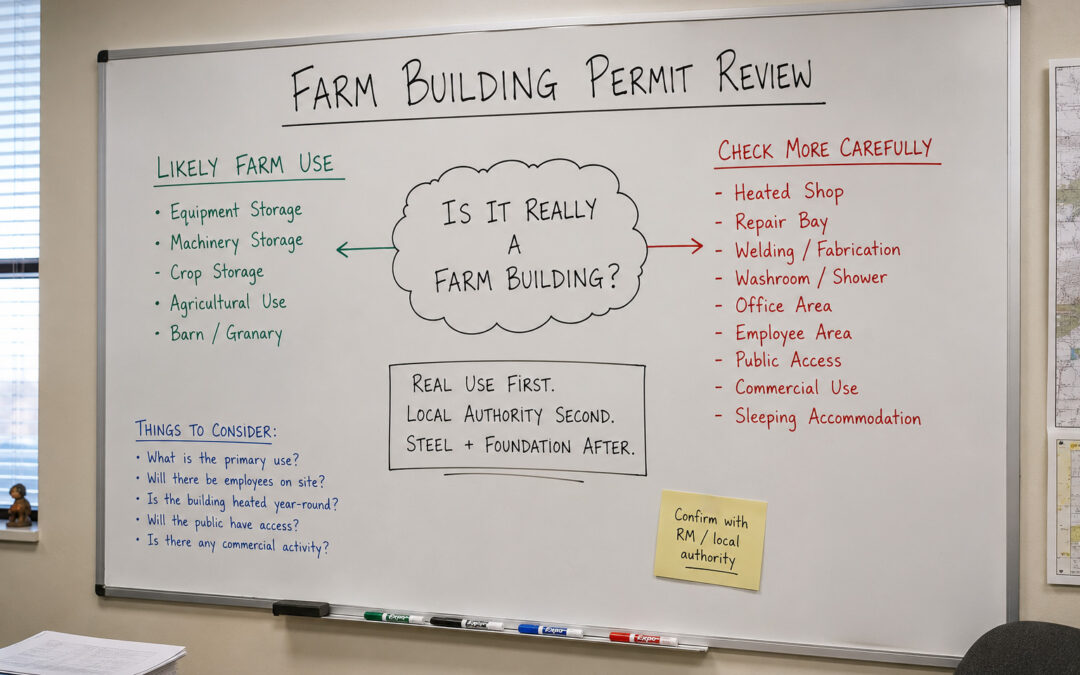
Farm and rural steel buildings need careful handling in Saskatchewan because permit and document requirements can depend on the building’s actual use, not only its rural location.
However, that does not mean every rural steel building has a simple or permit-free path. Local authorities may still have building-bylaw requirements, development processes, zoning rules, inspection expectations, or submission requirements. Buildings with sleeping accommodation are treated differently and should never be assumed to follow a simple farm-building path.
A basic farm storage building may be treated differently from a heated repair shop, commercial farm-service building, ag-processing space, building with employee or customer access, public-facing facility, equipment wash bay, office area, washroom, or any building with sleeping or living accommodation.
The buyer should confirm:
- Whether the building qualifies as a farm building for the specific local process.
- Whether the building includes non-farming, commercial, public, residential, or mixed use.
- Whether local building bylaws still require submission or review.
- Whether development approval is required.
- Whether trade permits are needed for plumbing, gas, electrical, HVAC, septic, or fire protection.
- Whether foundation, site plan, drainage, or inspection information is required.
The safe approach is not to claim an exemption early. The safe approach is to describe the real use and confirm the submission requirements with the local authority before ordering steel or scheduling concrete.
How Document Needs Change by Steel Building Type
Different steel building types create different document questions. The table below is not a permit checklist. It is a planning tool to help buyers understand why one steel building may need more supporting information than another.
| Steel Building Type | Extra Document Issues to Confirm |
| Cold storage building | Site plan, foundation, drainage, snow/wind criteria, unconditioned status, and access. |
| Heated farm shop | Development path, foundation, reactions, anchor bolts, energy path, ventilation, electrical, gas, and plumbing where applicable. |
| Truck garage | Large doors, slab loading, ventilation, drainage, wash bay, fire/life safety, trade permits, and site access. |
| Warehouse | Occupancy, racking, exits, loading, fire access, energy requirements, slab design, and truck circulation. |
| Commercial workshop | Use, parking, employee/public access, washrooms, accessibility, HVAC, electrical, fire/life safety, and professional documents. |
| Agricultural processing building | Use classification, sanitation or process areas where applicable, plumbing, drainage, ventilation, energy path, and trade scope. |
| Riding arena | Large-span framing, public access where applicable, footing/foundation design, ventilation, lighting, exits, and occupancy considerations. |
| Aircraft hangar | Large door openings, clear span, fire/life safety, site access, apron/access coordination, and foundation reactions. |
| Industrial steel building | Equipment loads, cranes, ventilation, hazardous areas where applicable, fire protection, power, foundation, and professional coordination. |
This is why a generic document list is not enough. The document package should match the actual use.
Supplier Drawings vs Permit Documents
Supplier drawings and permit documents are related, but they are not the same thing.
Supplier drawings usually explain the steel building system. Permit documents explain the whole project for review and construction.
A steel supplier package may include frame layout, members, bracing, base plates, reactions, anchor bolts, and erection information. The permit package may also need site plan, development approval, foundation drawings, soil assumptions, drainage information, building use details, energy documents, trade scope, professional documents, and inspection information.
The supplier drawings are an input. The permit package is the coordinated submission.
If the supplier drawings are treated as the whole permit package, important site, foundation, energy, trade, and development issues may be missed.
Documents That Are Usually Not Enough by Themselves
Some documents are useful, but they should not be treated as the complete permit package by themselves.
A supplier quote is not a permit package.
A supplier drawing set is not always a full permit package.
A rough site sketch may not be a reviewable site plan.
A generic slab detail may not be a foundation design.
A preliminary anchor bolt template should not be used for concrete unless final coordination is confirmed.
A development approval does not automatically approve construction.
A building permit submission does not mean construction is approved.
A stamped steel drawing does not automatically cover the foundation, site plan, energy scope, or trade permits.
The strongest package is not built from one impressive document. It is built from coordinated documents that support one project.
Document Coordination Checklist
Before submitting a steel building permit package in Saskatchewan, confirm:
- The application form matches the project.
- The correct local authority has been confirmed.
- Development approval or zoning review has been checked.
- The site plan shows the actual proposed building location.
- The building use is described accurately.
- Construction drawings match the steel package.
- Structural steel drawings are current.
- CSA A660 documentation and supplier steel package are included where relevant and requested.
- Foundation drawings match final reactions.
- Anchor bolt layout matches the latest base plates.
- Soil assumptions are documented.
- Frost and drainage are addressed.
- Slab use is known.
- Energy requirements have been checked where applicable.
- Trade permits have been identified where applicable.
- Fire/life safety and accessibility have been considered where applicable.
- Professional responsibility is clear where required.
- Inspection expectations are understood.
- The package is coordinated enough for review.
If any of these items are unclear, the application may not be ready for efficient review.
Red Flags in a Steel Building Permit Package
A Saskatchewan steel building permit package should be reviewed carefully if:
- The site plan is only a rough sketch with no setbacks or access information.
- The building use is described vaguely as storage even though the building will be heated, serviced, commercial, occupied, or used for repair.
- Foundation drawings were prepared before final steel reactions were issued.
- Anchor bolt information is based on a preliminary layout.
- Supplier drawings show a different door layout than the construction drawings.
- Energy requirements have not been checked for a conditioned commercial or industrial building.
- Trade work is planned but not identified in the permit scope.
- The approved drawings and construction drawings are not the same version.
- Concrete is being scheduled before approval is clear.
- The site plan, foundation drawings, and steel drawings do not agree.
- No one has confirmed who is responsible for foundation design.
- The buyer is assuming rural or farm use automatically makes the project simple.
These are the kinds of issues that turn a document package into a delay, redesign, or field correction problem.
Common Document Mistakes That Delay Steel Building Permits
- Submitting supplier drawings as if they are the full permit package.
- Using a weak site plan.
- Describing the building use too vaguely.
- Missing development approval or zoning confirmation.
- Preparing foundation drawings before final reactions.
- Using an outdated anchor bolt layout.
- Not checking soil, frost, or drainage.
- Treating a heated shop like cold storage.
- Missing NECB or energy information where applicable.
- Ignoring plumbing, gas, HVAC, electrical, septic, or fire protection scope.
- Assuming rural land means no permit concern.
- Missing professional documents where required.
- Submitting drawings that do not match each other.
- Starting concrete before the approved drawing path is clear.
- Answering review comments one document at a time instead of updating the whole package.
The fastest way to lose time is to submit documents before the project is coordinated.
Final Pre-Submission Test
Before submitting the package, ask these questions:
- Can the reviewer identify the correct property, owner, building location, and proposed use?
- Does the site plan show the proposed building clearly enough for setback, access, drainage, and servicing review?
- Do the construction drawings match the steel supplier drawings?
- Do the foundation drawings match the final steel reactions?
- Does the anchor bolt layout match the latest base plate and column-grid information?
- Have soil, frost, grading, and drainage assumptions been addressed where needed?
- Has the energy path been checked for heated, conditioned, commercial, or industrial space?
- Have trade permits and trade scopes been identified where applicable?
- Is professional responsibility clear for structural, foundation, geotechnical, energy, mechanical, electrical, or fire/life safety work where required?
- Is the construction team using the same drawing version that is being submitted for review?
If the answer is no to any of these, the file may still be submitted, but it is not yet a strong permit package.
Real Scenario: The Documents Were There, but They Did Not Match
A Saskatchewan buyer plans a 60×100 steel building for farm equipment storage. The buyer has a supplier quote, preliminary steel drawings, a rough site sketch, and a contractor ready to pour concrete.
During planning, the real use changes. The building will include a heated repair bay, larger overhead doors, electrical work, ventilation, a washroom, and heavy equipment movement. The site plan does not show drainage clearly. The foundation drawings were started before final steel reactions were available. Anchor bolt details were taken from an early layout.
The reviewer asks for clarification. Now the buyer needs updated use information, development path confirmation, a stronger site plan, final steel reactions, revised foundation drawings, anchor bolt coordination, energy review, trade permit planning, and inspection sequencing.
The problem was not that no documents existed. The problem was that the documents did not describe a single coordinated project.
That is the risk this blog is meant to prevent.
Do Not Make These Decisions From Incomplete Documents
Do not order steel only because the quote looks complete.
Do not release fabrication from preliminary drawings if review could change openings, base plates, reactions, or layout.
Do not pour concrete from a foundation drawing that was prepared before final reactions.
Do not set anchor bolts from an old template.
Do not assume development approval means construction approval.
Do not book trades before the real use and permit path are clear.
Do not build from drawings that are different from the approved permit set.
These decisions become expensive because they happen before the project has been fully coordinated.
Plan the Documents Before the Steel Is Ordered
The best time to organize permit documents is before the steel package is treated as final, before concrete is scheduled, and before construction sequencing becomes difficult to change.
Tower Steel Buildings helps Saskatchewan buyers organize the steel-building inputs that support better permit planning, including building scope, layout, steel reactions, base plate information, anchor bolt coordination, foundation-related information, and quote-to-permit planning.
This does not replace the municipality, local authority, building official, foundation designer, engineer, trade contractor, or other professionals responsible for the actual project. It does help buyers understand what information should be aligned before submission.
Request project-specific steel building quotes and permit-readiness guidance before finalizing your building size, foundation, or construction schedule.
Saskatchewan Accuracy Note
The practical permit process still depends on the local authority, municipality, rural municipality, building bylaw, building official process, project use, site conditions, and scope of work.
Because local bylaws and submission processes can vary, buyers should confirm current forms, fees, drawing requirements, inspections, and trade-permit expectations directly with the municipality, rural municipality, or authority having jurisdiction before submission.
Farm-building requirements must also be handled carefully. Saskatchewan material indicates that farm-building exemptions can apply when the principal use is farming and specific criteria are satisfied, but buyers should not assume that every rural, commercial, serviced, public, mixed-use, or sleeping-accommodation building follows the same path.
Buyers should confirm the actual submission requirements with the authority having jurisdiction before treating the document package as final.
Final Perspective
The documents required for a steel building permit in Saskatchewan are not just paperwork. They are proof that the project has been defined.
A strong permit package gives the reviewer one coordinated project: the proposed building, site, use, structure, foundation, anchor bolt layout, energy assumptions, trade scope, and construction sequence all align.
A weak package may include many documents, but if those documents disagree, the project is not ready for clean review.
For serious steel building buyers, the goal is not to submit more documents than necessary. The goal is to submit the right documents, coordinated around the actual building and actual site, before the project becomes expensive to change.
Reviewed by Engineering Team
This content has been reviewed by the Tower Steel Buildings Engineering Team.
The review focused on practical steel building permit document readiness in Saskatchewan, including local authority review, municipality and rural municipality requirements, building official expectations, development approval, zoning confirmation, site plan coordination, construction drawings, structural steel drawings, CSA A660 documentation, supplier steel package information, foundation drawings, steel reactions, anchor bolt layout, soil assumptions, frost exposure, drainage and grading, energy documents, trade permits, fire and life safety information, accessibility, professional responsibility, construction value information, inspection readiness, and drawing version control.
The purpose of this review is to help serious steel building buyers understand that permit documents are not useful simply because they exist. A permit package is useful when the documents describe one clear, site-specific, code-aware, coordinated, and buildable project.
For Saskatchewan steel building projects, document problems often begin when supplier drawings are treated as the full permit package, the site plan is weak, the building use is described too vaguely, foundation drawings are prepared before final reactions, anchor bolt layouts are based on preliminary information, energy or trade requirements are discovered late, or rural and farm-building assumptions are made without confirming the local process.
This review focused on one practical question: do the documents describe the same building, on the same site, for the same use, with the same foundation, same reactions, same anchor bolt layout, and same construction path?
A Saskatchewan steel building permit package is ready when the local authority, building official, owner, supplier, foundation designer, contractor, and inspector can all understand the same project without guessing from mismatched drawings or incomplete assumptions.
This content is intended to support buyer education and permit-readiness planning. Final permit requirements, development approval requirements, farm-building treatment, submission expectations, inspections, approvals, professional responsibilities, and construction-code interpretations remain under the authority of the applicable municipality, rural municipality, local authority, building official, inspector, engineer, foundation designer, trade contractor, or other qualified professional involved in the project.
1. What documents are required for a steel building permit in Saskatchewan?
A steel building permit package in Saskatchewan may include a permit application, development approval where required, site plan, construction drawings, structural steel drawings, CSA A660 documentation and supplier steel package where applicable, foundation drawings, steel reactions, anchor bolt layout, building use information, geotechnical or soil information where required, drainage or grading information, energy documents where applicable, trade permit information, professional documents where required, and construction value information.
The exact requirements depend on the municipality, rural municipality, local authority, building use, site conditions, project size, and authority having jurisdiction.
2. Are supplier drawings enough for a Saskatchewan steel building permit?
Supplier drawings are important, but they are not usually enough by themselves for a serious permanent steel building permit. They may show the steel system, frame layout, base plates, reactions, anchor bolts, bracing, and erection details.
A complete permit package may also need a site plan, development approval, foundation drawings, building use information, energy documents where applicable, trade scope, professional documents, drainage information, and other local requirements.
3. Do CSA A660 documents replace a steel building permit package?
No. CSA A660 documents do not replace a steel building permit package. They may support the steel building system portion of the submission, but they do not replace local authority review, development approval, site plan, foundation design, soil assumptions, energy documentation, trade permits, or project-specific professional responsibility where required.
The steel package still needs to be coordinated with the actual site, building use, foundation drawings, final reactions, anchor bolt layout, and local permit requirements.
4. Do I need a site plan for a steel building permit?
Most steel building permit applications should include a site plan or site information showing where the building will sit on the property. The site plan may need to show property lines, setbacks, existing structures, proposed building location, access, parking, loading, services, drainage, grading, and site constraints.
For steel buildings, the site plan should match the foundation drawings and structural drawings. If the documents show different assumptions, the package may be delayed.
5. Do I need development approval before submitting building permit documents?
Development approval or zoning review may be required before or alongside the building permit, depending on the local authority and project. Development review usually deals with use, location, setbacks, access, lot layout, parking, drainage, and land-use rules.
For steel buildings, development approval should be checked early because it can change the building location, footprint, access, drainage, foundation layout, or building use.
6. Why are foundation drawings required for steel buildings?
Foundation drawings are important because the foundation must support the specific steel building on the specific site. They should coordinate with final steel reactions, column grid, base plates, anchor bolts, soil assumptions, frost conditions, drainage, slab use, and building use.
A generic slab sketch may not be enough for a permanent steel building because steel frames transfer concentrated loads into foundations and anchors.
7. Why do steel reactions need to be included or coordinated?
Steel reactions tell the foundation designer what loads the steel frame transfers into the foundation. These can include vertical loads, lateral loads, uplift, shear, moments, snow-load effects, wind-load effects, and other project-specific forces.
If reactions are missing, preliminary, or changed late, the foundation drawings may need revision. That can delay permit review, concrete work, anchor bolt coordination, and inspections.
8. Is an anchor bolt layout required for a steel building permit?
An anchor bolt layout may be required or strongly needed for coordination because anchor bolts must match the final column grid, base plates, and steel drawings. Even when not listed as a separate permit item, anchor bolt information is critical before concrete work begins.
If anchor bolts do not match the steel building, erection can stop, and the project may need engineering review, concrete repair, drilling, epoxy anchor review, or other corrective work.
9. Do Saskatchewan steel buildings need energy documents?
Some steel buildings may need energy documents, especially heated, conditioned, commercial, industrial, warehouse, office, or shop buildings subject to the National Energy Code for Buildings.
A cold unconditioned storage building and a heated commercial steel building may not follow the same energy-document path. Energy requirements should be confirmed before finalizing the envelope, insulation, overhead doors, mechanical design, and permit submission.
10. Do I need trade permit documents with the building permit?
Trade permit documents may be separate from the main building permit, but trade scope should still be identified early. Electrical, plumbing, HVAC, gas, fire protection, septic, servicing, washrooms, ventilation, or process equipment can affect review, inspections, and construction sequencing.
A building priced as an empty shell may follow a different path once the real use includes heat, washrooms, ventilation, commercial activity, or repair work.
11. Do rural or farm steel buildings need the same permit documents?
Not always. Rural or farm steel buildings may follow a different path depending on the local authority, principal building use, agricultural use, size, servicing, and whether the building includes residential, commercial, public-access, heated, serviced, or mixed-use areas.
The safe approach is to confirm with the municipality or rural municipality. Do not assume a farm location automatically removes permit, development, inspection, energy, or trade requirements.
12. Do I need professional stamped drawings for a steel building permit?
Professional documents may be required depending on building size, use, complexity, structural design, foundation design, local authority requirements, and project risk. Buyers should confirm this with the authority having jurisdiction and the professionals responsible for the project.
Do not assume one stamp covers every part of the project. Structural steel drawings and foundation drawings may involve different scopes and different professional responsibility.
13. What is the biggest document mistake in a steel building permit application?
The biggest mistake is submitting documents that do not match. A permit package can be delayed if the site plan, building use, supplier drawings, foundation drawings, reactions, anchor bolt layout, energy information, and trade scope describe different versions of the project.
A strong steel building permit package should be coordinated around the actual site, actual use, actual steel package, actual foundation design, and actual construction sequence.
14. What should I confirm before submitting steel building permit documents?
Before submitting, confirm the local authority, development approval path, real building use, site plan, structural steel drawings, supplier documentation, foundation drawings, final reactions, anchor bolt layout, soil assumptions, frost and drainage approach, energy requirements where applicable, trade scope, professional responsibility where required, construction value, and inspection expectations.
If these items are not aligned, the package may be submitted, but it may not be ready for efficient review.
15. Can I pour concrete after submitting documents but before approval?
Pouring concrete after submitting documents but before approval is risky. Submission is not the same as approval. If the reviewer requires changes to the site plan, foundation drawings, reactions, anchor bolt layout, building location, drainage, or trade scope, the concrete work may not match the final approved project.
Concrete is expensive to correct after placement. Buyers should confirm approval status, current drawings, foundation responsibility, and anchor bolt layout before proceeding.
16. How can Tower Steel Buildings help organize permit documents?
Tower Steel Buildings can help buyers organize steel-building inputs that support permit planning, including building scope, layout, steel reactions, base plate information, anchor bolt coordination, foundation-related information, and quote-to-permit readiness.
This support does not replace the municipality, local authority, building official, engineer, foundation designer, or trade professionals, but it can reduce avoidable confusion before submission, fabrication, concrete work, and construction scheduling.