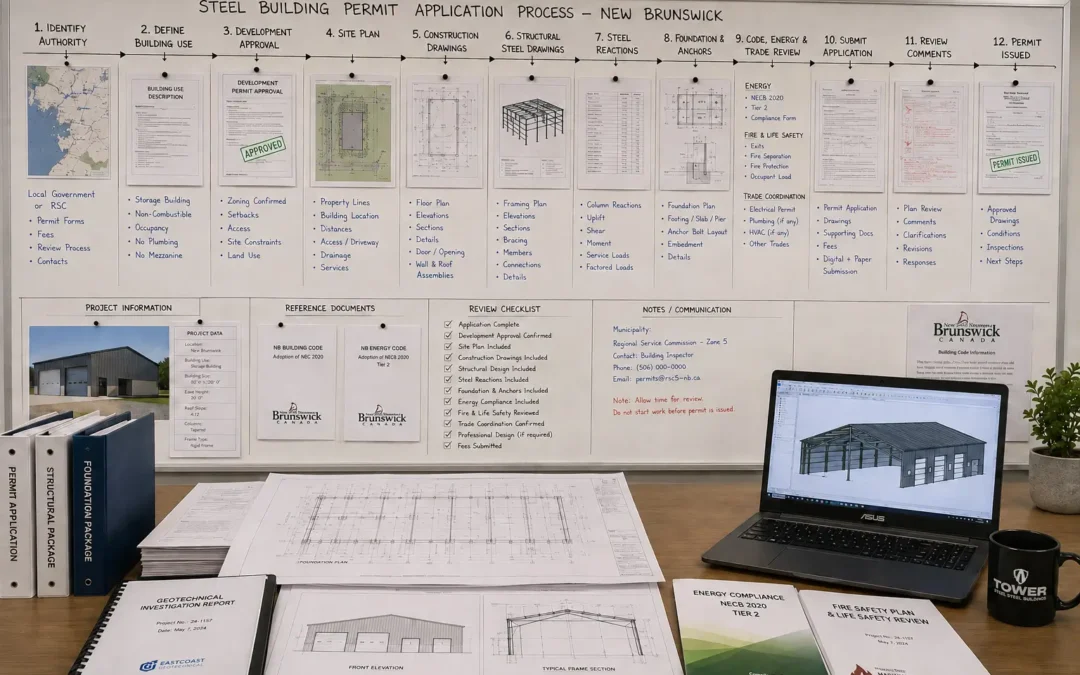
The real cost of a steel building permit in New Brunswick is not only the permit fee
Steel building permit cost in New Brunswick is not one fixed number. It changes based on the local government or Regional Service Commission, development approval path, construction value, building use, site conditions, engineering scope, foundation design, soil assumptions, energy-code requirements, trade scope, revision cycles, inspections, and whether the project is properly coordinated before submission.
A buyer may ask: How much does a steel building permit cost in New Brunswick?
The better question is: What must be paid for before the local authority has enough information to approve the project and inspect the work?
That difference matters because the municipal or RSC permit fee may be only one part of the permit-related budget. A serious steel building can also require site planning, engineering drawings, foundation coordination, steel reactions, anchor bolt coordination, energy modelling where applicable, trade coordination, revisions, and resubmission work.
New Brunswick’s building-code information confirms that the National Building Code of Canada 2020 and the National Energy Code for Buildings 2020 set technical provisions for new buildings, alterations, changes of use, and demolition. It also states that both documents are adopted at energy efficiency tier two.
For a serious buyer, the practical lesson is direct: the lowest visible permit fee is not always the lowest project risk. Missing drawings, unclear use, foundation assumptions, late NECB requirements, or early construction decisions can create more expensive corrections later.
Quick Answer
A steel building permit in New Brunswick can cost far more than the building permit fee alone. The total permit-related budget can include local building permit fees, development permit fees, construction-value-based charges, engineering drawings, foundation drawings, steel reactions, anchor bolt coordination, site plans, geotechnical information where required, drainage or grading work, NECB energy documentation where required, trade permits, inspections, revisions, and professional coordination.
For the full approval path, see our main guide to steel building permits in New Brunswick.
Steel Building Permit Cost in New Brunswick: Simple Definition
Steel building permit cost in New Brunswick means the full cost exposure connected to getting a steel building reviewed, approved, revised where necessary, and ready for inspection. It includes the local or regional permit fee, but it can also include development review, professional drawings, foundation coordination, site information, energy documents, trade permits, inspection requirements, and corrections caused by incomplete or inconsistent submissions.
The building permit fee is the visible fee. The real cost is the cost of making the project reviewable.
Buyer Warning
Do not budget a steel building permit by looking only at the permit fee table. That number may not include development review, engineering, foundation drawings, geotechnical information, energy modelling, trade permits, grading, drainage, revisions, re-inspections, or the cost of correcting work that moved ahead too early.
The most expensive permit cost is not the first fee. It is the correction that happens after steel has been ordered, concrete has been poured, anchor bolts have been set, or crews have been scheduled.
Planning Cost Snapshot: What Can Affect Permit-Related Budget
The items below are not official New Brunswick permit prices. Official permit fees must be confirmed with the local government, Regional Service Commission, building department, development officer, current fee schedule, and authority having jurisdiction.
| Cost Area | What It Usually Depends On | Why It Can Affect Budget |
| Local building permit fee | Local or RSC fee schedule, construction value, minimum fees, administrative fees | Many official fee examples calculate permit fees from construction value. |
| Development permit / planning review | Land use, zoning, rural plan, setbacks, access, variance, rezoning, site constraints | Development issues can change the building location, size, use, or site layout. |
| Permit drawings and coordination | Building use, project size, construction drawings, structural drawings, professional involvement | A more complex building usually needs more coordinated information before review. |
| Foundation and steel coordination | Steel reactions, column grid, base plates, anchor bolts, soil assumptions, frost, slab use | Foundation drawings must match the actual steel building system and site conditions. |
| Geotechnical / site information | Soil conditions, wet sites, filled sites, slopes, drainage, heavy loads, unknown bearing conditions | Not every project needs a geotechnical report, but soil assumptions always affect foundation risk. |
| Energy / NECB / envelope | Heated, conditioned, commercial, industrial, or NECB-subject buildings | NECB-subject buildings can require energy modelling and supporting documents. |
| Trade permits and inspections | Electrical, plumbing, HVAC, gas, fire protection, septic, servicing, washrooms, ventilation | Trade scope can affect permit path, inspections, and sequencing. |
| Revisions and resubmissions | Incomplete drawings, unclear use, missing reactions, weak site plan, late comments | Corrections cost more when the project was submitted before coordination was complete. |
Real New Brunswick Fee Examples: Why There Is No Single Permit Cost
New Brunswick permit costs vary because municipalities and Regional Service Commissions do not all use the same fee structure. The following examples are provided for planning education and must be confirmed against the current local fee schedule before budgeting.
Moncton’s building and development permit page lists a 2026 building permit fee of $8 per $1,000 of construction value, with a minimum fee of $25. It also lists development permit fee categories, including “other development” categories based on construction value.
Fredericton’s building permit page lists the building permit cost as $8 per $1,000 worth of construction value, rounded up, and also lists separate costs for items such as curb cuts, curb replacement, and sidewalk reinstatement where applicable.
Capital Region Service Commission fees list building permits at $5 per thousand plus $25, development permits at $50, and separate fees for items such as temporary permits and special commission meetings.
Plan360 permit fee examples show that fees can vary by municipality and project category. Some examples list building permit rates such as $5 per $1,000, $7.50 per $1,000 for “all other” construction, development/demolition permit fees, renewal fees, waivers, and double fees if construction starts before the permit is issued.
Southwest New Brunswick Service Commission permit information lists a building permit fee of $25 plus $5 per $1,000 of estimated cost, a development permit fee in an area with a fees by-law, and other planning-related fees.
These examples prove the main point: steel building permit cost in New Brunswick is not one number. It depends on the local fee schedule, construction value, development permit path, project use, inspection needs, revisions, and the true technical scope of the building.
What Actually Drives Steel Building Permit Cost in New Brunswick
The permit fee is usually driven by a formula. The real cost is driven by uncertainty. When the use, site, structure, foundation, energy scope, trade scope, or approval path is unclear, the cost moves from predictable fees into redesign, resubmission, and field correction.
Cost Driver 1: The Correct Local Authority or RSC
GNB land-use guidance advises property owners to contact a development officer at the local government or Regional Service Commission to determine whether a development permit is required. It also explains that local building inspectors review building permit applications, issue permits, and conduct inspections.
That matters for cost because the correct authority controls the forms, fee schedule, development review path, inspection process, and any additional requirements. A steel building in a city, RSC-serviced area, rural district, or site-sensitive area may not follow the same cost path.
Cost Driver 2: Construction Value
Many New Brunswick building permit fee examples use construction value. That means the permit fee rises as the declared project value rises. For steel buildings, construction value can be affected by building size, frame type, doors, insulation, foundations, trade work, site work, and building use.
This is why a buyer should not treat the steel package price as the only number; the real budget often follows the same logic explained in steel building cost per sq ft in Canada, where site conditions, foundations, permits, loads, and scope gaps change the final number.
The permit authority may need the estimated value of the work, not only the steel supply quote.
Cost Driver 3: Development Permit and Planning Requirements
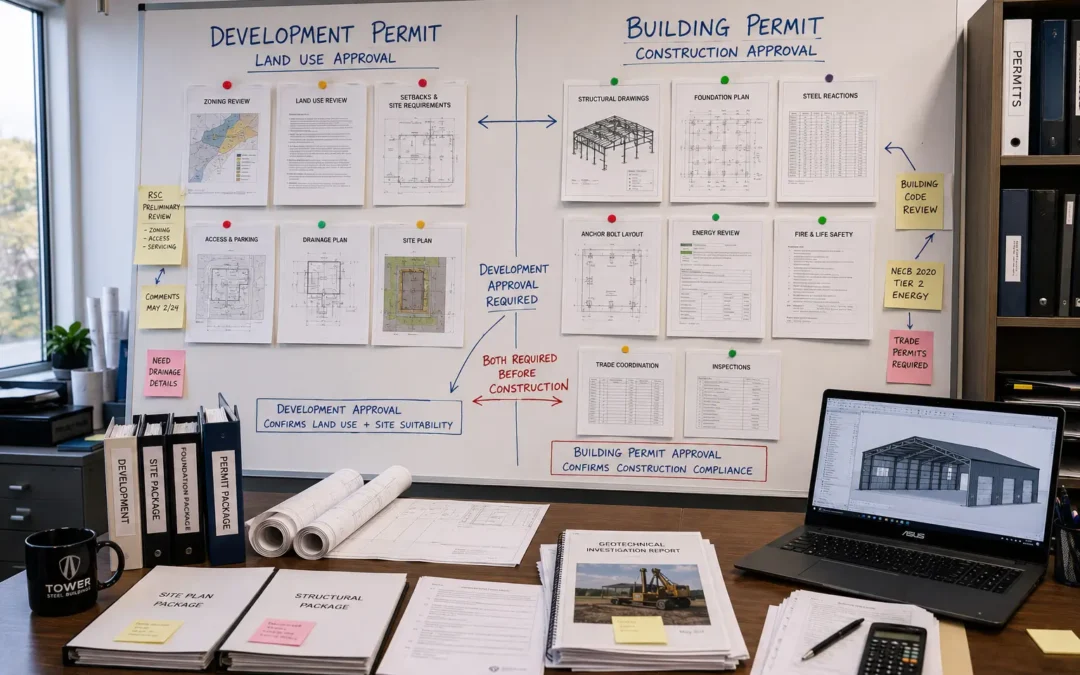
A development permit deals with whether the proposed use, location, setbacks, access, lot requirements, and development restrictions are acceptable. A building permit deals with the construction/code side. When the development path is not confirmed early, cost increases because drawings may need to change after the steel building has already been priced.
Development-related cost can include permit fees, site plan updates, zoning review, variance applications, rezoning, development officer review, access changes, parking or loading review, drainage coordination, or agency involvement where the site has constraints.
Cost Driver 4: Building Use
Building use controls cost because it changes the review path. A cold, unconditioned storage building does not usually carry the same cost exposure as a heated truck garage, commercial workshop, warehouse, agricultural processing building, public-access building, or industrial facility.
Use can affect development approval, occupancy, fire and life safety, energy documents, trade permits, plumbing, ventilation, accessibility, parking, drainage, and inspections. If the use is unclear at the beginning, the cost often appears later as comments, revisions, and redesign.
Cost Driver 5: Steel Design, Span, Snow, Wind, and Openings
Steel building cost changes when the structural demand changes. Wide spans, tall eaves, large overhead doors, heavy equipment, mezzanines, higher loads, bracing changes, snow loading, wind exposure, and site-specific design conditions can all affect engineering and permit documentation.
Before assuming a generic kit is enough, buyers should understand why site-specific steel building engineering matters for permit readiness.
As loads increase, member sizes can increase, connection forces can change, and foundation reactions can become more demanding, which is why engineering errors that increase steel building costs must be controlled before permit drawings, reactions, and foundations are treated as final.
That directly affects drawings, review, foundations, and cost.
Cost Driver 6: Foundation Drawings, Steel Reactions, and Anchor Bolts
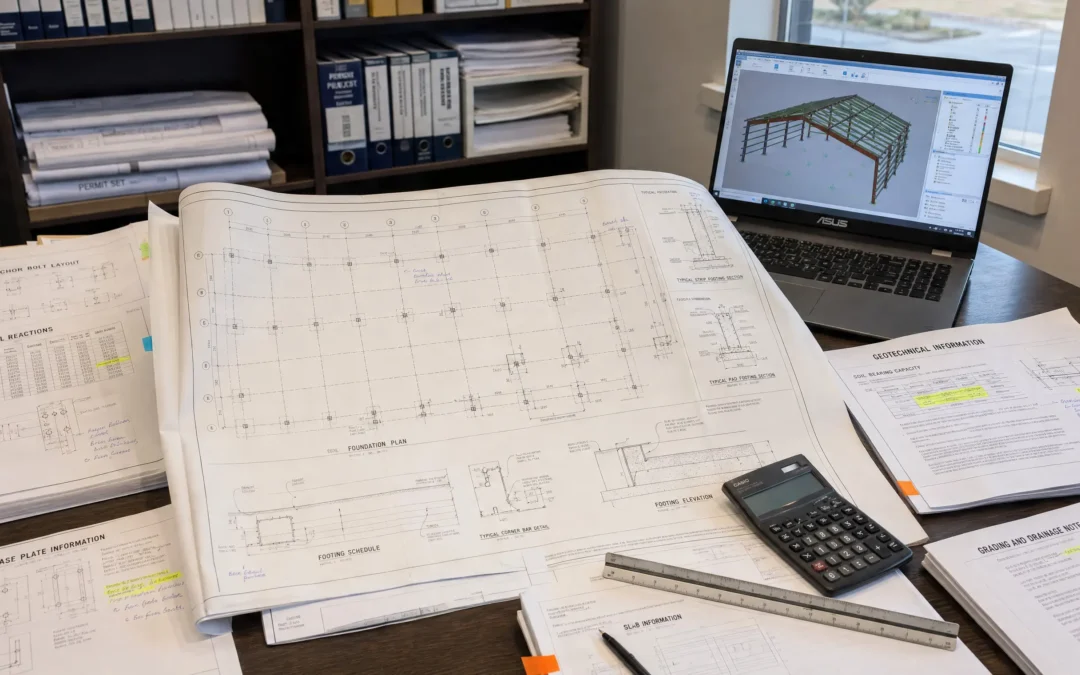
Foundation cost is one of the biggest hidden permit-related cost areas in steel building projects. The foundation must match the steel reactions, column grid, base plates, anchor bolts, soil assumptions, frost conditions, drainage, and final building use.
Tower Steel Buildings helps coordinate foundation-related design inputs, including steel reactions, column grids, base plate information, and anchor bolt information, so the foundation designer can prepare project-specific foundation drawings before review. Learn more about steel building foundation design.
Soil conditions can also change the foundation cost. Review how soil conditions and steel building foundation design affect bearing, settlement, frost response, and slab performance.
If final steel reactions are missing, the foundation designer is working from assumptions. If anchor bolts do not match the base plates, the project can move from permit correction into construction failure.
Cost Driver 7: Site Plan, Drainage, Access, and Servicing
The site plan is not a decorative drawing. It proves how the building fits the property. For steel buildings, site cost can increase when access, grading, drainage, servicing, wells, septic, watercourses, wetlands, slopes, heavy vehicle movement, or neighbouring property impacts are unclear.
Large roof areas can create real drainage demand. Heavy trucks can create access and slab concerns. Rural sites can involve septic, driveway, or watercourse constraints. Wet or filled sites can affect foundation assumptions.
If the site plan is weak, cost shows up as revisions, drainage and grading mistakes that delay steel building projects, foundation redesign, or delayed review.
Cost Driver 8: NECB, Energy Modelling, and Building Envelope
Southwest New Brunswick Service Commission states that buildings subject to the National Energy Code require modelling to document Tier 2 compliance with the 2020 NECB, and that energy modelling documents must be included with the registered design professional’s plans.
For commercial, conditioned, or NECB-subject buildings, buyers should understand energy code compliance for commercial steel buildings before submission.
Energy-related cost may include envelope details, insulation review, thermal bridging, air barrier strategy, door specifications, mechanical coordination, and energy modelling where required. A cold, unconditioned storage building and a heated commercial workshop may not follow the same document path.
Cost Driver 9: Trade Permits, Fire and Life Safety, and Inspections
Trade and inspection costs can affect heated shops, truck garages, warehouses, industrial buildings, washroom-equipped buildings, ventilated spaces, and buildings with fire protection systems. Electrical, plumbing, mechanical, HVAC, gas, fire protection, septic, or servicing permits may be separate or require coordination depending on the project.
During construction planning, coordinating trades during steel building construction helps reduce field conflicts, inspection problems, and rework.
A building that is priced as an empty shell can become more expensive when the real use includes heat, washrooms, ventilation, fire protection, process equipment, or public access.
Cost Driver 10: Wrong Sequencing
Most cost overruns are not caused by one expensive item. They are caused by starting the project in the wrong sequence.
Cost rises when buyers price steel before confirming development approval, design foundations before final reactions, pour concrete before anchor bolt layout is confirmed, add heat after the permit path is set, or order steel before the site plan and building use are clear.
By the time a cost issue is discovered during construction, it is no longer a budgeting problem, and steel building lead times and total project cost can both be affected by redesign, resubmission, fabrication changes, concrete correction, or delayed inspections.
It is a correction problem.
Permit Fee vs Permit-Related Cost
The permit fee is the amount charged by the local authority based on its fee schedule. Permit-related cost is the wider budget required to make the application reviewable and buildable.
| Category | What It Usually Means | Why Buyers Confuse It |
| Building permit fee | The local or RSC fee charged for the permit, often based on construction value. | It looks like “the permit cost,” but it may not include drawings, reports, trades, or revisions. |
| Development permit / planning cost | Land-use, zoning, setbacks, access, site placement, variance, or rezoning-related costs. | Buyers often assume a building permit covers the land-use side. |
| Professional and technical cost | Engineering drawings, foundation drawings, reactions, NECB documents, fire/life safety information, and consultant work. | These are often required before approval but are not paid to the permit counter. |
| Correction cost | Revisions, resubmissions, redesign, inspection issues, or field rework. | This is usually caused by submitting too early or building before approval is clear. |
Real Cost Scenario: The Permit Fee Was Small, but the Project Was Not Ready
A buyer plans a steel building in rural New Brunswick. At the quote stage, the building is described as equipment storage. The buyer focuses on the permit fee and assumes the total cost will be simple.
Then the real project is clarified. The building will be heated. It will include large overhead doors, equipment repair, electrical service, ventilation, a washroom, and business storage. The site has drainage concerns and the foundation drawings were started before final steel reactions were issued.
The local authority asks for clarification. Now the project needs updated use information, development path confirmation, a stronger site plan, final steel reactions, revised foundation drawings, anchor bolt coordination, possible energy documentation, trade permit planning, and inspection sequencing.
The permit fee was never the main problem; the real damage came from hidden costs after signing a steel building contract when use, site conditions, reactions, foundation scope, energy requirements, and trade permits were not confirmed early.
The real cost came from the project not being defined before submission.
How to Control Steel Building Permit Cost in New Brunswick
Cost control starts before the application is submitted. Before budgeting for the permit path, confirm:
- which local government or RSC controls the permit path
- whether a development permit or planning approval is required
- the real building use, not the easiest label
- construction value assumptions used for fee calculation
- site plan requirements
- access, grading, drainage, servicing, and environmental constraints
- final steel reactions before foundation drawings are finalized
- anchor bolt layout before concrete work is planned
- whether geotechnical input is required or strongly recommended
- whether the building is subject to NECB energy documentation
- whether fire/life safety, accessibility, or trade permits affect the cost
- whether professional drawings or field review forms are required
- whether revisions are being budgeted realistically
- whether fabrication or concrete is being scheduled before approval is clear
Use the steel building permit checklist before you apply to pressure-test readiness before spending heavily on drawings, steel, foundation work, or construction scheduling.
Regional Cost Context Across New Brunswick
Fredericton, Moncton, Saint John, and larger municipalities
Larger municipalities may have more formal fee schedules, construction-value calculations, development permit categories, curb or sidewalk-related fees, commercial building expectations, and internal review paths. Commercial and industrial steel buildings may involve planning, building, fire, servicing, accessibility, plumbing, and professional documents.
Regional Service Commission areas
RSC-serviced areas may use regional fee schedules and may handle planning, development, building permit applications, inspections, or advisory services for rural districts and local governments. Fees may include building permit formulas, development permit fees, waivers, renewals, or doubled fees if work starts before permit issuance, depending on the local fee schedule.
Rural and agricultural properties
Rural does not automatically mean cheaper or simpler. Rural steel buildings can still involve development permits, access, drainage, servicing, septic, wetlands, watercourses, agricultural use classification, commercial use questions, and inspection logistics.
Coastal, river-adjacent, wet, and site-sensitive areas
New Brunswick sites near rivers, wetlands, coastal exposure, slopes, fill, watercourses, or poor drainage can create extra cost through site plans, environmental review, foundation design, stormwater, grading, access, and professional input.
What Not to Do When Budgeting for a Steel Building Permit
- Do not assume the permit fee is the total permit-related cost.
- Do not assume every New Brunswick municipality or RSC uses the same fee formula.
- Do not finalize steel pricing before the development path and building use are clear.
- Do not finalize foundation drawings before final steel reactions are available.
- Do not set anchor bolts from an outdated layout.
- Do not treat NECB, fire/life safety, accessibility, or trade scope as optional if the building use triggers them.
- Do not start construction because the application was submitted.
- Do not ignore revision and resubmission cost.
Related New Brunswick Steel Building Permit Resources
For a complete New Brunswick permit cluster, buyers should also review these related resources:
- Steel Building Permits New Brunswick
- Documents Required for a Steel Building Permit in New Brunswick
- How to Apply for a Steel Building Permit in New Brunswick
- Development Permit vs Building Permit New Brunswick
- Steel Building Permit Timeline New Brunswick
- Foundation Drawings New Brunswick
- Why Steel Building Permits Get Delayed New Brunswick
- Why Steel Building Permits Get Rejected New Brunswick
Plan Your New Brunswick Steel Building With Cost Risk in Mind
Most steel building permit-related cost problems are not caused by one expensive fee. They are caused by unclear use, weak development confirmation, incomplete site information, uncoordinated steel and foundation drawings, missing reactions, anchor bolt conflicts, soil assumptions, NECB surprises, trade permit gaps, and construction decisions made before approval is clear.
Tower Steel Buildings helps New Brunswick buyers prepare steel building projects with better permit-readiness information before submission. Request pricing and permit-readiness guidance before finalizing your building size, foundation, or construction schedule.
The earlier these risks are identified, the easier they are to control.
Final Perspective
Steel building permit cost in New Brunswick should not be confused with the permit fee alone.
The real cost depends on whether the project is ready to be reviewed. A low permit fee does not protect the buyer if the site plan is weak, the foundation is based on assumptions, the reactions are missing, the building use is unclear, NECB applies unexpectedly, or trade permits are ignored.
The strongest cost-control strategy is not chasing the lowest permit fee. It is preparing one clear, coordinated, site-specific project before submission.
A New Brunswick steel building permit budget is realistic when the local authority, RSC where applicable, development reviewer, building inspector, steel supplier, foundation designer, and owner all understand the same building, the same site, and the same approval path before money is committed too far.
Reviewed by Engineering Team
This content has been reviewed by the Tower Steel Buildings Engineering Team.
Steel building permit cost is rarely just one municipal fee. For serious permanent steel buildings in New Brunswick, permit-related cost can be affected by the reviewing authority, development approval, construction value, site planning, structural drawings, foundation design, steel reactions, anchor bolt coordination, soil assumptions, drainage, energy documentation, trade scope, professional design involvement, revisions, inspections, and field readiness.
This guidance is intended to help buyers understand where permit-related costs can appear before they commit to engineering, fabrication, delivery, excavation, concrete work, anchor bolt placement, or construction scheduling.
A steel building project is not cost-ready because a price has been quoted or one drawing has been issued. It is cost-ready when the site, use, structure, foundation, reactions, anchor bolts, code path, trade scope, and construction sequence describe one clear, coordinated, buildable project.
1. How much does a steel building permit cost in New Brunswick?
There is no single fixed steel building permit cost in New Brunswick. The permit fee depends on the local government or Regional Service Commission, construction value, development approval requirements, building use, site conditions, inspection scope, and the documents required for review.
For many steel building projects, the permit fee is only the visible cost. The full permit-related budget may also include site plans, structural drawings, foundation drawings, steel reactions, anchor bolt coordination, geotechnical information where required, NECB documentation where applicable, trade permits, revisions, resubmissions, and inspection preparation.
2. Is the building permit fee the full cost of getting a steel building approved?
No. The building permit fee is not usually the full cost of getting a steel building approved. It is the fee charged by the local authority, often based on construction value, a minimum fee, or a local fee formula.
The full permit-related cost can include development review, site plan preparation, engineering drawings, foundation design, steel reactions, anchor bolt layout, geotechnical input, drainage information, energy documentation, trade permits, revision work, resubmissions, and inspection coordination. Buyers should budget for the full approval path, not just the permit counter fee.
3. Why do steel building permit costs vary across New Brunswick?
Steel building permit costs vary across New Brunswick because each local government or Regional Service Commission may use its own fee schedule, construction-value calculation, development permit fee, planning process, inspection process, revision process, renewal fee, waiver fee, or additional fee structure for work started too early.
The correct reviewing authority should be confirmed for the exact property before budgeting. A steel building in a municipality may not follow the same cost path as a similar building in a rural district or an area served by a Regional Service Commission.
4. Does construction value affect the steel building permit fee?
Yes. Construction value can affect the steel building permit fee because many fee schedules calculate permit fees using the declared or estimated value of construction.
For steel buildings, construction value may include more than the steel package price. Depending on the authority’s rules, the value may need to reflect foundation work, labour, mechanical or electrical components, site work, or other construction costs. Buyers should confirm how construction value is calculated before assuming the permit fee.
5. Can development approval increase steel building permit cost?
Yes. Development approval can increase permit-related cost when land use, zoning, setbacks, access, lot coverage, parking, drainage, site grading, driveway location, environmental constraints, or site layout require additional review.
If development approval is missed, the project can be delayed before the building permit is fully reviewed. In some cases, the buyer may need revised site plans, planning review, variance applications, rezoning, or additional supporting documents. That can affect both cost and schedule.
6. Do foundation drawings increase steel building permit cost?
Yes. Foundation drawings can increase permit-related cost because the foundation must be designed for the actual steel building loads and site conditions.
For steel buildings, foundation drawings should match the final steel reactions, column grid, base plates, anchor bolts, soil assumptions, frost conditions, drainage, building use, and final site plan. If the foundation is designed before the steel reactions are final, the project may face redesign, extra engineering cost, resubmission, concrete delays, or anchor bolt conflicts.
7. Why do steel reactions affect permit cost?
Steel reactions affect permit cost because they tell the foundation designer what loads the steel frame transfers into the foundation. These loads can include vertical reactions, lateral reactions, uplift, shear, and other forces created by snow, wind, exposure, building use, frame layout, and openings.
If reactions are missing, preliminary, or changed late, the foundation drawings may need to be revised. That can increase engineering cost, delay permit review, affect anchor bolt layout, and create field risk if concrete has already been formed, poured, or scheduled.
8. Can anchor bolt mistakes increase the cost of a steel building project?
Yes. Anchor bolt mistakes can become expensive because anchor bolts must match the final column grid, base plates, and steel drawings. If the anchor bolt layout is wrong, the steel frame may not fit during erection.
Correction can involve concrete repair, drilling, epoxy anchor review, base plate changes, engineering re-review, inspection delay, crane standby, and idle erection crews. Anchor bolts should not be set from outdated or preliminary layouts.
9. Can soil conditions or a geotechnical report increase permit-related cost?
Yes. Soil conditions can increase permit-related cost because the foundation design depends on what the ground can safely support. Not every steel building in New Brunswick automatically needs a geotechnical report, but soil assumptions always affect foundation risk.
A geotechnical report may be important or required for larger buildings, commercial buildings, industrial buildings, truck garages, heavy equipment buildings, wet sites, filled sites, sloped sites, coastal or high-exposure sites, unknown bearing conditions, or projects with heavier loads. If soil capacity is assumed instead of confirmed, the buyer may face foundation redesign, settlement risk, drainage problems, or inspection concerns.
10. Can NECB energy requirements increase steel building permit cost?
Yes. NECB requirements can increase permit-related cost for steel buildings that are subject to the National Energy Code of Canada for Buildings. These projects may require envelope coordination, insulation details, mechanical coordination, energy modelling, or supporting documentation.
A cold, unconditioned storage building and a heated commercial, industrial, warehouse, office, or shop building may not follow the same energy-document path. Energy requirements should be confirmed before the wall system, roof system, insulation package, doors, mechanical design, and permit submission are finalized.
11. Can trade permits increase the total cost of a steel building project?
Yes. Trade permits can increase total project cost when the steel building includes electrical, plumbing, mechanical, HVAC, gas, fire protection, septic, servicing, washrooms, ventilation, or process-related work.
Trade permits may be separate from the main building permit, but they still need to be coordinated with the real use of the building. A heated truck garage, repair shop, warehouse with washrooms, industrial building, or commercial steel building may require more trade planning than a basic cold storage structure.
12. Why is starting construction before permit approval expensive?
Starting construction before permit approval can be expensive because the project may not match what the reviewer ultimately requires. If the site plan, foundation, steel reactions, anchor bolts, drainage, energy path, or trade scope changes during review, completed work may need to be corrected.
Some local fee schedules may also charge additional fees when work starts before approval. The larger risk is field correction: concrete repair, anchor bolt changes, revised engineering, resubmission, inspection delay, crane standby, idle crews, and schedule disruption.
13. What is the biggest hidden cost in a steel building permit?
The biggest hidden cost is usually correction cost. This can include revised drawings, foundation redesign, engineering rework, resubmission, inspection issues, anchor bolt changes, concrete repair, or field modifications caused by submitting before the project is fully coordinated.
Many buyers focus only on the permit fee and miss the larger exposure. A low permit fee does not mean a low permit-related cost if the site plan, steel package, foundation design, reactions, drainage, energy requirements, or trade scope are incomplete.
14. How can I reduce steel building permit costs in New Brunswick?
You can reduce avoidable permit-related costs by confirming the correct reviewing authority early, defining the real building use, checking development requirements, preparing a complete site plan, coordinating structural and foundation drawings, confirming steel reactions, verifying anchor bolt layout, addressing soil and drainage, and identifying energy, fire, accessibility, and trade requirements before submission.
The goal is not to make the permit package larger than necessary. The goal is to make it complete, accurate, and coordinated enough to reduce avoidable review comments, redesign, resubmission, and field rework.
15. Should I budget for permit revisions?
Yes. Serious steel building projects should allow room for review comments and possible revisions. Even a well-prepared package can receive comments from the authority having jurisdiction, especially when the project involves development approval, foundation design, energy documentation, fire and life safety review, trade permits, drainage, or unusual site conditions.
The objective is to reduce avoidable revisions by coordinating the package before submission. Buyers should not assume the first submission will be perfect if the building use, site plan, foundation, reactions, or trade scope is still being finalized.
16. When should I confirm permit cost before ordering a steel building?
Permit cost should be confirmed before ordering the building, releasing fabrication, pouring concrete, or setting anchor bolts. At minimum, the buyer should confirm the reviewing authority, permit fee basis, development approval path, required drawings, construction value calculation, inspection expectations, and any known trade or energy documentation requirements.
Ordering too early can create cost risk. If the authority requires changes to the site plan, foundation, building use, drainage, energy path, or trade scope, the buyer may face redesign, fabrication changes, concrete rework, or schedule delays.
17. How can Tower Steel Buildings help buyers plan for permit-related costs?
Tower Steel Buildings can help buyers think through steel building cost, permit readiness, building use, project scope, steel package coordination, foundation coordination, steel reactions, anchor bolt layout, and quote-to-permit planning before major money is committed.
This helps serious buyers understand what should be confirmed before fabrication, delivery, excavation, concrete work, or construction scheduling. Better planning does not remove every permit cost, but it can reduce avoidable surprises caused by incomplete drawings, late reactions, uncoordinated foundations, unclear building use, or rushed submissions.