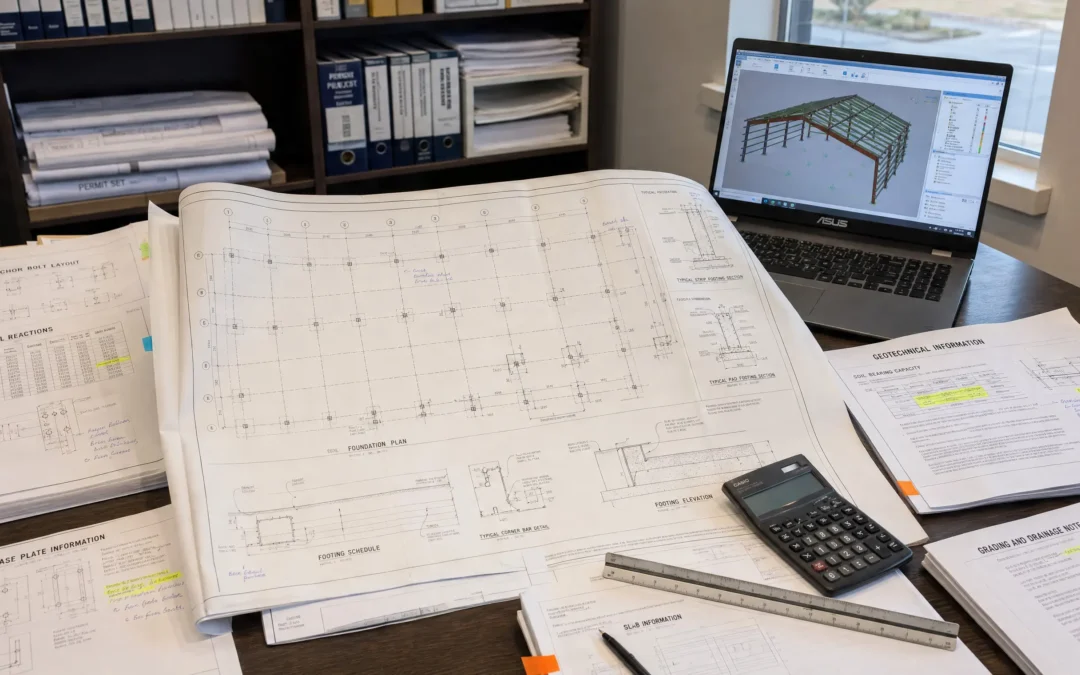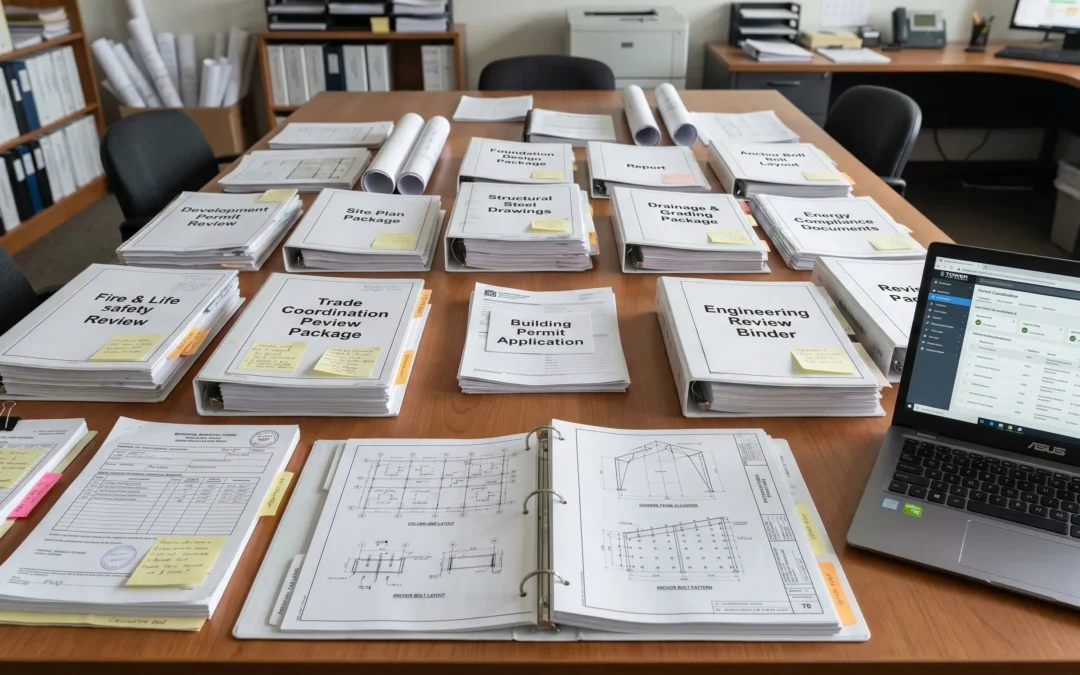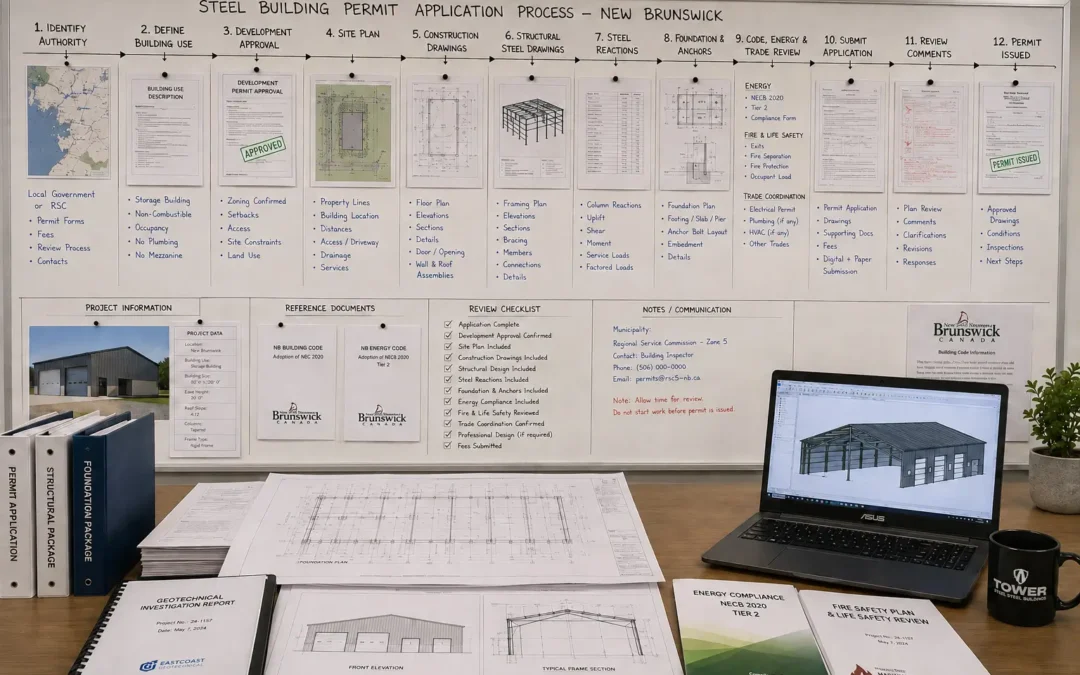
A steel building permit package is not a pile of drawings. It is proof that the project is ready to be reviewed.
The documents required for a steel building permit in New Brunswick depend on the property location, local permit authority, building use, development approval path, servicing, structural design, foundation system, energy scope, fire and life safety requirements, trade scope, and professional design requirements.
For a serious permanent steel building, the reviewing authority will usually need enough information to verify the site, use, structure, foundation, fire and life safety, energy scope, trade scope, and inspection path. The exact documents vary by municipality, rural district, Regional Service Commission, and project type, but a sales drawing alone is rarely enough for a complete steel building permit package.
This is where many buyers get caught. They assume the supplier drawing is the permit package. It may be part of the package, but it does not automatically prove the full project.
A complete permit package must show that the building fits the land, the use is allowed, the structure is designed for the location, the foundation supports the steel reactions, the anchor bolts match, the site conditions are understood, and inspections can be completed against clear approved drawings.
New Brunswick’s building code information confirms that the National Building Code of Canada 2020 and the National Energy Code for Buildings 2020 set technical provisions for new buildings, alterations, changes of use, and demolition. It also states that both documents are adopted at energy efficiency tier two.
For a serious buyer, the practical lesson is direct:
The application is not ready because a form is complete. It is ready when the documents describe one site-specific, code-aware, buildable project.
Quick Answer
Documents commonly required for a steel building permit in New Brunswick can include:
- completed permit application
- owner authorization where applicable
- development permit or planning approval where required
- site plan
- construction drawings
- structural steel drawings
- foundation drawings
- steel reactions
- anchor bolt layout
- geotechnical information where required
- grading or drainage information where required
- energy documentation where required
- fire and life safety information where applicable
- trade permit information
- professional engineering or design documents where required
- construction value and permit fee information
- inspection readiness information
The exact package depends on the local government or Regional Service Commission, building use, site conditions, and project complexity. A small accessory-type structure may follow a different path than a commercial warehouse, truck garage, industrial shop, agricultural processing building, equipment storage building, or heated workshop.
For the full approval path, see our main guide to steel building permits in New Brunswick.
New Brunswick Steel Building Permit Document Checklist
Use this checklist as a buyer-readiness framework before submitting a steel building permit application in New Brunswick.
Land and approval documents
- permit application form
- owner authorization where required
- development permit or planning approval where required
- zoning or land-use confirmation where required
- variance, rezoning, or special approval information where applicable
Site documents
- site plan
- property lines and parcel information
- existing buildings and proposed building location
- distances to property lines and nearby structures
- driveway, access, parking, or loading information where applicable
- watercourse, wetland, slope, drainage, or servicing constraints where applicable
Building and structure documents
- construction drawings
- structural steel drawings
- steel reactions
- foundation drawings
- anchor bolt layout
- slab, footing, pier, or grade beam details
- geotechnical information where required
Code, safety, and trade documents
- energy documentation where required
- fire and life safety information where applicable
- accessibility information where applicable
- electrical, plumbing, HVAC, gas, fire protection, septic, or servicing permit information where applicable
- professional engineering or registered design documents where required
This is not a universal legal checklist. The local authority still controls the final submission requirements. The value of this checklist is that it shows what serious steel building buyers should confirm before spending heavily on fabrication, concrete, or construction scheduling.
What Makes New Brunswick Different
New Brunswick permit review can involve local governments, rural districts, Regional Service Commissions, planning staff, building inspectors, development officers, trade permit reviewers, fire and life safety reviewers, servicing reviewers, and professional designers depending on where the property is located and what the building is used for.
A steel building in Fredericton, Moncton, Saint John, Sussex, Woodstock, Miramichi, Edmundston, Bathurst, Campbellton, or a rural district may not follow the same intake path.
The building code framework is provincial, but permit administration is local or regional. GNB land-use guidance advises property owners to contact a development officer at the local government or Regional Service Commission to determine whether a development permit is required. It also notes that local building inspectors review building permit applications, issue building permits, and conduct inspections.
That means the document package should not be copied from a generic checklist. It should be built around the actual property, authority, site, use, and building design.
The Document Package Has Three Jobs
A strong steel building permit package in New Brunswick has three jobs.
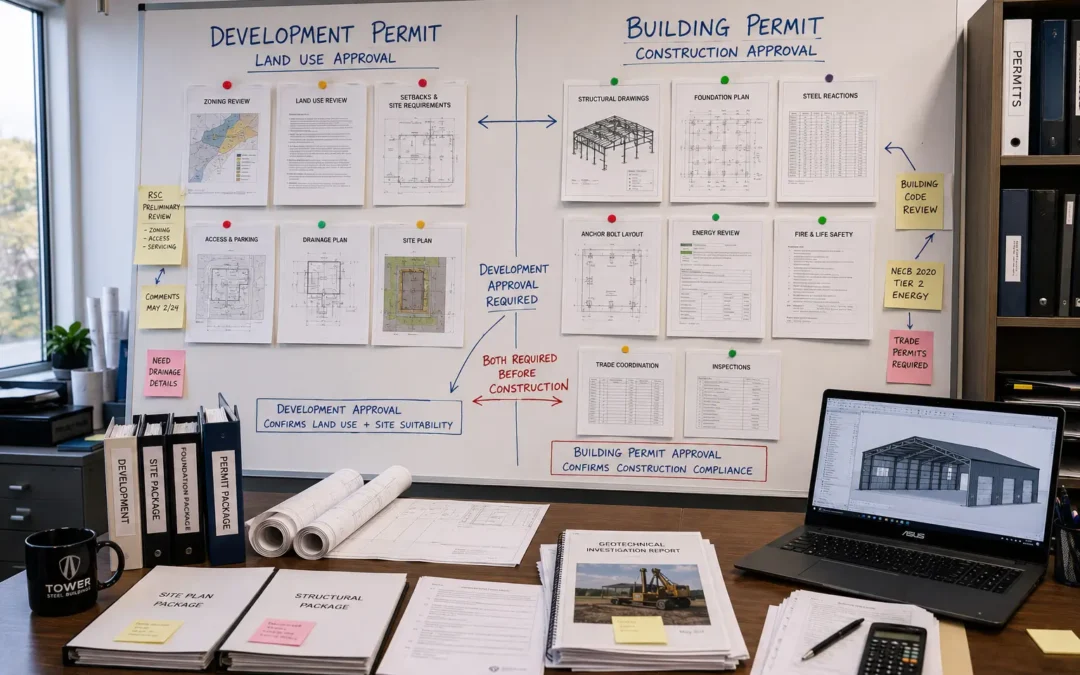
First, it must prove the project is allowed on the land. This is the planning and development side. It includes zoning, land use, setbacks, lot requirements, access, building placement, site constraints, and whether development approval is required.
Second, it must prove the building is technically buildable. This is the building permit side. It includes construction drawings, structural design, foundation drawings, steel reactions, anchor bolts, code requirements, energy requirements, fire and life safety, trade scope, and inspections.
Third, it must prove the documents agree. This is the coordination side. The site plan, steel drawings, foundation drawings, reactions, anchor bolts, use description, energy documents, and trade scope must describe the same project.
Most serious permit problems happen in the third category. The documents exist, but they do not match.
Core Document Map for New Brunswick Steel Buildings
| Document Group | What It Proves | Why It Matters for Steel Buildings |
| Permit application | Formal request for review | Starts the file, but does not prove the project is ready |
| Owner authorization | Applicant has authority to apply | Prevents legal and administrative problems |
| Development approval | Use and site placement are acceptable | Land-use issues can stop building permit approval |
| Site plan | Building fits the property | Shows setbacks, access, buildings, services, and constraints |
| Construction drawings | The proposed building is clear | Shows layout, elevations, sections, openings, assemblies, and use |
| Structural drawings | Steel system is engineered | Shows frames, bracing, connections, loads, and design assumptions |
| Steel reactions | Foundation loads are known | Foundation design depends on these forces |
| Foundation drawings | Concrete supports the steel correctly | Must match reactions, anchor bolts, soil, frost, and site conditions |
| Anchor bolt layout | Steel can connect to foundation | Prevents erection failure and concrete rework |
| Geotechnical information | Soil conditions are understood | Reduces settlement, bearing, frost, and slab risk |
| Grading and drainage information | Water movement is addressed | Protects foundations, slabs, access, and adjacent properties |
| Energy documents | NECB or energy compliance is addressed | Important for buildings subject to energy-code review |
| Fire/life safety documents | Occupancy and safety path are understood | Critical for commercial, industrial, public-access, and higher-risk buildings |
| Trade permit information | Building systems are coordinated | Electrical, plumbing, HVAC, gas, fire protection, and servicing can affect inspections |
| Professional documents | Responsibility is clear where required | Engineering or professional review may be needed for structural, foundation, NECB, or complex scope |
1. Permit Application Form
The permit application form is the administrative starting point. It identifies the property, owner, applicant, proposed work, construction value, building use, and basic project information.
For a steel building, the application must match the rest of the package. If the application says “storage” but the drawings show heat, washrooms, offices, equipment repair, public access, or industrial use, review can slow down. If the construction value does not reflect the real scope, the file can be questioned. If the building size or location differs from the site plan, the application is not clean.
A building permit application is not a permit. It is a request for review. Construction should not begin until the permit is issued and the approved drawings are understood.
2. Development Permit or Planning Approval
Many steel building projects in New Brunswick involve development review, building permit review, or both.
The development side confirms whether the project is acceptable from a land-use perspective. The building permit side confirms whether the construction meets code and technical requirements.
Development review may consider:
- zoning or land-use designation
- proposed use
- setbacks
- lot coverage
- building placement
- building height
- access
- parking or loading
- driveway location
- rural plan requirements
- variances or rezoning where applicable
- watercourse, wetland, or environmental constraints where applicable
The Government of New Brunswick advises property owners to contact a development officer at the local government or Regional Service Commission to determine whether a development permit is required.
For steel buildings, this must happen early. A land-use issue can force a building to move, shrink, change use, change access, or go through additional planning review. If that happens after engineering or foundation design, cost and timeline increase.
3. Site Plan
The site plan is one of the most important documents in a New Brunswick steel building permit package. It shows where the building will sit and how the site works.
A site plan for a steel building may need to show:
- property boundaries
- parcel identification or property information
- existing buildings
- proposed building location
- building dimensions
- distances to property lines
- distance to other buildings
- access and driveway location
- parking or loading areas where applicable
- wells, septic, services, easements, or utilities where applicable
- watercourses, wetlands, slopes, or regulated areas where applicable
- grading and drainage direction where required
- exterior storage, yard use, or operational areas where relevant
Moncton’s building and development permit guidance gives examples of site plan sketches showing property lines, buildings on the property, proposed building dimensions, and distances to surrounding property lines. This type of information matters because the reviewer must understand how the proposed structure fits the property.
For steel buildings, the site plan must match the structural and foundation drawings. If the site plan shows one building size or location and the steel drawings show another, the package is not coordinated.
4. Construction Drawings
Construction drawings explain the building itself. They are different from a sales brochure, concept sketch, or quote drawing.
For a steel building, construction drawings may include:
- floor plans
- elevations
- cross-sections
- building dimensions
- door and window locations
- overhead door openings
- interior layout where applicable
- washrooms, offices, mezzanines, or service rooms where applicable
- wall and roof assembly information
- insulation and envelope details where applicable
- exit paths where applicable
- fire separations where applicable
- occupancy or use information
- accessibility details where applicable
Plan360 permit checklist examples show how site plans, foundation plans, floor plans, elevations, and cross-sections can become part of a permit package depending on project type. Plan360 checklist materials also show how drainage information can be requested where surface water movement must be addressed. For steel buildings, the exact requirements vary, but the principle is the same: site information matters.
A steel shell drawing may not explain the real project. A serious permit package must show the use, layout, safety path, building envelope, foundation relationship, and construction scope.
5. Structural Steel Building Drawings
Structural steel drawings show how the steel building carries load, but site-specific steel building engineering is what proves the structure reflects the actual New Brunswick location, use, snow, wind, openings, foundation reactions, and site conditions.
These drawings may include:
- rigid frames
- columns
- rafters
- purlins
- girts
- bracing
- framed openings
- base plates
- connection details
- load assumptions
- snow and wind design information
- building geometry
- design notes
- engineer seal where required
New Brunswick steel buildings must be designed for the actual location and use. Structural requirements can change based on building width, length, eave height, clear span, snow loading, wind exposure, large doors, bracing layout, equipment loads, mezzanines, use, and foundation reactions.
The structural drawings should not be treated as a generic kit drawing. They must match the project conditions.
When structural drawings are not site-specific, the problem is not cosmetic. Load paths can change, connection forces can shift, foundation reactions can change, and the building may not behave as intended.
6. Steel Reactions
Steel reactions are the forces transferred from the steel frame into the foundation.
They may include:
- vertical reactions
- lateral reactions
- uplift forces
- shear forces
- moment reactions
- column base reactions
- load combinations
These reactions are essential because the foundation designer needs to know what the concrete must resist. Without final reactions, foundation design is based on assumptions.
That is risky for steel buildings because reactions can change when the span, height, roof geometry, openings, bracing, snow load, wind exposure, mezzanine, equipment load, or use changes.
A foundation package without final reactions is not complete for a serious steel building. It may be a starting point, but it is not a reliable construction basis.
7. Foundation Drawings
Foundation drawings show how the building is supported.
For a steel building, foundation drawings may include:
- footing layout
- piers or pedestals
- slab details
- grade beams where required
- foundation walls where required
- reinforcement details
- concrete specifications
- frost protection
- soil-bearing assumptions
- column grid
- base plate coordination
- anchor bolt placement
- drainage notes
- construction notes
- engineer seal where required
Foundation drawings must match the steel reactions and anchor bolt layout. They must also respond to soil conditions, frost, slab use, drainage, grading, and building use.
A foundation drawing is not complete because it shows concrete. It is complete when it supports the exact building, on the exact site, with the correct reactions, anchor bolts, soil assumptions, frost considerations, drainage strategy, and construction sequence.
Once concrete is poured, many mistakes are no longer design problems. They become construction problems.
8. Anchor Bolt Layout
Anchor bolt layout is one of the most field-critical documents in a steel building project.
Anchor bolts connect the steel columns to the foundation. The layout must match the base plates, column grid, foundation drawing, and erection requirements.
An anchor bolt layout should confirm:
- bolt size
- bolt spacing
- bolt projection
- bolt embedment
- base plate hole locations
- column grid
- orientation
- edge distances
- templates where required
- relationship to footings, piers, or slab edges
If anchor bolts are wrong, the steel may not fit. That can cause crane standby, idle crews, concrete repair, base plate modifications, field drilling problems, engineering re-review, inspection delay, and schedule loss.
This is why anchor bolt coordination must happen before concrete placement.
9. Geotechnical Information
Not every steel building needs a geotechnical report, but soil conditions that impact steel building foundation design always matter because bearing capacity, frost behaviour, groundwater, settlement, slab performance, and drainage can change the permit package.
Larger buildings, commercial buildings, truck garages, heavy equipment buildings, industrial buildings, agricultural processing buildings, coastal sites, wet sites, sloped sites, filled sites, and unknown bearing conditions can make geotechnical input important or required.
Soil conditions affect:
- bearing capacity
- settlement
- frost behaviour
- groundwater
- slab performance
- footing size
- foundation type
- compaction
- drainage
- long-term performance
If soil is assumed, the foundation carries risk. Unknown soil does not remove the problem. It pushes the problem into review, construction, and long-term use.
A geotechnical report costs money. A foundation designed on the wrong assumption can cost far more.
10. Grading, Drainage, and Site Servicing Information
Steel buildings are affected by the site around them. A permit authority may need grading, drainage, servicing, or site information when water movement, access, utilities, or adjacent impacts are unclear.
This can matter for:
- sloped sites
- rural properties
- wet areas
- watercourse or wetland buffers
- large roof areas
- heavy vehicle access
- industrial yards
- truck garages
- parking and loading areas
- septic or well locations
- stormwater flow
- erosion risk
- neighbouring property impacts
Drainage is not landscaping. It affects foundations, slabs, frost movement, erosion, access, and long-term durability.
Plan360 permit checklist examples show how site plans, foundation plans, floor plans, elevations, cross-sections, and drainage information can become part of a permit package depending on project type. For steel buildings, the exact requirements vary, but the principle is the same: site information matters.
11. Energy Documentation
Energy documentation can be important for medium, large, complex, heated, occupied, commercial, industrial, or conditioned steel buildings.
New Brunswick’s provincial building code information states that the National Energy Code for Buildings 2020 is adopted at energy efficiency tier two. Southwest New Brunswick Service Commission also notes that buildings subject to the NECB require modelling to document how the proposed structure will meet Tier 2 of the 2020 NECB, and that applications must include energy modelling documents in addition to plans from the registered design professional.
For steel buildings, energy documentation may affect:
- insulation levels
- roof and wall assemblies
- thermal bridging
- air barrier details
- vapour control
- door specifications
- overhead door performance
- mechanical design
- heating strategy
- energy modelling
- envelope coordination
A cold unconditioned storage building and a heated commercial workshop do not follow the same document path. If the building will be heated, occupied, commercial, industrial, or subject to NECB requirements, energy documentation should be addressed before submission.
12. Fire and Life Safety Information
Fire and life safety documentation can become important for commercial, industrial, warehouse, truck garage, repair, public-access, or occupied steel buildings.
The permit package may need to show:
- occupancy classification
- occupant load
- exits
- travel distance
- fire separations
- fire access
- emergency lighting
- fire alarm information where applicable
- sprinkler information where applicable
- hazardous materials where applicable
- vehicle repair or fuel-related use
- accessibility requirements where applicable
- washrooms or service spaces where applicable
This is where vague building labels create problems. “Shop” does not tell the reviewer enough. A private storage shop, truck repair shop, welding shop, commercial service shop, and industrial workspace can all create different review questions.
The permit package should describe the real use, not the simplest name.
13. Trade Permit Information
Steel building projects may require separate trade permits or trade-related coordination.
This can include:
- electrical permits
- plumbing permits
- mechanical permits
- HVAC permits
- gas permits
- fire protection permits
- septic or servicing permits where applicable
Trade scope matters for heated shops, warehouses, truck garages, industrial buildings, agricultural processing buildings, commercial buildings, washroom-equipped buildings, ventilated spaces, and buildings with fire protection systems.
Trade permits may not always be part of the same building permit package, but they affect inspection sequence, schedule, and cost. A building permit package is incomplete if it treats the project as an empty shell while the real building includes heat, washrooms, ventilation, equipment, fire protection, or electrical service.
14. Professional Engineering or Registered Design Documents
Some steel building projects require professional involvement because the building is commercial, industrial, public, complex, large-span, structurally non-prescriptive, subject to NECB, or outside basic prescriptive design.
Professional documents may include:
- structural engineering drawings
- foundation engineering drawings
- steel shop drawings
- geotechnical reports
- energy modelling
- fire protection design
- mechanical design
- electrical design
- plumbing design
- architectural drawings where applicable
- field review or commitment forms where required
Fredericton’s building permit forms page lists forms such as owner commitment, field review commitment, confirmation of construction field review, building matrix, integrated systems testing, and alternate solution forms. That is a useful signal for serious buyers: larger or more complex buildings can involve professional responsibility, not just basic drawings.
If professional responsibility is unclear, permit review can stall. A stamped drawing is not the same as a fully coordinated permit package. The professional documents must match the site, structure, foundation, energy scope, and building use.
The Biggest Document Mistake
The biggest document mistake is not “missing one page.”
The bigger mistake is assuming one document solves the whole approval path.
A supplier drawing does not replace a site plan. A site plan does not replace foundation design. Foundation drawings do not replace final steel reactions. Development approval does not replace building permit review. Energy modelling does not fix unclear building use.
Each document answers a different question.
The permit package works only when those answers agree.
What Happens When Documents Do Not Match
A permit package can contain many documents and still fail if those documents do not describe the same building.
Common document mismatch problems include:
- application says storage, drawings show commercial repair
- site plan shows one building size, structural drawings show another
- foundation drawings are based on old steel reactions
- anchor bolt layout does not match base plates
- grading plan conflicts with finished floor elevation
- energy documents assume a different wall or roof assembly
- trade scope appears in drawings but not in permit planning
- fire and life safety assumptions do not match the actual use
- development approval does not match building permit submission
A missing document is usually easy to fix. A conflicting package is harder because the project team has to determine which version is correct.
The permit authority needs one project to review, not several versions of the same project.
New Brunswick Regional Review Context
New Brunswick projects do not all move through one single municipal office. The authority depends on where the land is located.
Fredericton, Moncton, Saint John, and larger municipalities
Larger municipalities may have more formal intake systems, building permit pages, development permit forms, professional forms, plumbing or trade-related review, commercial building expectations, and internal review paths. Commercial or industrial steel buildings may involve planning, building, fire, servicing, plumbing, accessibility, and professional document review.
Regional Service Commission areas
Regional Service Commissions can handle planning, development, building permit applications, inspections, or advisory services for communities and rural districts. For example, Kings Regional Service Commission states that building permits are required throughout the province for new construction, demolition, relocation, alteration, or replacement, and that commercial, industrial, or public buildings may take longer because they can require different approvals.
Rural and agricultural properties
Rural does not automatically mean simple. Rural steel buildings can still involve development permits, land-use plans, access, drainage, servicing, septic, wetlands, watercourses, agricultural use, commercial use, or public-facing activity. A farm storage building and a rural equipment repair business may not follow the same review path.
Coastal, river-adjacent, wet, and site-sensitive areas
New Brunswick has many site-sensitive conditions, including coastal exposure, rivers, wetlands, watercourses, slopes, fill, and rural drainage. These can affect site plans, foundation design, environmental permits, stormwater, grading, access, and inspection planning.
What Serious Buyers Should Confirm Before Submission
Before submitting a steel building permit package in New Brunswick, confirm:
- what the building will actually be used for
- who has permit authority for the property
- whether a development permit is required
- whether zoning, rural plan, variance, or rezoning issues exist
- whether the site plan matches the proposed building
- whether access, drainage, services, wetlands, or watercourses create constraints
- whether structural drawings are site-specific
- whether steel reactions are final
- whether foundation drawings match the reactions
- whether anchor bolt layout is coordinated
- whether soil assumptions are reliable
- whether energy documentation is required
- whether fire and life safety information is required
- whether trade permits are needed
- whether professional documents are required
- whether construction is being scheduled before approval is clear
If these items are not confirmed, the submission may not be ready.
What Not to Do
Do not assume the same document package works everywhere in New Brunswick.
Do not assume a supplier drawing is the complete permit package.
Do not finalize foundation drawings before steel reactions are confirmed.
Do not set anchor bolts from an outdated layout.
Do not describe the building as storage if it will function as a shop, repair facility, commercial workspace, or industrial building.
Do not ignore development permit requirements.
Do not leave soil, drainage, energy, fire and life safety, or trade scope unclear.
Do not start fabrication, excavation, concrete placement, or anchor bolt work before approval is clear.
Most permit problems are not caused by one missing form. They are caused by submitting before the project is coordinated.
Real Document Failure Scenario
A buyer wants a steel building in rural New Brunswick.
At the sales stage, the building is described as storage. The buyer wants to move quickly, so the supplier package is prepared first. The site plan is basic. Foundation design is started before final reactions are issued. No one confirms whether the building will include heat, equipment repair, washrooms, commercial storage, or customer access.
The application goes in.
The reviewer asks for clarification.
The building is not only storage. It includes heated work areas, large overhead doors, repair activity, trade systems, and business use. The site plan does not fully explain access or drainage. The foundation drawings do not match final steel reactions. The anchor bolt layout is not clearly coordinated.
Now the package needs revised use information, development confirmation, updated site plan, fire and life safety review, energy documents, foundation coordination, steel reactions, anchor bolt layout, trade permit planning, and revised drawings.
The steel building was not the problem.
The document package was.
Related New Brunswick Permit Resources
For a complete New Brunswick permit cluster, buyers should also review these related resources:
- Steel Building Permits New Brunswick
- Development Permit vs Building Permit New Brunswick
- Steel Building Permit Timeline New Brunswick
- Steel Building Permit Cost New Brunswick
- Foundation Drawings New Brunswick
- Why Steel Building Permits Get Delayed New Brunswick
- Why Steel Building Permits Get Rejected New Brunswick
- How to Apply for a Steel Building Permit in New Brunswick
Once the supporting pages are published, convert each item into a real internal link. Do not leave the final live page with plain-text related resources if those URLs exist.
Plan Your New Brunswick Steel Building With Permit-Ready Information
Most document problems are not caused by one missing page. They are caused by unclear use, weak land-use confirmation, incomplete site information, uncoordinated steel and foundation drawings, missing reactions, anchor bolt conflicts, soil assumptions, drainage gaps, energy documentation issues, trade permit gaps, and construction decisions made before approval is clear.
Tower Steel Buildings helps New Brunswick buyers prepare steel building projects with the right technical information before submission, including document readiness, structural coordination, foundation drawing alignment, steel reactions, anchor bolt coordination, supplier documentation, and project-specific steel building quotes.
Request pricing and permit-readiness guidance before finalizing your building size, foundation, or construction schedule.
The earlier these risks are identified, the easier they are to control.
Final Perspective
Documents required for a steel building permit in New Brunswick are not just paperwork.
They are proof.
They prove the building is allowed on the land. They prove the site can accept it. They prove the structure is designed for the location. They prove the foundation supports the steel. They prove the anchor bolts align. They prove energy, fire and life safety, trade, and inspection issues are not being ignored.
A permit package can contain many documents and still fail if those documents do not agree.
The real standard is not document volume.
It is coordination.
A New Brunswick steel building permit package is ready when the local authority, RSC where applicable, development reviewer, building inspector, steel supplier, foundation designer, and owner can all see the same project in the same documents.
Reviewed by Engineering Team
This content has been reviewed by the Tower Steel Buildings Engineering Team.
The review focused on practical steel building permit document readiness in New Brunswick, including development approval, local authority or Regional Service Commission review, site plan coordination, construction drawings, structural steel drawings, foundation drawings, steel reactions, anchor bolt layout, geotechnical assumptions, grading and drainage information, energy documentation, fire and life safety information, trade permit coordination, professional engineering documents, and inspection readiness.
The purpose of this review is to help serious steel building buyers understand that a permit package is not complete simply because several drawings exist. A permit package is only useful when the documents describe one clear, site-specific, code-aware, buildable project.
For New Brunswick steel building projects, this means the site plan must match the building layout, the structural drawings must match the intended use, the foundation drawings must match the steel reactions, the anchor bolt layout must match the base plates, and the supporting documents must align with the actual permit authority, building use, site conditions, and construction scope.
This content is intended to support buyer education and permit-readiness planning. Final permit requirements, submission expectations, review comments, inspections, and approvals remain under the authority of the applicable local government, Regional Service Commission, building official, development officer, inspector, or licensed professional involved in the project.
1. What documents are usually required for a steel building permit in New Brunswick?
A steel building permit package in New Brunswick commonly includes a permit application, site plan, construction drawings, structural steel drawings, foundation drawings, steel reactions, anchor bolt layout, and supporting project information. Depending on the property, building use, size, site conditions, and authority having jurisdiction, it may also require development approval, geotechnical information, grading or drainage details, energy documents, fire and life safety information, trade permit coordination, professional engineering documents, and fee or construction-value information.
There is no single universal checklist for every steel building. A cold storage building, heated truck garage, agricultural building, warehouse, repair shop, and public-access commercial building can each trigger different document expectations. The permit package should be confirmed before fabrication, concrete, or construction scheduling begins.
2. Are supplier drawings enough for a steel building permit?
Supplier drawings are usually not enough by themselves for a serious permanent steel building permit. They may describe the steel building system, frame layout, member sizes, cladding, connections, and design information for the supplied structure, but a permit package often needs more than the supplier’s steel package.
A complete permit submission may also need a site plan, development approval where required, foundation drawings, final steel reactions, anchor bolt layout, soil assumptions, drainage information, energy documentation, fire and life safety information, trade permit planning, and professional responsibility for the submitted design. Supplier drawings become permit-useful when they are coordinated with the site, foundation, code path, and construction sequence.
3. Do I need a development permit before a building permit in New Brunswick?
Some steel building projects in New Brunswick may need development approval before or alongside the building permit. The requirement depends on the property location, local land-use rules, zoning, setbacks, building placement, access, servicing, site constraints, building use, and the authority having jurisdiction.
Development approval usually deals with whether the building is allowed on the site and how it fits the property. Building permit approval deals more directly with code compliance, structural design, foundation details, drawings, and inspections. A buyer should confirm the development path early because land-use issues can delay the project before the structural package is even reviewed.
4. Why is the site plan important for a steel building permit?
The site plan is important because it shows where the steel building sits on the property and how it relates to setbacks, access, existing structures, services, drainage, property lines, easements, slopes, and other site constraints. Reviewers use the site plan to understand whether the proposed building fits the site and whether the permit package matches the actual project.
For steel buildings, the site plan must also align with the structural drawings and foundation drawings. If the site plan shows one building location, the foundation drawings show another assumption, and the steel package does not match the final layout, the project is not permit-ready. That kind of mismatch can create review comments, redesign, anchor bolt conflicts, drainage problems, and construction delays.
5. Why are steel reactions needed for a steel building foundation?
Steel reactions are needed because they tell the foundation designer what forces the steel frame transfers into the foundation. These forces can include vertical loads, lateral loads, uplift, shear, and other frame reactions created by the building design, snow, wind, exposure, use, and geometry.
Without final steel reactions, the foundation design is based on assumptions. That is a serious risk. A proper foundation package should match the final steel reactions, base plates, anchor bolt layout, column grid, soil assumptions, frost requirements, drainage conditions, and site-specific design needs. If reactions change after the foundation is designed, the foundation, anchor bolts, and inspections may need to be reviewed again.
6. Why does the anchor bolt layout matter in a steel building project?
The anchor bolt layout matters because anchor bolts connect the steel columns to the concrete foundation. If the anchor bolts do not match the column grid, base plates, and final steel drawings, the steel frame may not fit during erection.
Anchor bolt mistakes are not small paperwork issues. They can cause concrete repair, drilling, epoxy anchor review, base plate modifications, crane standby, idle erection crews, engineering re-checks, inspection delays, and extra cost. Anchor bolts should not be placed from preliminary drawings unless the project team has clearly confirmed that the layout is final and coordinated with the steel supplier and foundation design.
7. Does every steel building in New Brunswick need a geotechnical report?
No, not every steel building in New Brunswick automatically needs a geotechnical report. However, soil conditions always matter because the foundation depends on what the ground can safely support.
A geotechnical report may become important or required for larger steel buildings, commercial buildings, industrial buildings, truck garages, heavy equipment buildings, wet sites, filled sites, sloped sites, coastal or high-exposure sites, poor drainage areas, unknown bearing conditions, or projects with heavier structural loads. If soil capacity is assumed instead of confirmed, the buyer carries more foundation risk. That risk can show up later as redesign, settlement, cracking, drainage problems, or inspection concerns.
8. Do steel buildings in New Brunswick need energy documents?
Some steel buildings in New Brunswick may need energy documents, especially heated commercial, industrial, warehouse, office, shop, or occupied buildings subject to the National Energy Code of Canada for Buildings. New Brunswick’s official building-code information identifies the National Building Code of Canada 2020 and the National Energy Code of Canada for Buildings 2020 as adopted at energy efficiency tier two.
The energy document path depends on the building use, size, occupancy, heating, insulation, envelope design, mechanical systems, and code classification. A cold unconditioned storage building and a heated commercial steel building may not have the same requirements. Energy requirements should be confirmed before finalizing the wall system, roof system, insulation package, doors, mechanical design, or permit submission.
9. Do fire and life safety documents apply to steel buildings?
Fire and life safety documents can apply to steel buildings depending on how the building will be used. A private unoccupied storage building may be reviewed differently from a repair garage, warehouse, industrial shop, public-access commercial building, riding arena, truck garage, or building with employees, customers, equipment, fuels, chemicals, or hazardous processes.
Reviewers may need information about occupancy, exits, travel distance, fire separations, fire department access, alarms, sprinklers, washrooms, accessibility, hazardous materials, ventilation, vehicle-related use, or process equipment. The real use of the building controls the review. Calling a building “storage” when it will actually be used for repair, production, public access, or heated work space can create permit delays and redesign.
10. Are trade permits separate from the steel building permit?
Trade permits may be separate from the main building permit, but they still need to be coordinated with the steel building project. Electrical, plumbing, mechanical, HVAC, gas, fire protection, septic, servicing, or process-related work may require separate permits, inspections, or design information depending on the project.
A steel building permit package can still be delayed if trade scope is ignored. For example, a heated truck garage may need mechanical ventilation, gas coordination, electrical service, drainage, plumbing, fire protection review, or other trade-related information. The building should be planned as the real finished use, not just as an empty shell.
11. What should I confirm before releasing steel fabrication or pouring concrete?
Before releasing steel fabrication or pouring concrete, confirm the development path, building use, site plan, final structural design, steel reactions, foundation drawings, anchor bolt layout, soil assumptions, frost requirements, drainage, energy requirements, fire and life safety requirements, trade scope, professional responsibility, and permit approval status.
This is one of the most important steps in a steel building project. Do not release fabrication, pour concrete, or set anchor bolts based on assumed approval or incomplete drawings. If the permit review changes the building layout, foundation design, reactions, or anchor bolt requirements, the buyer may face redesign costs, fabrication conflicts, concrete rework, schedule delays, and inspection problems.
12. Who approves or reviews steel building permit documents in New Brunswick?
Steel building permit documents in New Brunswick may be reviewed by a local government, Regional Service Commission, building official, planning staff, development officer, building inspector, fire and life safety reviewer, servicing reviewer, trade permit reviewer, or professional designer, depending on the property location and project scope.
The correct review path should be confirmed before the permit package is prepared. A project in a municipality may follow a different process than a project in a rural district or an area served by a Regional Service Commission. The reviewer’s main concern is not just whether a steel building can be supplied, but whether the submitted package describes one clear, code-aware, site-specific, coordinated, and buildable project.
13. How can Tower Steel Buildings help with permit-ready steel building planning?
Tower Steel Buildings can help buyers plan a steel building project with the permit path, pricing, building use, steel package, foundation coordination, reactions, anchor bolt layout, and project timing in mind. This helps buyers understand what should be confirmed before they commit to fabrication, concrete, or construction scheduling.
A steel building project is not ready because one drawing exists. It is ready when the site, use, structure, foundation, reactions, anchor bolts, code path, and construction sequence describe one clear, coordinated, buildable project. For serious buyers, that planning can reduce avoidable permit comments, redesign, foundation conflicts, erection delays, and cost surprises.