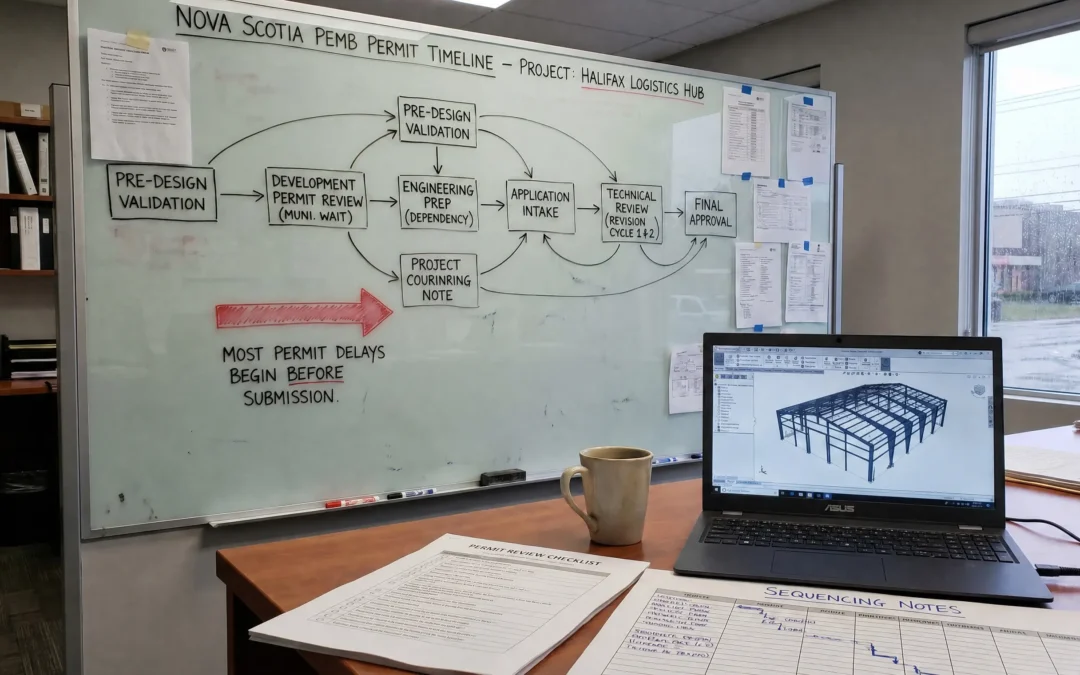
Most steel building permit delays in Nova Scotia are decided before the application is submitted
Steel building permit delays in Nova Scotia rarely happen because one reviewer is slow or one form is missing. Most delays happen because the project is not ready for review when it is submitted.
A buyer may ask:
Why is my steel building permit taking so long?
The better question is:
What part of the project was not confirmed before submission?
That difference matters.
A steel building permit can be delayed by unclear building use, missing development permit approval, weak site plans, incomplete drawings, foundation mismatch, missing steel reactions, anchor bolt conflicts, soil assumptions, drainage gaps, energy documentation issues, trade permit scope, professional letters, or partial responses to municipal comments.
The delay may appear during municipal review, but it usually starts earlier.
It starts when the building is priced before land use is confirmed. It starts when foundation drawings are prepared before final steel reactions are issued. It starts when anchor bolts are set before the approved layout is confirmed. It starts when the application says “storage,” but the building is actually a heated commercial workshop.
Nova Scotia’s Building Code Regulations adopted the 2020 National Building Code, 2020 National Energy Code for Buildings, 2020 National Plumbing Code, and 1995 National Farm Building Code, as amended by Nova Scotia, as part of the Nova Scotia Building Code framework effective April 1, 2025, with later staged amendments scheduled after the initial adoption period.
Buyers should confirm current code, energy, and municipal submission requirements before finalizing permit documents.
For serious steel building buyers, the practical lesson is simple:
A steel building permit is delayed when the municipality cannot confirm what it needs to confirm.
Quick Answer
Steel building permits get delayed in Nova Scotia because the permit package does not clearly prove that the building is allowed, code-compliant, site-specific, structurally coordinated, and ready to inspect. Common delay causes include missing development permit confirmation, unclear building use, weak site plans, incomplete construction drawings, missing foundation drawings, missing steel reactions, anchor bolt conflicts, unsupported soil assumptions, drainage issues, missing energy documents, incomplete fire and life safety information, missing trade permit coordination, missing professional letters where required, and incomplete responses to review comments.
The fastest projects are not the ones submitted earliest. They are the ones submitted with the least uncertainty. A realistic steel building permit timeline in Nova Scotia starts with document readiness, development review, engineering coordination, and the number of review cycles likely before approval.
Why Steel Building Permits Get Delayed in Nova Scotia: Simple Definition
A steel building permit delay in Nova Scotia happens when the municipality cannot complete review, issue approval, or move the application forward because required information, drawings, approvals, coordination, or professional responsibility is missing, unclear, inconsistent, or incomplete.
For steel buildings, delay usually means the submitted documents do not yet describe one clear, compliant, site-specific, buildable structure.
Permit Delay vs Permit Rejection vs Permit Timeline
A permit timeline is the full path from early project planning to permit issuance and inspections.
A steel building permit rejection or review comment means the municipality cannot approve the submission as presented.
A permit delay is the extra time created when information is missing, unclear, inconsistent, or changed after submission.
For steel buildings, delays often happen because one missing detail affects several documents at once. A site plan change can affect the foundation layout. A use change can affect fire, energy, trade permits, and occupancy. A steel reaction change can affect foundation drawings and anchor bolts.
That is why delay control is not about rushing the application. It is about reducing uncertainty before review begins.
What This Guide Covers
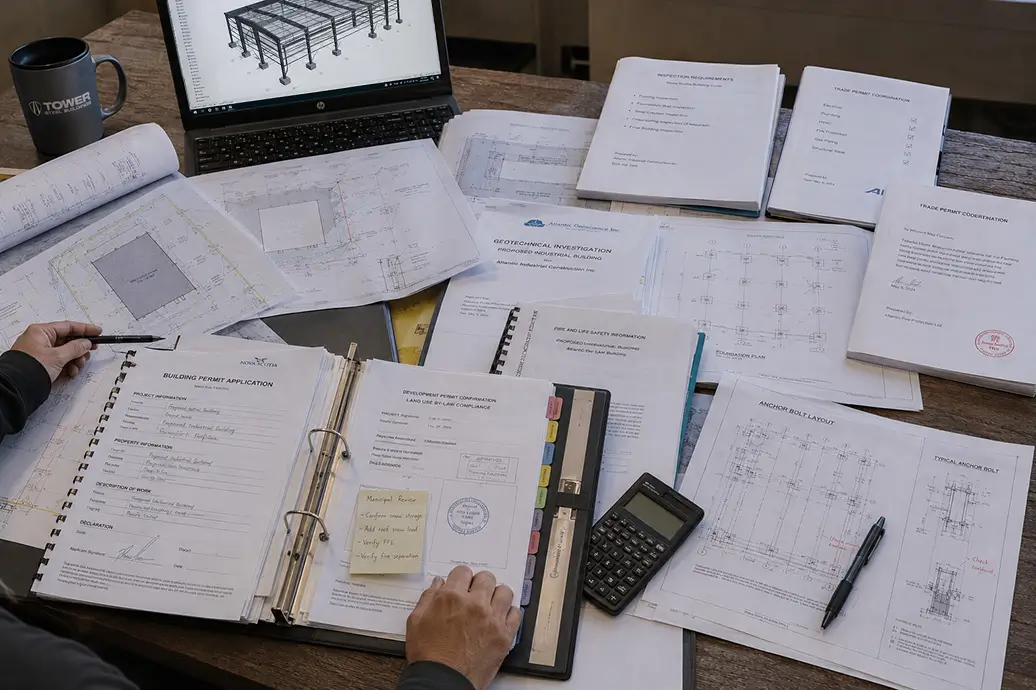
This guide explains the real reasons steel building permits get delayed in Nova Scotia and how serious buyers can avoid preventable review cycles. Most delay risks start with incomplete or inconsistent documents required for a steel building permit in Nova Scotia, especially when site plans, structural drawings, foundation drawings, steel reactions, and building use do not match.
In this guide, you will understand:
- why steel building permits get delayed in Nova Scotia
- why development permit issues can stop the building permit path
- how unclear building use causes review problems
- why site plans affect approval timing
- why construction drawings, structural drawings, and foundation drawings must match
- why steel reactions and anchor bolt layouts matter
- how soil, drainage, grading, energy, fire, and trade scope affect timelines
- why starting work before approval can create expensive delay
- what to do when permit comments are issued
- how to prepare a cleaner permit package before submission
This page is written for buyers planning steel buildings in Nova Scotia, including farm buildings, garages, workshops, warehouses, truck garages, commercial buildings, industrial buildings, storage buildings, marine-related buildings, and custom steel building projects.
Buyer Warning
The most expensive permit delay is not a slow review.
The most expensive delay is a review comment that arrives after steel has been fabricated, concrete has been poured, anchor bolts have been set, or crews have been scheduled.
At that point, the delay is no longer only administrative.
It becomes redesign, rescheduling, rework, and field correction.
Permit Delay Snapshot
The exact cause of delay depends on the municipality, building use, site, and submission quality. For steel buildings in Nova Scotia, the most common delay patterns usually fall into these areas.
| Delay Cause | What the Municipality Cannot Confirm | Real Project Impact |
| Development permit path not confirmed | Whether the use and building location are allowed | Building permit review may pause or not move cleanly |
| Unclear building use | Which code, occupancy, fire, energy, and trade requirements apply | Wrong review path, added comments, redesign |
| Weak site plan | Whether the building fits the property | Setback, access, drainage, servicing, and location questions |
| Incomplete construction drawings | What is actually being built | Review cannot confirm layout, scope, exits, assemblies, or use |
| Supplier package treated as complete | Whether the full project is permit-ready | Missing site, foundation, energy, trade, or professional documents |
| Structural drawings not site-specific | Whether the steel building is designed for the real location and use | Engineering comments and re-review |
| Foundation drawings missing or mismatched | Whether the foundation supports the steel building | Redesign, re-submission, field risk |
| Steel reactions missing | What loads the foundation must support | Foundation review cannot be completed responsibly |
| Anchor bolt layout missing or wrong | Whether steel columns can connect to the foundation | Erection delay and concrete correction risk |
| Soil assumptions unsupported | Whether the foundation design is reliable | Geotechnical request, redesign, settlement risk |
| Drainage or grading unclear | Whether water movement is controlled | Site comments and foundation durability concerns |
| Energy documents missing | Whether heated or conditioned spaces comply | Delay for shops, warehouses, commercial buildings |
| Fire and life safety gaps | Whether occupancy, exits, fire access, and safety systems work | Major review comments |
| Trade permits ignored | Whether plumbing, electrical, HVAC, fire protection, or servicing are coordinated | Inspection and scheduling delay |
| Partial comment responses | Whether the original issue has actually been resolved | Second and third review cycles |
Practical Delay Impact Ranges
These ranges are planning guidance only. They are not guaranteed municipal review times. Actual delay depends on the municipality, project scope, submission quality, consultant response time, and how many documents must be revised.
| Delay Trigger | Possible Added Time | Why It Adds Time |
| Development permit path not confirmed | 2 to 8+ weeks | Land-use review, zoning confirmation, setbacks, use, or development restrictions may need to be resolved first |
| Unclear building use | 1 to 4+ weeks | Occupancy, fire, energy, trade, parking, and inspection requirements may need clarification |
| Weak or incomplete site plan | 1 to 4+ weeks | Setbacks, access, drainage, servicing, and building location may need revision |
| Missing steel reactions | 1 to 3+ weeks | Foundation review may pause until final reactions are issued and coordinated |
| Foundation drawings not coordinated | 2 to 6+ weeks | Foundation design, reactions, anchor bolts, and site plan may need to be revised together |
| Geotechnical information requested | 3 to 8+ weeks | Field investigation, reporting, engineering review, and foundation revisions may be required |
| Drainage or grading information missing | 2 to 6+ weeks | Site water movement, grading, neighbouring property impact, or foundation protection may need review |
| Energy or fire/life safety gaps | 2 to 6+ weeks | Heated, occupied, commercial, or public-access use may require added documentation |
| Partial response to comments | 1 to 4+ weeks per cycle | Second and third review cycles happen when only one sheet is fixed instead of the full package |
A delay becomes expensive when it pushes into fabrication, concrete, anchor bolts, crane scheduling, or construction season.
Delay 1: The Development Permit Path Was Not Confirmed
One of the most common reasons steel building permits get delayed in Nova Scotia is that the development permit path was not confirmed before the building permit package was prepared.
A development permit and a building permit are not the same thing.
A development permit deals with land use, zoning, setbacks, lot requirements, development restrictions, building placement, and whether the proposed use is allowed on the property.
A building permit deals with construction, code compliance, technical design, structural safety, and inspections.
If the development side is not resolved, the building permit may be delayed, held, or unable to move cleanly.
Antigonish County development permit guidance states that where a Land Use By-law applies, a development permit is necessary before receiving a building permit, and that the development permit confirms compliance with zoning, use, lot requirements, and development restrictions.
That is the first lesson.
A steel building can be structurally correct and still be delayed because the land-use side was not ready.
The municipality cannot issue a building permit cleanly if the proposed use, location, setback, lot coverage, or development restriction is unresolved.
Delay 2: The Building Use Is Too Vague
Unclear building use is one of the fastest ways to create permit delay.
“Storage” is not always enough.
“Shop” is not enough.
“Farm building” is not enough if the building will also include commercial repair, heated work areas, employees, customer access, washrooms, equipment service, processing, welding, vehicle storage, or industrial activity.
Building use affects:
- development permit path
- zoning review
- building classification
- fire and life safety
- structural loading
- energy requirements
- ventilation
- accessibility
- plumbing
- parking
- trade permits
- inspections
A steel building permit can slow down when the application says one use but the drawings suggest another.
If the application says farm storage, but the plans show heat, overhead doors, work bays, washrooms, equipment repair, and customer access, the reviewer has to ask questions.
That is not unnecessary delay.
That is the permit process identifying an unclear project.
The municipality needs the real building use before it can review the building properly.
Delay 3: The Site Plan Is Incomplete
A weak site plan can stop a steel building permit before structural review becomes the main issue.
For new construction, additions, or placing a building, the municipality needs to understand where the building sits on the property and how it affects the site.
A site plan may need to show:
- property boundaries
- Parcel Identification number
- lot dimensions
- proposed building location
- existing structures
- building dimensions
- building height
- setbacks
- driveways
- parking or loading
- access points
- easements
- wells or septic areas where applicable
- utilities or servicing
- drainage direction
- grading information where required
- watercourses, wetlands, slopes, or site constraints where applicable
CBRM site plan requirements state that a site plan must be submitted with a completed application for all new construction, addition, or place/locate projects.
A site plan delay is not only a drawing issue.
It can reveal a project issue.
The building may not meet setbacks. The driveway may not work. Drainage may be unclear. The location may conflict with existing structures, septic, easements, utilities, slopes, or site access.
A steel building is not reviewed in the air.
It is reviewed on a property.
Delay 4: Construction Drawings Do Not Explain the Real Building
Construction drawings must explain what is being built.
For steel buildings, this can include:
- floor plans
- elevations
- sections
- wall assemblies
- roof assemblies
- door and window locations
- overhead door openings
- interior layout
- exits
- washrooms where applicable
- stairs or mezzanines where applicable
- insulation or envelope details
- mechanical rooms where applicable
- occupancy areas
County of Kings building permit guidance states that a full set of construction drawings should include a foundation plan, floor plan, cross-section, and informal site plan showing the proposed location and setbacks.
A steel building submission can be delayed if the drawings show only the shell.
The reviewer needs to understand how the building will be used, how people move through it, whether exits work, whether washrooms or services are included, how the envelope is built, and how the structure connects to the foundation.
A supplier frame package may be useful.
It is not always a complete permit package.
Delay 5: Supplier Drawings Are Treated as the Whole Permit Package
This is a major steel building misunderstanding.
Steel supplier drawings are important, but they are not always enough for permit approval.
Supplier drawings may show:
- steel frames
- purlins
- girts
- bracing
- cladding
- framed openings
- base plates
- anchor bolt requirements
- general building geometry
But a complete permit package may also need:
- development permit confirmation
- site plan
- construction drawings
- foundation drawings
- steel reactions
- geotechnical information
- grading or drainage information
- energy documents
- fire and life safety details
- trade permit coordination
- professional letters where required
Most supplier packages are not wrong.
They are incomplete unless they are coordinated with the site, foundation, approval path, and actual building use.
A permit delay can happen because the steel package describes the building system, but the permit package does not describe the full project.
Delay 6: Structural Drawings Are Not Site-Specific
Steel buildings must be designed for the actual project conditions.
Structural design can change based on:
- building width
- building length
- eave height
- clear span
- snow loading
- wind exposure
- coastal exposure
- bracing layout
- large door openings
- framed openings
- mezzanines
- equipment loads
- building use
- foundation reactions
A generic structural package may not satisfy review if it does not show that the building is designed for the real Nova Scotia location and use.
The review is not only asking whether the building is steel.
It is asking whether the steel building works under the required conditions.
When drawings are not coordinated, load paths change, connection forces shift, and the structure may not behave as intended.
That is where permit review becomes engineering review.
Delay 7: Foundation Drawings Are Missing or Not Coordinated
Foundation drawings are one of the biggest delay points in steel building projects.
A foundation drawing must show how the building loads transfer into the ground.
For steel buildings, foundation drawings must coordinate with:
- steel reactions
- column grid
- base plates
- anchor bolt layout
- soil assumptions
- frost conditions
- slab loads
- drainage
- grading
- building use
- site plan
- construction sequence
A permit can be delayed when the foundation drawing is missing, too generic, or based on outdated steel information.
A steel building foundation is not just a concrete slab.
Rigid frame steel buildings transfer concentrated loads through columns. Those loads can include vertical reactions, lateral reactions, uplift, shear, and moment reactions depending on the frame and site conditions.
If the foundation does not match the steel, the project may fail in review.
If the mismatch is missed during review, it can fail during erection.
Once concrete is poured, many mistakes are no longer design problems.
They become construction problems.
Delay 8: Steel Reactions Are Missing
Steel reactions tell the foundation designer what loads the steel frame transfers into the foundation.
They may include:
- vertical reactions
- lateral reactions
- uplift forces
- shear forces
- moment reactions
- column base reactions
- load combinations
If steel reactions are missing, unclear, outdated, or not coordinated with the foundation drawings, the permit reviewer may not have enough information to confirm the structural system.
A foundation cannot be reviewed properly if the loads are unknown.
Missing reactions usually mean one of two things:
The foundation is being designed from assumptions.
Or the steel package and foundation package are not coordinated.
Both create delay.
A comment at this stage is not just paperwork.
It is protecting the project from a more expensive field failure later.
Delay 9: Anchor Bolt Layout Is Missing or Wrong
Anchor bolt layout is one of the most important steel building coordination documents.
Anchor bolts connect the steel columns to the foundation.
The layout must match:
- column grid
- base plate holes
- bolt diameter
- bolt spacing
- bolt projection
- bolt embedment
- templates where required
- orientation of base plates
- foundation layout
- steel reactions
If anchor bolt layout is missing or does not match the steel package, the permit may be delayed.
If the mistake is discovered after concrete is poured, the problem becomes expensive.
Anchor bolt mistakes can cause:
- steel erection delays
- crane standby
- idle crews
- concrete repair
- base plate modification
- field drilling problems
- engineering re-review
- inspection delays
- schedule disruption
This is not paperwork.
This is a field-critical coordination issue.
Delay 10: Soil Conditions Are Assumed
Not every project requires a geotechnical report, but soil conditions always matter.
A permit package can be questioned when the foundation design appears to rely on unsupported soil assumptions.
This is especially important for:
- larger buildings
- heavier buildings
- commercial buildings
- industrial buildings
- agricultural buildings with heavy equipment
- truck garages
- coastal sites
- sloped sites
- wet sites
- filled sites
- unknown bearing conditions
Soil affects:
- bearing capacity
- settlement risk
- frost behaviour
- groundwater
- compaction requirements
- slab performance
- footing size
- foundation type
If soil is assumed, the foundation carries risk.
Unknown soil does not remove the problem.
It pushes the problem into review, construction, and long-term performance.
Nova Scotia’s Schedule A field-review forms include a geotechnical design requirements commitment certificate, showing that geotechnical design can become a formal professional discipline when applicable.
Delay 11: Grading and Drainage Are Not Addressed
Nova Scotia sites can involve heavy rainfall, coastal exposure, sloped terrain, rural drainage, wet ground, and septic or servicing constraints.
A steel building permit can be delayed when the submission does not show how water will move around the building.
Drainage and grading affect:
- foundations
- slabs
- access
- erosion
- neighbouring properties
- frost movement
- stormwater flow
- long-term durability
A site plan that shows only the building footprint may not be enough.
If water flows toward the slab, collects near the foundation, crosses a driveway, affects neighbouring property, or conflicts with services, the municipality may request more information.
Drainage is not a landscaping detail.
It is part of building performance.
A steel building can be structurally correct and still be delayed because the water strategy is unclear.
Delay 12: Energy or Building Envelope Documents Are Missing
Energy and building envelope documentation can delay steel building permits when the building is heated, occupied, commercial, industrial, or conditioned.
A cold storage building and a heated commercial workshop may not have the same requirements.
Energy or envelope information may include:
- insulation specifications
- wall assembly details
- roof assembly details
- thermal breaks
- air barrier details
- door information
- overhead door specifications
- mechanical coordination
- energy compliance documentation where required
Nova Scotia’s Building Code Regulations include the National Energy Code for Buildings as adopted and amended by Nova Scotia.
If the drawings show heat, offices, washrooms, occupied spaces, or conditioned commercial use but the energy details are missing, the submission can receive comments.
Insulation is not only an optional upgrade.
For many buildings, it becomes part of permit compliance and performance.
Delay 13: Fire and Life Safety Information Is Incomplete
Fire and life safety review can become a major delay point for commercial, industrial, warehouse, truck garage, vehicle repair, marine service, public-access, or occupied steel buildings.
A submission may need to clarify:
- occupancy classification
- occupant load
- exits
- travel distances
- fire separations
- fire access route
- emergency lighting
- fire alarm information where applicable
- sprinkler information where applicable
- hazardous materials where applicable
- vehicle repair or fuel-related use
- washrooms
- accessibility requirements where applicable
A simple storage building is not reviewed the same way as a working commercial shop.
If use is unclear, fire and life safety review becomes unstable.
A permit delay can happen because the drawings do not give the reviewer enough information to determine the correct safety requirements.
The issue is not that the municipality is overcomplicating the project.
The issue is that the project has not been described clearly enough.
Delay 14: Trade Permits Are Ignored
Some steel building projects require separate trade permits or trade-related documentation.
This can include:
- electrical permits
- plumbing permits
- mechanical permits
- HVAC permits
- fire protection permits
- private sewage or servicing permits where applicable
Trade scope matters for:
- heated shops
- truck garages
- warehouses
- commercial buildings
- industrial buildings
- marine service buildings
- buildings with washrooms
- buildings with ventilation systems
- buildings with fire protection systems
- buildings with process equipment
A building permit package can be delayed when it treats the building as an empty shell but the real project includes plumbing, heating, ventilation, electrical, fire protection, or equipment systems.
Trade permits are not always part of the same approval, but they affect the project sequence.
A steel building cannot be treated as ready if the building services are ignored.
Delay 15: Professional Letters or Commitments Are Missing
Professional letters of undertaking or commitment certificates may be required when specific professional design or field-review requirements apply.
This can depend on building size, occupancy, complexity, structural design, foundation design, geotechnical conditions, fire protection, energy, mechanical systems, electrical systems, plumbing systems, or municipal expectations.
Nova Scotia’s Building Code Regulations include Schedule A forms for professional design and field-review situations, including letters of undertaking and commitment certificates. Buyers should confirm with the municipality which forms apply to the project before submission.
For steel buildings, professional responsibility must be clear.
A stamped drawing is not always the same as a fully coordinated submission.
The municipality may need to know who is responsible for design and field review of specific disciplines.
If professional responsibility is unclear, the permit can be delayed until the correct forms or confirmations are provided.
Delay 16: The Application Is Treated as Permission to Start Work
Submitting an application does not mean the permit has been issued.
This is one of the most dangerous assumptions in steel building projects.
CBRM permit application guidance states that the application is not a permit and does not authorize the applicant to proceed with work until the permit is issued.
For steel buildings, starting too early can be expensive because early work may include:
- ordering steel
- releasing fabrication
- excavation
- formwork
- concrete placement
- anchor bolt setting
- site grading
- contractor scheduling
- crane booking
If review comments change the building layout, use, foundation, reactions, anchor bolts, or site location, the early work may no longer match the approved project.
At that stage, the issue is no longer a drawing correction.
It is field rework.
Delay 17: Review Comments Are Answered One Sheet at a Time
A first review comment is not the problem.
A partial response is often the real problem.
If the municipality asks for foundation coordination, updating only one sheet may not be enough.
If the site plan changes, the foundation drawings, structural drawings, grading information, and anchor bolt layout may also need review.
If the building use changes, energy, fire, life safety, trade permits, and occupancy information may also need updates.
A permit response should be treated as a system.
Not as a single-sheet correction.
Partial responses create second and third review cycles.
Those review cycles can add weeks to the overall Nova Scotia steel building permit approval timeline when drawings, foundation details, site plans, and trade scope are not corrected together.
That is where timeline and cost increase.
Delay 18: The Project Changes After Submission
Steel building projects often change after the first quote.
The buyer adds a larger door. The use changes from storage to repair. The building becomes heated. Washrooms are added. A mezzanine is considered. The site location shifts. The slab use changes. A driveway location changes. The municipality asks for drainage clarification.
Any one of these changes can affect multiple documents.
A larger overhead door can change frame behaviour.
A heated use can trigger energy documentation.
A site shift can change setbacks, drainage, and foundation layout.
A use change can affect occupancy, fire, parking, trade permits, and inspections.
Late changes do not only change one drawing.
They change the review path.
Real Delay Scenario: The Building Was Ready to Order, but Not Ready for Permit
A buyer plans a steel building in rural Nova Scotia.
At the quote stage, it is described as farm storage. The supplier prepares a standard steel package. The buyer wants to order quickly before pricing changes. The site plan is rough. Foundation drawings are waiting for final reactions. No one confirms whether the building will be heated or partly used for equipment repair.
The permit package is submitted.
The municipality asks for clarification.
The building is not just storage. It includes heated work areas, large overhead doors, equipment service, occasional business storage, and customer access.
Now the project needs:
- development permit confirmation
- revised use description
- updated site plan
- fire and life safety clarification
- energy documentation
- foundation coordination
- final steel reactions
- anchor bolt layout
- trade permit planning
- revised drawings
The delay did not start at review.
It started when the project was described incorrectly.
The steel building was not the issue.
The permit package was.
How Permit Delays Become Cost
A permit delay is not just time lost.
It can create:
- extra engineering fees
- revised drawings
- resubmission time
- development review delays
- foundation redesign
- anchor bolt changes
- site plan revisions
- contractor rescheduling
- delayed fabrication
- crane standby
- idle crews
- concrete rework
- inspection delays
- missed construction season
- delayed occupancy or business use
The cheapest time to fix a permit issue is before submission.
That is why the real steel building permit cost in Nova Scotia should include revision risk, engineering coordination, foundation changes, site conditions, and construction delays, not only the municipal permit fee.
The most expensive time is after fabrication, concrete work, or site construction has already started.
By the time a delay reaches the field, it is already expensive.
What to Do When Your Steel Building Permit Is Delayed
A delayed, returned, or commented permit package should not be answered one sheet at a time.
First, identify the real cause of the delay.
Is it land use?
Is it site layout?
Is it building use?
Is it structural design?
Is it foundation coordination?
Is it trade scope?
Is it energy compliance?
Is it fire and life safety?
Is it missing professional responsibility?
Then update all affected documents together.
For example:
- if the building use changes, review fire, energy, trade, occupancy, and site requirements
- if the site plan changes, review foundation layout, grading, drainage, and access
- if steel reactions change, review foundation drawings and anchor bolt layout
- if anchor bolts change, review concrete layout and erection planning
- if trade scope changes, review inspections and related permits
The goal is not only to answer the comment.
The goal is to remove the uncertainty that caused the comment.
What Not to Do When a Permit Is Delayed
Do not assume the municipality is only asking for paperwork.
Do not answer only one drawing if the comment affects the site plan, foundation, structure, trade scope, or building use.
Do not pour concrete while foundation or anchor bolt comments are unresolved.
Do not release fabrication if the steel reactions, frame layout, or permit comments may still change.
Do not change the building use during review without checking fire, energy, trade, occupancy, site, and foundation impacts.
Most permit delays get worse when the response is too narrow.
How to Avoid Steel Building Permit Delays in Nova Scotia
A strong permit application starts before the drawings are finalized.
Before design:
- define the real building use
- confirm the development permit path
- check zoning and land-use requirements
- review access, drainage, servicing, and site constraints
- identify whether geotechnical information may be needed
- identify trade permit scope
- confirm whether the building will be heated, occupied, commercial, industrial, or agricultural
Before submission:
- prepare a complete site plan
- coordinate structural and foundation drawings
- confirm steel reactions
- confirm anchor bolt layout
- include geotechnical information where required
- include grading or drainage information where required
- include energy information where required
- include fire and life safety information where applicable
- include professional letters where required
- verify that all drawings describe the same building
During review:
- answer every comment completely
- update affected drawings together
- avoid changing use mid-review
- avoid changing site layout without checking foundation and structure
- do not begin fabrication or concrete work based on assumed approval
The goal is not to submit faster.
The goal is to submit a package that can be reviewed without avoidable uncertainty.
Permit Delay Readiness Checklist
Before submitting a steel building permit application in Nova Scotia, confirm:
- building use is clearly defined
- development permit path is known
- zoning or land-use requirements are checked
- site plan is complete
- building location is confirmed
- access and driveway needs are reviewed
- servicing requirements are understood
- drainage and grading are addressed
- construction drawings show the real building
- structural drawings match the building use
- foundation drawings match steel reactions
- anchor bolt layout is coordinated
- soil assumptions are documented
- geotechnical report is included where required
- energy requirements are considered
- fire and life safety requirements are considered
- trade permit scope is identified
- professional letters are included where required
- construction is not scheduled ahead of approval
If these are not complete, the project is not ready for submission.
A complete permit package gives the municipality one clear project to review.
Before submission, buyers should compare their package against the full Nova Scotia steel building permit document requirements so missing drawings, reactions, site information, and professional confirmations are caught before review.
An incomplete or conflicting package gives reviewers reasons to hold, return, comment on, or delay the file.
Regional Delay Risks Across Nova Scotia
Permit delay risks vary across Nova Scotia because municipalities, sites, building uses, and review expectations vary.
Halifax Regional Municipality and urban centres
Halifax-area steel buildings may involve more formal permit intake, commercial building documents, development-related review, site information, fire access, servicing, right-of-way issues, Halifax Water coordination, parking, plumbing documentation, and professional design expectations.
Cape Breton and industrial areas
Cape Breton projects may involve building and development permit documents, site plan requirements, industrial or commercial classifications, marine-related uses, heavy equipment buildings, large storage buildings, and inspection coordination.
Annapolis Valley and agricultural regions
Kings County, Annapolis County, and nearby agricultural regions may involve farm storage, agricultural processing, equipment buildings, large doors, rural commercial use, driveway access, septic, drainage, and farm-use classification.
Northern, inland, and rural Nova Scotia municipalities
Rural and inland projects may look simple but can involve development permits, access, drainage, servicing, wetlands, watercourses, environmental constraints, and inspection logistics.
Rural does not automatically mean faster approval.
Coastal and site-sensitive locations
Coastal, wet, sloped, shoreline, flood-prone, or drainage-sensitive sites can create stronger review focus on foundation design, erosion, grading, access, drainage, corrosion exposure, and site disturbance.
Nova Scotia’s climate and coastal exposure can turn site documents into delay triggers.
Related Nova Scotia Permit Resources
For a complete Nova Scotia permit cluster, buyers should also review these related topics:
- Steel Building Permit Guide Nova Scotia
- Documents Required for Steel Building Permit Nova Scotia
- Steel Building Permit Timeline Nova Scotia
- Steel Building Permit Cost Nova Scotia
- Foundation Drawings Nova Scotia
- Common Steel Building Permit Rejections Nova Scotia
- Development Permit vs Building Permit Nova Scotia
- How to Apply for a Steel Building Permit in Nova Scotia
These resources should connect the full approval path, including development approval, document readiness, timeline planning, cost risk, rejection causes, foundation coordination, and final permit requirements.
Permit-Ready Steel Building Support in Nova Scotia
Most steel building permit delays are not caused by one missing form. They are caused by unclear scope, weak coordination, late development review, foundation conflicts, trade permit gaps, drainage assumptions, and construction decisions made before approval is clear.
Tower Steel Buildings helps Nova Scotia buyers prepare steel building projects with the right technical information before submission. That includes structural coordination, foundation drawing alignment, project-specific engineering inputs, supplier documentation, steel reactions, anchor bolt coordination, and quote-to-permit planning.
For serious buyers, the goal is not simply to wait out a delayed permit. The goal is to prepare a coordinated permit package that reduces avoidable review cycles, prevents field conflicts, and protects the construction schedule.
The earlier these risks are identified, the easier they are to control.
Final Perspective
Steel building permit delays in Nova Scotia are rarely random.
They usually point to uncertainty.
Unclear use. Missing development permit path. Weak site plan. Incomplete construction drawings. Structural drawings that do not match the foundation. Missing reactions. Anchor bolt conflicts. Soil assumptions. Drainage gaps. Energy details missing. Fire and life safety not explained. Trade permits ignored. Professional responsibility unclear. Work started before approval.
A permit package is not delayed because the building is large or small.
It is delayed because the municipality cannot confirm what it needs to confirm.
The real standard is not document volume.
It is clarity and coordination.
A steel building permit package is ready when it describes one clear, compliant, site-specific, buildable structure.
Reviewed by Engineering Team
This content has been reviewed by the Tower Steel Buildings Engineering Team.
It reflects real Nova Scotia steel building permit delay risks, including development permit coordination, land-use review, site plan requirements, structural drawings, foundation drawings, steel reactions, anchor bolt layouts, geotechnical information, grading and drainage considerations, energy documentation, fire and life safety review, trade permits, professional letters, inspections, and field-cost risk.
The guidance is based on real project conditions where steel building permit applications are commonly delayed, returned, held, or corrected: unclear building use, late development permit review, weak site plans, uncoordinated structural and foundation drawings, missing reactions, anchor bolt conflicts, soil assumptions, drainage gaps, missing energy details, trade permit gaps, partial comment responses, premature fabrication, and concrete work started before approval.
This content is intended to help serious buyers understand delay risk before committing to engineering, fabrication, delivery, excavation, concrete work, or construction scheduling.
For budgeting, the hidden risk is that Nova Scotia steel building permit costs can rise when permit comments trigger redesign, resubmission, foundation changes, anchor bolt corrections, or delayed construction scheduling.
1. Why do steel building permits get delayed in Nova Scotia?
Steel building permits get delayed when the municipality cannot confirm land use, site layout, code compliance, structural design, foundation design, drainage, energy requirements, fire and life safety, trade scope, or professional responsibility from the submitted package.
The issue is usually not one missing form.
The issue is that the documents do not clearly describe one compliant, site-specific, buildable project.
2. Does a delay mean my steel building cannot be approved?
Not usually.
Many delays mean the submission needs clarification, revised drawings, development permit confirmation, foundation coordination, updated site plans, energy documentation, fire and life safety clarification, or professional letters.
The project may still be buildable.
The current package simply may not prove it clearly enough.
3. Can missing development approval delay a building permit?
Yes.
Where a development permit is required, the building permit may not move cleanly until the land-use side is resolved.
Development approval confirms whether the proposed use, location, setbacks, lot requirements, and development restrictions comply with local planning rules.
A structurally correct steel building can still be delayed if the development path is wrong.
4. Why does building use delay steel building permits?
Building use controls the review path.
A farm storage building, commercial shop, truck garage, warehouse, marine service building, industrial building, and public-access facility can trigger different requirements.
If the use is vague or mislabelled, the reviewer cannot properly confirm occupancy, fire safety, energy requirements, trade permits, parking, access, or inspections.
5. Can a weak site plan delay approval?
Yes.
A weak site plan can delay approval because the municipality may not be able to confirm building location, setbacks, access, existing structures, services, drainage, grading, or site constraints.
For steel buildings, the site plan must also match the structural and foundation drawings.
If the site plan disagrees with the building drawings, the package is not coordinated.
6. Are supplier drawings enough to avoid delays?
Not always.
Supplier drawings may describe the steel building system, but they may not prove that the full project is permit-ready.
The municipality may also need a site plan, development permit confirmation, foundation drawings, steel reactions, anchor bolt layout, geotechnical information, grading or drainage details, energy documents, fire and life safety information, trade permits, and professional letters where required.
7. Why do foundation drawings delay steel building permits?
Foundation drawings delay permits when they are missing, too generic, based on assumptions, or not coordinated with the steel frame.
For steel buildings, foundation drawings must match final steel reactions, anchor bolt layout, base plates, soil assumptions, frost considerations, drainage, and site plan.
If the foundation does not match the steel building, the project can fail in review or during erection.
8. Why are steel reactions important for permit timing?
Steel reactions tell the foundation designer what loads the steel frame transfers into the concrete.
Without final reactions, the foundation design may be based on assumptions.
A reviewer may request reactions or revised foundation information if the foundation cannot be verified against the steel building system.
9. Can anchor bolt issues delay construction even after permit review?
Yes.
Anchor bolt layout must match the steel frame base plates.
If anchor bolts are incorrect or not coordinated, the issue can cause crane standby, idle crews, concrete repair, base plate changes, engineering re-review, and delayed erection.
This is why anchor bolt coordination must happen before concrete placement.
10. Can energy documentation delay a steel building permit?
Yes, when the building is heated, occupied, commercial, industrial, or conditioned.
Energy documentation may affect insulation, wall and roof assemblies, thermal breaks, air barriers, doors, mechanical systems, and envelope details.
If the permit package shows a heated or conditioned use but does not include enough energy information, the municipality may ask for more documents.
11. Can starting work before approval make delays worse?
Yes.
Starting fabrication, excavation, concrete work, or anchor bolt placement before approval is clear can turn a review comment into field rework.
If comments change the building layout, use, foundation, steel reactions, anchor bolt layout, or site location, early work may no longer match the approved design.
That is one of the most expensive mistakes in steel building projects.
12. What should I do if my permit is delayed?
Start by identifying the real reason for the delay.
Check whether the issue relates to development approval, site plan, building use, structural drawings, foundation drawings, steel reactions, anchor bolts, drainage, energy, fire and life safety, trade permits, or professional letters.
Then revise all affected documents together before resubmitting.
13. How do I avoid steel building permit delays in Nova Scotia?
Avoid delays by confirming the development permit path, defining the building use clearly, preparing a complete site plan, coordinating structural and foundation drawings, confirming steel reactions, verifying anchor bolt layout, addressing soil and drainage conditions, including energy and fire and life safety information where required, identifying trade permit scope, and including professional letters where applicable.
The goal is not to submit quickly.
The goal is to submit a clear, coordinated package that the municipality can review without avoidable uncertainty.