The Assumption That Breaks Steel Building Projects
Most steel building problems do not start with bad steel or incorrect calculations.
They start with a wrong assumption:
The building is treated as transferable.
It is not.
A steel building is a structural system that must match the conditions where it is built. When that match does not exist, problems develop gradually:
- uneven settlement
- recurring misalignment
- localized structural stress
- long-term performance loss
Site conditions control structural behavior, not the standard design.
Real projects must resolve these conditions in the same way seen in custom steel buildings for unique site constraints, where layout, terrain, and soil define the final structural approach.
A steel building does not fail because of steel design. It fails because the design does not match the site.
Definition: What Site-Specific Engineering Actually Means
Site-specific engineering is the process of designing a steel building using verified local conditions, not assumptions.
This includes:
- environmental loads such as snow and wind
- soil properties and bearing capacity
- frost exposure and moisture conditions
- drainage behavior
- building layout and intended use
A standard design assumes conditions.
A site-specific design verifies them.
That difference determines whether the structure performs reliably over time.
Site-specific engineering is the difference between a structure that performs as expected and one that slowly develops failure conditions over time.
Structural design expectations must also align with standards developed by the Canadian Standards Association (CSA), which govern material performance and engineering responsibility.
Why Standard Steel Building Designs Fail in Real Projects
Pre-engineered buildings are often quoted using generalized assumptions.
Typical assumptions include:
- uniform snow loads
- generic wind exposure
- average soil capacity
- basic drainage
These assumptions rarely match actual site conditions.
What actually happens
- structural loads are underestimated
- column reactions exceed assumptions
- foundation sizing becomes incorrect
- soil behavior is misinterpreted
Failure chain
assumed loads → incorrect reactions → foundation mismatch → uneven stress → performance failure
A design can be structurally correct and still fail when it does not match the site.
Structural Loads Are Defined by Location
Loads are not fixed. They are site-driven.
That variation is governed by regional environmental conditions such as those outlined in steel building snow load zones in Canada, where location directly defines structural demand.
These load requirements are defined through national frameworks developed by the Codes Canada program administered by the National Research Council.
They depend on:
- snow accumulation and drift
- wind exposure and terrain
- building geometry
- surrounding obstructions
Engineering reality
As loads increase:
- bending forces increase in frames and secondary members
- axial forces increase in columns
- connection demand increases
- foundation reactions increase
These forces do not distribute evenly.
Uneven loading does not just increase force. It redistributes moment and shear demand across the structural system, causing some members to carry load they were not originally intended to resist.
Real consequence
- localized overstress
- excessive deflection
- connection fatigue
- increased foundation demand
Loads do not scale with size. They scale with site conditions.
Snow Load Is a Distribution Problem
Snow is rarely uniform across a roof.
Uniform snow load assumptions are one of the most common causes of localized structural overstress in steel buildings.
It accumulates unevenly due to:
- wind direction
- roof steps and height changes
- adjacent buildings
- obstructions
What goes wrong
Design assumes uniform load.
What actually happens
- drift zones form
- localized load increases
- purlins and frames carry uneven stress
- column reactions increase in specific bays
Failure chain
uneven snow → localized overload → connection stress → structural distortion
Most roof problems are caused by uneven load, not total snow weight.
Wind Design Requires a Continuous Load Path
Wind introduces:
- lateral pressure
- uplift forces
- internal pressure changes
What must be verified
- how wind forces enter the structure
- how they transfer through frames and bracing
- how loads reach the foundation
What goes wrong
- bracing interrupted by openings
- uplift underestimated
- load paths incomplete
Failure condition
broken load path → force accumulation → instability
Loads do not combine evenly. They shift internal forces and concentrate stress.
Foundation Design Is Controlled by Soil and Structural Reactions
The steel structure transfers load through column reactions into the ground.
Foundation design must account for:
- bearing capacity
- footing size
- uplift resistance
- settlement tolerance
- frost behavior
- moisture conditions
At this point, the structure transitions from steel behaviour to ground response, which is defined through foundation engineering where load transfer and soil interaction must align.
Engineering reality
Column reactions determine:
- footing dimensions
- soil pressure
- structural stability
If these reactions are based on incorrect assumptions:
- foundations become undersized
- uplift is not resisted
- differential settlement occurs
Failure chain
incorrect reactions → weak support → uneven movement → structural misalignment
The building does not fail at the steel. It fails at the support.
Foundation performance determines structural stability. Steel strength cannot compensate for incorrect support conditions.
Do You Need a Geotechnical Report Before Final Design?
In most commercial and mid-to-large steel building projects, yes.
A geotechnical report provides:
- soil classification
- bearing capacity
- groundwater conditions
- compaction requirements
- frost susceptibility
What happens if it is skipped
- underdesign leads to settlement
- overdesign increases cost
Decision rule
If soil conditions are unknown, foundation design is an assumption.
Assumed soil conditions are one of the most common causes of redesign and cost escalation.
Frost Is a Movement Problem, Not Just Depth
Frost does not act uniformly.
It depends on:
- soil moisture
- temperature variation
- heating conditions
- drainage effectiveness
Critical behavior
- perimeter freezes faster than interior
- unheated slabs experience deeper frost
- saturated soil expands more
What this creates
- edge lifting
- differential movement
- repeated seasonal stress
Failure chain
moisture + freezing → differential heave → structural distortion
Frost behavior is driven by moisture and conditions, not just depth.
Drainage Controls Long-Term Structural Stability
Water directly affects soil strength.
Key issues
- roof runoff concentrated near perimeter
- poor grading around foundation
- water accumulation at one side
What happens over time
- soil saturation increases
- bearing capacity reduces
- frost movement intensifies
Failure chain
poor drainage → saturated soil → reduced support → settlement
Drainage is a structural support condition, not a minor site detail.
Openings and Layout Change Structural Behavior
Openings alter load paths.
Examples:
- large overhead doors
- multiple wall penetrations
- clear-span interiors
What changes
- bracing zones are removed
- internal pressure increases
- stress concentrates at openings
Result
- reinforcement required
- structural demand increases
- cost increases
Structural demand is influenced by layout, not just building size.
Future Loads Must Be Designed, Not Added Later
Buildings evolve.
Future additions include:
- mezzanines
- suspended equipment
- solar systems
- interior build-outs
What changes
- member forces increase
- connection demand increases
- vibration behavior changes
What happens if ignored
- structure becomes underdesigned
- costly retrofits required
Future use is part of current structural demand.
How Steel Building Quotes Go Wrong Before Engineering Starts
Most quotes are issued before site conditions are verified.
What is assumed
- standard snow load
- generic wind exposure
- soil capacity without testing
- drainage left undefined
- future loads excluded
What happens next
- engineering begins
- real conditions are introduced
Result
- redesign required
- cost increases
- delays occur
A low quote often reflects incomplete assumptions, not actual project cost.
The Hidden Trade-Off: Overdesign vs Underdesign
Without site data, design becomes guesswork.
Underdesign
- lower initial cost
- high risk of failure
Overdesign
- higher upfront cost
- inefficient material use
Engineering reality
Accurate design requires:
- verified loads
- verified soil
- defined drainage
Correct design is not conservative. It is precise.
How Site Mismatch Shows Up Before Structural Failure
Most failures begin as serviceability issues.
Early warning signs
- doors binding in one area
- slab cracks near column lines
- roof deflection in specific zones
- water accumulation along perimeter
- seasonal movement patterns
These are not random.
They indicate mismatch between design and site.
Serviceability problems appear before structural failure.
How to Identify Site-Related Design Failure Before It Gets Worse
If you observe:
- repeated seasonal movement
- localized cracking near load paths
- consistent water accumulation
- misalignment in specific bays
The building is reacting to site conditions.
Why Good Design Still Fails on Site
Even a correct design can fail during construction.
Execution issues at ground level typically originate during steel building site preparation where compaction, grading, and drainage must match design intent.
Common execution issues
- improper grading
- poor soil compaction
- drainage not installed as designed
- anchor bolt misalignment
What this causes
- uneven support
- water concentration
- load transfer inconsistencies
Design defines performance. Execution determines outcome.
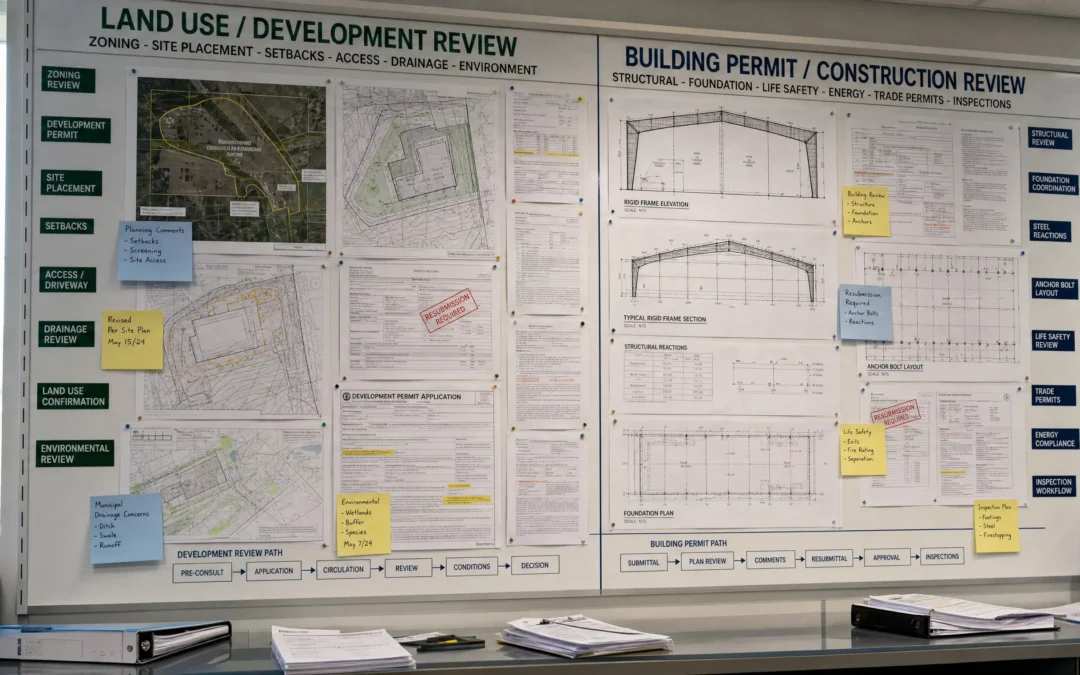
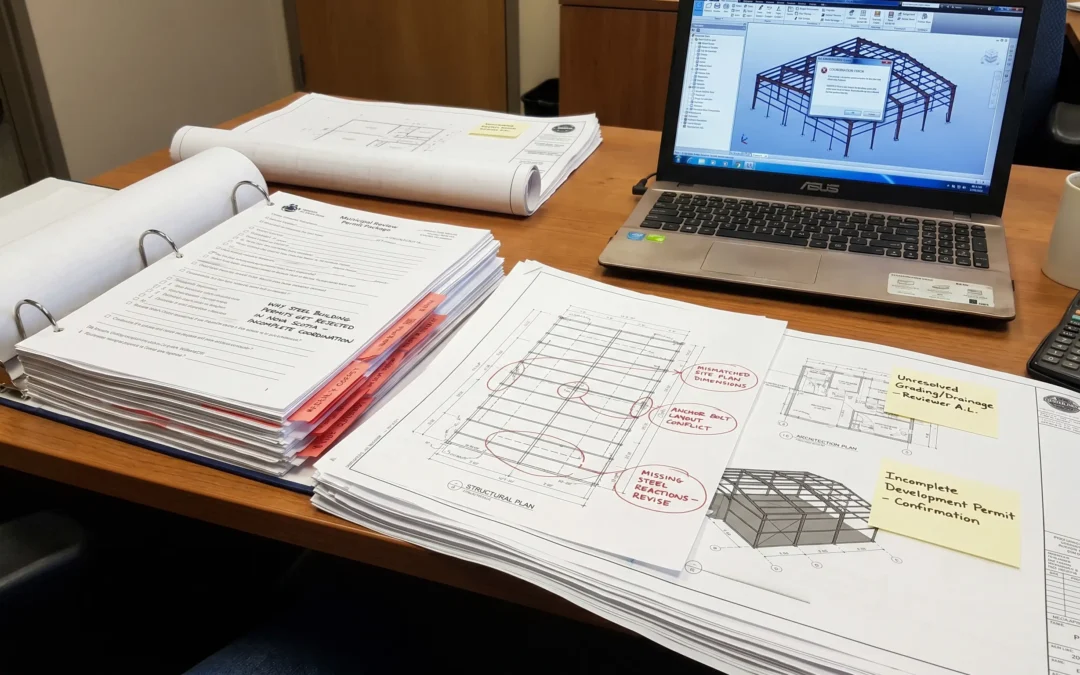
Permit Approval Depends on Verified Site Conditions
Permit reviewers verify:
- load data matches location
- geotechnical assumptions are supported
- drainage is clearly defined
- drawings are coordinated
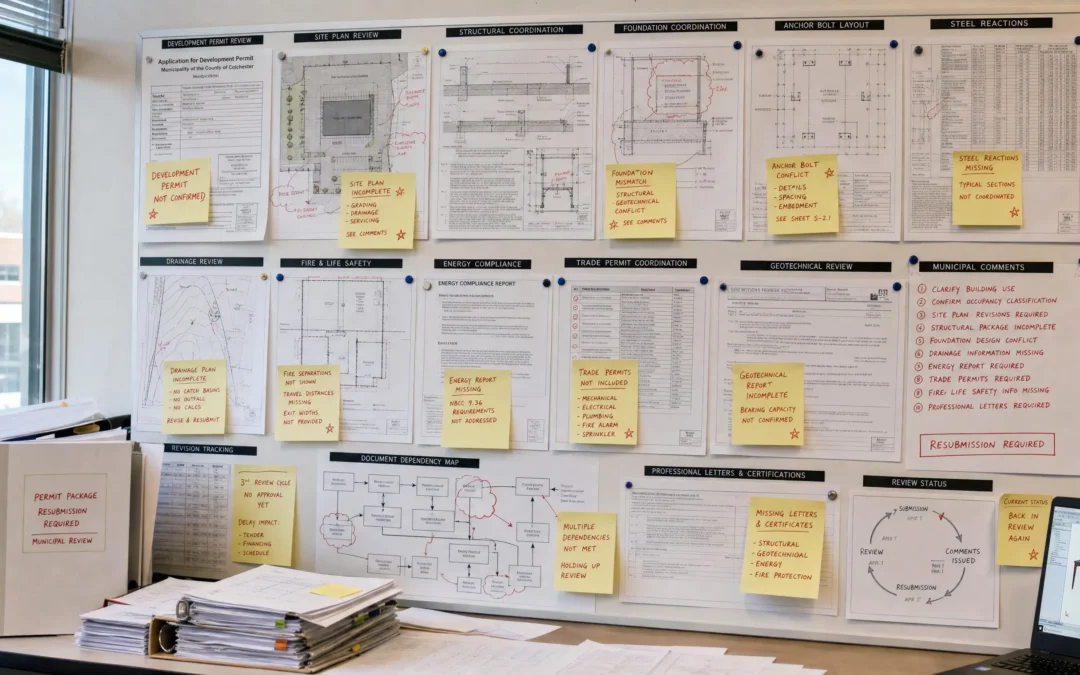
What happens in real review
- incomplete submissions are rejected early
- clarification requests are issued
- resubmissions are required
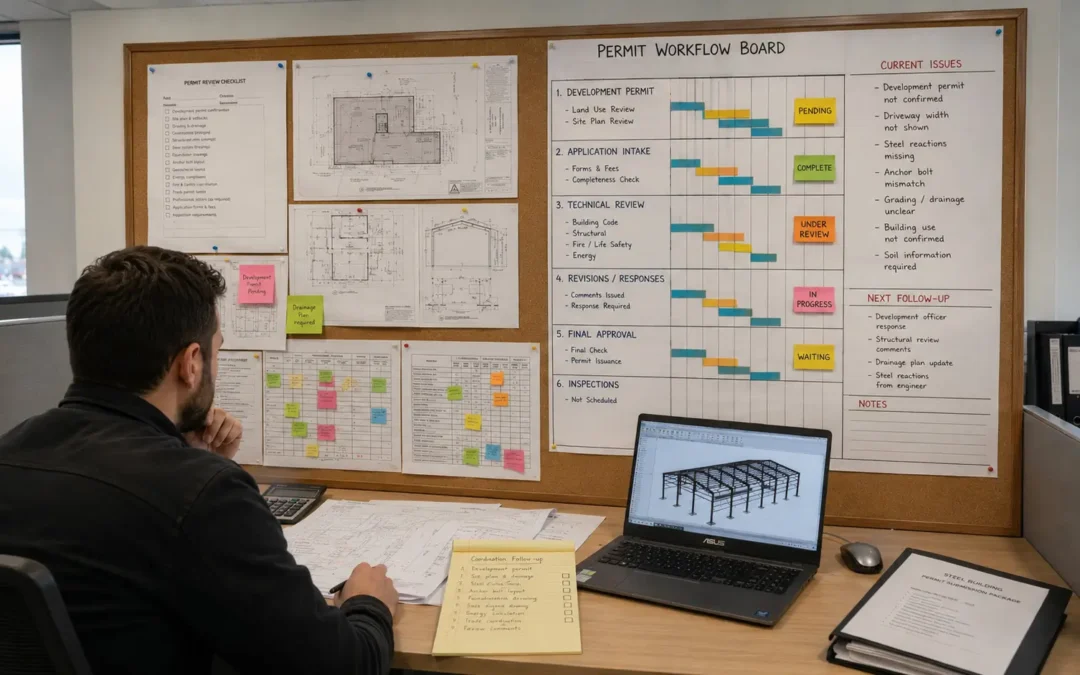
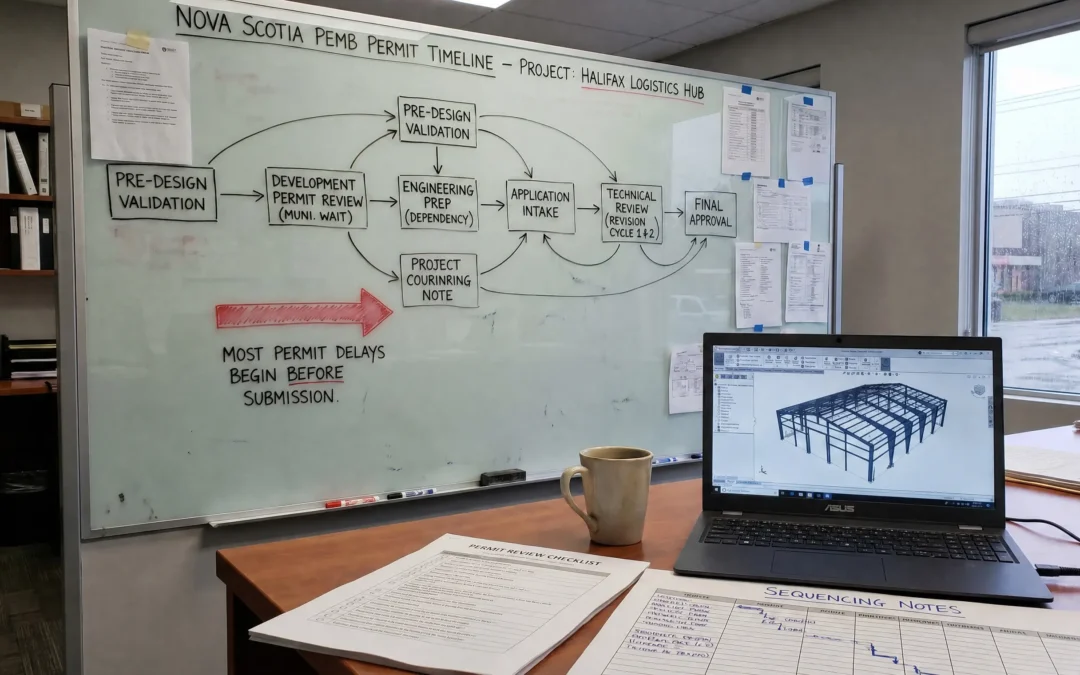
Real impact
- 2–6 week delays per cycle
- multiple review rounds
- project timeline disruption
Permits do not fail because of complexity. They fail because of uncertainty.
Incomplete inputs at this stage are one of the most common reasons outlined in steel building permit rejection mistakes, where assumptions prevent approval.
What Must Be Verified Before Final Pricing or Permit Submission
Before committing to a project, confirm:
- verified environmental loads
- geotechnical data
- drainage strategy
- building use
- opening layout
- future loads
- heating condition
If these are not defined:
- pricing is unreliable
- design is incomplete
- risk is high
How Site Mismatch Affects Long-Term Performance
Site mismatch affects lifecycle performance.
What happens over time
- minor movement becomes recurring
- moisture becomes chronic
- alignment issues worsen
Long-term impact
- increased maintenance
- repeated adjustments
- premature repairs
- reduced service life
Buildings degrade when site conditions are not properly addressed.
Real Project Scenario
A steel building was quoted using assumed loads and soil conditions.
During permit review:
- higher snow load identified
- soil capacity lower than expected
- drainage incomplete
Result
- redesign required
- foundation enlarged
- project delayed
- cost increased significantly
After first winter:
- doors required adjustment
- slab cracks developed
- water collected at perimeter
The building system was correct.
The design did not match the site.
Final Perspective
Steel buildings do not adapt to site conditions.
They respond to them.
Site conditions are not variables to adjust later. They define structural behavior from the beginning.
Planning a steel building project in Canada requires verifying loads, soil, and layout before design decisions are made.
If site conditions are not engineered into the design, the structure will adjust itself over time through movement, stress, and performance loss.
When the design does not match the site:
- loads redistribute
- support conditions change
- stress develops over time
Site conditions control structural behavior, not the standard design.
Reviewed by Engineering Team
This content has been reviewed by the Tower Steel Buildings Engineering Team based on real project conditions across varying Canadian environments, including soil behavior, frost interaction, drainage performance, structural load response, and lifecycle outcomes.
1. What is site-specific engineering in steel buildings?
Site-specific engineering is the process of designing a steel building based on verified local conditions such as snow load, wind exposure, soil capacity, frost behavior, and drainage.
Instead of using assumed values, it uses actual site data to determine structural loads, foundation design, and system performance.
Key point:
Site-specific engineering ensures the building is designed for where it will be built, not where a similar design worked before.
2. Why is site-specific engineering required in Canada?
Because environmental and ground conditions vary significantly across locations.
Factors such as:
- snow drift and accumulation
- freeze-thaw cycles
- soil moisture and frost depth
- wind exposure
directly affect structural performance.
Reality:
A design that works in one region can fail in another if these conditions are not accounted for.
3. Why can two identical steel buildings perform differently?
Because structural behavior is controlled by site conditions, not just the building design.
Differences in:
- soil support
- snow distribution
- wind exposure
- drainage
change how loads act on the structure.
Conclusion:
Identical buildings can behave differently because the forces acting on them are not identical.
4. Do I need a geotechnical report before building a steel structure?
In most commercial and large-scale projects, yes.
A geotechnical report confirms:
- soil bearing capacity
- groundwater conditions
- compaction requirements
- frost susceptibility
Decision trigger:
If soil conditions are unknown, the foundation design is based on assumptions and risk increases significantly.
5. What happens if site conditions are assumed instead of verified?
When site conditions are assumed:
- structural loads may be underestimated
- foundations may be undersized
- drainage may be ineffective
Result:
This leads to redesign, cost increases, and long-term performance issues.
Reality:
Most steel building problems originate from incorrect assumptions, not incorrect calculations.
6. How do snow loads affect steel building design?
Snow loads are not uniform. They redistribute across the roof due to drift and wind interaction.
This creates:
- localized overload zones
- uneven structural stress
- increased column reactions
Key insight:
Snow distribution, not just total snow load, controls structural demand.
7. Why is drainage considered a structural issue?
Because water affects soil strength and stability.
Poor drainage leads to:
- saturated soil
- reduced bearing capacity
- increased frost movement
Consequence:
This directly impacts foundation performance and causes long-term structural movement.
8. What are the early signs of site-related design problems?
Most problems appear as serviceability issues before structural failure.
Common signs include:
- doors not closing properly in one area
- slab cracks near columns or load zones
- water collecting along one side of the building
- seasonal movement that repeats
Action:
If these patterns repeat, the issue is likely a mismatch between design and site conditions.
9. Why do steel building permits get delayed or rejected?
Permits are delayed when site conditions are not clearly defined or verified.
Common reasons include:
- missing geotechnical data
- unclear drainage strategy
- incorrect load assumptions
- uncoordinated drawings
Impact:
Each revision cycle can delay the project by 2 to 6 weeks or more.
10. How do steel building quotes become inaccurate?
Most quotes are based on assumed conditions rather than verified data.
Typical issues include:
- standard load values used instead of local requirements
- soil conditions not tested
- drainage not defined
- future loads excluded
Result:
Costs increase after engineering begins.
Reality:
Initial pricing often reflects assumptions, not actual project cost.
11. What is the difference between assumed design and verified design?
Assumed design uses general or standard values.
Verified design uses actual site-specific data.
Key difference:
- assumed design = lower initial cost but higher risk
- verified design = accurate cost and reliable performance
Conclusion:
Verified design eliminates uncertainty and reduces long-term risk.
12. Can a steel building meet code and still perform poorly?
Yes.
Code compliance depends on correct input data. If loads, soil conditions, or drainage are incorrect:
- calculations may be valid
- but the design is based on the wrong conditions
Reality:
A code-compliant design can still fail in performance if site inputs are incorrect.
13. How do you verify if a steel building supplier is using real site data?
Ask for:
- location-specific load values
- confirmation of soil assumptions or geotechnical data
- drainage considerations
- building use and future load assumptions
Decision trigger:
If these are not clearly defined, the design is based on generic inputs.
14. Why can a building pass engineering but still fail in real use?
Because engineering depends on assumptions.
If:
- loads are underestimated
- soil behavior is incorrect
- drainage is not implemented
the building will experience:
- misalignment
- movement
- performance issues
Conclusion:
Engineering accuracy depends on correct site data, not just correct calculations.
15. When should site-specific engineering be completed?
Before final pricing and permit submission.
If it is done later:
- redesign is required
- costs increase
- project timelines are delayed
Best practice:
Define site conditions before committing to design or budget.