Steel Building Permit Timeline Alberta (Real Timelines You Can Actually Plan Around)
Most steel building permit timelines in Alberta are affected before review even begins
Steel building permit timelines in Alberta are not controlled by review speed alone.
They are shaped by:
- project readiness
- document coordination
- approval sequencing
- Authority Having Jurisdiction (AHJ) review capacity
A steel building permit timeline is not a waiting period. It is a process that reacts to how well the project is prepared before submission.
Before technical review begins, the AHJ evaluates whether the submission is usable.
If it is not:
- the file may be returned
- placed on hold
- reviewed with comments
- or require additional information before progressing
Acceptance of a submission does not mean technical review has started. It means the application is complete enough to enter the system.
Definition: Steel Building Permit Timeline Alberta
A steel building permit timeline in Alberta is the total time required for a project to move from initial planning to final approval under:
- the National Building Code – 2023 Alberta Edition, developed under the Codes Canada program administered by the National Research Council
- the Safety Codes Act, which governs permit administration and enforcement in Alberta
It includes:
- land-use confirmation
- development permit approval (if required)
- engineering and document preparation
- submission and completeness review
- technical review
- revision cycles
- final approval
This is not a single step. It is a sequence of dependent steps where delays occur when one step is incomplete.
For full approval structure, documentation requirements, and Alberta-specific permit strategy, refer to the complete Steel Building Permits Alberta guide.
Full Timeline Structure (How the Process Actually Works)
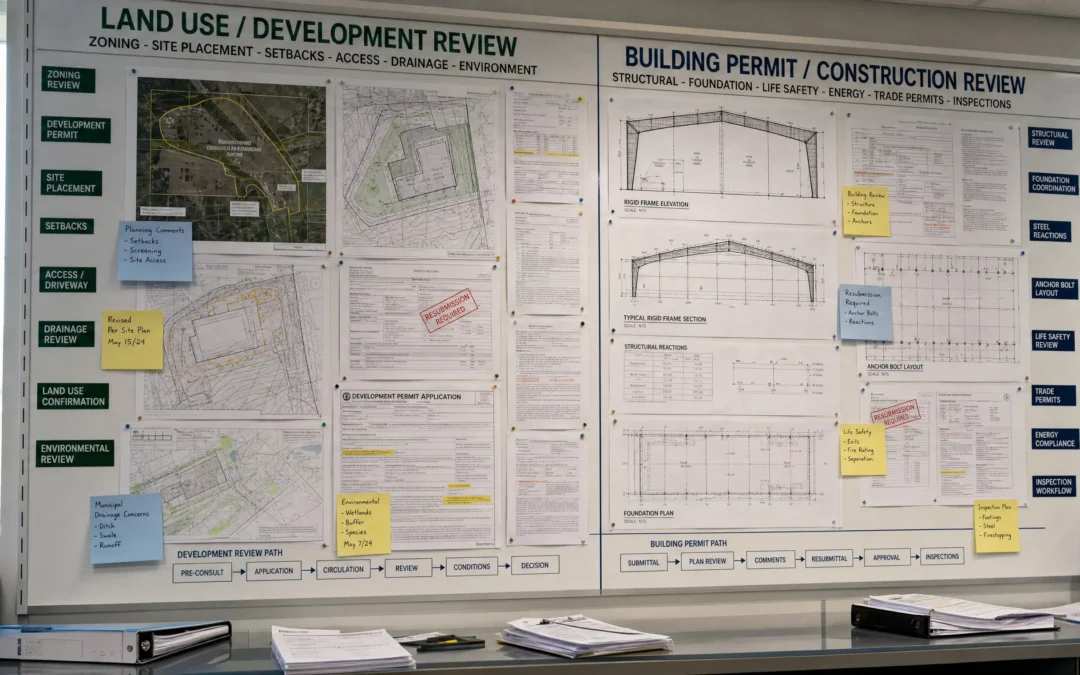
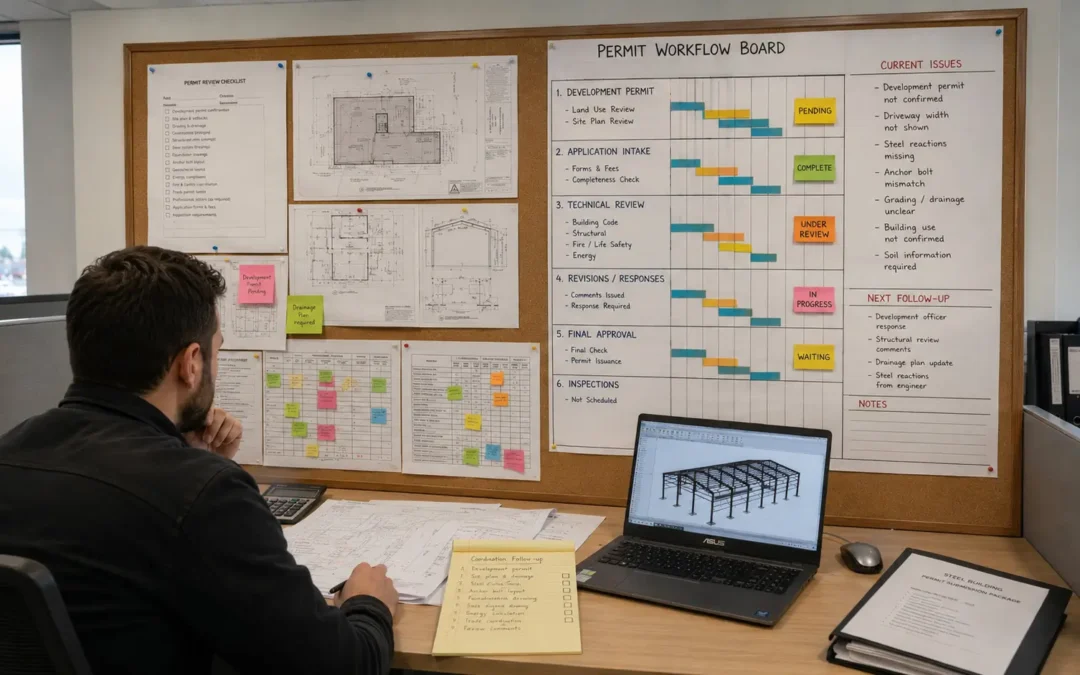
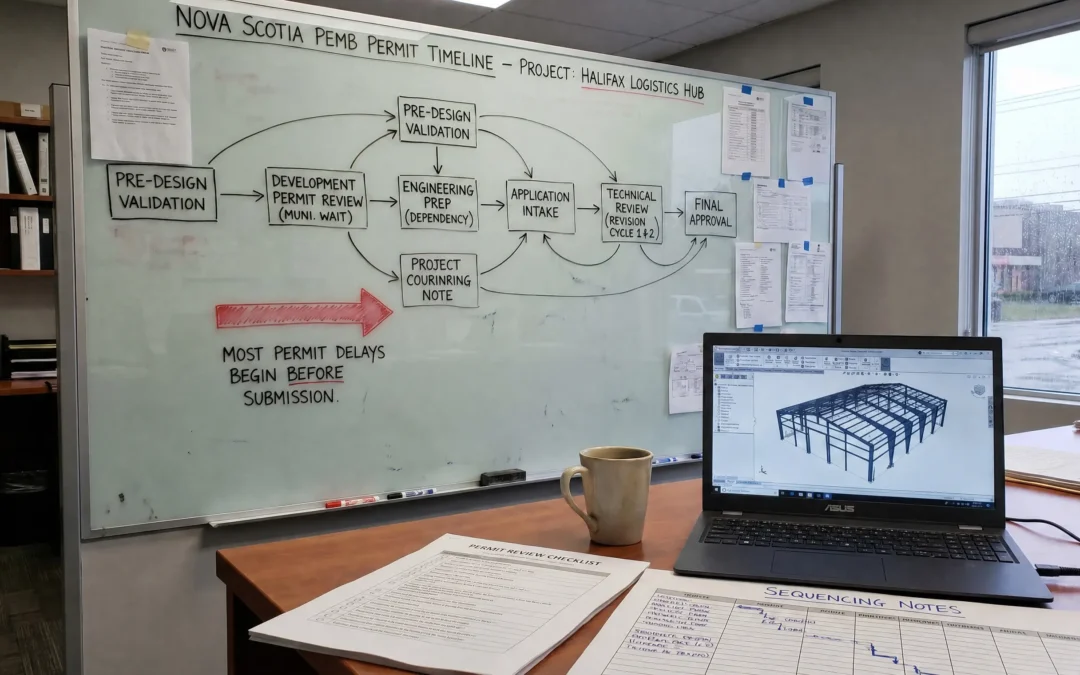
Before going into detail, the entire permit timeline can be understood in seven stages:
- Pre-design validation before submission
- Development permit (if required)
- Engineering and document preparation
- Submission and completeness review
- Technical review
- Revision cycles
- Final approval and permit issuance
Each stage has its own risks. Most delays are introduced before or between these stages, not during a single review.
The full submission sequence and approval flow are explained in the steel building permit Alberta process guide, where each stage is broken down in detail.
Timeline Ranges (Planning Guidance Only)
The following ranges are practical planning ranges, not guaranteed approval timelines.
Actual timing depends on:
- Authority Having Jurisdiction
- project type
- development approval requirements
- submission quality
- internal review workload
- how quickly issues are resolved
Stage 1: Pre-Design Validation Before Submission (1 to 4 weeks)
This is not always a formal AHJ review stage. It is the preparation period where zoning, use, site information, and approval path are confirmed before drawings are finalized.
Real timing:
- straightforward confirmation: 3 to 7 days
- unclear use or missing site data: 2 to 4 weeks
What actually happens here
This is where the project is defined in terms of:
- what the building will be used for
- whether that use is permitted on the property
- whether development approval is required
- what constraints exist on the site
When this becomes a problem
- design starts before zoning is confirmed
- site constraints are ignored
- building use is assumed instead of verified
Why it causes delays
If the building is designed without confirming land-use compliance, the entire project may need to be revised later.
What it leads to
- redesign after submission
- development permit delays
- extended timelines before technical review even begins
Stage 2: Development Permit (If Required) (2 to 8+ weeks)
Real timing:
- permitted use: 2 to 4 weeks
- discretionary use: 4 to 8+ weeks
- rezoning or variance: 8 to 16+ weeks or more
Building permit review may be paused, limited, or delayed until required land-use approval is resolved.
Timeline impact at this stage depends heavily on whether land-use approval is required, which is explained in Development Permit vs Building Permit Alberta.
What actually happens here
The municipality or planning authority evaluates:
- whether the building use is allowed
- whether the site layout complies with zoning
- whether access, setbacks, and site conditions are acceptable
When this becomes a problem
- development permit requirement is identified after engineering is complete
- the proposed use is not permitted
- site layout conflicts with zoning
Why it causes delays
The building permit cannot move forward properly if land-use approval is unresolved.
What it leads to
- redesign of the project
- revised site plans
- extended approval timelines
Stage 3: Engineering and Permit Document Preparation (3 to 8+ weeks)
Real timing:
- simple buildings: 2 to 4 weeks
- complex or coordinated projects: 4 to 8+ weeks
What actually happens here
Multiple components are developed:
- structural design
- foundation design
- site plan
- architectural layout
- coordination between all disciplines
When this becomes a problem
- responsibilities are unclear
- drawings are developed independently
- assumptions are made about site or loads
Why it causes delays
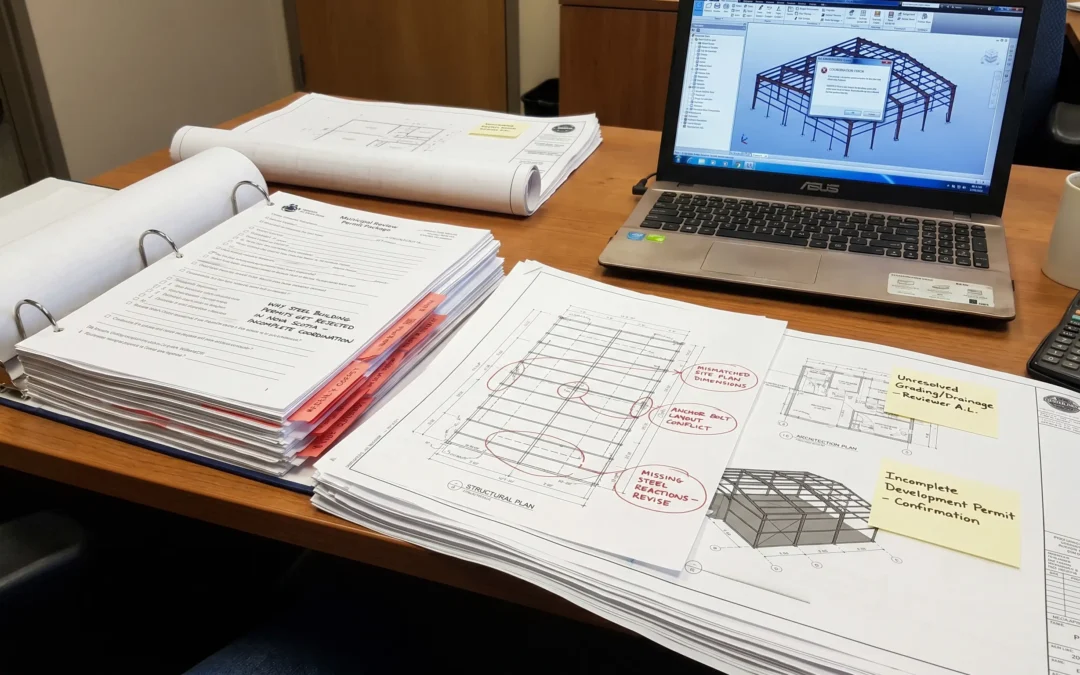
Permit review depends on consistency. If documents do not align, the AHJ must issue comments.
What it leads to
- incomplete submission
- coordination errors
- revision cycles during review
Permit timelines depend heavily on coordination at this stage, which is addressed through site-specific steel building engineering where loads, site conditions, and design assumptions are aligned before submission.
Stage 4: Submission and Completeness Review (1 to 3 weeks)
Real timing:
- clean submission: 3 to 10 days
- incomplete submission: 1 to 3 weeks or returned
What actually happens here
The AHJ determines whether:
- all required documents are included
- the submission is usable
- the project can proceed to technical review
Delays at this stage often start with incomplete or inconsistent submissions, which is why the documents required for a steel building permit in Alberta must be confirmed before applying.
Critical clarification
Acceptance does not mean approval. It does not mean technical review has started.
When this becomes a problem
- missing documents
- unclear scope
- inconsistent drawings
Why it causes delays
The AHJ cannot begin full review without a complete and coordinated submission.
What it leads to
- delay before review
- returned applications
- additional preparation time
Stage 5: Technical Review (2 to 6+ weeks per cycle)
Real timing:
- clean submission: 2 to 4 weeks
- moderate issues: 4 to 6 weeks
- complex issues: 6+ weeks
What actually happens here
The AHJ evaluates:
- structural design
- code compliance
- safety requirements
- alignment between documents
When this becomes a problem
- structural assumptions are unclear
- drawings conflict
- site conditions are not properly addressed
Why it causes delays
Reviewers must issue comments and wait for corrections before proceeding.
What it leads to
- revision cycles
- extended review time
Stage 6: Revision Cycles (2 to 6+ weeks per cycle)
Typical pattern:
- one cycle: normal
- two cycles: common
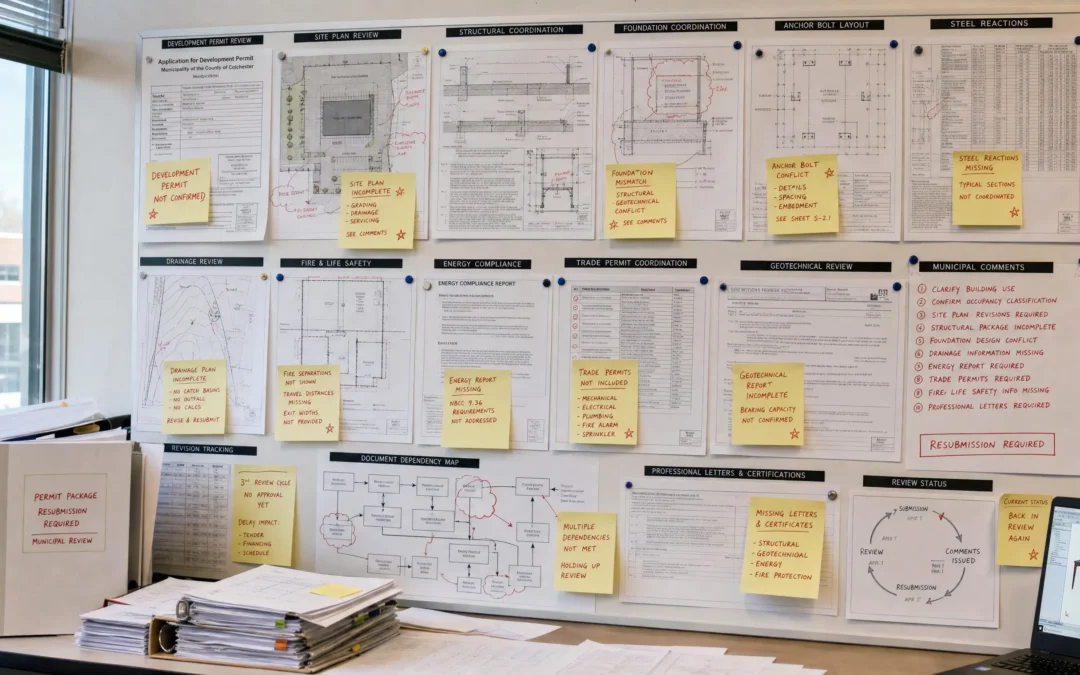
- three or more: coordination problem
What actually happens here
The applicant responds to review comments and resubmits updated documents.
When this becomes a problem
- responses are incomplete
- new issues are introduced
- coordination is still missing
Why it causes delays
Each revision must be reviewed again.
What it leads to
- repeated review cycles
- timeline extension
Queue Reality (Critical Insight)
Review is not continuous.
- submissions wait in queues
- reviews are scheduled
- revisions may re-enter queues
A revised submission does not always return to the same place in the review sequence. Depending on the AHJ process, it may wait for another review slot.
Many of these repeated cycles follow patterns outlined in steel building permit rejection mistakes, where coordination issues and incomplete responses delay approval.
Stage 7: Final Approval and Permit Issuance (1 to 2 weeks)
Once all issues are resolved:
- the permit is issued
- final conditions are confirmed
Total Project Timelines (Real Conditions)
Best-case project: 6 to 10 weeks
- zoning confirmed early
- minimal issues
- clean submission
Typical project: 10 to 16 weeks
- development permit required
- minor revisions
- normal coordination challenges
Problem project: 16 to 28+ weeks
- incomplete submission
- zoning issues
- multiple revision cycles
High-risk or complex project: 20 to 40+ weeks
- discretionary use
- rezoning
- large industrial projects
- redesign after submission
Actual timelines vary significantly depending on jurisdiction workload, approval path, project complexity, and submission quality.
What Actually Causes Delays
Primary delay triggers
- zoning not confirmed before design
- development permit discovered late
- incomplete site plan
- unclear building use
- uncoordinated structural and architectural drawings
- foundation not aligned with loads or soil
- partial responses to review comments
- changes after submission
- resubmissions entering queues
Permit timelines extend when issues are introduced, not randomly.
Final Perspective
A steel building permit timeline in Alberta is not fixed.
It is controlled by:
- preparation
- coordination
- decision timing
- issue resolution
If these are aligned, timelines are predictable.
If not, timelines extend through review cycles and queue delays.
A project is not approved faster because it is simple. It is approved faster because it is correct.
Reviewed by Engineering Team
This content has been reviewed by the Tower Steel Buildings engineering team.
It reflects real steel building permit timeline behavior across Alberta, including:
- application of the National Building Code – 2023 Alberta Edition
- permit administration under the Safety Codes Act
- Authority Having Jurisdiction (AHJ) review processes
- development permit dependencies and sequencing
- document coordination requirements across structural, site, and architectural drawings
- real comment cycle behavior and revision impacts
- queue-based review timing and resubmission effects
This guidance is based on actual project workflows, not theoretical timelines.
1. How long does a steel building permit take in Alberta?
Steel building permit timelines in Alberta typically range from 6 to 16 weeks for standard projects, and may extend to 20 to 40+ weeks for complex or high-risk projects.
This becomes a problem when a fixed timeline is assumed before zoning, development approval requirements, and document coordination are confirmed.
The delay occurs because the project must pass through multiple stages, including completeness review, technical review, and often one or more revision cycles, each of which depends on submission quality and AHJ workload.
The result is extended timelines, contractor scheduling conflicts, and increased project pressure if assumptions are incorrect.
2. What is the fastest realistic steel building permit timeline?
The fastest realistic timeline is approximately 6 to 10 weeks, but only under ideal conditions.
This becomes a problem when even minor issues exist, such as incomplete drawings or unclear building use.
The delay occurs because the AHJ must issue comments and wait for corrected documents before continuing review.
The result is that even small coordination issues can quickly move a project out of the best-case timeline range.
3. Why do steel building permit timelines increase in Alberta?
Steel building permit timelines increase when the submission requires clarification, correction, or resubmission.
This becomes a problem when drawings are incomplete, zoning is unclear, or structural, site, and architectural documents are not aligned.
The delay occurs because the AHJ must issue review comments, wait for revised documents, and re-evaluate the submission before approval can continue.
The result is additional review cycles, queue re-entry, and extended timelines.
4. Does a development permit add time to the permit process?
Yes, development approval can add several weeks or more to the overall timeline.
This becomes a problem when the need for a development permit is not identified early in the project.
The delay occurs because land-use approval must be resolved before building permit review can fully proceed, depending on the municipality and approval process.
The result is delayed submissions, redesign, and extended timelines.
5. Do revision cycles extend or reset the timeline?
Revision cycles typically extend the timeline and may effectively restart parts of the review process.
This becomes a problem when responses to review comments are incomplete or introduce new inconsistencies.
The delay occurs because revised submissions may re-enter review queues and require full or partial re-evaluation by the AHJ.
The result is longer timelines and reduced predictability in approval.
6. How long does technical review take in Alberta?
Technical review typically takes 2 to 6+ weeks per review cycle, depending on complexity and workload.
This becomes a problem when the submission contains errors, unclear assumptions, or coordination gaps.
The delay occurs because reviewers must verify compliance with the building code and may require clarification or corrections before proceeding.
The result is extended review periods and additional revision cycles.
7. Can a complete submission still be delayed?
Yes, even a complete submission can experience delays.
This becomes a problem when AHJ workload is high or when internal review queues are long.
The delay occurs because all submissions must wait their turn for review, regardless of quality.
The result is slower progression through the review process even when the project is well prepared.
8. What causes the biggest permit timeline delays?
The biggest delays are caused by incomplete submissions, unclear building use, unresolved development approval, and uncoordinated drawings.
This becomes a problem when the AHJ cannot verify compliance without requesting additional information.
The delay occurs through review comments, resubmissions, and queue re-entry.
The result is extended timelines and increased project cost.
9. Is rural Alberta faster for steel building permits?
Not necessarily.
This becomes a problem when fewer restrictions are assumed in rural areas.
The delay occurs because the same Safety Codes system applies, and coordination, documentation, and review requirements still exist.
The result is similar delays if the project is not properly prepared.
10. How can I reduce the steel building permit timeline?
The timeline can be reduced by preparing a complete and coordinated submission before applying.
This becomes a problem when projects proceed without confirming zoning, development approval requirements, and document alignment.
The delay occurs because incomplete or inconsistent submissions trigger review comments and revision cycles.
The result is extended timelines that could have been avoided with proper preparation.
11. Can a steel building permit timeline be guaranteed in Alberta?
No, a steel building permit timeline cannot be guaranteed.
This becomes a problem when buyers plan construction, financing, or contractor schedules based on assumed approval dates.
The delay occurs because timelines depend on AHJ workload, project complexity, submission quality, and approval sequencing.
The result is scheduling conflicts, cost pressure, rushed submissions, and avoidable revision cycles.
12. What is the most important factor controlling permit timeline?
The most important factor is submission quality and document coordination.
This becomes a problem when different parts of the project are developed independently without alignment.
The delay occurs because inconsistencies must be identified and corrected during review.
The result is additional comment cycles, resubmissions, and extended timelines.