How to Apply for a Steel Building Permit Alberta (Step-by-Step Process That Avoids Delays)
A steel building permit in Alberta is not just paperwork. It is a safety-code review tied to land use, engineering, and local approval requirements.
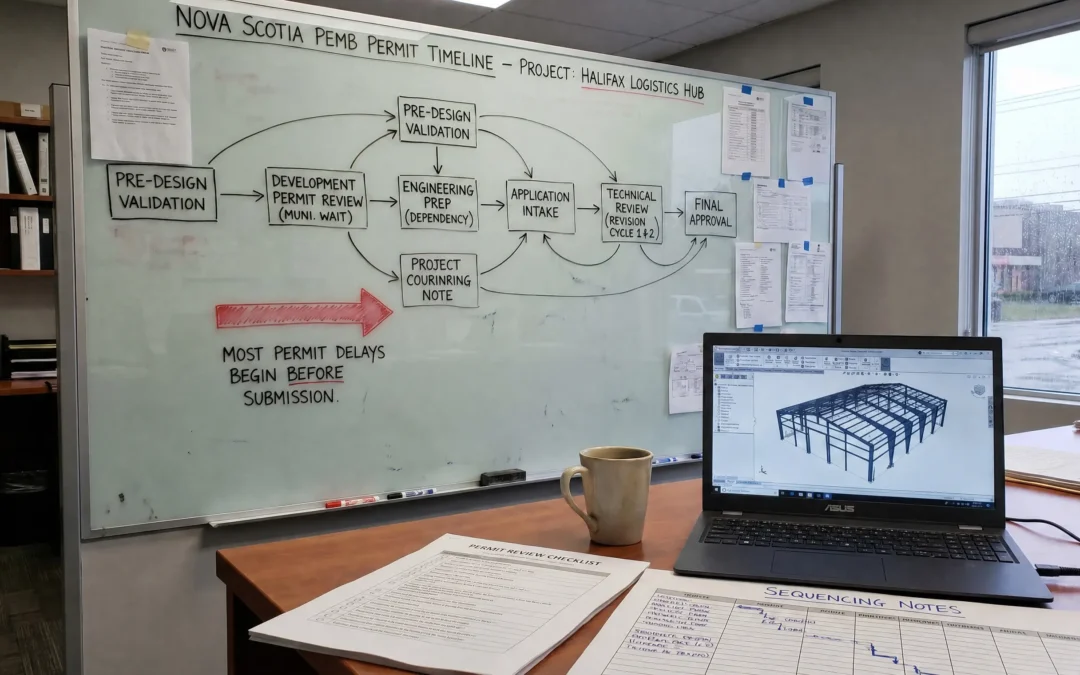
Most steel building permit delays in Alberta are caused before the application is even submitted.
In Alberta, a steel building project usually moves through two separate approval tracks:
- Development approval, which confirms whether the project is allowed on the property.
- Building permit approval, which confirms whether the building design complies with applicable safety codes.
A steel building permit application is reviewed against the National Building Code – 2023 Alberta Edition, which is currently in force in Alberta for building design and construction. Alberta’s building code system operates under the Safety Codes Act, and building safety codes officers review projects for compliance within that framework.
National model code development is administered through the Codes Canada program by the National Research Council.
The practical issue is simple:
A complete, coordinated submission usually moves faster than an application built on assumptions.
Permit timelines are affected by submission quality, project complexity, municipal or agency workload, and how quickly review comments are resolved.
To apply for a steel building permit in Alberta, the process typically involves:
1. Confirm the authority having jurisdiction
2. Define building use
3. Confirm development permit requirements
4. Prepare engineering design
5. Submit a complete permit package
6. Respond to review comments
7. Obtain permit approval
Definition: What a Steel Building Permit Means in Alberta
A steel building permit in Alberta is an approval issued by the applicable authority having jurisdiction, usually a municipality or an accredited agency, confirming that the proposed building design complies with applicable safety-code requirements.
For steel buildings, the review may include:
- structural design and load assumptions
- foundation design
- building use and occupancy classification
- fire and life safety requirements
- accessibility requirements
- site coordination where required
The permit does not confirm that the building is ideal for the business plan. It confirms that the submitted design meets the applicable code and local approval requirements.
Alberta’s Safety Codes System: What Makes the Process Different
Alberta does not treat building permits as a loose administrative step. The province operates under the Safety Codes Act, which provides the legal framework for safety-code administration, including accreditation and the role of safety codes officers. The National Building Code – 2023 Alberta Edition is adopted under this framework.
That matters because a steel building application is not reviewed only as a drawing package. It is reviewed as a code-compliance submission.
Who reviews the building permit
Depending on the location and permit setup, the authority having jurisdiction may involve:
- a municipality
- an accredited agency
- safety codes officers working within Alberta’s safety codes framework
This is why a permit process in Calgary, Edmonton, a county, or a smaller Alberta municipality may not feel identical even though the same provincial code framework applies.
What this means for applicants
You need to confirm where the application must be submitted before preparing the package. In some cases, the municipality handles the process directly. In other cases, an accredited agency may be involved in permit administration or inspection services.
Do not assume the process is identical across Alberta.
Development Permit vs Building Permit in Alberta
This is one of the most important distinctions for steel building buyers.
Development permit
A development permit deals with land use.
It answers questions like:
- Is this use allowed on the property?
- Does the building fit within setbacks?
- Does the site layout satisfy local land-use rules?
- Are access, parking, height, and lot coverage acceptable?
Building permit
A building permit deals with code and construction compliance.
It answers questions like:
- Is the structure designed correctly?
- Are the drawings complete?
- Does the foundation design match the loads and site conditions?
- Does the building meet applicable fire, accessibility, and safety requirements?
Why this distinction matters
A project can be structurally sound and still fail at the development-permit stage if the proposed use or site layout does not comply with the land-use bylaw.
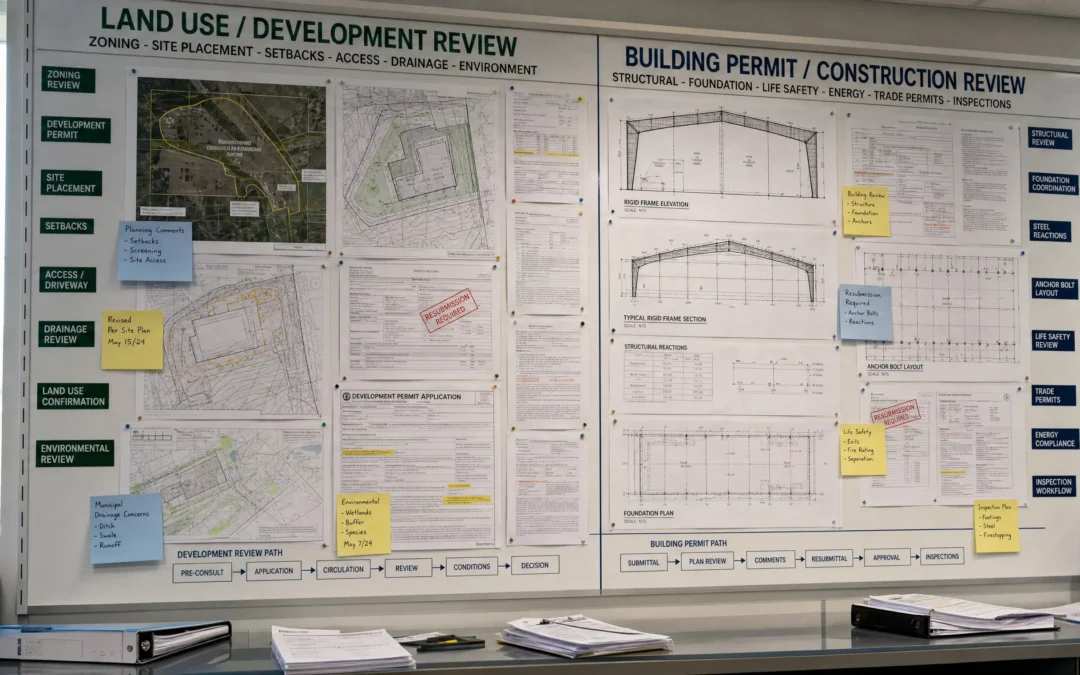
The correct order is usually:
- confirm land-use feasibility
- confirm development-permit requirements
- prepare permit-ready engineering
- submit the building permit package
If this sequence is reversed, the project may spend money on engineering before proving that the site can legally support the proposed use.
Step 1: Confirm the Authority Having Jurisdiction
Before preparing a steel building permit package, confirm who reviews and administers the approval.
This may be:
- the local municipality
- a county or municipal district
- an accredited agency operating within Alberta’s Safety Codes system
What goes wrong
Applicants sometimes prepare drawings first, then discover:
- the wrong application path was used
- a development permit was required first
- additional local documents are needed
- the municipality requires a different submission format
Result
The application may be held, returned for missing information, or reviewed only after the required local process is satisfied.
Step 2: Define the Building Use Before Design
Building use controls almost everything in the approval process.
It affects:
- occupancy classification
- fire protection requirements
- accessibility requirements
- parking and site layout
- structural design assumptions
A “shop” can mean different things:
- private storage shop
- vehicle repair shop
- commercial service building
- light industrial workspace
- agricultural support building
Each can trigger different review concerns.
What goes wrong
The building is described too broadly, and the design proceeds before the use is properly defined.
Result
During review, the authority may ask for clarification or require changes to the design, layout, fire protection, exiting, accessibility, or parking assumptions.
Step 3: Confirm Development Permit Requirements
Before spending heavily on final building design, confirm whether a development permit is required.
This is especially important for:
- commercial buildings
- industrial buildings
- agricultural-adjacent uses
- buildings on rural parcels
- projects involving new access, parking, or site layout changes
What planners may review
- permitted use
- site coverage
- setbacks
- height
- access
- parking
- drainage or servicing constraints
Practical warning
A building can meet structural code requirements and still be delayed if development approval is incomplete.
Step 4: Prepare Alberta-Appropriate Engineering
Steel building drawings should be prepared or reviewed by professionals licensed to practise engineering in Alberta.
APEGA regulates the practice of engineering and geoscience in Alberta.
APEGA regulates the practice of engineering and geoscience in Alberta, including professional authentication expectations for engineering work products.
APEGA also sets authentication requirements for professional work products and confirms that digital signatures verify the right to practise in Alberta at the time of signing.
For companies providing engineering services in Alberta, APEGA’s Permit to Practice requirements may apply. APEGA states that companies practising engineering or geoscience in Alberta as part of their business must hold a Permit to Practice.
What this means for steel buildings
The permit package should clearly show:
- who is responsible for the engineering
- what drawings are authenticated
- what design scope is covered
- whether structural, foundation, and related elements are coordinated
What goes wrong
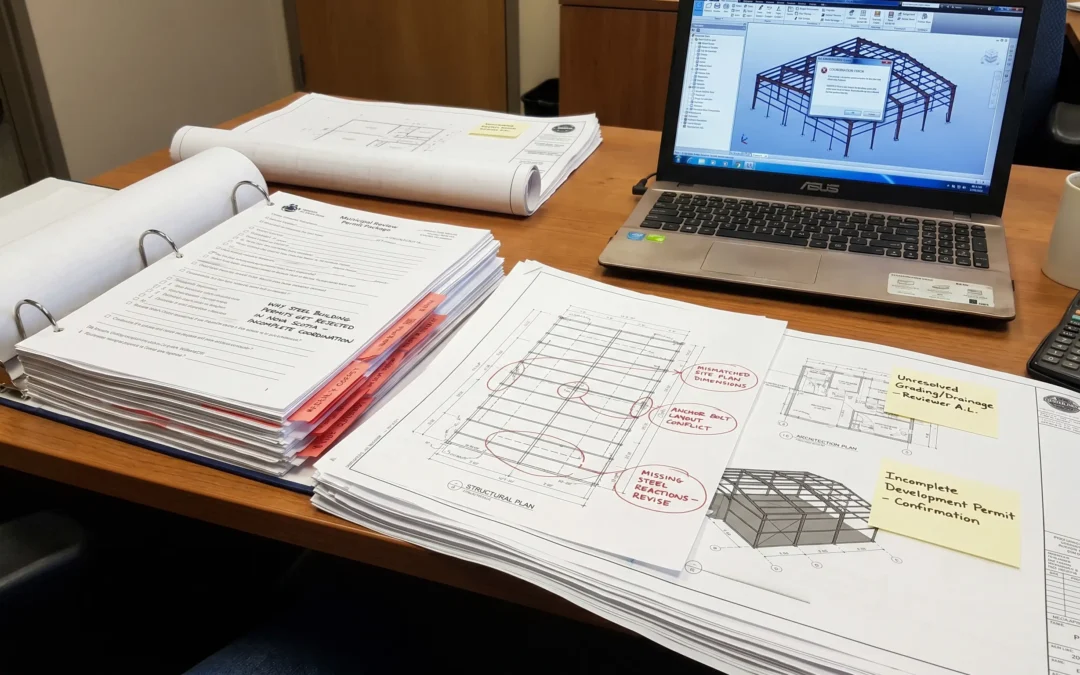
Review issues often appear when:
- structural drawings are stamped but foundation assumptions are unclear
- architectural layouts conflict with structural drawings
- load assumptions are not clearly shown
- engineering scope is not obvious
Result
The reviewer may request clarification, revised drawings, or additional engineering documentation.
Step 5: Prepare a Complete Building Permit Submission
A steel building permit package commonly includes:
- building permit application form
- site plan
- development permit confirmation, if applicable
- architectural or layout drawings
- structural drawings
- foundation design
- applicable engineering authentication
- supporting reports, if required by the project or municipality
The exact requirements vary by municipality and project type.
What makes a package weak
- unclear use
- missing drawings
- inconsistent dimensions
- unclear foundation design
- missing site plan information
- unsupported structural assumptions
What happens
The file may be returned as incomplete, held for additional information, or moved into a comment cycle before approval.
A more accurate way to say it is:
Incomplete applications do not always get rejected immediately, but they do create review friction and delay.
That language is more accurate than saying every incomplete application simply “does not move forward.”
Why Most Steel Building Permits Get Delayed or Rejected in Alberta
Permit rejections in Alberta are rarely caused by complex engineering.
They are caused by mismatched assumptions between design, site conditions, and regulatory requirements.
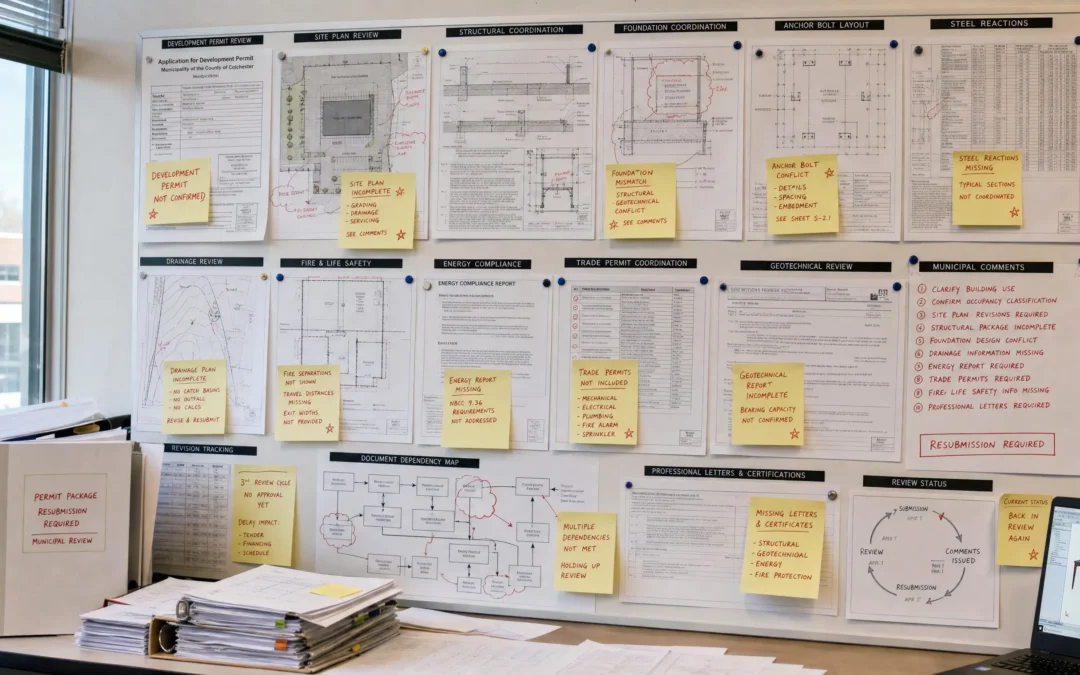
Common failure points include:
- development approval not aligned with building design
- structural loads not matching actual building use
- missing or incorrect geotechnical assumptions
- incomplete or inconsistent drawing packages
- connection and foundation details not coordinated
From an inspection standpoint, reviewers are not looking for perfection.
They are looking for clarity and consistency.
Inspectors reject uncertainty, not complexity.
That same approval failure pattern is explained in steel building permit rejection mistakes, where unclear drawings and missing site information create review problems.
When drawings leave gaps, conflict internally, or do not reflect site reality, the application is delayed or returned.
Permit-ready drawings depend on site-specific steel building engineering where loads, soil, drainage, and layout are verified before submission.
This is why experienced permit strategy is not optional on steel building projects. It directly controls approval speed, construction timeline, and overall project cost.
Step 6: Understand How Review Actually Works
Permit review is not one single step.
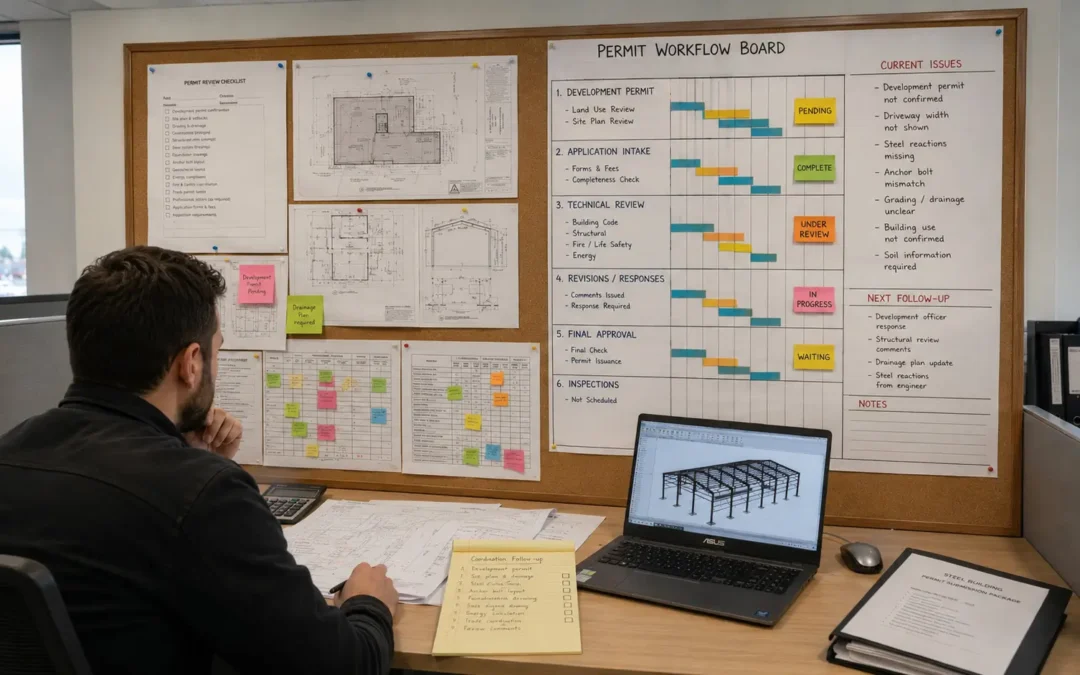
It usually includes:
- completeness screening
- land-use or planning confirmation, if required
- technical review
- comments or correction requests
- resubmission
- final approval
What reviewers commonly flag
- missing documents
- unclear building use
- inconsistent drawings
- unsupported foundation assumptions
- incomplete engineering scope
- unresolved development-permit conditions
Important accuracy point
Submission quality is a major factor in timelines, but it is not the only factor.
Review timelines can also be affected by:
- municipal workload
- project complexity
- seasonal volume
- number of departments involved
- speed of applicant responses
A stronger and more accurate anchor line is:
Permit timelines are shaped by submission quality, project complexity, reviewer workload, and how quickly comments are resolved.
This is safer and more truthful than saying timelines are controlled only by submission quality.
Step 7: Respond to Review Comments Properly
Review comments are not a failure by themselves.
They are part of the approval process.
The problem is poor response quality.
What causes repeated cycles
- answering only part of a comment
- revising one drawing but not coordinating others
- changing the design without updating calculations
- failing to clarify responsibility for engineering scope
Result
The reviewer may issue another comment round, which extends the timeline.
Prevention
Respond to comments as a coordinated package.
Do not send piecemeal corrections unless the authority specifically allows or requests it.
Step 8: Permit Issuance and Inspection
Once the building permit is issued, construction can proceed according to the approved drawings and conditions.
Inspections may include:
- foundation inspection
- framing inspection
- final inspection
- discipline-specific inspections where applicable
Critical reality
Permit approval does not mean the building can be built differently in the field.
Construction must match the approved drawings.
If field conditions require changes, those changes may need approval before work continues.
Common Alberta Steel Building Permit Problems
1. Development permit was missed
The applicant treats the project as a building-code issue, but the municipality requires development approval first.
2. Use is unclear
A “shop” or “storage building” is not defined precisely enough for occupancy and land-use review.
3. Engineering scope is incomplete
Structural drawings may be present, but foundation design, connection details, or load assumptions are unclear.
4. Site plan is weak
Setbacks, access, grading, or drainage information may be missing or unclear.
5. Documents do not match
Dimensions, door locations, occupancy assumptions, or building areas differ across drawings.
Final Perspective
Applying for a steel building permit in Alberta is not just submitting drawings. For full approval requirements, site conditions, and permit risks, refer to our steel building permits Alberta guide.
It is proving that the project is allowed, code-compliant, properly engineered, and coordinated with the site.
The most reliable path is:
- confirm the authority having jurisdiction
- confirm development-permit requirements
- define the building use
- prepare Alberta-appropriate engineering
- submit a complete, coordinated package
- respond to comments completely
Permit timelines are shaped by submission quality, project complexity, reviewer workload, and how quickly comments are resolved.
That is the accurate Alberta reality.
Reviewed by Engineering Team
This content has been reviewed by Tower Steel Buildings engineering team.
The guidance reflects Alberta-specific permit realities, including:
- the Safety Codes Act framework
- review under the National Building Code – 2023 Alberta Edition
- the role of municipalities, accredited agencies, and safety codes officers
- development permit and building permit sequencing
- engineering authentication expectations through APEGA
- common causes of review comments, resubmissions, and inspection issues
This content is intended as practical guidance only. Exact submission requirements, fees, review timelines, and permit pathways vary by municipality, accredited agency, project type, and site conditions.
1. What code applies to steel building permits in Alberta?
Steel building permit review in Alberta is based on the National Building Code – 2023 Alberta Edition, along with applicable municipal bylaws and project-specific requirements.
2. Is a development permit the same as a building permit in Alberta?
No.
A development permit deals with land use, setbacks, site layout, parking, and whether the project is allowed on the property.
A building permit deals with code compliance, engineering, safety, and construction requirements.
3. Who approves a steel building permit in Alberta?
The authority having jurisdiction may be a municipality or, depending on the location and arrangement, an accredited agency operating within Alberta’s Safety Codes system.
4. Do I need an Alberta engineer for a steel building permit?
Steel building structural design should be prepared or authenticated by professionals licensed to practise engineering in Alberta. APEGA regulates engineering practice in Alberta and sets authentication requirements for professional work products.
5. What causes steel building permits to be delayed in Alberta?
Common causes include incomplete drawings, unclear building use, unresolved development-permit requirements, inconsistent documents, missing reports, or review comments that are not fully answered.
6. Can I apply for a building permit before confirming zoning?
You can ask the municipality about process requirements, but it is risky to prepare final engineering before confirming land-use feasibility. If the proposed use or site layout is not permitted, engineering work may need to be revised.
7. What should be included in a steel building permit submission?
A typical package may include a site plan, building permit application, development permit confirmation if required, architectural or layout drawings, structural drawings, foundation design, engineering authentication, and supporting reports if required.
8. Are permit requirements the same across Alberta?
No.
The provincial code framework applies across Alberta, but submission requirements, fee schedules, intake processes, and review timelines vary by municipality, accredited agency, project type, and site conditions.
9. What happens if the submitted drawings are incomplete?
The file may be returned, placed on hold, or reviewed with comments requesting missing information. Incomplete or inconsistent submissions usually create delays and resubmission cycles.
10. Can construction start before the permit is issued?
Generally, construction should not start until the required permit is issued. Starting without the required approval can lead to enforcement action, stop-work issues, or required corrections depending on the authority having jurisdiction.