Development Permit vs Building Permit Alberta (What Actually Matters Before You Build)
Most steel building projects in Alberta get delayed because the permit process is misunderstood
Development permits and building permits are often treated as the same step.
They are not.
They control different parts of a project, and misunderstanding the difference is one of the most common reasons projects are delayed, redesigned, or pushed into extended approval timelines.
Steel building projects do not typically fail because the structure is complex.
They fail because:
- land use is not confirmed before design
- the wrong approval is pursued first
- the sequence of approvals is misunderstood
- coordination between disciplines is incomplete
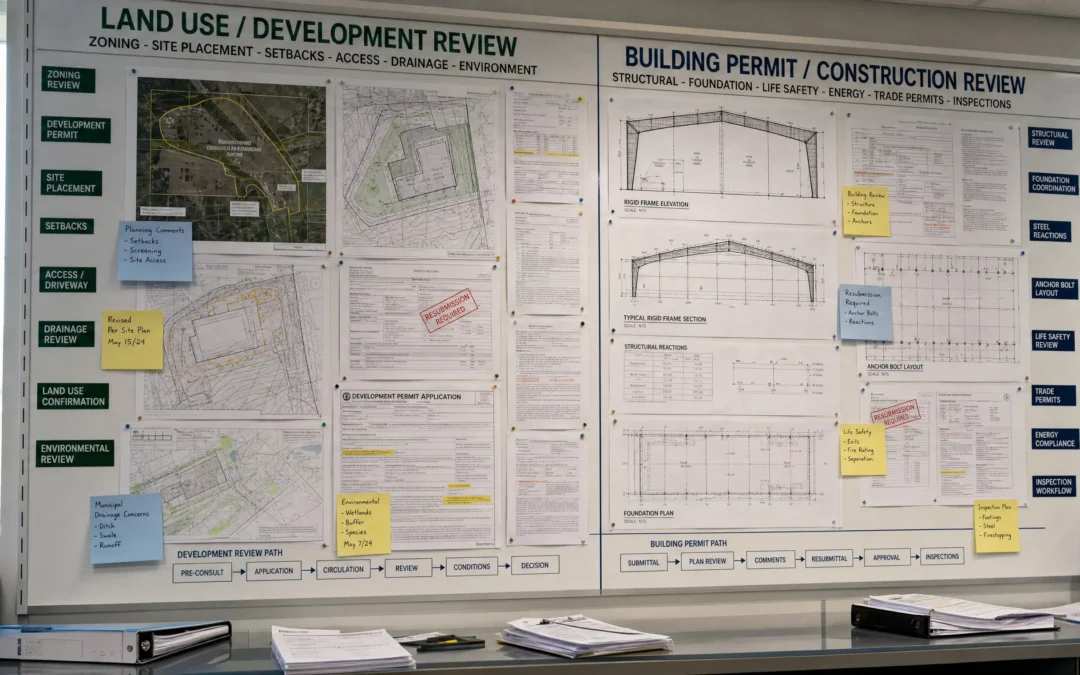
A steel building project in Alberta is approved through two separate checks: land-use compliance and building code compliance.
For the complete approval framework, sequencing, and permit strategy, refer to the full Steel Building Permits Alberta guide.
Definition: Development Permit vs Building Permit in Alberta
A development permit evaluates whether a project is allowed on a specific property based on zoning and municipal land-use bylaws.
A building permit evaluates whether the building design complies with structural, safety, and code requirements.
Both approvals operate within Alberta’s regulated framework under:
- the Safety Codes Act
- the National Building Code – 2023 Alberta Edition, developed under the Codes Canada program administered by the National Research Council
A steel building project in Alberta is approved through two separate checks: land-use compliance and building code compliance, both of which must align before final approval.
How the Permit System Actually Works in Alberta
In Alberta, permits are not handled as a single unified approval process.
They are administered through:
- municipal planning departments (for development permits)
- municipalities or accredited agencies acting as the Authority Having Jurisdiction (AHJ) for building permits
This structure exists under Alberta’s Safety Codes system.
Authority Having Jurisdiction (AHJ)
The Authority Having Jurisdiction (AHJ) may be:
- a municipality
- or an accredited agency authorized under provincial legislation
In Alberta, development permit review is typically handled by municipal planning departments, while building permit review is administered by the AHJ under the Safety Codes system.
Key Difference (Clear Comparison)
| Aspect | Development Permit | Building Permit |
| Purpose | Land-use approval | Structural and code compliance |
| Focus | Zoning, setbacks, site layout | Safety, structure, building systems |
| Governed by | Municipal bylaws | National Building Code – Alberta Edition |
| Approval type | Planning | Technical |
| Impact | Determines if you can build | Determines if the building is safe |
Development Permit (What It Actually Controls)
A development permit determines whether the proposed building is allowed on the property.
What is reviewed
- zoning classification
- permitted or discretionary use
- setbacks and building placement
- site layout
- access and servicing
Permitted vs Discretionary Use (Critical Alberta Concept)
Land uses are classified as:
- permitted
- discretionary
Permitted use
Allowed if all bylaw requirements are met.
Discretionary use
Requires additional review and may include conditions or refusal.
When this becomes a problem
- building use is assumed without verification
- discretionary use is not identified early
- zoning restrictions are ignored
Why it matters
Development approval determines whether the project can proceed at all.
What it leads to
- delays
- redesign
- potential rejection
A development permit is not required in all cases, but must always be confirmed before proceeding.
Building Permit (What It Actually Controls)
A building permit evaluates whether the building is structurally safe and compliant.
What is reviewed
- structural design
- load assumptions (snow, wind, environmental loads)
- foundation design
- fire and life safety
- compliance with building code
Engineering Requirement
All structural design must be prepared or reviewed by a licensed Professional Engineer registered with APEGA.
When this becomes a problem
- incomplete drawings
- inconsistent documents
- unsupported assumptions
Why it matters
The AHJ must verify safety before issuing approval.
What it leads to
- review comments
- revision cycles
- extended timelines
How Development Permit and Building Permit Work Together
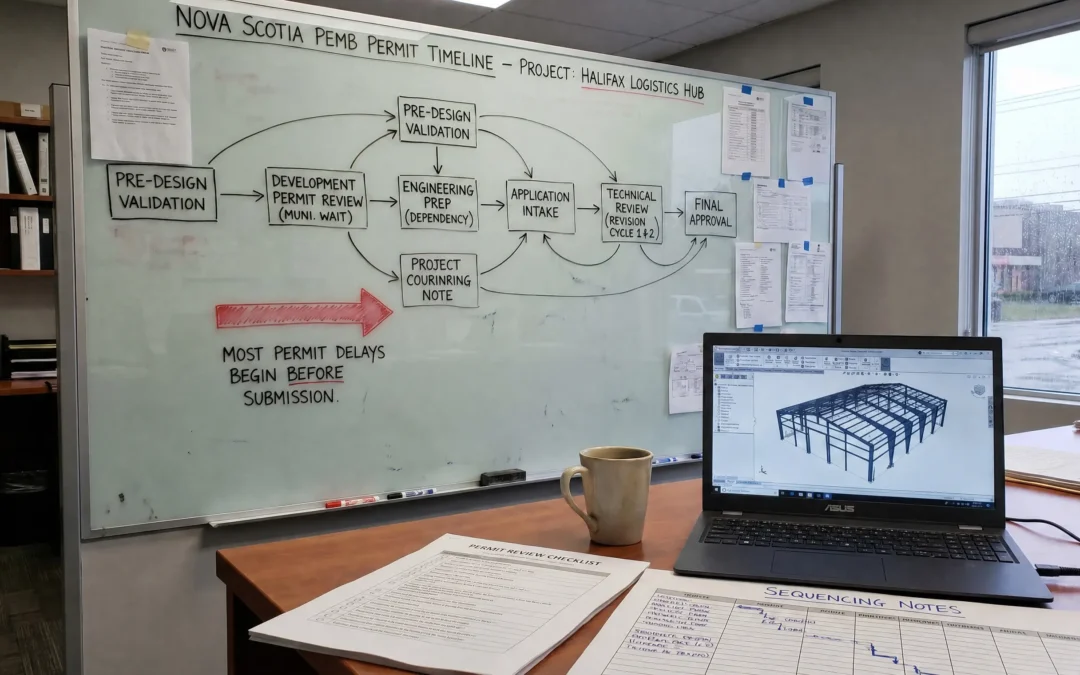
They are typically sequential and interdependent, but may be processed in parallel depending on the municipality.
The full approval flow and submission sequence are outlined in steel building permit Alberta process, where each stage is defined before review begins.
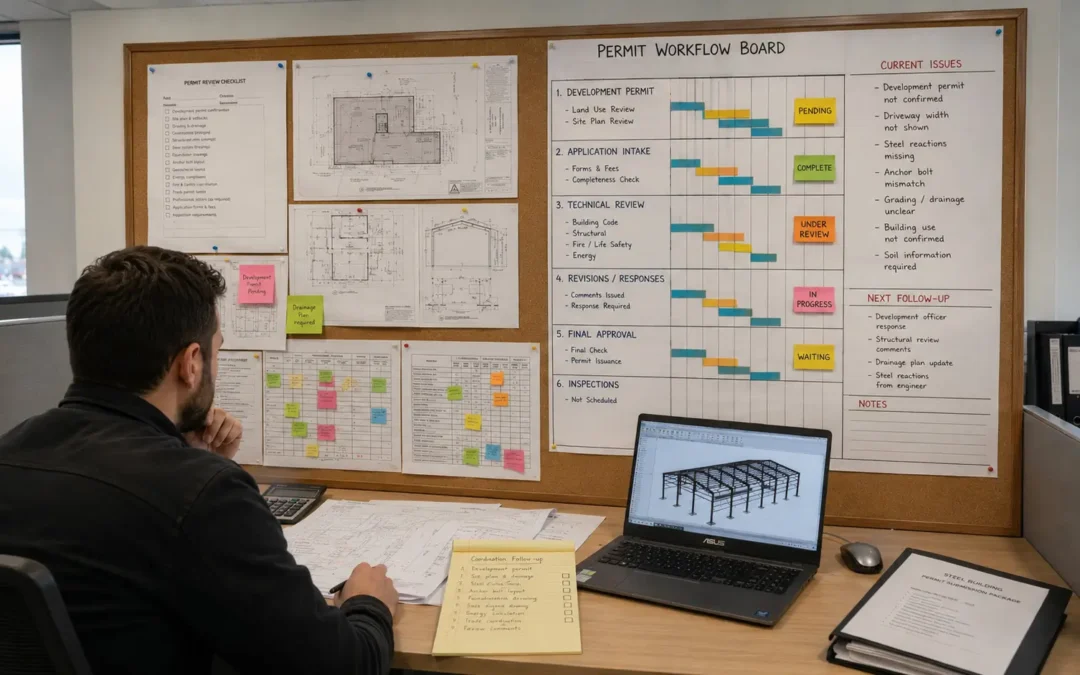
Typical sequence
- confirm land use
- determine development permit requirement
- obtain development approval (if required)
- prepare coordinated design
- submit building permit
Critical reality
Building permit review may be paused, limited, or delayed until required land-use approval is resolved.
Real-world edge case
Design changes after development approval may require re-approval, which can extend timelines and require updated submissions.
Real Project Flow (What Actually Happens)
Correct approach
- zoning confirmed early
- development permit requirement verified
- approval path defined
- design prepared accordingly
- building permit submitted
Common incorrect approach
- building designed first
- zoning checked later
- development issues discovered
- redesign required
- resubmission
Result
- lost time
- increased cost
- extended approval timeline
What Goes Wrong in Real Projects
1. Zoning Not Confirmed Early
Why it happens
assumptions are made
What it leads to
- redesign
- approval delays
2. Development Permit Requirement Missed
Why it happens
approval sequence not understood
What it leads to
- process interruption
- extended timelines
3. Design Done Before Approval Path Is Clear
Why it happens
focus placed on building before site
What it leads to
- rework
- delays
This typically occurs when engineering is not aligned with site conditions and approval requirements, which is addressed through site-specific steel building engineering.
4. Drawings Not Coordinated
Why it happens
multiple parties working independently
What it leads to
- inconsistencies
- revision cycles
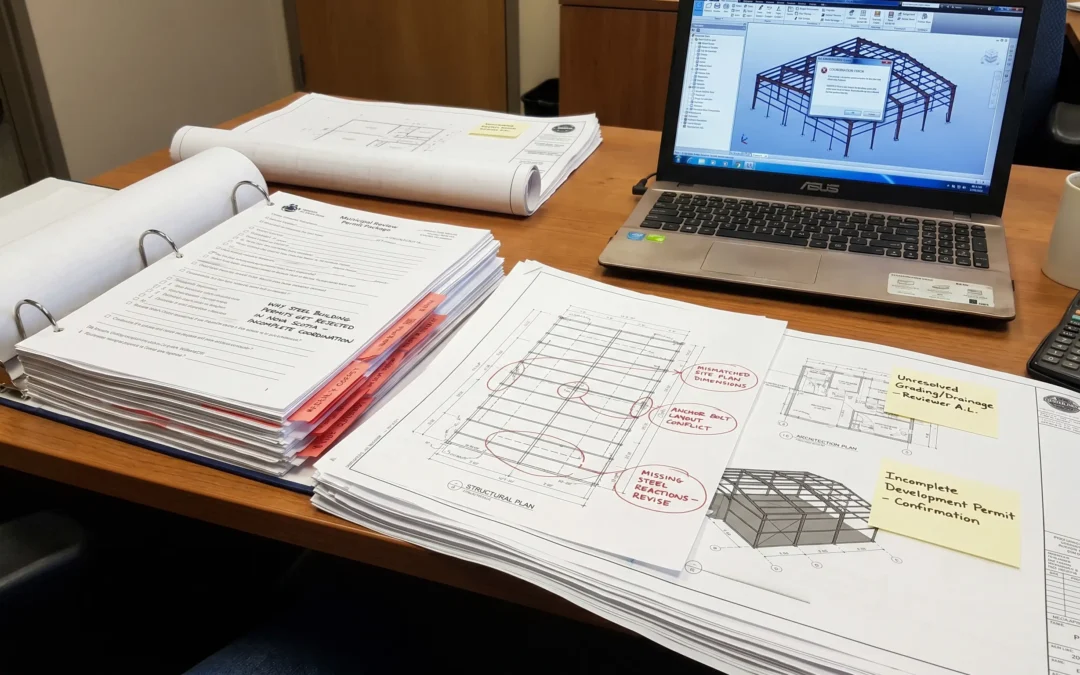
These issues reflect common approval failures outlined in steel building permit rejection mistakes, where sequencing and coordination errors prevent progress.
Responsibility Gap (Major Hidden Issue)
Permit issues often occur when responsibility between:
- building supplier
- structural engineer
- site designer
- owner or contractor
is not clearly defined.
What it leads to
- incomplete submissions
- coordination failures
- delays
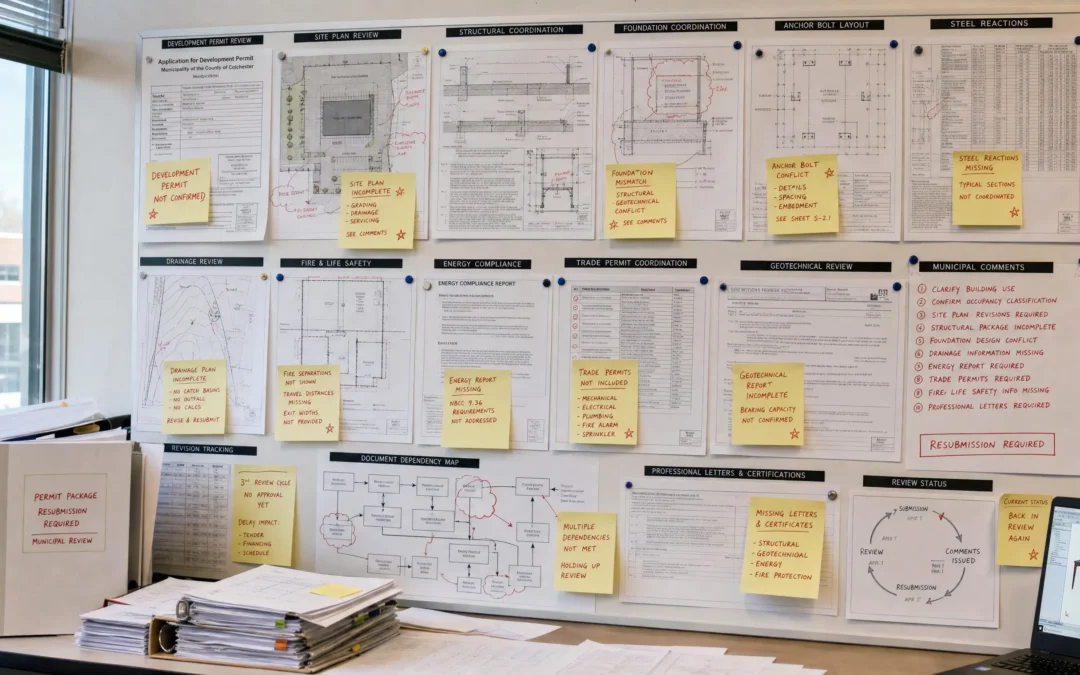
Most permit problems are coordination failures, not engineering failures.
Timeline Impact (Why This Matters)
Understanding the difference between development permit and building permit directly affects the project timeline.
If handled correctly
- approvals move predictably
- fewer revisions
- faster timelines
If misunderstood
- approvals stall
- redesign occurs
- multiple review cycles are introduced
Misunderstanding this sequence is one of the main reasons steel building permit timelines in Alberta extend beyond initial expectations.
These timeline effects are explained in steel building permit timeline Alberta, where each approval stage and delay condition is broken down.
Final Perspective
Development permits and building permits are not interchangeable.
They control different parts of the project and must be approached correctly.
A project progresses efficiently when:
- land use is confirmed early
- approval sequence is understood
- documents are coordinated
A project slows down when:
- assumptions are made
- approvals are misunderstood
- coordination is incomplete
Approval does not depend on how fast you submit. It depends on whether each step is correct before moving forward.
Reviewed by Engineering Team
This content has been reviewed by the Tower Steel Buildings engineering team.
It reflects real project conditions and approval processes across Alberta, including:
- application of the National Building Code – 2023 Alberta Edition
- permit administration under the Safety Codes Act
- the role of municipal planning departments in development permit review
- building permit review conducted by the Authority Having Jurisdiction (AHJ)
- coordination requirements between structural, site, and architectural design
- real causes of delays, redesign, and approval challenges
This information is based on practical project experience, not theoretical interpretation.
1. What is the difference between a development permit and a building permit in Alberta?
A development permit confirms whether a project is allowed based on zoning and land-use bylaws, while a building permit confirms that the building design meets structural and safety requirements.
This becomes a problem when both approvals are treated as a single step.
The issue occurs because land-use compliance and building code compliance are evaluated separately.
The result is delays, redesign, and approval issues.
2. Do I always need both permits?
Both approvals are often required, but not in all cases.
This becomes a problem when requirements are assumed without confirmation.
The issue occurs because municipal rules vary.
The result is incorrect submissions and delays.
3. Which permit comes first?
Development permit requirements should be confirmed first.
This becomes a problem when design starts without zoning verification.
The issue occurs because building permit review may depend on land-use approval.
The result is delays and redesign.
4. Can both permits be processed together?
Sometimes partially, depending on the municipality.
This becomes a problem when full parallel processing is assumed.
The issue occurs because development approval may still control the process.
The result is delays.
5. What happens if zoning is not confirmed early?
The project may require redesign.
This becomes a problem when use does not align with zoning.
The issue occurs because land-use compliance is required.
The result is delays and added cost.
6. What causes delays between permits?
Poor sequencing and coordination.
This becomes a problem when development approval is incomplete.
The issue occurs because building permit review depends on it.
The result is extended timelines.
7. Why do projects get redesigned?
Because early assumptions were incorrect.
This becomes a problem when zoning or site constraints are not verified.
The issue occurs because both permits evaluate different aspects.
The result is redesign and delay.
8. What is the biggest mistake in the process?
Treating both permits as one step.
This becomes a problem when sequencing is misunderstood.
The issue occurs because approvals are separate.
The result is delays and rework.
9. Can design changes affect approvals after development permit?
Yes.
This becomes a problem when changes occur after approval.
The issue occurs because re-review may be required.
The result is extended timelines and updated submissions.