Documents Required for a Steel Building Permit in Alberta (Complete Breakdown Before You Apply)
Most steel building permit applications in Alberta are delayed before review even begins
In Alberta, steel building permits are not delayed because of complex engineering.
They are delayed because:
- required documents are missing
- submitted documents are incomplete
- documents do not align with each other
Before any structural or code compliance review begins, the Authority Having Jurisdiction (AHJ) evaluates whether the submission is usable.
If the submission is not usable:
- the application may be returned
- placed on hold
- or moved into a revision cycle
Permit approval depends on documentation quality before technical review even starts.
Permit approval is based on complete and coordinated documentation, not just engineering design.
Definition: What “Permit Documents” Mean in Alberta
Permit documents in Alberta are the drawings, forms, and supporting information required by the Authority Having Jurisdiction (AHJ) to verify compliance with:
-
the National Building Code – 2023 Alberta Edition, developed under the Codes Canada program administered by the National Research Council
- municipal land-use bylaws
- the Safety Codes Act
For steel buildings, this typically includes:
- application forms
- site plans
- architectural drawings
- structural drawings
- foundation design
- supporting documentation
Specific document requirements may vary slightly depending on the municipality or accredited agency responsible for the permit review.
A steel building permit submission in Alberta is not a collection of drawings. It is a coordinated system of documents that must align with each other, the site, and the intended building use.
Steel Building Permit Document Checklist (Alberta – Quick Summary)
A typical steel building permit submission in Alberta includes:
- Building permit application form
- Site plan
- Architectural drawings
- Structural drawings
- Foundation design
- Supporting engineering documents
- Development permit documentation (if required)
- Additional supporting information
- Owner authorization (if applicable)
- Project value declaration
The full submission sequence and review stages are explained in the steel building permit Alberta process guide.
This is a summary. Actual requirements depend on the municipality or accredited agency.
A steel building permit submission in Alberta requires a complete and coordinated set of documents that align with zoning, site conditions, and structural design under the Safety Codes system.
Understanding Alberta’s Permit System
This is a Safety Codes system, not just a document submission
In Alberta:
- permits are reviewed under the Safety Codes framework
- Safety Codes Officers perform reviews and inspections
- approvals are issued by the Authority Having Jurisdiction (AHJ)
Authority Having Jurisdiction (AHJ)
In Alberta, the AHJ may be:
- a municipality
- or an accredited agency
depending on the project location.
Submission pathways and timelines vary, but code compliance requirements remain consistent.
Core Principle: Documents Must Be Coordinated
Permit review is not based on individual drawings.
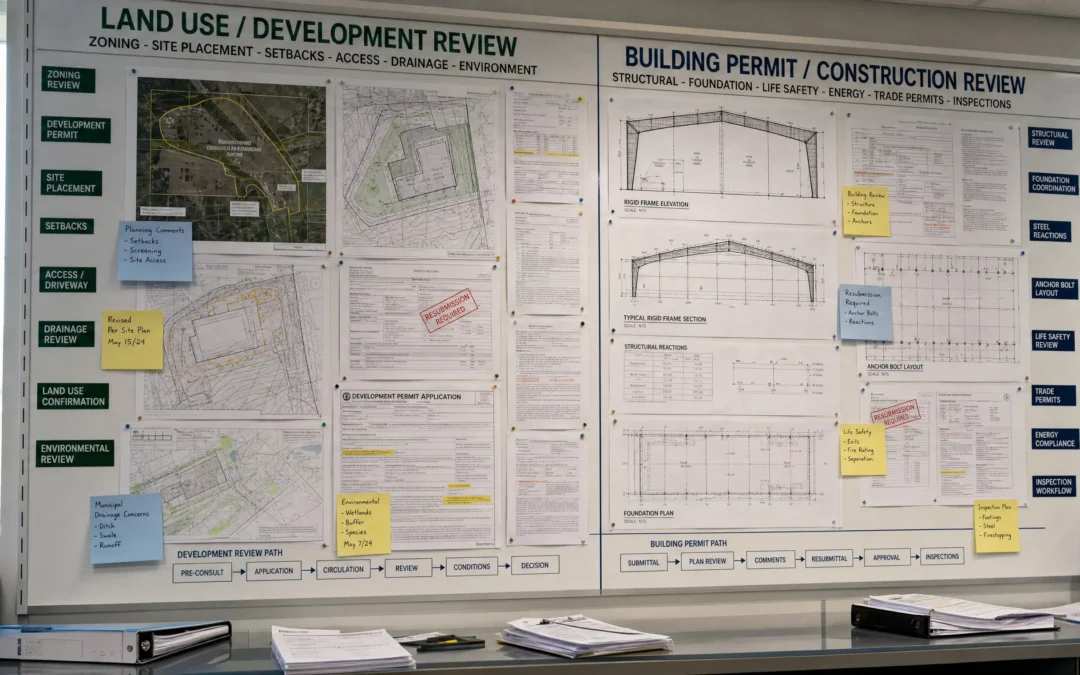
The Authority Having Jurisdiction (AHJ) evaluates:
- consistency across documents
- alignment between site, structure, and use
- clarity of scope and responsibility
If documents conflict, approval slows down.
This type of inconsistency usually comes from missing coordination, which is addressed through site-specific steel building engineering where structure, site, and usage are aligned before submission.
Incomplete submissions typically lead to delays, additional review cycles, or returned applications.
How Reviewers Actually Look at Your Submission
At the initial stage, the Authority Having Jurisdiction (AHJ) is not validating engineering in detail.
They are asking one question:
Can this submission be reviewed without interpretation?
If reviewers need to:
• guess missing information
• reconcile conflicting drawings
• request basic clarifications
the application slows down immediately.
Inspectors reject uncertainty, not complexity.
This same issue is detailed in steel building permit rejection mistakes, where unclear or inconsistent submissions lead to delays and resubmissions.
A technically correct design can still be delayed if the documentation does not clearly communicate intent, scope, and coordination.
Complete Document Breakdown
1. Building Permit Application Form
Includes:
- project address
- owner information
- contractor details
- building description
- intended use
Issues occur when the declared use does not match drawings or supporting documents.
2. Site Plan
In most cases, a site plan is required for zoning and layout verification.
It should show:
- property boundaries
- building location
- setbacks
- access points
- parking areas
Errors in site plans are one of the most common causes of early review comments.
3. Architectural Drawings
These define how the building will be used.
Include:
- floor plans
- elevations
- building dimensions
- door and opening locations
If the use is unclear or inconsistent, the AHJ will request clarification.
4. Structural Drawings
Structural drawings must be prepared or reviewed by a licensed Professional Engineer registered with APEGA.
They include:
- frame layout
- member sizes
- connection details
The AHJ verifies structural adequacy and alignment with architectural drawings.
5. Foundation Design
Includes:
- footing details
- slab design
- soil assumptions
Foundation design must match both the structure and site conditions.
Generic or assumed designs often trigger revisions.
6. Supporting Engineering Documents
May include:
- design calculations
- load summaries
- engineering notes
Missing or unclear supporting information leads to additional review requests.
7. Development Permit Documents (If Required)
A development permit is not required in all cases, but must be confirmed with the municipality.
Land-use and zoning approval sequencing is explained in Development Permit vs Building Permit Alberta, where approval order directly affects timelines.
It addresses:
- zoning compliance
- land use
- site layout
Uses may be classified as permitted or discretionary, which affects approval timelines and certainty.
8. Additional Supporting Information
Depending on the project:
- access details
- site coordination
- drainage considerations
Requirements vary by project scope and municipality.
9. Owner Authorization
Required when:
- the applicant is not the property owner
- a third party submits the application
Missing authorization may result in the application being held or returned.
10. Project Value Declaration
Used to:
- calculate permit fees
- support administrative review
Incorrect or missing values may require clarification before review proceeds.
Staged Permits (Foundation Permit Option)
Some projects may be eligible for staged permits.
This can include:
- foundation permit issued before full building permit
- phased approvals
Eligibility depends on the Authority Having Jurisdiction (AHJ).
Full building approval is still required for completion.
Where Most Projects Break: Responsibility Is Not Clearly Defined
Permit issues often occur when responsibility between:
- the building supplier
- the structural engineer
- the foundation designer
- the owner or contractor
is not clearly defined.
This leads to:
- missing documents
- unclear scope
- inconsistent information
Permit issues are often caused by coordination gaps, not design errors.
How the Authority Having Jurisdiction (AHJ) Evaluates Submissions
The AHJ evaluates:
- completeness
- consistency
- compliance
They do not review documents in isolation.
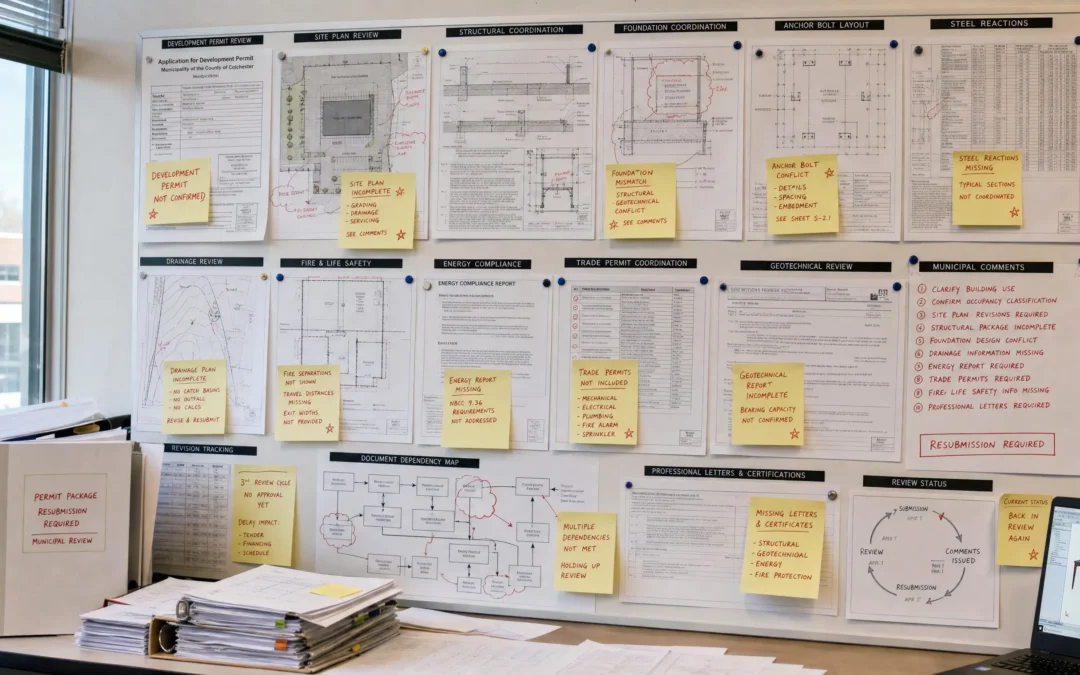
If documents are inconsistent, review slows down.
Incomplete submissions may be placed back into review queues after revision, which can extend timelines beyond the original review cycle.
What Stops or Slows Approval
Common triggers:
- missing site information
- incomplete structural details
- unclear building use
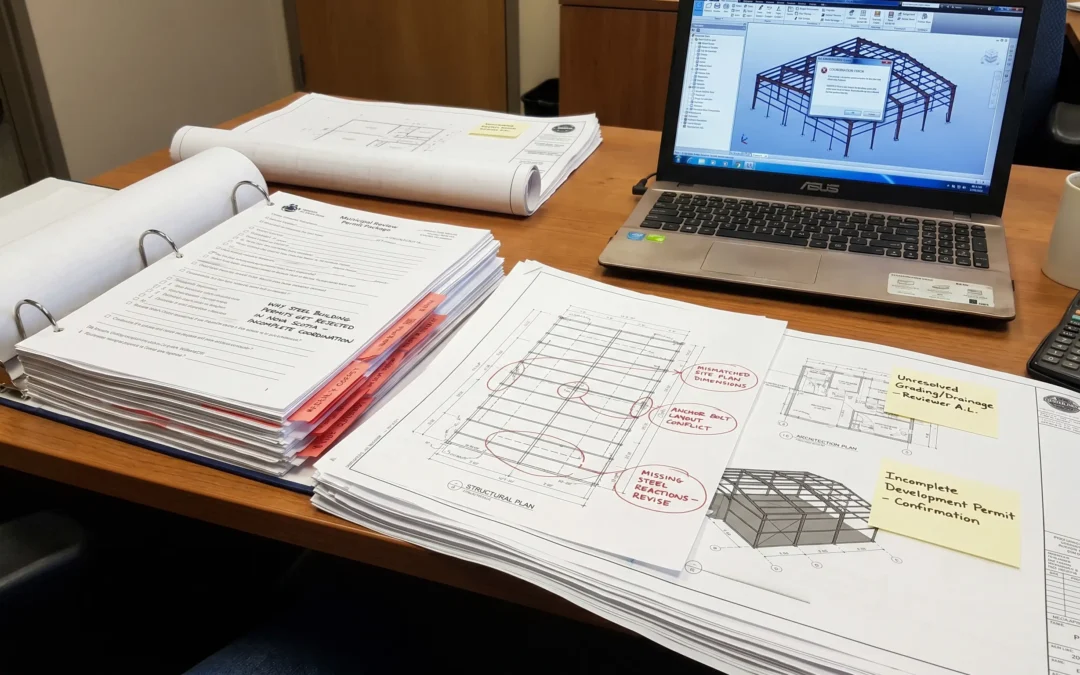
- mismatched drawings
Applications may be:
- returned
- placed on hold
- or reviewed with comments
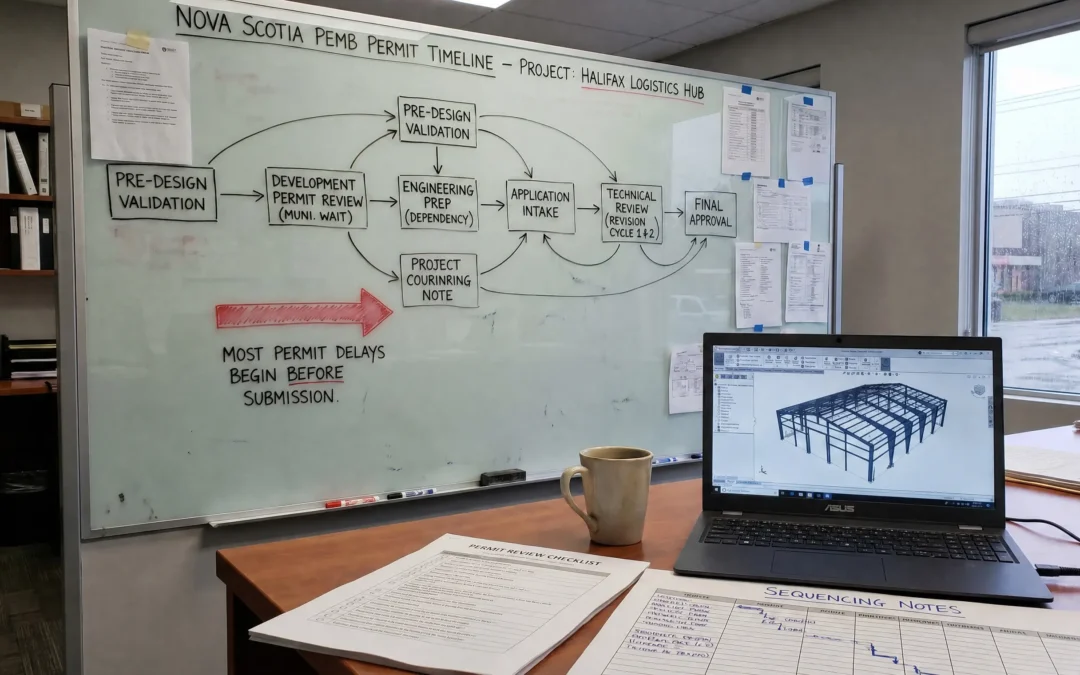
Delays at this stage often impact the overall steel building permit timeline in Alberta. Many of these issues later appear as common permit rejections in Alberta and are directly tied to how documentation is prepared before submission.
Real Project Scenario
- Documents prepared
- Application submitted
- Inconsistencies identified
- Comments issued
- Revisions required
Result:
- multiple review cycles
- delays
- increased cost
Many of these issues later appear as common permit rejections in Alberta.
What These Delays Actually Cost
Each additional review cycle typically adds:
• 2 to 6 weeks of delay depending on jurisdiction
• engineering revision costs
• contractor rescheduling
• potential material or price changes
On larger steel building projects, these delays often exceed the original permit timeline.
Most of this cost is avoidable when documentation is complete before submission.
How to Prepare Documents Correctly
Before submission:
- confirm zoning
- define building use
- complete engineering
- coordinate all documents
Check:
- consistency
- completeness
- clarity
If documents are not coordinated, approval becomes unpredictable.
Final Perspective
A steel building permit in Alberta is not approved based on one drawing or one document.
For complete approval requirements, permit risks, and Alberta-specific submission strategy, refer to the full Steel Building Permits Alberta guide.
It is approved when:
- all required documents are submitted
- all documents are consistent
- all requirements are satisfied
If documentation is complete and coordinated, approval becomes predictable.
If not, delays and revisions occur.
Permit approval is based on complete and coordinated documentation, not just design.
Reviewed by Engineering Team
This content has been reviewed by the Tower Steel Buildings engineering team.
It reflects real steel building permit submission and review behavior across Alberta, including:
- application of the National Building Code – 2023 Alberta Edition
- the role of the Safety Codes Act and Safety Codes Officers
- Authority Having Jurisdiction (AHJ) structures, where approvals may be issued by a municipality or an accredited agency
- coordination between development permit requirements and building permit submissions
- expectations for engineering prepared or reviewed by a licensed Professional Engineer registered with APEGA
- how document inconsistencies, missing scope, and unclear responsibility affect review outcomes
This guidance is based on observed project workflows and permit submissions in Alberta.
It is intended for practical decision-making by owners, contractors, and developers. It does not replace project-specific direction from municipalities, accredited agencies, or licensed professionals.
Permit requirements, submission expectations, and timelines vary by municipality, project scope, land-use classification, and site conditions.
1. What documents are actually required for a steel building permit in Alberta?
A permit submission typically includes application forms, site plans, architectural drawings, structural drawings, foundation design, and supporting documents.
When it becomes a problem:
When one or more of these documents is missing or not aligned with the others.
Why:
Reviewers assess the submission as a coordinated system, not as individual files.
What it leads to:
The application may be returned, placed on hold, or pushed into multiple review cycles.
2. What happens if my permit documents are incomplete?
Incomplete submissions typically lead to delays, additional review cycles, or returned applications.
When it becomes a problem:
At the initial completeness review stage before technical evaluation begins.
Why:
The authority having jurisdiction cannot verify compliance without a complete submission.
What it leads to:
Review cannot proceed efficiently, and the timeline becomes unpredictable.
3. Is a site plan always required for a steel building permit?
In most cases, yes. It is one of the most important documents for verifying building location and zoning compliance.
When it becomes a problem:
When the site plan is missing, inaccurate, or does not reflect the actual layout.
Why:
Zoning, setbacks, and site relationships cannot be confirmed without it.
What it leads to:
Development-related issues are flagged, and the application may be delayed or revised.
4. Why do projects get delayed even when all documents are submitted?
Because submission is not the same as coordination.
When it becomes a problem:
When drawings conflict with each other or with the declared building use.
Why:
Reviewers must resolve inconsistencies before approving the project.
What it leads to:
Comment cycles, revisions, and extended approval timelines.
5. Do I need engineered structural drawings for a steel building permit?
Yes. Structural drawings must be prepared or reviewed by a licensed Professional Engineer registered with APEGA.
When it becomes a problem:
When engineering is missing, incomplete, or unclear in scope.
Why:
The reviewer must confirm that the structure complies with the National Building Code – 2023 Alberta Edition.
What it leads to:
Requests for additional information or resubmission of the structural package.
6. Is a development permit always required before applying for a building permit?
Not always. It depends on the municipality and project.
When it becomes a problem:
When development permit requirements are not confirmed before preparing the building permit submission.
Why:
Land-use approval may be required before technical review can proceed.
What it leads to:
The project may be delayed while development approval is obtained or reassessed.
7. What causes the most common permit delays in Alberta?
The most common causes are document-related, not engineering-related.
When it becomes a problem:
When submissions are incomplete, inconsistent, or unclear.
Why:
Reviewers cannot verify compliance without clear and coordinated information.
What it leads to:
Additional review cycles, resubmissions, and increased project timelines.
8. Can I submit my drawings early and fix issues later?
You can submit early, but it usually creates more problems than it solves.
When it becomes a problem:
When the submission is incomplete or not coordinated at the time of review.
Why:
Early submission does not bypass the need for complete and consistent documentation.
What it leads to:
Repeated revisions and longer approval timelines.
9. Why do structurally correct projects still face permit issues?
Because structural correctness alone does not satisfy permit requirements.
When it becomes a problem:
When zoning, site conditions, or document coordination are not aligned with the design.
Why:
Permit approval depends on compliance across multiple areas, not just structure.
What it leads to:
Delays, redesign, or additional approval steps.
10. What is the biggest mistake in steel building permit submissions?
Submitting documents without confirming zoning and coordination.
When it becomes a problem:
At the beginning of the project, before design and submission are aligned.
Why:
Design decisions may not reflect site or regulatory requirements.
What it leads to:
Redesign, delays, and increased cost.
11. What role does the Authority Having Jurisdiction (AHJ) play in document review?
The AHJ reviews and approves the permit submission.
When it becomes a problem:
When applicants assume requirements are identical across all municipalities or agencies.
Why:
Submission expectations and processes may vary depending on the AHJ.
What it leads to:
Incorrect submissions and avoidable delays.
12. What is the single most important rule for getting a permit approved?
Documents must be complete, consistent, and coordinated before submission.
When it becomes a problem:
When any of these elements is missing.
Why:
Approval depends on the ability to verify compliance clearly and efficiently.
What it leads to:
Unpredictable timelines and multiple revisions.