

In Saskatchewan, the first permit mistake is usually not the steel frame. It is assuming the wrong local authority process, treating a farm or rural building as automatically exempt, or missing the Building Official review path. Foundation reactions, anchor bolts, site conditions, and use classification should be coordinated before steel or concrete moves too far.
Important: Final permit approval, inspections, occupancy, timelines, and local requirements remain subject to the local authority, rural municipality, licensed Building Official, authority having jurisdiction, submitted documents, consultant scope, and site-specific conditions.
Get a Free Steel Building Quote
Your information will only be used to prepare and follow up on your quote.
What changes the permit path?
- Municipality or rural municipality
- Building bylaw
- Farm-building classification
- Building Official review
- Occupancy and site conditions
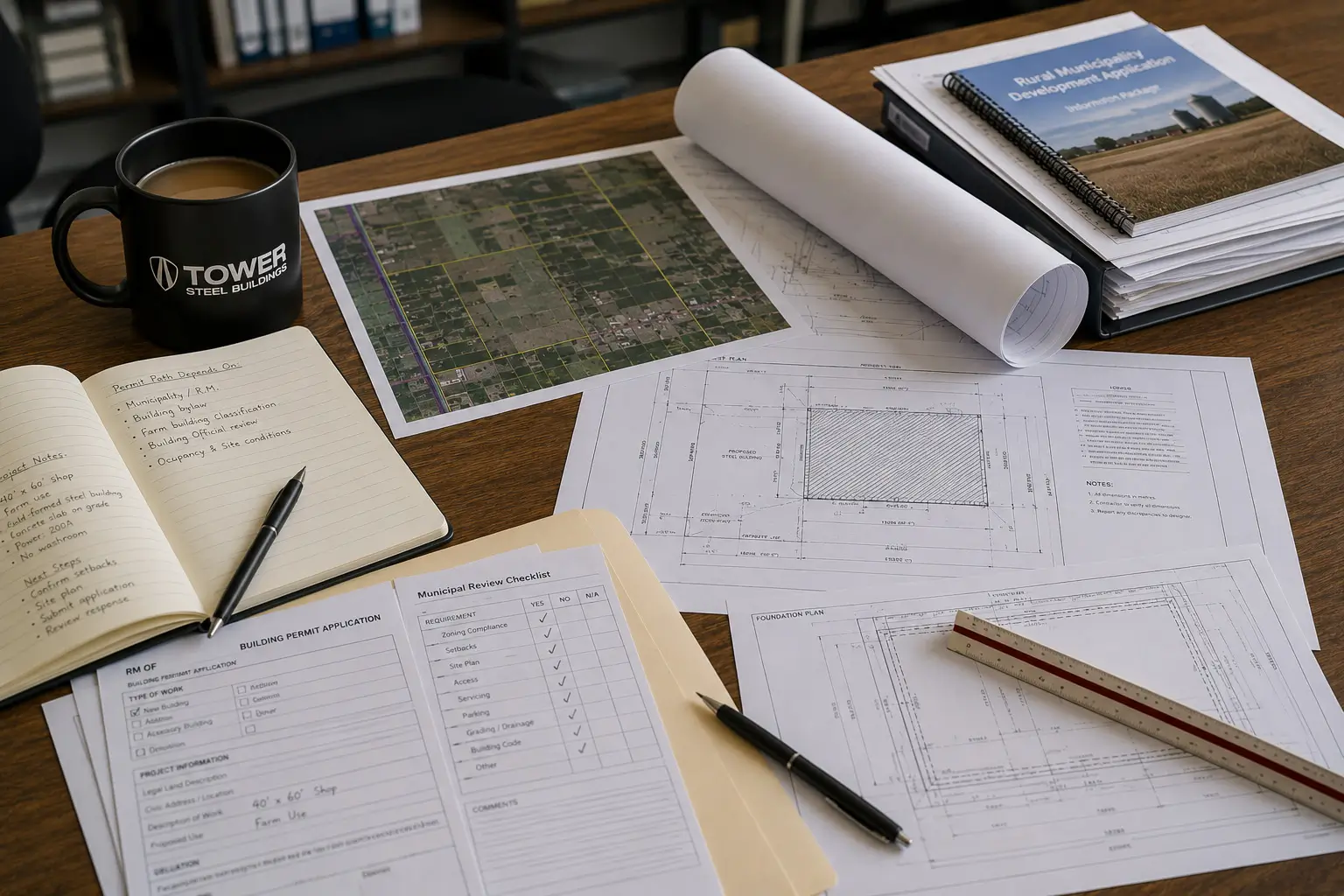
Use it before the project moves too far
It helps buyers understand the approval path before ordering steel, finalizing foundation drawings, setting anchor bolts, or scheduling construction.
The goal is simple: confirm the local authority path, building use, farm-building treatment, site inputs, and steel building documentation before the project becomes expensive to correct.
A steel quote is only useful when the assumptions are clear. If the building use, local authority, foundation reactions, openings, or site conditions change later, the price and drawings may need to change too.
Information to prepare
- Property location, civic address, or legal land description
- Municipality or rural municipality
- Intended building use and project classification
- Approximate width, length, height, and door locations
- Heated, unheated, insulated, or cold storage use
- Foundation status and site access constraints
- Drainage, snow drifting, soil, frost, and servicing concerns
- Existing local authority, RM, or Building Official comments

NBC 2020

NECB 2020

NPC 2020

NFC 2020

Construction Codes Act

Local Authority

Licensed Building Official

Farm Rules
Saskatchewan steel buildings fail on assumptions before they fail on steel.
If the site, use, exposure, local authority path, foundation reactions, and access conditions are not coordinated early, the correction often happens later when it costs more.
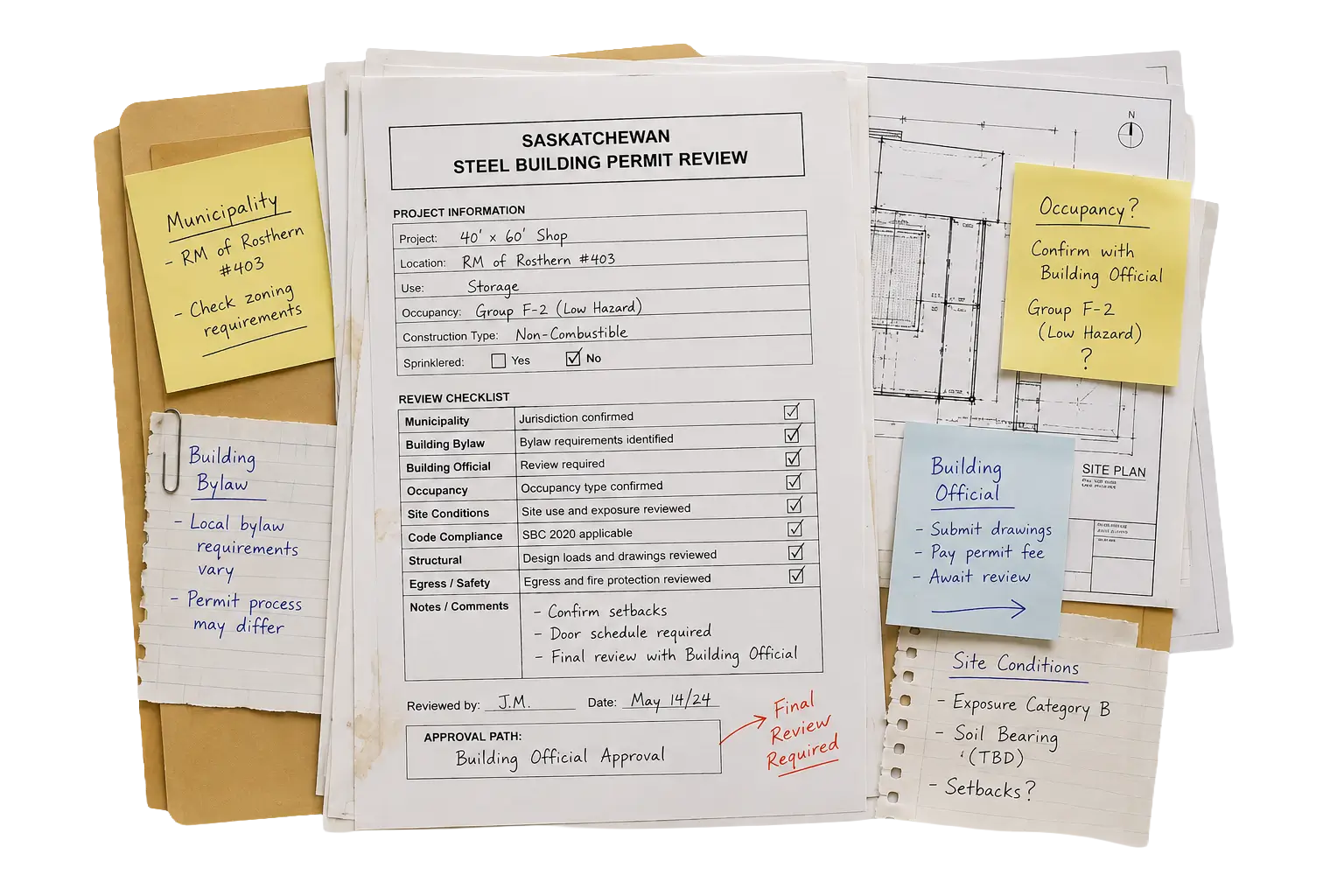
For steel building buyers, the file must be clear enough for the Building Official to understand the building use, structural package, site plan, foundation design, energy/code scope, and inspection path.
What the Building Official may need to understand
- Building use and occupancy
- Site plan and building placement
- Structural drawings and design criteria
- Foundation reactions and anchor bolt layout
- Fire/life safety and accessibility where applicable
- Energy-code path where applicable
- Required inspection stages
Local Authority
Controls building bylaws, permit intake, inspection process, fees, local interpretation, and administrative requirements.
Licensed Building Official
Reviews drawings, checks code-related requirements, inspects construction, and provides enforcement services for the local authority.
Rural Municipality
May involve farm-building classification, approaches, drainage, rural site plans, local rules, and Building Official coordination.
| Project Situation | Who May Be Involved | Why It Matters |
|---|---|---|
| City, town, or village | Local authority + licensed Building Official | Building bylaw, permit intake, plan review, inspections, and fees may apply. |
| Rural municipality | RM office + appointed Building Official | Rural site plans, agricultural use, approaches, drainage, and farm-building questions may need early review. |
| Farm operation | Local authority, RM, or Building Official | Farm-building treatment may apply only if the building meets the correct definition. |
| Farm residence or sleeping accommodation | Building Official / local authority | Sleeping accommodation is not treated as a simple exempt farm building. |
| Commercial or industrial project | Building Official + local authority + consultants | Occupancy, fire/life safety, accessibility, NECB, site access, and inspections may apply. |
| Cannabis or alcohol-related building | Building Official + local authority | Saskatchewan farm-building guidance identifies cannabis-related and beverage-alcohol-related uses that are not treated as farm buildings for the purposes of the farm-building definition. |
Do not treat a steel quote as a building permit.
A steel building can still be delayed if the site plan, use, local authority process, farm-building classification, development requirements, foundation reactions, anchor bolts, or CSA A660 documentation does not match the Saskatchewan review path.
Development Approval
Building Permit
Related Approvals
Inspections / Occupancy
Warning 01
Warning 01
Warning 01
Important site conditions can include open prairie wind exposure, snow drifting around large walls and roof steps, frost depth and foundation protection, variable soils where applicable, drainage, surface runoff, approach access, agricultural moisture, unheated versus heated use, large overhead doors, equipment loads, truck movement, fire access, and remote construction logistics.
Site conditions affect real design decisions
- Frame design, bracing, cladding, and fasteners
- Anchor bolts, uplift, shear, and foundation reactions
- Slab, footings, frost protection, and drainage
- Access planning, truck movement, and erection logistics
| Document / Input | Why It Matters |
|---|---|
| Legal land description / civic address | Confirms jurisdiction and review path. |
| Site plan | Shows building location, setbacks, approaches, existing structures, drainage, and access. |
| Building drawings | Shows use, size, elevations, sections, openings, and code-related details. |
| Steel building drawings | Shows frame layout, bracing, cladding, openings, and design criteria. |
| Foundation reactions | Required for proper foundation design. |
| Anchor bolt plan | Prevents costly field conflicts. |
| Foundation drawings | Coordinates slab, footings, frost protection, soils, and drainage. |
| CSA A660 documentation | Supports steel building system review where applicable. |
| Energy information | Needed where NECB or other energy provisions apply. |
| Fire/access/servicing information | Important for commercial, industrial, warehouse, and public-use projects. |

Confirm local authority
Identify the city, town, village, northern municipality, rural municipality, or other local authority.

Confirm zoning / farm treatment
Check permitted use, development approval, and whether farm-building treatment applies.

Define use and occupancy
Clarify farm, storage, workshop, warehouse, commercial, industrial, mining, cannabis, or cold storage use.

Prepare site plan
Show building location, access, drainage, utilities, approaches, structures, grading, and site conditions.

Coordinate steel / foundation
Align reactions, uplift, shear, anchor bolts, slab/footings, frost protection, and soil assumptions.

Submit / respond / inspect
Submit the package, answer review comments, build after approval, and complete inspections.
Failure Pattern 01
The buyer assumes the project is exempt, farm-only, or simple rural work without confirming the local authority, rural municipality, Building Official, or bylaw process.
Failure Pattern 02
The building is on agricultural land, but the use, occupancy, cannabis/alcohol involvement, sleeping accommodation, or commercial treatment changes review expectations.
Failure Pattern 03
The steel package, foundation design, and field work move out of sequence, causing anchor bolt conflicts, redesign, inspection issues, and added costs.
Building bylaw path not confirmed
The project starts before the buyer confirms which local authority, rural municipality, or Building Official controls the permit process.
Farm exemption assumed incorrectly
The building is treated as exempt before use, occupancy, sleeping accommodation, and local bylaw requirements are confirmed.
Development approval not resolved
The project starts before the buyer confirms which local authority, rural municipality, or Building Official controls the permit process.
Incomplete site plan
The plan does not clearly show building location, approaches, access, drainage, structures, servicing, or site constraints.
Foundation reactions missing
The foundation designer cannot properly coordinate footings, slab, frost protection, uplift, shear, or anchor bolts.
Review comments require revisions
Building Official comments trigger drawing revisions, additional documents, or re-coordination between the buyer, supplier, designer, and contractor.
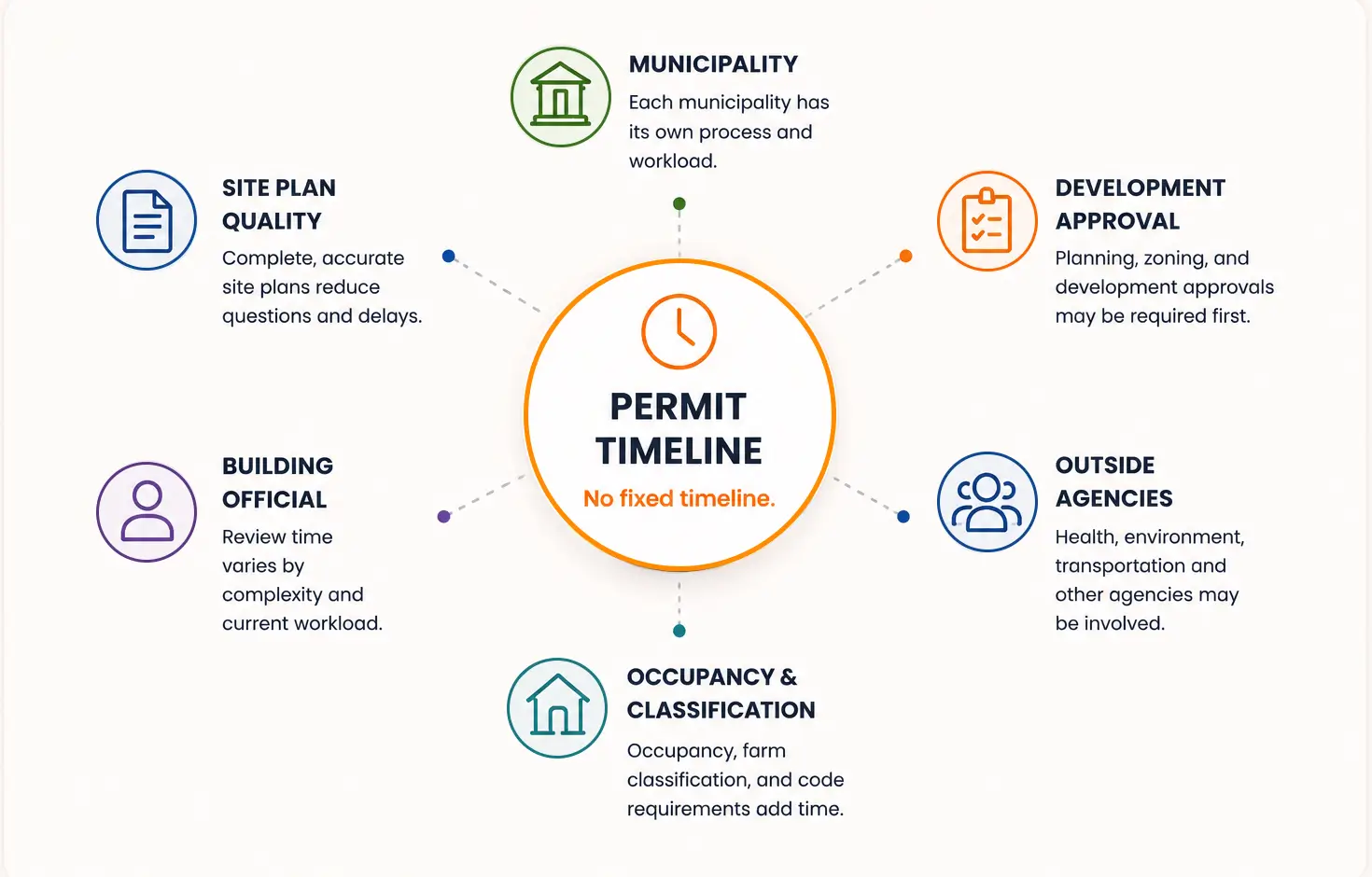
Timeline problems usually start before submission.
Missing site information, unclear use, unconfirmed farm-building treatment, weak drawings, outside-agency requirements, or foundation assumptions can create review comments before the project reaches construction.
Regina
COMMON CONCERN
Commercial occupancy, site access, servicing, energy, fire/life safety.
BUYER ACTION
Confirm local permit and planning sequence.
Saskatoon
COMMON CONCERN
Industrial/commercial use, zoning, inspections, accessibility, fire access.
BUYER ACTION
Verify intake requirements before final drawings.
Prince Albert
COMMON CONCERN
Local building bylaw, site plan, commercial/industrial use.
BUYER ACTION
Confirm local Building Official requirements.
Moose Jaw
COMMON CONCERN
Zoning, development permit, servicing, commercial occupancy.
BUYER ACTION
Confirm local review path.
Yorkton
COMMON CONCERN
Site access, drainage, commercial or agricultural use.
BUYER ACTION
Confirm permit documents early.
Swift Current
COMMON CONCERN
Wind exposure, industrial/agricultural use, site servicing.
BUYER ACTION
Confirm site and structural assumptions.
North Battleford
COMMON CONCERN
Building bylaw, inspections, site plan, drainage.
BUYER ACTION
Confirm local intake and required drawings.
Lloydminster
COMMON CONCERN
Cross-border city complexity, Saskatchewan/Alberta-side jurisdiction.
BUYER ACTION
Confirm exact municipal and provincial jurisdiction.
Rural Municipalities
COMMON CONCERN
Farm-building treatment, RM building bylaw, approaches, drainage, sleeping accommodation.
BUYER ACTION
Confirm exemption, permit, and inspection requirements before ordering steel.
Farm Buildings
Equipment Storage
Workshops
Truck Garages
Warehouses
Commercial Buildings
Industrial Buildings
Mining Buildings
Cannabis Buildings
Cold Storage
Aircraft Hangars
Container Roof Systems
What Tower Steel Buildings Helps Coordinate
- Steel building scope, use, size, and opening layout
- Snow, wind, exposure, and site-condition inputs
- Foundation reactions and anchor bolt coordination
- CSA A660 steel building system documentation planning
- Permit-readiness questions before submission
- Drawing package alignment with buyer, contractor, and foundation designer
What Remains With the Local Authority / Building Official / AHJ
- Final zoning and development decisions
- Building permit approval
- Permit fees and timelines
- Inspection requirements
- Occupancy or final approval
- Interpretation and enforcement of building bylaws
- Outside agency approvals
National Building and Fire Code Information
Used for Saskatchewan’s 2020 national code adoption context and January 1, 2024 effective date.
Construction Legislation and Regulations
Used for The Construction Codes Act and shared responsibility context.
Building Bylaws
Used for municipal building bylaw and licensed Building Official appointment context.
Farm Buildings Advisory
Used for farm-building treatment, sleeping accommodation, and cannabis/alcohol classification guidance.
Building Official Licensing
Used for Building Official review, inspection, enforcement, and licence class context.
CSA A660 Certification
Used for steel building system documentation and permit-review support.
Steel Buildings Saskatchewan
Steel Building Cost Canada
Steel Building Foundation Drawings
CSA A660 Steel Buildings
Steel Building Permits Alberta
Steel Building Permits Manitoba
Agricultural Steel Buildings
Commercial Steel Buildings
1. What is a steel building permit in Saskatchewan?
A steel building permit is local authority approval to construct a steel building based on submitted drawings, site information, building use, code requirements, and local review conditions.
Depending on the property, the review may involve a municipality, rural municipality, licensed Building Official, local planning authority, or authority having jurisdiction.
2. Do steel buildings need permits in Saskatchewan?
New permanent steel buildings in Saskatchewan commonly require local authority review and may require a building permit before construction, depending on the local building bylaw, building use, size, occupancy, site conditions, and whether any farm-building treatment applies.
Before ordering steel, buyers should confirm the local authority, building bylaw, development approval path, site plan requirements, foundation documentation, inspection expectations, and any farm-building treatment that may apply.
3. Where do I apply for a Saskatchewan steel building permit?
You usually start with the local authority responsible for the property, such as the municipality, rural municipality, local building department, or authority having jurisdiction.
The local authority can confirm the building bylaw, development approval path, permit application requirements, Building Official review, inspections, fees, and whether outside approvals are needed.
Do not assume the supplier, contractor, or engineer decides the permit path. The local authority controls the approval process.
4. How long does a Saskatchewan steel building permit take?
There is no single Saskatchewan-wide timeline. Timing depends on the local authority, building use, project size, development approval path, site plan quality, engineering completeness, foundation design, energy-code requirements, review comments, and inspection coordination.
Simple complete submissions can move faster. Commercial, industrial, large agricultural, mixed-use, or foundation-sensitive projects can take longer if drawings, reactions, site plan, drainage, or building use are unclear.
5. Who reviews steel building permits in Saskatchewan?
Steel building permits are typically reviewed through the local authority and its appointed licensed Building Official.
Construction-code compliance is shared between owners, local authorities, Building Officials, consultants, contractors, and other project professionals where applicable.
6. What building code applies to steel buildings in Saskatchewan?
Saskatchewan’s 2020 national construction codes came into effect on January 1, 2024. These include the National Building Code, National Energy Code for Buildings, and National Plumbing Code for applicable building, energy, and plumbing requirements.
The NECB is especially relevant to medium and large buildings, while smaller or simpler buildings may follow different applicable energy provisions.
The 2020 National Fire Code also came into effect January 1, 2024 for fire-safe operation of buildings and facilities through Saskatchewan’s fire-safety framework.
The exact code path depends on building type, occupancy, size, systems, and scope.
7. What is The Construction Codes Act?
The Construction Codes Act provides the legislative framework for the application of construction codes in Saskatchewan.
For a steel building buyer, the practical point is that compliance is shared between the owner, local authority, Building Official, consultants, and contractors. A permit-ready steel building package still has to fit the local authority process, building bylaw, site conditions, and submitted design information.
8. What is the role of a licensed Building Official?
A licensed Building Official provides plan review, inspection, and enforcement services for the local authority.
Building Official scope can depend on licence class, building occupancy, building size, and code area. For steel building buyers, this means the file should clearly explain the building use, site plan, structural package, foundation design, energy-code path where applicable, and required inspection stages where applicable.
9. Are farm buildings exempt from building permits in Saskatchewan?
Do not assume exemption without confirming the building use and local authority requirements.
Farm-building treatment depends on the building meeting the applicable Saskatchewan farm-building definition, the intended use, whether people will occupy or sleep in the building, and how the local authority applies its building bylaw.
Buyers should confirm this with the local authority before assuming exemption. Agricultural land by itself does not automatically mean the building is permit-free or exempt from construction standards.
10. Do farm residences or buildings with sleeping accommodation need review?
Yes. Do not treat farm residences, living quarters, seasonal accommodation, bunkhouse space, office/residential mixed use, or any building with sleeping accommodation as a simple farm-building exemption.
Sleeping accommodation can trigger review for life safety, smoke and carbon monoxide alarms, occupancy, exiting, ventilation, energy, plumbing, and inspections where applicable.
These uses should be confirmed with the local authority before assuming farm-building treatment or exemption from construction standards.
11. Should zoning and the site plan be checked before ordering steel?
Yes. Zoning, land use, setbacks, access, drainage, development approval, approaches, servicing, and site constraints should be checked before the steel package is treated as final.
These items can affect building placement, foundation planning, access design, drainage requirements, permit submission documents, and whether the proposed use is allowed on the property.
12. What is the difference between development approval and building permit review?
Development approval checks whether the use, location, and site layout are acceptable under local planning rules.
Building permit review checks technical construction documents, structural design, foundations, code compliance, fire/life safety, accessibility, energy requirements where applicable, and inspections.
A project can have a strong steel building package and still stall if the development side is not resolved first.
13. What documents are needed for a Saskatchewan steel building permit?
Common documents may include legal land description, civic address, site plan, building drawings, steel building drawings, foundation drawings, foundation reactions, anchor bolt plan, drainage information, servicing details, energy information where applicable, and outside approvals where required.
A serious steel building permit file usually needs more than a sales drawing. The reviewer needs enough information to understand the building use, site conditions, structural design, foundation coordination, access, drainage, and applicable code path.
14. Do I need engineered foundation drawings?
For serious permanent steel buildings, foundation drawings are commonly needed so footings, slab, frost protection, anchor bolts, and steel column reactions are coordinated correctly.
Foundation design should match the actual steel building reactions, not a generic slab assumption. If the reactions, anchor bolt layout, openings, or frost/soil assumptions change later, the foundation may need to be revised.
15. Can I order steel before permit approval?
Ordering steel before the local authority path, development approval, building use, foundation reactions, and site conditions are clear can create redesign and resubmission risk.
Ordering early may be done at the buyer’s risk, but the steel package should be coordinated with the actual property, foundation design, intended use, and review path before the project moves too far.
16. Can I pour concrete before approval?
Do not pour concrete unless the required permit, staged approval, or written direction for that stage has been issued by the reviewing authority, and the foundation design, anchor bolt layout, and permit conditions are clear.
Pouring too early can create expensive correction work if reactions, anchor bolt layout, frost assumptions, soil conditions, or approved drawings change before erection.
17. Why do generic steel kits get questioned during permit review?
Generic steel kit information may not show site-specific loads, building use, foundation reactions, anchor bolts, openings, bracing, snow drifting, wind exposure, drainage, fire access, or local authority requirements.
Building Officials often need project-specific drawings and documentation. A sales layout or standard sketch may not be enough for a serious Saskatchewan steel building permit file.
18. Why do steel building projects get redesigned after purchase?
Redesign can happen when land use, farm-building classification, occupancy, door locations, snow or wind assumptions, foundation reactions, anchor bolts, drainage, access, or site conditions were not confirmed before the steel package was purchased or finalized.
Common triggers include larger doors, changed use, missing foundation data, different exposure conditions, site plan comments, local authority comments, or added Building Official requirements.
19. Why do steel building costs increase after permit review starts?
Costs can increase when review comments require revised drawings, foundation changes, drainage updates, added site information, outside approvals, fire/accessibility changes, energy details, or re-coordination between the buyer, steel supplier, foundation designer, and contractor.
Most steel building cost overruns start when the building, foundation, site, use, and permit package are not aligned early.
20. How do prairie wind, snow drifting, frost, and soil affect design?
Prairie wind exposure, snow drifting, frost depth, drainage, soil conditions, and open-site exposure can affect frame design, bracing, cladding, anchor bolts, foundation design, slab details, and long-term maintenance.
These conditions should be treated as design inputs, not afterthoughts. A building that works on one site may require different assumptions on another Saskatchewan property.
21. Can a steel building be used for commercial occupancy?
Yes, but the property must allow the proposed commercial use, and the building must be reviewed for the intended occupancy.
A warehouse, contractor shop, fleet garage, manufacturing facility, commercial garage, cannabis building, cold storage building, or retail-support building may follow a different review path than private storage or farm-use structures.
22. What commercial code issues can affect a Saskatchewan steel building permit?
Commercial steel buildings commonly require coordination for occupancy classification, barrier-free accessibility, fire separations, exits, emergency lighting, washrooms, mechanical ventilation, energy-code requirements where applicable, fire protection, structural loading, parking, site access, servicing, and inspections.
These items can affect the building layout, wall assemblies, door locations, foundation planning, mechanical design, drawings, permit review, and inspection path.
23. Does CSA A660 replace a permit?
No. CSA A660 supports steel building system documentation and manufacturer conformance, but it does not replace local authority approval, site-specific engineering, foundation design, or building permit review.
CSA A660 was developed to help enforcement officials review steel building system permit submissions and addresses the manufacturer’s process, including design and engineering, materials control, fabrication, shipping, and erection documentation. It is not a permit approval by itself.
24. Can Tower Steel Buildings help with permit-readiness?
Tower Steel Buildings can help coordinate permit-ready steel building system documentation and key design inputs connected to the building package, within its project scope.
This may include steel building scope, building use, size, design criteria, foundation reactions, anchor bolt information, CSA A660 documentation, and permit-readiness questions before submission.
Final approval, permit acceptance, inspections, timelines, and local requirements remain with the local authority, licensed Building Official, rural municipality, or authority having jurisdiction.