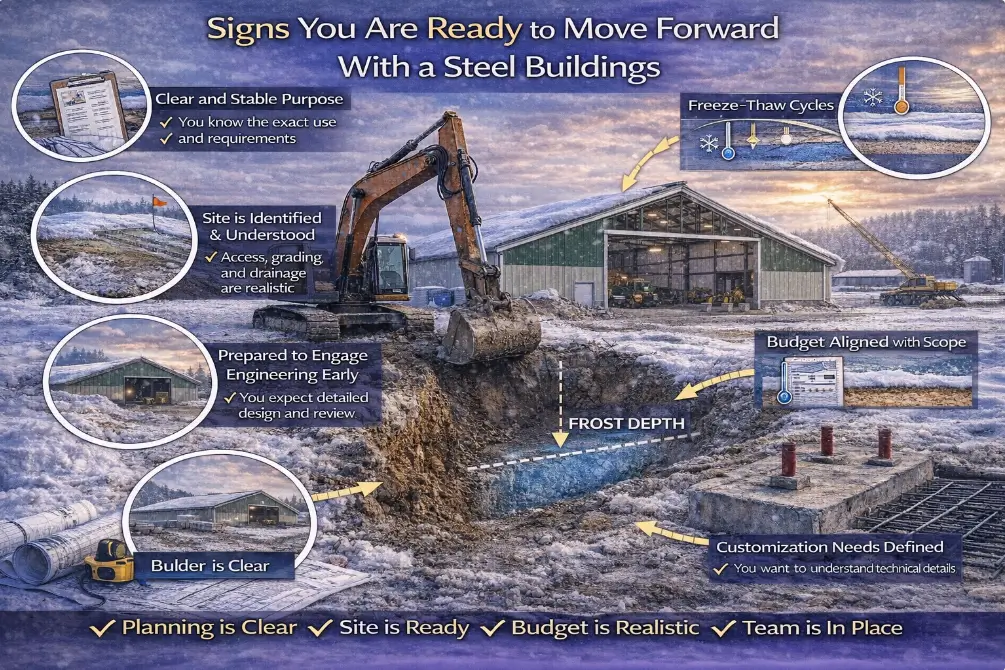
Requesting a steel building quote is often treated as a simple first step. In reality, the quality of information provided at this stage directly affects pricing accuracy, timeline certainty, and the overall success of the project.
Across Canada, many steel building projects encounter avoidable delays or cost adjustments not because steel prices changed, but because critical details were missing when the initial quote was prepared. A quote based on assumptions is rarely a reliable foundation for decision-making.
This article explains what owners, developers, farmers, and business operators should prepare before requesting a steel building quote. The goal is not to complicate the process, but to ensure that early pricing reflects real conditions, regulatory requirements, and intended use.
This guidance applies to permanent steel buildings intended for long-term use, permitting, and inspection. Structural requirements are governed nationally by the National Building Code of Canada official publication. It may not apply to temporary storage structures or lightly engineered enclosures where full code compliance is not required.
Why Preparation Matters More Than Most Buyers Expect
Steel building quotes are not commodity pricing. Unlike finished consumer products, a steel building is an engineered system that responds to site conditions, loads, usage, and regulatory context.
When information is incomplete, suppliers must either assume conservative conditions or defer engineering decisions. Both approaches affect pricing in different ways and often lead to revisions later. Many of these revisions result from design changes that increase steel building pricing.
Well-prepared quote requests typically result in:
- Narrower price ranges
- Fewer post-quote adjustments
- Faster permitting
- More predictable schedules
Poorly prepared requests often produce:
- Low initial numbers that change later
- Engineering redesigns
- Permit delays
- Construction sequencing conflicts
Preparation does not mean final drawings. It means clarity.
This level of preparation is part of steel building project readiness planning.
Intended Use of the Steel Building
The single most important input for a meaningful quote is how the building will actually be used.
Steel buildings designed for storage behave very differently from those designed for manufacturing, equipment maintenance, livestock housing, or public occupancy.
Before requesting a quote, be prepared to describe:
- Primary function of the building
- Secondary or future uses
- Whether the building will house people, equipment, or animals
- Any planned interior build-outs or mezzanines
- Whether cranes, lifts, or heavy machinery are expected
A building designed for warehousing may not be suitable for an auto repair shop without structural changes. A farm building designed for hay storage differs significantly from one housing livestock.
Clear use descriptions reduce assumptions and improve engineering alignment.
Location and Site Context
Steel building design in Canada is always site-specific. This is why site selection planning for steel buildings in Ontario should be completed before requesting pricing. Snow loads, wind exposure, frost depth, and municipal requirements vary significantly by region.
When requesting a quote, be prepared to provide:
- Municipality and province
- Property address or general location
- Urban, rural, or industrial setting
- Proximity to open terrain, water, or exposed areas
- Any known zoning constraints
Even preliminary location information allows suppliers to apply realistic design parameters instead of generic assumptions.
Location data should be reviewed alongside steel building zoning requirements in Ontario municipalities.
Site Conditions and Access
While detailed geotechnical reports are not required at the quote stage, basic site context is essential.
Useful information includes:
- Flat or sloped terrain
- Known drainage challenges
- Soil type if known
- Access limitations for delivery or cranes
- Seasonal constraints such as winter access or spring thaw conditions
Steel erection planning depends heavily on site readiness. Quotes that assume ideal access may change significantly if crane reach, staging space, or ground bearing conditions are constrained.
Approximate Building Size and Clearances
Exact dimensions are not required early, but approximate size matters.
Be prepared to define:
- Target width, length, and height ranges
- Required clear spans
- Door sizes and locations
- Interior clearance requirements
- Roof slope preferences if any
Height is often underestimated. Clearance for equipment, vehicles, or storage racks frequently drives structural design more than footprint.
Providing realistic clearance expectations early avoids redesign later.
Foundation Strategy and Responsibility
Foundation design is one of the most common sources of misunderstanding in steel building projects.
Before requesting a quote, clarify:
- Whether foundation design is expected to be included or coordinated
- If a local engineer will design foundations separately
- Whether slab loads are known or expected to change
- If future expansion is anticipated
Steel reactions must align with foundation capacity. This coordination is explained in steel building foundation design and engineering planning. Quotes prepared without clarity on foundation scope often shift later when reactions are finalized.
Regulatory and Permitting Environment
Permitting requirements affect both design scope and schedule.
Helpful information includes:
- Whether zoning compliance is confirmed
- If site plan approval is required
- Any known municipal conditions or overlays
- Agricultural, commercial, or industrial zoning classification
A quote prepared with awareness of permitting complexity is typically more accurate than one prepared in isolation.
Budget Range and Timeline Expectations
Providing a budget range does not weaken your position. It improves relevance.
Suppliers can propose appropriate structural systems, finishes, and scopes when budget expectations are understood.
Similarly, timeline expectations matter. Some projects are schedule-driven due to operational needs, financing, or seasonal constraints.
Be prepared to communicate:
- Target budget range
- Preferred construction window
- Critical deadlines
- Flexibility or lack thereof
Long-Term Ownership Perspective
Steel buildings are long-life assets. Structural performance is often verified through CSA A660 certification for steel building systems. Short-term cost decisions often create long-term consequences.
Before requesting a quote, consider:
- Expected ownership duration
- Maintenance tolerance
- Expansion potential
- Resale or refinancing plans
- Insurance considerations
Buildings designed for long-term ownership prioritize durability, access, and adaptability differently than short-term structures.
Information You Do Not Need at the Quote Stage
To avoid unnecessary delay, it is equally important to know what is not required initially.
You typically do not need:
- Final architectural drawings
- Completed geotechnical reports
- Final interior layouts
- Contractor-selected finishes
- Fully engineered foundation drawings
Clarity matters more than completeness.
How Preparation Improves Quote Quality
Well-prepared quote requests allow steel building suppliers to:
- Reduce contingencies
- Align engineering assumptions
- Identify risks early
- Provide meaningful comparisons
- Support smoother permitting
From a buyer perspective, preparation improves confidence that pricing reflects reality, not optimism.
Common Mistakes When Requesting Steel Building Quotes
Several recurring issues undermine quote accuracy:
- Describing use too vaguely
- Underestimating height and clearance
- Ignoring site access constraints
- Deferring foundation coordination
- Treating quotes as final pricing commitments
Avoiding these mistakes does not require technical expertise. It requires foresight.
Preparation as a Risk Management Tool
Requesting a steel building quote is not just a pricing exercise. It is a risk allocation decision.
Early clarity shifts risk from redesign and change orders into controlled planning. Unclear project inputs are one of the primary drivers of construction risk in steel building projects. It allows buyers to compare proposals on substance, not just numbers.
In Canadian steel construction, projects that perform best are rarely those that started with the lowest initial quote. They are the ones that started with the clearest information.
Final Perspective
Preparing properly before requesting a steel building quote does not slow projects down. Many owners address these coordination steps through turnkey steel building project delivery. It accelerates them by reducing friction later.
Clear use definitions, realistic site context, and early coordination allow quotes to function as planning tools rather than placeholders.
In steel construction, clarity costs very little upfront and saves significantly over the life of the project.
Reviewed by the Tower Steel Buildings Engineering Team
This article has been reviewed by the Tower Steel Buildings Engineering Team to ensure technical accuracy, regulatory relevance, and alignment with real-world steel building planning practices across Canada.
1. What information is most important when requesting a steel building quote?
The most critical inputs are intended building use, approximate size and height, location, and site conditions. These factors influence structural loads, engineering scope, and permitting requirements more than aesthetic details.
2. Do I need final drawings before requesting a steel building quote?
No. Final drawings are not required at the quote stage. However, clear descriptions of use, layout intent, and site context are essential for producing a meaningful and reliable price range.
3. Why does the intended use of the building affect the quote so much?
Different uses impose different structural demands. A storage building, a manufacturing facility, and a livestock structure all require different load assumptions, framing strategies, and foundation coordination, which directly affect cost.
4. Should I have zoning approval before requesting a quote?
Zoning approval is not mandatory at the quote stage, but knowing the zoning classification and any known restrictions helps avoid designs that require significant revisions later.
5. Is it a problem if I do not know my foundation design yet?
Not necessarily. Many projects proceed with coordinated foundation design later. However, clarifying whether foundation engineering is included, excluded, or coordinated helps prevent scope gaps and pricing surprises.
6. How accurate is a steel building quote without geotechnical data?
Quotes can still be useful without geotechnical reports, but they will include assumptions. Once soil data is available, foundation and reaction coordination may adjust pricing slightly.
7. Does providing a budget range limit my options?
No. Providing a budget range allows suppliers to align structural systems and design assumptions with realistic expectations, often resulting in more relevant and comparable proposals.
8. Can I request multiple quotes with the same information?
Yes. In fact, providing consistent information across suppliers is the only way to compare quotes meaningfully. Differences in scope, assumptions, and engineering depth become clearer when inputs are consistent.
9. Why do some quotes change significantly after initial review?
Significant changes usually occur when assumptions are replaced with confirmed details. Common triggers include finalized loads, foundation reactions, permitting conditions, or clarified use requirements.