Why Both Systems Must Work Together for Long-Term Performance
Livestock steel buildings operate under some of the most demanding moisture conditions in Canadian construction. Warm interior air, constant animal respiration, bedding moisture, and daily washdown routines create high humidity levels year-round.
Many farm operators assume strong ventilation alone will manage condensation and air quality. Others invest heavily in insulation while overlooking airflow design. In practice, neither system works properly on its own.
In Canada’s cold climate, condensation control requires an engineered balance between ventilation and insulation. Canadian structural and agricultural building standards are outlined in the National Building Code of Canada. When these systems are coordinated, livestock facilities remain dry, durable, and healthy for animals. When they are not, corrosion, mould, structural damage, and rising maintenance costs follow.
This article explains how ventilation and insulation function differently in agricultural steel buildings, why each is necessary, and how proper design protects both animal welfare and long-term building performance. Design considerations for farm structures are discussed in agricultural steel buildings in Ontario.
Why Livestock Buildings Generate High Moisture Loads
Unlike storage or equipment buildings, livestock facilities continuously produce moisture.
Primary moisture sources include:
- Animal respiration and body heat
- Manure and bedding moisture
- Washdown and sanitation practices
- Feed and water spillage
- Warm interior air during winter operations
A single livestock building can release hundreds of litres of water vapour per day, depending on animal density and building size, into the interior air.
Without proper environmental control, this moisture inevitably condenses on cold steel surfaces, leading to corrosion, insulation saturation, and unhealthy living conditions. The relationship between moisture exposure and steel durability is explored in corrosion risks in coastal and high-moisture areas.
How Condensation Forms in Steel Livestock Buildings
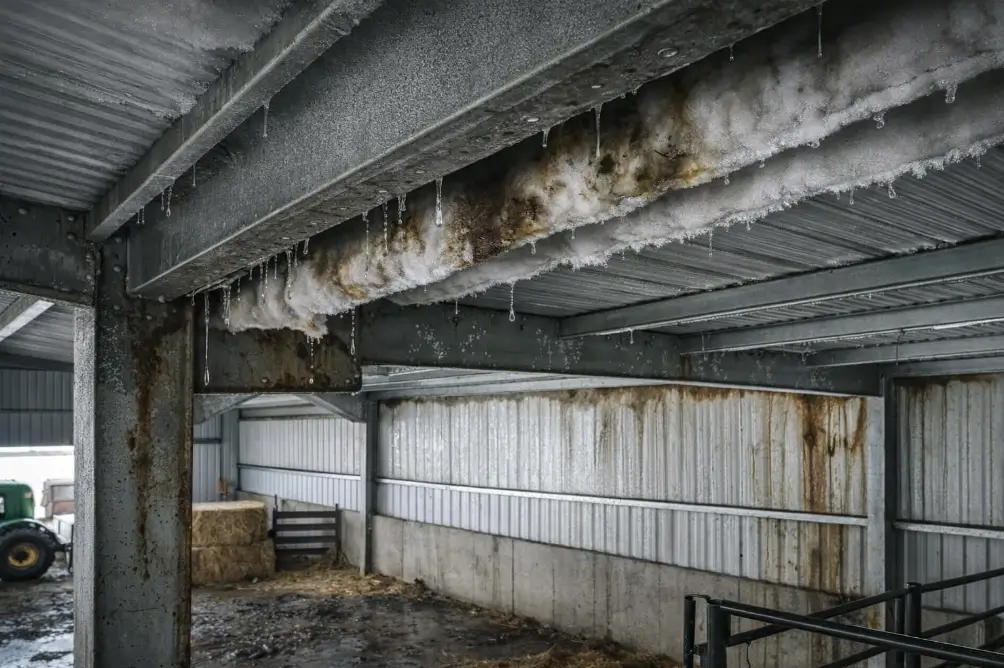
Condensation occurs when warm, moisture-laden air contacts steel surfaces that have cooled below dew point temperature. For a deeper explanation of how moisture damage develops in farm structures, see condensation failures in agricultural steel buildings.
Steel conducts cold extremely efficiently. During winter months, roof panels, purlins, wall girts, and framing members rapidly reflect exterior temperatures inward.
When interior humidity meets these cold surfaces:
- Water droplets form along roof framing
- Moisture accumulates behind insulation
- Corrosion begins at fasteners and joints
- Dripping damages bedding and feed areas
This process continues silently long before visible structural issues appear.
Why Ventilation Alone Fails Without Insulation
Many older agricultural steel buildings rely heavily on airflow to manage moisture.
This approach creates several problems.
Cold Steel Surfaces Remain Exposed
Even with strong ventilation, winter steel temperatures often drop well below dew point.
For example, many older cattle barns show continuous winter dripping along roof purlins despite high airflow, eventually leading to widespread corrosion and insulation failure.
Energy Loss Increases
Excessive ventilation during cold seasons removes heated air, increasing fuel costs without solving condensation.
Drafts Stress Livestock
High airflow creates uneven temperature zones, chilling animals and increasing respiratory illness risk.
Moisture Persists in Structural Areas
Airflow rarely reaches roof cavities, framing joints, and insulated pockets where condensation damage begins.
Ventilation controls humidity concentration, but it cannot change steel surface temperature.
Why Insulation Alone Fails Without Ventilation
Insulation helps prevent steel from becoming cold enough to condense moisture. However, insulation by itself does not remove humidity from the air.
Without ventilation:
- Moisture levels continue rising
- Warm air saturates insulation layers
- Condensation shifts deeper into wall and roof assemblies
- Mould growth accelerates
Over time, insulation loses thermal effectiveness as moisture accumulates, while hidden corrosion continues inside the building envelope.
Why Ventilation and Insulation Must Be Engineered Together
Warm air movement alone cannot eliminate moisture problems.
When warm, moisture-laden air contacts steel surfaces below dew point temperature, condensation will occur regardless of ventilation volume.
Insulation controls surface temperature.
Ventilation controls humidity levels.
Only when both systems are coordinated can moisture be managed effectively in Canadian livestock facilities.
Key Insulation Strategies for Livestock Steel Buildings
Effective insulation systems typically include:
Thermal Barriers at Steel Surfaces
Rigid boards, spray foam, or layered blanket insulation to keep steel above dew point temperature.
Vapour Control Layers
Proper vapour retarders prevent moisture migration into insulation cavities.
Continuous Coverage
Avoiding gaps at purlins, joints, and structural transitions where condensation commonly starts.
Durable Moisture-Resistant Materials
Insulation exposed to agricultural environments must resist rot, mould, and chemical breakdown.
Additional insulation system options for steel structures are explained in steel building insulation systems in Ontario.
Key Ventilation Strategies for Livestock Facilities
Ventilation design should focus on:
Continuous Air Exchange
Removing moisture-laden air steadily rather than in bursts.
Controlled Airflow Paths
Ensuring fresh air reaches animal zones and stale air exits efficiently.
Seasonal Adjustability
Higher airflow during summer, controlled rates during winter.
Integration With Heating Systems
Preventing cold drafts while maintaining humidity control.
Livestock building ventilation guidance is published by Agriculture and Agri-Food Canada.
Common Design Mistakes in Agricultural Steel Buildings
Many condensation failures stem from early design shortcuts:
- Installing insulation without vapour control
- Oversizing ventilation fans without surface temperature management
- Leaving steel framing exposed inside roof cavities
- Relying on ridge vents alone
- Treating livestock buildings like storage sheds
Each shortcut saves money upfront but creates long-term repair costs.
Long-Term Consequences of Poor Moisture Control
Unchecked condensation in farm steel structures leads to:
- Accelerated corrosion of frames and fasteners
- Structural weakening over time
- Insulation collapse and mould growth
- Higher heating costs
- Shortened building lifespan
- Increased animal illness and productivity loss
These issues rarely appear immediately. They compound quietly year after year.
Why Proper Design Pays for Itself
Buildings engineered with balanced insulation and ventilation:
- Remain structurally sound longer
- Require fewer repairs
- Use less heating energy
- Maintain healthier livestock environments
- Retain higher asset value
Lifecycle performance considerations are explained in steel building long-term cost savings. In agricultural steel construction, moisture control is not a comfort feature. It is a structural preservation strategy.
How Modern Livestock Steel Buildings Are Engineered
High-performing agricultural facilities now integrate:
- Surface temperature modelling
- Moisture load calculations
- Vapour barrier design
- Airflow mapping
- Cold climate detailing
Integrated design coordination is described in steel building engineering review checklist. This engineering approach ensures condensation is prevented rather than reacted to.
Final Perspective
Ventilation and insulation are not competing solutions.
They are complementary systems that must be engineered together to manage moisture in livestock steel buildings.
Ventilation removes humidity.
Insulation controls condensation surfaces.
When either is missing, moisture damage follows.
When both are coordinated properly, steel livestock buildings remain dry, durable, energy-efficient, and healthy for decades.
Reviewed by the Tower Steel Buildings Engineering Team
This article has been reviewed by the Tower Steel Buildings Engineering Team, bringing practical experience in agricultural steel building design, moisture control systems, and cold-climate construction across Canada. Our engineers regularly coordinate insulation, ventilation, and structural detailing to ensure livestock facilities perform reliably under Canadian environmental conditions.
1. How do you prevent condensation in livestock steel buildings?
Condensation is prevented by keeping steel surfaces above dew point temperature through proper insulation while continuously removing moisture-laden air through engineered ventilation systems. Both systems must work together to control humidity and surface cooling.
2. Is ventilation alone enough to control moisture in farm steel buildings?
No. Ventilation reduces humidity levels but does not prevent cold steel surfaces from forming condensation in winter. Without insulation, moisture will still collect on framing, roof panels, and joints, leading to corrosion and structural damage.
3. What type of insulation works best for agricultural steel buildings?
Moisture-resistant insulation systems such as closed-cell spray foam, rigid thermal boards, and properly sealed blanket systems perform best. These must be paired with vapour control layers to prevent moisture migration into building assemblies.
4. Why do older livestock barns drip water in winter?
This occurs when warm interior air contacts cold steel surfaces below dew point temperature. Even with strong ventilation, exposed steel framing cools rapidly in winter, causing continuous condensation along roof purlins and structural members.
5. How much moisture do livestock buildings produce?
Depending on animal density and building size, livestock facilities can release hundreds of litres of water vapour per day through respiration, manure, washdown, and feed moisture. This high moisture load requires engineered environmental control.
6. Can condensation damage steel building structures over time?
Yes. Long-term condensation accelerates corrosion, weakens fasteners, degrades insulation, promotes mould growth, and shortens the overall lifespan of steel buildings if not properly controlled.
7. Should vapour barriers be used in agricultural steel buildings?
Yes. Vapour barriers prevent moisture-laden air from migrating into insulation cavities where hidden condensation can form. Proper placement and sealing are critical to long-term performance.
8. Does moisture control improve energy efficiency?
Absolutely. Dry insulation maintains thermal performance, reduces heating loss, and lowers energy consumption, especially during Canadian winters.
9. How do modern steel livestock buildings manage condensation better?
Modern designs integrate insulation, vapour control, airflow modelling, and cold-climate detailing to prevent surface cooling and continuously manage moisture levels rather than reacting to condensation after it occurs.
10. Is moisture control more important in Canadian climates?
Yes. Canada’s long cold seasons create large temperature differences between interior air and steel surfaces, making condensation far more aggressive than in warmer regions.