Introduction
Most steel building budgets fail before construction even begins.
Not because the cost per sq ft was wrong. Because it was treated as a final number instead of a starting point.
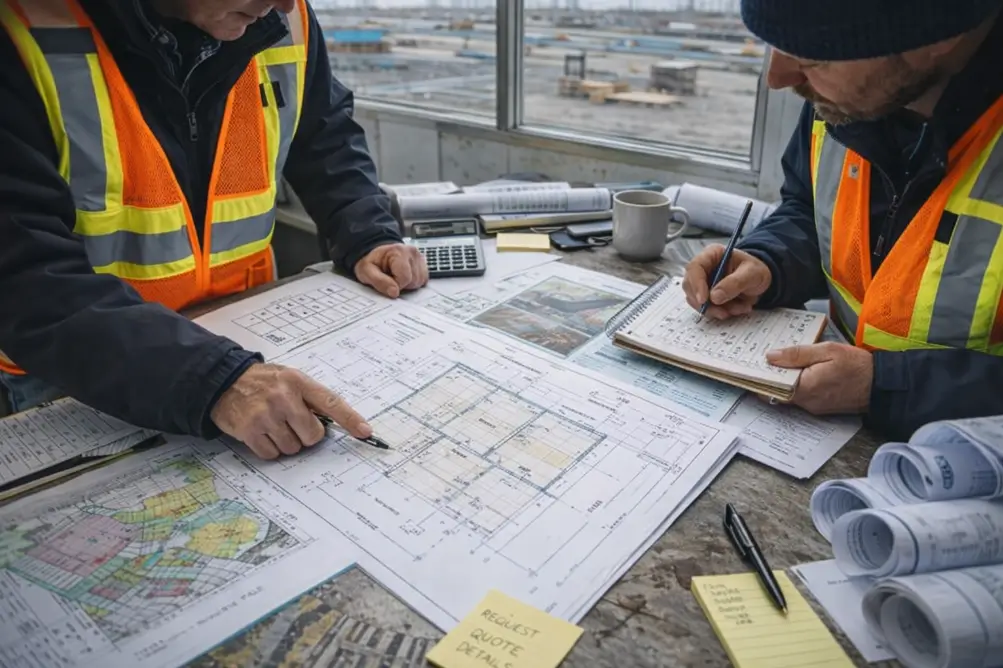
A price like $50 per sq ft can quickly become $80 or more once site conditions, loads, interior scope, delivery execution, permits, and financing timing are applied.
This guide explains realistic cost per sq ft ranges, what actually changes them in Canadian projects, and how to use them correctly so your budget holds.
What Cost Per Sq Ft Actually Means
Cost per sq ft is a simplified estimate.
Definition:
Steel Building Cost Per Sq Ft Canada refers to total project cost divided by building area, including structure, site, foundation, and construction.
Structural design and material performance are also guided by standards developed by the Canadian Standards Association (CSA).
What it must include
- Steel building kit
- Foundation
- Site work
- Delivery and erection
- Insulation and envelope
- Interior systems
- Permits and coordination
Hard truth:
If it excludes site, foundation, and scope, it is not a real number.
Steel Building Cost Per Sq Ft Ranges (Canada)
Realistic total project ranges
| Building Type | Cost Per Sq Ft |
| Basic farm storage (unheated) | $25 – $45 |
| Heated workshop | $45 – $85 |
| Commercial shell | $60 – $110 |
| Finished commercial building | $100 – $180+ |
| Industrial / heavy-use | $120 – $200+ |
Higher-cost industrial structures are often influenced by factors outlined in long-span steel structure engineering challenges where load distribution, deflection, and structural efficiency directly impact cost.
Key insight:
Cost per sq ft depends more on use than size.
Total Cost Breakdown Snapshot
| Cost Component | Typical Share |
| Steel building kit | 25% – 40% |
| Foundation | 20% – 35% |
| Site work | 10% – 25%+ |
| Delivery & erection | 10% – 20% |
| Interior systems | Often largest |
Where Cost Per Sq Ft Breaks First
Cost Failure Hierarchy
1. Site and foundation (most consistent failure point)
- Soil conditions
- Frost depth
- Drainage
2. Interior scope (largest cost driver in finished buildings)
- HVAC
- Electrical
- Offices
- Finishes
3. Load design (hidden multiplier)
- Snow, wind, seismic
4. Delivery and construction execution
- Access, staging, sequencing
5. Permits and financing timing
- Delays, revisions, funding gaps
Hard truth:
Cost per sq ft fails because these factors are not included early.
These failures align with broader risk assessment for high-value steel building projects where early assumptions create downstream cost escalation.
Size Effect: Why Bigger Buildings Cost Less Per Sq Ft
What actually happens
- Larger buildings reduce cost per sq ft
- Smaller buildings increase cost per sq ft
Why
- Fixed costs are spread across more area
- Perimeter becomes more efficient
Hard truth:
Small steel buildings are often the most expensive per sq ft projects in Canada.
Load Design: The Hidden Cost Multiplier
Canadian reality
- Snow load increases in northern regions
- Wind load increases in Prairies
- Seismic design required in BC
Cost impact
- Steel weight increases 10%–25%
- Fabrication complexity increases
Regional load requirements are explained in steel building snow load zones in Canada where environmental forces significantly affect structural weight and cost.
Structural load requirements are based on frameworks developed through the Codes Canada program administered by the National Research Council.
Load → Foundation Cost Impact
Loads affect more than the structure.
What changes
- Larger column loads
- Deeper footings
- More concrete and reinforcement
Real cost impact
- Foundation increases 10%–30%
- Slab upgrades: $5–$15 per sq ft
Hard truth:
Higher loads increase cost per sq ft across the entire project.
Foundation and Ground Conditions
This is where cost escalation begins.
Foundation cost behaviour is directly tied to foundation engineering where soil conditions, frost depth, and load transfer determine structural performance and total project cost.
Soil impact
- Clay soils → movement → stronger foundations
- Poor soil → larger footings
- Compaction failure → settlement and slab cracking
Groundwater
- Slows excavation
- Requires drainage systems
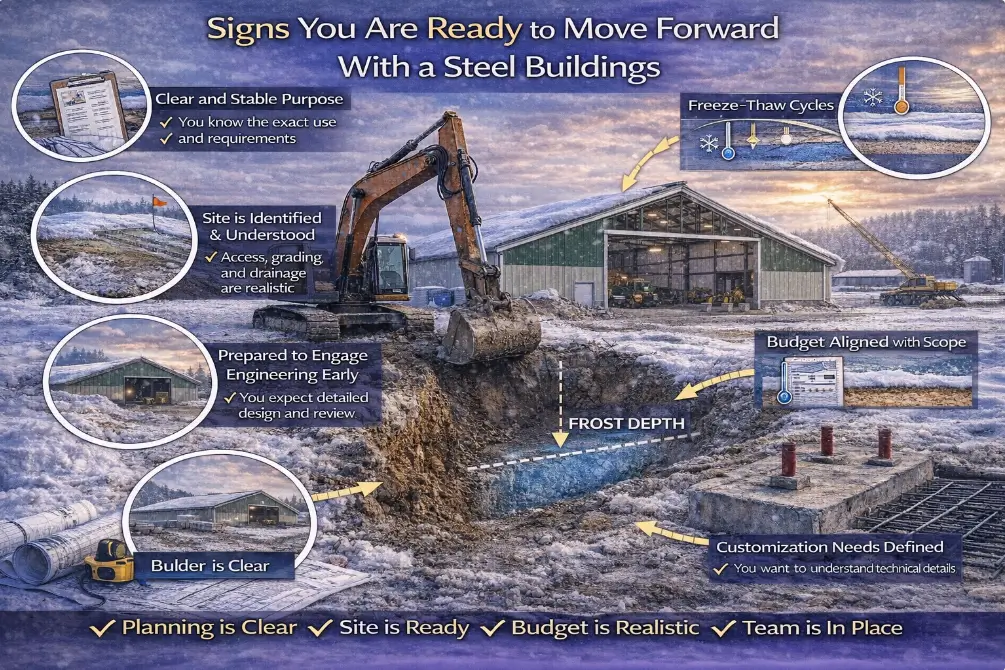
Frost depth
- Drives footing depth and concrete volume
Each additional 0.3 m depth increases cost significantly.
Site Work: The Hidden Multiplier
Cost increases in this phase are closely related to steel building site preparation where grading, drainage, access, and utilities define real construction conditions.
What drives cost
- Grading
- Drainage
- Access roads
- Utilities
Real impact
Adds $5–$25 per sq ft depending on site conditions.
Delivery and Construction Execution (Critical)
Delivery is a major cost driver, not a minor detail.
1. Site access
- Trucks require stable ground
- Temporary access roads often required
Cost: $5,000–$25,000+
2. Multi-load coordination
- Buildings arrive in multiple shipments
- Poor coordination delays erection
3. Staging constraints
- Limited space forces re-handling
- Double handling increases labour cost
4. Sequencing failures
- Out-of-order delivery causes erection delays
5. Crane coordination
- Idle crane: $150–$300/hour
- Delays: $2,000–$10,000+
Chain reaction
Poor delivery → erection delay → labour inefficiency → higher cost per sq ft
Hard truth:
Delivery execution is one of the top 3 cost drivers when mismanaged.
Interior Scope: The Largest Cost Driver
Interior systems define final cost.
What drives cost
- HVAC
- Electrical
- Plumbing
- Offices
- Finishes
Real impact
Interior systems typically add $40–$100+ per sq ft
Project-Type Cost Logic (Expanded)
Farm storage
- Minimal structural demand
- No interior systems
Lowest cost per sq ft
Workshop
- Requires insulation, heating, slab upgrades
Moderate cost increase due to envelope and slab performance
Commercial building
- Requires code compliance
- Fire safety systems
- Accessibility
Higher cost due to regulatory and system requirements
Industrial building
- Heavy loads
- Stronger slab and structure
Highest cost due to structural and durability requirements
Key insight:
Cost per sq ft increases based on structural demand and systems, not just size.
Province-Level Differences (Canada)
Ontario
- Permit complexity
- Site servicing
Alberta / Prairies
- Wind and frost
British Columbia
- Seismic and energy codes
Hard truth:
Cost per sq ft varies significantly by province.
Permits and Approval Complexity
Permits are multi-stage processes.
Approval timelines and design revisions are often driven by steel building zoning requirements in Ontario where municipal rules directly impact building layout and approvals.
What actually happens
- Submission
- Municipal review
- Consultant coordination (civil, fire, planning)
- Revisions
- Resubmissions
Timeline
- Each cycle: 2–6 weeks
- Multiple cycles typical
What drives cost
- Engineering revisions
- Site plan changes
- Approval dependencies
Chain reaction
Permit delay → schedule shift → winter construction → cost increase
Hard truth:
Permit coordination is a major cause of cost escalation.
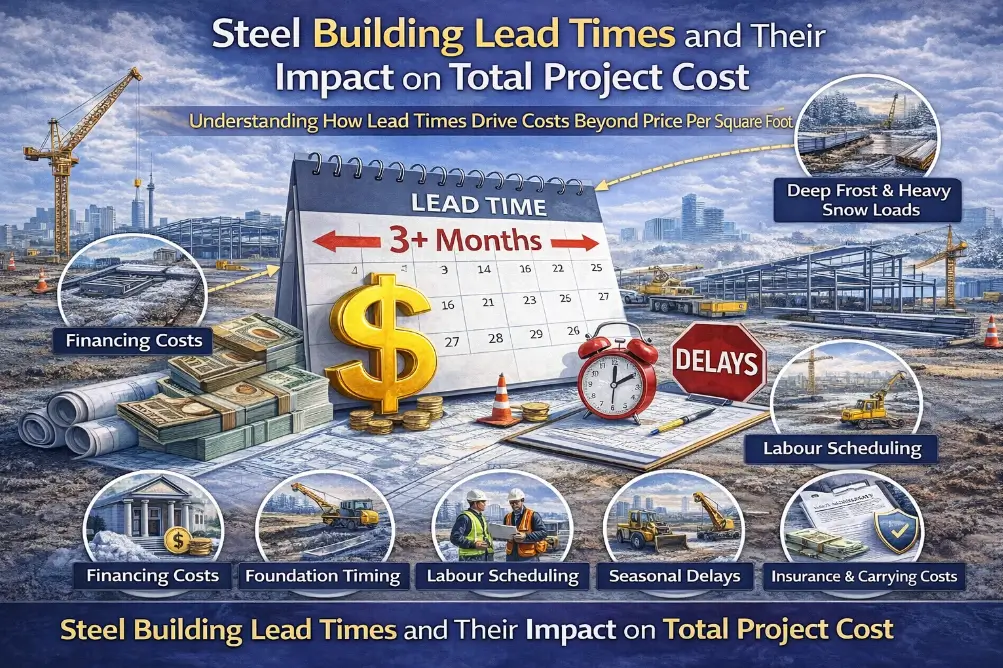
Financing and Timing Impact
Typical structure
- Steel requires 20%–40% deposit upfront
- Lender draws are delayed
- Permits slow approvals
What goes wrong
Deposit paid → funding delayed → fabrication delayed → construction delayed
Chain reaction
Delay → winter construction → labour inefficiency
Cost impact
- 15%–30% increase in total cost
Hard truth:
Most cost increases are caused by timing, not pricing.
Timing and Seasonal Impact
Winter construction
- Slower labour
- Heating required
- Reduced efficiency
Cost impact
- 15%–30% higher cost per sq ft
Real Cost Per Sq Ft Examples (Upgraded)
Example 1: 5,000 sq ft storage building
- Base estimate: $50 per sq ft
- Site issues: +$8 per sq ft
- Foundation depth increase: +$5 per sq ft
Final: ~$63 per sq ft
Example 2: Same building as workshop
- Insulation + systems: +$15 per sq ft
- Slab upgrade: +$6 per sq ft
Final: ~$84 per sq ft
Example 3: Commercial building
- Interior systems: +$40 per sq ft
- Permit delay → winter: +$10 per sq ft
Final: ~$130+ per sq ft
Key takeaway
Cost per sq ft changes due to real conditions, not assumptions.
Steel Building Cost Per Sq Ft – Key Truths
- Cost per sq ft is a range, not a fixed number
- Steel is only part of the cost
- Site and foundation drive early cost
- Interior scope drives final cost
- Loads increase both structure and foundation cost
- Delivery, permits, and timing drive real cost escalation
How to Use Cost Per Sq Ft Correctly
- Use it for early estimates only
- Define building use first
- Validate site conditions
- Understand load requirements
- Plan delivery and staging
- Align financing with schedule
Final Perspective
Cost per sq ft is not a reliable answer.
It is a starting point.
Accurate cost planning requires aligning engineering, site conditions, and execution strategy from the beginning.
Planning a steel building project in Canada ensures realistic budgeting based on actual project variables rather than assumptions.
Real steel building cost in Canada is driven by:
- Site conditions
- Structural loads
- Building use
- Interior systems
- Delivery execution
- Permits and timing
If you treat cost per sq ft as a final number, your budget will fail.
If you treat it as a variable shaped by real conditions, your project will hold.
Reviewed by Tower Steel Buildings Engineering Team
This article has been reviewed by the Tower Steel Buildings Engineering Team to ensure the cost guidance reflects real structural design, site conditions, and construction realities across Canadian steel building projects.
1. What is the average cost per sq ft for steel buildings in Canada?
Steel building cost per sq ft typically ranges from $25 to $200+, depending on building type and scope. Basic farm storage sits at the low end, while finished commercial or industrial buildings reach the high end due to interior systems and structural demands.
Reality: Most estimates fail when they assume one average number across different uses.
2. Why does cost per sq ft vary so much?
Cost per sq ft changes based on site conditions, loads, interior systems, and project execution. For example, poor soil or deeper frost requirements can add $5–$25 per sq ft, while interior systems can add $40–$100+ per sq ft.
Reality: Cost variation is driven by conditions, not pricing inconsistency.
3. Is cost per sq ft reliable for budgeting?
It is reliable only for early-stage estimates. Once site conditions, permits, and scope are defined, actual cost can increase significantly. Projects that rely on sq ft pricing alone often see 15%–30% overruns.
Reality: Cost per sq ft is a starting point, not a final number.
4. How do loads affect cost per sq ft?
Higher snow, wind, or seismic loads increase both structural steel and foundation requirements. This typically raises total cost by 10%–30% due to heavier frames, deeper footings, and more reinforcement.
Reality: Load design increases cost across the entire building, not just the structure.
5. What is the biggest cost driver in steel buildings?
Foundation and site conditions are usually the biggest cost drivers. Soil issues, drainage problems, and frost depth often increase excavation and concrete costs before construction even begins.
Reality: Most budgets break at the ground level, not in the steel.
6. How does delivery affect cost per sq ft?
Delivery impacts cost through site access, staging, and sequencing. Poor access may require temporary roads costing $5,000–$25,000, and crane delays can add $150–$300 per hour.
Reality: Delivery failures turn into construction delays and labour cost increases.
7. Do permits really increase cost per sq ft?
Yes. Permit delays trigger design revisions and push construction timelines. Each review cycle typically adds 2–6 weeks, and delays often shift projects into winter, increasing costs by 15%–30%.
Reality: Permits increase cost through time, not just fees.
8. How does financing affect steel building cost?
Steel fabrication usually requires a 20%–40% upfront deposit, while lender funding is released later. This mismatch delays fabrication and construction, often leading to winter execution and higher costs.
Reality: Most cost overruns start as cash flow timing problems.
9. Does Canadian climate increase cost per sq ft?
Yes. Frost depth increases foundation cost, snow load increases structural demand, and winter construction reduces labour efficiency. These factors typically raise costs by 15%–30%.
Reality: Climate affects both design and construction cost in Canada.
10. Why do similar buildings have different cost per sq ft?
Buildings of the same size can differ due to loads, soil conditions, interior scope, and delivery complexity. A simple storage building and a finished commercial building can differ by 2x or more in cost per sq ft.
Reality: Size does not define cost. Use and conditions do.
11. What is the most common mistake when using cost per sq ft?
The biggest mistake is treating it as a fixed number. Buyers often ignore site, foundation, and scope, which leads to major cost gaps during construction.
Reality: Cost per sq ft fails when project variables are not defined early.
12. What is the safest way to estimate steel building cost?
Start with cost per sq ft as a range, then adjust based on site conditions, load requirements, building use, and timing. A full project estimate should include all components, not just the structure.
Reality: Accurate budgets come from full project planning, not simplified averages.