Condensation is one of the most common and least understood causes of early damage in agricultural steel buildings. Many farm owners assume moisture issues are cosmetic or seasonal, only to discover years later that corrosion, insulation breakdown, structural deterioration, and air quality problems have been quietly compounding.
In Canada’s variable climate, agricultural environments create ideal conditions for condensation to form inside steel buildings. Warm humid air from livestock, stored crops, and washdowns regularly meets cold steel surfaces during fall, winter, and spring transitions. When moisture control is not engineered properly, water forms inside the building envelope instead of draining away.
Over time, this moisture exposure shortens building lifespan, increases maintenance costs, and in severe cases compromises structural integrity.
Understanding why condensation occurs and how it should be managed is critical for anyone planning a permanent agricultural steel building. This is especially important when evaluating the performance requirements of agricultural steel building design considerations in Canada.
Why Condensation Is More Severe in Farm Steel Structures
All buildings experience some moisture movement, but farm steel structures face much higher internal humidity levels than typical commercial or storage facilities.
Common moisture sources include:
- Livestock respiration and body heat
- Manure systems and washdowns
- Wet equipment and vehicles
- Stored hay, grain, and feed releasing moisture
- Seasonal temperature swings
Steel surfaces rapidly drop below dew point temperature in cold weather. Moisture formation related to temperature differential is defined by the psychrometric dew point principles in building science. When warm moist air contacts those cold surfaces, water vapour turns into liquid condensation.
Without proper thermal breaks, ventilation, and vapour control, moisture accumulates on roof panels, wall cladding, purlins, and framing members. Long-term performance depends heavily on selecting appropriate steel building insulation systems for moisture control.
This process may not be visible every day, but repeated cycles slowly saturate materials and promote corrosion.
The Long-Term Impact of Uncontrolled Condensation
Condensation problems rarely cause immediate failure. Instead, they quietly degrade building components year after year.
For example, a livestock housing building may experience constant winter condensation along roof purlins that appears harmless at first, but within a few years leads to widespread corrosion, insulation saturation, and costly roof replacement.
Common long-term effects include:
Corrosion of Steel Components
Water sitting on steel surfaces accelerates oxidation, especially where coatings are thin, scratched, or exposed at fasteners and seams.
Over time this leads to:
- Reduced structural capacity
- Weakened connections
- Panel perforation
- Premature replacement of roof and wall sheets
Insulation Breakdown
Wet insulation loses thermal performance and becomes heavy and compressed.
This results in:
- Increased heat loss
- Higher heating costs
- Continued condensation cycling
- Mold development in organic insulation materials
Structural Moisture Trapping
Condensation trapped between layers of roofing, insulation, and vapour barriers can remain wet for months.
This hidden moisture:
- Corrodes steel unseen
- Damages fasteners
- Reduces coating lifespan
Air Quality and Livestock Health Issues
Persistent moisture encourages mold, bacteria, and ammonia accumulation, which can affect livestock respiratory health and building hygiene.
Why Many Agricultural Facilities Are Not Designed for Moisture Control
A major reason condensation failures occur is that moisture management is often treated as an accessory instead of a structural design factor.
Common mistakes include:
- Assuming steel buildings “breathe” naturally
- Using basic insulation without vapour barriers
- Ignoring ventilation planning
- Installing roof panels directly over cold framing
- Treating condensation as a maintenance issue rather than a design issue
Many preliminary steel building packages focus primarily on structural loads while overlooking thermal behaviour and humidity movement.
In agricultural environments, this approach almost guarantees moisture problems.
The Role of Thermal Bridging in Condensation Formation
Steel is an excellent conductor of heat. Framing members that pass through insulation create cold pathways known as thermal bridges.
These bridges:
- Cool interior surfaces rapidly
- Create localized condensation points
- Increase overall moisture accumulation
Without proper thermal breaks or continuous insulation systems, condensation forms along purlins, girts, fasteners, and panel seams.
Over time, these become the primary corrosion zones in farm buildings.
Ventilation Alone Is Not a Complete Solution
Many farm owners rely solely on natural or mechanical ventilation to manage moisture.
While ventilation is essential, it cannot correct poor thermal design on its own.
Ventilation helps remove humid air, but when cold steel surfaces remain exposed, condensation will still occur during temperature swings. Agricultural ventilation performance is further addressed in the ASHRAE agricultural building ventilation standards.
Effective moisture control requires:
- Controlled vapour movement
- Proper insulation systems
- Thermal separation of steel framing
- Balanced ventilation design
Relying on airflow alone often results in partial improvement while structural moisture damage continues.
Vapour Barriers and Moisture Migration
Warm air carries water vapour. When it moves through walls and roof assemblies and reaches colder layers, condensation forms inside the building envelope.
A properly installed vapour barrier:
- Controls air movement
- Limits moisture penetration
- Protects insulation layers
- Reduces internal condensation
In agricultural steel buildings, vapour barriers must be continuous and well sealed, particularly around penetrations, doors, and structural connections.
Gaps and poorly sealed seams allow warm moist air to bypass protection systems.
Roof Design and Condensation Risk
Roof geometry significantly influences condensation behaviour.
Common risk factors include:
- Shallow roof slopes that slow drainage
- Long roof spans with cold surface exposure
- Poor ridge ventilation
- Inadequate insulation thickness
Cold roof panels act as condensation collectors during winter and shoulder seasons.
Designing roof assemblies that maintain warmer interior surface temperatures dramatically reduces moisture formation.
How Canadian Climate Intensifies Condensation Problems
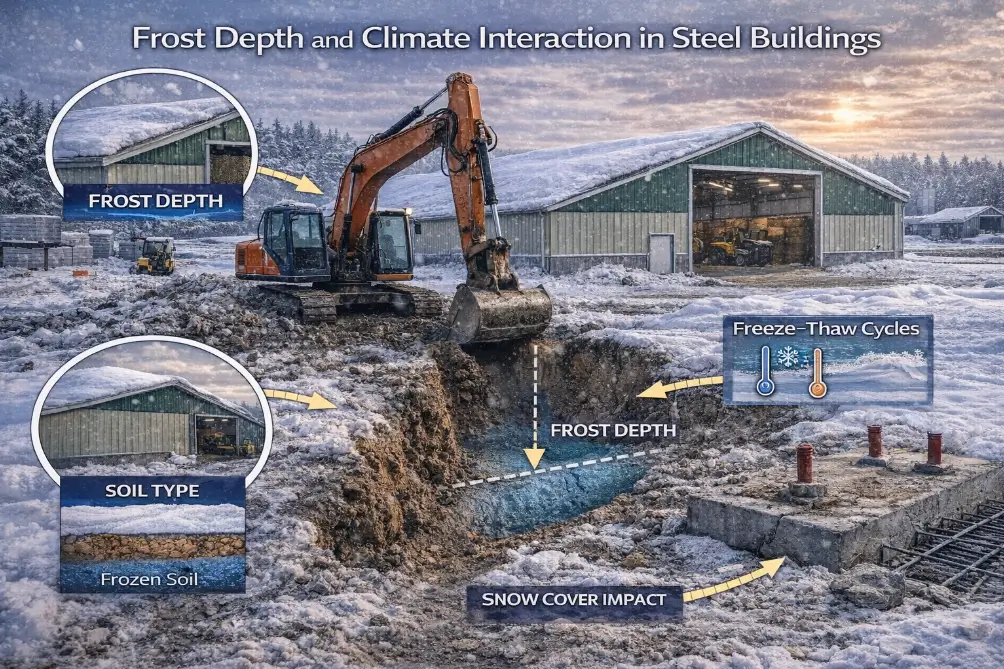
Canada’s seasonal transitions are especially hard on agricultural steel buildings. Seasonal freezing behaviour and ground temperature interaction are explained in detail in frost depth effects on steel building foundations in Canada.
Key contributors include:
- Rapid temperature drops at night
- Freeze thaw cycles
- Cold steel surfaces during humid days
- Extended winter heating periods
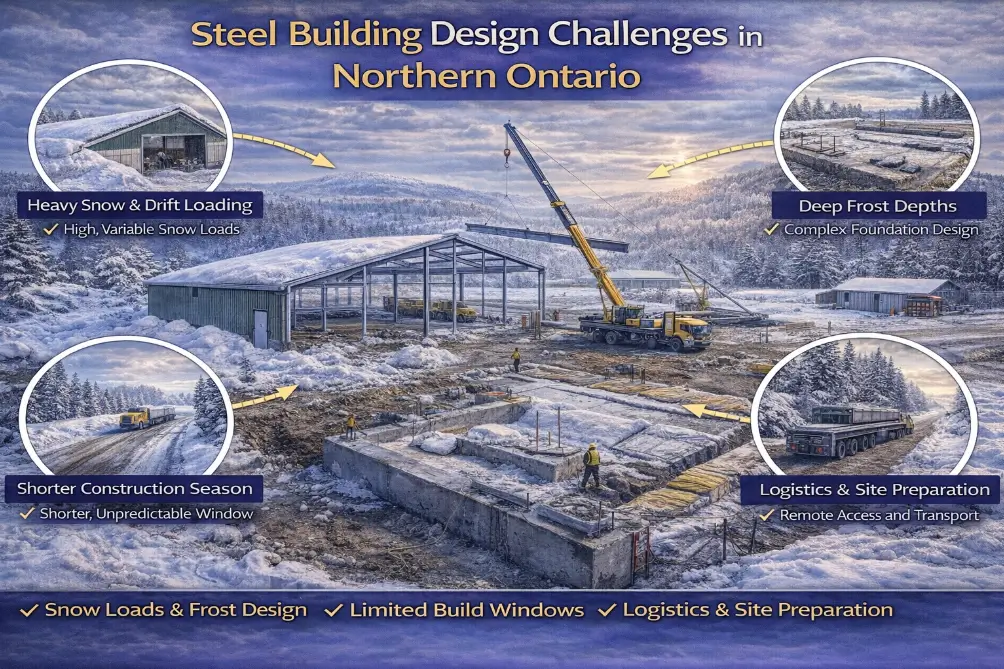
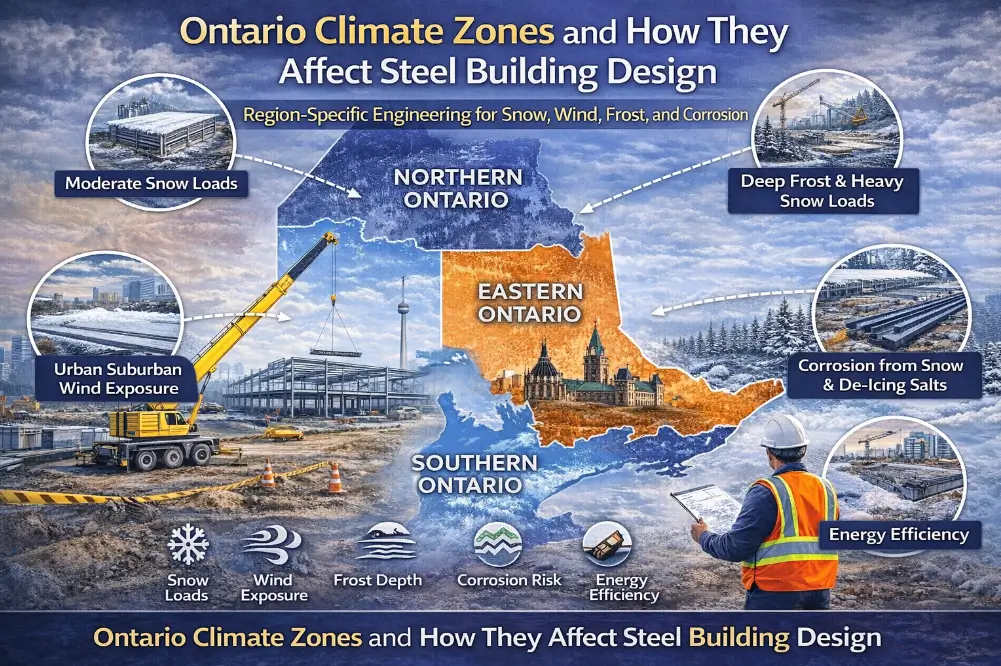
Buildings that perform adequately in dry climates often struggle in Canadian conditions without additional moisture engineering.
Condensation failures are far more likely when thermal behaviour is not specifically addressed for cold weather environments.
Early Warning Signs of Condensation Failure
Farm owners should monitor for:
- Dripping from roof panels
- Rust forming along purlins and fasteners
- Damp insulation
- Mold smell or visible growth
- Peeling coatings on steel surfaces
- Frost accumulation inside roof spaces
These signs indicate that moisture control systems are insufficient and deterioration is underway.
Preventing Condensation Failures Through Proper Design
Effective moisture control in agricultural steel buildings involves an integrated approach.
Key design strategies include:
Continuous Insulation Systems
Minimizing thermal bridging keeps interior surfaces warmer and reduces condensation potential.
Proper Vapour Barriers
Sealed barriers control moisture migration into roof and wall assemblies.
Ventilation Planning
Balanced airflow removes excess humidity without creating cold surface exposure.
Roof Assembly Engineering
Warm side insulation placement and drainage design reduce condensation formation.
Material Selection
Coatings, fasteners, and insulation should be chosen for agricultural moisture exposure.
Why Moisture Control Is an Engineering Responsibility
Condensation is not simply a comfort issue. It affects:
- Structural durability
- Building lifespan
- Maintenance costs
- Livestock health
- Insurance risk
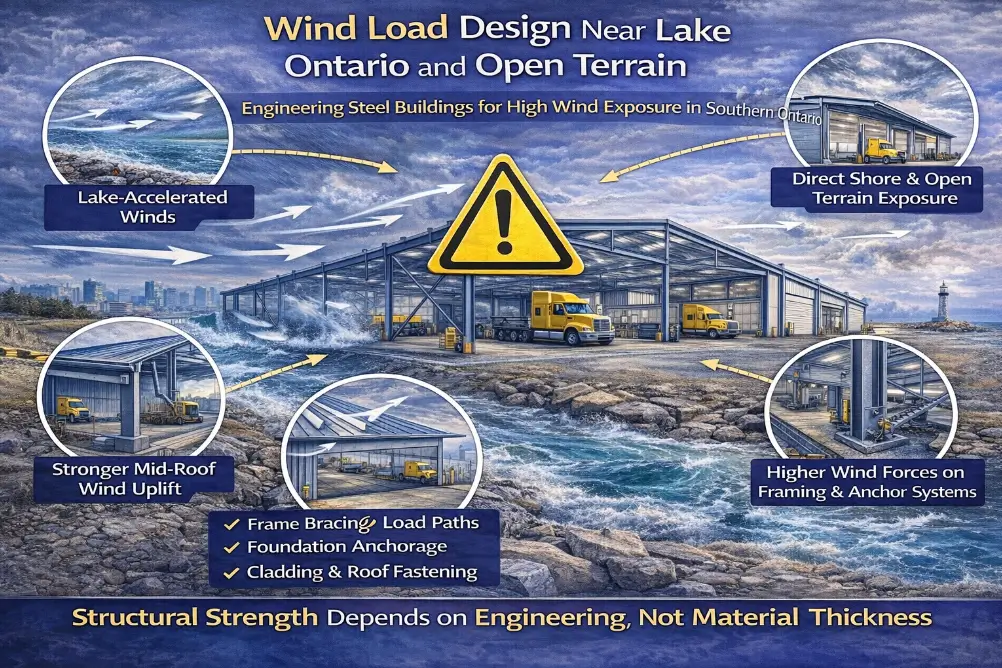
For permanent farm buildings, moisture behaviour should be considered alongside snow loads, wind loads, and foundation design.
Environmental performance requirements for Canadian structures are established under the National Building Code of Canada environmental control provisions.
Buildings engineered with moisture control in mind consistently outperform those treated as basic steel shells.
The Cost of Ignoring Condensation at Design Stage
Short-term savings from simplified insulation or ventilation approaches often lead to:
- Accelerated corrosion repairs
- Premature roof replacement
- Increased heating costs
- Structural reinforcement
- Reduced asset lifespan
Correcting moisture failures after construction is significantly more expensive than preventing them during design. This aligns with long-term research on steel building lifecycle maintenance cost performance.
Why Integrated Engineering Produces Better Agricultural Buildings
Organizations such as Tower Steel Buildings apply moisture control principles as part of total building engineering, not as optional add ons. Moisture-engineered farm facilities are commonly delivered through custom engineered farm steel building systems.
By coordinating structural design, insulation systems, vapour control, and ventilation planning early, agricultural steel buildings perform reliably across Canada’s demanding climate conditions.
This approach protects both the structure and long term operating costs.
Final Perspective
Condensation failures in agricultural steel buildings are not inevitable. They are the result of design decisions that overlook moisture movement, thermal behaviour, and environmental exposure.
When moisture control is engineered correctly, steel buildings remain dry, durable, and efficient for decades. When ignored, deterioration begins almost immediately.
In Canadian agricultural construction, moisture management is not an upgrade. It is a fundamental component of building performance.
Reviewed by the Tower Steel Buildings Engineering Team
This article has been reviewed by the Tower Steel Buildings Engineering Team, bringing together structural engineering, building envelope design, and agricultural construction experience specific to Canadian climate conditions. The review ensures technical accuracy, practical field relevance, and alignment with long-term performance standards for agricultural steel buildings.
1. What causes condensation inside agricultural steel buildings?
Condensation forms when warm, humid interior air contacts cold steel surfaces and drops below dew point temperature. Common moisture sources include livestock respiration, washdowns, wet equipment, and stored crops combined with Canada’s cold seasonal temperatures.
2. Are steel buildings more prone to condensation than other farm structures?
Steel buildings conduct heat more rapidly than wood or masonry, which creates colder interior surfaces during winter conditions. Without proper insulation, vapour control, and thermal separation, steel structures experience higher condensation risk than well-designed traditional buildings.
3. Can ventilation alone prevent condensation problems?
Ventilation helps remove humid air but does not eliminate condensation if cold steel surfaces remain exposed. Effective moisture control requires a combination of insulation systems, vapour barriers, thermal breaks, and balanced airflow design.
4. Does condensation damage the structure of a steel building?
Yes. Repeated moisture exposure accelerates corrosion of framing members, fasteners, and panels. Over time this can weaken structural components, reduce coating lifespan, and lead to costly repairs or premature replacement.
5. What insulation systems work best for agricultural steel buildings in Canada?
Systems that provide continuous insulation with proper vapour barriers perform best. This includes insulated roof assemblies, thermal breaks at framing members, and sealed vapour control layers to prevent moisture migration into cold surfaces.
6. How can I tell if condensation is already causing damage?
Early signs include dripping from roof panels, rust along purlins and fasteners, damp insulation, mold odours, frost buildup in roof spaces, and peeling protective coatings on steel surfaces.
7. Is condensation covered under building warranties or insurance?
Most warranties and insurance policies exclude damage caused by moisture buildup resulting from inadequate design or maintenance. Proper moisture engineering at the design stage is the primary protection against condensation-related failures.
8. Should condensation control be included in engineering design?
Absolutely. Moisture behaviour should be engineered alongside structural loads, insulation performance, and ventilation planning. In agricultural environments, condensation control is a core building performance requirement, not an optional upgrade.
9. Do Canadian climate conditions make condensation worse?
Yes. Freeze-thaw cycles, cold winters, and rapid temperature swings significantly increase condensation risk. Buildings designed without accounting for Canadian climate behaviour experience far higher moisture-related deterioration.
10. Is fixing condensation after construction expensive?
Post-construction corrections often involve roof replacement, insulation removal, corrosion repairs, and operational downtime. Preventing condensation through proper design is far more cost-effective than repairing long-term damage.