Introduction
Slab-on-grade vs pier foundations in Canada is not a design preference. It is a ground, load, and climate decision.
Foundation design and frost considerations follow national frameworks developed under the Codes Canada program administered by the National Research Council.
Many projects choose a foundation type based on cost or familiarity. That approach fails when soil conditions, frost depth, or building use are not aligned with the system. By the time issues appear, the wrong foundation has already been installed.
Definition:
A slab-on-grade foundation is a continuous concrete slab poured directly on prepared ground, designed to distribute loads across the entire footprint.
A pier foundation uses isolated concrete footings or piers that transfer loads to deeper, stable soil layers, with the building supported above grade.
Master hook:
Foundation choice is not about preference. It is about how the ground carries load.
This behaviour is defined through foundation design for steel buildings, where load transfer and soil response are engineered together rather than assumed.
Ultra-hard line:
You don’t choose a foundation type. The site forces the decision.
This is the same principle applied in site-specific steel building engineering, where structural systems are developed based on actual site conditions rather than standard templates.
Diagnostic shortcut:
If soil is inconsistent or frost depth is high, the wrong foundation will fail regardless of cost.
Quick Comparison (Problem → Mechanism → Outcome)
| Factor | Slab-on-Grade | Pier Foundation |
| Load distribution | Spread across surface | Transferred to deeper points |
| Soil sensitivity | High | Lower if designed correctly |
| Frost risk | High if not protected | Reduced with proper depth |
| Cost predictability | Moderate | Variable |
| Best use | Stable, well-prepared sites | Variable or poor soil sites |
| Failure risk | Settlement, cracking | Misalignment if poorly coordinated |
Reality:
Neither system is better universally. Each works only under the right conditions.
What Most Projects Get Wrong
Many projects compare slab and pier foundations based only on upfront cost.
This is where failure starts.
Foundation selection is often made before:
• soil testing is complete
• frost depth is confirmed
• drainage strategy is designed
• structural loads are finalized
By the time these factors are understood, the foundation decision has already been made.
This leads to redesign, reinforcement, or long-term structural issues.
Reality:
Foundation decisions made too early are one of the most expensive mistakes in steel construction.
When Slab-on-Grade Works
Why it is used
Slab-on-grade is efficient when the ground is stable and predictable.
Conditions required
- well-compacted granular soil
- low groundwater
- proper drainage
- controlled frost design
What actually happens
The slab spreads load evenly across the surface.
Failure chain
poor soil → uneven support → differential settlement → slab cracking → structural movement
Diagnostic hook
If slab cracks appear in multiple directions, the support underneath is inconsistent.
Cost range
- $15 to $40 per sq ft under good conditions
Where it fails
- soft or organic soils
- poor drainage
- frost exposure without insulation
Hard truth:
Slab-on-grade only works when the ground is fully controlled.
When Pier Foundations Work
Why they are used
Pier foundations bypass weak surface soil and transfer loads deeper.
Conditions where they are effective
- variable soil conditions
- sloped sites
- frost-sensitive ground
- high water tables
What actually happens
Loads are concentrated and transferred through piers into stable soil layers.
Failure chain
incorrect depth → frost movement → pier shifting → frame misalignment
Diagnostic hook
If individual columns move differently, pier depth or soil interaction is incorrect.
Cost range
- $25 to $80+ per sq ft equivalent depending on depth and spacing
Where they fail
- inconsistent pier placement
- poor alignment
- incorrect load distribution
Hard truth:
Pier systems reduce soil risk but increase coordination risk.
Soil Conditions: The Real Decision Maker
Ground variability and bearing capacity are further broken down in soil conditions and steel building foundations in Canada, where soil directly dictates structural performance.
Stable granular soil
- favors slab-on-grade
- predictable load distribution
Clay or expansive soil
- high movement risk
- often better suited for pier systems
Organic or loose soil
- poor load capacity
- requires deep support
Diagnostic rule
If soil bearing capacity is uncertain, slab systems carry higher risk.
Advanced detail
Projects based on assumed soil values often fail when bearing capacity testing reveals lower support capacity, forcing redesign or foundation change.
These late-stage changes are a primary cause of delays identified in steel building permit rejection mistakes, where incomplete inputs lead to resubmission and redesign.
Reality:
The soil decides the foundation type before design begins.
Frost Impact on Foundation Choice
Slab-on-grade risk
- frost can lift the entire slab
- requires insulation or deeper edge design
Pier system advantage
- piers extend below frost depth
- reduce upward movement
Failure chain
frost → soil expansion → movement → cracking or misalignment
Diagnostic hook
If seasonal movement occurs, frost protection is insufficient.
Cost impact
- frost design can add $5 to $20 per sq ft
Hard truth:
Frost is one of the main reasons slab systems fail when misapplied.
Load Behavior and Structural Performance
Structural design must also align with standards developed by the Canadian Standards Association (CSA).
Slab-on-grade
- distributes load evenly
- sensitive to uneven soil
Pier foundation
- concentrates load
- relies on correct spacing and depth
Failure chain
incorrect load distribution → stress concentration → movement → structural issues
Diagnostic hook
If loads increase after design, slab thickness or pier size must change.
Reality:
Foundation design follows load, not layout.
Drainage and Water Control
Slab-on-grade
- highly sensitive to water accumulation
- requires proper grading
Pier foundation
- reduces surface water impact
- still requires drainage planning
Failure chain
water → soil weakening → settlement or movement
Diagnostic hook
If water is visible on site, both systems require redesign.
Cost impact
- drainage adds $3,000 to $15,000+
Hard truth:
Water is the most common cause of foundation failure.
These issues almost always originate during steel building site preparation, where grading, compaction, and drainage control determine long-term stability.
Construction and Coordination Risk
Slab-on-grade
- simpler to construct
- fewer alignment issues
Pier foundation
- requires precise placement
- alignment critical for steel erection
Failure chain
misaligned piers → anchor issues → erection delays → rework
Diagnostic hook
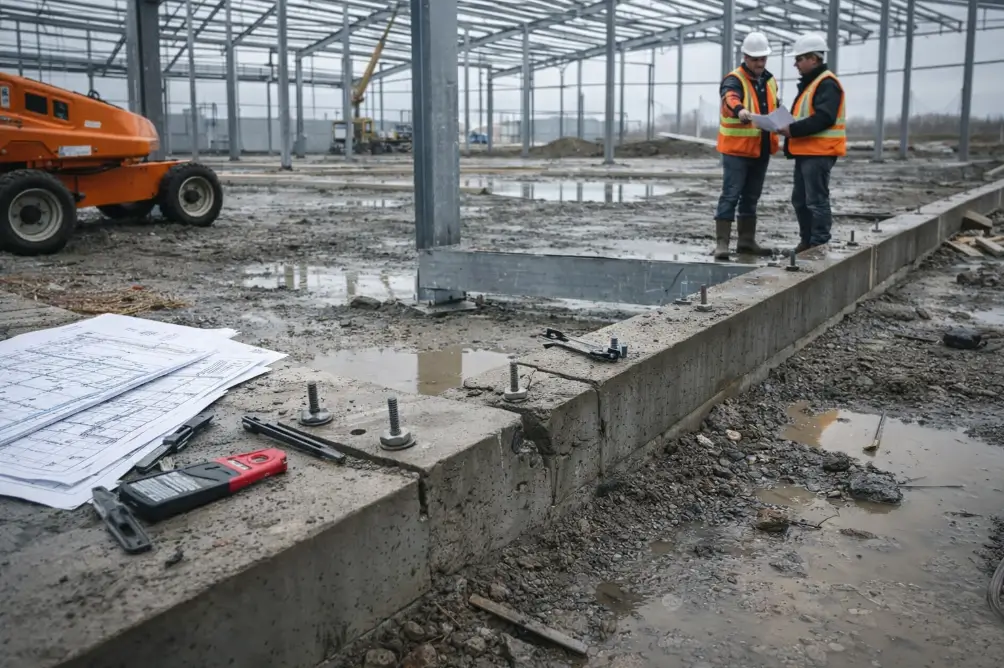
If anchor bolts do not align, pier layout or execution failed.
Reality:
Pier systems require tighter coordination than slab systems.
Cost Comparison (Real Behavior)
Slab-on-grade
- lower initial cost
- higher risk if soil is poor
Pier foundation
- higher upfront variability
- more stable under difficult conditions
Real cost chain
cheap slab → poor soil → failure → repair → higher lifetime cost
vs
proper pier design → higher initial cost → stable performance
Hard truth:
Initial cost savings often lead to higher long-term cost.
Real Project Case Studies
Case 1: Slab Failure on Poor Soil
Problem:
Cracking across slab
Cause:
Inadequate soil preparation
Failed fix:
Surface repairs
Final fix:
Partial reconstruction and stabilization
Cost:
~$22,000
Outcome:
Foundation stabilized and no further cracking occurred in subsequent seasons.
Case 2: Pier Foundation Misalignment
Problem:
Columns did not align during erection
Cause:
Incorrect pier placement
Fix:
Rework and adjustment
Cost:
~$12,000 delay + correction
Outcome:
Structure aligned correctly with no further erection issues.
Case 3: Frost Heave on Slab
Problem:
Seasonal lifting
Cause:
Insufficient frost protection
Fix:
Insulation and drainage correction
Cost:
~$15,000
Outcome:
No further movement observed in following winters.
How to Choose the Right Foundation
Choose slab-on-grade when:
- soil is stable and tested
- drainage is controlled
- frost design is properly addressed
Choose pier foundation when:
- soil is variable or weak
- frost risk is high
- site conditions are inconsistent
Cost Failure Hierarchy (What Goes Wrong First)
- Soil conditions misjudged
- Drainage not addressed
- Frost design underestimated
- Load assumptions incorrect
- Execution or alignment errors
Reality:
Foundation failure starts with wrong assumptions, not construction mistakes.
Final Perspective
Slab-on-grade and pier foundations both work when used correctly.
They both fail when the site, soil, and environmental conditions are ignored. The right foundation is not the cheaper option. It is the one that matches the ground conditions and load requirements.
Reviewed by Engineering Team
This content has been reviewed by the Tower Steel Buildings Engineering Team based on real-world experience designing slab and pier foundation systems across varying soil conditions, frost environments, drainage challenges, and structural load requirements.
If the Wrong Foundation Is Chosen, the Cost Does Not Stay the Same
If the foundation type does not match the site, the cost will increase through repairs, delays, and structural issues. Identify the correct system early, or expect the problem to repeat.
1. Which is better, slab-on-grade or pier foundations in Canada?
Neither is universally better. Slab-on-grade works on stable, well-prepared soil, while pier foundations perform better on weak, variable, or frost-sensitive ground.
Impact:
Choosing the wrong system leads to movement, cracking, or misalignment.
Reality:
The site conditions determine the correct foundation, not preference or cost.
2. Is slab-on-grade cheaper than pier foundations?
Slab-on-grade is usually cheaper upfront, typically $15 to $40 per sq ft, but can become more expensive if soil or drainage issues exist.
Impact:
Repairs from settlement can exceed $10,000–$30,000+.
Reality:
Lower initial cost often leads to higher long-term cost if misapplied.
3. When should I use a pier foundation instead of a slab?
Pier foundations should be used when soil is weak, inconsistent, sloped, or prone to frost movement.
Impact:
They transfer loads to deeper stable layers, reducing surface soil risk.
Reality:
Pier systems are used when the ground near the surface cannot be trusted.
4. Can slab-on-grade foundations handle frost conditions?
Yes, but only if designed with proper frost protection such as insulation or deeper edge design.
Impact:
Without protection, frost heave causes lifting and cracking.
Cost impact:
Frost design adds $5 to $20 per sq ft.
Reality:
Frost is predictable and must be engineered into the design.
5. Why do slab-on-grade foundations crack?
Cracking occurs due to uneven soil support, poor compaction, or load stress exceeding design capacity.
Impact:
Leads to water entry, structural stress, and long-term deterioration.
Reality:
Cracks are usually a symptom of ground movement, not concrete failure.
6. Are pier foundations more stable than slab-on-grade?
Pier foundations are more stable in poor soil conditions but depend on correct depth, spacing, and alignment.
Impact:
Incorrect installation can cause misalignment and erection delays.
Reality:
Stability depends on execution, not just foundation type.
7. How does soil type affect foundation choice?
Soil determines load capacity, movement behavior, and drainage characteristics.
Impact:
Weak or expansive soils increase risk of settlement or frost heave.
Reality:
Soil is the primary factor in foundation design decisions.
8. What is the biggest risk with slab-on-grade foundations?
The biggest risk is differential settlement caused by inconsistent soil or poor drainage.
Impact:
Leads to cracking, uneven floors, and structural movement.
Reality:
Slab systems fail when the ground is not fully controlled.
9. What is the biggest risk with pier foundations?
The biggest risk is misalignment due to incorrect placement or insufficient depth.
Impact:
Causes erection problems, delays, and costly rework.
Reality:
Pier systems require precise coordination during construction.
10. Can foundation type affect steel building erection?
Yes. Foundation accuracy directly affects column alignment, anchor bolt placement, and structural assembly.
Impact:
Misalignment can delay erection and increase crane and labor costs.
Reality:
Foundation errors show up immediately during steel erection.
11. Can I change from slab to pier foundation after design?
Yes, but it typically causes redesign, delays, and increased cost.
Impact:
May affect schedule and engineering approvals.
Reality:
Foundation decisions should be finalized early.
12. Which foundation type lasts longer?
Both can last decades if designed and constructed correctly.
Impact:
Lifespan depends on soil, drainage, and maintenance.
Reality:
Performance is determined by design quality, not foundation type.
13. How much does soil testing help in choosing the right foundation?
Soil testing identifies bearing capacity and moisture conditions early.
Impact:
Can prevent 20% to 60%+ cost overruns.
Reality:
Soil testing is one of the highest return decisions in construction.