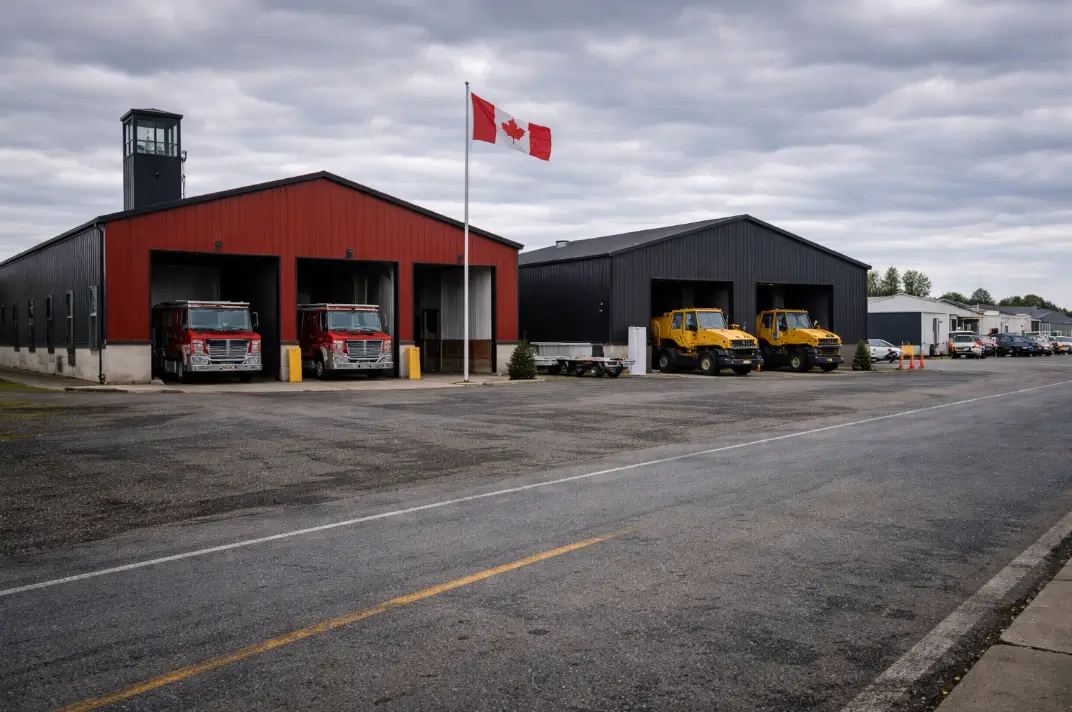
Clear span steel buildings have become a foundational structural solution for industrial facilities across Canada. From manufacturing plants and logistics hubs to heavy equipment service and processing operations, clear-span design allows owners to maximize usable floor space while maintaining structural integrity, operational efficiency, and long-term adaptability.
This article explains how clear-span steel buildings work, why they are particularly effective for industrial applications, and what decision-makers should understand before committing to this type of structure. It is written for owners, developers, engineers, and operations managers planning permanent industrial steel buildings in Ontario and Canada where workflow, equipment access, and future growth matter.
What Is a Clear-Span Steel Building?
A clear-span steel building is a structure designed without interior columns or load-bearing posts across the primary floor area. Roof and wall loads are transferred to the foundation through engineered steel frames positioned at the building perimeter.
This structural approach creates an uninterrupted interior space that supports large equipment, vehicle circulation, overhead lifting systems, and evolving production layouts. In industrial applications, where internal obstructions can limit safety and efficiency, clear-span design removes unnecessary constraints.
Clear spans vary in width depending on building height, roof geometry, load requirements, and engineering strategy. In Canadian industrial construction, clear spans of 60 feet, 80 feet, or more are common when engineered correctly.
Why Clear Span Matters in Industrial Facilities
Clear-span construction directly supports industrial efficiency by allowing the building to serve operations rather than dictate them.
In industrial facilities, interior columns often create:
- Equipment bottlenecks
- Inefficient material flow
- Increased collision risk
- Layout rigidity
Clear-span buildings eliminate these issues by providing open, flexible interiors that can be organized around real operational needs.
For manufacturing environments, this means production lines can follow logical sequencing rather than structural limitations. Many large-scale operations rely on engineered steel buildings for manufacturing facilities that are designed to handle heavy loads, equipment integration, and long-term industrial performance.
For warehousing and logistics, it allows racking systems and aisle widths to be optimized without obstruction. This open layout is a key reason many operations invest in modern warehouse steel buildings built specifically for high-volume storage, material handling, and vehicle circulation.
Structural Engineering Behind Clear-Span Steel Buildings
Clear-span structures rely on engineered load paths that shift structural demands from interior columns to perimeter frames and foundations.
Removing interior supports increases the importance of accurate engineering. Primary frames, connections, and foundations must be designed to manage gravity loads, lateral forces, and serviceability limits without relying on intermediate supports.
Key engineering considerations include:
- Roof and wall load distribution
- Snow and wind loads based on site location
- Frame spacing, depth, and stiffness
- Deflection control for roof systems
- Bracing strategy and connection detailing
- Foundation coordination and anchor design
In Canada, clear-span steel buildings must meet provincial building code requirements derived from the National Building Code of Canada. The National Building Code of Canada establishes structural performance requirements for wind loads, snow loads, seismic forces, and life safety across diverse Canadian climate regions. Regional snow loads, wind exposure, seismic considerations, and soil conditions all influence frame design.
Because of these variables, clear-span steel buildings are not standard products. Each structure must be engineered for its specific site, use, and loading conditions. Proper steel building engineering ensures that frame sizing, connections, bracing systems, and deflection limits are accurately designed for real-world Canadian loads and long-term reliability.
How Clear-Span Design Supports Industrial Workflow
Clear-span interiors allow industrial workflows to be designed around process efficiency rather than structural compromise.
In manufacturing facilities, clear spans support:
- Linear production flow
- Flexible equipment placement
- Automation system integration
- Safer separation of vehicles and personnel
In maintenance and service facilities, they allow large vehicles or machinery to be positioned freely, improving technician access and reducing downtime.
Workflow efficiency directly affects productivity, safety, and operating costs. Clear-span steel buildings enable these efficiencies by removing physical constraints from the interior environment.
When Clear-Span Is the Right Choice for Industrial Buildings
Clear-span construction is not always necessary, but it is the right choice when specific operational conditions exist.
Clear-span steel buildings are most appropriate when:
- Equipment scale requires unobstructed floor space
- Workflow layouts may change over time
- Overhead cranes or lifting systems are planned
- Future expansion or reconfiguration is likely
- The building is a long-term operational asset
For facilities where interior columns do not interfere with operations, a clear-span design may not be justified. The value lies in flexibility, not span width alone.
Overhead Cranes and Clear-Span Structures
Many industrial facilities require overhead cranes for lifting, staging, or material handling. Clear-span steel buildings are particularly well suited for crane integration when engineered from the outset.
Crane-supported clear-span buildings require additional structural analysis, including:
- Crane capacity and impact factors
- Longitudinal and lateral crane forces
- Column and foundation reinforcement
- Deflection limits for crane runways
Crane integration must be considered early in design. Retrofitting cranes into a building not engineered for them often results in costly structural modifications or operational compromises.
Environmental Control in Clear-Span Industrial Buildings
Clear-span interiors support more efficient environmental control by allowing mechanical and lighting systems to be distributed evenly.
Benefits include:
- Improved natural light distribution
- Consistent ventilation patterns
- Simplified HVAC layout
- Easier system maintenance
Without interior columns, mechanical systems can be designed around the space rather than around obstructions, improving performance and long-term serviceability.
Fire Safety and Emergency Access Considerations
Fire safety planning is a critical factor in industrial construction. Professional engineering standards across the country are guided by Engineers Canada, which promotes consistent engineering practice and public safety nationwide. Clear-span steel buildings support fire safety through open layouts that improve visibility, access, and emergency response.
Benefits often include:
- Clear emergency egress routes
- Flexible fire separation zoning
- Improved firefighting access
- Predictable structural behaviour under fire exposure
These factors should be coordinated with the applicable building code, fire-protection requirements and the authority having jurisdiction for the project.
Expansion and Long-Term Adaptability
Industrial buildings are long-term assets. Clear-span steel buildings are inherently adaptable because primary structural elements are located at the perimeter.
Common adaptation strategies include:
- Adding length through additional bays
- Increasing equipment density without structural changes
- Reconfiguring layouts as operations evolve
This adaptability supports growth without requiring structural reconstruction, preserving long-term value.
Clear-Span Steel Buildings in Canadian Climate Conditions
Industrial steel buildings in Canada must perform reliably under snow, wind, and temperature extremes.
Clear-span designs must address:
- Snow accumulation and drift behaviour
- Wind exposure based on terrain and building height
- Thermal movement and expansion
- Moisture and condensation control
Roof geometry, parapets, adjacent structures, and drift zones often govern design more than average snow depth. Accurate engineering ensures wide spans perform safely under real environmental conditions.
Foundation Coordination for Clear-Span Structures
Clear-span buildings concentrate loads at perimeter columns, making foundation design critical.
Accurate foundation design for steel buildings is essential to manage concentrated column loads, anchor bolt placement, frost protection, and long-term structural stability.
Clear-span buildings tolerate far less foundation error than column-supported structures, making early coordination essential.
Foundation coordination typically includes:
- Soil bearing analysis
- Column base and anchor bolt design
- Frost protection strategies
- Slab integration with structural loads
Early alignment between the steel building engineer and foundation designer reduces redesign risk and construction delays.
Cost Considerations for Clear-Span Industrial Buildings
Clear-span steel buildings often involve higher upfront structural cost than column-supported alternatives. However, lifecycle cost tells a different story.
Operational benefits often include:
- Reduced layout inefficiencies
- Lower reconfiguration costs
- Improved equipment utilization
- Higher long-term asset value
For industrial owners, flexibility and operational efficiency frequently outweigh modest differences in initial construction cost.
Clear-Span Steel Buildings as Industrial Infrastructure
Clear-span steel buildings function best when treated as infrastructure rather than simple enclosures.
When engineered and coordinated properly, they provide:
- Long service life
- Predictable performance
- Operational flexibility
- Strong long-term value
Organizations such as Tower Steel Buildings apply this approach by integrating engineering, fabrication, and site coordination early, ensuring clear-span designs perform as intended under real industrial conditions.
Final Perspective
Clear-span steel buildings are not about maximizing width for its own sake. They are about creating industrial space that supports operations, adapts to change, and performs reliably under Canadian conditions.
When designed around real workflows, accurate engineering, and long-term ownership realities, clear-span steel buildings provide a structural foundation that enables productivity, safety, and growth for decades to come.
Planning a new industrial facility? Explore our industrial steel buildings in Ontario and Canada page for building options and a project-specific quote.
Reviewed by the Tower Steel Buildings Engineering Team
This article was reviewed by the Tower Steel Buildings Engineering Team to ensure technical accuracy, alignment with Canadian building codes, and relevance to real-world industrial construction practices. The review reflects hands-on experience with clear-span steel buildings used in manufacturing, logistics, maintenance, and heavy industrial applications across Canada.
1. What is the main advantage of a clear-span steel building for industrial use?
The primary advantage is the elimination of interior columns. This creates uninterrupted floor space that improves equipment layout, material flow, safety, and long-term adaptability. For industrial operations, this flexibility often delivers greater value than lower initial structural cost.
2. Are clear-span steel buildings more expensive than column-supported buildings?
Clear-span buildings typically have higher upfront structural costs due to larger frames and more demanding engineering. However, they often reduce operational inefficiencies, future modification costs, and layout limitations, which can improve total lifecycle value.
3. How wide can a clear-span steel building be in Canada?
Clear spans of 60 to 100 feet or more are common when engineered correctly. Maximum span depends on building height, roof geometry, snow and wind loads, crane requirements, and foundation conditions rather than a fixed limit.
4. Do clear-span buildings work with overhead cranes?
Yes, clear-span steel buildings are well suited for overhead cranes when crane loads are incorporated during design. Structural frames, connections, and foundations must be engineered specifically for crane forces to ensure safe and reliable operation.
5. How do Canadian snow loads affect clear-span steel buildings?
Snow loads significantly influence clear-span design. Roof geometry, drift zones, adjacent structures, and exposure conditions often govern structural requirements more than average snowfall. Proper engineering is essential to manage these forces safely.
6. Are clear-span steel buildings easier to expand in the future?
Yes. Because primary structural elements are located at the perimeter, clear-span buildings can often be extended lengthwise or reconfigured internally without major structural disruption, making them well suited for long-term industrial growth.
7. What foundation considerations are most important for clear-span buildings?
Clear-span structures concentrate loads at perimeter columns, making foundation accuracy critical. Early coordination between the steel building engineer and foundation designer helps prevent settlement issues, anchor misalignment, and costly redesigns.