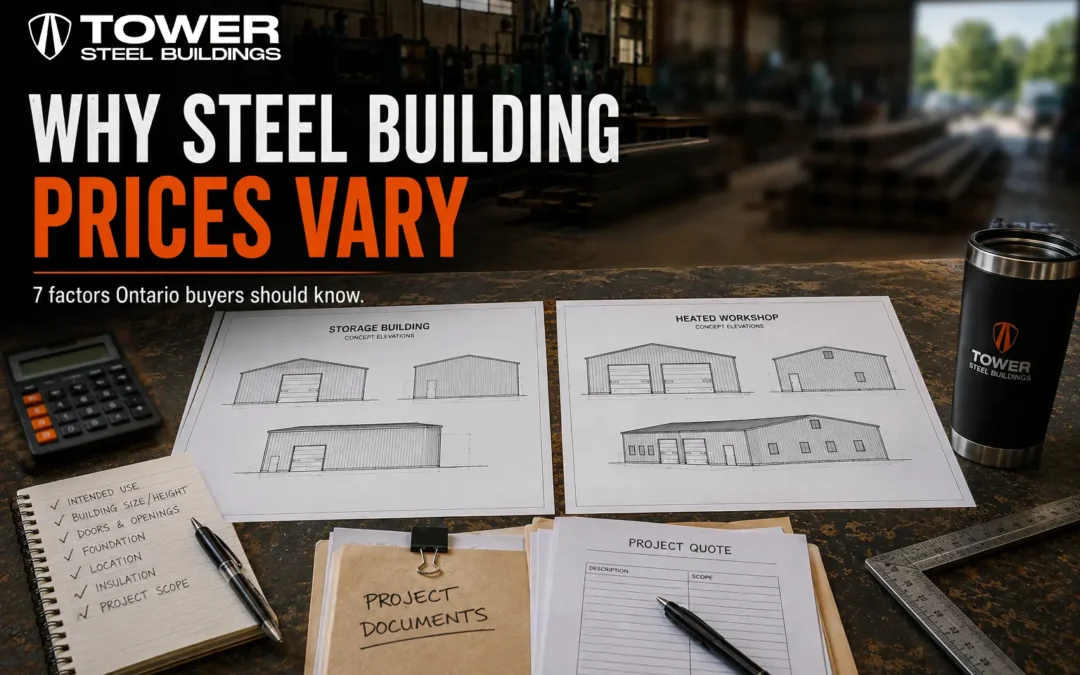
If you have requested multiple steel building quotes in Ontario, you may have been surprised by how far apart the numbers can be. Two quotes for buildings with the same footprint and height can differ by tens of thousands of dollars, sometimes without an obvious explanation.
This difference is not random, and it is rarely caused by simple profit margins. In almost every case, large price gaps are driven by differences in engineering scope, construction assumptions, and how much risk is being priced into the quote.
This article explains why steel building quotes in Ontario vary so widely, what is typically included or excluded, and how buyers can evaluate proposals based on substance rather than headline price.
Who This Article Is For (And Who It Is Not)
This article is intended for owners planning permanent steel buildings that must meet Ontario permitting, inspection, and long-term operational requirements. This includes commercial, industrial, agricultural, manufacturing, and institutional buildings where structural performance, approvals, and lifecycle cost matter.
It may not apply to temporary storage structures, lightly engineered sheds, or short-term installations where full code compliance, stamped engineering, or long-term durability is not required.
Understanding this distinction upfront helps ensure quotes are compared fairly and expectations remain aligned.
A Steel Building Quote Is a Scope Definition, Not Just a Price
A steel building quote is not a retail price tag. It is a scope document that reflects dozens of technical decisions, assumptions, and exclusions.
When two quotes appear far apart, it usually means the buildings are not being designed, engineered, or constructed to the same standard, even if the basic dimensions match.
In Ontario, where building permits, inspections, and code enforcement are rigorous, these differences almost always surface later in the project if they are not addressed upfront.
Engineering Scope Is the Biggest Price Variable
One of the primary reasons steel building quotes in Ontario vary by tens of thousands of dollars is the scope of engineering included in the proposal.
Many buyers assume engineering is either included or not included. In reality, engineering scope exists on a spectrum. Where a supplier draws that line has a major impact on both price and project risk.
What Full Structural Engineering Typically Includes
A comprehensive steel building quote often includes complete structural engineering stamped by a licensed professional engineer. This scope typically covers:
Code-Compliant Structural Design
Design aligned with the Ontario Building Code and applicable referenced standards, not just minimum assumptions.
Load Analysis
Project-specific evaluation of snow, wind, live, dead, seismic, and operational loads based on site location and building use. Load analysis must align with the National Building Code of Canada and site-specific conditions.
Framing Design of Primary and Secondary Members
Engineering of rigid frames, columns, rafters, purlins, girts, and bracing systems as an integrated structural system.
Connection and Bracing Design
Detailed engineering of bolted and welded connections, lateral bracing systems, and load transfer paths.
Foundation Coordination
Provision of column reactions, anchor bolt forces, and structural interface data required for proper foundation design.
Erection Design Considerations
Review of temporary stability requirements, sequencing assumptions, and structural behaviour during erection.
Quotes that include this level of engineering are typically higher. They reflect the real effort required to produce permit-ready, buildable documents that align with municipal review expectations.
What Limited or Deferred Engineering Often Looks Like
Lower steel building quotes frequently rely on partial or deferred engineering assumptions. These quotes may:
- Include preliminary member sizing only
- Defer full load analysis until after contract signing
- Exclude connection and bracing design from the initial scope
- Omit foundation coordination responsibilities
- Assume standard conditions that may not apply to the site
While these quotes appear competitive, they are not equivalent in scope. The cost difference does not disappear. It is simply postponed until permitting, foundation design, or construction exposes the gaps.
In Ontario, incomplete engineering often leads to redesigns, permit delays, and costly change orders once drawings are reviewed by municipal authorities.
Construction Scope Is Often Confused With Engineering Scope
Another major source of price variation is how construction-related responsibilities are defined, or not defined, in the quote.
Some proposals assume ideal site conditions and minimal coordination, while others account for real construction constraints common across Ontario.
Construction Scope Items That Affect Real Cost
More complete steel building quotes often reflect construction realities such as:
Pre-Planning and Site Readiness
Evaluation of access, staging, drainage, and sequencing requirements that affect erection efficiency.
Structural Steel Erection
Clear definition of what erection includes and what site conditions are assumed.
Building Alignment and Structural Verification
Verification of plumbness, alignment, and fit-up during installation.
Roof and Wall Construction With Weather Protection
Sequencing that protects materials and structure during Ontario weather conditions.
Structural Openings and Coordination
Proper framing around doors, equipment openings, and future penetrations.
Installation of Trims, Cladding, and Insulation (If Required)
Clear inclusion or exclusion of building envelope components.
Quality Control and Inspections
Verification processes during fabrication and erection to catch issues early.
Safety Management and Compliance
Adherence to site safety requirements that affect productivity and scheduling.
Quotes that acknowledge these factors often look higher on paper, but they are also more realistic.
Snow, Wind, and Site Assumptions Drive Steel Tonnage
Ontario’s environmental conditions vary significantly by location. Snow loads, wind exposure, and site geometry directly influence steel member sizes and connection requirements.
Two quotes may differ because:
- One is designed to minimum values
- Another accounts for drift, parapets, or adjacent structures
- One assumes open terrain
- Another reflects urban exposure
These differences materially affect steel tonnage and fabrication complexity.
Foundation Responsibility Is Often Hidden
Foundation design and coordination are frequently excluded or vaguely defined in steel building quotes.
Some quotes include:
- Load reactions and anchor forces
- Coordinated foundation interface data
Others leave foundation responsibility entirely to the owner.
When foundation scope is excluded, the steel building quote may appear lower, but the cost simply shifts to later stages through redesigns or consultant fees.
Fabrication Standards and Quality Control Matter
Quotes may also differ based on fabrication standards.
Facilities operating under CSA A660 certification maintain documented quality control, welding procedures, and material traceability. These processes reduce risk but increase upfront cost.
Lower quotes may reflect looser controls that transfer risk to the jobsite.
Who Pays When Assumptions Are Wrong
A critical issue buyers often overlook is responsibility when assumptions fail.
In most steel building contracts, the owner bears the cost of:
- Code-driven upgrades discovered later
- Revised loads
- Foundation redesigns
- Site condition conflicts
Higher-quality quotes reduce these exposures by addressing them early.
Why Complex Buildings Cannot Be Priced Like Storage Kits
Manufacturing buildings, crane-supported structures, long-span warehouses, and high-occupancy facilities cannot be priced using the same assumptions as lightly loaded storage buildings.
These structures require:
- Higher structural redundancy
- Tighter deflection limits
- More extensive coordination with foundations and equipment
- Greater inspection scrutiny
Quotes that attempt to price these buildings using simplified assumptions often lead to significant cost escalation later in the project.
The Cheapest Quote Is Rarely the Lowest-Cost Project
A low initial price often relies on assumptions that shift cost downstream.
A more complete quote reflects real engineering, construction, and regulatory conditions. While the upfront number may be higher, the total project cost is often lower and more predictable.
The cheapest steel building contract is rarely the lowest-cost project.
How Experienced Buyers Compare Steel Building Quotes
Serious buyers compare more than price. They ask:
- What engineering is included and stamped
- What loads were used
- How foundation coordination is handled
- What construction assumptions are made
- How changes are priced
Quotes that answer these clearly tend to produce smoother projects.
Final Perspective
Steel building quotes in Ontario vary by tens of thousands of dollars because they price different levels of certainty.
Buyers who engage suppliers early to clarify engineering scope, construction assumptions, and risk allocation typically experience fewer delays, fewer change orders, and smoother approvals across Ontario municipalities.
Accuracy costs less than correction.
Reviewed by the Tower Steel Buildings Engineering Team
This article has been reviewed by the Tower Steel Buildings Engineering Team to confirm technical accuracy, alignment with Ontario permitting practices, and consistency with real-world steel building design and construction experience.
Our engineers work directly with Ontario municipalities, third-party reviewers, fabricators, and erection crews to ensure that quoted scopes reflect realistic engineering requirements, construction constraints, and long-term structural performance expectations.
The intent of this review is to provide owners with practical, experience-based guidance that supports informed decision-making when comparing steel building proposals.
1. Why do steel building quotes in Ontario differ so much for similar sizes?
Steel building quotes often differ because they include different levels of engineering, fabrication quality, and construction assumptions. Two buildings with the same footprint may be designed for different loads, deflection limits, or site conditions, which significantly affects steel tonnage and cost.
2. Does a lower steel building quote mean engineering is missing?
Not always, but many lower quotes defer or limit engineering scope. This can include partial load analysis, simplified connection design, or exclusion of foundation coordination. These costs typically reappear later through redesigns, permit revisions, or change orders.
3. Are foundation costs usually included in steel building quotes?
Foundation construction is often excluded, but coordination responsibilities vary. Some quotes include detailed load reactions and anchor forces, while others leave foundation design entirely to the owner. Clarifying this early helps prevent unexpected engineering or redesign costs.
4. Who pays when engineering assumptions change during permitting?
In most cases, the owner bears the cost when assumptions change. If loads increase, site conditions differ, or municipal reviewers require revisions, the resulting redesign and material changes are typically treated as extras unless explicitly covered in the original scope.
5. Why are manufacturing or crane buildings more expensive than storage buildings?
Manufacturing and crane-supported buildings require tighter deflection control, higher redundancy, and more extensive coordination between structure, foundations, and equipment. These requirements increase engineering effort, steel weight, and fabrication complexity.
6. Is CSA A660 certification related to quote differences?
Yes. CSA A660-certified fabrication involves documented quality control, welding procedures, and material traceability. Quotes based on certified processes often cost more upfront but reduce fabrication and erection risk during construction.
7. How should buyers fairly compare steel building quotes?
Buyers should compare engineering scope, load criteria, foundation coordination, fabrication standards, and construction assumptions, not just price. A clear scope comparison often explains most pricing differences.
8. Can the lowest quote end up costing more overall?
Yes. Lower quotes frequently rely on assumptions that lead to redesigns, delays, or change orders. A more complete upfront scope often results in lower total project cost and fewer disruptions.