Steel buildings are used across Canada in everything from downtown commercial developments to remote agricultural operations. While the structural principles may be similar, the approval process for steel buildings can vary dramatically depending on whether a project is located in an urban municipality or a rural jurisdiction.
Many owners assume that permit requirements are simply a matter of submitting drawings and waiting for approval. In reality, the approval path is shaped by zoning controls, infrastructure availability, inspection capacity, environmental constraints, and how each municipality interprets building regulations.
Understanding the differences between urban and rural approval environments can help project owners avoid delays, redesigns, and unexpected costs. Municipal zoning interpretation differences → see our guide to steel building zoning requirements across Ontario municipalities.
How Municipal Authority Shapes Steel Building Approvals
In Canada, building approvals are administered at the municipal level. While provincial building codes establish baseline structural and safety requirements, municipalities control:
- Zoning permissions
- Site plan approvals
- Development standards
- Servicing requirements
- Environmental reviews
- Inspection processes
National structural standards are defined in the National Building Code of Canada official publication.
Urban and rural municipalities often operate under very different planning pressures and resource constraints. These differences influence how quickly projects move forward and what documentation is required.
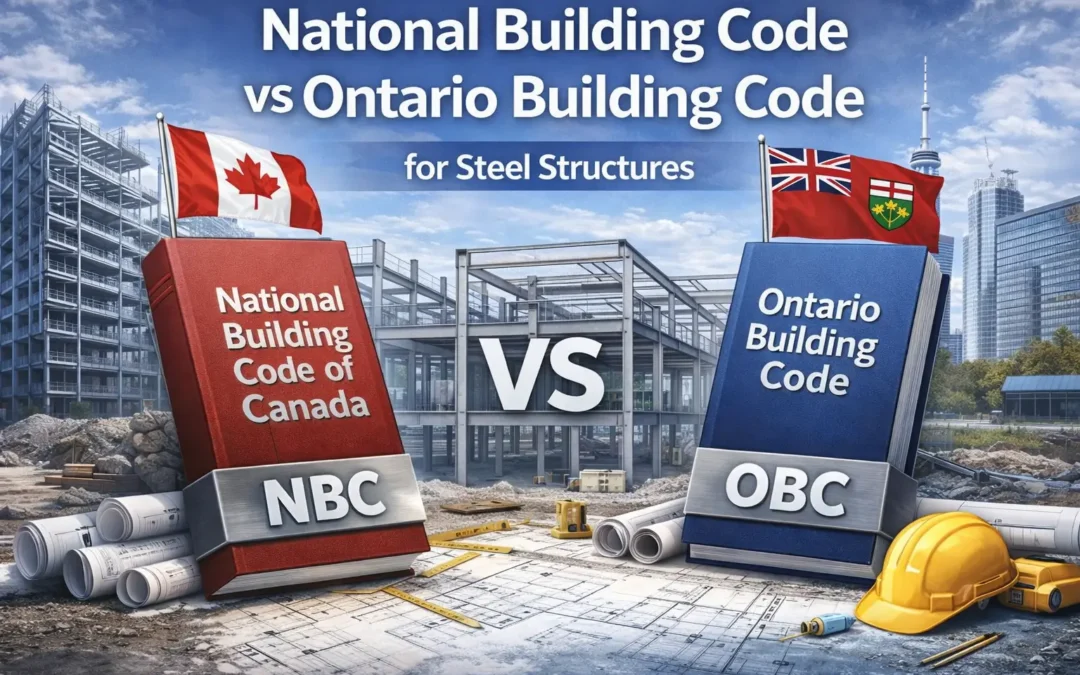
Jurisdictional code differences are explained in National vs Ontario Building Code requirements for steel structures.
Approval Challenges in Urban Steel Building Projects
Urban environments prioritize land use efficiency, infrastructure coordination, and community impact. Steel buildings in cities typically face a more layered approval process.
Zoning and Land Use Restrictions
Urban zoning bylaws tend to be highly specific about:
- Building height limits
- Floor area ratios
- setbacks from property lines
- parking requirements
- permitted uses
Municipal zoning authority in Ontario is governed by the Ontario Planning Act land use framework.
A steel warehouse, commercial building, or light industrial structure may be structurally compliant but still require zoning variances if use classifications or dimensional limits are exceeded.
Even small deviations can trigger:
- committee of adjustment hearings
- public notices
- neighbour consultations
These steps often add months to project timelines.
Site Plan Control and Design Review
Most urban municipalities require site plan approval in addition to building permits. This process examines:
- vehicle access and traffic flow
- drainage patterns
- landscaping and screening
- fire access routes
- stormwater management
For steel buildings, this frequently involves revisions to foundation elevations, driveway placement, and building orientation before permits are issued.
Structural design may be complete long before site plan matters are resolved.
Utility Coordination
Urban projects typically must connect to:
- municipal water systems
- sanitary sewer networks
- storm drainage infrastructure
- electrical and gas services
Approval often requires coordination with multiple utility authorities. If servicing capacity is limited or upgrades are required, additional engineering studies may be requested.
These infrastructure considerations commonly slow urban approvals more than structural design itself.
Environmental and Community Impact Reviews
Urban municipalities are more likely to request:
- noise studies
- traffic impact assessments
- environmental site assessments
- shadow or visual impact analysis
While steel buildings themselves are not problematic, their size, use, and location often trigger these reviews.
Each adds documentation and review time to the project schedule.
Approval Challenges in Rural Steel Building Projects
Rural municipalities generally focus on land use compatibility, environmental protection, and servicing feasibility. While the process may appear simpler, rural approvals carry their own complexities.
Limited Zoning Definitions
Rural zoning bylaws are often broader and less precise than urban ones. This can work both ways.
Some projects move quickly because fewer restrictions apply. Others become complicated when a proposed use does not fit clearly within defined categories such as:
- agricultural
- rural industrial
- commercial
- resource-based operations
Unclear classification may require rezoning or planning interpretations that delay approval.
Environmental Constraints
Rural steel buildings frequently encounter:
- wetlands and conservation areas
- floodplains
- woodlands and wildlife habitat
- soil and groundwater considerations
Approvals may involve conservation authorities who review grading, drainage, and foundation impacts.
Environmental review authority is established under the Ontario Conservation Authorities Act. Environmental site constraints often influence foundation performance, as explained in soil conditions affecting steel building foundations in Canada.
These reviews can add technical requirements that are not common in urban projects.
Servicing and Access Requirements
Unlike urban areas, rural projects often rely on:
- private wells
- septic systems
- gravel or private roads
- limited emergency access
Approvals may require:
- hydrogeological studies
- septic design approvals
- road access permits
- fire department reviews for water supply
Even when building design is straightforward, servicing approvals can become the longest part of the process.
Inspection Scheduling
Rural municipalities may have fewer building inspectors covering large geographic areas.
This can lead to:
- longer wait times for inspections
- construction pauses between stages
- weather-related rescheduling
Steel erection sequencing often must accommodate inspection availability.
Structural Requirements Are the Same, but Documentation Expectations Differ
Regardless of location, steel buildings must comply with provincial building codes and structural standards. Snow loads, wind loads, foundation design, and material performance do not change between urban and rural sites.
Regional environmental design variation is detailed in Ontario climate zones and steel building design considerations.
What changes is:
- how approvals are administered
- what supporting documents are required
- the coordination needed between departments
Urban projects tend to involve more planning layers. Rural projects often involve more environmental and servicing considerations.
Common Approval Delays in Urban Projects
Urban steel building projects are frequently delayed by:
- zoning variance hearings
- unresolved site plan issues
- servicing capacity studies
- environmental assessments
- coordination between departments
These delays often occur after structural engineering is complete.
Common Approval Delays in Rural Projects
Rural steel building projects commonly face:
- conservation authority reviews
- septic and water approvals
- access road permits
- unclear zoning interpretations
- inspection scheduling challenges
These delays often arise before foundation work begins.
Why Early Coordination Matters More Than Location
Many approval problems are not caused by the municipality itself but by lack of early coordination between:
- engineers
- planners
- environmental consultants
- building departments
- utility providers
Projects that engage all required authorities early tend to progress smoothly regardless of being urban or rural.
Structured coordination is outlined in steel building engineering review before finalizing design.
Those that proceed sequentially often encounter redesigns and delays.
Urban Does Not Always Mean Faster Approvals
While cities have more resources, they also have:
- more regulations
- more review layers
- higher documentation standards
A rural project with clear zoning and minimal environmental impact may approve faster than an urban development requiring variances and site plan negotiations.
Rural Does Not Always Mean Simpler
Although rural areas may have fewer formal planning layers, environmental protection, servicing limitations, and inspection logistics can significantly extend timelines.
Assuming rural projects are automatically quicker often leads to unrealistic scheduling.
Key Differences at a Glance
Urban approvals typically involve:
- strict zoning controls
- site plan approvals
- utility coordination
- community impact reviews
Rural approvals typically involve:
- land use classification
- environmental authority input
- private servicing approvals
- access and emergency planning
Both require full structural compliance.
Planning for Approval Success
Regardless of project location, successful steel building approvals depend on:
- understanding local zoning early
- engaging engineering and planning professionals upfront
- coordinating environmental and servicing reviews
- allowing realistic timelines for approvals
- preparing complete permit documentation
Most costly delays occur when approvals are treated as a formality rather than a critical project phase.
Approval preparation is a key part of steel building project readiness planning.
Why Approval Strategy Is Part of Project Cost Control
Permit delays can lead to:
- redesign fees
- idle equipment and crews
- seasonal construction disruptions
- financing carry costs
- material price escalation
The financial effect of scheduling delays is analyzed in steel building lead times and total project cost in Canada. Approval strategy is not administrative overhead. It directly affects total project cost and schedule certainty.
The Bottom Line
Steel building approvals in Canada are shaped as much by municipal processes as by structural engineering.
Urban projects face layered planning and infrastructure coordination. Rural projects encounter environmental, servicing, and logistical challenges.
Neither is inherently easier.
Projects that succeed are those that treat approvals as a coordinated technical process rather than a paperwork exercise.
When zoning, environmental review, engineering, and servicing are aligned early, steel buildings move smoothly from design to construction regardless of location.
When they are not, delays become inevitable.
Reviewed by the Tower Steel Buildings Engineering Team
This article has been reviewed by the Tower Steel Buildings Engineering Team to ensure technical accuracy, regulatory relevance, and real-world construction insight across Canadian municipalities.
1. Are steel building approval requirements the same across all Canadian cities?
No. While provincial building codes establish structural standards, each municipality controls zoning, site plan approvals, environmental reviews, servicing requirements, and inspection procedures. Approval timelines and documentation can vary significantly between urban and rural jurisdictions.
2. Do rural steel building projects require fewer permits than urban projects?
Not necessarily. Rural projects often require additional approvals related to septic systems, wells, conservation authorities, access roads, and environmental impact. While zoning may be less complex, servicing and environmental reviews can extend timelines.
3. Why do some steel buildings meet code but still get denied permits?
Structural compliance alone does not guarantee approval. Projects can be delayed or rejected due to zoning restrictions, site plan deficiencies, land use classification issues, or environmental constraints even when engineering is fully compliant.
4. What typically causes the longest delays in urban steel building approvals?
The most common urban delays come from zoning variances, site plan negotiations, utility coordination studies, environmental assessments, and multi-departmental review cycles rather than from structural engineering itself.
5. What are the biggest approval risks in rural steel building projects?
Common rural risks include conservation authority reviews, unclear land use permissions, septic and water system approvals, limited inspection availability, and access road requirements that are not addressed early.
6. Can approval timelines be shortened for steel building projects?
Yes. Early coordination with municipal planners, engineers, environmental consultants, and utility providers significantly reduces redesigns and review cycles. Projects that address zoning, servicing, and site requirements upfront typically move much faster.
7. Does the size of a steel building affect permit complexity?
Larger buildings often trigger additional reviews such as site plan control, traffic assessments, stormwater management studies, and fire access planning, especially in urban municipalities.
8. Are environmental approvals required for all rural steel buildings?
Not all, but many rural projects near wetlands, floodplains, conservation areas, or sensitive soils require review by conservation authorities or environmental agencies before building permits are issued.
9. How early should approvals be considered in a steel building project?
Approval strategy should begin at the conceptual design stage. Waiting until engineering is complete often leads to redesigns when zoning, servicing, or environmental issues surface.
10. Is urban approval always slower than rural approval?
No. Some rural projects face lengthy environmental and servicing reviews, while certain urban projects proceed quickly when zoning and infrastructure are already in place. Approval speed depends more on preparation than location.