Structural safety in steel buildings is not defined by strength alone. In Canada, where buildings are expected to perform reliably under snow, wind, temperature variation, and long service lives, safety depends just as much on redundancy as it does on capacity.
Structural redundancy is the ability of a building to continue carrying loads safely even when a single component is damaged, overstressed, or compromised. It is one of the least visible aspects of steel building design, yet one of the most important for long-term performance, occupant safety, and risk management.
This article explains what structural redundancy means in steel buildings, how it is achieved through engineering and detailing, and why it matters for owners planning permanent steel structures in Canadian conditions.
What Structural Redundancy Means in Steel Buildings
Structural redundancy refers to the presence of multiple load paths within a building system. Instead of relying on one element to carry a critical load, a redundant structure distributes forces across several interconnected components.
In practical terms, redundancy allows a steel building to:
- Redistribute loads if a member is damaged or removed
- Maintain stability during localized failures
- Resist progressive collapse
- Tolerate construction tolerances and unforeseen stresses
A non-redundant structure may meet minimum design loads under ideal conditions, but it has little margin for error. A redundant structure is designed to perform safely even when conditions deviate from assumptions.
Canadian building codes recognize this principle implicitly by requiring robustness, continuity, and system-level performance rather than isolated member checks.
This distinction becomes clearer when comparing national vs provincial building code requirements for steel structures in Canada.
Why Redundancy Is a Safety Issue, Not an Efficiency Issue
Redundancy is often misunderstood as unnecessary conservatism or overdesign. In reality, it is a safety strategy, not a material strategy.
A structure can be efficient and redundant at the same time. Redundancy does not mean heavier steel everywhere. It means thoughtful engineering that considers how forces flow through the building under real conditions, not just idealized calculations.
In steel buildings, redundancy improves safety by addressing:
- Unintended load redistribution
- Construction sequencing effects
- Long-term degradation
- Localized damage from impact or environmental exposure
These factors are particularly relevant in Canada, where structures must perform across decades of seasonal stress rather than a narrow design window.
One of the most critical contributors to redundancy decisions is regional snow exposure, which is outlined in steel building snow load zones across Canada.
Load Paths and Why They Matter
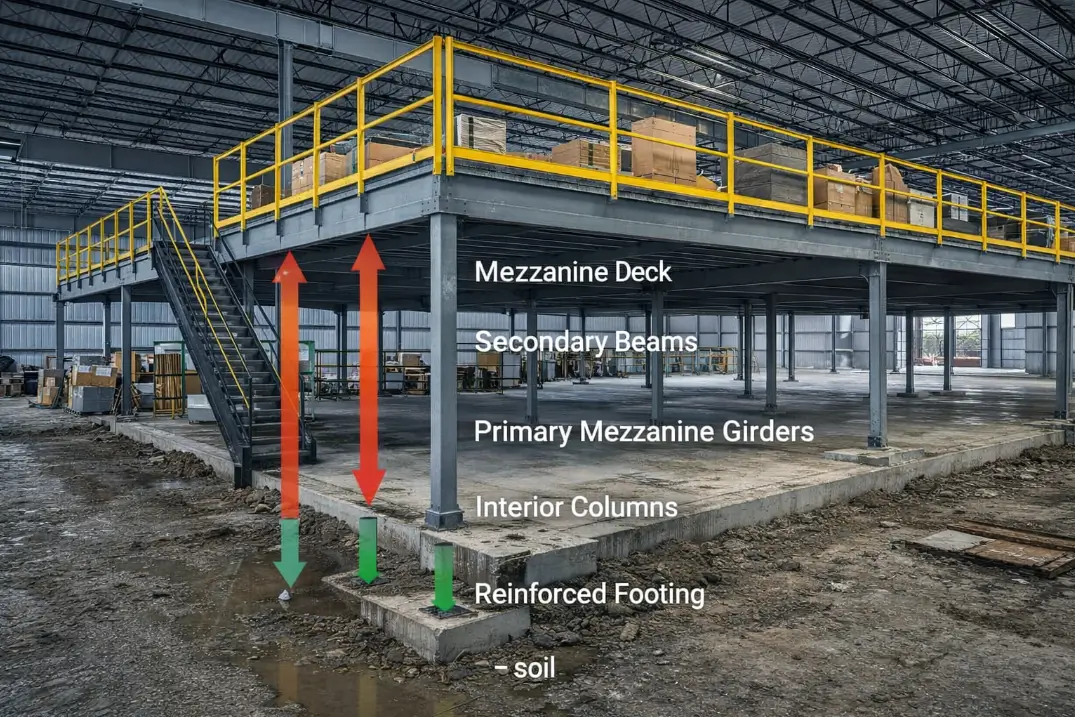
Every steel building relies on load paths to transfer forces from the roof and walls down to the foundation. Redundancy exists when more than one path is available.
For example:
- Roof loads may be shared between purlins, frames, and bracing
- Lateral loads may be resisted by both moment frames and braced bays
- Vertical loads may redistribute through adjacent members if one element yields
When load paths are continuous and interconnected, the structure has resilience. When load paths are singular and brittle, small failures can trigger disproportionate consequences.
Understanding load paths at a system level is one of the defining differences between basic compliance and robust design. Industry best practices for steel system behavior are also developed by the Canadian Institute of Steel Construction.
This system-level thinking is explained further in our guide on steel building engineering, where load paths, redundancy, and performance criteria are evaluated together.
Redundancy in Primary Steel Framing Systems
Primary frames form the backbone of most steel buildings. Redundancy in these systems depends on how frames interact with each other, not just how strong each frame is individually.
Key redundancy considerations include:
- Frame spacing that allows load sharing
- Continuous roof diaphragms that tie frames together
- Secondary framing that participates structurally rather than acting as decoration
A building composed of isolated frames with minimal interconnection may meet code loads, but it has limited ability to adapt if one frame is compromised.
In contrast, a properly integrated frame system behaves as a unified structure, improving both safety and predictability.
Secondary Framing Is Not Secondary to Safety
Secondary members such as purlins, girts, and bracing often play a larger role in redundancy than owners realize.
When secondary framing is designed as part of the structural system, it can:
- Provide alternate load paths
- Stabilize primary members against buckling
- Distribute localized forces over a wider area
When secondary framing is treated as non-structural or minimized excessively, redundancy is reduced even if primary members appear robust.
In steel buildings, safety often depends on how well primary and secondary systems work together, not on either system alone.
Bracing Systems and Redundancy
Bracing is a primary contributor to redundancy in steel buildings, particularly for lateral stability.
Redundant bracing systems:
- Use multiple braced bays rather than a single critical bay
- Avoid reliance on one tension-only element for global stability
- Provide alternate load paths if one brace becomes overstressed
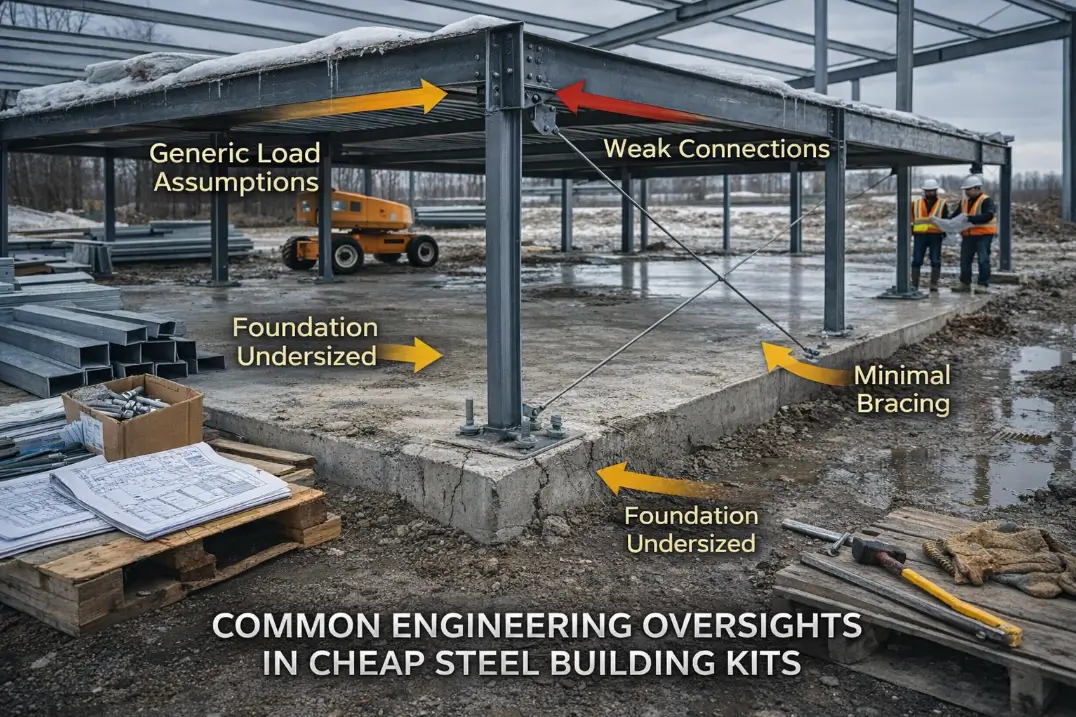
Bracing that is minimal but code-compliant may function adequately under design wind or seismic loads, but it offers little tolerance for damage, misalignment, or future modifications.
Redundant bracing improves resilience without necessarily increasing steel tonnage significantly.
Connection Design and Progressive Failure Prevention
Connections are often where redundancy is gained or lost.
A steel building may have strong members, but poorly detailed connections can become single points of failure. Redundant design considers how connections behave when loads exceed assumptions or when one element fails.
Key principles include:
- Ductile connection behavior rather than brittle failure
- Load redistribution capacity through adjacent connections
- Avoidance of critical connections that carry disproportionate demand
In Canadian steel construction, connection design plays a central role in preventing progressive collapse and maintaining system integrity.
Structural Redundancy During Construction and Erection
Safety does not begin at occupancy. Many structural failures occur during erection, when the building is partially complete and load paths are not yet fully established. This is why temporary stability and sequencing are addressed in temporary bracing requirements during steel building erection.
Redundancy during erection depends on:
- Temporary bracing strategies
- Sequencing of structural components
- Early stabilization of frames and diaphragms
A building that is redundant in its final state may still be vulnerable during construction if interim conditions are not considered.
This is why erection planning and temporary stability design are essential parts of safe steel building delivery in Canada.
Redundancy and Long-Term Durability
Redundancy also affects how a building performs over time.
Steel buildings are exposed to:
- Corrosion
- Fatigue
- Thermal movement
- Minor impacts and alterations
A redundant structure can tolerate localized degradation without compromising global safety. A non-redundant structure has little margin once deterioration begins.
From a lifecycle perspective, redundancy reduces the likelihood that minor issues escalate into major structural concerns.
Insurance, Risk Management, and Redundancy
While redundancy is an engineering concept, it also has practical implications for risk assessment.
Insurers, lenders, and institutional owners increasingly evaluate:
- Structural robustness
- Failure tolerance
- Maintenance risk
Buildings designed with clear redundancy and predictable behavior tend to present lower long-term risk profiles, even when initial costs are similar.
In Canadian industrial and commercial projects, this can influence insurability and long-term asset value.
Code Compliance Versus Structural Robustness
Canadian building codes establish minimum safety thresholds. These thresholds are defined through the National Building Code, published by Codes Canada under the National Research Council. They do not guarantee optimal redundancy or resilience.
A steel building can be fully code-compliant and still rely on:
- Singular load paths
- Highly optimized members with little reserve
- Limited tolerance for damage or change
Robust design goes beyond minimum compliance by addressing how the structure behaves when assumptions are violated. In Canada, responsibility for this level of engineering judgment falls under standards governed by Engineers Canada.
This distinction is critical for owners planning permanent facilities rather than short-term enclosures.
When Redundancy Matters Most
Structural redundancy is especially important in:
- Long-span buildings
- Industrial and manufacturing facilities
- Warehouses with high racking loads
- Buildings with cranes or dynamic equipment
- Facilities expected to operate continuously
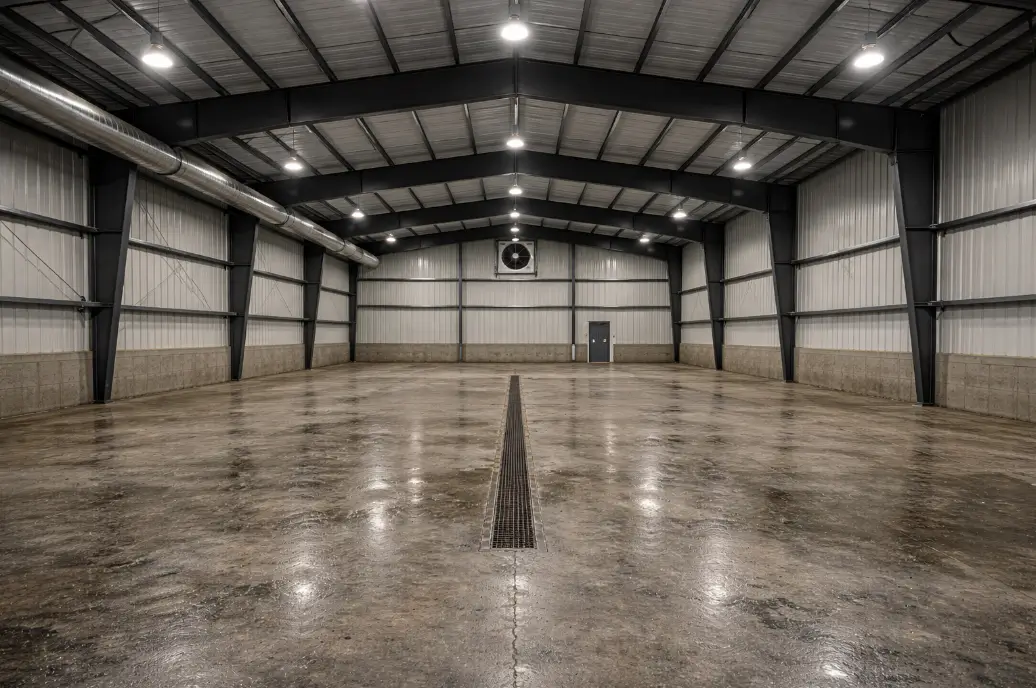
This is particularly true in wide-span facilities, as discussed in clear-span steel buildings for industrial applications.
In these environments, the cost of failure is not just structural. It includes downtime, operational disruption, and safety exposure.
Redundancy reduces the probability that isolated issues escalate into system-level problems.
Balancing Redundancy and Efficiency
Good engineering does not chase redundancy blindly. It balances safety, efficiency, and constructability.
Effective redundancy is achieved through:
- Thoughtful system layout
- Integrated framing and bracing
- Intelligent connection detailing
- Coordination between structural, foundation, and erection design
When redundancy is integrated early, it rarely appears as excess cost. When added late, it often becomes expensive and disruptive.
Structural Redundancy as a Design Philosophy
Ultimately, redundancy reflects a design philosophy rather than a checklist.
It asks questions such as:
- What happens if this element fails
- Where does the load go next
- How does the structure behave under abnormal conditions
These questions separate buildings designed only to pass inspection from buildings designed to perform safely over decades.
Final Perspective
Structural redundancy is one of the most important yet least visible contributors to steel building safety. It cannot be added easily after design decisions are made, and it cannot be evaluated by looking at member sizes alone.
In Canadian steel construction, where buildings face long service lives, variable climates, and evolving use, redundancy is not a luxury. It is a fundamental component of responsible design.
Steel buildings that incorporate redundancy deliberately tend to be safer, more durable, and more predictable in performance. Over time, those qualities matter far more than marginal differences in initial material cost.
In steel building design, safety is not defined by strength alone. It is defined by how well the structure continues to perform when conditions are no longer ideal.
Reviewed by the Tower Steel Buildings Engineering Team
This article was reviewed by the Tower Steel Buildings engineering team, drawing on decades of combined experience designing, fabricating, and coordinating steel buildings across Canada. The review focused on structural safety, redundancy principles, and real-world performance considerations under Canadian building codes and site conditions.
1. What is structural redundancy in a steel building?
Structural redundancy is the ability of a steel building to safely redistribute loads if a single member, connection, or component is damaged or overstressed. It ensures that localized issues do not result in disproportionate structural failure.
2. Is structural redundancy required by Canadian building codes?
Canadian building codes establish minimum safety requirements but do not prescribe specific redundancy strategies. Redundancy is achieved through engineering judgment, system-level design, and thoughtful detailing beyond minimum code checks.
3. Does structural redundancy mean using more steel?
Not necessarily. Redundancy is about providing alternate load paths and system continuity, not simply increasing member sizes. Well-designed redundancy often improves safety without significantly increasing material quantities.
4. Why does redundancy matter more in long-span steel buildings?
Long-span buildings rely on fewer primary structural elements. If one element is compromised, the impact is greater. Redundancy helps distribute loads and maintain stability when spans are large and interior supports are limited.
5. How does redundancy affect construction and erection safety?
Redundancy improves safety during erection by providing interim stability and tolerance for sequencing effects. Buildings with limited redundancy are more vulnerable during partial construction when all load paths are not yet active.
6. Can a code-compliant steel building still lack redundancy?
Yes. A building can meet code requirements and still rely on singular load paths or highly optimized members with limited reserve capacity. Redundancy addresses how the structure behaves beyond minimum design assumptions.