Facilities that store hazardous materials face higher structural, environmental, and regulatory demands than standard industrial buildings. Whether housing flammable liquids, corrosive chemicals, compressed gases, or regulated waste streams, these structures must protect people, inventory, and the surrounding environment while meeting strict Canadian safety codes.
Steel buildings are widely used for hazardous material storage across Canada because of their strength, non-combustible nature, and adaptability to strict safety and environmental requirements.
Hazardous material storage facilities fall under broader commercial steel building applications where structural performance, fire resistance, and regulatory compliance must be engineered from the outset.
However, successful hazardous storage facilities depend not just on choosing steel, but on how the building is engineered, detailed, and coordinated with operational requirements.
A properly engineered building design process is required to coordinate structural systems, containment strategies, and environmental controls before construction begins.
This article explains why steel buildings are well suited for hazardous material storage, the design considerations that matter most, and how proper engineering protects both compliance and long-term performance.
What is a hazardous material storage steel building?
A hazardous material storage steel building is an engineered facility designed to safely store flammable, corrosive, or regulated substances while meeting Canadian fire codes, environmental requirements, and structural safety standards.
Why Hazardous Material Storage Requires Specialized Building Design
Hazardous materials introduce risks that standard warehouses do not face.
Hazardous storage layouts may resemble warehouse structures, but require significantly higher levels of containment, ventilation control, and regulatory compliance.
These risks are not limited to fire or spills. They include chemical corrosion, environmental contamination, explosion potential, regulatory scrutiny, and worker safety concerns.
Typical challenges include:
- Fire separation and containment
- Structural resistance to blast or impact loads in certain applications
- Corrosion from chemical vapours or liquid exposure
- Spill control and drainage management
- Ventilation for fumes and off-gassing
- Access control and emergency response clearance
A poorly designed building can lead to:
- Regulatory shutdowns
- Insurance refusal or premium escalation
- Environmental liability
- Accelerated structural deterioration
- Worker safety hazards
Steel construction offers advantages that directly address these risks when engineered correctly.
Why Steel Is the Preferred Structure for Hazardous Storage Facilities
Non-Combustible Construction
Steel is non-combustible and does not contribute fuel to a fire. This is a critical requirement in facilities storing flammable or reactive substances.
Steel framing supports:
- Fire-rated wall assemblies
- Fire separation zones
- Controlled compartmentalization
- Structural integrity under elevated temperatures
This improves fire performance and simplifies compliance with Canadian building and fire codes.
Why are steel buildings used for hazardous material storage?
Steel buildings are used because they are non-combustible, structurally strong, and adaptable to fire-rated assemblies, containment systems, and ventilation requirements needed for hazardous material storage.
Structural Strength for Heavy Loads and Containment Systems
Hazardous storage often involves:
- Large tank systems
- Secondary containment berms
- Drum stacking racks
- Mechanical ventilation equipment
- Fire suppression systems
Steel buildings are engineered to carry these concentrated loads safely through primary frames, foundations, and slab systems.
Canadian structural design also requires evaluation of regional snow and wind conditions which directly influence load calculations, member sizing, and safety factors.
Unlike light construction methods, steel structures allow engineers to design specifically for:
- Point loads from storage vessels
- Live loads from forklifts and material handling
- Dynamic loads from equipment operation
Storage systems can impose high point loads from tanks, drum racks, and containment zones, requiring reinforced slab and foundation design coordinated with equipment layout.
High point loads from tanks and containment systems make foundation engineering essential to ensure proper load transfer, slab performance, and long-term stability.
Durability in Chemically Aggressive Environments
Many hazardous materials release vapours or liquids that accelerate corrosion in poorly protected structures.
Steel buildings can be engineered with:
- Protective coatings
- Galvanized components
- Sealed connection detailing
- Proper drainage design
When specified correctly, steel maintains structural performance far longer than untreated materials exposed to chemical environments.
Chemically aggressive environments require protection strategies similar to those outlined in salt exposure and corrosion protection in steel buildings, where long-term material degradation must be controlled through coatings and detailing.
What matters most in hazardous material storage building design?
The most critical factors are fire separation, spill containment, ventilation, corrosion protection, and structural capacity for concentrated loads, all coordinated with regulatory requirements.
Key Design Considerations for Hazardous Material Steel Buildings
Hazardous storage facilities are not simply warehouses with thicker walls. They require integrated engineering across multiple disciplines.
Hazardous material facilities are part of broader industrial steel building applications where structural design, operational workflow, and safety systems must be engineered together.
Fire Separation and Containment Planning
One of the most important design elements is compartmentalization.
Engineers must coordinate:
- Fire-rated walls between storage zones
- Separation between hazardous and administrative spaces
- Roof assemblies that limit fire spread
- Structural stability during fire exposure
This prevents localized incidents from escalating into full-facility emergencies.
Spill Containment and Floor Design
Concrete slabs are often designed with:
- Chemical-resistant coatings
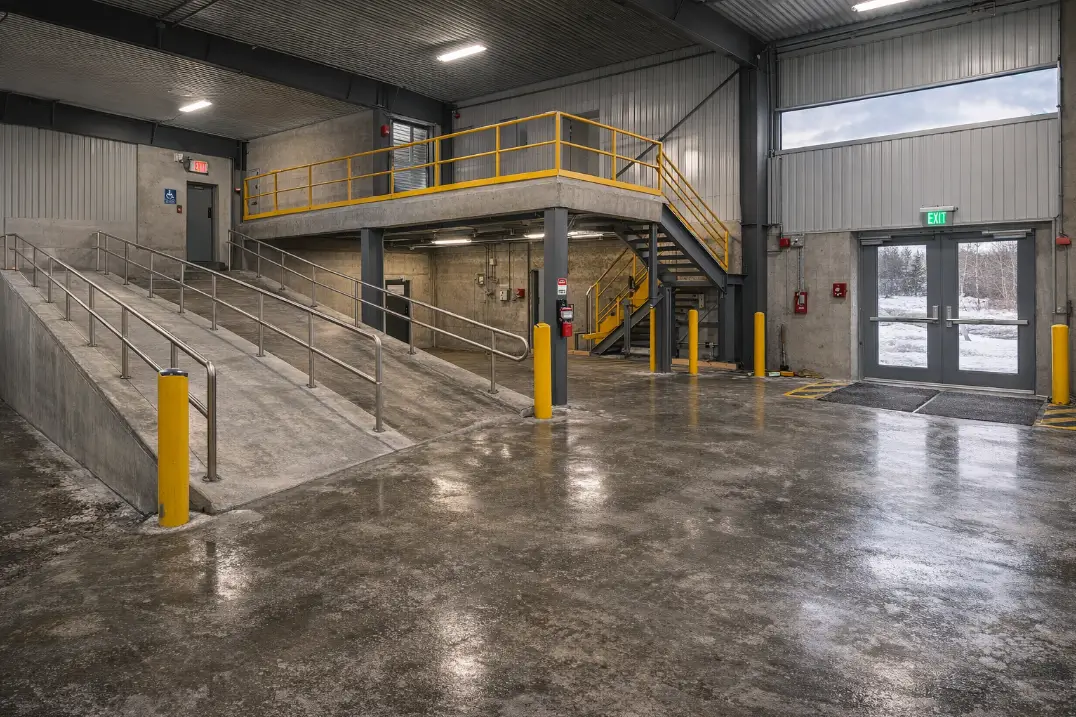
- Sloped surfaces directing spills to containment points
- Berm systems around storage zones
- Isolated drainage systems
Structural engineers coordinate slab thickness and reinforcement to resist:
- Chemical degradation
- Heavy storage loads
- Long-term moisture exposure
Secondary containment systems are commonly designed to hold 100% to 110% of the largest stored volume, depending on regulatory and operational requirements.
Ventilation and Air Quality Control
Hazardous materials frequently emit vapours that must be safely removed.
Steel buildings allow easy integration of:
- High-volume ventilation systems
- Explosion-rated exhaust fans (where required)
- Make-up air units
- Duct routing without structural interference
Proper airflow design reduces corrosion risk and protects worker health.
Corrosion Protection Strategies
Corrosion is one of the most common long-term failures in hazardous facilities.
Effective protection includes:
- Hot-dip galvanizing
- Epoxy and polyurethane coatings
- Sealed fasteners and joints
- Proper moisture control
Engineering specifications should match the specific chemical environment, not rely on generic paint systems.
Regulatory and Code Compliance in Canada
Hazardous material storage buildings in Canada must comply with applicable provincial building codes, the National Fire Code of Canada, environmental regulations, and site-specific safety requirements depending on the materials stored and facility classification.
National code development and regulatory frameworks are defined through the Codes Canada program administered by the National Research Council, which guides structural, fire, and safety requirements across the country.
Structural steel systems are also governed by standards developed by the Canadian Standards Association (CSA), which define material performance, fabrication quality, and design requirements.
Hazardous material storage buildings in Canada must comply with a range of regulations, including:
- Provincial building codes
- Fire codes
- Environmental protection regulations
- Occupational health and safety standards
- Industry-specific storage rules
Steel structures support compliance because they can be engineered precisely for:
- Fire resistance ratings
- Load performance
- Separation distances
- Equipment support
Insurance outcomes depend on the materials stored, fire protection systems, and facility design. Non-combustible steel construction can support a stronger risk profile when properly engineered.
Design requirements vary based on hazard classification, storage quantities, and fire protection strategies, and should always be confirmed with local authorities and qualified professionals.
Insurance and Risk Management Benefits of Steel Construction
Insurers closely evaluate hazardous storage facilities.
Steel buildings often result in:
- Lower fire risk classification
- Improved loss containment capability
- Higher structural resilience
- Clear compliance documentation
This can directly affect:
- Premium costs
- Coverage approval
- Long-term insurability
Facilities built with combustible framing or poor corrosion protection frequently face escalating insurance issues.
Long-Term Operational Performance
The true cost of hazardous material storage is measured over decades, not at construction.
Well-engineered steel buildings provide:
- Minimal structural degradation
- Easier cleaning and decontamination
- Lower repair frequency
- Greater adaptability to regulatory changes
Poorly designed facilities often require:
- Early coating replacement
- Structural retrofits
- Drainage rework
- Fire separation upgrades
Which significantly increase lifecycle costs.
Properly engineered steel hazardous storage buildings can achieve 40+ years of service life, even in chemically aggressive environments when coatings and ventilation are correctly specified.
Adaptability for Changing Regulations and Materials
Hazardous storage rules evolve over time.
Steel buildings offer:
- Easy expansion capability
- Interior reconfiguration
- Additional containment installation
- Upgraded ventilation integration
This allows facilities to adapt without full reconstruction.
Common Mistakes in Hazardous Storage Building Design
Even when steel is used, problems arise when engineering is incomplete.
Frequent issues include:
- Under-designed slabs for tank loads
- Generic coatings unsuited to chemical exposure
- Poor ventilation routing causing condensation
- Inadequate fire separation zones
- Drainage systems tied into stormwater incorrectly
These errors often appear years later, creating expensive retrofits.
Why Early Engineering Coordination Matters
Hazardous material storage facilities require early collaboration between:
- Structural engineers
- Environmental consultants
- Fire protection specialists
- Operations teams
When these groups work in isolation, conflicts arise between:
- Structural capacity and containment needs
- Ventilation and roof framing
- Fire walls and equipment placement
Early coordination prevents costly redesign.
Steel Buildings as Long-Term Risk Control Infrastructure
A hazardous material building is not just a shelter. It is a control system for:
- Fire risk
- Environmental protection
- Worker safety
- Regulatory compliance
- Asset security
Steel construction provides the predictable structural platform required for these systems to function reliably.
Why Hazardous Storage Buildings Fail Over Time
Many hazardous storage facilities fail because they are designed as standard warehouses rather than engineered containment environments. Common issues include inadequate spill containment, improper ventilation design, insufficient corrosion protection, and structural systems not designed for concentrated loads. Steel buildings perform reliably when these factors are engineered together from the start.
Hazardous material storage facilities require precise coordination between structural engineering, fire protection systems, and environmental compliance strategies.
Projects involving regulated materials should begin with a detailed engineering approach. Planning a hazardous material storage steel building requires coordination with experienced professionals familiar with Canadian codes and long-term performance requirements.
Final Thoughts
Steel buildings have become the standard for hazardous material storage across Canada because they offer strength, fire resistance, adaptability, and long-term durability unmatched by many traditional systems.
However, performance depends on proper engineering, corrosion protection, containment coordination, and regulatory integration.
When hazardous storage facilities are designed as engineered infrastructure rather than simple warehouses, steel buildings provide decades of safe, compliant, and cost-effective service.
In environments where risk tolerance is low and regulatory scrutiny is high, the structural system matters. Steel offers the control, predictability, and resilience required for responsible hazardous material storage.
Reviewed by the Tower Steel Buildings Engineering Team
This article has been reviewed by the Tower Steel Buildings Engineering Team, drawing on decades of experience designing and manufacturing steel buildings for hazardous material storage, industrial containment facilities, and regulated environments across Canada. The review ensures technical accuracy, code-aligned design principles, and real-world constructability considerations.
1. Are steel buildings required for hazardous material storage in Canada?
Steel buildings are not always legally required, but they are strongly preferred by regulators, insurers, and fire authorities because of their non-combustible nature, structural strength, and predictable fire performance. Many hazardous material applications effectively demand steel construction to meet safety and insurance requirements.
2. What fire ratings are typically needed for hazardous material steel buildings?
Fire ratings vary by material type, storage volume, and facility layout. Many hazardous storage buildings require fire-rated wall assemblies, roof systems, and separation zones designed to limit fire spread and protect adjacent spaces. These ratings are determined through building code, fire code, and site-specific hazard assessments.
3. How is spill containment handled in steel hazardous storage buildings?
Containment is typically integrated into slab design using berm systems, sloped floors, chemical-resistant coatings, and isolated drainage systems. Structural engineers coordinate containment loads and slab reinforcement to safely support stored materials while preventing environmental contamination.
4. Do hazardous materials cause corrosion in steel buildings?
Certain chemicals and vapours can accelerate corrosion if not properly addressed. Steel buildings for hazardous storage are engineered with protective coatings, galvanized components, moisture control strategies, and sealed connections to resist chemical exposure over the long term.
5. Can steel buildings support large tanks and heavy hazardous storage systems?
Yes. Steel structures are commonly engineered to support heavy tank systems, stacked drum storage, mechanical ventilation equipment, fire suppression systems, and secondary containment loads. Load paths are designed from the storage equipment through framing and foundations to ensure safe performance.
6. Are hazardous material steel buildings harder to insure?
Properly engineered steel buildings are often easier to insure than combustible structures. Insurers typically view steel construction favourably due to improved fire resistance, predictable structural performance, and enhanced containment capability. Poorly designed facilities, regardless of material, may face insurance challenges.
7. How long do steel buildings last in hazardous environments?
When designed with proper corrosion protection, ventilation, and containment systems, steel buildings can perform for several decades even in aggressive chemical environments. Longevity depends on coating systems, moisture control, maintenance practices, and accurate engineering for exposure conditions.
8. Can hazardous material steel buildings be expanded in the future?
Yes. One advantage of steel construction is its adaptability. Buildings can often be expanded, compartmentalized, or upgraded to accommodate new materials, revised regulations, or increased storage capacity when engineered with future growth in mind.
9. What professionals should be involved in designing a hazardous storage steel building?
Successful facilities typically involve structural engineers, environmental consultants, fire protection specialists, operations managers, and building manufacturers working together early in the design process. This coordination ensures structural safety, regulatory compliance, and long-term performance.
10. Are steel buildings suitable for cold-climate hazardous storage in Canada?
Steel buildings perform exceptionally well in Canadian climates when engineered for regional snow loads, wind exposure, frost depth, and condensation control. Proper insulation, ventilation, and moisture management are key to maintaining safe conditions year-round.