Across Canada, emergency services and municipal departments depend on facilities that must perform reliably in extreme weather, operate continuously, and adapt as community needs evolve. National investment in public infrastructure is also supported through programs from Infrastructure Canada. Fire halls, police stations, public works yards, ambulance depots, training centres, and municipal storage buildings all share one requirement above all others: operational failure is not an acceptable risk.
Steel buildings have become a preferred structural solution for many emergency and municipal facilities because they combine long-term durability, flexible design, rapid construction, and predictable lifecycle performance. When engineered properly, steel structures provide the strength and adaptability required for critical public infrastructure while supporting cost control for municipalities and taxpayers.
This article explores why steel buildings are increasingly used for emergency services and municipal operations across Canada, and the design considerations that make them effective for long-term public service.
Why Municipal and Emergency Facilities Have Unique Structural Demands
Unlike commercial or residential buildings, emergency service facilities must perform under conditions that often exceed normal operational expectations.
They must support:
- Heavy vehicle loads from fire trucks, snow plows, and service fleets
- Continuous use with minimal downtime
- Large clear spans for vehicle bays and equipment movement
- High roof heights for apparatus storage and maintenance
- Extreme durability under winter freeze-thaw cycles
- Fast construction to meet growing community needs
These buildings also face strict regulatory oversight, public safety requirements, and long-term ownership horizons that can exceed 40 years.
In Canada, these requirements are guided by the Codes Canada program administered by the National Research Council.
Steel construction aligns well with these demands because it allows for engineered precision, structural efficiency, and consistent quality control.
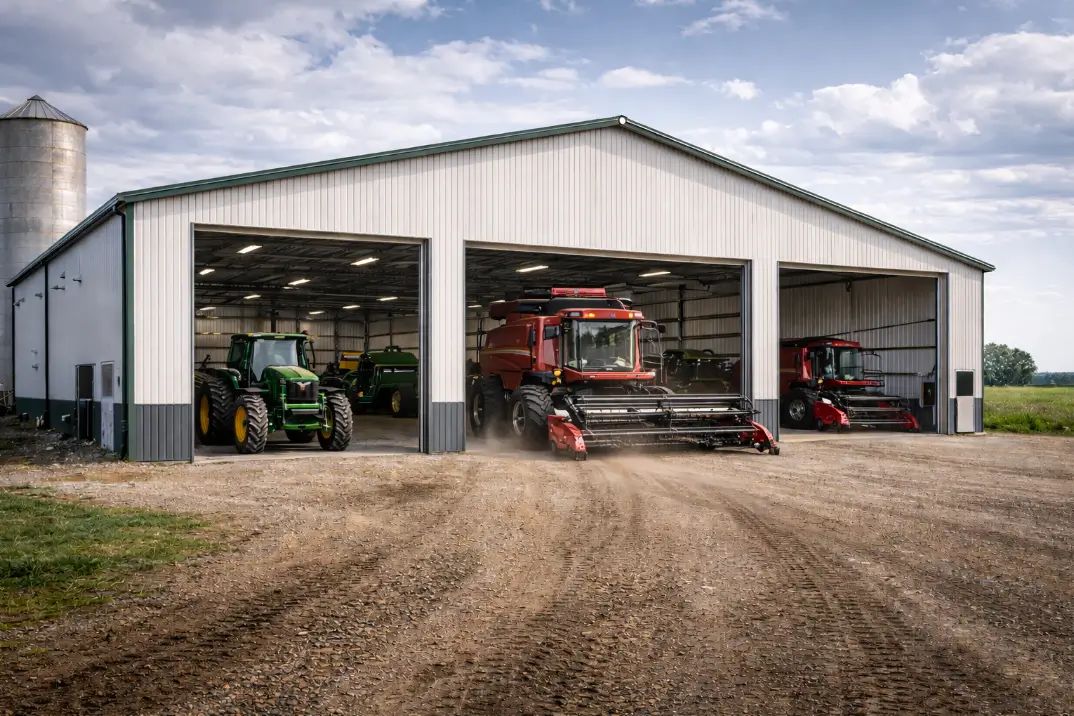
Clear-Span Space for Apparatus Bays and Fleet Operations
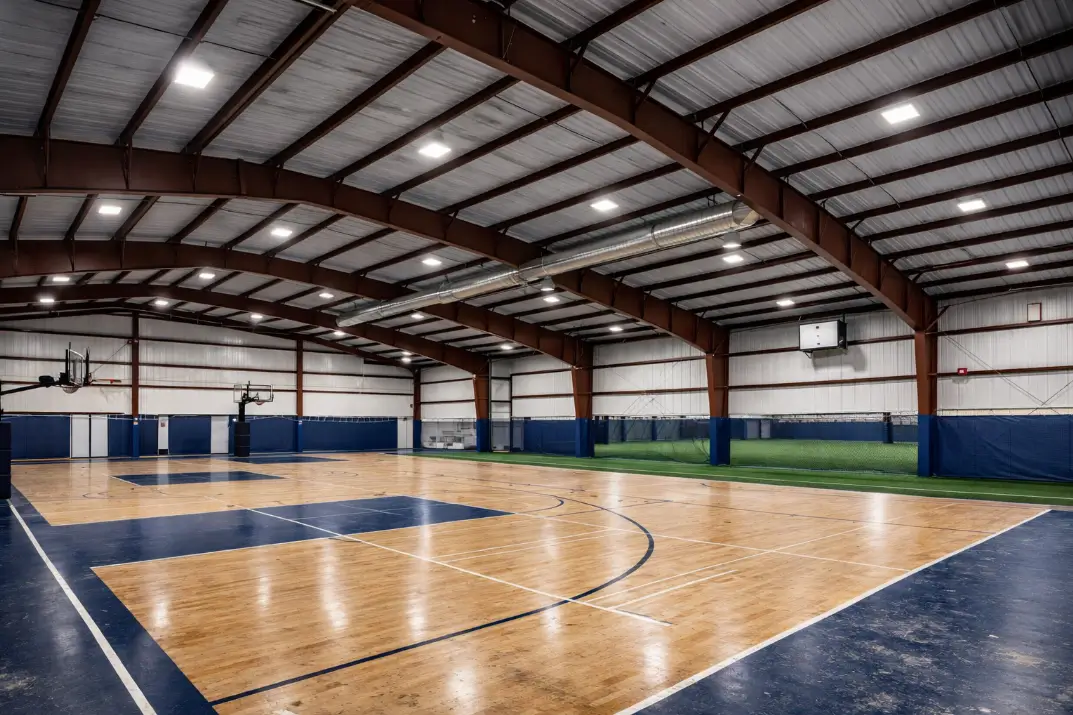
One of the most important advantages of steel buildings for emergency services is the ability to create wide clear spans without interior columns. This structural approach is similar to clear span steel buildings used in industrial applications where large open interiors are engineered without internal obstructions.
For fire halls, ambulance depots, and public works garages, this provides:
- Unobstructed vehicle movement
- Flexible bay layouts
- Safer turning clearances
- Easier equipment positioning
- Future reconfiguration without structural changes
Steel frames can be engineered to span large widths while concentrating loads into perimeter columns and foundations, eliminating internal obstructions that complicate daily operations.
This is particularly valuable for modern fire trucks and municipal service vehicles, which continue to grow in size and height.
Structural Capacity for Heavy Loads and Specialized Equipment
Emergency and municipal buildings routinely support loads far beyond typical commercial use.
These include:
- Fire apparatus weighing tens of tonnes
- Snow removal equipment
- Fuel systems and maintenance lifts
- Mezzanine storage for parts and gear
- Training tower connections
- Hose drying racks and suspended systems
Steel structures are well suited to handle these demands because load paths can be precisely engineered into the frame design.
Structural steel design practices in Canada align with standards published by the Canadian Standards Association (CSA).
Columns, rafters, connections, and foundations are coordinated to support concentrated loads without overstressing slabs or framing members.
This engineered approach prevents cracking, settlement, and structural fatigue that often appear in under-designed facilities.
Durability in Harsh Canadian Climates
Municipal and emergency buildings are exposed year-round to:
- Heavy snow loads
- Freeze-thaw cycles
- De-icing salts and chemicals
- Wind-driven rain and drifting snow
- Temperature extremes
Steel buildings, when properly protected and detailed, deliver consistent long-term structural performance under these conditions.
These environmental conditions are further detailed in steel building snow load zones in Canada where regional snow behaviour directly impacts structural design requirements.
Key durability advantages include:
- Non-combustible framing
- Resistance to rot, warping, and insect damage
- High strength-to-weight ratios
- Consistent material performance
With proper coatings, drainage design, insulation systems, and condensation control, steel facilities maintain structural integrity far longer than many traditional building systems.
Long-term exposure to moisture and chemicals can still present risks similar to those outlined in corrosion risks in steel buildings in coastal Canada if protective systems are not properly designed.
This is critical for municipalities that plan facilities as multi-decade infrastructure investments.
Rapid Construction for Growing Communities
Emergency services often expand faster than traditional construction schedules allow.
Population growth, new developments, and updated response standards can require:
- Additional apparatus bays
- New training spaces
- Expanded storage
- Satellite stations
Steel buildings offer significantly faster erection timelines once foundations are prepared.
Prefabricated structural components arrive ready for assembly, reducing on-site labour, weather delays, and scheduling uncertainty.
This allows municipal departments to bring new facilities online months sooner than many conventional builds, improving service coverage while controlling project risk.
Adaptability for Changing Municipal Needs
Few municipal buildings remain unchanged over their full lifecycle.
Steel structures support long-term adaptability through:
- Expandable end walls
- Modular bay layouts
- Load capacity for future equipment
- Mezzanine additions
- Interior reconfiguration
Fire halls may need more bays. Public works yards may require larger maintenance areas. Training spaces may evolve.
Steel framing allows these changes to occur without major structural demolition, protecting long-term asset value.
Fire Safety and Resilience
Emergency facilities must meet strict fire safety requirements, especially for public occupancy areas, equipment storage, and fuel systems.
Steel offers inherent advantages:
- Non-combustible structure
- Compatibility with fire-rated assemblies
- Easy integration of sprinklers and alarms
- Stable performance under heat exposure
This improves life safety while often simplifying fire code compliance compared to combustible structural systems.
For facilities housing emergency responders, this resilience is especially critical.
Energy Efficiency and Operational Cost Control
Modern steel buildings are not the drafty metal structures of the past.
When designed with:
- High-performance insulation systems
- Continuous vapour barriers
- Thermal break details
- Airtight wall assemblies
- Efficient HVAC integration
Improper moisture control is a common issue highlighted in condensation failures in agricultural steel buildings where vapour and thermal design were not properly integrated.
Steel buildings can achieve excellent energy performance even in cold Canadian climates.
This reduces long-term heating costs, improves occupant comfort, and protects equipment from moisture damage.
Over decades of operation, energy efficiency becomes one of the largest cost factors for municipal facilities, making envelope design just as important as structural strength.
Foundation Coordination and Site Conditions
Emergency and municipal buildings often occupy varied sites including:
- Urban lots
- Rural service yards
- Former industrial land
- High water table areas
- Frost-sensitive soils
Steel building loads are concentrated at column bases, making foundation coordination critical. Proper coordination with steel building foundation design in Ontario ensures that structural loads are safely transferred into the ground under varying soil conditions.
Proper geotechnical evaluation ensures:
- Correct frost depth protection
- Soil bearing capacity alignment
- Drainage control
- Settlement prevention
Well-coordinated foundations protect structural performance, slab integrity, and long-term building alignment.
This is an area where experienced steel building engineering provides major value.
Training Facilities and Specialized Spaces
Many emergency service complexes now include:
- Indoor training halls
- Apparatus maneuvering spaces
- Emergency simulation rooms
- Equipment maintenance shops
- Storage for disaster response supplies
Steel buildings allow these spaces to be integrated under one roof or expanded over time without disrupting operations.
Clear-span training areas in particular benefit from steel’s structural efficiency.
Lifecycle Value for Taxpayers
Municipal projects are judged not just on initial cost, but on long-term performance.
Steel buildings typically deliver:
- Lower structural maintenance
- Reduced repair frequency
- Predictable performance
- High adaptability
- Long service life
When lifecycle costs are considered, steel facilities often provide lower total ownership cost compared to traditional construction systems.
These lifecycle advantages are further explained in long term maintenance costs and steel building ROI.
This makes them well aligned with public infrastructure funding goals.
Quality Control Through Engineered Fabrication
One of the strongest advantages of steel buildings is the controlled fabrication process.
Structural components are manufactured under strict quality standards, inspected for accuracy, and delivered ready for assembly.
This consistency:
- Reduces construction defects
- Improves structural reliability
- Speeds erection
- Enhances safety
For critical public facilities, this level of precision adds an important layer of risk reduction.
Supporting Canada’s Municipal Infrastructure with Engineered Steel
Organizations such as Tower Steel Buildings apply integrated engineering, fabrication, and construction coordination to ensure emergency service and municipal facilities meet real-world operational demands across Canada’s diverse climates and regulatory environments.
By combining structural performance with long-term adaptability, steel buildings continue to serve as a reliable foundation for public infrastructure.
Final Perspective
Emergency services and municipal operations rely on buildings that must function without compromise.
Steel construction provides the strength, flexibility, durability, and efficiency required to support:
- Heavy equipment
- Continuous use
- Harsh climates
- Evolving community needs
- Long-term public investment
When engineered correctly, steel buildings become resilient infrastructure assets rather than short-term structures.
For Canada’s emergency responders and municipal departments, that reliability is not optional. It is essential.
Reviewed by the Tower Steel Buildings Engineering Team
This article has been reviewed by the engineering and project coordination specialists at Tower Steel Buildings, ensuring technical accuracy, Canadian code alignment, and real-world applicability for emergency services and municipal infrastructure projects.
1. Why are steel buildings commonly used for fire halls and municipal service yards?
Steel buildings provide clear-span vehicle bays, high structural load capacity, fast construction timelines, and long-term durability in harsh Canadian climates. They support heavy emergency vehicles, constant daily use, and future expansion more effectively than many traditional construction systems.
2. Can steel buildings support the weight of fire trucks and heavy municipal equipment?
Yes. Properly engineered steel buildings are designed for concentrated wheel loads, lifting equipment, mezzanine storage, fuel systems, and specialized service infrastructure. Structural frames and foundations are coordinated to handle these demands safely and efficiently.
3. Are steel emergency service buildings energy efficient in cold Canadian winters?
Modern steel buildings can achieve high energy performance when designed with continuous insulation, vapour control layers, airtight assemblies, and efficient mechanical systems. Many municipal steel facilities operate with lower heating costs than older conventional structures.
4. How long do steel municipal buildings typically last?
When properly engineered, protected, and maintained, steel buildings routinely perform for 40 to 60 years or more. Their resistance to rot, warping, and structural degradation makes them well suited for long-term public infrastructure.
5. Can steel fire halls and service buildings be expanded later?
Yes. Steel buildings are often designed with future expansion in mind through removable end walls, modular bay layouts, and structural capacity allowances. This allows municipalities to grow facilities as community needs evolve.
6. Are steel buildings compliant with Canadian fire safety requirements?
Steel is non-combustible and integrates well with fire-rated wall assemblies, sprinkler systems, and life safety designs. This often simplifies fire code compliance while improving overall building resilience.
7. How quickly can a steel emergency services building be constructed?
Once foundations are complete, steel structures can typically be erected far faster than many traditional builds. Prefabricated components reduce on-site labour, weather delays, and scheduling uncertainty, allowing facilities to become operational sooner.
8. Are steel buildings suitable for training facilities and multi-use municipal spaces?
Yes. Clear-span interiors, high ceilings, and structural flexibility make steel buildings ideal for training halls, maintenance shops, storage areas, and combined municipal service complexes under one roof.