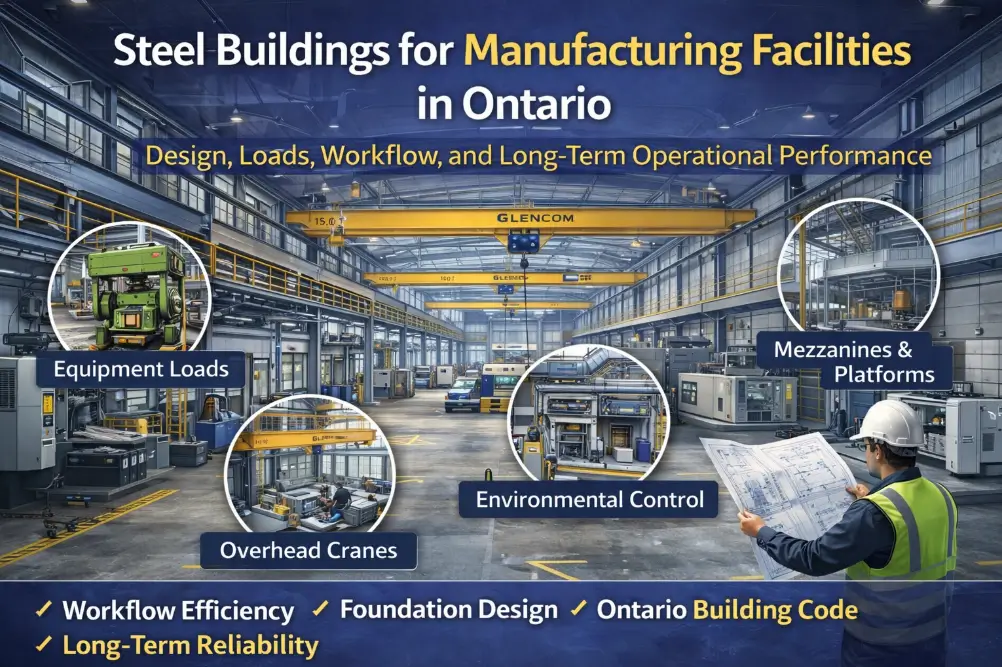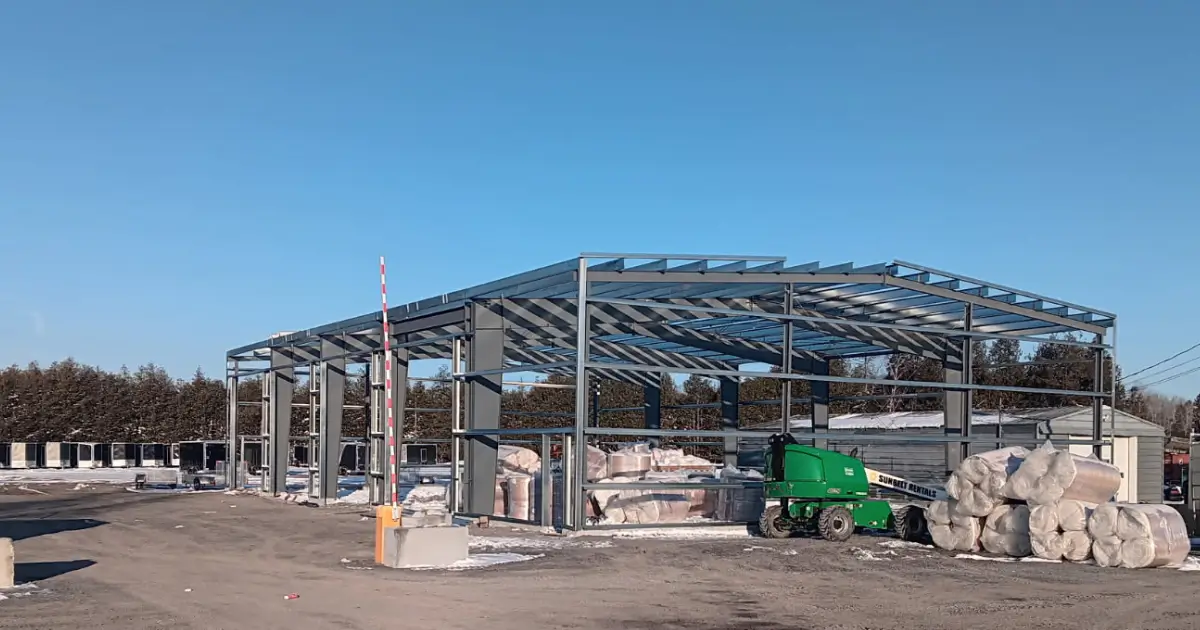
Cold storage facilities place some of the most demanding performance requirements on building structures in Canada. Unlike standard warehouses or industrial buildings, refrigerated environments must control temperature, moisture movement, structural loads, and energy efficiency simultaneously, all while operating continuously year after year.
Steel buildings have become a preferred structural system for cold storage and refrigeration facilities across Canada because of their strength, clear-span capabilities, durability, and adaptability to high-performance insulation systems. However, designing steel buildings for cold environments requires far more than simply enclosing refrigerated equipment within metal walls.
Successful cold storage facilities depend on integrated engineering that considers thermal performance, condensation control, structural movement, foundation interaction, and long-term operational efficiency from the earliest design stage.
Integrated planning is outlined in steel building engineering review checklist before final design.
This article explains how steel buildings are used in cold storage and refrigeration applications, the unique challenges these environments create, and the engineering principles that ensure long-term reliability in Canada’s climate.
Why Steel Buildings Are Well Suited for Cold Storage Facilities
Cold storage buildings demand precise structural performance and long-term durability. Steel framing offers several advantages that make it particularly effective for refrigerated environments.
Steel structures provide:
- High load capacity for heavy refrigeration equipment, racking systems, and suspended mechanical units
- Clear-span interiors that maximize storage volume and forklift circulation
- Dimensional stability that supports airtight thermal envelope construction
- Compatibility with insulated wall and roof panel systems
- Long service life with proper corrosion protection
Unlike wood framing, steel does not absorb moisture, warp, or deteriorate under cold temperature cycling. This stability is critical in environments where temperature differentials between interior and exterior surfaces can exceed 40°C for much of the year.
For large cold storage warehouses, steel’s ability to span wide distances without interior columns also improves operational efficiency by maximizing usable storage space and racking flexibility.
Understanding the Thermal Demands of Cold Storage Buildings
Cold storage facilities operate under constant thermal stress.
Interior temperatures may range from:
- Chilled environments for produce or pharmaceuticals
- Frozen storage for meat, seafood, or long-term food preservation
Meanwhile, exterior Canadian temperatures can swing from summer heat to extreme winter cold.
Regional climate variation is analyzed in Ontario climate zones and steel building design.
This creates continuous heat flow pressure across the building envelope.
The building must:
- Prevent heat infiltration
- Control moisture migration
- Maintain stable interior temperatures
- Minimize energy loss
Any weakness in insulation continuity, air sealing, or vapor control can dramatically increase operating costs and lead to condensation problems.
Steel building design must therefore integrate:
- High-performance insulated wall and roof assemblies
- Proper vapor barrier placement
- Thermal break detailing at structural connections
- Controlled air leakage paths
Cold storage success is driven as much by envelope engineering as by structural strength. Envelope system options are detailed in steel building insulation systems in Ontario.
Condensation and Moisture Control in Refrigerated Steel Buildings
One of the most critical challenges in cold storage design is condensation management. Advanced moisture behaviour is explained in condensation failures in agricultural steel buildings.
Condensation occurs when warm, moisture-laden air contacts surfaces that are below dew point temperature. In cold storage environments, steel surfaces rapidly drop below dew point temperature in cold weather, making them prime condensation points if not properly insulated and sealed.
Uncontrolled condensation can lead to:
- Corrosion of steel framing
- Insulation saturation and performance loss
- Mold growth in warmer transitional spaces
- Ice buildup on structural members
- Premature equipment deterioration
Effective condensation control strategies include:
- Continuous insulation layers with no thermal gaps
- Vapor barriers on the warm side of assemblies
- Sealed penetrations for mechanical and electrical systems
- Controlled air pressure differentials between spaces
Steel framing works exceptionally well with modern insulated metal panels and continuous envelope systems when properly detailed.
Poor envelope coordination, not steel itself, is the primary cause of moisture failures in cold storage buildings.
Structural Load Considerations Unique to Cold Storage Facilities
Cold storage buildings often carry higher loads than standard warehouses.
These may include:
- Dense palletized frozen goods
- Tall racking systems
- Heavy refrigeration units mounted on roofs or mezzanines
- Ice buildup allowances in certain environments
Steel framing systems are engineered to handle these concentrated loads efficiently, but accurate load identification early in design is critical.
Important structural considerations include:
- Floor slab thickness and reinforcement for high point loads
- Roof structure designed for mechanical equipment loads
- Column spacing optimized for racking layouts
- Seismic and wind loading appropriate to location
- Snow load design accounting for drifting and thermal effects
Because refrigeration equipment layouts often evolve during project planning, early coordination between structural engineers and refrigeration designers prevents costly retrofits later.
Regional structural loading is explained in steel building snow load zones across Canada.
Foundations and Thermal Movement in Cold Storage Buildings
Cold storage buildings interact with foundations differently than standard structures.
Key challenges include:
- Frost penetration risks around refrigerated areas
- Temperature-driven structural movement
- Differential settlement from thermal gradients
- Insulated slab requirements
Cold interior temperatures can extend frost deeper into the ground beneath buildings, increasing frost heave risks if foundations are not properly insulated and designed. Cold-region foundation protection is detailed in frost depth requirements for steel building foundations.
Foundation strategies may include:
- Insulated slabs and perimeter frost protection
- Frost-protected shallow foundations in some applications
- Deep foundations where soil conditions require
- Vapor barriers under slabs to control moisture migration
Steel buildings tolerate very little foundation movement without performance impact, making geotechnical investigation and foundation coordination essential. Soil performance and foundation stability are explained in soil conditions affecting steel building foundations in Canada.
Energy Efficiency and Operating Cost Control
Energy consumption is one of the largest operating expenses in cold storage facilities.
International refrigeration efficiency guidance is provided by ASHRAE refrigeration design standards.
Even small improvements in building envelope performance can produce major long-term savings.
Steel buildings support:
- Thick continuous insulation systems
- High-performance insulated metal panels
- Airtight construction detailing
- Roof assemblies designed for minimal thermal bridging
Well-designed steel cold storage facilities typically achieve:
- Lower refrigeration equipment runtime
- Reduced defrost cycles
- More stable interior temperatures
- Lower moisture infiltration
This translates directly into:
- Lower electrical costs
- Reduced maintenance
- Longer equipment life
Over decades of operation, envelope performance often outweighs initial construction cost differences. Lifecycle economics are explored in long-term maintenance costs and steel building ROI.
Fire Safety and Regulatory Considerations
Cold storage buildings must meet building code requirements related to:
- Fire separation
- Structural fire resistance
- Insulated panel fire performance
- Mechanical system safety
Canadian structural and fire standards are defined in the National Building Code of Canada official publication. Certain insulation types and panel systems require specific fire ratings depending on occupancy classification and building size.
Material fire performance testing standards are published by CSA Group Canada standards organization.
Steel framing performs well in fire-resistant assemblies when combined with appropriate protective systems.
Early coordination with code consultants ensures that refrigeration envelope choices align with regulatory requirements without late-stage redesign.
Construction Sequencing for Cold Storage Steel Buildings
Cold storage projects require careful construction sequencing.
Typical workflow includes:
- Structural steel erection
- Building envelope completion and sealing
- Installation of insulated panels
- Vapor barrier continuity verification
- Refrigeration system installation
- Commissioning and performance testing
Building enclosure must be fully sealed before refrigeration systems are activated to avoid condensation saturation during startup.
Steel buildings allow fast structural erection, but envelope detailing quality ultimately determines performance.
When Steel Buildings Are the Right Choice for Cold Storage Projects
Steel buildings are particularly well suited when:
- Large clear spans are required
- High racking systems are planned
- Heavy refrigeration equipment loads exist
- Long-term durability is essential
- Expansion may be required in the future
They provide structural flexibility that adapts as storage technologies evolve.
Long-Term Performance and Lifecycle Reliability
Cold storage buildings operate continuously under extreme thermal stress.
Steel structures, when properly protected and coordinated with envelope systems, deliver:
- Long service life
- Minimal structural degradation
- Stable geometry for insulation systems
- Predictable maintenance requirements
Most performance failures in cold storage buildings result from envelope design shortcuts, not from steel framing itself.
Integrated engineering produces facilities that perform efficiently for decades.
Final Perspective
Steel buildings have become a backbone of modern cold storage and refrigeration infrastructure across Canada. Their strength, adaptability, and compatibility with high-performance building envelopes make them ideally suited for the extreme demands of refrigerated environments.
However, success in cold storage construction is not achieved through structure alone. It requires coordinated engineering that integrates thermal performance, moisture control, foundation design, and mechanical systems from the outset.
When designed with these realities in mind, steel cold storage buildings function as reliable, energy-efficient operational assets that support food supply chains, pharmaceutical storage, and industrial refrigeration for decades.
Reviewed by the Tower Steel Buildings Engineering Team
This article has been reviewed by the Tower Steel Buildings Engineering Team to ensure technical accuracy, compliance with Canadian construction standards, and alignment with real-world cold storage design practices.
1. Are steel buildings suitable for frozen cold storage facilities in Canada?
Yes. Steel buildings are widely used for both chilled and frozen cold storage across Canada due to their high load capacity, clear-span design flexibility, and compatibility with high-performance insulated wall and roof systems. Proper envelope design is essential to control condensation and energy loss.
2. What type of insulation works best in steel cold storage buildings?
Insulated metal panels and continuous high-R-value insulation systems are commonly used because they provide thermal continuity, vapor control, and long-term durability. The correct insulation thickness depends on operating temperature, regional climate, and energy efficiency targets.
3. How do cold storage steel buildings prevent condensation and corrosion?
Condensation is controlled through continuous insulation, proper vapor barrier placement, airtight construction, and elimination of thermal bridging. When these systems are properly engineered, steel framing remains dry and corrosion risk is minimized over the building’s lifespan.
4. Do cold storage facilities require special foundation design?
Yes. Cold interior temperatures can extend frost penetration beneath the building. Foundations often require insulated slabs, frost-protected perimeters, and moisture barriers to prevent heaving, settlement, and long-term structural movement.
5. Can steel buildings support heavy refrigeration equipment and racking systems?
Steel structures are well suited for heavy point loads from refrigeration units, suspended piping systems, and tall storage racks. Loads must be identified early so framing and foundations can be engineered accordingly.
6. Are steel cold storage buildings energy efficient?
When designed correctly, steel cold storage buildings can achieve excellent energy performance. Continuous insulation systems, airtight construction, and minimal thermal bridging significantly reduce refrigeration loads and operating costs over time.
7. How long do steel cold storage buildings typically last?
With proper corrosion protection, envelope detailing, and maintenance, steel cold storage buildings can perform reliably for 30 to 50 years or more. Structural steel itself often outlasts mechanical and refrigeration equipment cycles.
8. Do cold storage buildings require special fire safety considerations?
Yes. Insulation types, fire separations, and building occupancy classifications influence fire protection requirements. Early coordination with code consultants ensures compliance without costly redesign.
9. Is expansion easier with steel cold storage buildings?
Steel framing allows future expansions and modifications more easily than many other structural systems. Clear-span layouts and modular framing can accommodate additional refrigerated space as operations grow.
10. What is the most common cause of cold storage building failures?
Most failures are related to poor moisture control, insulation gaps, and envelope detailing rather than structural steel. Condensation management and thermal continuity are the most critical design elements for long-term performance.