Across Canada, winter road maintenance relies heavily on de-icing salts to keep highways, municipal roads, and industrial routes safe. National environmental practices and winter maintenance policies are supported by Environment and Climate Change Canada. While essential for transportation, these salts create one of the most aggressive corrosion environments steel buildings can face.
Steel structures located near highways, trucking corridors, distribution centres, municipal yards, and heavily travelled roads experience accelerated deterioration if corrosion protection is not properly engineered from the beginning.
Design requirements in Canada are guided by the Codes Canada program administered by the National Research Council.
Structural durability practices also align with standards developed by the Canadian Standards Association (CSA).
Unlike normal moisture exposure, salt introduces chemical reactions that dramatically increase the rate of steel degradation. This accelerated deterioration is similar to conditions outlined in corrosion risks in steel buildings in coastal Canada where aggressive environmental exposure significantly impacts structural longevity.
Left unaddressed, it can shorten structural life, increase maintenance costs, complicate insurance coverage, and reduce long-term asset value.
Understanding how salt affects steel buildings and how to design effective corrosion protection is critical for owners planning permanent structures in Canada’s winter climate.
Why Road Salt Is One of the Most Aggressive Corrosion Triggers
Salt does not simply make steel wet. It fundamentally changes how corrosion occurs.
When salt dissolves in moisture, it creates an electrolyte solution that increases electrical conductivity on steel surfaces. This accelerates oxidation, allowing rust to form faster and penetrate deeper into the metal.
In clean water exposure, corrosion occurs gradually.
In salt-contaminated environments, corrosion accelerates exponentially.
This is why coastal structures, marine equipment, and winter road-adjacent buildings experience similar degradation patterns even though one is exposed to ocean spray and the other to road runoff.
In many parts of Canada, steel buildings near salted roads deteriorate faster than those located in rural or low-traffic areas.
How Far From a Road Does Salt Exposure Travel?
Many owners assume corrosion risk only exists right beside highways. In reality, salt particles travel much farther than expected.
Salt reaches steel buildings through:
- Wind-blown spray from traffic
- Mist generated by plows and tires
- Runoff carried across paved and graded surfaces
- Vehicles and equipment tracking salt inside
- Snow melt pooling near foundations
Depending on traffic volume, wind patterns, and site grading, corrosion risk can extend hundreds of metres from roadways.
Industrial parks, logistics centres, farms near highways, municipal yards, and commercial developments often fall within this high-exposure zone without realizing it.
The Most Vulnerable Areas of Steel Buildings Near Roads
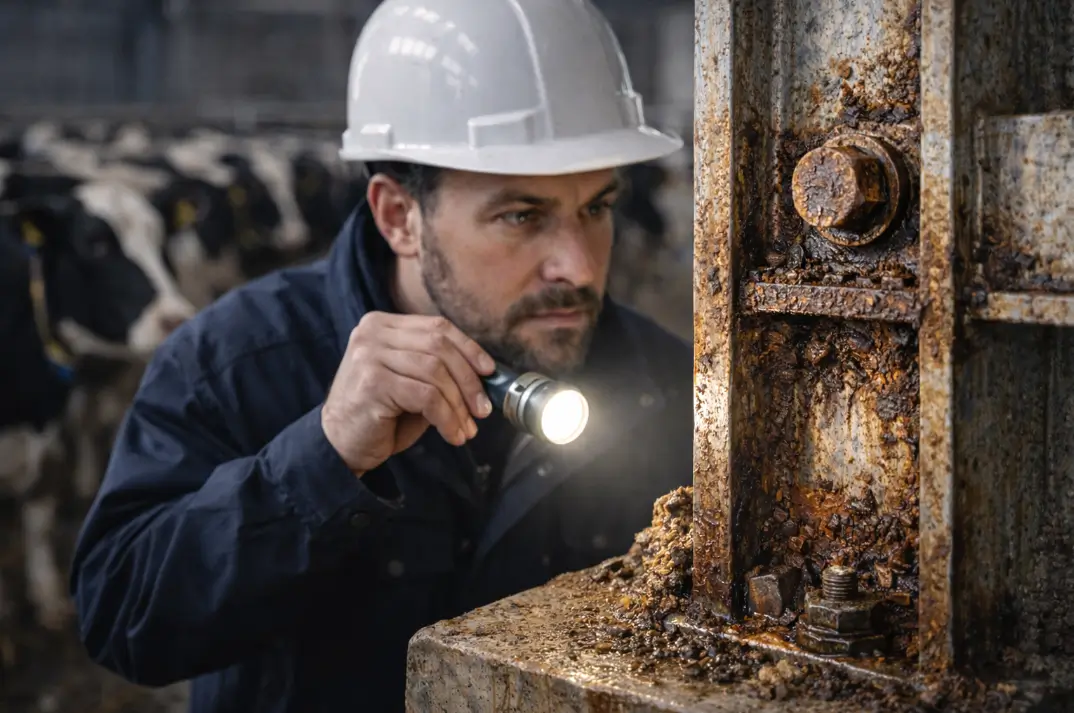
Salt does not attack every part of a building equally. Certain components consistently experience the earliest and most severe corrosion.
1. Base Plates and Anchor Zones
Where steel columns meet concrete foundations, moisture and salt tend to accumulate. Proper detailing at these locations is critical, as explained in steel building foundation design in Ontario where load transfer and moisture exposure must be coordinated.
This creates persistent wet exposure that accelerates rust at load-bearing points.
2. Lower Wall Framing and Girts
Road spray and snow buildup repeatedly coat lower wall sections, leading to progressive corrosion over years.
3. Door Thresholds and Openings
Salt-laden slush enters buildings through large vehicle doors, where it settles along frames and tracks.
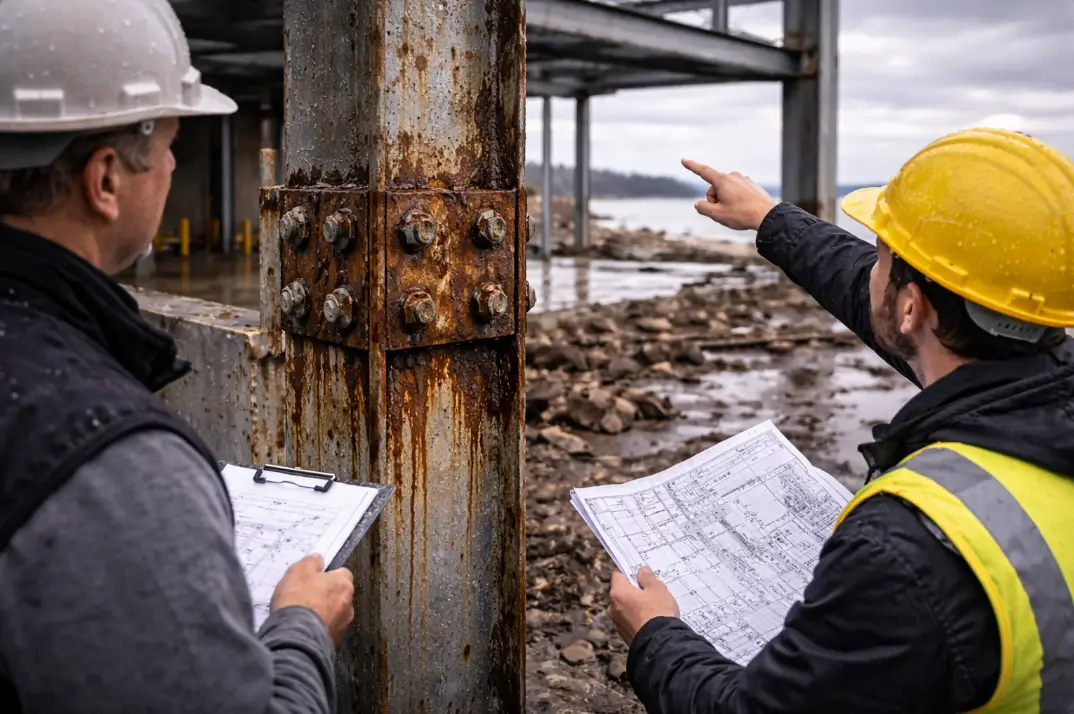
4. Connection Points and Bolted Joints
Moisture traps at joints create micro-environments where corrosion concentrates.
5. Interior Columns Near Vehicle Traffic
Forklifts, trucks, and equipment continuously introduce salt residue indoors during winter months.
Without protective strategies, these areas become long-term maintenance liabilities.
Why Standard Steel Protection Is Often Not Enough
Basic shop primers and light coatings used in many low-cost steel building packages are designed for normal atmospheric conditions.
They are not engineered for:
- High chloride exposure
- Continuous wet-dry cycles
- Freeze-thaw moisture retention
- Ground-level splash zones
In salt-heavy environments, these coatings often fail within a few seasons, exposing raw steel to rapid corrosion.
This is why buildings near roads require corrosion protection strategies that go beyond minimum fabrication standards.
Effective Corrosion Protection Strategies for Road-Adjacent Steel Buildings
1. Hot-Dip Galvanizing
Galvanized steel provides a zinc coating that acts as a sacrificial layer, protecting steel even when surface damage occurs.
Benefits include:
- Excellent resistance to salt exposure
- Long service life in aggressive environments
- Protection of hidden surfaces and joints
For base plates, lower framing, and exposed structural components, galvanizing offers one of the strongest defences.
2. High-Performance Coating Systems
In very aggressive zones, multi-layer industrial coating systems are often used, such as:
- Zinc-rich primers
- Epoxy intermediate layers
- Polyurethane or protective topcoats
These systems form chemical barriers that resist moisture and salt penetration far better than standard paint.
They are commonly used in bridges, marine structures, and heavy industrial facilities for a reason.
3. Detail Design That Prevents Moisture Traps
Corrosion is not only about coatings. Poor detailing can defeat even the best protection systems.
Effective design includes:
- Sloped base plates and drainage paths
- Avoiding horizontal ledges that trap water
- Sealed connections where moisture accumulates
- Proper flashing and trim around openings
Dry steel corrodes slowly. Trapped moisture corrodes quickly.
4. Site Drainage and Grading Control
Many corrosion problems originate from poor water management.
Key strategies include:
- Sloping ground away from foundations
- Preventing runoff from roadways toward buildings
- Installing perimeter drainage where needed
- Avoiding snow pile locations near walls
Keeping salt-laden water away from steel dramatically extends building lifespan.
5. Interior Protection and Cleaning Strategies
For buildings with vehicle traffic:
- Durable floor coatings reduce salt absorption
- Wash-down areas limit residue buildup
- Regular winter cleaning removes corrosive deposits
Ignoring interior exposure allows corrosion to attack from both sides.
How Salt Corrosion Impacts Long-Term Building Costs
Corrosion is rarely dramatic at first. It progresses quietly, compounding year after year.
Common long-term impacts include:
- Structural repairs and reinforcement
- Premature component replacement
- Increased insurance scrutiny
- Reduced resale value
- Downtime for remediation work
- Higher maintenance budgets
Buildings that appear inexpensive upfront often become the most expensive over their lifespan if corrosion protection is overlooked.
These long-term cost patterns are further explained in long term maintenance costs and steel building ROI.
Why Canadian Climate Makes Salt Corrosion More Severe
Canada’s freeze-thaw cycles intensify corrosion damage.
Each winter introduces salt exposure.
Each spring melts distribute moisture into steel joints.
Each freeze traps water in micro-cracks and seams.
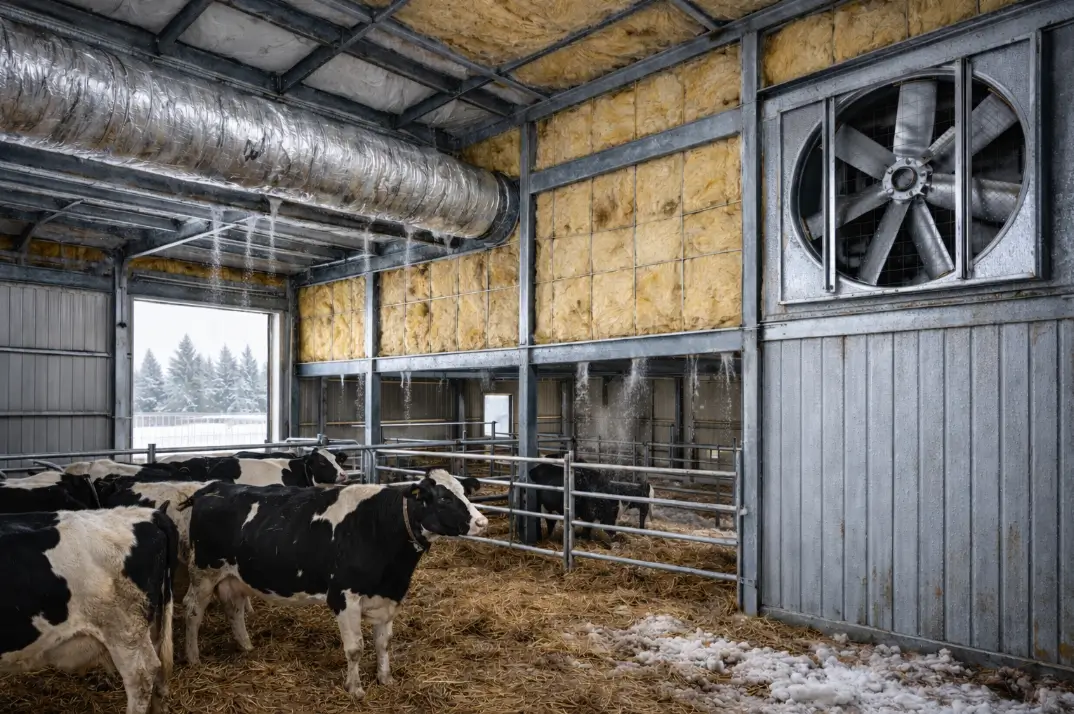
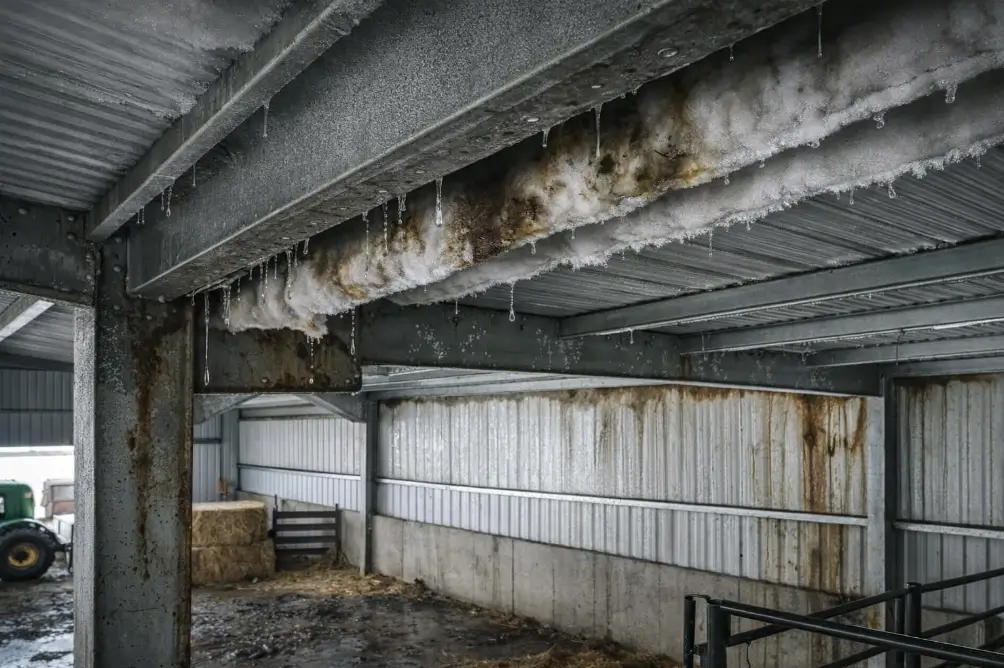
This behaviour is closely related to failures described in condensation failures in agricultural steel buildings where repeated moisture cycles accelerate material degradation.
This cycle repeats annually, accelerating coating breakdown and steel degradation far faster than in mild climates.
Design strategies that perform well in warm regions often fail prematurely in Canadian winter conditions.
Insurance and Risk Considerations
Many insurers now assess corrosion exposure when underwriting industrial and commercial properties.
Buildings near major roads may face:
- Higher premiums
- Maintenance documentation requirements
- Coating inspection schedules
- Structural condition reviews
Proper corrosion protection is increasingly viewed as risk mitigation, not just durability enhancement.
Early Planning Makes the Biggest Difference
The most cost-effective time to address corrosion protection is during design and fabrication.
Retrofits often require:
- Surface preparation
- Abrasive blasting
- Downtime
- Access equipment
- Disruption of operations
Designing protection into the structure initially costs far less than correcting deterioration later.
When Higher Upfront Protection Pays Off
In most Canadian road-adjacent projects, enhanced corrosion protection:
- Extends building lifespan by decades
- Reduces maintenance frequency
- Preserves structural capacity
- Improves insurability
- Maintains property value
Owners who plan for environmental exposure upfront consistently experience lower lifetime ownership costs.
Recognizing When Salt Protection Is Necessary
Corrosion-resistant design should be strongly considered when:
- Buildings are near highways or major roads
- Facilities involve frequent vehicle movement
- Snow storage occurs nearby
- Sites receive heavy winter runoff
- Operations include wash-down or moisture exposure
In these environments, standard protection is rarely sufficient.
This is a common issue in projects discussed in cheap steel building kit engineering oversights where environmental exposure is underestimated during design.
Corrosion Protection Is an Engineering Decision, Not a Finish Choice
This aligns with principles outlined in steel building engineering in Ontario where long-term performance must be defined during design, not after construction.
One of the most common misconceptions is treating corrosion protection as a cosmetic upgrade.
In reality, it is a structural longevity decision that directly affects:
- Load capacity over time
- Safety margins
- Maintenance budgets
- Asset lifespan
Effective corrosion planning belongs in engineering scope, not as an afterthought.
Final Perspective
Salt exposure is unavoidable near Canadian roadways. Corrosion damage is not.
Steel buildings located in these environments require deliberate engineering, proper coatings, intelligent detailing, and thoughtful site planning to perform reliably over decades.
Ignoring salt exposure may save small amounts during construction, but it almost always results in significantly higher long-term costs.
When corrosion protection is designed correctly from the beginning, steel buildings near roads can perform just as reliably as those in low-exposure locations.
The difference lies in planning.
Reviewed by the Tower Steel Buildings Engineering Team
This article has been reviewed by the Tower Steel Buildings Engineering Team to ensure technical accuracy, Canadian climate relevance, and alignment with real-world steel building design and corrosion protection practices.
1. How close to a road does salt exposure start affecting steel buildings?
Salt exposure can begin impacting steel buildings hundreds of metres from major roadways, depending on traffic volume, wind patterns, drainage, and snow management. Spray from vehicles, wind-blown salt mist, and runoff often travel far beyond the road edge, especially along highways and industrial corridors.
2. Is galvanized steel enough for buildings near salted roads?
Hot-dip galvanized steel provides strong corrosion resistance in many road-adjacent environments and is often sufficient for base plates, lower framing, and exposed components. In very aggressive zones, such as high-traffic highways or constant wet exposure areas, galvanized steel is sometimes combined with industrial coating systems for additional protection.
3. Which parts of a steel building corrode first near highways?
The most vulnerable areas typically include base plates at foundations, lower wall framing, door openings, bolted connections, and interior columns near vehicle traffic. These locations trap moisture and salt residue, creating conditions where corrosion accelerates fastest.
4. Can poor site drainage make corrosion worse even with good coatings?
Yes. Even high-quality coatings and galvanized steel can deteriorate prematurely if salt-laden water is allowed to pool near foundations or splash repeatedly against structural components. Proper grading, runoff control, and drainage design are essential parts of corrosion protection near roads.
5. Does road salt affect interior steel components too?
Absolutely. Vehicles and equipment track salt inside during winter months, where moisture combines with residue along floors, columns, and door frames. Without interior protection and regular cleaning, corrosion can develop on internal structural elements as well as exterior surfaces.
6. How long can corrosion protection extend the life of a steel building?
With proper coating systems, galvanized components, good drainage design, and routine maintenance, steel buildings in high-salt environments can maintain structural integrity for several decades. In many cases, effective corrosion planning doubles or triples service life compared to unprotected structures.
7. Do insurance companies consider corrosion risk near highways?
Increasingly, yes. Insurers often evaluate proximity to salted roads when assessing long-term risk for industrial and commercial buildings. Facilities with documented corrosion protection strategies and maintenance programs generally experience smoother underwriting and fewer coverage concerns.
8. Is corrosion protection more expensive upfront?
Enhanced corrosion protection adds modest cost during fabrication and construction, but it significantly reduces long-term maintenance, repair, and replacement expenses. Over the life of a steel building, early protection almost always results in lower total ownership cost.
9. Can corrosion be fixed later if it becomes a problem?
While corrosion can be repaired, remediation typically involves abrasive blasting, coating removal, structural repairs, and operational downtime. These interventions are far more expensive and disruptive than designing proper protection from the beginning.
10. When should corrosion protection be addressed in a steel building project?
Ideally during engineering and fabrication planning. Coating selection, galvanized components, detailing strategies, and site drainage should all be integrated into the design stage, not treated as afterthoughts once steel arrives on site.