High-value steel building projects such as manufacturing plants, logistics hubs, cold storage facilities, municipal infrastructure, and large agricultural operations represent long-term capital investments. These buildings are not temporary assets. They are operational infrastructure expected to perform reliably for decades under Canadian climate conditions, regulatory oversight, and evolving business needs.
Because of the scale and lifespan involved, risk management in steel construction is not about avoiding problems entirely. It is about identifying where failure is most likely to occur, understanding how those failures compound over time, and designing projects so that risks are controlled before steel ever arrives on site.
Well-executed risk assessment consistently separates projects that proceed smoothly from those that experience delays, redesigns, budget overruns, and performance issues long after construction is complete.
What is risk assessment in steel building projects?
Risk assessment in steel building projects is the process of identifying design, site, regulatory, and construction risks early so they can be controlled before fabrication and construction begin.
What “Risk” Really Means in Steel Building Projects
In construction, risk is often misunderstood as unexpected accidents or rare engineering failures. In reality, the largest risks in high-value steel building projects are almost always predictable.
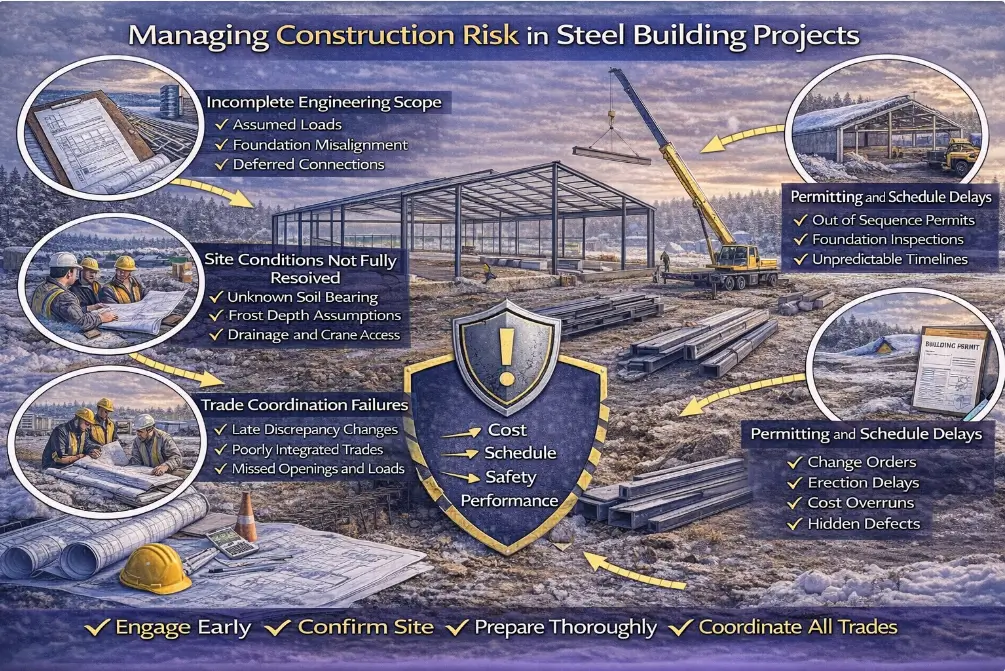
They typically fall into four broad categories:
- Design and engineering assumptions
- Site and foundation conditions
- Regulatory and permitting challenges
- Construction sequencing and coordination gaps
When these risks are not addressed early, they do not disappear. They simply shift downstream where corrections are far more expensive.
High-value projects magnify this effect. The larger and more complex the building, the more costly even small oversights become.
Why High-Value Steel Buildings Carry Unique Risk Profiles
Smaller storage buildings or simple garages may tolerate modest inefficiencies without serious consequences. Large commercial, industrial, and institutional steel buildings cannot.
High-value projects usually involve:
- Long spans and heavy structural loads
- Specialized equipment or process requirements
- Complex foundations and soil conditions
- Tight permit scrutiny and inspection regimes
- Significant financing and insurance involvement
Many of these project types fall within broader commercial steel building applications where structural performance, operational demands, and regulatory scrutiny must be addressed early.
Each of these factors increases the sensitivity of the project to early decisions.
A minor design assumption that might be manageable on a small structure can create six-figure consequences on a large facility.
The Most Common Risk Categories in Steel Building Projects
1. Engineering Scope Risk
One of the most frequent sources of cost and schedule disruption is unclear or incomplete engineering scope.
This often includes:
- Structural loads not aligned with actual building use
- Foundation reactions assumed rather than calculated
- Expansion provisions not engineered
- Equipment loads introduced after design completion
- Bracing systems simplified to reduce upfront cost
While a building may technically meet minimum code requirements, it may not be engineered appropriately for its operational reality.
A building can be code compliant and still carry significant performance risk.
Engineering gaps typically surface during permitting, foundation construction, or erection when corrections become unavoidable.
2. Site and Soil Condition Risk
Every steel building ultimately transfers load into the ground.
That is why foundation engineering is one of the most important risk-control factors in any high-value steel building project.
When site conditions are poorly understood, structural performance becomes unpredictable.
Steel buildings transfer concentrated loads into the ground, making accurate soil data essential to prevent settlement, cracking, and long-term structural movement.
Common site-related risks include:
- Insufficient geotechnical investigation
- Incorrect frost depth assumptions
- Unaccounted groundwater movement
- Differential settlement potential
- Sloped or constrained property impacts
Many of these issues mirror the realities covered in custom steel buildings for unique site constraints where soil, slope, access, and regulatory limitations directly shape structural design.
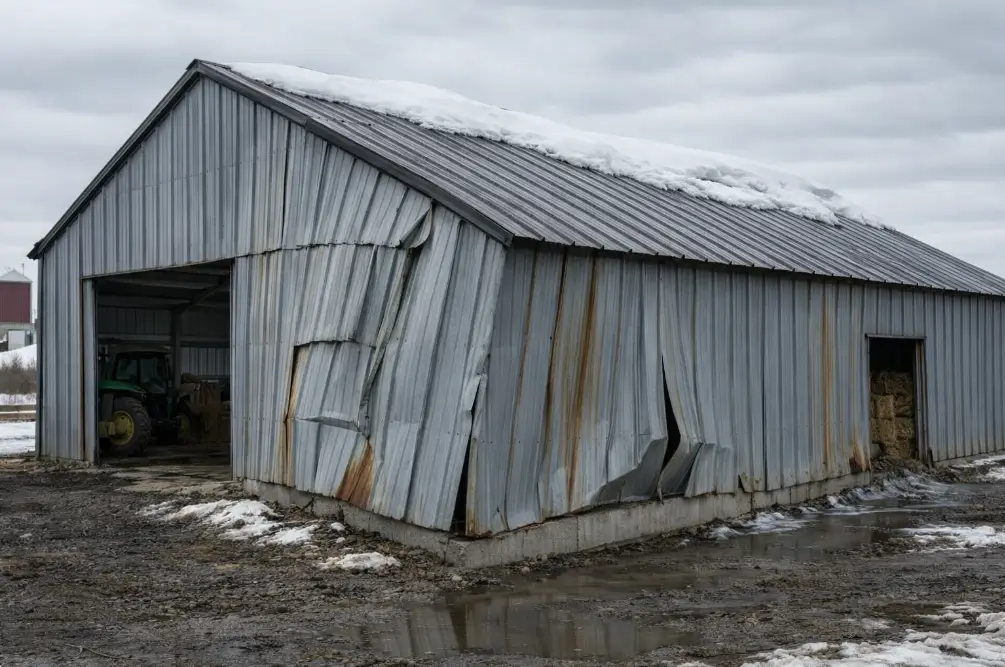
Foundations poured without confirmed soil data frequently require reinforcement, underpinning, or redesign once settlement or cracking appears.
On high-value projects, foundation remediation often exceeds original engineering costs.
3. Regulatory and Approval Risk
Steel buildings in Canada are subject to provincial building codes, municipal zoning rules, site plan control, environmental regulations, and inspection processes.
Regulatory review often begins with steel building zoning requirements in Ontario and expands into site-specific municipal and environmental compliance.
Risks arise when:
- Zoning setbacks or height limits are misunderstood
- Use classifications trigger additional requirements
- Fire separations are overlooked
- Environmental buffers affect site layout
- Municipal review timelines are underestimated
A project can be structurally sound yet delayed months due to planning or compliance oversights.
High-value projects typically experience deeper regulatory review, making early alignment essential.
4. Construction Coordination Risk
Steel buildings rely on precise sequencing between multiple trades.
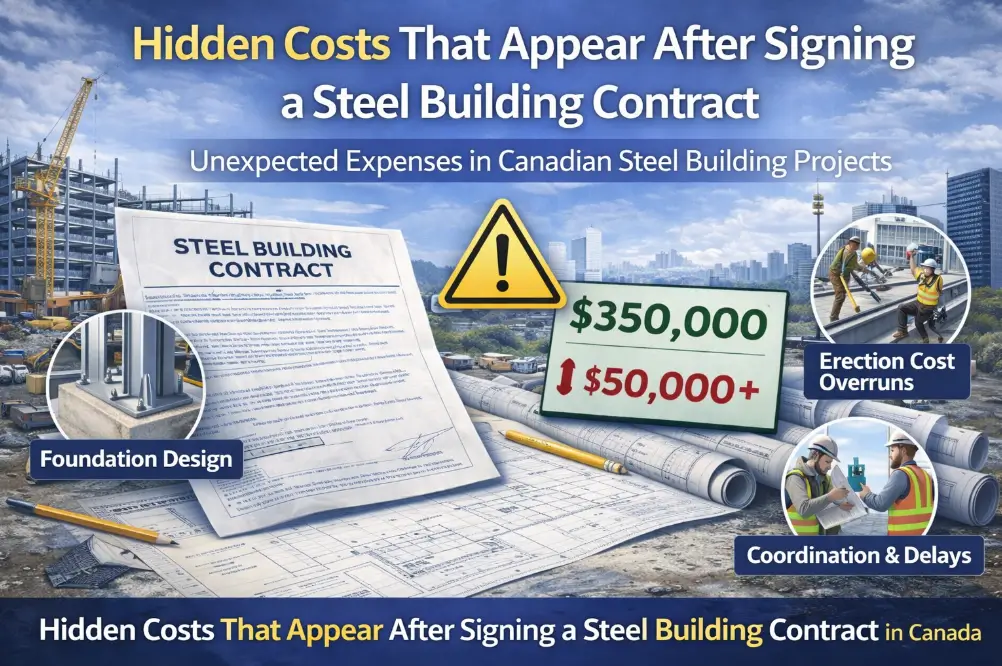
Even minor sequencing errors can result in costly rework when structural, mechanical, and foundation elements are not aligned before construction begins.
Common coordination failures include:
- Foundations poured before steel reactions are finalized
- Mechanical penetrations not coordinated with framing
- Crane access not planned during site design
- Drainage systems conflicting with footings
- Electrical routing interfering with structural members
When coordination breaks down, crews are forced to modify finished work, request engineering revisions, and reschedule inspections.
Each correction compounds cost and delays.
Risk Is Highest at the Beginning of the Project
One of the most important realities in steel construction is that the majority of risk is introduced long before fabrication begins.
The earliest phases control:
- Structural system selection
- Foundation strategy
- Load assumptions
- Site layout
- Regulatory pathway
- Construction sequencing
Once steel is fabricated, flexibility disappears.
Correcting early mistakes later almost always involves demolition, redesign, or structural reinforcement.
Projects that invest in early risk assessment consistently experience lower total cost, smoother schedules, and stronger long-term performance.
Key Components of an Effective Risk Assessment
Clear Definition of Building Use
Risk assessment begins with accurately defining how the building will operate.
This includes:
- Equipment weights and locations
- Future expansion plans
- Storage loads and traffic patterns
- Crane systems or mezzanines
- Environmental exposure levels
Assumptions made without operational clarity create structural mismatches.
Buildings designed generically often require costly retrofits to support actual use.
Verified Site and Soil Information
Geotechnical data should be obtained before foundation and structural systems are finalized.
This allows engineers to:
- Size foundations appropriately
- Control settlement risk
- Design frost protection correctly
- Manage drainage effectively
Skipping soil investigation is one of the highest risk decisions on any high-value project.
Regulatory Pathway Review
Understanding approvals early prevents costly redesign.
Effective risk planning includes:
- Zoning compliance verification
- Site plan control requirements
- Fire and occupancy classification review
- Environmental constraints
- Municipal review timelines
Projects that integrate these factors upfront rarely experience permitting surprises.
Construction Sequencing Strategy
Risk assessment should include erection planning.
Early sequencing decisions are closely tied to steel building site preparation where access, grading, drainage, and staging conditions directly affect construction efficiency.
This covers:
- Crane positioning
- Material staging
- Access routes
- Weather exposure periods
- Trade coordination milestones
When sequencing is planned alongside design, delays drop dramatically.
How Risk Compounds Over the Life of the Building
Many project risks do not appear immediately.
Instead, they quietly increase operational cost.
Examples include:
- Under-designed drainage leading to foundation moisture damage
- Insufficient corrosion protection accelerating structural deterioration
- Poor thermal detailing increasing energy consumption
- Inadequate load capacity limiting future upgrades
- Condensation issues damaging insulation and finishes
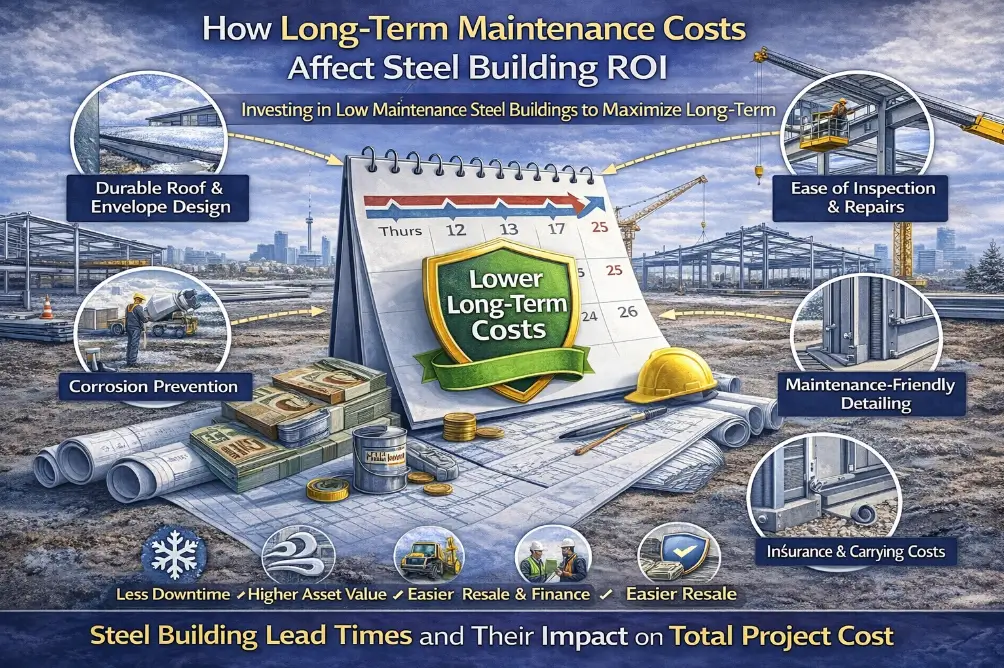
Long-term deterioration risk also depends on salt exposure and corrosion protection in steel buildings where environmental exposure can accelerate structural decline if not addressed early.
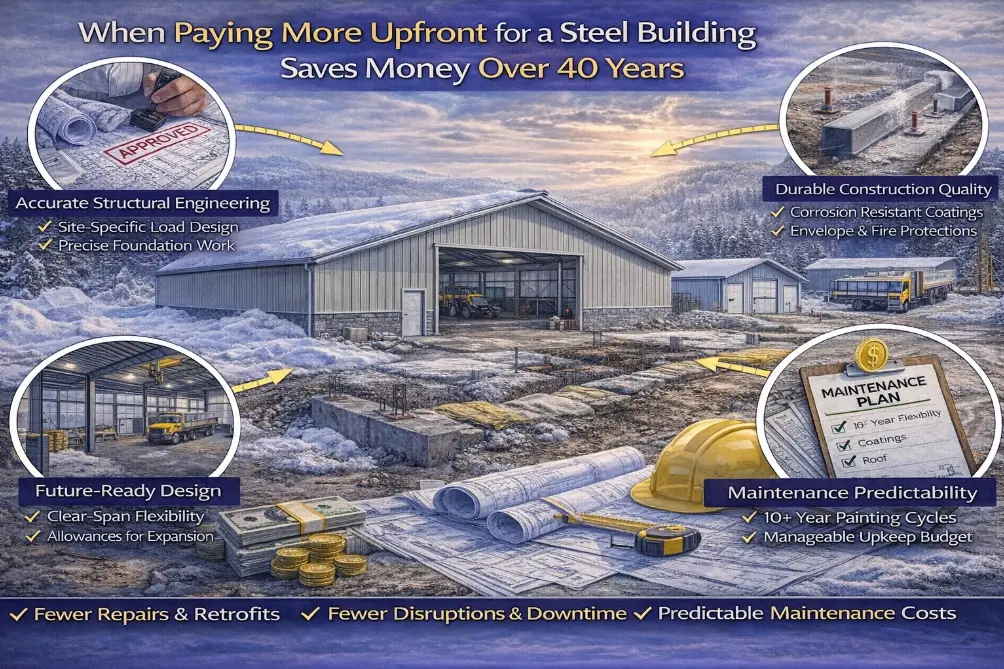
High-value steel buildings are long-term assets. Small design shortcuts can generate decades of maintenance expense.
The Financial Side of Construction Risk
Small early design assumptions can lead to significant downstream costs, particularly in high-value projects where scale amplifies the impact of errors.
Risk directly affects:
- Financing approval
- Insurance premiums
- Maintenance budgets
- Asset valuation
- Operational uptime
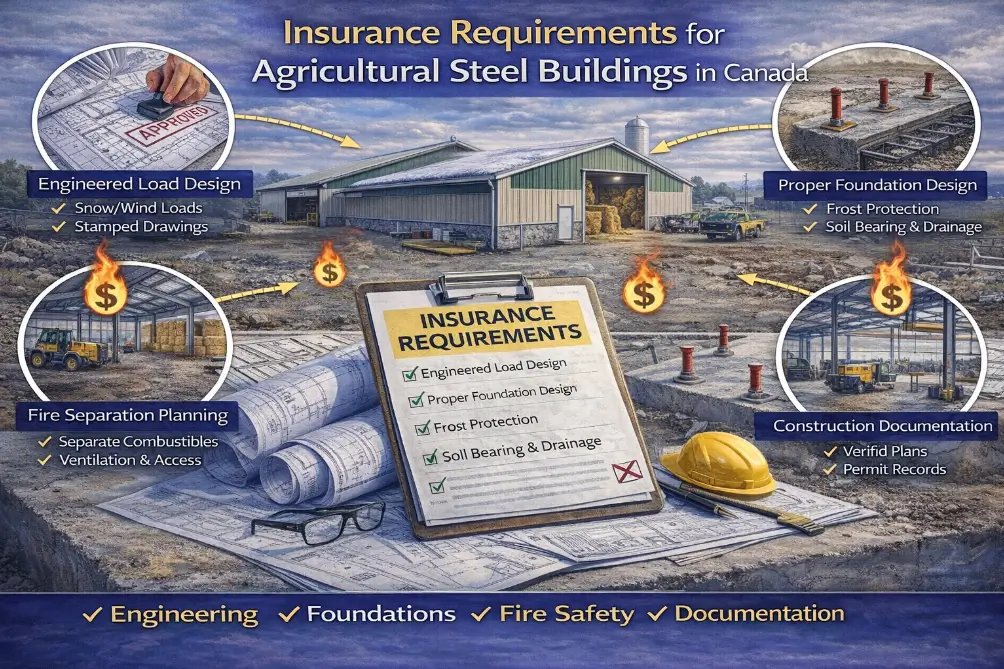
Lenders and insurers increasingly review engineering quality, foundation design, and long-term durability factors.
Buildings that demonstrate thorough planning and engineered performance typically face fewer financial constraints.
Early Warning Signs of Elevated Project Risk
Owners and developers should pay close attention when they encounter:
- Quotes issued before engineering scope is defined
- Foundation drawings prepared without steel load data
- Generic designs reused across different sites
- Permits submitted with assumptions still unresolved
- Construction schedules that ignore approvals and inspections
These are not efficiencies. They are risk transfers waiting to become cost overruns.
Risk Does Not Mean Over-Engineering
One common misconception is that managing risk requires excessive material or conservative design.
In reality, proper risk assessment leads to accurate engineering.
It ensures:
- Loads match actual use
- Foundations match soil conditions
- Systems match regulatory requirements
- Details match environmental exposure
Accurate steel design and detailing must also align with standards established by the Canadian Standards Association (CSA) governing structural performance and fabrication quality.
Canadian code frameworks are developed through the Codes Canada program administered by the National Research Council, but project-specific engineering still determines real-world performance.
Well-engineered buildings typically use materials more efficiently than poorly planned ones.
Accuracy costs less than correction.
When Risk Assessment Is Most Critical
While every project benefits from risk planning, it becomes essential when:
- Building size increases significantly
- Specialized equipment is involved
- Long spans are required
- Cold storage or moisture exposure is present
- Municipal review is complex
- Financing is substantial
- Long-term ownership is expected
These projects carry the highest downstream cost if early decisions are wrong.
That exposure becomes even more pronounced in long-span steel structure engineering challenges where concentrated reactions, deflection, and coordination demands increase project sensitivity.
The Strategic Advantage of Proactive Risk Management
Projects that treat risk assessment as part of design rather than an afterthought consistently achieve:
- Faster approvals
- Fewer change orders
- Predictable schedules
- Lower maintenance costs
- Stronger asset value
This is not coincidence. It is the result of aligning engineering, site planning, regulatory compliance, and construction execution from the beginning.
Why Steel Building Projects Fail Over Time
Most steel building failures are not caused by material defects but by early-stage decisions. Incomplete engineering, unverified site conditions, and poor coordination often lead to structural adjustments, delays, and long-term performance issues. Projects that address risk early perform more predictably and cost less over time.
Final Perspective
High-value steel building projects succeed or struggle based on decisions made long before fabrication begins.
Risk control begins with accurate engineering, verified site information, and early coordination across every major decision point.
Planning a steel building project in Canada requires a process that identifies risk before it turns into redesign, delay, or long-term cost.
Risk is not eliminated through optimism or low bids. It is controlled through:
- Accurate engineering
- Verified site conditions
- Regulatory awareness
- Coordinated construction planning
The most successful steel buildings are not the cheapest to design. They are the most thoroughly planned.
In steel construction, risk ignored early always returns later with interest.
Reviewed by the Tower Steel Buildings Engineering Team
This article has been reviewed by the Tower Steel Buildings Engineering Team to ensure technical accuracy, alignment with Canadian building codes, real-world constructability, and long-term performance considerations for high-value steel building projects across Canada.
1. How early should risk assessment begin on a steel building project?
Risk assessment should begin before conceptual design is finalized. The most critical risks related to engineering scope, soil conditions, zoning, permitting, and construction sequencing are introduced during early planning. Once steel is fabricated, correcting errors becomes significantly more expensive and time-consuming.
2. What are the biggest cost risks in high-value steel building projects?
The largest risks typically come from incomplete engineering, unverified soil conditions, regulatory surprises, and poor trade coordination. These issues often result in foundation redesigns, structural modifications, permit delays, and construction rework that compound project costs.
3. Is geotechnical testing really necessary for steel buildings?
Yes. Steel buildings transfer significant concentrated loads into the ground. Without proper soil analysis, foundations may be under-designed or incorrectly detailed, leading to settlement, cracking, drainage problems, and long-term structural issues that are far more expensive to correct than early testing.
4. Can a steel building be code-compliant and still high risk?
Absolutely. Building codes establish minimum safety standards, not optimal performance. A structure may technically meet code while being poorly engineered for its specific use, equipment loads, environmental exposure, or future expansion, resulting in operational limitations and higher lifecycle costs.
5. Who is typically responsible for managing construction risk?
Risk management is shared among owners, engineers, steel suppliers, general contractors, and design consultants. However, many risks arise when responsibilities are not clearly assigned early. Successful projects define engineering scope, site preparation, approvals, and coordination roles at the outset.
6. How does risk assessment affect financing and insurance?
Lenders and insurers increasingly review engineering quality, foundation design, durability measures, and compliance planning. Projects with documented risk mitigation often experience smoother approvals, better financing terms, and fewer insurance complications.
7. Does managing risk mean higher upfront construction costs?
Not necessarily. Effective risk assessment usually leads to accurate engineering rather than over-engineering. By preventing redesigns, delays, and long-term maintenance issues, well-planned projects frequently cost less over their full lifecycle.
8. What are warning signs that a project may carry elevated risk?
Common red flags include quotes issued before engineering scope is defined, foundations designed without confirmed steel loads, generic designs reused across different sites, unresolved permit assumptions, and schedules that ignore inspection and approval timelines.
9. How does early planning reduce long-term operating costs?
Proper planning ensures structural systems match real usage, foundations suit site conditions, drainage and corrosion protection are addressed, and thermal performance is optimized. These factors significantly reduce maintenance, repairs, and downtime over the building’s lifespan.
10. Are large steel buildings more sensitive to risk than smaller structures?
Yes. High-value projects with long spans, heavy equipment, specialized operations, and regulatory oversight amplify the impact of even minor design or coordination errors. Early risk control becomes increasingly critical as project size and complexity grow.