Ontario’s climate is not uniform, and that reality directly affects how steel buildings must be designed, engineered, and constructed. A steel building that performs well in Southern Ontario may face serious structural, condensation, or durability issues if the same design is used in Northern or Eastern regions without adjustment.
Understanding Ontario climate zones is essential for anyone planning a steel building project. Climate influences snow loads, wind exposure, thermal performance, corrosion risk, foundation depth, and long-term operating costs. These factors must be addressed during design, not after construction begins.
This guide explains how Ontario’s climate zones affect steel building design and why region-specific engineering is critical for safety, performance, and permit approval.
How Ontario Climate Zones Are Defined
Ontario climate zones are shaped by geography, elevation, proximity to large water bodies, and prevailing weather patterns. While the Ontario Building Code establishes baseline requirements, climate-related design values are applied on a site-specific basis using local reference data rather than province-wide averages.
Climate-related design requirements in Ontario are governed by the Ontario Building Code.
These requirements are applied differently at the provincial level, as explained in National vs Ontario Building Code requirements for steel structures.
Key climate variables include:
- Ground snow load
- Wind exposure and gust intensity
- Temperature ranges and freeze-thaw cycles
- Humidity and condensation risk
- Soil frost depth
- Corrosion potential from moisture and de-icing chemicals
Reference climate values used across Ontario originate from the National Building Code of Canada.
Snow load variation across Ontario is examined in more detail in steel building snow load zones in Canada.
These variables change significantly across Ontario, which is why steel building design must be tailored to the project location rather than reused from another region.
Southern Ontario Climate Considerations
Southern Ontario includes areas such as Toronto, Mississauga, Hamilton, Brampton, Guelph, Kitchener, Waterloo, London, and Windsor.
Snow Load and Roof Design
Snow loads in Southern Ontario are generally lower than in northern regions, but they still demand careful engineering. Wet snow, drifting, and ice accumulation can impose loads that exceed assumptions based solely on average snowfall.
Roof geometry, parapets, adjacent structures, and drift zones often govern design more than average snow depth, particularly on low-slope roofs and buildings surrounded by other structures.
Steel roof systems must be engineered to account for uneven snow distribution, drifting at roof transitions, and potential ponding during freeze-thaw cycles.
Wind Exposure in Urban and Open Areas
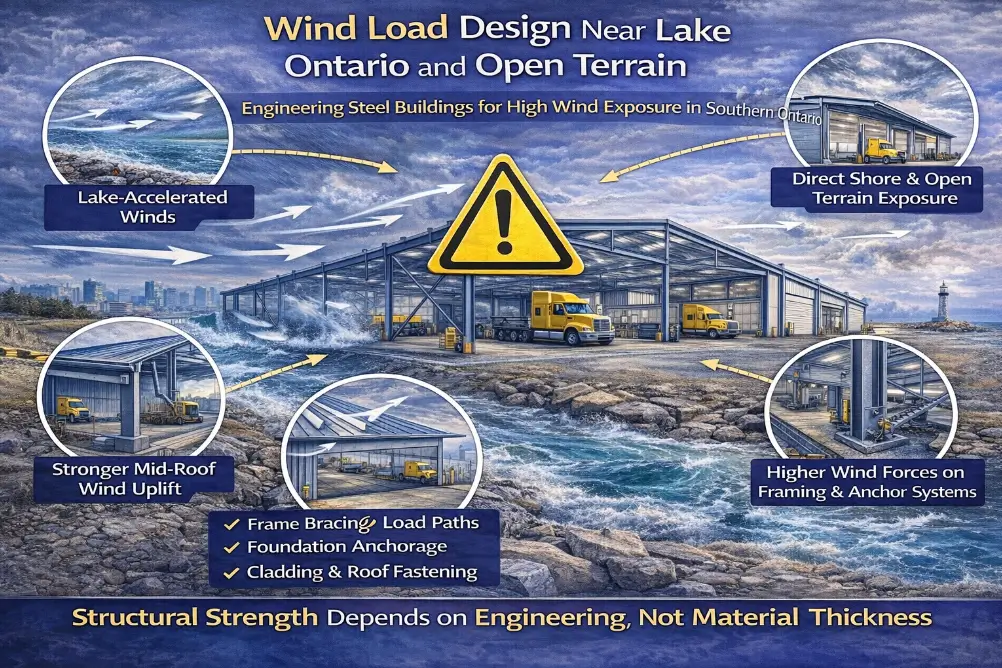
Urban wind patterns in Southern Ontario are influenced by surrounding buildings, while open suburban and industrial zones experience higher direct exposure. Steel buildings must be designed to resist:
- Roof uplift forces
- Lateral loads on wall systems
- Pressure concentration around large doors and openings
Wind design is especially important for warehouses and commercial steel buildings with wide clear spans and tall wall heights.
Condensation and Thermal Performance
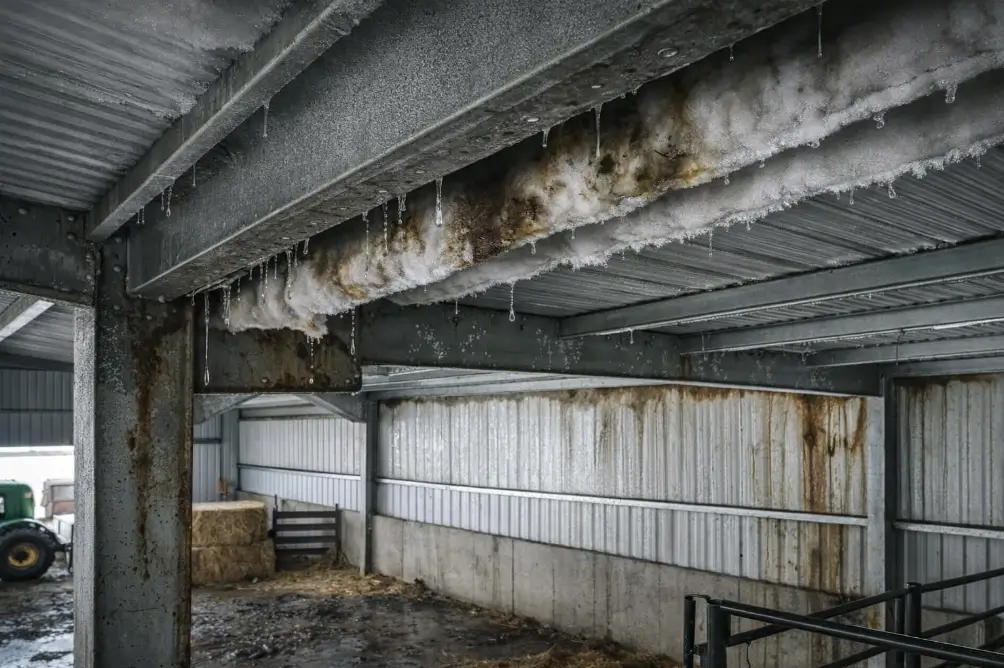
Southern Ontario experiences frequent temperature swings around the freezing point. This increases condensation risk inside steel buildings if insulation and vapor control are not properly designed.
Effective thermal design includes appropriate insulation systems, vapor barriers, controlled ventilation, and detailing that prevents moisture migration into wall and roof assemblies.
Eastern Ontario Climate Considerations
Eastern Ontario includes regions such as Ottawa, Kingston, Cornwall, and surrounding municipalities.
Increased Snow Loads and Drift Effects
Eastern Ontario typically experiences higher ground snow loads due to regional weather patterns and lake-effect systems. Steel building roof systems must be designed to resist sustained snow accumulation and localized drifting.
Framing members, purlins, girts, and connections are often sized differently than similar buildings in Southern Ontario to account for these conditions.
Cold Weather and Building Envelope Performance
Extended cold periods place greater demands on insulation and air sealing. Steel buildings in Eastern Ontario require:
- Higher insulation values
- Robust vapor control strategies
- Attention to thermal bridging
Failure to address these factors can result in condensation, ice buildup, and higher heating costs over the building’s life.
Northern Ontario Climate Considerations
Northern Ontario presents the most demanding climate conditions for steel building design.
Heavy Snow Loads and Structural Demand
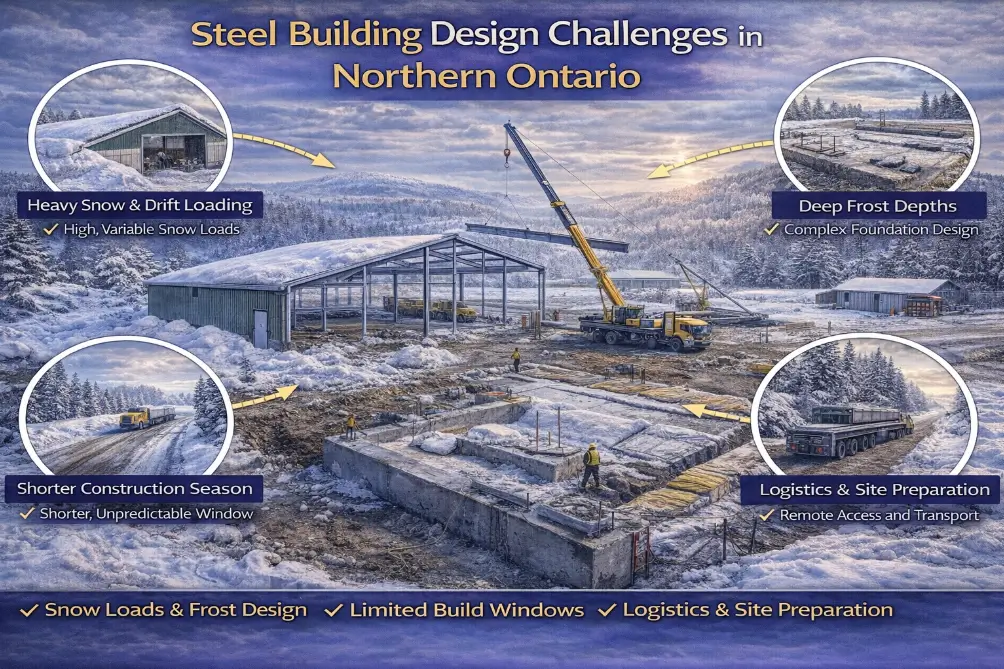
Northern regions experience significantly higher ground snow loads and longer snow retention periods. Roof systems must be designed to withstand sustained loading rather than intermittent events.
This typically leads to heavier framing members and reinforced roof assemblies.
Extreme Cold and Frost Depth
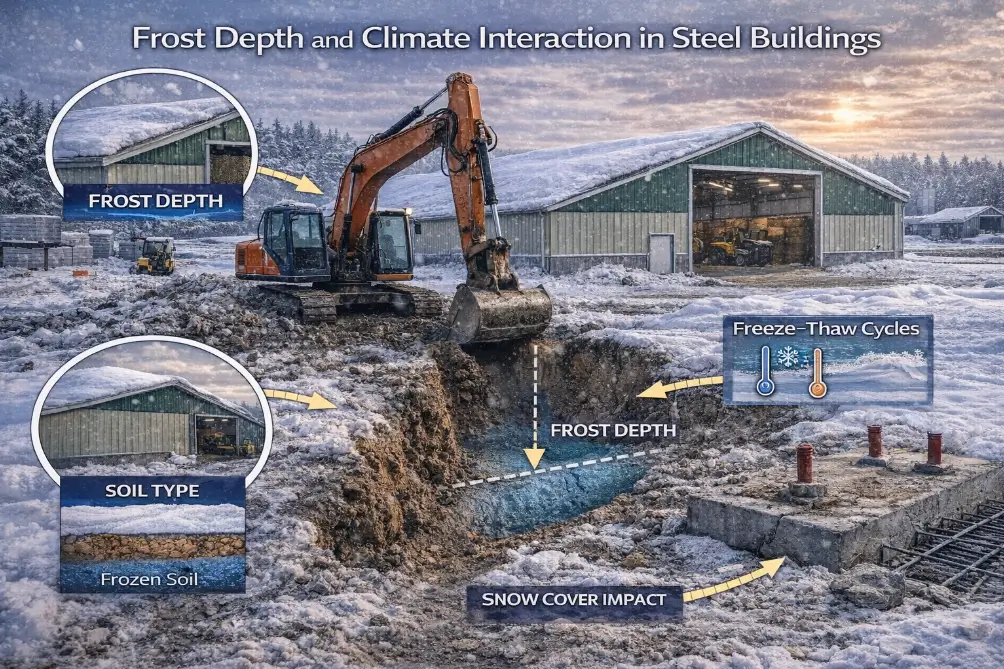
Deep frost penetration affects foundation design more than any other climate factor. Steel building foundations must be engineered with frost protection measures such as deeper footings, frost walls, or insulated foundation systems to prevent heaving and differential movement.
Remote Construction Challenges
Many Northern Ontario projects are located in remote areas with limited access and shorter construction seasons. Steel building design often accounts for logistics, erection sequencing, and modular delivery to reduce on-site challenges.
Wind Exposure Across Ontario
Wind exposure varies across Ontario based on terrain, elevation, and surrounding development. Steel buildings must be designed using site-specific exposure categories rather than generic assumptions.
Proper wind design protects structural integrity, reduces envelope damage, and supports long-term performance.
Wind exposure categories and climatic research data are maintained by the National Research Council Canada.
Corrosion Risk and Environmental Exposure
Ontario’s climate contributes to corrosion risk through humidity, freeze-thaw cycles, road salt, and industrial or agricultural exposure. Steel building design should incorporate appropriate coatings, finishes, and detailing to manage corrosion risk and preserve structural capacity over time.
Foundation Design and Climate Interaction
Climate directly affects foundation performance through frost depth, soil moisture variation, and freeze-thaw cycling. Climate-driven soil behaviour is explored further in soil conditions affecting steel building foundations in Canada.
Steel building foundation design in Ontario must address:
- Local frost depth requirements
- Drainage and water management
- Soil conditions influenced by climate
These considerations are addressed during steel building foundation design in Ontario, where frost depth and soil conditions are evaluated together.
Proper coordination between the steel building engineer and foundation designer ensures long-term stability and prevents movement that can compromise the structure.
Energy Efficiency and Building Envelope Design
Ontario’s climate makes energy efficiency a critical design factor for steel buildings.
Effective envelope design reduces heat loss, controls moisture movement, and improves occupant comfort while lowering operating costs over the building’s lifespan.
Insulation strategies vary by region and are discussed in steel building insulation options in Ontario.
Permit Approval and Climate Compliance
Municipal building departments review steel building designs based on site-specific climate data. Designs that do not reflect local snow loads, wind pressures, or frost depth often face delays or rejection.
Climate-appropriate design documentation streamlines permit approvals and reduces project risk.
Climate design values are established through steel building engineering in Ontario, using site-specific reference data.
Climate design values are reviewed and sealed by engineers regulated through Professional Engineers Ontario.
Climate Design, Insurance, and Long-Term Performance
Climate-aware steel building design does more than satisfy code requirements. It also reduces insurance scrutiny, limits long-term maintenance exposure, and supports predictable lifecycle performance, particularly for commercial and industrial owners.
Buildings engineered for local climate conditions are less likely to experience structural distress, moisture-related damage, or envelope failures that can affect insurability and asset value.
Why Climate-Specific Steel Building Design Matters
A steel building is a long-term investment. Designs that ignore Ontario’s regional climate differences often face higher maintenance costs, operational challenges, and reduced service life.
Climate-specific engineering ensures steel buildings perform as intended across Ontario’s varied environmental conditions.
Designing Steel Buildings for Ontario Conditions
Effective steel building design in Ontario integrates:
- Structural engineering
- Local climate data analysis
- Foundation design coordination
- Envelope and insulation planning
- Long-term durability considerations
When climate factors are addressed early, steel buildings deliver predictable performance, lower lifecycle costs, and long-term reliability.
Reviewed by the Tower Steel Buildings Engineering Team
This article has been reviewed by the Tower Steel Buildings engineering team to ensure accuracy, technical relevance, and alignment with Canadian design practices. Our review process reflects real-world experience designing steel buildings across multiple Ontario climate zones, with direct consideration for snow load, wind exposure, frost depth, and long-term structural performance under the Ontario Building Code.
1. How many climate zones affect steel building design in Ontario?
Ontario does not use a single climate zone for steel building design. Instead, design values are applied based on regional data that reflects local snow loads, wind pressures, frost depth, and temperature ranges. These values vary significantly between Southern, Eastern, and Northern Ontario.
2. Does the Ontario Building Code use the same snow load everywhere?
No. While the Ontario Building Code provides baseline requirements, snow load values are site-specific. Ground snow load, drifting potential, roof geometry, and surrounding structures all influence the final design loads used by the engineer.
3. Why can two steel buildings in Ontario require different structural designs?
Even buildings with the same size and use can require different designs if they are located in different climate regions. Snow load, wind exposure, frost depth, and soil conditions vary across Ontario and directly affect structural member sizing, foundation design, and envelope performance.
4. How does climate affect steel building foundations in Ontario?
Climate influences frost penetration, soil moisture movement, and freeze-thaw cycles. Foundation design must account for local frost depth, drainage, and soil behavior to prevent heaving, settlement, and long-term structural issues.
5. Can climate-specific design affect insurance or long-term maintenance?
Yes. Steel buildings designed for local climate conditions typically face fewer issues related to snow loading, moisture intrusion, and thermal stress. This can reduce insurance scrutiny and lower long-term maintenance and repair costs over the life of the building.
6. Who determines the climate design values for a steel building project?
Climate design values are established by the structural engineer using Ontario Building Code requirements and site-specific reference data. These values are then applied to the steel building and foundation design to ensure compliance and performance.