Understanding the difference between the National Building Code of Canada and the Ontario Building Code is essential for anyone planning a steel building project in Ontario. While the two codes are closely related, they are not interchangeable, and misunderstanding their roles can lead to permit delays, redesign costs, and inspection issues.
Steel structures are particularly sensitive to code interpretation because they rely on precise engineering assumptions. These assumptions directly influence steel building engineering in Ontario, especially when drawings are reviewed for permit approval. Snow load values, wind pressures, seismic design, and foundation requirements must align with the code enforced by the local authority having jurisdiction.
This article explains how the National Building Code and the Ontario Building Code relate to steel structures, where they differ, and what steel building buyers need to know to avoid costly mistakes.
What the National Building Code of Canada Is
The National Building Code of Canada, commonly referred to as the NBC, is a model code developed by the National Research Council of Canada. It establishes a consistent technical framework for building safety across the country.
The NBC is not law on its own. Provinces and territories adopt it, modify it, and enforce their own versions.
For steel structures, the NBC provides guidance on:
- Structural design principles
- Load combinations
- Snow, wind, and seismic criteria
- Fire safety and occupancy classifications
- Referenced standards such as CSA specifications
The NBC is intended to create national consistency, but it allows provinces to adjust requirements to reflect local climate, geography, and administrative practices.
What the Ontario Building Code Is
The Ontario Building Code, often referred to as the OBC, is Ontario’s legally enforceable construction code. It is based on the National Building Code but includes Ontario-specific amendments, administrative rules, and enforcement procedures.
In Ontario, steel structures must comply with the OBC, not the NBC directly.
The OBC governs:
- Permit review and approval
- Inspector authority and inspection stages
- Ontario-specific load references
- Foundation and soil requirements
- Construction documentation standards
Municipal building departments enforce the OBC, and inspectors rely on it when reviewing drawings and conducting site inspections.
How the Two Codes Are Related
The Ontario Building Code is derived from the National Building Code, but it is not a direct copy. Ontario adopts the NBC framework and then modifies it to suit provincial conditions.
For steel buildings, this means:
- Structural design methods remain nationally consistent
- Load values and references may be adjusted
- Administrative and documentation requirements differ
A steel building engineered strictly to NBC assumptions but not aligned with the OBC may still face permit rejection in Ontario. This risk commonly appears when buyers begin planning a steel building project in Ontario without confirming which code governs approvals.
Why Steel Structures Require Careful Code Alignment
Steel structures differ from many other construction types because they rely heavily on engineering calculations rather than prescriptive construction rules.
Steel buildings are sensitive to:
- Snow load assumptions
- Wind exposure categories
- Seismic design parameters
- Load path continuity
- Foundation interaction
If the governing code is misunderstood, the design may technically satisfy one standard while failing another.
This is where confusion between the NBC and OBC often causes delays.
Snow Load Differences and Interpretation
Snow load is one of the most common areas where code confusion arises.
The NBC provides national snow load maps and methodologies. The OBC adopts these concepts but applies Ontario-specific references and enforcement practices.
In Ontario:
- Snow load values must reflect local municipal data
- Roof geometry, drift zones, and adjacent structures are closely reviewed
- Inspectors expect site-specific justification
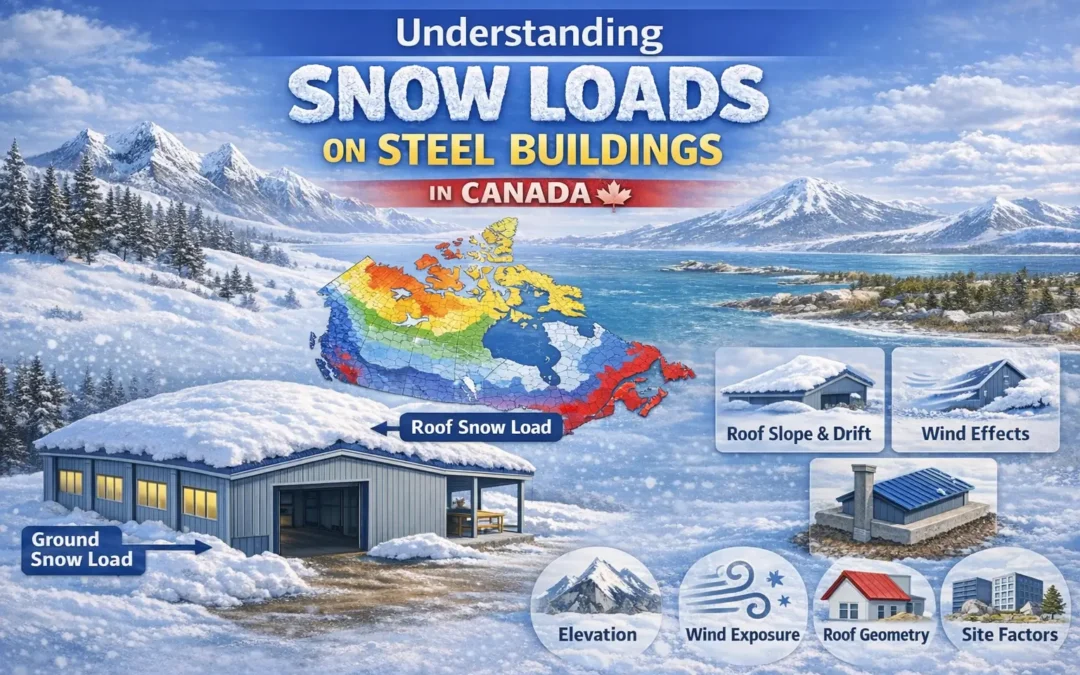
Steel structures amplify snow load issues because they are lighter and more precise than many traditional construction systems. Small assumptions can have large structural consequences. This is why understanding snow load zones for steel buildings in Canada is critical during code review and engineering.
Wind Load and Exposure Considerations
Wind load design also follows a similar relationship between the NBC and OBC.
The NBC establishes wind pressure calculations and exposure categories. The OBC applies these principles within Ontario’s regulatory framework.
For steel buildings, wind design must consider:
- Open terrain versus urban exposure
- Building height and roof slope
- Door and wall openings
- Internal pressure conditions
Misalignment between NBC assumptions and OBC enforcement expectations often leads to drawing revisions during permit review. These revisions are commonly tied to gaps in steel building design and engineering in Ontario.
Seismic Design and Regional Application
Seismic requirements are less visible but equally important.
The NBC provides national seismic hazard values. The OBC incorporates these values while defining how they are applied within Ontario.
Steel structures must be engineered for seismic loads even in regions where earthquakes are not commonly felt. Inspectors and engineers treat seismic compliance as a baseline requirement, not an optional one.
Administrative and Enforcement Differences
One of the most important distinctions between the NBC and OBC is how they are enforced.
The NBC is a technical reference. The OBC is a legal and administrative tool.
In Ontario:
- Building officials enforce the OBC
- Permit reviews follow OBC documentation standards
- Inspection stages are defined by the OBC
- Authority rests with the local municipality
A steel building that is technically sound but poorly aligned with OBC documentation expectations may still be delayed. These delays often result in hidden costs after signing a steel building contract.
How CSA Standards Fit Into Both Codes
Both the NBC and OBC reference CSA standards for steel structures, including CSA A660 certification for steel buildings for quality assurance in steel building systems.
CSA standards provide manufacturing and quality control frameworks that support code compliance.
While CSA certification does not replace building code compliance, it reinforces engineering credibility and manufacturing discipline.
For steel structures, CSA standards help bridge the gap between design intent and fabricated reality.
Common Mistakes Buyers Make
Many steel building delays stem from misunderstandings about which code applies.
Common mistakes include:
- Assuming NBC compliance is sufficient in Ontario
- Using generic designs not adapted to Ontario amendments
- Failing to coordinate foundation design with OBC requirements
- Submitting drawings without local code references
These mistakes are rarely intentional. They result from underestimating the administrative role of the OBC.
How Engineers Navigate Both Codes
Experienced steel building engineers treat the NBC and OBC as complementary, not competing.
A sound approach includes:
- Using NBC structural principles as the technical foundation
- Applying OBC amendments and enforcement expectations
- Referencing site-specific load data
- Coordinating with municipal requirements early
This dual awareness reduces redesign, inspection delays, and project risk.
Why Code Clarity Affects Project Cost
Misunderstanding the relationship between the NBC and OBC does not just affect compliance. It affects cost.
Delays caused by code misalignment often lead to:
- Redesign and re-engineering fees
- Permit resubmission costs
- Schedule disruptions
- Financing and insurance delays
Clear code alignment at the design stage is one of the most effective ways to control total project cost. This is a core principle of steel building cost planning in Ontario.
Final Perspective for Steel Building Buyers in Ontario
The National Building Code and the Ontario Building Code are closely related, but they serve different purposes.
The NBC establishes national engineering principles. The OBC translates those principles into enforceable provincial requirements.
For steel structures, understanding this distinction is critical. Proper alignment protects schedules, budgets, and long-term performance.
In steel construction, compliance is not just about meeting a standard. It is about meeting the right standard, in the right jurisdiction, with the right documentation.
Reviewed by the Tower Steel Buildings Engineering Team
This article has been reviewed by the Tower Steel Buildings Engineering Team to ensure technical accuracy, correct interpretation of Canadian and Ontario building codes, and alignment with real-world permitting and inspection practices for steel structures across Canada.
The review reflects current code application, engineering coordination standards, and field experience working with municipal building departments and third-party reviewers.
1. Is the National Building Code mandatory for steel buildings in Ontario?
No. The National Building Code of Canada is a model code. In Ontario, the legally enforceable code is the Ontario Building Code. While the OBC is based on the NBC, steel buildings must comply with the OBC and its provincial amendments to receive permits and pass inspections.
2. Can a steel building designed to the National Building Code be approved in Ontario?
Not automatically. A steel building designed only to NBC assumptions may require revisions to meet Ontario Building Code requirements. Municipal reviewers expect drawings to reference the OBC, local load data, and Ontario-specific administrative standards.
3. Why does the Ontario Building Code matter more than the NBC during inspections?
Inspectors enforce the Ontario Building Code, not the National Building Code. Inspection checklists, documentation requirements, and approval authority are defined by the OBC and local municipal policies.
4. Do snow and wind load values differ between the NBC and OBC?
The underlying methodology is similar, but application differs. In Ontario, snow and wind loads must reflect local reference data, site exposure, roof geometry, and municipal expectations. Steel structures are reviewed closely due to their precision and sensitivity to load assumptions.
5. How do CSA standards relate to building code compliance?
CSA standards support building code compliance by establishing manufacturing, quality control, and engineering consistency. They do not replace building code requirements, but they help ensure that fabricated steel components match approved design intent.
6. Who is responsible for ensuring code compliance on a steel building project?
Responsibility is shared. The structural engineer is responsible for design compliance, the manufacturer must fabricate to approved drawings, and the owner must ensure that site conditions, foundations, and construction align with permitted documents.
7. Can misunderstanding the NBC and OBC relationship cause project delays?
Yes. Misalignment between design assumptions and Ontario Building Code requirements is a common cause of permit revisions, inspection failures, and schedule delays. Clarifying code application early reduces risk and cost.
8. Does the Ontario Building Code override the National Building Code?
In Ontario, yes. The Ontario Building Code is the governing authority. The National Building Code provides the technical foundation, but the OBC determines what is enforceable.