Indoor sports facilities have evolved far beyond simple gymnasiums. Across Canada, communities, schools, private operators, and municipalities are investing in large, multi-use indoor environments that support year-round athletics, training, leagues, and events.
National investment trends in sports infrastructure are also supported through programs and data from Sport Canada.
From hockey practice centres and soccer domes to basketball courts, tennis clubs, and field houses, modern facilities require wide open space, structural reliability, climate control, and long-term cost efficiency.
Steel buildings have become the preferred structural system for these environments because they offer clear-span interiors, predictable performance under snow and wind loads, fast construction timelines, and exceptional durability in Canadian conditions.
This article explains why steel is uniquely suited for indoor sports facilities, how these buildings are engineered, and what owners should consider when planning long-term athletic infrastructure.
Why Steel Buildings Are Ideal for Indoor Sports Facilities
Sports facilities demand structural systems that can handle large uninterrupted spaces while supporting lighting, HVAC equipment, scoreboards, sound systems, and sometimes suspended netting or training rigs.
Steel framing excels in these environments because it provides:
- Wide clear spans without interior columns
- High load capacity for roof-mounted equipment
- Consistent performance in snow and wind conditions
- Long-term dimensional stability
- Lower maintenance than wood or hybrid structures
Unlike traditional construction methods that require frequent supports or heavy trusses, pre-engineered steel frames distribute loads efficiently through perimeter columns and engineered roof systems. This allows designers to create open playing surfaces without visual obstructions or safety concerns.
For athletes, coaches, and facility managers, the result is usable space that remains flexible for decades.
Clear-Span Design and Uninterrupted Playing Space
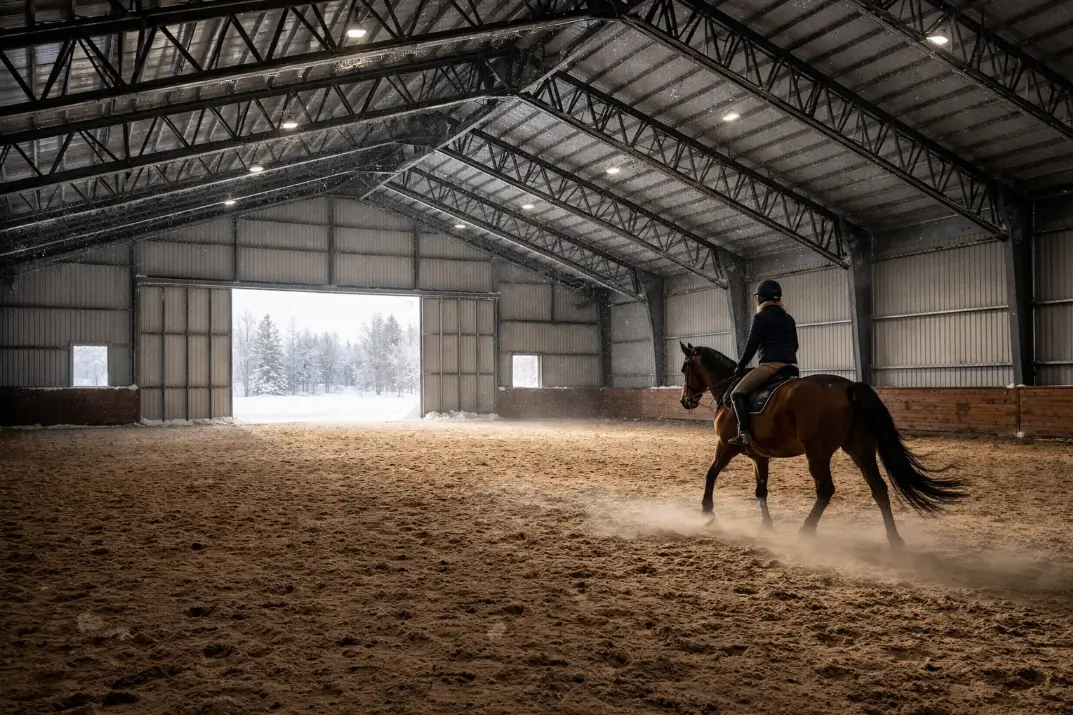
The defining requirement of any indoor sports facility is open floor area. Basketball courts, soccer fields, hockey training zones, volleyball courts, and running tracks all require wide spans without posts interfering with movement.
Steel buildings routinely achieve spans of 60 to over 250 feet depending on application and engineering requirements. This capability is similar to clear span steel buildings used in industrial applications where wide open interiors are achieved through engineered frame systems. This is accomplished through rigid frame systems, tapered columns, and optimized roof geometry.
Clear-span steel construction allows:
- Multiple courts under one roof
- Full-size soccer or football practice fields
- Spectator seating without structural obstructions
- Flexible layouts that adapt over time
As sports programs grow or change, open interiors allow owners to reconfigure equipment, flooring, or court markings without structural limitations.
Structural Engineering for Dynamic Loads and Equipment
Indoor sports buildings are not empty shells. They support significant additional loads that must be accounted for during engineering design.
Common loads include:
- HVAC units and ductwork
- Lighting systems and rigging
- Audio systems and scoreboards
- Catwalks and maintenance platforms
- Suspended nets and training apparatus
Steel buildings are engineered to carry these loads safely through defined load paths to foundations. Structural steel design in Canada aligns with standards developed by the Canadian Standards Association (CSA).
Unlike retrofitted structures where equipment is added after construction, properly designed steel facilities integrate all operational demands into the original engineering package.
This prevents deflection issues, roof fatigue, connection failures, and long-term structural stress.
Snow Load and Wind Load Performance Across Canada
Canadian climate conditions place some of the highest environmental demands on building structures in the world. These regional variations are further explained in steel building snow load zones in Canada where snow accumulation and drift behaviour directly influence structural design. Snow accumulation, drifting, freeze-thaw cycles, and wind exposure vary significantly by region.
Wind exposure in open and coastal areas is addressed in wind load design for steel buildings near Lake Ontario where pressure and suction forces significantly impact structural systems.
Steel sports facilities are engineered using:
- Regional snow load data
- Drift accumulation modeling
- Wind exposure categories
- Roof geometry considerations
- Local building code requirements
In Canada, these requirements are developed through the Codes Canada program administered by the National Research Council.
Roof slope, frame spacing, and bracing systems are optimized to handle both uniform snow loads and localized drift zones near walls, ridges, and adjacent structures.
This is critical for large-span facilities where roof failure risk increases if loads are underestimated.
When properly engineered, steel sports buildings perform consistently across decades of winter cycles with minimal structural movement.
Climate Control and Year-Round Comfort
Indoor sports facilities operate throughout the year, often with high occupancy and significant moisture generation from athletes.
Steel buildings support modern climate control strategies including:
- High-efficiency insulation systems
- Vapour barriers to control condensation
- Mechanical ventilation for air quality
- Radiant heating or forced air systems
- Dehumidification where required
Improper moisture control is a leading cause of issues highlighted in condensation failures in agricultural steel buildings.
Steel’s dimensional stability ensures that insulation layers remain intact and vapour barriers stay sealed over time. This reduces moisture infiltration that can damage finishes, corrode structural components, or degrade air quality.
Well-designed steel facilities maintain comfortable temperatures, stable humidity levels, and healthy indoor environments even during extreme cold or high-activity periods.
Durability and Low Lifecycle Maintenance
Sports facilities represent long-term community and business investments. Owners expect decades of service without ongoing structural repairs.
Steel buildings offer:
- Resistance to rot, mould, and pests
- Minimal warping or shrinkage
- Long-lasting protective coatings
- Predictable structural performance
Unlike wood structures that can suffer moisture damage or settlement movement, steel frames remain stable over time. This protects flooring systems, wall finishes, mechanical systems, and roof assemblies.
Over a 30 to 40 year lifespan, steel facilities typically experience lower maintenance costs and fewer structural interventions than traditional construction.
These lifecycle advantages are further explored in long term maintenance costs and steel building ROI.
Speed of Construction and Reduced Disruption
Many sports facilities operate on strict timelines tied to school calendars, league seasons, or funding windows.
Steel building construction offers significant scheduling advantages:
- Off-site fabrication improves quality control
- Fast on-site erection timelines
- Minimal weather delays once foundations are complete
- Predictable material availability
While site preparation and foundations remain critical, the steel superstructure can often be erected in weeks rather than months.
This allows interior trades, flooring installation, and mechanical work to begin sooner, compressing total project schedules.
For municipalities and private operators alike, faster completion means earlier revenue generation and reduced carrying costs.
Flexible Expansion and Future Adaptation
Athletic programs evolve. Facilities may require additional courts, seating expansions, storage areas, or new training spaces over time.
Steel buildings can be designed with future growth in mind through:
- Removable end walls
- Foundation provisions for extensions
- Modular framing layouts
- Load path allowances for expansion
When planned early, expansions can be integrated smoothly without major structural rework.
This adaptability protects long-term investment and allows facilities to respond to growing demand without relocating or rebuilding entirely.
Acoustic Performance and Interior Comfort
Noise control is a major concern in large open spaces filled with activity.
Steel sports facilities often incorporate:
- Acoustic wall panels
- Sound-absorbing ceiling systems
- Insulated cladding assemblies
- Strategic mechanical layout
These treatments reduce echo, improve speech clarity for coaching and announcements, and create a more comfortable environment for athletes and spectators.
Structural steel supports these systems easily while maintaining clean open interiors.
Fire Performance and Safety Considerations
Safety is a central design priority for public and commercial athletic facilities.
Steel structures provide:
- Non-combustible framing
- Predictable fire behaviour
- Compatibility with fire-rated assemblies
- Clear evacuation layouts
Building code requirements for occupancy loads, exits, fire separations, and sprinkler systems integrate naturally with steel construction.
This simplifies compliance and enhances long-term safety.
Typical Applications for Steel Indoor Sports Facilities
Steel buildings are used across a wide range of athletic environments including:
- Community recreation centres
- Private sports training complexes
- Ice rink shells and practice facilities
- Indoor soccer and football fields
- Basketball and volleyball courts
- Tennis and pickleball clubs
- Multi-use field houses
- School gymnasium expansions
The common requirement across all of these uses is open space, durability, and reliable performance in all seasons.
Steel consistently delivers on those needs.
Foundation Coordination and Site Planning
Large-span steel sports buildings concentrate structural loads at perimeter columns and frame bases. Proper foundation design is essential for long-term performance.
Key considerations include:
- Soil bearing capacity
- Frost depth protection
- Drainage and grading
- Load reactions from steel frames
- Slab performance for sports surfaces
Foundations must be engineered in coordination with the steel structure, not as a separate design exercise.
This coordination is essential in steel building foundation design in Ontario where load transfer and soil conditions directly affect long-term performance.
Well-coordinated foundations prevent settlement, cracking, moisture infiltration, and structural movement.
Operational Efficiency and Energy Performance
Energy costs are a major operating expense for large indoor facilities.
Steel buildings support modern energy strategies including:
- High R-value insulation systems
- Tight building envelopes
- Efficient HVAC zoning
- Daylighting solutions
- Reflective roofing where appropriate
Over time, these systems significantly reduce heating and cooling costs while maintaining athlete comfort.
The result is a facility that performs financially as well as structurally.
Why Steel Has Become the Standard for Modern Sports Facilities
Across Canada, steel has become the structural backbone of modern athletic infrastructure for one simple reason: it performs consistently under demanding conditions.
Owners benefit from:
- Predictable engineering outcomes
- Faster project completion
- Lower lifecycle costs
- Flexible future use
- Long-term structural reliability
Athletes benefit from:
- Open safe playing areas
- Comfortable indoor climates
- Better acoustics and lighting
- Reliable year-round access
Communities benefit from facilities that last decades without ongoing structural investment.
Final Thoughts
Indoor sports facilities are complex buildings that must balance large open space, environmental control, structural strength, and long-term operational efficiency.
Steel buildings meet these demands better than any other structural system currently available for Canadian conditions.
When properly engineered and coordinated, steel sports facilities provide decades of reliable service while maintaining flexibility for evolving programs and community needs.
They are not just buildings. They are long-term athletic infrastructure.
Reviewed by the Tower Steel Buildings Engineering Team
The technical accuracy of this article has been reviewed by the Tower Steel Buildings Engineering Team to ensure alignment with Canadian building codes, regional climate considerations, and real-world steel building design and construction practices for indoor sports facilities.
1. Why are steel buildings preferred for large indoor sports facilities in Canada?
Steel buildings allow wide clear spans without interior columns, which is essential for courts, fields, and training spaces. They are also engineered to handle Canadian snow loads, wind exposure, and long-term structural performance, making them reliable for year-round athletic use.
2. How wide can clear-span steel sports facilities be without support columns?
Depending on engineering requirements and site conditions, steel buildings can achieve clear spans ranging from 60 feet to well over 250 feet. This makes them suitable for full-size soccer fields, multi-court complexes, and large recreation centres.
3. Are steel sports facilities energy efficient in cold Canadian climates?
Yes. When designed with proper insulation systems, vapour barriers, and modern HVAC integration, steel buildings perform extremely well in cold climates. Their structural stability helps maintain airtight building envelopes that reduce heating costs and condensation issues.
4. Can steel indoor sports buildings be expanded in the future?
Steel buildings are commonly designed with future expansion in mind. End walls can be removable, foundations can be sized for extensions, and framing layouts can accommodate growth, allowing facilities to increase capacity as demand rises.
5. How long do steel sports facilities typically last?
With proper engineering, coatings, and routine maintenance, steel buildings often perform for 40 years or more. Many continue operating well beyond that timeframe with minimal structural repairs compared to traditional construction.
6. Are steel sports facilities quieter than older metal buildings?
Modern steel facilities incorporate acoustic treatments such as insulated wall systems, sound-absorbing panels, and engineered ceiling assemblies. These significantly reduce echo and improve comfort compared to older metal structures.
7. Do steel buildings meet fire safety requirements for public sports facilities?
Yes. Steel framing is non-combustible and integrates easily with fire-rated assemblies, sprinkler systems, and exit requirements. This makes steel well suited for public occupancy buildings such as recreation centres and athletic complexes.
8. How quickly can a steel indoor sports facility be constructed?
Once foundations are complete and materials are fabricated, steel structures can often be erected in weeks rather than months. This allows interior build-out to begin sooner, reducing total project timelines significantly.
9. Are steel buildings suitable for ice rinks and high-humidity environments?
Yes, provided the building is properly engineered with vapour barriers, insulation systems, and moisture control strategies. Steel’s dimensional stability supports long-term performance in environments where condensation control is critical.
10. What role does foundation design play in large-span sports buildings?
Foundations are critical because clear-span steel frames concentrate loads at column bases. Proper soil evaluation, frost protection, and load coordination prevent settlement, cracking, and moisture issues that could impact structural performance over time.