Steel buildings perform exceptionally well across Canada when properly engineered and protected. However, in coastal regions and high-moisture environments, corrosion becomes one of the most significant long-term risks affecting structural integrity, maintenance costs, and building lifespan.
Many early steel building failures in marine climates, agricultural zones, and wet industrial areas are not caused by poor structural design. They occur because environmental exposure was underestimated.
Understanding how moisture, salt, and atmospheric conditions interact with steel allows owners to make design decisions that protect their investment for decades rather than facing premature repairs. Early planning strategies are covered in steel building project readiness.
Why Moisture Exposure Changes Everything in Steel Construction
Steel corrodes when oxygen and moisture are present. In high-moisture regions, this reaction accelerates.
Coastal air carries salt particles that deposit onto steel surfaces. Inland high-humidity environments produce persistent condensation cycles. Agricultural and industrial areas release moisture and corrosive vapours that further intensify deterioration.
Unlike occasional rainfall, these conditions remain active year-round.
When protective systems are not selected for environmental exposure levels, corrosion becomes inevitable rather than accidental.
Canadian Regions Most Affected by Corrosion Risk
Corrosion concerns are highest in:
- Coastal British Columbia and Atlantic Canada
- Great Lakes shoreline zones including Lake Ontario and Lake Erie regions
- High-humidity agricultural regions
- Cold storage and refrigeration facilities
- Livestock buildings and fertilizer storage areas
- Marine and port-side industrial zones
Even inland locations can experience severe corrosion when moisture remains trapped within building assemblies.
Environmental exposure matters as much as structural loading in long-term performance.
How Corrosion Develops in Steel Buildings Over Time
Corrosion rarely appears suddenly. It progresses through predictable stages:
- Surface coating degradation
- Moisture penetration to base steel
- Oxidation spreading under coatings
- Structural thickness reduction
- Connection weakening
- Accelerated failure at joints
Most serious structural corrosion begins at:
- Roof purlins and girts
- Base plates near concrete
- Connection bolts
- Drainage points
- Areas with trapped condensation
Once corrosion penetrates beneath coatings, repair becomes far more expensive than prevention.
Salt Exposure: The Hidden Coastal Accelerator
Salt acts as an electrolyte, dramatically increasing corrosion speed.
In coastal zones:
- Salt settles on exposed steel surfaces
- Moisture activates chemical reactions
- Protective coatings break down faster
- Corrosion spreads laterally under paint
Steel near marine environments can corrode multiple times faster than inland structures.
This is why standard coating systems suitable for dry climates often fail prematurely near oceans and large lakes.
Condensation: The Silent Corrosion Engine
In high-moisture climates, condensation becomes a primary driver of steel deterioration.
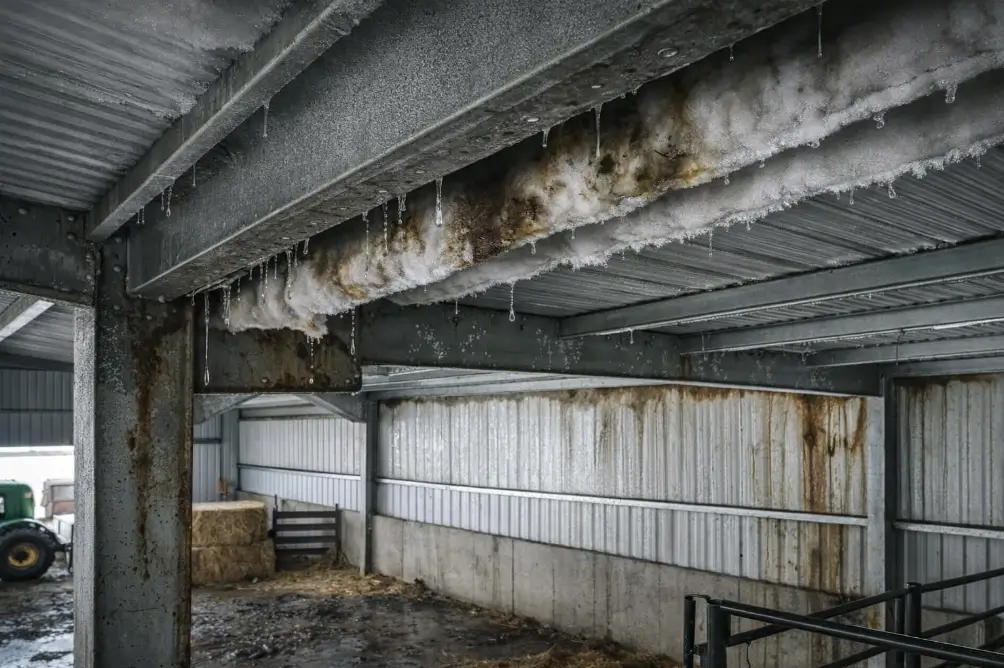
Warm, moisture-laden interior air contacts steel surfaces that drop below dew point temperature. Water forms repeatedly, sometimes daily, across roof panels and framing members.
This moisture:
- Drips onto structural connections
- Pools in hidden cavities
- Remains trapped within insulation layers
- Creates continuous corrosion cycles
Condensation often causes more damage than rain exposure. The role of condensation in steel deterioration is examined in condensation failures in agricultural steel buildings.
Buildings that appear watertight from the exterior may still experience severe internal corrosion.
How Agricultural and Industrial Moisture Compounds Corrosion
Certain environments intensify corrosion far beyond normal humidity:
Livestock Facilities
Animal respiration releases large volumes of moisture and ammonia vapour that aggressively attack steel coatings.
Fertilizer and Chemical Storage
Many fertilizers and industrial products emit corrosive compounds that break down protective finishes.
Cold Storage Buildings
Temperature differentials create constant condensation cycles on steel surfaces. Cold environments create similar moisture challenges described in steel buildings for cold storage and refrigeration.
In these applications, standard building coatings rarely provide sufficient protection.
Why Base Connections Fail First
Steel corrosion frequently begins where steel meets concrete.
Moisture migrates through concrete foundations via capillary action. Foundation moisture behaviour is discussed in soil conditions affecting steel building foundations in Canada. Salts and groundwater chemicals reach base plates and anchor bolts.
This results in:
- Hidden corrosion below floor level
- Weakening of load transfer points
- Expansion that cracks concrete
- Structural movement over time
Once base connections deteriorate, repair often requires major structural intervention.
Protective Coating Systems and Their Role in Longevity
Not all coatings perform equally in high-moisture environments.
Common protective approaches include:
- Hot-dip galvanizing
- High-performance epoxy systems
- Zinc-rich primers
- Polyurethane top coats
- Multi-layer industrial coatings
Industrial corrosion protection standards are published by the CSA Group materials standards organization.
The correct system depends on:
- Moisture exposure level
- Salt concentration
- Chemical exposure
- Maintenance accessibility
- Expected service life
Under-specifying coatings saves little upfront and costs significantly more long term.
Ventilation and Moisture Control as Corrosion Prevention Tools
Design strategies greatly influence corrosion performance:
- Controlled airflow to remove humid air
- Vapour barriers preventing moisture migration
- Insulated assemblies reducing condensation formation
- Drainage paths eliminating trapped water
- Thermal breaks at steel interfaces
Corrosion prevention is as much a building science issue as a materials issue.
Buildings designed to manage moisture last dramatically longer.
The Long-Term Cost Impact of Corrosion Neglect
Ignoring corrosion risks often results in:
- Premature repainting cycles
- Structural repairs
- Connection replacement
- Roof framing failure
- Reduced resale value
- Insurance concerns
- Operational downtime
In high-moisture environments, corrosion damage can begin within a few years if improperly protected.
Over decades, the cost difference between preventive design and reactive repair can reach hundreds of thousands of dollars. Lifecycle performance considerations are explored in steel building long term cost savings.
Why Code Compliance Alone Is Not Enough
Building codes establish minimum safety standards, not durability guarantees. Canadian structural standards are published in the National Building Code of Canada.
A steel building can meet structural code requirements while still being poorly protected against environmental exposure.
Long-term performance requires:
- Environmental exposure classification
- Appropriate coating selection
- Moisture management design
- Maintenance planning
Durability is a design decision, not a byproduct of structural adequacy.
Planning for Service Life Rather Than Initial Cost
Owners who approach steel buildings as long-term assets prioritize:
- Corrosion-resistant materials
- Protective systems matched to environment
- Moisture control strategies
- Accessible maintenance zones
- Lifecycle cost optimization
Short-term savings almost always lead to higher lifetime expense in corrosive environments.
Common Early Mistakes That Lead to Corrosion Failure
- Using standard coatings in marine climates
- Ignoring condensation risk
- Poor drainage detailing
- Unprotected base connections
- Inadequate ventilation
- Assuming code compliance ensures durability
- Delaying corrosion protection decisions
These mistakes typically surface years later when repair costs are highest.
The Role of Integrated Engineering in Corrosion Control
Effective corrosion mitigation requires coordination between:
- Structural engineers
- Building envelope designers
- Coating specialists
- Mechanical ventilation planners
- Construction teams
Integrated planning is outlined in steel building engineering review checklist.
When corrosion protection is treated as an afterthought, problems follow.
When integrated early, steel buildings can perform reliably for 40 to 60 years or more.
Why Coastal and High-Moisture Steel Buildings Demand Higher Design Discipline
Harsh environments do not forgive shortcuts.
Moisture, salt, condensation, and chemicals steadily attack steel components day after day.
Buildings designed with exposure realities in mind maintain structural integrity, lower operating costs, and preserve asset value.
Those designed only for minimum compliance often face accelerating deterioration.
Final Perspective
Corrosion in coastal and high-moisture areas is not an unpredictable risk. It is a known engineering challenge with proven solutions.
Steel buildings perform exceptionally well when environmental exposure is properly addressed through protective systems, moisture control, and coordinated design.
When ignored, corrosion becomes one of the most expensive long-term failures in steel construction.
In high-moisture Canadian environments, durability is not achieved by chance. It is achieved by design.
Reviewed by the Tower Steel Buildings Engineering Team
This article has been reviewed by the Tower Steel Buildings Engineering Team to ensure technical accuracy, Canadian climate relevance, and alignment with long-term steel building performance standards. The insights reflect real project experience across coastal, agricultural, industrial, and high-moisture environments throughout Canada.
1. How long do steel buildings last in coastal or high-moisture environments?
With proper corrosion protection, moisture control, and maintenance planning, steel buildings in coastal and high-humidity regions can perform reliably for 40 to 60 years or more. Without appropriate protection, corrosion damage can begin within a few years and significantly shorten building lifespan.
2. Is standard paint enough to protect steel in coastal areas?
Standard architectural paint systems are usually not sufficient for marine or high-moisture environments. Coastal exposure typically requires galvanizing or industrial multi-layer coating systems designed to resist salt deposition, moisture penetration, and long-term surface breakdown.
3. What areas of a steel building corrode first?
Corrosion most commonly begins at:
- Base plates and anchor bolts near concrete
- Roof purlins and framing exposed to condensation
- Bolted connections and drainage points
- Hidden cavities where moisture becomes trapped
These areas experience continuous moisture exposure and limited airflow.
4. Can condensation cause structural corrosion even if there are no roof leaks?
Yes. Condensation is one of the most common causes of internal corrosion in steel buildings. Warm, humid air contacting cold steel surfaces repeatedly forms moisture that accelerates corrosion, even in buildings that are fully watertight.
5. Are agricultural steel buildings more prone to corrosion?
Agricultural environments often experience higher corrosion risk due to moisture, ammonia vapours, and organic acids released by livestock and stored materials. These conditions break down coatings faster and require more robust protection systems than standard commercial buildings.
6. Does building code require corrosion protection for steel structures?
Building codes establish minimum structural safety but do not fully address long-term corrosion durability. Environmental exposure classification and protective system selection typically go beyond code minimums and must be addressed during design.
7. Is galvanizing always the best corrosion protection option?
Galvanizing is highly effective in many environments, but the best solution depends on moisture exposure, chemical presence, and service life expectations. In some industrial or agricultural settings, specialized coating systems may outperform galvanizing alone.
8. How can corrosion at steel base plates be prevented?
Effective strategies include:
- Moisture barriers between concrete and steel
- Proper drainage design
- Protective coatings on embedded components
- Elevated base detailing in high-moisture zones
Early foundation coordination is critical for long-term performance.
9. Does ventilation really reduce corrosion risk?
Yes. Proper ventilation removes humid air before it condenses on steel surfaces. Buildings with controlled airflow, vapour barriers, and insulation experience significantly lower internal corrosion compared to unventilated structures.
10. Is corrosion damage usually covered by building warranties?
Corrosion related to environmental exposure or moisture management is often excluded from standard warranties unless specific protective systems were specified. Designing for durability upfront reduces long-term financial risk.
11. How do I know what level of corrosion protection my building needs?
Corrosion protection should be based on:
- Geographic exposure (coastal, inland, agricultural)
- Humidity levels
- Chemical presence
- Building use
- Expected service life
An integrated engineering approach evaluates these factors early in design.