The Moment a Project Quietly Fails
The drawings are submitted.
Everything looks complete. The building is engineered. The supplier has done this before.
Two weeks later, the response comes back:
Permit rejected.
Not delayed. Not revised.
Rejected.
This is where projects lose months before construction even begins.
Because rejection is not a correction. It is a reset.
Permits are rejected when the design cannot be trusted.
What a Permit Rejection Actually Means
A rejection is not about a small issue.
It means the submission failed at a fundamental level.
A revision request means:
- small corrections are required
- the design is mostly acceptable
A rejection means:
- core information is missing or inconsistent
- compliance cannot be verified
- the review cannot proceed
Definition for clarity:
A steel building permit rejection occurs when submitted drawings and documentation fail to meet basic code, zoning, or engineering requirements, requiring major redesign before resubmission.
Once rejected, the process starts over.
The First Mistake: Treating the Building Like a Product
This is where most projects go wrong.
Steel buildings are often sold as packages.
Buyers assume:
“If it is engineered, it should pass.”
This is incorrect.
A building is not approved because it exists.
It is approved because it fits:
- the site
- the soil
- the zoning
- the local load requirements
If the design is not tied to those conditions, it cannot be approved.
Missing Site-Specific Design
One of the fastest ways to get rejected.
A building that is not tied to its site conditions cannot be reviewed with confidence. Real projects must resolve grading, drainage, and layout constraints at the same level of detail seen in custom steel buildings for unique site constraints.
Common issues:
- drawings not tied to a real location
- no reference to local snow or wind loads
- no grading or drainage plan
When grading, drainage, and access are unresolved, the submission reflects incomplete planning. These failures typically originate during steel building site preparation where execution constraints should already be defined.
From a reviewer’s perspective:
There is no way to validate performance without site data.
This creates uncertainty.
Uncertainty leads to rejection.
Foundation Design That Does Not Match Reality
The structure above grade often gets all the attention.
At the review level, foundation design is treated as a load-transfer system, not a drawing exercise. Soil behaviour, frost depth, and reaction forces must align with foundation engineering before a submission can be considered structurally valid.
The foundation is where many submissions fail.
Typical problems:
- no geotechnical input
- incorrect soil assumptions
- missing frost protection
Engineering logic is simple:
All loads transfer to the ground.
Structural responsibility and design integrity must also align with standards developed by the Canadian Standards Association (CSA), which define expectations for steel design and fabrication.
If the ground is not properly defined, the structure is not safe.
This is not a revision issue.
It is a rejection-level problem.
Load Assumptions That Do Not Match the Location
Steel buildings must reflect real environmental loads.
Those loads are not arbitrary. They are derived from national frameworks developed through the Codes Canada program administered by the National Research Council.
Environmental loads are not adjustable assumptions. They are location-specific design inputs governed by regional conditions such as those outlined in steel building snow load zones in Canada.
Common mistakes:
- using generic load values
- not accounting for snow drift
- ignoring wind exposure conditions
This creates a mismatch between:
design intent and actual performance
From a permit standpoint:
If loads are unclear or incorrect, the structure cannot be approved.
Zoning Conflicts That Were Never Checked
Many rejections happen before structural review even begins.
Zoning failure is rarely technical. It comes from misalignment with municipal constraints such as setbacks, height limits, and permitted use, which are defined early in steel building zoning requirements in Ontario.
Typical zoning issues:
- building too close to property lines
- exceeding height limits
- incorrect use classification
These are not minor fixes.
They require:
- redesign
- planning adjustments
- possible variances
This can delay a project for months.
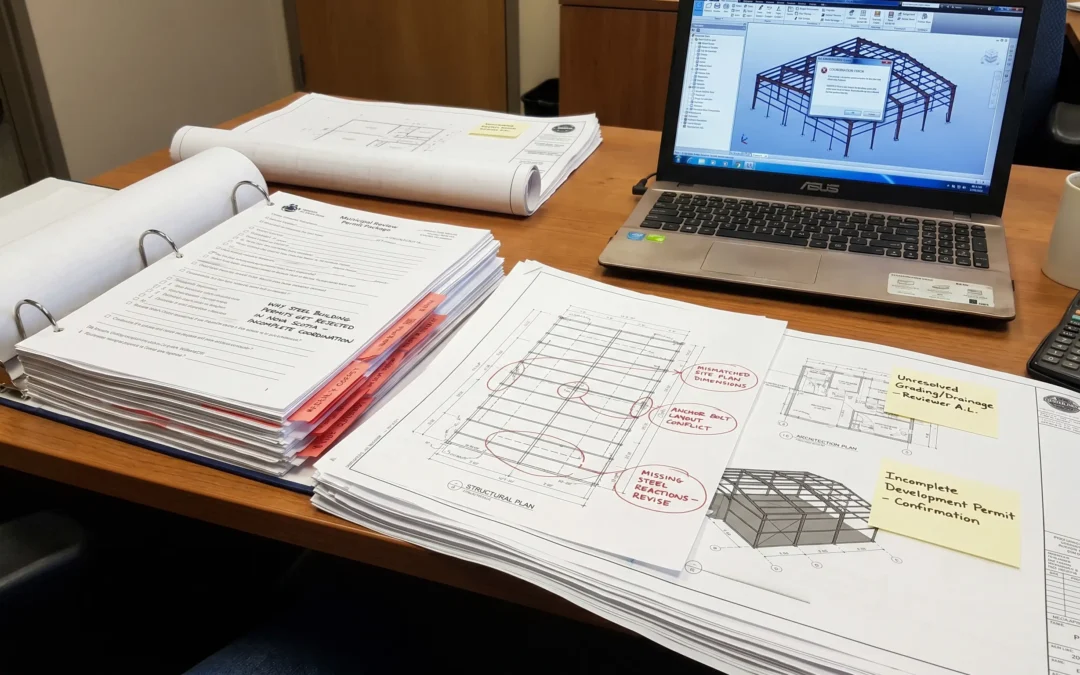
Drawings That Do Not Match Each Other
Coordination errors are a major rejection trigger.
Examples seen on real submissions:
- site plan shows one footprint
- structural drawings show another
- elevations do not match dimensions
To a reviewer:
This creates risk.
If documents conflict, none of them can be trusted.
Rejection becomes the only option.
Missing Critical Structural Details
A submission can look complete but still fail.
Common missing elements:
- connection details
- anchor bolt layout
- load path clarity
- roof system specifications
Without these:
- structural behavior cannot be verified
- safety cannot be confirmed
This is not a minor omission.
It is a fundamental gap.
Lack of Clear Engineering Responsibility
Another common issue:
- drawings without proper stamps
- unclear design ownership
- partial engineering scope
Municipal reviewers require:
- full accountability
- clear responsibility
If no one is clearly responsible for the design, it will not be approved.
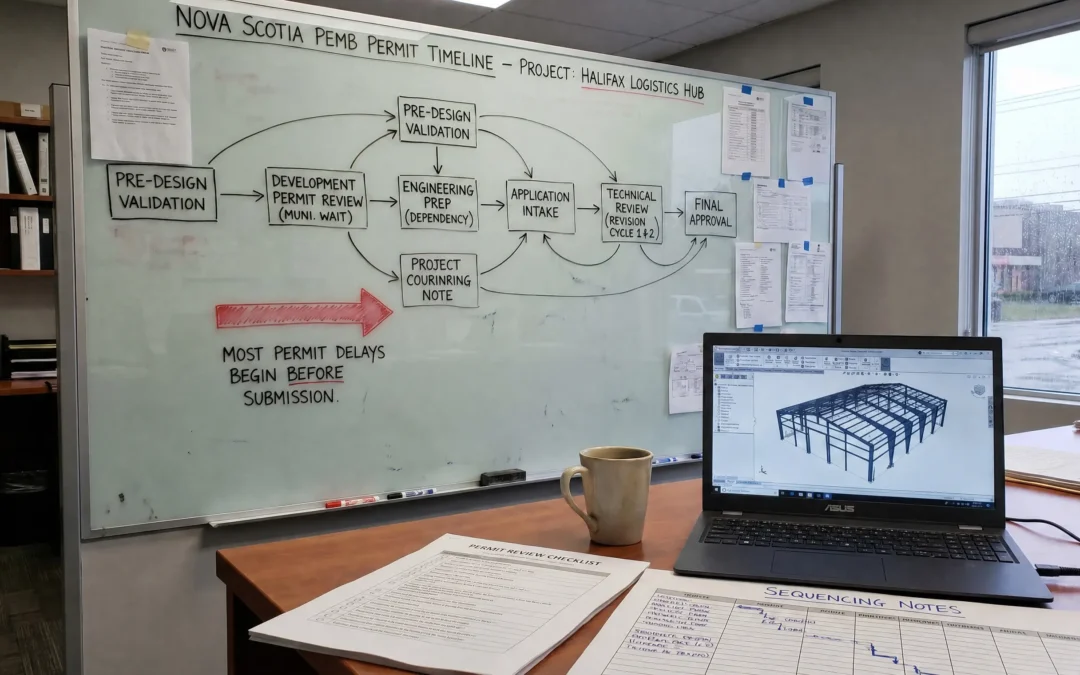
How to Predict a Permit Rejection Before Submission
Rejections are rarely unexpected.
They can be predicted early.
A submission is at high risk if:
- drawings are not fully coordinated
- site data is missing or assumed
- zoning is not confirmed before design
- load assumptions are generic or unclear
Diagnostic rule:
If multiple gaps exist across design, site, and zoning, the submission will not pass initial review.
This is commonly seen on projects rushed into submission.
Why Rejections Take Longer Than Delays
A delay involves correction.
A rejection requires rebuilding.
Steps include:
- redesigning structural elements
- updating load calculations
- revising foundation design
- re-coordinating all drawings
Then:
- full resubmission
- new review cycle
Each rejection adds months, not weeks.
When Rejection Turns Into a Cost Problem
Rejections affect more than schedule.
They impact:
- contractor availability
- material pricing
- financing timelines
Typical cost ranges:
- redesign: $5,000 to $15,000
- major correction: $15,000 to $40,000
- delay impact: significantly higher
Most cost comes from lost time, not engineering.
The Hidden Pattern Behind Rejections
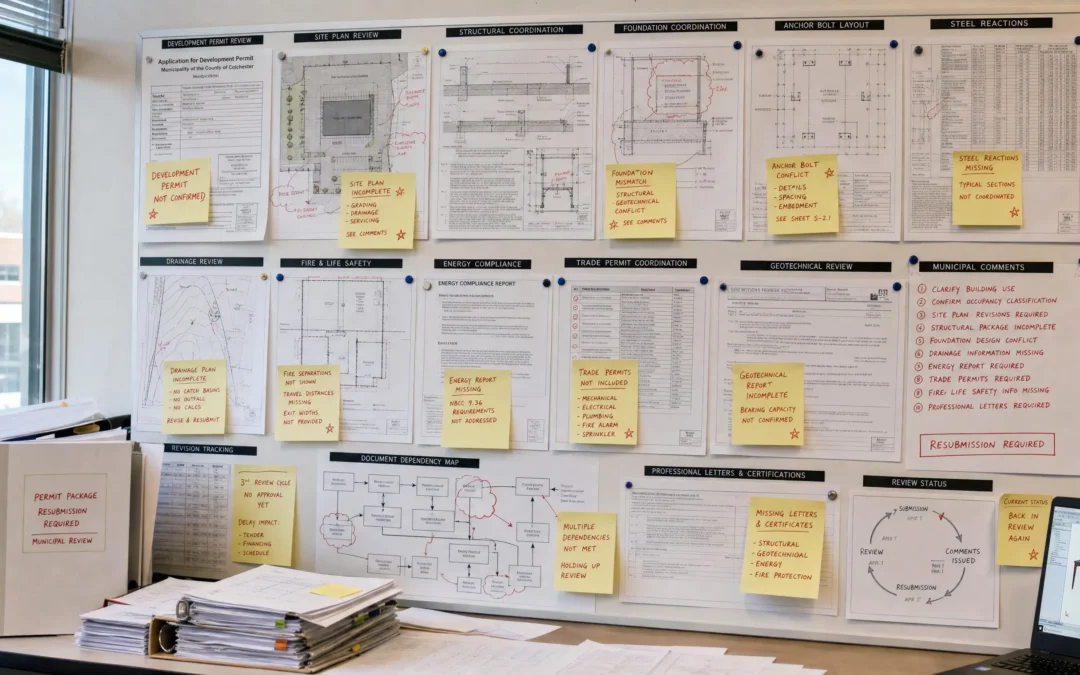
Rejections follow a predictable chain:
assumption → incomplete design → unclear submission → reviewer uncertainty → rejection
The issue is not one mistake.
It is a lack of coordination across the entire system.
What appears as isolated errors is usually a system breakdown. The same pattern is seen in risk assessment for high-value steel building projects where early assumptions cascade into structural, regulatory, and coordination failures.
Final Perspective
Steel building permits are not rejected because the system is strict.
Permit approval is not achieved through submission volume. It comes from alignment between structural design, site data, and regulatory constraints before drawings are issued.
Planning a steel building project in Canada requires that level of coordination at the beginning, not after rejection.
They are rejected because the submission cannot be verified.
A complete, coordinated, and site-specific design moves forward.
An incomplete one starts over.
That is the difference between approval and rejection.
Reviewed by Engineering Team
This content has been reviewed by the Tower Steel Buildings Engineering Team based on real permit rejection cases, redesign cycles, and municipal review feedback across multiple jurisdictions. The insights reflect actual coordination failures, missing design elements, and approval challenges seen in steel building projects.
1. What is the most common reason steel building permits get rejected?
Incomplete or uncoordinated submissions.
This includes:
- missing structural details
- unclear load calculations
- inconsistent drawings
Reality: If the reviewer cannot verify the design with confidence, the permit is rejected.
2. How much delay does a permit rejection typically cause?
A rejection usually adds 4 to 12 weeks minimum.
If redesign is required, delays can extend to 2 to 4 months or more.
Decision trigger: If major elements must be redesigned, expect a full timeline reset.
3. How can I predict a permit rejection before submission?
Look for these risk indicators:
- drawings not tied to site conditions
- missing foundation or soil data
- zoning not verified
- load assumptions not clearly stated
Diagnostic rule: If multiple critical elements are assumed instead of defined, rejection is likely.
4. Why do zoning issues lead to immediate rejection?
Because zoning determines whether the project is allowed at all.
Common failures:
- setbacks not met
- building height exceeded
- incorrect land use
Reality: If zoning fails, the permit cannot proceed to technical review.
5. Can a fully engineered steel building still be rejected?
Yes.
Engineering alone is not enough.
The design must also be:
- site-specific
- code-compliant for that location
- coordinated with all documents
6. Why is foundation design one of the biggest rejection risks?
Because it defines how loads are transferred to the ground.
Missing or incorrect foundation design creates:
- structural uncertainty
- safety concerns
- code non-compliance
Decision trigger: If soil and foundation conditions are not clearly defined, rejection is likely.
7. How do incorrect load calculations lead to rejection?
If snow, wind, or seismic loads are:
- incorrect
- outdated
- not location-specific
the structure cannot be verified for safety.
Consequence: This usually requires full recalculation and redesign, not a simple correction.
8. Why do conflicting drawings cause immediate rejection?
Because they make the submission unreliable.
Examples:
- different dimensions across drawings
- mismatch between site and structural plans
Reality: If one part of the submission cannot be trusted, the entire submission is rejected.
9. When does a permit rejection become a serious cost issue?
When it affects:
- construction scheduling
- contractor availability
- material pricing
- financing timelines
Typical impact:
- engineering redesign: $5,000 to $20,000
- project delay costs: often higher
10. How many revisions indicate a serious problem?
One revision is common.
Two or more revisions usually indicate:
- poor initial coordination
- missing information
- incorrect assumptions
Decision trigger: Multiple revision cycles mean the original submission was not permit-ready.
11. Can using a generic building design cause rejection?
Yes.
Generic designs often:
- do not match local loads
- ignore site conditions
- lack required details
Reality: Designs must be location-specific to be approved.
12. What is the biggest mistake made before submitting for a permit?
Starting design before confirming:
- zoning
- site conditions
- local requirements
Consequence: This leads to redesign, not revision, and significantly increases delays.
13. Why do some steel building permits get approved quickly?
Because they are:
- fully coordinated
- complete at submission
- aligned with zoning, site, and code requirements
Reality: Fast approvals are the result of preparation, not luck.
14. Why do permit rejections usually happen early in the review process?
Because reviewers first check for:
- completeness
- basic compliance
- coordination
If fundamental information is missing or unclear, the review cannot proceed.
Reality: Rejections occur at the initial validation stage, before detailed review begins.