Steel riding arenas have become the preferred building solution for equestrian facilities across Canada. The growth of equestrian and agricultural infrastructure is also supported by data and programs from Agriculture and Agri-Food Canada. From private farms to professional training centres, steel structures offer the clear spans, durability, and climate performance required for year-round riding.
But successful riding arena projects are not just about choosing steel as a material. They depend on careful structural planning that accounts for loads, airflow, foundations, moisture control, and long-term operational demands.
When these design elements are addressed properly at the engineering stage, steel arenas deliver decades of reliable performance. When they are overlooked, owners face condensation problems, structural movement, maintenance escalation, and even safety risks.
This guide breaks down the key structural considerations that matter most when designing steel riding arenas in Canadian conditions.
Why Riding Arenas Demand Specialized Structural Design
Riding arenas differ significantly from typical storage or industrial buildings.
They require:
- Wide clear spans without interior columns
- High interior volumes for air movement and visibility
- Moisture-resistant construction
- Controlled lighting and ventilation
- Foundations designed for soft riding surfaces
Structurally, they behave more like large sports facilities than warehouses.
The combination of long roof spans, open wall planes, snow loading, and internal humidity makes engineering accuracy especially important.
Clear-Span Framing and Load Distribution
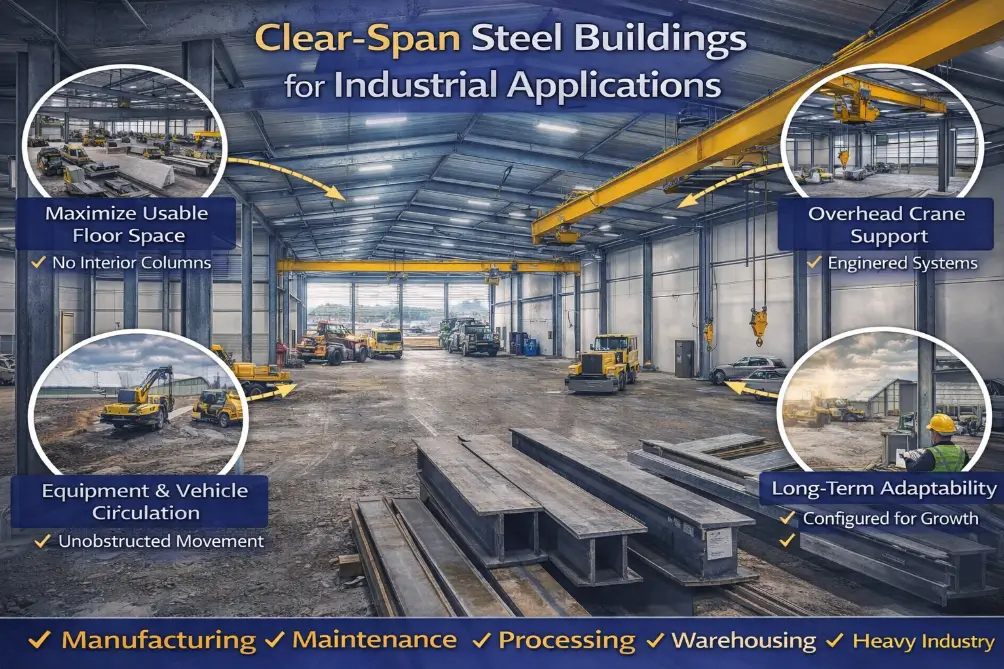
Most riding arenas are designed as clear-span buildings, meaning there are no internal columns to interrupt riding space. This structural approach is similar to clear-span industrial buildings where wide unobstructed interiors require precise load distribution and stronger perimeter framing.
This creates several engineering challenges:
- All roof loads must transfer to perimeter frames
- Wind forces act across large uninterrupted wall surfaces
- Snow drift can accumulate along eaves and valleys
- Structural deflection must remain tightly controlled
Longer spans increase:
- Frame size
- Connection forces
- Foundation reactions
Engineering must ensure that:
- Beams resist bending without excessive movement
- Columns resist combined vertical and lateral loads
- Bracing systems control sway under wind pressure
Clear-span does not mean lightweight. It requires stronger perimeter structure and precise load paths.
Structural design practices in Canada follow standards developed by the Canadian Standards Association (CSA).
Snow Load Behaviour Over Large Roof Areas
Snow loading is one of the most critical design drivers for steel riding arenas in Canada.
These conditions closely reflect the challenges outlined in northern Ontario design challenges for steel buildings where extreme snow loads and cold temperatures govern structural design.
Unlike smaller buildings, arenas:
- Accumulate large snow volumes
- Experience drifting near walls and adjacent structures
- Often include roof slopes that affect snow movement
Key design factors include:
- Ground snow load values by region
- Roof geometry and pitch
- Drift accumulation zones
- Unbalanced loading scenarios
Drift loads frequently govern structural sizing more than uniform snow depth.
Proper engineering ensures:
- Roof members are sized for worst-case drift
- Connections are reinforced where loads concentrate
- Deflection limits prevent ponding and structural fatigue
Ignoring drift behaviour is one of the most common causes of under-engineered arenas. Similar issues are frequently seen in under-engineered farm steel buildings where snow loads and environmental conditions are underestimated.
Wind Forces on Large Open Structures
Riding arenas present large surface areas to wind exposure.
This affects:
- Wall pressures and suction
- Roof uplift forces
- Frame sway behaviour
Open rural locations often experience higher wind velocities than urban sites.
Structural design must account for:
- Exposure category
- Terrain effects
- Building height and width
- Door openings and ventilation louvers
Engineers typically design bracing systems that:
- Transfer lateral forces into foundations
- Prevent excessive racking movement
- Maintain building stiffness under gust conditions
Without proper lateral load design, arenas can experience long-term joint loosening, cracking at foundations, and operational discomfort.
Foundation Design for Riding Arena Loads
Foundations for riding arenas carry significantly higher reactions than many owners expect. Proper coordination with steel building foundation design in Ontario ensures that concentrated loads are safely transferred into the ground.
Because loads concentrate at perimeter frames, footing sizes and reinforcement must be engineered accordingly.
Foundation considerations include:
- Soil bearing capacity
- Frost depth requirements
- Drainage conditions
- Concentrated column reactions
- Lateral thrust forces
Additionally, riding surface layers often include:
- Compacted base materials
- Drainage layers
- Sand or fibre footing systems
Foundation elevations must coordinate precisely with these layers to prevent moisture migration and settlement.
Clear-span buildings tolerate less foundation movement than smaller structures, making geotechnical coordination essential.
Managing Moisture and Condensation Structurally
Equestrian arenas generate significant internal moisture from:
- Horse respiration
- Wet footing materials
- Seasonal temperature differences
When warm humid air contacts cold steel surfaces, condensation forms. This is a common issue discussed in condensation failures in agricultural steel buildings where moisture control was not properly integrated into design.
Structurally this can lead to:
- Corrosion of steel members
- Insulation saturation
- Dripping onto riding surfaces
- Long-term deterioration
Long-term exposure to moisture can also result in the types of deterioration explained in corrosion risks in steel buildings across Canada.
Effective structural design incorporates:
- Proper insulation assemblies
- Vapour barriers
- Controlled ventilation
- Thermal breaks where necessary
Roof and wall systems must be engineered not just for strength, but for moisture control.
Ignoring condensation behaviour often causes premature arena failure even when structural loads are adequate.
Roof Pitch and Geometry for Performance
Roof slope impacts far more than appearance.
Proper pitch:
- Encourages snow shedding
- Reduces drift accumulation
- Improves ventilation flow
- Supports natural light placement
Too shallow a pitch can:
- Trap snow
- Increase structural demand
- Promote moisture retention
Too steep can:
- Increase wind uplift
- Raise frame costs
Engineering typically balances:
- Snow management
- Structural efficiency
- Construction economy
Most riding arenas fall within optimized pitch ranges designed specifically for Canadian climates.
Door Openings and Structural Reinforcement
Large arena doors are often required for:
- Tractor access
- Equipment movement
- Emergency egress
- Seasonal ventilation
However, wide openings weaken structural wall planes.
Engineering must compensate by:
- Reinforcing header beams
- Increasing column sizes
- Adding lateral bracing
- Designing stronger foundations
Unplanned door placement is a frequent cause of structural redesign.
All major openings should be included in engineering from the earliest concept stage.
Lighting Integration and Roof Loading
Modern riding arenas increasingly incorporate:
- High-bay LED lighting systems
- Skylights or translucent panels
- Ventilation fans
These introduce:
- Additional dead loads
- Localized connection forces
- Penetration coordination
Structural members must be sized to:
- Support fixture weight
- Resist vibration
- Maintain roof integrity around openings
Lighting layout should be coordinated with engineering to avoid retrofit complications later.
Expansion Planning and Structural Flexibility
Many arena owners eventually:
- Add viewing areas
- Expand riding space
- Integrate stables or storage wings
Structural planning can accommodate future growth by:
- Designing end frames for extension
- Allowing for load continuity
- Locating foundations strategically
Retrofitting expansion onto non-planned structures is far more expensive than early coordination.
Fire Safety and Structural Resilience
Although riding arenas are typically low-occupancy, structural fire performance still matters.
Steel structures:
- Do not contribute fuel to fires
- Maintain predictable behaviour under heat
- Allow clear evacuation space
Design considerations may include:
- Fire separation walls if attached to barns
- Door spacing for egress
- Structural member protection in certain zones
These are typically addressed through local code requirements and site-specific engineering. In Canada, these requirements are developed through the Codes Canada program administered by the National Research Council.
Construction Tolerances and Erection Precision
Large clear-span steel buildings require high erection accuracy.
Structural design must consider:
- Alignment tolerances
- Bolt slip allowances
- Deflection control
Poor erection practices can introduce:
- Twisting frames
- Uneven load distribution
- Premature connection fatigue
Engineered erection sequencing and verification procedures help ensure the arena performs as designed.
Long-Term Structural Durability
A well-engineered steel riding arena should deliver:
- 30 to 40+ years of structural performance
- Minimal maintenance
- Stable alignment
- Consistent load behaviour
Durability depends on:
- Proper coatings
- Moisture control
- Foundation integrity
- Accurate load design
Early engineering accuracy reduces lifetime operating costs dramatically.
Why Structural Engineering Quality Matters More Than Material Alone
Steel itself is only part of performance.
Two arenas built with similar materials can perform very differently based on:
- Load analysis accuracy
- Foundation coordination
- Moisture control strategy
- Connection detailing
Most long-term problems in riding arenas are not material failures. They are engineering oversights.
The Value of Integrated Engineering for Riding Arenas
Successful arena projects typically involve:
- Early structural planning
- Site condition review
- Ventilation strategy coordination
- Foundation integration
- Future expansion consideration
Organizations such as Tower Steel Buildings apply this integrated approach by coordinating engineering, fabrication, and site planning early, ensuring riding arenas perform as intended under real Canadian conditions.
Final Thoughts
Steel riding arenas offer unmatched performance when designed correctly.
But clear spans, high moisture environments, heavy snow loads, and large open structures demand specialized engineering.
The most successful arenas are those where:
- Structural loads are fully analysed
- Foundations are coordinated early
- Moisture control is designed in, not added later
- Openings and expansions are planned
- Erection precision is engineered
In riding arena construction, strength alone is not enough. Structural intelligence determines longevity, safety, and long-term cost control.
When engineered properly, steel arenas become reliable year-round facilities that support equestrian operations for decades to come.
Reviewed by the Tower Steel Buildings Engineering Team
This article has been reviewed by the Tower Steel Buildings Engineering Team to ensure technical accuracy, alignment with Canadian building standards, and real-world applicability for steel riding arena projects across varying climates and site conditions. The review reflects practical engineering experience in clear-span structures, snow load design, moisture control, and long-term structural performance.
1. How wide can a clear-span steel riding arena be without interior columns?
Clear-span steel riding arenas commonly range from 60 to over 200 feet wide depending on structural design, snow loads, and wind exposure. Larger spans require heavier perimeter frames and stronger foundations but are routinely achieved through proper engineering.
2. Are steel riding arenas safe in heavy snow regions of Canada?
Yes, when engineered correctly. Snow load design includes uniform loading, drift accumulation, and roof geometry effects. Properly designed steel arenas handle regional snow conditions safely and consistently across Canadian climates.
3. What foundation type is best for a steel riding arena?
Foundation design depends on soil conditions, frost depth, drainage, and load reactions from the steel structure. Most arenas use reinforced concrete footings and piers coordinated with riding surface layers to prevent settlement and moisture migration.
4. How do you prevent condensation inside a steel riding arena?
Condensation control is achieved through insulation systems, vapour barriers, controlled ventilation, and proper thermal design. These elements prevent steel surfaces from dropping below dew point temperature and reduce long-term corrosion risks.
5. Does roof pitch really affect arena performance?
Yes. Roof slope influences snow shedding, drift formation, ventilation effectiveness, and structural loading. Proper pitch selection improves durability, reduces maintenance, and lowers long-term structural stress.
6. Can riding arenas be expanded in the future?
They can, if structural planning includes expansion considerations such as removable end walls, foundation continuity, and load path coordination. Retrofitting without early planning is possible but typically more costly.
7. Are large arena doors a structural issue?
Wide openings weaken wall load resistance and must be reinforced through engineered headers, bracing systems, and larger column sizing. Door locations should always be included in early structural design.
8. How long should a properly engineered steel riding arena last?
With proper engineering, coatings, moisture control, and foundation integrity, steel riding arenas commonly achieve 30 to 40 years or more of reliable structural performance with minimal maintenance.
9. Is steel better than wood for riding arenas?
Steel offers superior clear-span capability, predictable structural behaviour, resistance to moisture damage, and long-term durability. It also provides improved fire performance and lower lifecycle maintenance when engineered properly.
10. When should engineering be involved in an arena project?
Engineering should begin at the concept stage before layout, openings, foundations, or ventilation systems are finalized. Early coordination prevents redesigns, cost escalation, and long-term performance issues.