Steel buildings have become the preferred choice for modern livestock operations across Canada due to their strength, fire resistance, and long-term structural reliability. However, agricultural environments introduce chemical exposures that do not exist in most commercial or industrial buildings.
One of the most damaging is ammonia.
Produced naturally through animal waste breakdown, ammonia gas accumulates in barns, poultry houses, dairy facilities, and manure handling areas. Over time, this exposure accelerates corrosion in steel components, fasteners, coatings, and even reinforced concrete.
Understanding how ammonia affects steel buildings is critical for designing agricultural facilities that remain safe, durable, and cost-effective over decades of operation. Livestock facilities represent one of the most demanding environments for farm steel buildings because moisture, organic waste, and chemical exposure interact continuously with structural materials.
Where Ammonia Comes From in Livestock Buildings
Ammonia forms when organic waste decomposes in the presence of moisture and bacteria. In livestock environments, this occurs continuously through:
- Manure accumulation and storage
- Wet bedding materials
- Urine breakdown on floors and grates
- Washdown water interacting with waste
- High humidity from animal respiration
Even well-ventilated buildings contain measurable ammonia concentrations, especially during colder months when airflow is reduced to conserve heat.
The result is a chemically aggressive interior atmosphere that quietly attacks exposed building materials.
Moisture accumulation inside barns is a major contributor to the structural problems described in condensation failures in agricultural steel buildings.
Why Ammonia Is Especially Corrosive to Steel
Ammonia itself is not acidic, but when it mixes with moisture in the air, it forms ammonium compounds that aggressively react with steel surfaces.
This process:
- Progressively dissolves and undermines protective zinc coatings on galvanized steel
- Penetrates paint systems and sealants
- Accelerates oxidation at joints and fasteners
- Traps moisture against framing members
- Promotes crevice corrosion in overlaps and connections
Once protective layers are compromised, bare steel corrodes rapidly.
Unlike outdoor corrosion that progresses slowly, ammonia-driven corrosion inside barns can advance several times faster than typical atmospheric corrosion.
Research into ammonia-driven corrosion mechanisms in agricultural structures has been widely studied in NACE International corrosion engineering resources.
Common Areas Where Corrosion Begins
Ammonia damage rarely appears uniformly. It concentrates in predictable high-risk zones.
Roof Framing and Purlins
Warm, moisture-laden air rises and condenses on cold roof steel. This creates a perfect environment for ammonia compounds to settle and attack steel members.
Corrosion often starts along:
- Purlin flanges
- Bolt connections
- Roof panel overlaps
- Insulation contact points
These moisture-driven deterioration patterns are also common in other humid environments where corrosion risks affect steel buildings exposed to high-moisture conditions.
Wall Girts and Lower Framing
Near floor level, ammonia concentrations are highest due to manure accumulation.
Steel components close to animals experience:
- Constant moisture exposure
- Chemical buildup
- Mechanical abrasion from equipment
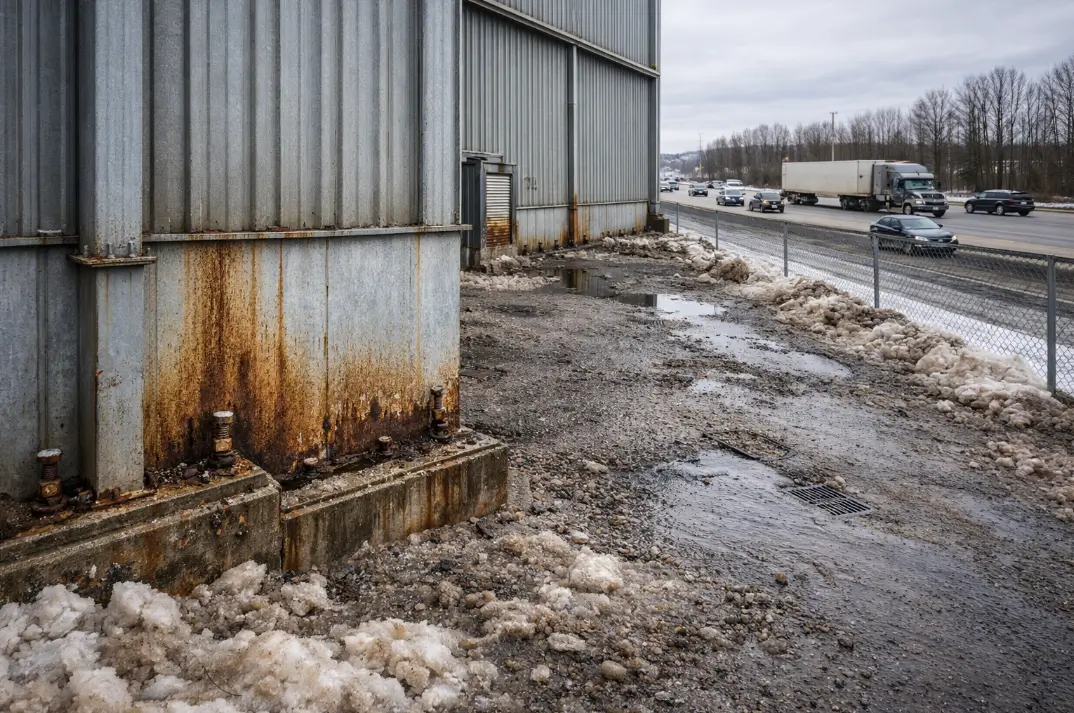
These areas frequently show the earliest signs of coating failure.
Fasteners and Connection Hardware
Bolts, screws, and brackets corrode faster than primary steel members because:
- They have thinner protective coatings
- Moisture pools around joints
- Crevices trap chemical residues
Once fasteners weaken, structural integrity can be compromised even if main frames appear intact.
How Corrosion Impacts Long-Term Building Performance
Ammonia corrosion rarely causes sudden failure. Instead, it silently degrades structures over time.
Typical consequences include:
- Reduced load-bearing capacity
- Loose or failed connections
- Panel detachment
- Water infiltration through corroded seams
- Escalating maintenance costs
- Premature structural replacement
Many farm buildings that appear structurally sound externally suffer severe internal corrosion hidden behind insulation or cladding.
For example, it is common to find heavily corroded roof purlins hidden above insulation layers while exterior panels still appear intact.
Why Agricultural Steel Buildings Corrode Faster Than Other Facilities
Compared to warehouses or manufacturing plants, livestock buildings create an extreme environment due to the combination of:
- High humidity
- Continuous chemical exposure
- Warm interior air in cold climates
- Organic residue buildup
- Reduced winter ventilation
This creates persistent surface moisture and chemical concentration that dramatically accelerates material degradation.
In Canada’s long cold seasons, condensation forms frequently, keeping steel surfaces wet for extended periods, which amplifies ammonia’s corrosive effects. Managing condensation inside agricultural structures requires coordination between airflow and thermal design, a relationship explored in ventilation vs insulation in livestock steel buildings.
Design Strategies That Reduce Ammonia Corrosion Risk
Proper agricultural steel building design focuses on limiting chemical contact, moisture accumulation, and coating breakdown.
1. Enhanced Protective Coatings
Standard galvanized coatings may not provide sufficient resistance in high-ammonia environments.
Agricultural facilities often benefit from:
- Heavier zinc coating thickness
- Epoxy or polymer-based protective finishes
- Corrosion-resistant fastener systems
These coatings extend service life when properly specified for livestock use.
2. Moisture Control Through Insulation and Ventilation
Keeping steel surfaces above dew point temperature significantly reduces condensation that allows ammonia compounds to activate corrosion.
Effective systems combine:
- Continuous insulation coverage
- Vapour barriers
- Controlled ventilation airflow
This minimizes wet steel exposure throughout the year. Moisture accumulation inside barns is a major contributor to the structural problems described in condensation failures in agricultural steel buildings.
3. Structural Detailing That Avoids Trapped Moisture
Designers can reduce corrosion by eliminating:
- Horizontal ledges where moisture collects
- Tight crevices in framing
- Unsealed overlaps
- Exposed insulation contact points
Smooth drainage paths and sealed joints reduce chemical buildup.
4. Separation of Steel From Direct Waste Exposure
Where possible:
- Steel columns are elevated above manure zones
- Concrete curbs protect framing bases
- Equipment shields sensitive connections
These barriers prevent prolonged chemical contact.
Maintenance Practices That Slow Corrosion Progression
Even well-designed buildings require ongoing monitoring.
Effective maintenance includes:
- Regular washing of structural surfaces
- Inspection of coating integrity
- Replacement of corroded fasteners
- Prompt repair of leaks and condensation zones
- Monitoring of ventilation performance
Early intervention prevents localized corrosion from spreading into major structural problems.
Why Corrosion Control Impacts Building Economics
Ignoring ammonia exposure often leads to:
- Unexpected structural repairs
- Early roof replacements
- Connection reinforcement
- Increased downtime
- Higher insurance scrutiny
- Reduced asset lifespan
Conversely, investing in corrosion-resistant design upfront significantly lowers long-term ownership costs.
Over decades of operation, buildings engineered for agricultural environments consistently deliver better return on investment.
Regulatory and Engineering Considerations in Canada
While Canadian building codes focus on structural safety loads, agricultural facilities require additional engineering judgement related to:
- Environmental exposure classification
- Material durability selection
- Moisture management systems
- Protective coating specifications
Experienced agricultural steel building engineers integrate corrosion mitigation into structural design rather than treating it as a maintenance afterthought.
Canadian structural durability and environmental exposure considerations are referenced in the National Building Code of Canada.
The Hidden Risk of Under-Engineered Farm Structures
Many low-cost agricultural steel buildings are designed using standard industrial material assumptions.
This often results in:
- Inadequate coating protection
- Poor condensation control
- Exposed framing details
- Fastener failure
- Accelerated structural deterioration
Buildings may meet minimum code loads but perform poorly under real livestock operating conditions. This problem is frequently observed in under-engineered farm steel buildings where agricultural exposure conditions are underestimated during structural design.
Long-term durability depends on environmental engineering, not just structural calculations.
Planning for Longevity in Livestock Steel Buildings
Successful agricultural steel buildings account for:
- Chemical exposure
- Moisture movement
- Seasonal temperature shifts
- Cleaning processes
- Ventilation patterns
- Operational wear
When corrosion is addressed during design rather than after damage appears, buildings remain reliable for decades instead of requiring major rehabilitation within years.
Final Perspective
Ammonia corrosion is one of the most underestimated risks in livestock steel building performance.
It does not announce itself early. It quietly weakens coatings, connections, and structural members until repairs become unavoidable.
Facilities designed with moisture control, protective materials, and agricultural exposure in mind consistently outperform those built with generic industrial assumptions.
In Canadian livestock environments, corrosion resistance is not a luxury feature. It is a core component of structural longevity and economic performance.
Reviewed by the Tower Steel Buildings Engineering Team
This article has been reviewed by the Tower Steel Buildings Engineering Team to ensure technical accuracy, real-world agricultural performance considerations, and alignment with Canadian environmental and structural design practices.
1. How does ammonia damage steel in livestock buildings?
Ammonia combines with moisture in the air to form corrosive compounds that break down protective coatings on steel. Over time, this leads to accelerated rusting, weakened connections, and reduced structural lifespan, especially in humid agricultural environments.
2. Are galvanized steel buildings resistant to ammonia corrosion?
Galvanized steel provides initial protection, but standard coating thickness may not be sufficient for high-ammonia livestock facilities. In aggressive farm environments, heavier galvanizing or specialized protective coatings are often required for long-term durability.
3. Which areas of a livestock steel building corrode the fastest?
Corrosion typically begins at roof purlins, wall girts near floor level, fasteners, and connection points. These areas experience the highest moisture accumulation and ammonia concentration, especially during colder months.
4. Can ventilation alone prevent ammonia corrosion?
Ventilation helps reduce ammonia buildup but cannot fully eliminate condensation on cold steel surfaces. Effective corrosion control requires a combination of ventilation, insulation, vapour barriers, and appropriate protective coatings.
5. How long can ammonia corrosion take to cause structural problems?
Damage often develops gradually over several years. While early stages may only show coating deterioration, unchecked corrosion can eventually weaken framing members and fasteners, leading to costly repairs or premature building replacement.
6. Are livestock steel buildings designed differently than industrial buildings?
Yes. Agricultural steel buildings must account for chemical exposure, high humidity, condensation risk, and washdown environments. Designs that only meet basic industrial assumptions often deteriorate much faster in livestock settings.
7. What are the best ways to protect steel buildings in farm environments?
Effective protection includes corrosion-resistant coatings, proper insulation and vapour control, moisture-shedding structural details, controlled ventilation, and routine maintenance inspections to address early signs of deterioration.
8. Does ammonia corrosion affect concrete foundations as well?
Yes. Ammonia compounds can contribute to chemical attack on concrete surfaces, especially around manure storage zones. Proper concrete mixes, protective barriers, and drainage design are important in high-exposure agricultural facilities.